

|
시장보고서
상품코드
2117292
피부경 : 시장 점유율 분석, 업계 동향과 통계, 성장 예측(2026-2031년)Dermatoscopes - Market Share Analysis, Industry Trends & Statistics, Growth Forecasts (2026 - 2031) |
||||||
 Mordor Intelligence
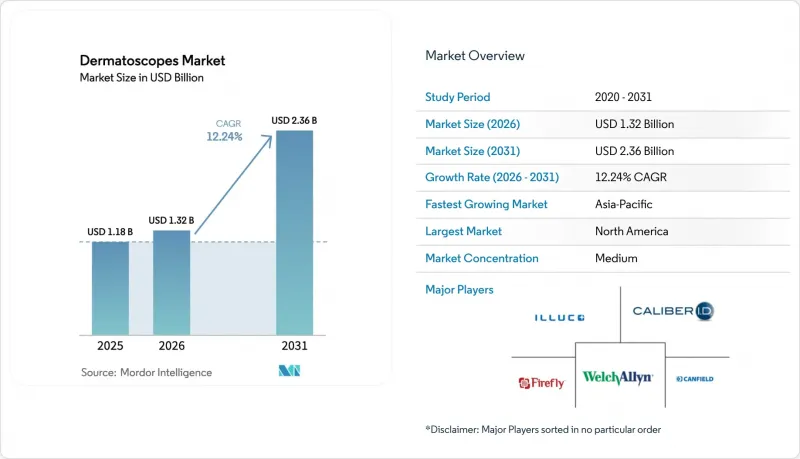
Mordor Intelligence에 따르면 피부경 시장 규모는 2025년 11억 8,000만 달러에서 2026년에는 13억 2,000만 달러로 확대되고, 2026년부터 2031년까지 CAGR 12.24%를 기록하며 2031년에는 23억 6,000만 달러에 달할 것으로 예측됩니다.
본 보고서는 제품 유형(휴대용, 데스크톱/탁상형, 스마트폰 부착형), 기술(LED, 크세논/할로겐,자외선, 편광 디지털), 측정 방식(접촉식, 비접촉식, 하이브리드), 최종사용자(진료소, 병원, 외래 진료 센터, 학술 기관), 및 지역(북미, 유럽, 기타)별로 분류되어 있습니다. 시장 예측은 금액(달러) 기준으로 제시되어 있습니다.
세계 피부경 시장의 동향 및 인사이트
조기 비침습적 진단이 필요한 피부암 발병률 증가
2024년, 미국에서는 550만 건이 넘는 신규 피부암 사례가 진단되었으며, 이에 따라 보험사들은 피부경 검사를 1순위 도구로 삼는 예방적 선별 경로를 우선시하게 되었습니다. 진행성 흑색종의 치료비는 1기 치료 비용을 훨씬 초과하기 때문에 치료의 경제성 측면에서도 조기 발견이 권장되고 있습니다. 대조군 연구에 따르면, 피부현미경 검사의 진단 정확도는 육안 검사의 75%에 비해 84%에 달하는 것으로 나타났으며, 이는 임상 현장에서의 도입을 뒷받침하고 있습니다. 퀸즐랜드 대학교가 2025년에 실시한 3D 전신 사진 촬영 시험에서는 비흑색종의 검출률이 향상되었으나, 흑색종의 감도에는 변화가 나타나지 않아 보완적인 광학 솔루션에 대한 지속적인 필요성이 부각되었습니다. 전반적으로, 역학적 실태와 의료비 절감의 필요성이 외과 및 1차 진료 현장에서 이 기기에 대한 지속적인 수요를 뒷받침하고 있습니다.
디지털 및 AI 통합형 피부경(dermoscope)의 기술적 진보
DermaSensor와 같은 FDA 승인 AI 플랫폼은 200가지 조직 유형에서 96%의 민감도를 달성했으며, 주관적인 이미지 평가를 정량적인 위험 점수로 변환함으로써 의사결정 주기를 단축합니다. FotoFinder사의 ‘Moleanalyzer pro’는 촬영된 병변에 히트맵을 통한 분류 정보를 중첩시키는데, 이 기능은 검증된 병리 데이터를 활용해 학습된 딥러닝 모델을 기반으로 합니다. 분광법과 기계 학습의 결합을 통해 실시간 세포 분석이 가능해졌으며, ZEISS의 2025년 조사 데이터 플랫폼은 다기관에서 이미지를 수집하고 주석 처리를 자동화하여 알고리즘의 미세 조정을 가속화합니다. iToBoS 컨소시엄이 개발 중인 차세대 전신 스캐너는 6분 만에 환자 전체의 위험도 계층화를 완료할 수 있다고 약속하며, 이는 전체 인구를 대상으로 한 감시 체계로의 전환을 시사합니다. 소프트웨어 지적재산권이 경쟁 우위를 점점 더 결정짓는 가운데, 광학 전문 기업과 AI 기업 간의 제휴가 활발해지고 있습니다.
저소득 국가에서의 고액 초기 비용과 제한된 보험 환급
초진 피부과 진료비가 이미 150-300달러에 달하는 지역에서는 피부경의 정가나 소프트웨어 구독료가 여전히 감당하기 어려운 수준이며, 보험사는 종종 피부경 검사를 ‘의학적으로 필요하지 않은’ 것으로 분류하고 있습니다. 메디케어의 2.83% 지급 삭감은 미국 진료소의 부담을 더욱 가중시키고 있으며, 광학 기기의 교체 주기가 지연될 가능성이 있습니다. DermaSensor사의월 199-399달러 SaaS 모델은 지속적인 비용 부담을 초래하며, 자원이 제한된 진료소에게는 장벽이 되고 있습니다. 보험사 측의 대응이 불분명하기 때문에 피부과 입원 치료비가 연간 50억 달러를 초과함에도 불구하고 자본 예산 수립이 주저되고 있습니다. 이는 치료 지연이 초래하는 대가를 여실히 보여줍니다. 보험 적용이 균등화되기 전까지는 저소득 지역에서의 출하량 증가가 역학적 수요를 따라잡지 못할 것입니다.
부문 분석
2025년, 핸드헬드형 기기는 피부경 시장 규모의 73.62% 점유율을 유지하고 있으며, 이는 익숙한 인체공학적 디자인에 대한 임상의들의 뿌리 깊은 선호도를 반영합니다. 데스크톱형 시스템은 여전히 틈새 시장으로 남아 있으며, 3차 의료 기관 내의 고해상도 검사 수요를 충족하고 있습니다. 대조적으로, 스마트폰 연결형 모델은 원격의료의 확대와 최소한의 설비 투자 비용에 힘입어 연평균 성장률(CAGR) 12.85%로 성장하고 있습니다. ‘skeen’의 무선 모델은 핸드헬드형의 편의성과 AI 클라우드를 활용한 트리아지를 융합하여, 다목적 휴대용 생태계로의 수렴을 시사하고 있습니다. 카시오의 ‘DZ-D100 Dermocamera’는 광학 기술의 전통을 활용하여, 기존 제조사의 로드맵을 뒤엎으려는 비전통적인 신규 진입 기업의 존재를 부각시키고 있습니다.
2세대 어태치먼트는 스마트폰의 보급을 활용하여 전용 디스플레이가 불필요해졌으며, 전자 진료 기록 시스템으로의 이미지 즉시 업로드를 가능하게 하고 있습니다. 의료 제공자의 경우, 하드웨어에 대한 지출이 감소함으로써 위성 클리닉에서의 장비 도입 확대에 따른 위험이 경감됩니다. 그 결과, 2027년 이후에는 특히 인도와 브라질의 공중보건 분야 원격 분류 이니셔티브에서 스마트폰 단말기가 기존 핸드피스와의 판매 대수 격차를 좁힐 것으로 예상됩니다. 이러한 추세는 피부과 전문의 밀도가 주민 10만 명당 1명 미만인 지역에 매우 중요한, 보다 분산된 선별 검사 모델을 뒷받침합니다.
LED 플랫폼은 긴 수명과 안정적인 밝기를 바탕으로 2025년에는 매출의 61.78%를 차지했습니다. 그러나 초기 백반이나 무증상 기저세포암의 변화에 대한 뛰어난 가시화가 연구를 통해 확인됨에 따라, 자외선 방식이 연평균 성장률(CAGR) 13.56%로 성장을 주도하고 있습니다. 다층 조명과 AI 분할을 통합한 편광 디지털 시스템은 기술 구성을 더욱 다양화하고 있는 반면, 에너지 효율 측면에서 크세논/할로겐 계열의 점유율은 계속해서 하락하고 있습니다. 가변 편광과 자동 병변 매핑을 결합한 OBSERV사의 ‘520x’ 하이브리드 콘솔은 다중 스펙트럼 및 소프트웨어 정의형 이미징으로의 전환을 상징하는 제품입니다.
자외선 분야의 전망은 단면 형광 검사가 희귀 병변의 검출 정확도를 향상시키고 생검 대기 시간을 단축한다는 증거가 축적되고 있다는 점에 기반을 두고 있습니다. 센서 추가 요구 사항으로 인해 비용 측면의 역풍은 계속되고 있지만, 양산화와 모듈식 업그레이드를 통해 향후 10년 말까지 가격대가 낮아질 것으로 예상됩니다. 그 결과, 기술 경쟁은 조명 광원 그 자체보다는 번들로 제공되는 소프트웨어 분석 기능을 중심으로 전개될 전망입니다.
지역별 분석
북미는 규제 명확화, 보험 적용, 성숙한 원격의료 플랫폼을 배경으로 2025년 피부경 시장에서 37.85%의 점유율을 유지했습니다. 피부암의 높은 유병률이 검사 수요를 뒷받침하고 있으며, 2024년 1월 DermaSensor의 승인으로 미국은 AI 통합형 광학 기기의 거점으로서의 입지를 공고히 했습니다. 그러나 2025년 메디케어 진료 보수 개정에 따른 삭감은 소규모 진료소의 설비 투자 예산을 압박하고 있습니다. 각 벤더사는 판매량을 유지하기 위해 리스 계약이나 스캔당 과금과 같은 대응책을 마련하고 있습니다.
연평균 성장률(CAGR) 14.32%로 성장하는 아시아태평양은 정부의 원격의료 보조금과 피부경 검사 교육 과정의 보급으로 혜택을 보고 있습니다. 중국의 ‘건강 중국 2030’ 이니셔티브에서는 AI 진단에 자금이 배정되고 있는 반면, 인도의 ‘아유슈만 바라트’ 디지털 미션에서는 환자 기록의 디지털화가 진행되어 원격 병변 진단이 간소화되고 있습니다. 이 지역의 스마트폰 보급률은 부착형 피부경 채택률과 연동되어 있어, 지방 지역의 인프라적 장벽을 최소화하고 있습니다.
유럽의 성장은 MDR(의료기기 규정) 하에서 견조한 추세를 보이고 있습니다. MDR은 엄격하지만, 안전 기준의 조화를 통해 공정한 경쟁 환경을 확립하고 있습니다. 독일에서 FotoFinder사의 무선 스코프가 디자인상을 수상한 것은 인체공학 분야에서 유럽의 리더십을 상징합니다. 2028년까지의 이행 기간 동안 적용되는 규정 준수 유예 조치는 중견 제조업체에 여유를 주고, 유통업체의 공급 리스크를 완화하고 있습니다. 이와 동시에, 범유럽 암 검진 지침에서는 다모달 진단 경로의 일환으로 피부경 검사가 권장됨에 따라 공립 병원의 수요가 증가하고 있습니다.
라틴아메리카 및 중동 및 아프리카는 절대적인 지출 규모에서는 뒤처지고 있지만, 다자간 금융 기관의 원격의료 연결 지원에 힘입어 연평균 성장률(CAGR)은 개선 추세를 보이고 있습니다. 브라질의 SUS(보편적 보건 시스템) 및 남아프리카공화국의 공립 진료소에서 진행된 시범 프로그램에서는 원격 분류에 따른 비용 절감 효과가 입증되어 향후 조달 주기를 뒷받침하고 있습니다. 환율 변동과 관세는 여전히 성숙 시장과의 가격 평준화를 저해하고 있어, 현지 조립 제품의 도입이나 차별화된 지불 모델의 도입이 필요해지고 있습니다.
기타 혜택:
- 엑셀 형식의 시장 예측(ME) 시트
- 3개월간의 애널리스트 지원
자주 묻는 질문
목차
제1장 소개
제2장 조사 방법
제3장 주요 요약
제4장 시장 구도
제5장 시장 규모와 성장 예측
제6장 경쟁 구도
제7장 시장 기회와 향후 전망
KSM 26.08.26According to Mordor Intelligence, the dermatoscope market size is expected to grow from USD 1.18 billion in 2025 to USD 1.32 billion in 2026 and is forecast to reach USD 2.36 billion by 2031 at 12.24% CAGR over 2026-2031.
This report is Segmented by Product Type (Handheld, Desktop/Table-top, Smartphone-Attachable), Technology (LED, Xenon/Halogen, Ultraviolet, Polarised Digital), Modality (Contact, Non-Contact, Hybrid), End User (Clinics, Hospitals, Ambulatory Centers, Academic Institutes), and Geography (North America, Europe, and More). Market Forecasts are Provided in Terms of Value (USD).
Global Dermatoscopes Market Trends and Insights
Rising Incidence of Skin Cancer Requiring Early Non-Invasive Diagnostics
Over 5.5 million new skin-cancer cases were diagnosed in the United States during 2024, prompting payers to prioritize preventive screening pathways that rely on dermoscopy as a first-line tool. Treatment economics support early detection, as the cost of advanced melanoma care far exceeds that of stage-I intervention. Controlled studies show dermoscopy lifts diagnostic accuracy to 84% versus 75% for naked-eye exams, reinforcing clinical adoption. The University of Queensland's 2025 3-D body-photography trial improved non-melanoma detection rates, yet unchanged melanoma sensitivity spotlights the continued need for complementary optical solutions. Collectively, epidemiological realities and cost containment imperatives underpin sustained device demand across surgical and primary-care settings.
Technological Advances in Digital & AI-Integrated Dermatoscopes
FDA-cleared AI platforms such as DermaSensor achieve 96% sensitivity across 200 histologies, converting subjective image review into quantitative risk scores that shorten decision cycles. FotoFinder's Moleanalyzer pro overlays heat-map triage on captured lesions, a capability derived from deep-learning models trained on verified pathology. Spectroscopy plus machine learning enables real-time cellular analysis, while ZEISS's 2025 research-data platform automates multicenter image ingestion and annotation, accelerating algorithm tuning. Next-generation full-body scanners under the iToBoS consortium promise six-minute whole-patient risk stratification, indicating a shift toward population-wide surveillance. As software intellectual property increasingly defines competitive advantage, partnerships between optics specialists and AI firms are intensifying.
High Upfront Cost & Limited Reimbursement in Low-Income Nations
Dermatoscope list prices and software subscriptions remain prohibitive where first-visit dermatology fees already range USD 150-300, with insurers often labeling dermoscopy "not medically necessary". Medicare's 2.83% payment cut compounds U.S. clinic strains, potentially delaying refresh cycles for optics hardware. DermaSensor's USD 199-399 monthly SaaS model adds recurring overhead, a hurdle for resource-limited practices. Insufficient payer clarity chills capital budgeting even as inpatient dermatology costs top USD 5 billion annually, illustrating the price of late-stage intervention. Until coverage parity is achieved, unit shipment growth in low-income geographies will trail epidemiologic need.
Other drivers and restraints analyzed in the detailed report include:
- Growing Adoption of Teledermatology & Remote Monitoring
- Surge in Dermatology Training Programs in Emerging Markets
- Shortage of Validated AI Datasets Delaying Regulatory Approvals
For complete list of drivers and restraints, kindly check the Table Of Contents.
Segment Analysis
Handheld units retained 73.62% share of the dermatoscope market size in 2025, mirroring entrenched clinician preference for familiar ergonomics. Desktop systems remain niche, addressing high-resolution research demands inside tertiary centers. In contrast, smartphone-attachable models are expanding at 12.85% CAGR, propelled by telehealth scale-up and minimal capital cost. The "skeen" wireless model bridges handheld convenience with AI cloud triage, signaling convergence toward multipurpose portable ecosystems. Casio's DZ-D100 Dermocamera underscores non-traditional entrants leveraging optics pedigree to upend incumbent roadmaps.
Second-generation attachments benefit from smartphone ubiquity, removing the need for proprietary displays and enabling instant image upload into electronic-health-record flows. For providers, reduced hardware outlay de-risks fleet expansion across satellite clinics. As a result, smartphone units are expected to narrow the volume gap with traditional handpieces beyond 2027, especially within public-health teletriage initiatives across India and Brazil. The trend supports a more distributed screening model, crucial for regions where dermatologist density falls below one per 100,000 inhabitants.
LED platforms delivered 61.78% revenue in 2025, buoyed by long service life and stable luminance. Yet ultraviolet modalities lead growth at 13.56% CAGR, backed by studies confirming superior visualization of early vitiligo and subclinical basal-cell change. Polarized-digital systems integrating multilayer illumination and AI segmentation further diversify the technology mix, while xenon/halogen share continues to erode on energy-efficiency grounds. OBSERV's 520x hybrid console, combining variable polarization with automated lesion mapping, typifies the migration toward multi-spectral, software-defined imaging.
Ultraviolet's prospects rest on mounting evidence that cross-sectional fluorescence improves rare lesion detection and shortens biopsy queues. Cost headwinds persist, given additional sensor requirements, but scale manufacturing and modular upgrades are expected to compress price points by the decade's close. Consequently, technology competition will likely center on bundled software analytics rather than illumination source alone.
Complete Report Scope:
- By Product Type (Value)
- Handheld Dermatoscopes
- Desktop /Table-top Dermatoscopes
- Smartphone-attachable Dermatoscopes
- By Technology (Value)
- LED Illumination
- Xenon / Halogen
- Ultraviolet
- Polarised Digital Imaging
- By Modality (Value)
- Contact Dermatoscopes
- Non-Contact Dermatoscopes
- Hybrid Dermatoscopes
- By End User (Value)
- Dermatology Clinics
- Hospitals
- Ambulatory Surgical Centres
- Academic & Research Institutes
- By Geography (Value)
- North America
- United States
- Canada
- Mexico
- Europe
- Germany
- United Kingdom
- France
- Italy
- Spain
- Rest of Europe
- Asia-Pacific
- China
- India
- Japan
- South Korea
- Australia
- Rest of Asia-Pacific
- South America
- Brazil
- Argentina
- Rest of South America
- Middle East and Africa
- GCC
- South Africa
- Rest of Middle East and Africa
- North America
Geography Analysis
North America retained 37.85% share of the dermatoscope market in 2025 on the back of regulatory clarity, insurance adoption, and mature telehealth platforms. High skin-cancer prevalence sustains procedural demand, while the January 2024 DermaSensor clearance cemented the U.S. as launchpad for AI-integrated optics. Still, Medicare's 2025 fee schedule cut dampens smaller-practice capital budgets; vendors are responding with leasing and per-scan pricing to preserve volume.
Asia-Pacific, expanding at 14.32% CAGR, benefits from government telemedicine grants and proliferating dermoscopy curricula. China's Healthy China 2030 initiative allocates funding for AI diagnostics, while India's Ayushman Bharat digital mission digitizes patient records, simplifying remote lesion review. The region's smartphone penetration aligns with attachable-scope uptake, minimizing infrastructure hurdles in rural provinces.
Europe's growth remains steady under the MDR regime, which, while stringent, levels the playing field through harmonized safety benchmarks. Germany's design award for FotoFinder's wireless scope exemplifies continental leadership in ergonomic engineering. Transitional compliance extensions through 2028 offer breathing room to mid-tier manufacturers, easing supply risk for distributors. In parallel, pan-European cancer-screening guidelines now endorse dermoscopy as part of multi-modality pathways, bolstering demand in public hospitals.
Latin America and the Middle East & Africa trail in absolute spend but show improving CAGR profiles as multilateral lenders support telehealth connectivity. Pilot programs in Brazil's SUS system and South Africa's public clinics have demonstrated cost savings via remote triage, supporting future procurement cycles. Currency volatility and customs tariffs still hamper pricing parity with mature markets, necessitating locally assembled units or differentiated payment models.
- FotoFinder Systems
- DermLite LLC
- HEINE Optotechnik
- Canfield Scientific Inc.
- Illuco Corporation Ltd.
- MetaOptima Technology Inc.
- Firefly Global
- AMD Global Telemedicine
- Welch Allyn Inc. (Hillrom)
- Opticlar Vision Ltd.
- Rudolf Riester
- KaWe (Kirchner & Wilhelm)
- Dino-Lite Europe / IDCP B.V.
- Carl Zeiss
- VisioMed Group SA
- Skyscope Digital Imaging Ltd.
Additional Benefits:
- The market estimate (ME) sheet in Excel format
- 3 months of analyst support
TABLE OF CONTENTS
1 Introduction
- 1.1 Study Assumptions & Market Definition
- 1.2 Scope of the Study
2 Research Methodology
3 Executive Summary
4 Market Landscape
- 4.1 Market Overview
- 4.2 Market Drivers
- 4.2.1 Rising incidence of skin cancer requiring early non-invasive diagnostics
- 4.2.2 Technological advances in digital & AI-integrated dermatoscopes
- 4.2.3 Growing adoption of teledermatology & remote monitoring
- 4.2.4 Surge in dermatology training programs in emerging markets
- 4.2.5 Bundled reimbursement codes for non-invasive skin imaging
- 4.2.6 Variable-polarisation & multispectral imaging enabling rare-lesion detection
- 4.3 Market Restraints
- 4.3.1 High upfront cost & limited reimbursement in low-income nations
- 4.3.2 Shortage of validated AI datasets delaying regulatory approvals
- 4.3.3 Sterilisation & infection-control challenges for contact devices
- 4.3.4 Fragmented SaMD regulatory requirements across regions
- 4.4 Value / Supply-Chain Analysis
- 4.5 Regulatory Landscape
- 4.6 Technological Outlook
- 4.7 Porter's Five Forces Analysis
- 4.7.1 Threat of New Entrants
- 4.7.2 Bargaining Power of Suppliers
- 4.7.3 Bargaining Power of Buyers
- 4.7.4 Threat of Substitutes
- 4.7.5 Competitive Rivalry
5 Market Size & Growth Forecasts
- 5.1 By Product Type (Value)
- 5.1.1 Handheld Dermatoscopes
- 5.1.2 Desktop /Table-top Dermatoscopes
- 5.1.3 Smartphone-attachable Dermatoscopes
- 5.2 By Technology (Value)
- 5.2.1 LED Illumination
- 5.2.2 Xenon / Halogen
- 5.2.3 Ultraviolet
- 5.2.4 Polarised Digital Imaging
- 5.3 By Modality (Value)
- 5.3.1 Contact Dermatoscopes
- 5.3.2 Non-Contact Dermatoscopes
- 5.3.3 Hybrid Dermatoscopes
- 5.4 By End User (Value)
- 5.4.1 Dermatology Clinics
- 5.4.2 Hospitals
- 5.4.3 Ambulatory Surgical Centres
- 5.4.4 Academic & Research Institutes
- 5.5 By Geography (Value)
- 5.5.1 North America
- 5.5.1.1 United States
- 5.5.1.2 Canada
- 5.5.1.3 Mexico
- 5.5.2 Europe
- 5.5.2.1 Germany
- 5.5.2.2 United Kingdom
- 5.5.2.3 France
- 5.5.2.4 Italy
- 5.5.2.5 Spain
- 5.5.2.6 Rest of Europe
- 5.5.3 Asia-Pacific
- 5.5.3.1 China
- 5.5.3.2 India
- 5.5.3.3 Japan
- 5.5.3.4 South Korea
- 5.5.3.5 Australia
- 5.5.3.6 Rest of Asia-Pacific
- 5.5.4 South America
- 5.5.4.1 Brazil
- 5.5.4.2 Argentina
- 5.5.4.3 Rest of South America
- 5.5.5 Middle East and Africa
- 5.5.5.1 GCC
- 5.5.5.2 South Africa
- 5.5.5.3 Rest of Middle East and Africa
- 5.5.1 North America
6 Competitive Landscape
- 6.1 Market Concentration
- 6.2 Market Share Analysis
- 6.3 Company Profiles {(includes Global level Overview, Market level overview, Core Segments, Financials as available, Strategic Information, Market Rank/Share for key companies, Products & Services, and Recent Developments)}
- 6.3.1 FotoFinder Systems GmbH
- 6.3.2 DermLite LLC
- 6.3.3 HEINE Optotechnik GmbH & Co. KG
- 6.3.4 Canfield Scientific Inc.
- 6.3.5 Illuco Corporation Ltd.
- 6.3.6 MetaOptima Technology Inc.
- 6.3.7 Firefly Global
- 6.3.8 AMD Global Telemedicine Inc.
- 6.3.9 Welch Allyn Inc. (Hillrom)
- 6.3.10 Opticlar Vision Ltd.
- 6.3.11 Rudolf Riester GmbH
- 6.3.12 KaWe (Kirchner & Wilhelm)
- 6.3.13 Dino-Lite Europe / IDCP B.V.
- 6.3.14 Carl Zeiss Meditec AG
- 6.3.15 VisioMed Group SA
- 6.3.16 Skyscope Digital Imaging Ltd.
7 Market Opportunities & Future Outlook
- 7.1 White-Space & Unmet-Need Assessment


