

|
시장보고서
상품코드
2072844
중국의 의약품 물류 시장 : 시장 점유율 분석, 업계 동향 및 통계, 성장 예측(2026-2031년)China Pharmaceutical Logistics - Market Share Analysis, Industry Trends & Statistics, Growth Forecasts (2026 - 2031) |
||||||
 Mordor Intelligence
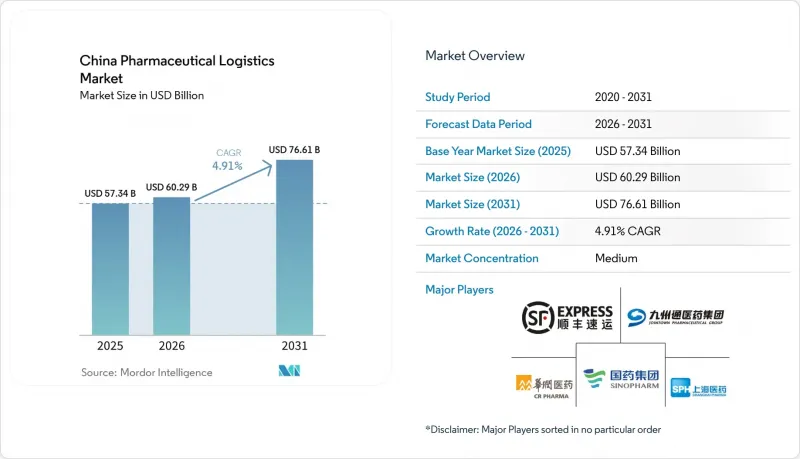
Mordor Intelligence에 의하면, 중국의 의약품 물류 시장 규모는 2025년에 573억 4,000만 달러로 평가되었고, 2026년에 602억 9,000만 달러로 추정되고, 2031년까지 766억 1,000만 달러에 이를 것으로 예측되며, 2026-2031년 CAGR 4.91%로 성장할 전망입니다.
이 시장은 고령화에 따른 의약품에 대한 안정적인 수요, 대규모 국내 의약품 생산 거점, 그리고 유통 품질을 의약품의 안전성 및 서비스의 일관성과 보다 직접적으로 연계시키는 정책 체계에 의해 뒷받침되고 있습니다. 본 보고서는 물류 기능별(수송, 창고 및 유통, 부가가치 서비스), 운영 방식별(콜드체인, 비콜드체인), 제품 유형별(처방약, 일반의약품, 생물학적 제제, 백신, 임상시험용 시료, 세포 및 유전자 치료, 의료기기, 동물용 의약품), 그리고 지역별(북부, 북동부, 기타)로 분류되어 있습니다. 시장 전망치는 금액(달러)으로 표시되어 있습니다.
중국의 의약품 물류 시장 동향 및 인사이트
국가 필수 의약품 유통 네트워크의 확대
2025년에 개정된 '국가기본의료보험 의약품 목록'에서는 보험 적용 대상 제품의 범위가 확대되었으며, 나아가 혁신적인 의약품을 대상으로 하는 민간 의료보험 카테고리가 처음으로 추가되었습니다. 이로 인해, 승인된 유통 채널을 통한 보험 적용 의약품의 유통량이 직접적으로 증가하게 될 것입니다. 이번 변경은 보험 적용에 따른 이용이 공급망의 병원 측과 소매 측 양쪽 끝단에서 처리량을 확대시킬 것이기 때문에 중국의 의약품 물류 시장에 있어 중요합니다. 이는 상온 보관 능력을 강화해야 할 뿐만 아니라, 혁신적인 치료법이 더 널리 보급됨에 따라 적절한 콜드체인 인프라도 필요하다는 점을 강조하고 있습니다. 제15차 5개년 계획에 기반한 정책 방향은 대규모 전국 유통업체들의 지지를 받고 있으며, 이를 통해 규정 준수, 배송 노선의 밀도, 조달 실행에 있어 규모의 경제가 강화될 것입니다. 그 결과, 중국의 의약품 물류 시장에서는 전국적인 물류 인프라의 확대와 더 높은 최소 서비스 기준이 동시에 실현될 것입니다. 따라서 추적성, 일련번호 부여, 온도 관리에 대한 투자에 어려움을 겪는 소규모 사업자들은 유통 네트워크가 확대됨에 따라 더 큰 압박에 직면하게 될 것입니다.
바이오의약품 및 온도 관리 제품에 대한 수요의 급증
바이오의약품 및 기타 온도에 민감한 제품은 상온 보관되는 제네릭 의약품보다 더 엄격한 관리, 강력한 검증, 그리고 보다 견고한 예외 관리가 필요하기 때문에 중국 의약품 물류 시장의 운영 중심을 변화시키고 있습니다. 2025년, 중국의 의약품 콜드체인 물류 비용은 267억 8,000만 위안(37억 9,000만 달러)에 달했으며, 냉장 창고 용량은 5.43% 증가한 452만 5,000세제곱미터로, 상온 창고의 성장률을 웃도는 속도로 확대되었습니다. 이러한 기술적 변화는 세포 및 유전자 치료 분야에서 더욱 두드러지며, 운송 온도는 기존의 2℃-8℃ 범위에서 특정 제품의 경우 -150℃--196℃의 극저온 조건으로 전환될 가능성이 있습니다. 이러한 요건으로 인해, 일반 화물 운송 회사가 통상적으로 갖추지 않은 전용 설비, 검증된 취급 절차 및 직원 교육을 갖춘 사업자에게만 시장 진입의 길이 열립니다. 또한, 이를 통해 자격을 갖춘 공급업체는 상온에서의 조달 주도형 물류 흐름보다 더 높은 가격을 책정할 수 있게 됩니다. 중국의 의약품 물류 시장에서는 표준적인 의약품 유통에 광범위한 가격 압박이 가해지고 있는 상황에서도, 이러한 추세로 인해 자본이 프리미엄 콜드체인 회랑으로 유입될 것입니다.
단절된 지방의 라스트 마일 인프라
농촌 지역의 라스트 마일 부문에서 나타나는 취약성은 여전히 중국 의약품 물류 시장에서 가장 두드러진 운영상의 제약 요소 중 하나입니다. 2025년 현재, 중국의 의약품 운송 차량 수는 4만 6,416대에 달했으나, 투자는 여전히 도시 지역의 주요 노선에 집중되어 있어, 그 결과 지방 시장에서는 인증된 운송 능력이 부족하고 노선 중복성도 낮은 상황입니다. 이러한 불균형은 서부 및 산악 지대의 주에서 특히 두드러지며, 도로 운송만으로는 온도 안정성의 허용 범위나 시간적 제약이 있는 재고 보충 수요를 충족하지 못할 수도 있습니다. 2025년 『Frontiers in Public Health』 저널의 조사에서도 필수 의약품에 대한 접근성은 여전히 지역별로 편차가 있는 것으로 나타났으며, 광범위한 정책적 노력에도 불구하고 사회경제적 상황이 실제 접근성에 계속 영향을 미치고 있는 것으로 밝혀졌습니다. 농촌 지역에서 집중 조달 계약을 담당하는 공급업체들은 라스트 마일 비용이 과소평가되는 문제에 종종 직면하고 있으며, 그 결과 자산 업그레이드나 서비스 확대에 투입될 자금이 줄어들고 있습니다. 하이난, 구름남, 신장, 충칭의 드론 운영 사례는 이러한 제약을 완화할 수 있음을 보여주고 있지만, 중국의 의약품 물류 시장에서는 여전히 많은 난관으로 가득한 내륙 노선에서 광범위한 상업적 커버리지가 부족한 실정입니다.
부문별 분석
2025년, 운송 부문은 중국 의약품 물류 시장 점유율의 52.46%를 차지했으며, 전체 운영 체인에서 가장 큰 기능 부문이 되었습니다. 이 부문의 규모는 도시 간 운송, 도심 지역 보충 배송, 병원 배송 및 약국 재입고 분야에서 도로 운송이 수행하는 핵심적인 역할을 반영하고 있습니다. 항공 화물은 긴급한 생물학적 제제, 고가 시료, 그리고 비용보다 속도와 온도 관리가 더 중요시되는 특정 임상 운송 분야에서 여전히 중요한 역할을 하고 있습니다. 내륙 수로 및 해상 운송은 배송 시간적 제약이 비교적 완만하고, 대량 운송에 유리한 특정 운송 노선에서 단위당 경제성이 뛰어나, 상온 벌크 화물의 운송을 계속해서 뒷받침하고 있습니다. 2025년 총 창고 용량은 9,381만 6,000세제곱미터에 달하며, 이는 운송 부문이 여전히 대규모 국내 보관 거점과 긴밀히 연계하여 기능을 수행하고 있음을 보여줍니다.
이 부분의 후반부에서는 다른 상황이 나타납니다. 부가가치 서비스는 2031년까지 연평균 성장률(CAGR) 7.74%를 나타낼 것으로 예측되며, 현재 차별화의 핵심 요소로 자리 잡고 있기 때문입니다. 제약사는 시리얼화, GDP 준수 온도 모니터링, DTP(환자 직접 판매) 약국용 주문 처리, 그리고 '서비스형 콜드체인'과 같은 업무를 자사에서 직접 구축하기보다는 제3자에게 위탁하는 것을 점점 더 선호하고 있습니다. 이러한 변화는 중국 의약품 물류 업계의 경제 구조를 바꾸고 있습니다. 왜냐하면 이익률은 순수한 운송 수익에서 규정 준수를 중시하는 부가 서비스로 전환되고 있기 때문입니다. SF 홀딩스가 2025년 하반기에 생명과학 및 의약품 분야를 위한 공급망 사업 그룹을 공식적으로 설립한 것은 이러한 재편을 반영한 것이며, 해당 분야의 매출이 20% 이상 성장하는 데 기여한 요인 중 하나가 되었습니다. 따라서 창고 보관 및 유통은 안정적인 중간 단계로서 여전히 중요하지만, 성장은 단순한 보관 공간뿐만 아니라 디지털 통합, 검증된 취급 절차, 그리고 아웃소싱 서비스의 충실도와 점점 더 밀접하게 연결되고 있습니다.
기타 혜택 :
- 엑셀 형식 시장 예측(ME) 시트
- 3개월간의 애널리스트 지원
자주 묻는 질문
목차
제1장 서론
제2장 조사 방법
제3장 주요 요약
제4장 시장 구도
제5장 시장 규모 및 성장 예측
제6장 경쟁 구도
제7장 시장 기회 및 향후 전망
AJY 26.07.07According to Mordor Intelligence, the china pharmaceutical logistics market size is projected to be USD 57.34 billion in 2025, USD 60.29 billion in 2026, and reach USD 76.61 billion by 2031, growing at a CAGR of 4.91% from 2026 to 2031.
The market is supported by steady demand for medicines from an aging population, a large domestic pharmaceutical production base, and a policy system that links distribution quality more directly to drug safety and service consistency. This report is Segmented by Logistics Function (Transportation, Warehousing and Distribution, Value-Added Services), by Mode of Operation (Cold-Chain, Non-Cold-Chain), by Product Type (Prescription Drugs, OTC, Biologics, Vaccines, Clinical Trial Materials, Cell and Gene Therapies, Medical Devices, Veterinary Medicine), and by Region (North, Northeast, and More). The Market Forecasts are in Value (USD).
China Pharmaceutical Logistics Market Trends and Insights
Expansion of the National Essential-Drug Distribution Network
The updated 2025 National Basic Medical Insurance Drug Directory widened the reimbursed product base and, for the first time, added a commercial health insurance category for innovative drugs, which directly increases the flow of covered medicines through licensed distribution channels. That change matters for the China pharmaceutical logistics market because reimbursed access expands throughput at both the hospital and retail ends of the chain. It underscores the need for additional ambient capacity, but also for qualified cold-chain infrastructure as innovative therapies enter broader circulation. The policy direction under the 15th Five-Year Plan also supports larger national distributors, which strengthens scale advantages in compliance, route density, and procurement execution. For the China pharmaceutical logistics market, the result is a larger national flow base paired with a higher minimum service standard. Smaller operators that cannot fund traceability, serialization, and temperature-controlled assets are therefore under more pressure as the distribution network broadens.
Rapid Growth in Biologics and Temperature-Controlled Demand
Biologics and other temperature-sensitive products are shifting the operating center of the China pharmaceutical logistics market, as they require tighter controls, stronger validation, and more robust exception management than ambient generics. Pharmaceutical cold-chain logistics costs in China reached CNY 26.78 billion (USD 3.79 billion) in 2025, while cold storage capacity rose 5.43% to 4.525 million cubic meters, a faster rate than growth in ambient warehousing. The technical shift is even greater in the cell and gene therapy lanes, where transport can shift from the established 2 °C to 8 °C range toward cryogenic conditions of -150 °C to -196 °C for certain products. That requirement narrows the field to operators with specialized equipment, validated handling protocols, and staff training that general freight firms do not usually maintain. It also allows qualified providers to defend higher pricing than they can in ambient, procurement-led flows. In the China pharmaceutical logistics market, this pushes capital toward premium cold-chain corridors even when broader price pressure affects standard medicine distribution.
Fragmented Rural Last-Mile Infrastructure
Rural last-mile weakness remains one of the clearest operating limits in the China pharmaceutical logistics market. China's pharmaceutical vehicle fleet reached 46,416 units in 2025, but investment still clustered around stronger urban corridors, which left lower-tier markets with thinner certified capacity and less route redundancy. That imbalance matters more in western and mountainous provinces, where road-only delivery can conflict with temperature stability windows and time-sensitive replenishment needs. A 2025 Frontiers in Public Health study also showed that access to essential medicines still varies across regions, with socio-economic conditions continuing to shape actual availability despite broad policy efforts. Providers serving centralized procurement contracts in rural areas often face underpriced last-mile costs, which reduces the funds available for asset upgrades and service expansion. Drone pilots in Hainan, Yunnan, Xinjiang, and Chongqing show that the constraint can be reduced, but the China pharmaceutical logistics market still lacks broad commercial coverage in many difficult inland routes.
Other drivers and restraints analyzed in the detailed report include:
- Rise of E-Commerce Pharmacies and 24-Hr Delivery Expectations
- Stricter GDP Audit and Licensing Enforcement
- Escalating Cold-Chain Energy Costs Under Carbon Caps
For complete list of drivers and restraints, kindly check the Table Of Contents.
Segment Analysis
Transportation held 52.46% of the China pharmaceutical logistics market share in 2025, making it the largest functional segment across the operating chain. The segment's scale reflects the central role of road movement in intercity transfers, urban replenishment, hospital delivery, and pharmacy restocking. Air freight remains relevant for urgent biologics, high-value samples, and selected clinical shipments where speed and temperature control matter more than cost. Inland waterway and sea transport still support bulk ambient flows in selected corridors where delivery windows are less strict, and unit economics favor larger-volume movement. Total warehousing capacity reached 93.816 million cubic meters in 2025, which shows that the transport layer continues to work in close coordination with a large national storage base.
The second half of this segment tells a different story, because value-added services are forecast to grow at a 7.74% CAGR through 2031 and are now becoming central to differentiation. Pharmaceutical manufacturers increasingly want third parties to handle serialization, GDP-compliant temperature monitoring, DTP pharmacy fulfillment, and cold-chain-as-a-service instead of building those capabilities alone. That shift changes the economics of the China pharmaceutical logistics industry, because margins move away from pure transport yield and toward compliance-heavy service overlays. SF Holding's formal creation of a supply chain business group for life sciences and pharmaceuticals in late 2025 reflects that repositioning and helped drive more than 20% revenue growth in the vertical. Warehousing and distribution therefore remain important as a stable middle layer, but growth is increasingly tied to digital integration, validated handling, and outsourced service depth rather than storage space alone.
Complete Report Scope:
- By Logistics Function
- Transportation
- Road
- Air
- Sea and Inland Waterways
- Rail
- Warehousing and Distribution
- Value-added Services and Others
- Transportation
- By Mode of Operation
- Cold-Chain Logistics
- Non-Cold-Chain Logistics
- By Product Type
- Prescription Drugs
- OTC Drugs
- Biologics and Biosimilars
- Vaccines and Blood Products
- Clinical Trail Materials
- Cell and Gene Therapies
- Medical Devices and Diagnostics
- Veterinary Medicine
- Others
- By Region
- North
- Northeast
- East
- Central
- South
- Southwest
- Northwest
List of Companies Covered in this Report:
- Sinopharm Logistics
- SF Express
- JD Logistics
- DHL Group
- United Parcel Service of America, Inc. (UPS)
- Kuehne+Nagel
- DSV A/S (Including DB Schenker)
- FedEx
- Cencora
- CJ Rokin Logistics
- Nippon Express Holdings
- Yamato Holdings
- ZTO Express
- YTO Express
- STO Express
- China Post EMS
- Cainiao Smart Logistics Network
- CMA CGM Group (Including CEVA Logistics)
- DCH Auriga
- Sinotrans Limited
- China Resources Pharmaceutical Commercial
- Jointown Pharmaceutical Group
Additional Benefits:
- The market estimate (ME) sheet in Excel format
- 3 months of analyst support
TABLE OF CONTENTS
1 Introduction
- 1.1 Study Assumptions and Market Definition
- 1.2 Scope of the Study
2 Research Methodology
3 Executive Summary
4 Market Landscape
- 4.1 Market Overview and Role of Logistics in Pharmaceutical
- 4.2 Pharmaceutical Spending Trends
- 4.3 Market Drivers
- 4.3.1 Expansion of the National Essential-Drug Distribution Network
- 4.3.2 Rapid Growth in Biologics and Temperature-Controlled Demand
- 4.3.3 Rise of E-Commerce Pharmacies and 24-Hr Delivery Expectations
- 4.3.4 Stricter GDP Audit and Licensing Enforcement
- 4.3.5 Centralized-Procurement Hubs Drive Regional Consolidation
- 4.3.6 Pilots of Drones/AVs for Western-Province Mid-Mile Routes
- 4.4 Market Restraints
- 4.4.1 Fragmented Rural Last-Mile Infrastructure
- 4.4.2 Escalating Cold-Chain Energy Costs Under Carbon Caps
- 4.4.3 Dry-Ice Supply Rules for MRNA Vaccines
- 4.4.4 Urban Hospital Traffic-Control Delivery Curfews
- 4.5 Regulatory Framework
- 4.6 Value Chain and Distribution Channel Architecture Analysis
- 4.7 Technology Innovations Outlook
- 4.8 Porter's Five Forces Analysis
- 4.8.1 Threat of New Entrants
- 4.8.2 Bargaining Power of Suppliers
- 4.8.3 Bargaining Power of Buyers
- 4.8.4 Threat of Substitutes
- 4.8.5 Rivalry Among Competitors
- 4.9 Evolution of Pharmaceutical Logistics Requirements
- 4.10 Impact of Geo-Political Events on Supply Chain Shifts
5 Market Size and Growth Forecasts
- 5.1 By Logistics Function
- 5.1.1 Transportation
- 5.1.1.1 Road
- 5.1.1.2 Air
- 5.1.1.3 Sea and Inland Waterways
- 5.1.1.4 Rail
- 5.1.2 Warehousing and Distribution
- 5.1.3 Value-added Services and Others
- 5.1.1 Transportation
- 5.2 By Mode of Operation
- 5.2.1 Cold-Chain Logistics
- 5.2.2 Non-Cold-Chain Logistics
- 5.3 By Product Type
- 5.3.1 Prescription Drugs
- 5.3.2 OTC Drugs
- 5.3.3 Biologics and Biosimilars
- 5.3.4 Vaccines and Blood Products
- 5.3.5 Clinical Trail Materials
- 5.3.6 Cell and Gene Therapies
- 5.3.7 Medical Devices and Diagnostics
- 5.3.8 Veterinary Medicine
- 5.3.9 Others
- 5.4 By Region
- 5.4.1 North
- 5.4.2 Northeast
- 5.4.3 East
- 5.4.4 Central
- 5.4.5 South
- 5.4.6 Southwest
- 5.4.7 Northwest
6 Competitive Landscape
- 6.1 Market Concentration
- 6.2 Key Strategic Moves
- 6.3 Market Share Analysis
- 6.4 Company Profiles (Includes Global Level Overview, Market Level Overview, Core Segments, Financials as Available, Strategic Information, Market Rank/Share for Key Companies, Products and Services, and Recent Developments)
- 6.4.1 Sinopharm Logistics
- 6.4.2 SF Express
- 6.4.3 JD Logistics
- 6.4.4 DHL Group
- 6.4.5 United Parcel Service of America, Inc. (UPS)
- 6.4.6 Kuehne+Nagel
- 6.4.7 DSV A/S (Including DB Schenker)
- 6.4.8 FedEx
- 6.4.9 Cencora
- 6.4.10 CJ Rokin Logistics
- 6.4.11 Nippon Express Holdings
- 6.4.12 Yamato Holdings
- 6.4.13 ZTO Express
- 6.4.14 YTO Express
- 6.4.15 STO Express
- 6.4.16 China Post EMS
- 6.4.17 Cainiao Smart Logistics Network
- 6.4.18 CMA CGM Group (Including CEVA Logistics)
- 6.4.19 DCH Auriga
- 6.4.20 Sinotrans Limited
- 6.4.21 China Resources Pharmaceutical Commercial
- 6.4.22 Jointown Pharmaceutical Group
7 Market Opportunities and Future Outlook
- 7.1 White-space and Unmet-Need Assessment


