
|
시장보고서
상품코드
2072899
인도의 3PL 창고 시장 : 점유율 분석, 업계 동향과 통계, 성장 예측(2026-2031년)India 3PL Warehousing - Market Share Analysis, Industry Trends & Statistics, Growth Forecasts (2026 - 2031) |
||||||
 Mordor Intelligence
Mordor Intelligence에 의하면, 인도 3PL 창고 시장 규모는 2025년 112억 3,000만 달러에서 2026년에는 120억 4,000만 달러로 확대되어 2031년까지 167억 6,000만 달러에 이를 것으로 예상되고 있어 2026년부터 2031년까지 CAGR 6.84%로 성장할 전망입니다.
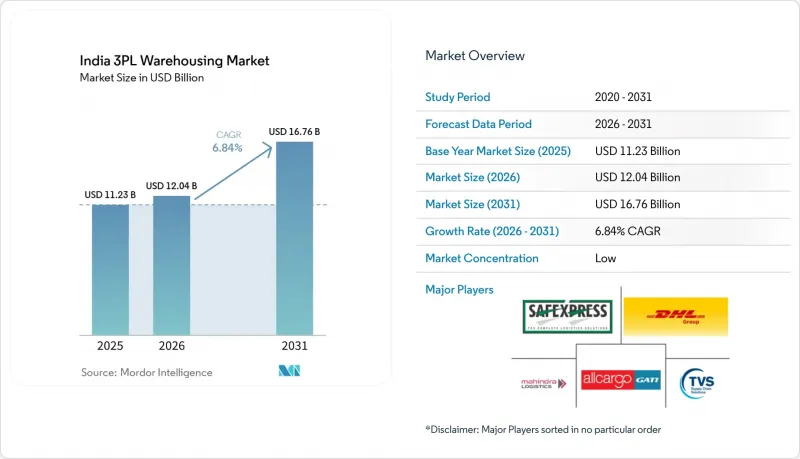
인도의 3PL 창고 시장은 아웃소싱 증가, 전자상거래 성장, 제조업 확대, 그리고 체계화된 공급망으로의 전환에 힘입어 호조를 보이고 있습니다. 본 보고서는 서비스 유형(보관, 유통·재고 관리 등), 창고 유형(일반 공유형/다중 고객형 창고, 보세 창고 등), 온도 관리(비온도 관리, 온도 관리), 기술 도입(수동, 반자동 등), 최종 사용 산업(제조업, 소비재 등), 지역(북부, 중부 등)별로 분류되어 있습니다. 시장 전망은 금액(달러) 기준으로 제시되어 있습니다.
인도 3PL 창고 시장 동향과 인사이트
전자상거래 물류 처리의 급속한 성장
인도의 3PL 창고 시장에서는 단순한 보관 공간 예약이 아닌, 풀필먼트 중심 수요로의 전환이 더욱 두드러지고 있습니다. 주요 도시에서는 재고 충실도와 마찬가지로 속도가 중요시되게 되면서, 전자상거래 사업자들은 다크 스토어와 보충 네트워크를 확대되고 있습니다. Flipkart Minutes는 2025년 말 500곳 이상에서 2026년 4월까지 1,000곳의 다크 스토어를 목표로 하고 있으며, 이는 도시 지역의 보충 네트워크가 얼마나 빠르게 확대되고 있는지를 여실히 보여주고 있습니다. 2025년 10월 현재, 인도에는 2,525곳의 다크 스토어가 운영 중이며, 이 수는 2030년까지 7,500곳에 달할 것으로 예측됩니다. 이에 따라 도시 내 마더 허브, 지역 보관 거점 및 신속한 피킹이 가능한 시설에 대한 수요는 계속해서 증가할 것으로 보입니다. 이러한 추세로 인해 3PL 사업자들은 더욱 고밀도화된 도시 배치, 더욱 콤팩트한 부지, 그리고 더욱 신속한 재고 회전을 염두에 두고 기존의 허브 앤 스포크형 모델을 재검토할 수밖에 없게 되었습니다.
인프라 구축 추진
인도의 3PL 창고 시장은 운송 시간 단축과 더 대규모이며 효율적인 창고 네트워크 구축을 가능하게 하는 운송 인프라 정비의 혜택도 누리고 있습니다. 동부 및 서부 전용 화물 회랑은 2025년 3월 기준 96.4%가 가동 중이며, 2,741km를 연결함으로써 델리-뭄바이 간 화물 운송 시간을 40% 가까이 단축하는 동시에, 화물차의 회전 기간을 15-16일에서 2-3일로 단축했습니다. 또한, 인도 철도는 2025년 10월까지 18개 주에 걸쳐 118곳의 가티 샤크티(Gati Shakti) 복합 화물 터미널을 가동함으로써, 철도 연계형 창고 수요의 적용 범위를 확대했습니다. 또한, PM GatiShakti 포털이 민간 사용자에게도 개방됨에 따라, 사업자들은 공통 데이터 레이어를 통해 회랑 접근성, 유틸리티 연결 현황, 토지 적합성을 평가할 수 있게 되어 부지 계획 수립이 개선되었습니다. 회랑의 가시성 향상과 운송 변동성 감소로 인해, 인도의 3PL 창고 시장 전반에서 대규모 멀티클라이언트형 및 공장 직결형 거점의 실현 가능성이 높아지고 있습니다.
부지 확보와 구역 지정의 병목 현상
부지 확보는 인도 3PL 창고 시장에 있어 여전히 직접적인 성장 제약 요인으로 작용하고 있습니다. 특히, 수요가 도시 주변부나 산업 회랑 인근으로 이동하고 있는 지역에서는 이러한 경향이 두드러집니다. 인도 창고 협회(Warehousing Association of India)는 2025년 7월, 창고를 설립하기 위해서는 여전히 주 정부와 중앙 정부로부터 60건에 가까운 허가가 필요하다고 밝혔습니다. 이로 인해 개발이 지연되고 실행 위험이 높아지고 있습니다. 도시의 용도지역 규제도 또 다른 장벽이 되고 있습니다. 많은 도시에서는 주거 지역 내 창고나 냉장 창고의 이용을 제한하고 있기 때문입니다. 동시에, 많은 주에서는 더 넓은 진입로나 최소 대지 면적을 의무화하고 있지만, 밀집된 지역에서는 이를 확보하기 어렵습니다. 이러한 과제는 도심에서 멀리 떨어진 곳이 아닌, 소비자 근처에 입지를 확보해야 하는 퀵커머스나 소규모 사업자에게 특히 큰 장벽이 됩니다. 또한, 이러한 상황은 인허가 절차를 관리하고, 조건이 더 좋은 토지를 임베디드하며, 프로젝트 완료까지 더 오래 기다릴 수 있는 자금력이 풍부한 사업자에게 유리하게 작용하고 있습니다.
부문별 분석
2025년 기준으로, 인도의 3PL 창고 시장 점유율의 59.07%를 보관 서비스가 차지하고 있으며, 기본적인 공간 제공과 하역 업무의 아웃소싱이 여전히 현재 수요에서 가장 큰 비중을 차지하고 있는 것으로 나타났습니다. 유통 및 재고 관리는 여전히 2위 서비스 분야로 자리 잡고 있습니다. 이는 전자상거래, 소비재, 소매업 분야의 고객들이 단일 운영 네트워크 내에서 재고 회전, 주문 처리, 반품 지원을 점점 더 필요로 하고 있기 때문입니다. 부가가치 서비스는 가장 빠르게 성장하고 있는 하위 부문으로, 2031년까지 연평균 성장률(CAGR)이 9.67%를 나타낼 것으로 예측되며, 이는 인도의 3PL 창고 업계가 단순한 보관에서 통합형 주문 처리로 전환되고 있음을 뒷받침합니다. 이러한 변화는 고객이 키팅, 라벨링, 2차 포장, 서류 작성 지원을 사내에서 관리하는 대신 창고 내에서 진행하기를 희망하는 경우에 가장 두드러집니다. 고객들이 단일 운영 플랫폼 전반에 걸쳐 인수인계 횟수를 줄이고 가시성을 높일 것을 요구함에 따라, 서비스 구성도 변화하고 있습니다.
부가가치 업무의 성장은 인도 3PL 창고 시장의 품질 기준이 높아지고 있는 점도 반영하고 있습니다. 식품 및 의약품 고객들은 더욱 엄격한 기록 관리, 로트 관리, FIFO(선입선출) 또는 FEFO(신선도 우선) 원칙의 철저한 이행, 그리고 더욱 강력한 공정 규정 준수를 요구하고 있으며, 이로 인해 전문적인 아웃소싱의 유용성이 높아지고 있습니다. 고객은 데이터 연동과 보다 원활한 업무 수행을 선호하기 때문에 더 우수한 창고 관리 시스템이나 추적성 도구에 투자하는 사업자는 이러한 계약을 수주하는 데 유리한 입장에 있습니다. 그 결과, 특히 여러 카테고리를 아우르는 공유 시설의 경우, 단순히 연면적뿐만 아니라 서비스의 폭이 더 명확한 차별화 요인으로 부상하고 있습니다.
2025년, 인도의 3PL 창고 시장에서 일반적인 공유형/다중 고객형 창고가 55%의 점유율을 차지하고 있으며, 이는 화주들 사이에서 유연하고 자산 부담이 적은 창고 형태에 대한 선호가 계속되고 있음을 반영합니다. 이러한 형태는 계절적 수요, 창업한 지 얼마 되지 않은 D2C 브랜드, 그리고 장기 임대 계약이나 전용 용량 확보를 원하지 않는 중견 제조업체에 적합합니다. 전용 계약형 창고는 공장에 인접한 시설, 맞춤형 레이아웃, 그리고 보장된 처리 능력을 필요로 하는 주요 고객들에게 여전히 중요한 역할을 하고 있습니다. 보세창고는 2031년까지 연평균 성장률(CAGR)이 8.85%로 가장 빠르게 성장하고 있는 형태입니다. 이는 수출 지향적 제조나 다자간 조달 과정에서 관세 납부 유예가 수반되는 보관 및 세관과 연계된 보다 엄격한 관리가 요구되기 때문입니다. 따라서 보세창고의 전략적 중요성은 그 현재 규모가 시사하는 바보다 훨씬 더 큽니다.
이 부문의 강점은 인도 3PL 창고 시장의 독자적인 수요 논리에 기인합니다. PLI(생산 연계 인센티브)와 관련된 전자기기, 반도체 및 산업용 공급망에서는 생산 개시 전 부품 입고 관리가 필요하며, 이로 인해 항만이나 산업 회랑에 인접한 보세 시설에 대한 수요가 증가하고 있습니다. TVS Supply Chain Solutions는 인도에서 Caterpillar의 세계 공급망을 지원하기 위해 2026년 3월 첸나이 근교에 40,000제곱피트 규모의 FTWZ 시설을 개설했습니다. 이는 산업 물류 분야에서 보세창고의 중요성이 커지고 있음을 여실히 보여주고 있습니다. 닛폰 익스프레스도 2026년 1월, 도레라에 위치한 반도체 물류 허브에 대해 언급하며, 반도체 소재 전용 보세창고를 조성할 계획을 밝혔습니다. 이러한 움직임은 보세 인프라가 단순한 틈새 통관 서비스가 아니라, 수출 관련 성장을 뒷받침하는 장기적인 기반이 되어가고 있음을 시사합니다.
기타 혜택:
- 엑셀 형식 시장 예측(ME) 시트
- 3개월간의 애널리스트 지원
자주 묻는 질문
목차
제1장 서론
제2장 조사 방법
제3장 주요 요약
제4장 시장 구도
제5장 시장 규모 및 성장 예측(금액, 2026-2031년)
제6장 경쟁 구도
제7장 시장 기회와 향후 전망
JHS 26.07.09According to Mordor Intelligence, the india 3PL warehousing market size is expected to increase from USD 11.23 billion in 2025 to USD 12.04 billion in 2026 and reach USD 16.76 billion by 2031, growing at a CAGR of 6.84% over 2026-2031.
India's 3PL warehousing market is performing well, driven by rising outsourcing, e-commerce growth, manufacturing expansion, and the shift toward organized supply chains. This report is Segmented by Service Type (Storage, Distribution and More), by Warehouse Type (General Shared, Bonded, and More), by Temperature Control (Non-Temperature, Temperature), by Technology Adoption (Manual, Semi-Automated, and More), by End User Industry (Manufacturing, Consumer Goods, and More), and by Region (North, Central, and More). The Market Forecasts are Provided in Terms of Value (USD).
India 3PL Warehousing Market Trends and Insights
Rapid Growth of E-Commerce Fulfillment
The India 3PL warehousing market is seeing a sharper shift toward fulfillment-led demand rather than simple capacity booking. E-commerce operators are expanding dark-store and replenishment networks because speed now matters as much as inventory depth in major cities. Flipkart Minutes targeted 1,000 dark stores by April 2026, up from more than 500 in late 2025, underscoring how quickly urban replenishment networks are scaling. India had 2,525 operational dark stores as of October 2025, and this base is projected to reach 7,500 by 2030, keeping demand high for intra-city mother hubs, local storage points, and rapid-picking formats. This pattern is forcing 3PL operators to redesign legacy hub-and-spoke models around denser urban layouts, smaller footprints, and faster inventory turns.
Infrastructure Push
The India 3PL warehousing market is also benefiting from transport upgrades that reduce movement time and support larger, more efficient warehouse networks. The Eastern and Western dedicated freight corridors were 96.4% operational by March 2025, covering 2,741 route km and cutting Delhi-Mumbai freight transit time by close to 40%, while wagon turnaround dropped from 15-16 days to 2-3 days. Indian Railways had also commissioned 118 Gati Shakti Multimodal Cargo Terminals across 18 states by October 2025, which widened the map for rail-linked warehousing demand. The opening of the PM GatiShakti portal to private users also improves site planning by enabling operators to assess corridor access, utility links, and land suitability through a common data layer. Better corridor visibility and lower transit variability are making bigger multi-client and factory-linked locations more viable across the India 3PL warehousing market.
Land Acquisition and Zoning Bottlenecks
Land access remains a direct growth constraint for the India 3PL warehousing market, especially where demand is shifting closer to city limits and industrial corridors. The Warehousing Association of India stated in July 2025 that setting up a warehouse still needed close to 60 state and central permissions, which slows development and raises execution risk. Urban zoning rules add another layer because several cities restrict warehouse and cold-storage use in residential zones. At the same time, many states require wider access roads and minimum plot sizes that are hard to secure in dense neighborhoods. These frictions are particularly difficult for quick-commerce and small-format operators because they need sites close to consumers rather than far from the urban core. They also favor well-capitalized operators that can manage approvals, buy better land parcels, and wait longer for project completion.
Other drivers and restraints analyzed in the detailed report include:
- PLI Schemes Triggering Near-Factory Logistics Hubs
- Rise of Dark Stores and Quick-Commerce Micro-Warehousing
- Fragmented Cold-Chain Compliance
For complete list of drivers and restraints, kindly check the Table Of Contents.
Segment Analysis
Storage accounted for 59.07% of the India 3PL warehousing market share in 2025, indicating that basic space-and-handle outsourcing still accounts for the largest share of current demand. Distribution and inventory management remained the second-largest service line because e-commerce, consumer goods, and retail clients increasingly need stock rotation, order handling, and returns support within a single operating network. Value-added services are the fastest-growing sub-segment, with a 9.67% CAGR through 2031, confirming that the India 3PL warehousing industry is moving beyond static storage toward integrated fulfillment. This shift is strongest where clients want kitting, labeling, secondary packaging, and documentation support within the warehouse, rather than managing those steps internally. The service mix is changing because clients want fewer handoffs and greater visibility across a single operating platform.
The growth of value-added work also reflects a higher quality threshold in the India 3PL warehousing market. Food and pharma customers need tighter record keeping, batch control, FIFO or FEFO discipline, and stronger process compliance, which makes specialist outsourcing more useful. Operators that invest in better warehouse management systems and traceability tools are better positioned to capture these contracts, as clients prefer connected data and cleaner execution. The result is that service depth is becoming a clearer differentiator than floor space alone, especially in shared facilities serving multiple categories.
General shared/multi-client warehousing held 55% of the India 3PL warehousing market share in 2025, reflecting the continued preference for flexible, asset-light warehousing among shippers. This format works well for seasonal demand, early-stage D2C brands, and mid-sized manufacturers that do not want to commit to long leases or dedicated capacity. Dedicated contract warehousing remains important for anchor clients that need plant-adjacent facilities, custom layouts, and protected throughput. Bonded warehousing is the fastest-growing format, with a 8.85% CAGR through 2031, because export-oriented manufacturing and multi-country sourcing require duty-deferred storage and tighter customs-linked controls. That makes bonded space more strategic than its current scale might suggest.
The strength of this segment comes from a different demand logic inside the India 3PL warehousing market. PLI-linked electronics, semiconductor, and industrial supply chains need inbound component management before production starts, and that supports bonded facilities near ports and industrial corridors. TVS Supply Chain Solutions opened a 40,000 ft2 FTWZ facility near Chennai in March 2026 to support Caterpillar's global supply chains from India, underscoring the growing prominence of bonded warehousing in industrial logistics. Nippon Express also discussed a semiconductor logistics hub in Dholera in January 2026, with plans for specialized bonded warehousing for semiconductor materials. These moves suggest that bonded infrastructure is becoming a long-term enabler of export-linked growth rather than a niche customs service.
Complete Report Scope:
- By Service Type
- Storage
- Distribution and Inventory Management
- Value-Added Services and Others (Kitting, Labelling)
- By Warehouse Type
- General Shared / Multi-client Warehousing
- Dedicated Contract Warehousing
- Bonded Warehousing
- By Temperature Control
- Non-Temperature Controlled
- Temperature Controlled
- By Technology Adoption
- Manual
- Semi-automated
- Fully Automated
- By End User Industry
- Manufacturing
- Consumer Goods
- Food and Beverage
- Retail and E-commerce
- Healthcare and Pharma
- Other End-user Industries
- By Region
- North
- Central
- West
- East
- South
List of Companies Covered in this Report:
- DHL Supply Chain
- Mahindra Logistics Ltd.
- TVS Supply Chain Solutions
- Allcargo Supply Chain Pvt. Ltd. (Gati-Allcargo ecosystem)
- Safexpress Pvt. Ltd.
- Delhivery Ltd.
- Blue Dart Express Ltd.
- Transport Corporation of India (TCI Supply Chain Solutions)
- CJ Darcl Logistics Ltd.
- DP World Logistics India
- Yusen Logistics India Pvt. Ltd.
- FedEx Supply Chain India
- Kuehne+Nagel India
- DSV (incl. Schenker integration)
- Nippon Express India
- Prozo Integrated Supply Chain Solutions
- Shiprocket Fulfillment
- Xpressbees Logistics
- Shadowfax Technologies
- Om Logistics Ltd.
Additional Benefits:
- The market estimate (ME) sheet in Excel format
- 3 months of analyst support
TABLE OF CONTENTS
1 Introduction
- 1.1 Study Assumptions & Market Definition
- 1.2 Scope of the Study
2 Research Methodology
3 Executive Summary
4 Market Landscape
- 4.1 Market Overview
- 4.2 Market Drivers
- 4.2.1 Rapid Growth of E-Commerce Fulfilment
- 4.2.2 Infrastructure Push (Gati Shakti, Bharatmala)
- 4.2.3 GST-Driven Network Consolidation
- 4.2.4 Organized Retail's Demand for Grade-A Space
- 4.2.5 Rise of Dark Stores and Quick-Commerce Micro-Warehousing
- 4.2.6 PLI Schemes Triggering Near-Factory Logistics Hubs
- 4.3 Market Restraints
- 4.3.1 Land Acquisition and Zoning Bottlenecks
- 4.3.2 Weak First/Last-Mile Multimodal Links
- 4.3.3 Fragmented Cold-Chain Compliance
- 4.3.4 High Power Tariffs Denting Automation ROI
- 4.4 Regulatory Framework
- 4.5 Value Chain and Distribution Channel Analysis
- 4.6 Technology Innovations Outlook
- 4.7 Porter's Five Forces
- 4.7.1 Threat of New Entrants
- 4.7.2 Bargaining Power of Suppliers
- 4.7.3 Bargaining Power of Buyers
- 4.7.4 Threat of Substitutes
- 4.7.5 Rivalry Among Competitors
- 4.8 Evolution of Cold-Chain Warehousing Requirements
- 4.9 Impact of Geo-Political Events on Supply Chain Shifts
5 Market Size & Growth Forecasts (Value, 2026-2031)
- 5.1 By Service Type
- 5.1.1 Storage
- 5.1.2 Distribution and Inventory Management
- 5.1.3 Value-Added Services and Others (Kitting, Labelling)
- 5.2 By Warehouse Type
- 5.2.1 General Shared / Multi-client Warehousing
- 5.2.2 Dedicated Contract Warehousing
- 5.2.3 Bonded Warehousing
- 5.3 By Temperature Control
- 5.3.1 Non-Temperature Controlled
- 5.3.2 Temperature Controlled
- 5.4 By Technology Adoption
- 5.4.1 Manual
- 5.4.2 Semi-automated
- 5.4.3 Fully Automated
- 5.5 By End User Industry
- 5.5.1 Manufacturing
- 5.5.2 Consumer Goods
- 5.5.3 Food and Beverage
- 5.5.4 Retail and E-commerce
- 5.5.5 Healthcare and Pharma
- 5.5.6 Other End-user Industries
- 5.6 By Region
- 5.6.1 North
- 5.6.2 Central
- 5.6.3 West
- 5.6.4 East
- 5.6.5 South
6 Competitive Landscape
- 6.1 Market Concentration
- 6.2 Key Strategic Moves
- 6.3 Market Share Analysis
- 6.4 Company Profiles (includes Global level Overview, Market level overview, Core Segments, Financials as available, Strategic Information, Market Rank/Share for key companies, Products & Services, and Recent Developments)
- 6.4.1 DHL Supply Chain
- 6.4.2 Mahindra Logistics Ltd.
- 6.4.3 TVS Supply Chain Solutions
- 6.4.4 Allcargo Supply Chain Pvt. Ltd. (Gati-Allcargo ecosystem)
- 6.4.5 Safexpress Pvt. Ltd.
- 6.4.6 Delhivery Ltd.
- 6.4.7 Blue Dart Express Ltd.
- 6.4.8 Transport Corporation of India (TCI Supply Chain Solutions)
- 6.4.9 CJ Darcl Logistics Ltd.
- 6.4.10 DP World Logistics India
- 6.4.11 Yusen Logistics India Pvt. Ltd.
- 6.4.12 FedEx Supply Chain India
- 6.4.13 Kuehne+Nagel India
- 6.4.14 DSV (incl. Schenker integration)
- 6.4.15 Nippon Express India
- 6.4.16 Prozo Integrated Supply Chain Solutions
- 6.4.17 Shiprocket Fulfillment
- 6.4.18 Xpressbees Logistics
- 6.4.19 Shadowfax Technologies
- 6.4.20 Om Logistics Ltd.
7 Market Opportunities & Future Outlook
- 7.1 White-space & Unmet-Need Assessment