|
시장보고서
상품코드
2073099
탄소 국경 조정 메커니즘(CBAM) 컴플라이언스 소프트웨어 시장 : 점유율 분석, 업계 동향과 통계, 성장 예측(2026-2031년)Carbon Border Adjustment Mechanism (CBAM) Compliance Software - Market Share Analysis, Industry Trends & Statistics, Growth Forecasts (2026 - 2031) |
||||||
 Mordor Intelligence
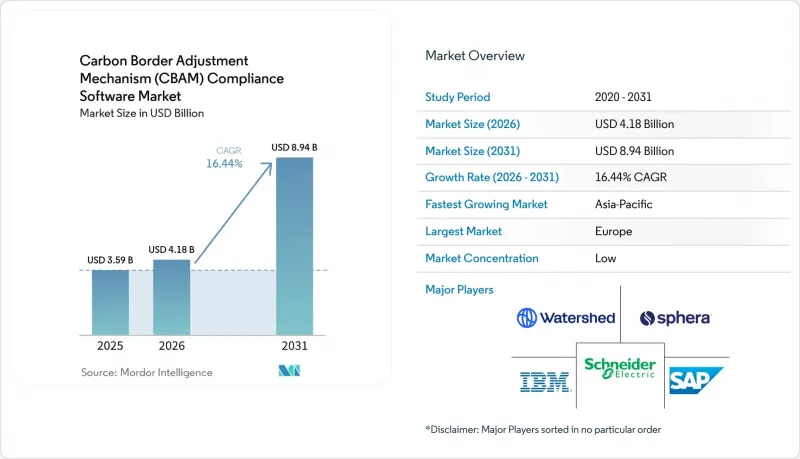
Mordor Intelligence에 의하면, 탄소 국경 조정 메커니즘(CBAM) 컴플라이언스 소프트웨어 시장 규모는 2025년에 35억 9,000만 달러, 2026년에 41억 8,000만 달러되어, 2031년까지 89억 4,000만 달러에 이를 것으로 예측되며, 2026-2031년까지 CAGR 16.44%로 성장할 전망입니다.
본 보고서는 구성 요소(소프트웨어 및 서비스), 도입 형태(클라우드 기반, 기타), 조직 규모(대기업 및 중소기업), 최종 사용자(통관업자 및 무역 컴플라이언스 자문가, 컨설팅 및 검증 서비스 제공업체, 기타), 지역별로 분류되어 있습니다. 시장 전망치는 금액(달러)으로 표시되어 있습니다.
전 세계 탄소 국경 조정 메커니즘(CBAM) 컴플라이언스 소프트웨어 시장 동향 및 인사이트
EU의 CBAM 확정 제도가 소프트웨어에 대한 즉각적인 수요를 촉진
2026년 1월 1일에 발효된 확정 단계에 따라, 탄소국경조정메커니즘(CBAM) 컴플라이언스 소프트웨어 시장은 계획 주도형에서 실행 주도형 영역으로 전환되었습니다. 규정(EU) 2023/956은 인증된 CBAM 신고자에게 법적 책임을 부과하고 있으며, 이에 따라 수입업체는 내재된 배출량을 파악하고, 연간 신고를 지원하며, 인증서 의무를 체계적으로 관리할 수 있는 시스템이 필요하게 되었습니다. 증명서 제출과 관련된 최초의 실질적인 금전적 위험으로 인해 소프트웨어 구매 주기가 단축되었습니다. 준비가 늦어지면 비용뿐만 아니라 수입의 지속성에도 영향을 미칠 가능성이 있기 때문입니다. 이행 규정(EU) 2025/2546에 따르면, 첫 번째 검증 연도에 EU 역외 생산 시설에 대한 현장 검증 방문이 의무화됨에 따라, 검증 담당자가 도착하기 전에 공급업체의 증빙 자료를 정리할 수 있는 플랫폼의 가치가 높아졌습니다. SAP가 2026년에 도입할 예정인, CBAM 인증서 저장소 관리를 위한 “Green Ledger”의 출시는 주요 기업 소프트웨어 공급업체들조차도 이러한 변화를 일시적인 보고 요건이 아닌, 영구적인 컴플라이언스 요건으로 인식하고 있음을 보여줍니다.
디지털 MRV 및 감사 대응형 보고서에 대한 수요가 증가함에 따라 플랫폼에 대한 요구 사항이 재정의되고 있습니다.
탄소 국경 조정 메커니즘(CBAM) 컴플라이언스 소프트웨어 시장은 외부 심사를 견딜 수 있는 디지털 모니터링, 보고, 검증(MRV) 워크플로로 전환되는 추세에 힘입어 성장하고 있습니다. 확정 단계에서는 연간 신고를 통해 제출되는 실제 내재 배출량이 독립적인 검증을 받아야 하므로, 추적성, 문서 관리, 구조화된 데이터 보관이 기본적인 구매 요건으로 설정되어 있습니다. 제6조 제6항에서는 신고 기록을 4년간 보관해야 할 의무가 규정되어 있기 때문에 명확한 감사 추적을 남기지 않고 데이터를 수집하는 플랫폼 간의 경쟁은 점차 줄어들고 있습니다. 이에 따라 탄소국경조정메커니즘(CBAM) 컴플라이언스 소프트웨어 시장에서 구매자의 기대도 변화하고 있으며, 고객들은 공급업체용 설문지, 계산 검증, 검증 기관용 증거 자료 일체를 단일 워크플로우를 통해 제공해 줄 것을 점점 더 요구하고 있습니다. 위임규정(EU) 2025/2551에 따라 검증 기관의 인증 조건에 대한 관심도 높아지고 있으며, 인증 기관의 심사 부담을 줄일 수 있도록 데이터를 구조화할 수 있는 소프트웨어가 우위를 점하고 있습니다.
규제 변동으로 인해 조달 결정이 지연됩니다.
탄소 국경 조정 메커니즘(CBAM) 컴플라이언스 소프트웨어 시장은 급속히 변화하고 있지만, 규제 변동성으로 인해 일부 조달 결정은 여전히 지연되고 있습니다. 유럽연합 집행위원회는 2025년 말에 주요 이행 규정과 위임 규정을 확정했습니다. 이로 인해 많은 기업들은 초기 워크플로가 여전히 최종 운영 규칙과 일치하는지 여부를 검증해야만 했습니다. 이러한 시기가 장기 소프트웨어 계약에 대한 주저함을 불러일으켰습니다. 구매자는 도입 직후 재설계가 필요할 가능성이 있는 도구에 대한 투자를 피하고 싶어 했기 때문입니다. COM(2025) 783에 근거하여 제안된 하류 부문에 대한 적용 범위 확대(2028년부터 철강 및 알루미늄을 원료로 하는 제품이 추가로 포함될 예정)는 이러한 신중한 태도를 더욱 강화하고 있습니다. 왜냐하면 현재 결정되는 소프트웨어 아키텍처는 가까운 미래에 더 광범위한 제품을 포괄해야 할 필요가 생길 가능성이 있기 때문입니다. 이로 인해 탄소국경조정메커니즘(CBAM) 컴플라이언스 소프트웨어 시장에 대한 수요가 사라지는 것은 아니지만, 지출 추세는 유연성이 높은 플랫폼, 도입 주기 단축, 업데이트 능력이 뛰어난 공급업체로 이동하고 있습니다.
부문별 분석
2025년, 소프트웨어는 탄소 국경 조정 메커니즘(CBAM) 컴플라이언스 소프트웨어 시장 점유율의 65.18%를 차지했습니다. 이는 증명서 관리, 신고 워크플로우, 내장형 배출량 계산 분야에서 플랫폼이 핵심적인 역할을 수행하고 있음을 반영한 것입니다. 이러한 주도적인 지위는 해당 제도의 법적 구조에 근거하고 있었습니다. 이는 증명서 제출이나 연례 신고에 있어 일회성 조언 지원이 아니라, 반복 가능한 관리 체제가 요구되기 때문입니다. 규정(EU) 2023/956에 따라 이러한 의무가 법적 구속력을 갖게 됨에 따라, 영향을 받는 수입업체들에게 소프트웨어는 지출 계획의 최우선 과제가 되었습니다. 소프트웨어 계층에서는 인증서 관리와 신고 지원이 법적 위험과 가장 직접적으로 관련된 기능이기 때문에 가장 필수적인 기능으로 두드러졌습니다. 또한, 기업들이 컴플라이언스 기록과 사내 재무·지속가능성 보고 모두에 활용할 수 있는 일관된 산정 논리를 필요로 하고 있기 때문에 내장형 배출량 산정 엔진의 전략적 중요성도 커졌습니다. SAP의 제품 로드맵은 이러한 광범위한 변화를 보여주고 있으며, “Green Ledger”는 기업 환경에서 인증서 관리와 보다 광범위한 탄소 회계 워크플로우를 연계하는 역할을 담당하고 있습니다.
서비스 부문은 2031년까지 연평균 성장률(CAGR) 17.66%로 확대될 것으로 예상되며, 소프트웨어가 여전히 더 큰 수익원임에도 불구하고 가장 빠르게 성장하는 부문이 될 전망입니다. 이러한 추세는 탄소 국경 조정 메커니즘(CBAM) 컴플라이언스 소프트웨어 시장이 단순히 도구를 구매하는 것뿐만 아니라, 이에 수반되는 공급업체 프로세스, 내부 통제, 검증 기관을 위한 워크플로우를 구축하는 것까지 포함하고 있음을 보여줍니다. 많은 기업이 소프트웨어를 신속하게 도입할 수 있지만, 시스템이 운영 측면에서 신뢰성을 확보하기 위해서는 ERP 설정, 데이터 거버넌스, 세관 규제 대응, 팀 교육 지원이 여전히 필요합니다. 2024년 12월 carbmee가 진행한 2,000만 유로(2,100만 달러) 규모의 시리즈 A 자금 조달은 소프트웨어와 도입 지원을 결합한 비즈니스 기회를 반영한 것이었습니다. 왜냐하면 이 자금 조달은 제품 혁신, 국제적인 사업 확대, 제공 능력 강화에 사용될 예정이었기 때문입니다. 또한, 규제 변경이나 인증 조건에 따라 한 번 구축하면 끝나는 것이 아니라 플랫폼에 대한 지속적인 조정이 필요하기 때문에 이 부문에서는 다른 많은 관련 컴플라이언스 부문보다 지속적인 지원이 더욱 중요합니다.
2025년, 탄소 국경 조정 메커니즘(CBAM) 컴플라이언스 소프트웨어 시장에서 클라우드 기반 솔루션이 71.22%를 차지할 것으로 예상되며, 이 부문은 2031년까지 연평균 성장률(CAGR) 18.27%로 성장할 것으로 전망됩니다. 최대 시장 점유율과 가장 빠른 성장률을 모두 유지하고 있다는 사실은 클라우드 기반 서비스가 이 분야의 운영 리듬과 매우 잘 부합하고 있음을 보여줍니다. 그 가장 큰 이유는 규제 변경에 있습니다. 인증서 취급 규정, 검증 요건, 제도의 업데이트는 사용자, 사업체, 공급업체 네트워크 전체에 신속하게 반영되어야 하기 때문입니다. 탄소국경조정메커니즘(CBAM) 컴플라이언스 소프트웨어 시장에서 구독형 제공 및 일원화된 업데이트는 기술적 선호 사항일 뿐만 아니라 컴플라이언스 기능이기도 합니다. 또한, 클라우드 환경은 분산형 협업을 보다 효과적으로 지원합니다. 이는 수입 담당 팀, 공급업체, 검증 기관, 재무 부서가 보고 주기를 통해 동일한 기록에 접근해야 하는 경우에 중요합니다.
On-Premise 배포는 특히 엄격한 데이터 상주 요건, 접근 제어 또는 내부 거버넌스 기준을 준수해야 하는 대규모 산업 그룹이나 규제 대상 조직에게 여전히 중요한 선택지입니다. 이러한 고객은 도입 기간이 길어지고 업데이트 속도가 느려지더라도 인프라를 보다 엄격하게 관리하는 것을 선호하는 경우가 있습니다. 이 부문은 조직 간 협업, 빈번한 규정 변경, 신속한 공급업체 지원에 의존하고 있기 때문에 수요의 균형은 계속해서 클라우드 쪽으로 기울고 있습니다. 대형 소프트웨어 공급업체들은 탄소 배출량 관리 및 컴플라이언스 기능을, 클라우드 퍼스트 모델을 통해 제공되는 경우가 점점 늘어나고 있는 광범위한 엔터프라이즈 플랫폼에 통합함으로써 이러한 추세를 더욱 강화하고 있습니다. 이로 인해 On-Premise형 벤더들은 보안 대책과 레거시 인프라가 여전히 민첩성보다 우선시되는 탄소국경조정메커니즘(CBAM) 대응 소프트웨어 시장의 더 좁은 부문에서 경쟁할 수밖에 없게 되었습니다.
지역별 분석
2025년, 유럽은 탄소 국경 조정 메커니즘(CBAM) 준수 소프트웨어 시장 점유율의 37.19%를 차지하며 1위를 유지했습니다. EU 역내에 거점을 둔 신고자에게 법적 의무가 부과되어 있기 때문에 이 지역의 기반은 구조적으로 견고하며, 소프트웨어 수요의 첫 물결은 역외가 아닌 역내에 정착하고 있습니다. 독일, 프랑스, 네덜란드, 이탈리아는 해당 수입 흐름에 따라 많은 산업 사용자들 사이에서 인증서 추적, 공급업체 기록 관리, 신고 지원에 대한 지속적인 수요가 발생하고 있다는 점에서 두드러집니다. 또한 유럽에서는 구매자들이 단순히 이용 가능한 솔루션에 타협하기보다는 전문 플랫폼과 대규모 엔터프라이즈 제품군을 비교 검토하고 있기 때문에 탄소국경조정메커니즘(CBAM) 준수 소프트웨어 시장에서 가장 빠른 시일 내에 경쟁 환경이 정상화되고 있습니다. 영국의 경우, 독자적인 CBAM이 2027년 1월 1일부터 시행될 예정이므로 지역적 요소가 한층 더 가미되고 있습니다. 이로 인해 이미 이중 관할권 하에 있는 수입업체들은 병행되는 보고 체계를 관리할 수 있는 소프트웨어를 검토해야 하는 상황에 놓이게 되었습니다.
아시아태평양은 2031년까지 연평균 성장률(CAGR) 16.81%를 나타낼 것으로 예측되며, 탄소 국경 조정 메커니즘(CBAM) 준수 소프트웨어 시장에서 가장 빠르게 성장하는 지역이 될 전망입니다. 주요 촉진요인은 수출업체 측 수요입니다. 중국, 인도, 한국, 일본의 생산자들은 EU 고객들에게 검증된 공장 차원의 배출량 데이터를 제출해야 한다는 압박을 점점 더 강하게 받고 있기 때문입니다. 이러한 수요는 대규모 다국적 수출업체에 그치지 않고 더 광범위한 공급망으로 확대되고 있으며, 특히 업스트림 원자재가 여러 시설이나 국가에서 조달되는 경우에 두드러집니다. 따라서 이 지역은 시설 데이터를 정리하고, 공급업체 간의 협력을 지원하며, 현지 보고 관행과 EU의 검증 요건을 연결해 줄 수 있는 플랫폼에 있어 장기적으로 큰 기회를 의미합니다.
북미, 남미, 중동 및 아프리카는 여전히 수익 규모가 작지만, 탄소 국경 조정 메커니즘(CBAM) 대응 소프트웨어 시장 전망을 좌우하는 데 중요한 역할을 하고 있습니다. 북미에서는 수요가 완벽하게 구축된 국내 탄소 국경 조정 체계보다는 수출 컴플라이언스 및 다국적 기업의 준비 상황과 밀접한 관련이 있습니다. 남미는 수출 관련 활동 및 정책 논의를 통해 주목을 받고 있으며, 특히 유럽 집행위원회가 CBAM의 광범위한 도입에 대해 검토하는 과정에서 브라질이 구체적으로 언급되고 있습니다. 중동 및 아프리카에서는 현재 수요가 아직 초기 단계에 머물러 있지만, EU와의 무역 관계로 인해 배출량 관련 문서화의 상업적 중요성이 커짐에 따라 철강 및 비료 등 관련 분야의 수출업체들이 컴플라이언스 도구 투자에 나서고 있습니다. 향후 공급업체의 컴플라이언스가 국경 간 무역의 표준 조건으로 자리 잡음에 따라, 이러한 지역들은 CBAM 컴플라이언스 소프트웨어 시장을 현재 유럽이 주도하는 범위를 넘어 확대시킬 가능성이 있습니다.
기타 혜택
- 엑셀 형식 시장 예측(ME) 시트
- 3개월간의 애널리스트 지원
자주 묻는 질문
목차
제1장 서론
제2장 조사 방법
제3장 주요 요약
제4장 시장 구도
제5장 시장 규모와 성장 예측
제6장 경쟁 구도
제7장 시장 기회와 향후 전망
JHS 26.07.07According to Mordor Intelligence, the carbon border adjustment mechanism (CBAM) compliance software market size is projected to be USD 3.59 billion in 2025, USD 4.18 billion in 2026, and reach USD 8.94 billion by 2031, growing at a CAGR of 16.44% from 2026 to 2031.
This report is Segmented by Component (Software, and Services), Deployment Mode (Cloud-Based, and More), Organization Size (Large Enterprises, and Small and Medium Enterprises), End User (Customs Brokers and Trade Compliance Advisors, Consulting and Verification Service Providers, and More), and Geography. The Market Forecasts are Provided in Terms of Value (USD).
Global Carbon Border Adjustment Mechanism (CBAM) Compliance Software Market Trends and Insights
EU CBAM Definitive Regime Accelerates Immediate Software Demand
The definitive phase, which took effect on January 1, 2026, shifted the Carbon Border Adjustment Mechanism (CBAM) compliance software market from a planning-led to an execution-led space. Regulation (EU) 2023/956 places the legal burden on authorized CBAM declarants, meaning importers now need systems that can capture embedded emissions, support annual declarations, and manage certificate obligations in a structured manner. The first real financial exposure tied to certificate surrender has shortened software buying cycles, as delayed preparation can now affect both costs and the continuity of imports. Implementing Regulation (EU) 2025/2546 added another layer by requiring physical on-site verification visits at non-EU production installations in the first verification year, which has increased the value of platforms that organize supplier evidence before a verifier arrives. SAP's planned Green Ledger release for CBAM certificate repository management in 2026 showed that large enterprise software vendors also viewed this shift as a permanent compliance need rather than a temporary reporting requirement.
Rising Demand for Digital MRV and Audit-Ready Reporting Reshapes Platform Requirements
The Carbon Border Adjustment Mechanism (CBAM) compliance software market is also being boosted by the move toward digital monitoring, reporting, and verification workflows that can withstand external review. Under the definitive phase, actual embedded emissions submitted in annual declarations must be independently verified, which has made traceability, document control, and structured data retention basic purchase requirements. Article 6(6) requires that declaration records be maintained for 4 years, so platforms that collect data without preserving a clean audit trail are becoming less competitive. This is changing buyer expectations within the carbon border adjustment mechanism compliance software market, as customers increasingly want supplier questionnaires, calculation checks, and verifier-ready evidence packs in a single workflow. Delegated Regulation (EU) 2025/2551 has also tightened attention on verifier accreditation conditions, which gives an advantage to software that can structure data in a way that reduces review friction for accredited bodies.
Regulatory Volatility Slows Procurement Decisions
The Carbon Border Adjustment Mechanism (CBAM) compliance software market is moving quickly, but regulatory volatility is still slowing some procurement decisions. The European Commission finalized major implementing and delegated acts late in 2025, which meant many companies had to validate whether their early workflows still aligned with the final operating rules. That timing created hesitation around long-term software contracts, because buyers wanted to avoid investing in tools that might need redesign just after deployment. The proposed downstream scope extension under COM(2025) 783, which would add more steel- and aluminum-based goods from 2028, has reinforced that caution, as software architecture decisions made now may soon require broader product coverage. This does not remove demand from the Carbon Border Adjustment Mechanism (CBAM) compliance software market, but it does shift spending toward flexible platforms, shorter implementation cycles, and vendors with stronger update capabilities.
Other drivers and restraints analyzed in the detailed report include:
- Carbon Pricing Expansion Beyond the EU Creates a Compound Compliance Environment
- Supplier Data Digitization Demand Spans Multi-Tier Supply Chains
- Supplier Data Gaps Create Friction across the Value Chain
For complete list of drivers and restraints, kindly check the Table Of Contents.
Segment Analysis
Software held 65.18% of the Carbon Border Adjustment Mechanism (CBAM) compliance software market share in 2025, which reflected the central role of platforms in certificate management, declaration workflows, and embedded emissions calculations. That leadership position was rooted in the regime's legal structure, because certificate surrender and annual declarations require repeatable controls rather than one-time advisory support. Regulation (EU) 2023/956 made those obligations binding, which pushed software to the front of spending plans for affected importers. Within the software layer, certificate management and declaration support stood out as the most essential capabilities because they sit closest to the point of legal exposure. Embedded emissions engines also gained strategic weight, because companies need a consistent calculation logic that can feed both compliance records and internal finance or sustainability reporting. SAP's product roadmap signaled this broader shift, with Green Ledger positioned to connect certificate management with wider carbon accounting workflows in enterprise environments.
Services are projected to expand at a 17.66% CAGR through 2031, making them the fastest-growing component, even though software remains the larger revenue pool. This pattern shows that the Carbon Border Adjustment Mechanism (CBAM) compliance software market is not just about buying a tool, but also about setting up supplier processes, internal controls, and verifier-facing workflows around it. Many companies can acquire software quickly, yet still need help with ERP configuration, data governance, customs alignment, and team training before the system becomes operationally reliable. carbmee's EUR 20 million (USD 21 million) Series A in December 2024 reflected that combined software and implementation opportunity, because the funding was tied to product innovation, international expansion, and stronger delivery capability. Ongoing support also matters more here than in many adjacent compliance categories, since regulatory updates and accreditation conditions require recurring platform adjustments rather than a one-time completed build.
Cloud-based solutions accounted for 71.22% of the Carbon Border Adjustment Mechanism (CBAM) compliance software market in 2025, and this segment is projected to grow at an 18.27% CAGR through 2031. Holding both the largest share and the fastest growth rate shows that cloud delivery matches this category's operating rhythm unusually well. The strongest reason is regulatory change, because certificate handling rules, verification requirements, and regime updates need to be reflected quickly across users, entities, and supplier networks. In the Carbon Border Adjustment Mechanism (CBAM) compliance software market, subscription delivery and central updates are compliance features as much as technology preferences. Cloud setups also support distributed collaboration more effectively, which matters when importing teams, suppliers, verifiers, and finance functions all need access to the same records across reporting cycles.
On-premises deployment remains relevant, especially for large industrial groups and regulated organizations that maintain strict data residency, access control, or internal governance standards. Those customers may still prefer tighter infrastructure control even if it increases implementation time and reduces update speed. Even so, the balance of demand continues to favor cloud because the category depends on cross-entity coordination, recurring rule changes, and faster vendor support. Large software providers have reinforced that direction by embedding carbon and compliance functions into broader enterprise platforms that are increasingly delivered through cloud-first models. This leaves on-premises vendors competing in narrower pockets of the carbon border adjustment mechanism compliance software market, where security policy or legacy infrastructure still outweighs agility.
Complete Report Scope:
- By Component
- Software
- CBAM Certificate Management and Trading Platforms
- Import Declaration and Customs Filing Automation
- Embedded Emissions Verification and Third-Party Validation Integration
- Other Softwares
- Services
- Implementation and Integration Services
- Support and Maintenance Services
- Software
- By Deployment Mode
- Cloud-Based
- On-Premises
- By Organization Size
- Large Enterprises
- Small and Medium Enterprises
- By End User
- Importers and Declarants
- Exporters and Suppliers
- Customs Brokers and Trade Compliance Advisors
- Consulting and Verification Service Providers
- By Geography
- North America
- United States
- Canada
- Mexico
- South America
- Brazil
- Argentina
- Rest of South America
- Europe
- Germany
- United Kingdom
- France
- Italy
- Spain
- Russia
- Rest of Europe
- Asia-Pacific
- China
- India
- Japan
- South Korea
- Australia
- Rest of Asia-Pacific
- Middle East
- Saudi Arabia
- United Arab Emirates
- Turkey
- Rest of Middle East
- Africa
- South Africa
- Nigeria
- Rest of Africa
- North America
Geography Analysis
Europe held 37.19% of the Carbon Border Adjustment Mechanism (CBAM) compliance software market share in 2025, maintaining its lead. The regional base is structurally strong because the legal obligation sits with EU-established declarants, so the first wave of software demand is anchored inside the bloc rather than outside it. Germany, France, the Netherlands, and Italy stand out because their covered import flows create repeated demand for certificate tracking, supplier record management, and declaration support across many industrial users. Europe is also where the Carbon Border Adjustment Mechanism (CBAM) compliance software market is seeing the earliest competitive normalization, as buyers compare specialist platforms with larger enterprise suites rather than simply settling for any available solution. The UK is adding another regional layer because its own CBAM is set to start on January 1, 2027, and that has already pushed dual-jurisdiction importers to review software that can manage parallel reporting frameworks.
Asia-Pacific is projected to grow at a 16.81% CAGR through 2031, making it the fastest-growing geography in the Carbon Border Adjustment Mechanism (CBAM) compliance software market. The main driver is exporter-side demand, since producers in China, India, South Korea, and Japan are under growing pressure to supply verified plant-level emissions data to EU customers. That need is expanding beyond large multinational exporters to broader supplier networks, especially where upstream materials are sourced from multiple facilities and countries. The region, therefore, represents a large long-term opportunity for platforms that can organize facility data, support supplier collaboration, and bridge local reporting practices with EU verification expectations.
North America, South America, the Middle East, and Africa remain smaller revenue pools, but they are still relevant to the future shape of the carbon border adjustment mechanism compliance software market. In North America, demand is more closely tied to export compliance and multinational group readiness than to a fully developed domestic border carbon framework. South America is gaining attention through export exposure and policy discussion, with Brazil specifically referenced in the European Commission's review of broader CBAM diffusion. In the Middle East and Africa, current demand is still at an earlier stage, but exporters in sectors such as steel and fertilizers are beginning to invest in readiness tools, as EU trade relationships make emissions documentation more commercially important. Over time, these regions can widen the CBAM compliance software market beyond its current Europe-led structure as supplier compliance becomes a standard condition of cross-border trade.
- Assent Inc.
- carbmee GmbH
- Coolset B.V.
- IntegrityNext AG
- Normative AB
- Sphera Solutions, Inc.
- SAP SE
- Microsoft Corporation
- Salesforce, Inc.
- Enablon France SAS
- Persefoni AI, Inc.
- Sweep SAS
- Plan A Earth GmbH
- Emitwise Limited
- Watershed Technology, Inc.
- EcoVadis SAS
- Quentic GmbH
- Position Green AB
- IBM Corporation
- Schneider Electric SE
Additional Benefits:
- The market estimate (ME) sheet in Excel format
- 3 months of analyst support
TABLE OF CONTENTS
1 INTRODUCTION
- 1.1 Study Assumptions and Market Definition
- 1.2 Scope of the Study
2 RESEARCH METHODOLOGY
3 EXECUTIVE SUMMARY
4 MARKET LANDSCAPE
- 4.1 Market Overview
- 4.2 Market Drivers
- 4.2.1 EU CBAM Definitive Regime Adoption From 2026
- 4.2.2 Rising Demand for Digital MRV and Audit-Ready Reporting
- 4.2.3 Expansion of Carbon Pricing and Border Carbon Policies Beyond the European Union
- 4.2.4 Supplier Data Digitization Across Multi-Tier Supply Chains
- 4.2.5 Internal Carbon Pricing and Procurement Decarbonization Programs
- 4.2.6 Customs-ERP Integration and Trade Compliance Automation
- 4.3 Market Restraints
- 4.3.1 Regulatory Volatility Across CBAM Methodologies and Timelines
- 4.3.2 Supplier Data Gaps and Verification Friction in Non-EU Supply Chains
- 4.3.3 High Implementation Cost for Mid-Market Importers and Exporters
- 4.3.4 Limited Interoperability With Legacy Enterprise and Customs Systems
- 4.4 Industry Value Chain Analysis
- 4.5 Impact of Macroeconomic Factors on the Market
- 4.6 Regulatory Landscape
- 4.7 Technological Outlook
- 4.8 Porter's Five Forces Analysis
- 4.8.1 Threat of New Entrants
- 4.8.2 Bargaining Power of Buyers
- 4.8.3 Bargaining Power of Suppliers
- 4.8.4 Threat of Substitutes
- 4.8.5 Competitive Rivalry
5 MARKET SIZE AND GROWTH FORECASTS (VALUE)
- 5.1 By Component
- 5.1.1 Software
- 5.1.1.1 CBAM Certificate Management and Trading Platforms
- 5.1.1.2 Import Declaration and Customs Filing Automation
- 5.1.1.3 Embedded Emissions Verification and Third-Party Validation Integration
- 5.1.1.4 Other Softwares
- 5.1.2 Services
- 5.1.2.1 Implementation and Integration Services
- 5.1.2.2 Support and Maintenance Services
- 5.1.1 Software
- 5.2 By Deployment Mode
- 5.2.1 Cloud-Based
- 5.2.2 On-Premises
- 5.3 By Organization Size
- 5.3.1 Large Enterprises
- 5.3.2 Small and Medium Enterprises
- 5.4 By End User
- 5.4.1 Importers and Declarants
- 5.4.2 Exporters and Suppliers
- 5.4.3 Customs Brokers and Trade Compliance Advisors
- 5.4.4 Consulting and Verification Service Providers
- 5.5 By Geography
- 5.5.1 North America
- 5.5.1.1 United States
- 5.5.1.2 Canada
- 5.5.1.3 Mexico
- 5.5.2 South America
- 5.5.2.1 Brazil
- 5.5.2.2 Argentina
- 5.5.2.3 Rest of South America
- 5.5.3 Europe
- 5.5.3.1 Germany
- 5.5.3.2 United Kingdom
- 5.5.3.3 France
- 5.5.3.4 Italy
- 5.5.3.5 Spain
- 5.5.3.6 Russia
- 5.5.3.7 Rest of Europe
- 5.5.4 Asia-Pacific
- 5.5.4.1 China
- 5.5.4.2 India
- 5.5.4.3 Japan
- 5.5.4.4 South Korea
- 5.5.4.5 Australia
- 5.5.4.6 Rest of Asia-Pacific
- 5.5.5 Middle East
- 5.5.5.1 Saudi Arabia
- 5.5.5.2 United Arab Emirates
- 5.5.5.3 Turkey
- 5.5.5.4 Rest of Middle East
- 5.5.6 Africa
- 5.5.6.1 South Africa
- 5.5.6.2 Nigeria
- 5.5.6.3 Rest of Africa
- 5.5.1 North America
6 COMPETITIVE LANDSCAPE
- 6.1 Market Concentration
- 6.2 Strategic Moves
- 6.3 Market Share Analysis
- 6.4 Company Profiles (includes Global Level Overview, Market Level Overview, Core Segments, Financials as available, Strategic Information, Market Rank/Share, Products and Services, Recent Developments)
- 6.4.1 Assent Inc.
- 6.4.2 carbmee GmbH
- 6.4.3 Coolset B.V.
- 6.4.4 IntegrityNext AG
- 6.4.5 Normative AB
- 6.4.6 Sphera Solutions, Inc.
- 6.4.7 SAP SE
- 6.4.8 Microsoft Corporation
- 6.4.9 Salesforce, Inc.
- 6.4.10 Enablon France SAS
- 6.4.11 Persefoni AI, Inc.
- 6.4.12 Sweep SAS
- 6.4.13 Plan A Earth GmbH
- 6.4.14 Emitwise Limited
- 6.4.15 Watershed Technology, Inc.
- 6.4.16 EcoVadis SAS
- 6.4.17 Quentic GmbH
- 6.4.18 Position Green AB
- 6.4.19 IBM Corporation
- 6.4.20 Schneider Electric SE
7 MARKET OPPORTUNITIES AND FUTURE OUTLOOK
- 7.1 White-Space and Unmet-Need Assessment