
|
시장보고서
상품코드
2073316
AI 활용 인재 분석 : 시장 점유율 분석, 업계 동향 및 통계, 성장 예측(2026-2031년)AI-Powered Talent Analytics - Market Share Analysis, Industry Trends & Statistics, Growth Forecasts (2026 - 2031) |
||||||
 Mordor Intelligence
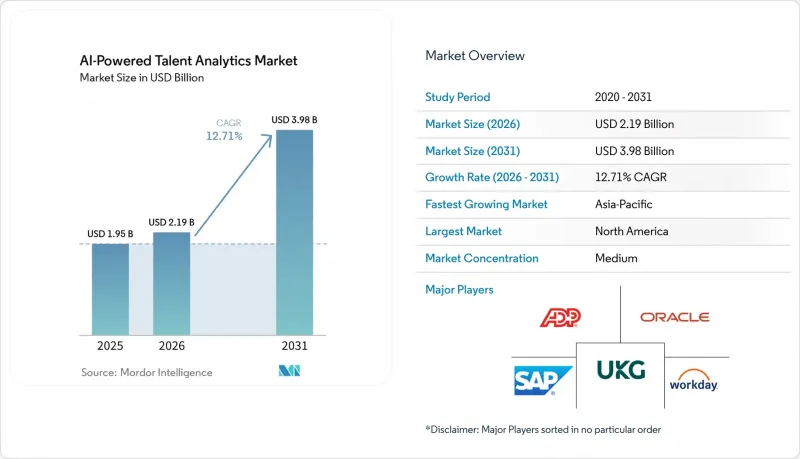
Mordor Intelligence에 의하면, AI 활용 인재 분석 시장 규모는 2025년 19억 5,000만 달러로 평가되었습니다. 2026년에는 21억 9,000만 달러로 확대되어 2026년부터 2031년에 걸쳐 CAGR 12.71%로 성장을 지속하여, 2031년에는 39억 8,000만 달러에 이를 것으로 예측됩니다.
본 보고서는 분석 유형(기술적 분석, 진단 분석, 예측 분석 등), 배포 모델(On-Premise, 클라우드, 하이브리드), 조직 규모(대기업, 중소기업(SME)), 최종 이용 산업(IT 및 통신, 제조업 등) 및 지역별로 분류되어 있습니다. 시장 전망은 금액(달러) 기준으로 제시되어 있습니다.
세계의 AI 활용 인재 분석 시장 동향 및 인사이트
스킬 매핑에 생성형 AI 통합
생성형 AI는 프로젝트 문서, 동료 평가, 학습 기록에서 역량을 추출하여 몇 분 만에 공석인 직책과 대조함으로써, 기업이 역량을 분류하는 방식을 근본적으로 변화시키고 있습니다. 2025년 10월에 출시된 SAP의 “People Intelligence"는 대규모 언어 모델을 활용하여 신기술이 시장에 등장한 지 수주 이내에 사내 스킬 그래프를 업데이트함으로써, 수동으로 분류 체계를 갱신할 때 흔히 발생하는 12-18개월의 지연을 해소하고 있습니다. Coursera에 따르면, 2025년에 생성형 AI 관련 과정의 수강자 수가 234% 급증했으며, 이는 새로운 역량이 노동 시장에 얼마나 빠르게 확산되고 있는지를 보여줍니다. 이러한 도구를 시범 도입한 조직에서는 인사 부서의 수작업에 따른 업무 부담을 약 40% 줄일 수 있으며, 인력 부족을 조기에 파악할 수 있어 교육 예산을 가장 가치 있는 기술 습득에 집중할 수 있게 됩니다.
클라우드 기반 HR 제품군의 급속한 확산
통합형 클라우드 플랫폼은 그동안 인재 모델링의 정확도를 제한해 왔던 데이터의 사일로화를 해소합니다. 2025년 9월에 도입된 ‘Workday Data Cloud"는 스토리지 중복 없이 Databricks, Snowflake, Salesforce를 연동하여 인사 팀이 실적, 재무, 고객 데이터를 하나의 뷰에서 통합할 수 있도록 합니다. Oracle Cloud HCM은 이직 위험 및 후계자 양성 준비 현황을 관리자용 대시보드에 직접 표시하여, 인사이트에서 실행까지 걸리는 시간을 단축합니다. 중소기업은 수천 개 고객사에서 수집한 익명 처리된 급여 및 직원 기록을 통합한 ADP DataCloud를 통해 동종 업계 타사와 비교할 수 있는 벤치마크에 접근할 수 있습니다. 또한, 빈번하게 이루어지는 클라우드 업데이트를 통해 새로운 규제 대응 기능이 즉시 제공되므로, 비용이 많이 드는 On-Premise 환경을 업그레이드하지 않고도 도입 환경의 규정 준수를 유지할 수 있습니다.
데이터 개인정보 보호 및 규정 준수의 복잡성
동의에 관한 규정이 국가마다 다르기 때문에 공급업체는 데이터를 현지화하고 지역별로 서로 다른 제품 버전을 유지해야 합니다. 인도의 “디지털 개인 데이터 보호법"에 따르면, 생체 인증 데이터의 부정 사용에 대해 위반자에게 최대 250 카롤 루피(3,000만 달러)의 벌금이 부과될 수 있습니다. 중국의 “개인정보보호법"에서는 직원 기록의 국내 보관이 의무화되어 있으며, 국경을 넘는 전송 시에는 정부의 보안 심사가 필요합니다. 유럽연합(EU)의 일반 데이터 보호 규정(GDPR(EU 개인정보보호규정)) 제22조는 완전히 자동화된 채용 결정을 제한하고, 사람의 감독을 의무화하고 있습니다. InCountry와 같은 서비스 제공업체들은 이러한 법규를 준수하기 위해 Oracle HCM 데이터를 각국별 전용 시설에서 호스팅하고 있습니다.
부문별 분석
처방형 도구는 연평균 성장률(CAGR) 14.67%로 성장하고 있으며, 이는 AI 활용 인재 분석 시장 전체의 성장률을 상회하고 있습니다. 예측형 플랫폼은 2025년에 55.41%의 시장 점유율을 차지하며, 이직 예측 및 인력 수요 계획 분야에서 성숙도를 보여주었습니다. 그러나 정확도 수준이 안정화되면, 차별화 요소는 엔진이 정착 보너스, 역량 강화 교육 또는 후계자 계획을 제안할 수 있는지 여부로 옮겨갑니다. IBM은 처방형 권장 사항을 통해 연간 3억 달러의 이직 비용을 절감했다고 보고했으며, 유니레버는 면접 순서 최적화 도구를 도입한 후 채용까지 걸리는 시간을 75% 단축했습니다. 설명형 대시보드는 규정 준수 측면에서 여전히 필수적이지만, 더 높은 부가가치를 창출하는 계층에 깨끗한 데이터를 제공하는 ‘출처"로서의 역할을 수행하고 있습니다. 진단적 분석은 참여도 저하나 다양성 격차에 대한 근본 원인 분석을 포괄하며, 과거를 되돌아보는 관점과 미래를 예측하는 관점을 연결하는 가교 역할을 합니다.
기업들은 도구의 난립을 피하기 위해 하나의 구독 서비스 내에 여러 가지 분석 유형을 통합하는 경향이 강해지고 있습니다. 이사회가 정량화된 ROI를 요구하는 가운데, AI 활용 인재 분석 시장에서 처방형 모듈에 할당되는 시장 규모는 2028년까지 서술형 모듈에 대한 지출을 넘어설 것으로 예측됩니다. 추천 엔진을 추가할 수 없는 공급업체는 상품화될 위험에 직면하게 됩니다. 한편, 감정 분석과 네트워크 분석을 통합한 업체들은 기존의 인사 지표로는 간과되기 쉬운 번아웃 징후나 비공식적인 영향력을 가진 인물을 밝혀냄으로써 경쟁 우위를 확보하고 있습니다.
클라우드 서비스는 낮은 초기 비용과 원활한 업그레이드 덕분에 2025년에도 매출 점유율 66.78%를 유지했습니다. 그럼에도 불구하고, 기업들이 기밀 데이터를 국내 서버에 저장하면서 무거운 분석 워크로드에는 퍼블릭 클라우드의 컴퓨팅 리소스를 활용하는 경향이 있어, 하이브리드 아키텍처는 연평균 성장률(CAGR) 15.09%를 나타낼 것으로 전망됩니다. 중국, 러시아, 중동 등 엄격한 데이터 현지화 규제가 적용되는 지역에서는 하이브리드 솔루션을 통한 AI 활용 인재 분석 시장 규모가 급속히 확대되고 있습니다. AWS의 “European Sovereign Cloud"는 EU 규제 당국의 요건을 충족하기 위해 운영을 물리적으로 분리해 놓은 서비스의 대표적인 사례입니다.
하이브리드 사용자들은 규정 준수를 보장받고 실시간 대시보드에서 낮은 지연 시간의 이점을 누리는 대가로 인프라 비용 증가를 감수하고 있습니다. 프로바이더는 데이터 레지던시와 관련하여 InCountry와 같은 전문 기업과 제휴하여, 구현 템플릿에 현지화 기능을 통합하고 있습니다. 인도의 동의 중심 제도나 캘리포니아주의 직원 데이터 권리를 본받는 정부가 늘어남에 따라, 균형은 더욱 하이브리드 쪽으로 기울어질 가능성이 있습니다.
지역별 분석
북미는 2025년에 36.88%의 점유율을 차지했으며, 이는 알고리즘의 조기 도입과 노동력에 관한 공시 의무에 힘입은 결과입니다. 뉴욕시의 “로컬 로 144"와 같은 편향 감사 방식은 규정 준수 비용을 증가시키는 한편, 리스크 회피 성향이 강한 이사회에서 정교한 분석의 정당성을 높여주고 있습니다. 캐나다 각 주의 개인정보 보호법과 멕시코에서 급증하는 니어쇼어링도 수요를 서서히 끌어올리고 있지만, 이 지역 전체의 중소기업들은 기술 부족과 예산 제약으로 인해 여전히 뒤처져 있습니다.
아시아태평양은 2031년까지 연평균 성장률(CAGR)이 14.05%로, 가장 빠른 성장세를 보이고 있습니다. 2024년 IDC 조사에 따르면, 기업의 43%가 향후 1년 동안 AI 예산을 20% 이상 늘릴 계획인 것으로 밝혀졌습니다. 주요 산업 전반에 걸쳐 29-41%에 달하는 기술 격차는 진단형 및 처방형 플랫폼에 있어 좋은 기회가 되고 있습니다. 인도의 데이터 보호 관련 과징금과 중국의 현지화 규제로 인해 많은 구매자들이 하이브리드 도입을 선택하고 있습니다. 일본은 노동력의 고령화에 대응하기 위해 후계자 분석에 주력하고 있는 반면, 호주와 한국은 새로운 법규에 따른 다양성 보고를 중시하고 있습니다.
유럽은 가장 엄격한 규제에 직면해 있습니다. “AI법"는 채용 도구를 “고위험"로 규정하고, 적합성 평가를 의무화하고 있습니다. 각 벤더사는 해당 법이 고용 현장에서의 감정 인식 기능을 전면적으로 금지하고 있다는 규정에 따라, 해당 기능을 비활성화했습니다. 독일과 프랑스는 “기업 지속가능성 보고 지침"를 준수하기 위해 임금 격차 대시보드에 막대한 투자를 하고 있습니다. 남미에서는 브라질을 필두로 불균등한 성장세가 나타나고 있습니다. 브라질에서는 다국적 기업들이 지역 데이터센터와 연계된 클라우드 분석 시스템을 도입하고 있습니다. 중동, 특히 사우디아라비아와 아랍에미리트에서는 노동력 분석이 국가의 다각화 정책에 포함되어 있습니다. 아프리카에서는 아직 개발도상국 단계이며, 남아프리카공화국과 나이지리아에 집중되어 있습니다. 이들 국가에서는 다국적 기업과 대형 국내 은행들이 기술 예측 도구의 시범 운영을 진행하고 있습니다.
기타 혜택 :
- 엑셀 형식 시장 예측(ME) 시트
- 3개월간의 애널리스트 지원
자주 묻는 질문
목차
제1장 서론
제2장 조사 방법
제3장 주요 요약
제4장 시장 구도
제5장 시장 규모 및 성장 예측
제6장 경쟁 구도
제7장 시장 기회 및 향후 전망
KTH 26.07.08According to Mordor Intelligence, the AI-powered talent analytics market size is expected to grow from USD 1.95 billion in 2025 to USD 2.19 billion in 2026 and is forecast to reach USD 3.98 billion by 2031 at 12.71% CAGR over 2026-2031.
This report is Segmented by Analytics Type (Descriptive Analytics, Diagnostic Analytics, Predictive Analytics, and More), Deployment Model (On-Premises, Cloud, and Hybrid), Organization Size (Large Enterprises, and Small and Medium Enterprises [SMEs]), End-Use Industry (IT and Telecommunications, Manufacturing, and More), and Geography. The Market Forecasts are Provided in Terms of Value (USD).
Global AI-Powered Talent Analytics Market Trends and Insights
Integration of Generative AI for Skills Mapping
Generative AI rewrites the way companies catalog competencies by extracting skills from project documents, peer reviews, and learning transcripts, then matching them to open roles in minutes. SAP's People Intelligence, launched in October 2025, uses large language models to refresh internal skills graphs weeks after new technologies enter the market, eliminating the 12- to 18-month lag typical of manual taxonomy updates. Coursera recorded a 234% jump in generative AI course enrollments during 2025, showing how quickly novel capabilities flow into the labor pool. Organizations that pilot these tools reduce manual HR workloads by roughly 40% and spot workforce gaps early, allowing learning budgets to target the highest-value skills.
Rapid Adoption of Cloud-Based HR Suites
Unified cloud platforms break the data silos that previously limited workforce modeling accuracy. Workday Data Cloud, introduced in September 2025, connects Databricks, Snowflake, and Salesforce without duplicating storage, enabling HR teams to blend performance, finance, and customer data in one view. Oracle Cloud HCM displays attrition risk and succession readiness directly inside manager dashboards, shrinking the insight-to-action window. Smaller companies access comparable benchmarks through ADP DataCloud, which aggregates anonymized payroll and workforce records from thousands of clients. Frequent cloud updates also push new regulatory features instantly, keeping deployments compliant without costly on-premises upgrades.
Data Privacy And Compliance Complexities
Divergent consent rules force vendors to localize data and maintain region-specific product variants. India's Digital Personal Data Protection Act can fine violators up to INR 250 crore (USD 30 million) for misuse of biometrics. China's Personal Information Protection Law requires domestic storage of employee records and government security reviews for cross-border transfers. European Union GDPR Article 22 restricts fully automated hiring decisions, obligating human oversight. Providers such as InCountry host Oracle HCM data in country-specific facilities to satisfy these statutes.
Other drivers and restraints analyzed in the detailed report include:
- Growing Emphasis on Workforce Diversity Metrics
- Shift Toward Data-Driven Reskilling Programs
- Algorithmic Bias And Audit Requirements
For complete list of drivers and restraints, kindly check the Table Of Contents.
Segment Analysis
Prescriptive tools are advancing at 14.67% CAGR, eclipsing overall AI-powered talent analytics market growth. Predictive platforms commanded 55.41% share in 2025, showing their maturity in churn forecasts and workforce demand planning. Yet once accuracy levels converge, the differentiator becomes whether the engine can suggest a retention bonus, an upskilling course, or a succession plan. IBM credits prescriptive recommendations for USD 300 million in annual turnover savings, and Unilever cut time-to-hire by 75% after adopting interview sequence optimizers. Descriptive dashboards remain vital for compliance but function as feeders that supply clean data to the higher-value layers. Diagnostic analytics span root-cause analysis of engagement dips and diversity gaps, forming the bridge between hindsight and foresight.
Enterprises increasingly bundle multiple analytics types within one subscription to avoid tool sprawl. The AI-powered talent analytics market size allocated to prescriptive modules is projected to outpace descriptive spend by 2028 as boardrooms demand quantified ROI. Vendors that fail to add recommendation engines risk relegation to commodity status. Those that integrate sentiment and network analysis gain an edge by surfacing burnout signals and informal influencers that traditional HR metrics miss.
Cloud delivery retained 66.78% revenue share in 2025 thanks to lower upfront costs and seamless upgrades. Even so, hybrid architectures are expanding at 15.09% CAGR as enterprises route sensitive data to in-country servers while using public-cloud compute for heavy analytics workloads. The AI-powered talent analytics market size attributed to hybrid solutions is accelerating in jurisdictions with strict data localization mandates such as China, Russia, and the Middle East. AWS European Sovereign Cloud exemplifies offerings that physically separate operations to satisfy EU regulators.
Hybrid users accept higher infrastructure spend in return for compliance assurance and latency benefits for real-time dashboards. Providers partner with specialists like InCountry for data residency, embedding localization into implementation templates. The balance may tilt further toward hybrid as more governments emulate India's consent-centric regime and California's employee data rights.
Complete Report Scope:
- By Analytics Type
- Descriptive Analytics
- Diagnostic Analytics
- Predictive Analytics
- Prescriptive Analytics
- Other Analytics Types
- By Deployment Model
- On-Premises
- Cloud
- Hybrid
- By Organization Size
- Large Enterprises
- Small and Medium Enterprises (SMEs)
- By End-Use Industry
- IT and Telecommunications
- Banking, Financial Services and Insurance (BFSI)
- Healthcare and Life Sciences
- Retail and E-commerce
- Manufacturing
- Government and Public Sector
- Other End-Use Industries
- By Geography
- North America
- United States
- Canada
- Mexico
- Rest of North America
- South America
- Brazil
- Argentina
- Rest of South America
- Europe
- Germany
- United Kingdom
- France
- Italy
- Spain
- Russia
- Rest of Europe
- Asia-Pacific
- China
- India
- Japan
- South Korea
- Australia
- Rest of Asia-Pacific
- Middle East
- Saudi Arabia
- United Arab Emirates
- Turkey
- Rest of Middle East
- Africa
- South Africa
- Nigeria
- Rest of Africa
- North America
Geography Analysis
North America commanded 36.88% share in 2025, sustained by early algorithmic hiring uptake and mandatory workforce disclosures. Bias audit laws such as New York City's Local Law 144 increase compliance spend but also legitimize advanced analytics among risk-averse boards. Canada's provincial privacy statutes and Mexico's nearshoring surge both add incremental demand, yet small businesses across the region still lag because of skills shortages and budget discipline.
Asia-Pacific is the fastest growing at 14.05% CAGR through 2031. A 2024 IDC survey found 43% of enterprises plan to raise AI budgets by over 20% during the next year. Skills gaps of 29-41% across major industries create fertile ground for diagnostic and prescriptive platforms. India's data-protection fines and China's localization rules push many buyers toward hybrid deployments. Japan focuses on succession analytics to counter aging workforces, while Australia and South Korea emphasize diversity reporting aligned with emerging legislation.
Europe grapples with the strictest rulebook. The AI Act labels recruitment tools high risk, compelling conformity assessments. Vendors disabled emotion recognition features to comply with the Act's outright ban in employment contexts. Germany and France invest heavily in pay-equity dashboards to align with the Corporate Sustainability Reporting Directive. South America grows unevenly, led by Brazil, where multinationals deploy cloud analytics bundled with regional data centers. The Middle East, notably Saudi Arabia and the United Arab Emirates, incorporates workforce analytics into national diversification agendas. Africa remains nascent, concentrated in South Africa and Nigeria where multinationals and large domestic banks pilot skills-forecasting tools.
- International Business Machines Corporation
- Microsoft Corporation
- SAP SE
- Oracle Corporation
- Workday Inc.
- Cornerstone OnDemand Inc.
- Automatic Data Processing Inc.
- Ceridian HCM Holding Inc.
- Visier Inc.
- Degreed Inc.
- Eightfold AI Inc.
- Gloat Inc.
- Beamery Inc.
- Phenom People Inc.
- HireVue Inc.
- Retrain.ai Inc.
- SeekOut Inc.
- Entelo Inc.
- Paylocity Holding Corporation
- UKG Inc.
Additional Benefits:
- The market estimate (ME) sheet in Excel format
- 3 months of analyst support
TABLE OF CONTENTS
1 INTRODUCTION
- 1.1 Study Assumptions and Market Definition
- 1.2 Scope of the Study
2 RESEARCH METHODOLOGY
3 EXECUTIVE SUMMARY
4 MARKET LANDSCAPE
- 4.1 Market Overview
- 4.2 Market Drivers
- 4.2.1 Rapid Adoption of Cloud-Based HR Suites
- 4.2.2 Growing Emphasis on Workforce Diversity Metrics
- 4.2.3 Integration of Generative AI for Skills Mapping
- 4.2.4 Shift Toward Data-Driven Reskilling Programs
- 4.2.5 Expansion of Remote-First Hiring Models
- 4.2.6 Increased Regulatory Focus on Fair-Use AI in HR
- 4.3 Market Restraints
- 4.3.1 Data Privacy and Compliance Complexities
- 4.3.2 Algorithmic Bias and Audit Requirements
- 4.3.3 Integration Challenges With Legacy HRIS
- 4.3.4 Limited Analytics Talent in HR Departments
- 4.4 Industry Value Chain Analysis
- 4.5 Regulatory Landscape
- 4.6 Technological Outlook
- 4.7 Porter's Five Forces Analysis
- 4.7.1 Threat of New Entrants
- 4.7.2 Bargaining Power of Suppliers
- 4.7.3 Bargaining Power of Buyers
- 4.7.4 Threat of Substitutes
- 4.7.5 Competitive Rivalry
- 4.8 Impact of Macroeconomic Factors on the Market
5 MARKET SIZE AND GROWTH FORECASTS (VALUE)
- 5.1 By Analytics Type
- 5.1.1 Descriptive Analytics
- 5.1.2 Diagnostic Analytics
- 5.1.3 Predictive Analytics
- 5.1.4 Prescriptive Analytics
- 5.1.5 Other Analytics Types
- 5.2 By Deployment Model
- 5.2.1 On-Premises
- 5.2.2 Cloud
- 5.2.3 Hybrid
- 5.3 By Organization Size
- 5.3.1 Large Enterprises
- 5.3.2 Small and Medium Enterprises (SMEs)
- 5.4 By End-Use Industry
- 5.4.1 IT and Telecommunications
- 5.4.2 Banking, Financial Services and Insurance (BFSI)
- 5.4.3 Healthcare and Life Sciences
- 5.4.4 Retail and E-commerce
- 5.4.5 Manufacturing
- 5.4.6 Government and Public Sector
- 5.4.7 Other End-Use Industries
- 5.5 By Geography
- 5.5.1 North America
- 5.5.1.1 United States
- 5.5.1.2 Canada
- 5.5.1.3 Mexico
- 5.5.1.4 Rest of North America
- 5.5.2 South America
- 5.5.2.1 Brazil
- 5.5.2.2 Argentina
- 5.5.2.3 Rest of South America
- 5.5.3 Europe
- 5.5.3.1 Germany
- 5.5.3.2 United Kingdom
- 5.5.3.3 France
- 5.5.3.4 Italy
- 5.5.3.5 Spain
- 5.5.3.6 Russia
- 5.5.3.7 Rest of Europe
- 5.5.4 Asia-Pacific
- 5.5.4.1 China
- 5.5.4.2 India
- 5.5.4.3 Japan
- 5.5.4.4 South Korea
- 5.5.4.5 Australia
- 5.5.4.6 Rest of Asia-Pacific
- 5.5.5 Middle East
- 5.5.5.1 Saudi Arabia
- 5.5.5.2 United Arab Emirates
- 5.5.5.3 Turkey
- 5.5.5.4 Rest of Middle East
- 5.5.6 Africa
- 5.5.6.1 South Africa
- 5.5.6.2 Nigeria
- 5.5.6.3 Rest of Africa
- 5.5.1 North America
6 COMPETITIVE LANDSCAPE
- 6.1 Market Concentration
- 6.2 Strategic Moves
- 6.3 Market Share Analysis
- 6.4 Company Profiles (includes Global Level Overview, Market Level Overview, Core Segments, Financials as available, Strategic Information, Market Rank/Share, Products and Services, Recent Developments)
- 6.4.1 International Business Machines Corporation
- 6.4.2 Microsoft Corporation
- 6.4.3 SAP SE
- 6.4.4 Oracle Corporation
- 6.4.5 Workday Inc.
- 6.4.6 Cornerstone OnDemand Inc.
- 6.4.7 Automatic Data Processing Inc.
- 6.4.8 Ceridian HCM Holding Inc.
- 6.4.9 Visier Inc.
- 6.4.10 Degreed Inc.
- 6.4.11 Eightfold AI Inc.
- 6.4.12 Gloat Inc.
- 6.4.13 Beamery Inc.
- 6.4.14 Phenom People Inc.
- 6.4.15 HireVue Inc.
- 6.4.16 Retrain.ai Inc.
- 6.4.17 SeekOut Inc.
- 6.4.18 Entelo Inc.
- 6.4.19 Paylocity Holding Corporation
- 6.4.20 UKG Inc.
7 MARKET OPPORTUNITIES AND FUTURE OUTLOOK
- 7.1 White-Space and Unmet-Need Assessment