

|
시장보고서
상품코드
2073318
경력 개발 및 모빌리티 플랫폼 : 시장 점유율 분석, 업계 동향 및 통계, 성장 예측(2026-2031년)Career Pathing and Mobility Platform - Market Share Analysis, Industry Trends & Statistics, Growth Forecasts (2026 - 2031) |
||||||
 Mordor Intelligence
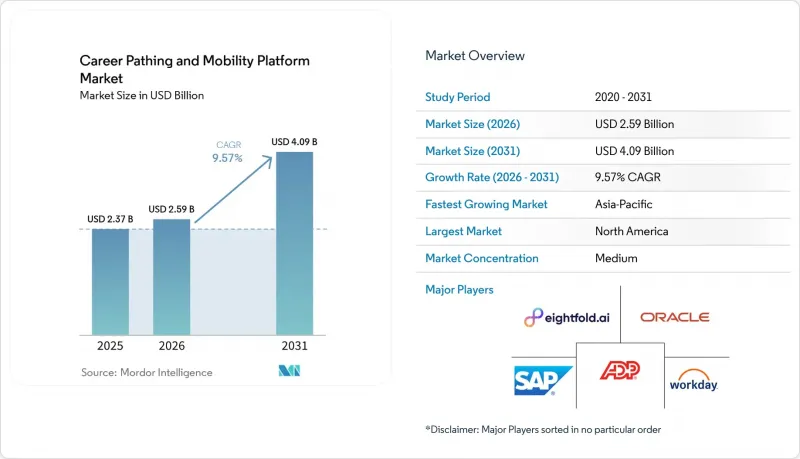
Mordor Intelligence에 의하면, 경력 개발 및 모빌리티 플랫폼 시장 규모는 2025년에 23억 7,000만 달러로 평가되었습니다. 2026년에 25억 9,000만 달러에 달하고, 2031년까지 40억 9,000만 달러에 이를 것으로 예측되며, 2026년부터 2031년에 걸쳐 CAGR 9.57%로 성장할 전망입니다.
본 보고서는 구성 요소(소프트웨어 및 서비스), 배포 방식(클라우드 기반 및 On-Premise형), 조직 규모(중소기업 및 대기업), 산업 분야(IT 및 통신, 헬스케어 및 생명과학, 소매 및 전자상거래, 제조업 등) 및 지역별로 분류되어 있습니다. 시장 전망은 금액(달러) 기준으로 제시되어 있습니다.
세계의 경력 개발 및 모빌리티 플랫폼 시장 동향 및 인사이트
기술 중심의 인재 전략으로의 급속한 전환
기업은 엄격한 직무 계층 구조를 해체하고, 필요에 따라 인재를 프로젝트에 배정할 수 있는 세분화된 역량 분류 체계를 도입하고 있습니다. 인사 부서는 현재 정식 승진을 기다리지 않고, 애널리스트를 데이터 사이언스 스프린트에 재배치하거나, 공급망 전문가를 지속가능성 업무로 전환시키고 있습니다. LinkedIn의 보고서에 따르면, 인사 담당 리더의 72%가 2025년에 “스킬 우선 채용"를 최우선 과제로 꼽았으며, 액센츄어의 추산에 따르면 은행 업계 직무의 44%에서 기술 재습득이 필요한 것으로 나타나, 광범위한 전략적 시급성이 드러났습니다. 유럽의 임금 투명성 관련 규제는 임금 격차에 대해 감사 가능한 근거를 요구함으로써 이러한 변화를 뒷받침하고 있으며, 기술 연계형 프레임워크는 바로 이러한 요건을 충족하고 있습니다. 그 결과, 동적 스킬 그래프를 통합한 플랫폼은 단순한 선택적 플러그인이 아니라 인재 계획에 없어서는 안 될 요소로 자리 잡고 있습니다.
AI 기반 인재 인텔리전스 플랫폼의 보급 확대
인공지능은 단순한 부가 기능에서 차세대 경력 개발 시스템 설계의 초석으로 진화했습니다. SAP Career Development Agent나 Oracle Career Advancement Command Center와 같이 최근 출시된 솔루션들은 채용 공고와의 매칭, 역량 개발 계획, 후계자 계획 수립을 자동화하여 관리자의 업무 부담을 줄이는 동시에 매칭의 정확도를 높이고 있습니다. Phenom은 연간 10억 건 이상의 인재 상호작용을 처리하고 행동 신호를 생성함으로써 채용까지 걸리는 기간을 최대 40% 단축하고 있습니다. 규제 당국은 현재 알고리즘에 의한 의사결정을 면밀히 검토하고 있으며, 공급업체에 대해 설명 가능성 대시보드나 ‘휴먼 인 더 루프"를 통한 오버라이드 기능의 통합을 요청하고 있습니다. AI 기반 인사이트를 업무에 활용하고 있는 조직에서는 재배치 주기의 단축과 측정 가능한 인재 유지율의 향상이 보고되고 있습니다.
직원 프로파일링과 관련된 데이터 개인정보 보호 문제
성과 평가, 역량 평가, 행동 신호를 종합함으로써 세분화된 분류가 가능해지지만, 동시에 GDPR(EU 개인정보보호규정) 및 EU AI법에 따른 엄격한 의무도 발생합니다. GDPR(EU 개인정보보호규정)에 따른 누적 과징금은 42억 유로를 넘어섰으며, 규제 당국은 막대한 과징금을 부과하겠다는 입장을 보이고 있습니다. 벤더는 역할 기반 접근 제어, 설명 가능성, 영향 평가에 투자해야 하며, 이로 인해 엔지니어링상의 오버헤드가 증가하여 기능 출시가 지연될 수 있습니다. 다국적 기업들은 유럽의 기준을 전 세계에 적용하는 경우가 많아, EU 역외 사업에서 발생하는 규정 준수 비용을 증가시키고 있습니다.
부문별 분석
서비스 부문은 2025년 매출에서 차지하는 비중이 40.55%로 소프트웨어 부문보다 낮았으나, 2031년까지의 연평균 성장률(CAGR)은 11.78%로 소프트웨어 부문의 성장률을 상회하고 있어, 라이선스 취득에서 가치 실현으로의 전환이 두드러지게 나타나고 있습니다. 도입 프로젝트에서는 기존 직무 아키텍처를 역량 프레임워크에 매핑하고, API 파이프라인을 구성하며, 알고리즘을 통해 도출된 인사이트를 해석할 수 있도록 인사 비즈니스 파트너를 교육하는 것이 점점 더 중요해지고 있습니다. 매니지드 서비스는 전담 HR 기술 팀을 보유하지 않은 중견 기업의 구매자들에게 지지를 받고 있는 반면, 대기업은 여러 사업 부문에 걸친 워크플로우를 맞춤화하기 위한 컨설팅 계약을 선호하고 있습니다. 탄탄한 서비스 부문을 갖춘 벤더는 고객 생애 가치(CLV)의 과반수를 확보함으로써, 구독 요금에 대한 가격 압박을 상쇄할 수 있습니다.
소프트웨어 구독 모델은 여전히 주류를 이루고 있지만, 벤더 간 핵심 기능이 점차 유사해짐에 따라 상품화 압력에 직면하고 있습니다. 현재 차별화의 핵심은 내장형 AI 코파일럿, 생태계와의 통합, 그리고 규제 준수 대응 툴킷입니다. 독자적인 스킬 그래프, 실시간 노동 시장 인텔리전스, 제품 내 벤치마킹 기능을 통합한 이 플랫폼은 다른 분야에서 사용자당 가격 압박이 심화되는 상황 속에서도 고액의 계약액을 확보하고 있습니다. 따라서 서비스 영역의 확대는 시장의 성숙과 성과 기반 파트너십에 대한 고객의 기대가 높아지고 있음을 보여줍니다.
2025년, 커리어 패스 및 모빌리티 플랫폼 시장 규모의 67.49%는 On-Premise 구축이 차지했으며, 이는 이미 이루어진 투자, 데이터 주권에 관한 규제, 그리고 맞춤형 통합이 반영된 결과입니다. 한편, 클라우드 솔루션은 신속한 가치 실현, AI 워크로드를 위한 탄력적인 컴퓨팅, 그리고 통합된 규정 준수 도구 덕분에 연평균 성장률(CAGR) 12.04%로 성장하고 있습니다. 100개 이상의 관할 구역에 팀을 두고 있는 다국적 기업은 지역별 데이터센터를 구축하지 않고도, 기술 분류 체계와 분석 대시보드를 통일하기 위해 전 세계의 클라우드 인프라를 활용하고 있습니다.
기밀성이 높은 직원 데이터를 On-Premise에 보관하면서 분석에는 클라우드 처리를 활용해야 하는 경우, 하이브리드 공존 모델은 여전히 필수적입니다. Oracle의 듀얼 스택 전략은 변경 관리의 위험을 완화하는 단계적 전환을 가능하게 하는 현실적인 중간 방안을 제시하고 있습니다. 예측 기간 동안 클라우드의 신규 도입이 On-Premise의 점유율을 서서히 잠식해 나갈 것으로 예상되지만, 완전한 대체는 업계 고유의 규제와 자본 예산 주기에 의해 제한될 것입니다.
지역별 분석
북미는 조기 도입 기업, 성숙한 벤더 생태계, 그리고 문서화된 경력 개발 경로 체계를 의무화하는 주 정부의 급여 투명성 규제에 힘입어 2025년 매출의 37.22%를 차지했습니다. 해당 지역에 본사를 둔 대형 컨설팅 기업은 디지털 인력 혁신에 경력 개발 경로 수립 도구를 도입함으로써 소프트웨어 수요를 더욱 확대되고 있습니다.
아시아태평양은 중국의 ‘ 광둥-홍콩-마카오 대만구"의 비자 제도 개혁, 싱가포르의 세제 혜택 구역, 그리고 국경을 넘는 업무 파견 증가에 힘입어, 2031년까지 연평균 성장률(CAGR) 10.97%로 가장 빠른 성장이 예상됩니다. 이 지역의 기업들은 여러 관할 구역에 걸친 근로 규정을 조정하고, 영구적인 이주를 수반하지 않는 순환 근무 프로그램을 지원할 수 있는 플랫폼을 선호합니다. 특히 일본을 비롯한 현지 유력 기업들은 연공서열에 기반한 승진 관행에 맞추어 업무 흐름을 조정하고 있어, 전 세계 벤더들에게는 기능 세트의 현지화가 과제로 대두되고 있습니다.
유럽 시장의 성장은 규정 준수의 복잡성을 가중시키는 엄격한 GDPR(EU 개인정보보호규정) 및 EU AI법의 규정에 의해 제약을 받고 있습니다. 그러나 바로 이러한 규제들이 턴키 방식의 감사 추적을 제공할 수 있는 공급업체에게는 방어적인 장벽이 되어, 프리미엄 가격 책정을 뒷받침하고 있습니다. 중동에서는 사우디아라비아의 “비전 2030"와 같은 국가 차원의 현지화 전략에 힘입어 도입이 가속화되고 있지만, 남미와 아프리카는 여전히 초기 단계에 머물러 있으며, 도입은 정부의 현대화 프로젝트나 다국적 기업의 자회사를 중심으로 집중되고 있습니다.
기타 혜택 :
- 엑셀 형식 시장 예측(ME) 시트
- 3개월간의 애널리스트 지원
자주 묻는 질문
목차
제1장 서론
제2장 조사 방법
제3장 주요 요약
제4장 시장 구도
제5장 시장 규모 및 성장 예측
제6장 경쟁 구도
제7장 시장 기회 및 향후 전망
KTH 26.07.08According to Mordor Intelligence, the career pathing and mobility platform market size is expected to be USD 2.37 billion in 2025, USD 2.59 billion in 2026, and reach USD 4.09 billion by 2031, growing at a CAGR of 9.57% from 2026 to 2031.
This report is Segmented by Component (Software, and Services), Deployment Mode (Cloud-Based, and On-Premises), Organization Size (Small and Medium Enterprises, and Large Enterprises), Industry Vertical (IT and Telecommunications, Healthcare and Life Sciences, Retail and E-Commerce, Manufacturing, and More), and Geography. The Market Forecasts are Provided in Terms of Value (USD).
Global Career Pathing and Mobility Platform Market Trends and Insights
Rapid Migration to Skills-Based Talent Strategies
Enterprises are dismantling rigid job hierarchies in favor of granular skills taxonomies that match people to projects on demand. Talent teams now redeploy analysts into data-science sprints or shift supply-chain specialists toward sustainability work without waiting for formal promotions. LinkedIn reported that 72% of talent leaders rank skills-first hiring as top priority in 2025, and Accenture estimated 44% of banking roles require reskilling, signaling wide-ranging strategic urgency. Pay transparency regulations in Europe reinforce this shift by demanding auditable justification for wage differences, which skills-aligned frameworks deliver. As a result, platforms embedding dynamic skills graphs are becoming integral to workforce planning rather than optional plug-ins.
Growing Adoption of AI-Driven Talent Intelligence Platforms
Artificial intelligence has moved from bolt-on feature to design cornerstone for next-generation career-pathing systems. Recent launches such as SAP Career Development Agent and Oracle Career Advancement Command Center automate vacancy matching, development planning, and succession mapping, reducing manager workload while elevating match precision. Phenom processes more than 1 billion talent interactions yearly, generating behavioral signals that trim time-to-fill by up to 40%. Regulatory bodies now scrutinize algorithmic decision-making, pushing vendors to embed explainability dashboards and human-in-the-loop override functions. Organizations that operationalize AI-driven insights report faster redeployment cycles and measurable retention gains.
Data Privacy Concerns Around Employee Profiling
Aggregating performance reviews, skills assessments, and behavioral signals enables granular segmentation but also triggers stringent GDPR and EU AI Act obligations. Cumulative GDPR fines surpassed EUR 4.2 billion, illustrating regulators' willingness to levy sizable penalties. Vendors must invest in role-based access, explainability, and impact assessments, adding engineering overhead that can slow feature releases. Multinationals often apply European standards globally, amplifying compliance costs across non-EU operations.
Other drivers and restraints analyzed in the detailed report include:
- Intensifying Demand for Internal Mobility Amid Hiring Freezes
- Expansion of Continuous Learning Ecosystems Integrations
- Integration Complexities with Legacy HR Tech Stacks
For complete list of drivers and restraints, kindly check the Table Of Contents.
Segment Analysis
Services accounted for a smaller share than software at 40.55% of 2025 revenue, yet their 11.78% CAGR through 2031 outstrips software growth, underscoring a shift from license acquisition to value realization. Implementation projects increasingly involve mapping legacy job architectures to skills frameworks, configuring API pipelines, and training HR business partners to interpret algorithmic insights. Managed services resonate with mid-market buyers that lack dedicated HR technology teams, while large enterprises favor consulting engagements to customize workflows across multiple business units. Vendors owning robust services arms can capture a disproportionate share of customer lifetime value and hedge against price pressure on subscriptions.
Software subscriptions, although still dominant, face commoditization as core functionality converges across vendors. Differentiation now hinges on embedded AI copilots, ecosystem integrations, and regulatory compliance toolkits. Platforms that bundle proprietary skills graphs, real-time labor market intelligence, and in-product benchmarking command premium contract values even as per-user pricing compresses elsewhere. The widening services footprint therefore signals market maturation and increasing customer expectation for outcome-based partnerships.
On-premises deployments retained 67.49% of the career pathing and mobility platform market size in 2025, reflecting sunk investments, data-sovereignty mandates, and customized integrations. Cloud solutions, however, are expanding at a 12.04% CAGR thanks to rapid time-to-value, elastic compute for AI workloads, and centralized compliance tooling.Multinationals with teams in 100-plus jurisdictions lean on global cloud backbones to unify skills taxonomies and analytics dashboards without regional data-center build-outs.
Hybrid coexistence models remain critical where sensitive employee data must reside on-premises while analytics leverage cloud processing. Oracle's dual-stack strategy illustrates the pragmatic middle ground, enabling phased migrations that derisk change management. Over the forecast period, incremental cloud wins are expected to chip away at on-premises share, yet full displacement will be gated by industry-specific regulations and capital budgeting cycles.
Complete Report Scope:
- By Component
- Software
- Services
- Professional Services
- Managed Services
- By Deployment Mode
- Cloud-Based
- On-Premises
- By Organization Size
- Small and Medium Enterprises (SMEs)
- Large Enterprises
- By Industry Vertical
- BFSI
- IT and Telecommunications
- Healthcare and Life Sciences
- Retail and E-Commerce
- Manufacturing
- Government and Public Sector
- Education
- Other Industry Verticals
- By Geography
- North America
- United States
- Canada
- Mexico
- South America
- Brazil
- Argentina
- Rest of South America
- Europe
- Germany
- United Kingdom
- France
- Italy
- Spain
- Russia
- Rest of Europe
- Asia-Pacific
- China
- India
- Japan
- South Korea
- Australia and New Zealand
- Rest of Asia-Pacific
- Middle East
- Saudi Arabia
- United Arab Emirates
- Turkey
- Rest of Middle East
- Africa
- South Africa
- Nigeria
- Rest of Africa
- North America
Geography Analysis
North America retained 37.22% of 2025 revenue, buoyed by early adopter enterprises, mature vendor ecosystems, and state-mandated pay transparency that obliges documented progression frameworks. Consulting majors headquartered in the region embed career-pathing tools within digital workforce transformations, further amplifying software demand.
Asia-Pacific is primed for the fastest expansion at a 10.97% CAGR through 2031, catalyzed by China's Greater Bay Area visa reforms, Singapore's preferential tax zones, and rising cross-border assignments. Enterprises in the region favor platforms that can reconcile multi-jurisdiction labor rules and support rotational programs without permanent relocations. Local champions, notably in Japan, tailor workflows to seniority-based advancement norms, challenging global vendors to localize feature sets.
Europe's market growth is framed by stringent GDPR and EU AI Act provisions that elevate compliance complexity.Yet the same regulations create a protective moat for vendors able to offer turnkey audit trails, driving premium pricing. Middle Eastern adoption accelerates under national localization strategies such as Saudi Arabia's Vision 2030, while South America and Africa remain early-stage, with deployments clustered in government modernization projects and multinational subsidiaries.
- Workday, Inc.
- SAP SE
- Oracle Corporation
- Cornerstone OnDemand, Inc.
- Fuel50 Limited
- Gloat, Inc.
- Eightfold AI, Inc.
- Degreed, Inc.
- Hitch Works, Inc.
- TalentGuard, Inc.
- Avature, S.R.L.
- ADP, Inc.
- Saba Software, Inc.
- Phenom People, Inc.
- SumTotal Systems, LLC
- iCIMS, Inc.
- PeopleFluent, Inc.
- SilkRoad Technology, Inc.
- SmartRecruiters, Inc.
- LinkedIn Corporation
Additional Benefits:
- The market estimate (ME) sheet in Excel format
- 3 months of analyst support
TABLE OF CONTENTS
1 INTRODUCTION
- 1.1 Study Assumptions and Market Definition
- 1.2 Scope of the Study
2 RESEARCH METHODOLOGY
3 EXECUTIVE SUMMARY
4 MARKET LANDSCAPE
- 4.1 Market Overview
- 4.2 Market Drivers
- 4.2.1 Rapid Migration to Skills-Based Talent Strategies
- 4.2.2 Growing Adoption of AI-Driven Talent Intelligence Platforms
- 4.2.3 Intensifying Demand for Internal Mobility Amid Hiring Freezes
- 4.2.4 Expansion of Continuous Learning Ecosystems Integrations
- 4.2.5 Increasing Compliance Pressures for Pay and Progression Transparency
- 4.2.6 Rise of Hybrid Work Accelerating Digital Career Coaching Tools
- 4.3 Market Restraints
- 4.3.1 Data Privacy Concerns Around Employee Profiling
- 4.3.2 Integration Complexities with Legacy HR Tech Stacks
- 4.3.3 Limited Analytics Skills Inside HR Departments
- 4.3.4 Economic Slowdowns Curtailing HR Technology Budgets
- 4.4 Industry Value Chain Analysis
- 4.5 Regulatory Landscape
- 4.6 Technological Outlook
- 4.7 Impact of Macroeconomic Factors on the Market
- 4.8 Porter's Five Forces Analysis
- 4.8.1 Threat of New Entrants
- 4.8.2 Bargaining Power of Suppliers
- 4.8.3 Bargaining Power of Buyers
- 4.8.4 Threat of Substitutes
- 4.8.5 Competitive Rivalry
5 MARKET SIZE AND GROWTH FORECASTS (VALUE)
- 5.1 By Component
- 5.1.1 Software
- 5.1.2 Services
- 5.1.2.1 Professional Services
- 5.1.2.2 Managed Services
- 5.2 By Deployment Mode
- 5.2.1 Cloud-Based
- 5.2.2 On-Premises
- 5.3 By Organization Size
- 5.3.1 Small and Medium Enterprises (SMEs)
- 5.3.2 Large Enterprises
- 5.4 By Industry Vertical
- 5.4.1 BFSI
- 5.4.2 IT and Telecommunications
- 5.4.3 Healthcare and Life Sciences
- 5.4.4 Retail and E-Commerce
- 5.4.5 Manufacturing
- 5.4.6 Government and Public Sector
- 5.4.7 Education
- 5.4.8 Other Industry Verticals
- 5.5 By Geography
- 5.5.1 North America
- 5.5.1.1 United States
- 5.5.1.2 Canada
- 5.5.1.3 Mexico
- 5.5.2 South America
- 5.5.2.1 Brazil
- 5.5.2.2 Argentina
- 5.5.2.3 Rest of South America
- 5.5.3 Europe
- 5.5.3.1 Germany
- 5.5.3.2 United Kingdom
- 5.5.3.3 France
- 5.5.3.4 Italy
- 5.5.3.5 Spain
- 5.5.3.6 Russia
- 5.5.3.7 Rest of Europe
- 5.5.4 Asia-Pacific
- 5.5.4.1 China
- 5.5.4.2 India
- 5.5.4.3 Japan
- 5.5.4.4 South Korea
- 5.5.4.5 Australia and New Zealand
- 5.5.4.6 Rest of Asia-Pacific
- 5.5.5 Middle East
- 5.5.5.1 Saudi Arabia
- 5.5.5.2 United Arab Emirates
- 5.5.5.3 Turkey
- 5.5.5.4 Rest of Middle East
- 5.5.6 Africa
- 5.5.6.1 South Africa
- 5.5.6.2 Nigeria
- 5.5.6.3 Rest of Africa
- 5.5.1 North America
6 COMPETITIVE LANDSCAPE
- 6.1 Market Concentration
- 6.2 Strategic Moves
- 6.3 Market Share Analysis
- 6.4 Company Profiles (includes Global Level Overview, Market Level Overview, Core Segments, Financials as available, Strategic Information, Market Rank/Share, Products and Services, Recent Developments)
- 6.4.1 Workday, Inc.
- 6.4.2 SAP SE
- 6.4.3 Oracle Corporation
- 6.4.4 Cornerstone OnDemand, Inc.
- 6.4.5 Fuel50 Limited
- 6.4.6 Gloat, Inc.
- 6.4.7 Eightfold AI, Inc.
- 6.4.8 Degreed, Inc.
- 6.4.9 Hitch Works, Inc.
- 6.4.10 TalentGuard, Inc.
- 6.4.11 Avature, S.R.L.
- 6.4.12 ADP, Inc.
- 6.4.13 Saba Software, Inc.
- 6.4.14 Phenom People, Inc.
- 6.4.15 SumTotal Systems, LLC
- 6.4.16 iCIMS, Inc.
- 6.4.17 PeopleFluent, Inc.
- 6.4.18 SilkRoad Technology, Inc.
- 6.4.19 SmartRecruiters, Inc.
- 6.4.20 LinkedIn Corporation
7 MARKET OPPORTUNITIES AND FUTURE OUTLOOK
- 7.1 White-Space and Unmet-Need Assessment


