

|
시장보고서
상품코드
2098561
GPU 프로그래밍 플랫폼 : 시장 점유율 분석, 업계 동향과 통계, 성장 예측(2026-2031년)GPU Programming Platform - Market Share Analysis, Industry Trends & Statistics, Growth Forecasts (2026 - 2031) |
||||||
 Mordor Intelligence
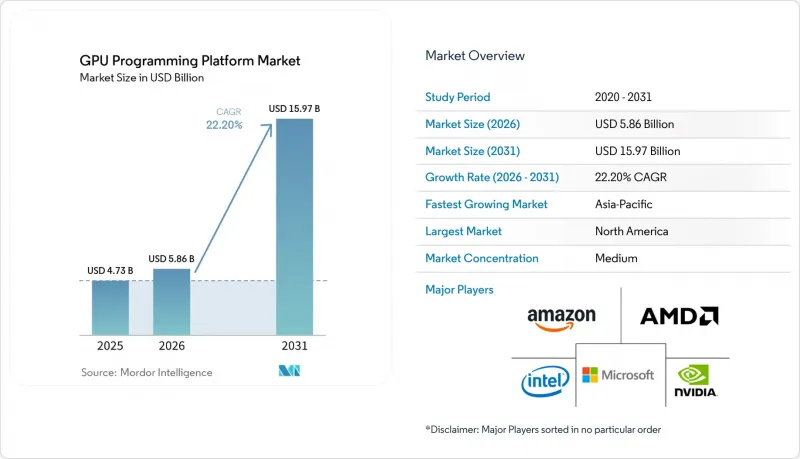
Mordor Intelligence에 의하면, GPU 프로그래밍 플랫폼 시장 규모는 2025년에 47억 3,000만 달러로 추정되고, 2031년까지 159억 7,000만 달러에 이를 것으로 예측되며, 2026-2031년 CAGR 22.20%를 기록할 전망입니다.
본 보고서는 구성 요소(소프트웨어 및 서비스), 도입 모델(On-Premise, 퍼블릭 클라우드, 프라이빗 클라우드/전용 호스팅 클라우드 등), 프로그래밍 모델(ROCm 및 HIP, OneAPI 및 SYCL, OpenCL, 지시어 기반 모델, GPU 커널 및 AI 컴파일러 툴체인 등), 최종 사용자(통신 등), 그리고 지역별로 분류되어 있습니다. 시장 전망은 금액(달러) 기준으로 제시되어 있습니다.
세계 GPU 프로그래밍 플랫폼 시장 동향 및 인사이트
이식성이 높은 GPU 코드가 필요한 AI 훈련 및 추론 워크로드 증가
AI 모델의 개발로 인해 GPU 프로그래밍 플랫폼 시장은 전문적인 틈새 시장에서 엔터프라이즈 컴퓨팅의 주류 소프트웨어 요구 사항으로 전환되었습니다. NVIDIA의 보고서에 따르면, Blackwell급 시스템은 최대 8,192개의 GPU 규모에서 MLPerf Training v6.0을 선도하고 있으며, 이는 대규모 훈련 클러스터가 프로덕션 환경에 배포될 때 소프트웨어 성능이 얼마나 중요한지를 보여줍니다. 이러한 광범위한 확장을 주도하고 있는 것은 추론입니다. 프로덕션 환경에서의 추론은 단일하고 균일한 훈련 환경이 아닌, 클라우드 인스턴스, 로컬 클러스터, 엣지 시스템이 혼재된 전체 환경에서 효율적으로 실행되어야 하기 때문입니다. 이러한 요구에 따라 GPU 프로그래밍 플랫폼 시장은 팀이 용도를 처음부터 재구축할 필요 없이 서로 다른 메모리 구조, 컴파일러 동작, 정밀도 설정을 관리할 수 있는 미들웨어, SDK 및 추상화 도구로 나아가고 있습니다. 또한, 미국 에너지부는 2026년에 AI로 생성된 HPC 코드가 주요 과학 분야에서 높은 신뢰성을 확보해 가고 있다고 지적했으며, 이는 공유 GPU 리소스 상에서 AI와 과학 계산 모두를 지원할 수 있는 플랫폼에 대한 수요를 뒷받침하는 것입니다.
벤더 간 GPU 이식성에 대한 기업 수요 증가
기업의 구매 담당자들은 특히 공급 집중이나 하드웨어 가격 책정이 도입 결정에 영향을 미칠 가능성이 있는 경우, 단일 GPU 벤더에 대한 의존도를 줄여주는 소프트웨어를 점점 더 요구하고 있습니다. GPU 프로그래밍 플랫폼 시장은 코드 변경을 최소화하면서 NVIDIA와 AMD 환경 모두에서 워크로드를 실행할 수 있게 해주는 이식성 계층으로 가치를 더욱 집중시킴으로써 이에 대응하고 있습니다. AMD는 2026년 초, ROCm의 채택 확대와 플랫폼 지원 강화를 강조하며, 대체 소프트웨어 스택이 프로덕션 환경의 AI 및 HPC 이용 사례에서 점점 더 실용적으로 자리 잡고 있음을 보여주었습니다. Modular사는 2026년 4월, 단일 컨테이너를 NVIDIA 및 AMD Instinct GPU 모두에서 실행할 수 있도록 함으로써 이러한 방향성을 더욱 강화했습니다. 이를 통해 기업들은 하드웨어 전환 때마다 용도를 재작성할 필요 없이 멀티 벤더 배포로 나아가는 직접적인 경로를 확보할 수 있게 되었습니다. 이는 중요한 의미를 지닙니다. 소프트웨어 결정이 단일 하드웨어 로드맵에 얽매이지 않게 되고, 조달 팀이 워크로드를 여러 벤더에 분산할 수 있게 되면 GPU 프로그래밍 플랫폼 시장은 더욱 빠르게 성장할 것이기 때문입니다.
CUDA 생태계의 깊은 락인(lock-in)과 전환 장벽
CUDA는 GPU 프로그래밍 플랫폼 시장의 광범위한 다각화에 대한 가장 강력한 구조적 제약으로 남아 있습니다. 그 이유는 많은 프로덕션 워크로드가 원래 NVIDIA 환경을 위해 구축, 테스트 및 최적화되어 왔기 때문입니다. NVIDIA는 CUDA-X 라이브러리, 컴파일러 개선, 그리고 이미 NVIDIA 생태계에 참여하고 있는 팀의 최적화 작업을 경감시켜 주는 개발자용 도구를 통해 그 우위를 더욱 공고히 하고 있습니다. 실무적으로, 대규모 AI 및 HPC 코드베이스를 보유한 기업은 긴 마이그레이션 과정을 겪게 됩니다. 커스텀 커널, 프레임워크 통합, 메모리 관리 선택과 관련해 다른 스택으로 전환할 때 개별적인 검증이 필요한 경우가 많기 때문입니다. 이 문제는 안전성이 중시되고 규제가 엄격한 워크로드에서 더욱 두드러지며, 기존 CUDA 기반 구현에 대한 검증 실적이 대체 기술 도입을 지연시키는 요인이 될 수 있습니다. 따라서 경쟁 하드웨어나 오픈 스택의 성능이 향상되더라도 GPU 프로그래밍 플랫폼 시장의 일부는 기존 환경에 얽매인 채로 남아 있습니다.
부문 분석
2025년 시점에서 GPU 프로그래밍 플랫폼 시장의 62.38%를 소프트웨어가 차지하고 있으며, 2031년까지 연평균 성장률(CAGR) 23.41%로 확대될 것으로 예측됩니다. 이는 가치가 하드웨어 접근에만 집중되어 있는 것이 아니라, 개발 및 실행 계층으로 이동하고 있음을 보여줍니다. 이러한 상황은 AI 훈련, 추론, 과학 계산 각 분야에서 GPU 워크로드를 활용할 수 있도록 하는 데 있어 프로그래밍 모델, 컴파일러, 미들웨어, 프로파일링 도구 및 SDK가 중요함을 반영합니다. NVIDIA는 2026년, CUDA 13.3과 CompileIQ를 도입함으로써 이러한 방향성을 더욱 강화했습니다. 이들은 AI 기반 컴파일러 자동 튜닝과 타일 기반 C++ 커널 프로그래밍을 도입하여, 프로덕션 환경 워크로드의 최적화 생산성을 향상시켰습니다. GPU 프로그래밍 플랫폼 시장이 확대되는 가운데, 소프트웨어 분야에 대한 지출이 여전히 가장 큰 비중을 차지하고 있습니다. 이는 기업들이 일회성 인프라 구축보다는 이식성, 모니터링 기능, 그리고 더 신속한 튜닝 주기를 필요로 하기 때문입니다.
2025년에는 서비스가 나머지 37.62%의 점유율을 차지할 것으로 예상되며, 도입 환경이 더욱 복잡해지고 마이그레이션 프로젝트가 증가함에 따라 GPU 프로그래밍 플랫폼 업계에서 이 분야의 비중이 높아지고 있습니다. 컨설팅, 통합 및 코드 이식 서비스는 프로덕션 환경의 성능을 저하시키지 않으면서 CUDA, ROCm, SYCL 각 환경 간에 워크로드를 이전하려는 수요의 혜택을 받고 있습니다. NVIDIA 및 Intel의 XPU 타겟 전반에 걸쳐 LLM을 활용한 Triton 커널 생성에 초점을 맞춘 Meta의 KernelAgent 프로젝트 역시, 툴체인 자동화가 진행됨에 따라 훈련, 구현 지원, 체계적인 개발자 지원에 대한 수요가 높아지고 있음을 보여줍니다. 사내에 컴파일러나 성능 엔지니어링 팀을 구축하고 싶지 않은 중견 기업에게 있어 매니지드 서비스는 계속해서 중요할 것으로 보이며, 이로 인해 GPU 프로그래밍 플랫폼 시장에는 소프트웨어 라이선싱 및 플랫폼 구독 외에도 지속적인 서비스 수요가 발생하고 있습니다.
2025년, 퍼블릭 클라우드는 GPU 프로그래밍 플랫폼 시장 규모의 46.51%를 차지했습니다. 이는 관리형 GPU 환경, 탄력적인 용량, 통합된 개발 서비스 측면에서 하이퍼스케일러가 가진 규모의 우위를 반영한 것입니다. 클라우드의 주도적 지위는 AWS, Google Cloud, Microsoft Azure, Oracle 및 컴퓨팅 기능에 오케스트레이션과 프레임워크 접근성을 결합한 GPU 특화형 제공업체들의 폭넓은 지원에 의해 구축되었습니다. 2026년 2월 VAST Data가 출시한 ‘Polaris’는 단일 제어 평면을 통해 퍼블릭 클라우드, 네오 클라우드, On-Premise 환경에 걸친 오케스트레이션을 제공함으로써 이러한 변화를 포착했습니다. 동시에, 많은 기업이 규제 대상 데이터나 지속적인 추론 워크로드를 사내 인프라 근처에 유지하면서, 피크 수요 시에는 외부 용량을 활용하려고 하고 있기 때문에 하이브리드 및 멀티클라우드는 2031년까지 연평균 성장률(CAGR) 22.73%로 확대될 것으로 예측됩니다.
데이터의 소재지, 보안, 또는 안정적인 이용률과 같은 이유로 보다 엄격한 인프라 제어가 요구되는 상황에서는 프라이빗 클라우드, 전용 호스팅형 클라우드 및 On-Premise 환경이 여전히 중요한 역할을 수행하고 있습니다. 2026년 2월 약 1만 대의 NVIDIA Blackwell GPU를 배치하여 출범한 독일의 ‘Industrial AI Cloud’는 주권적이며 규제 대상인 배포 환경이라 하더라도 퍼블릭 클라우드 아키텍처에만 의존하지 않고도 대규모 AI 프로그램에 연결할 수 있음을 입증했습니다. On-Premise의 중요성은 미국 에너지부(DOE)의 NERSC Doudna 시스템과 같은 과학 분야에서도 두드러집니다. 이 분야에서는 차세대 슈퍼컴퓨팅이 클라우드 AI 파이프라인에서 사용되는 것과 동일한 소프트웨어 라이브러리를 지원하는 로컬 프로그래밍 환경에 여전히 의존하고 있습니다. 이러한 혼합 환경은 GPU 프로그래밍 플랫폼 시장을 지탱하고 있습니다. 고객들은 특정 배포 모델을 다른 모델보다 우선적으로 선택하기보다는 모든 배포 모델에 걸쳐 소프트웨어의 연속성을 추구하기 때문입니다.
지역별 분석
2025년, 북미는 GPU 프로그래밍 플랫폼 시장 점유율의 51.82%를 차지하며 다른 모든 지역을 확고하게 선도했습니다. 이 지역에는 GPU 벤더, 하이퍼스케일러, AI 소프트웨어 기업 및 기업 고객이 가장 집중되어 있어 플랫폼 개발과 도입 모두에 견고한 기반을 제공합니다. 2026년 CoreWeave의 자금 조달 활동과 Jane Street와의 60억 달러 규모 계약은 해당 지역의 GPU 인프라에 대한 상업적 수요가 여전히 급속히 확대되고 있음을 보여줍니다. 2025년 9월 NVIDIA가 Intel과 제휴한 것도 AI 인프라를 둘러싼 북미공급망과 플랫폼 간 협력의 깊이를 반영한 것이었습니다. 또한, 미국 에너지부는 고성능 컴퓨팅을 위한 코드 이식성 및 추상화에 대한 노력을 지속적으로 지원하고 있으며, 이는 이기종 GPU 환경을 둘러싼 장기적인 소프트웨어 수요 유지에 기여하고 있습니다.
유럽은 데이터 주권, 산업 정책, 그리고 규제된 AI 도입이 수요를 형성하고 있기 때문에 GPU 프로그래밍 플랫폼 시장에 있어 구조적으로 중요한 지역으로 남아 있습니다. EU는 최대 5곳의 AI 기가팩토리 건설을 계획하고 있으며, 첫 번째 시설은 2026년부터 가동을 시작할 것으로 예측됩니다. 이는 공공 및 산업 투자와 연계된 새로운 주권형 GPU 소프트웨어 환경의 물결을 뒷받침하는 것입니다(ZDF). 도이치 텔레콤, NVIDIA, Polarise와 공동으로 개발된 독일의 ‘Industrial AI Cloud’는 2026년 2월, Blackwell 기반의 대규모 도입을 통해 이 모델의 가장 명확한 사례 중 하나를 제시했습니다. 이 환경에서는 프라이빗 클라우드 및 연결된 클라우드 리소스 전반에 걸쳐 규정 준수, 성능 추적, 도입 유연성을 결합할 수 있는 소프트웨어 스택이 중점을 두고 있습니다.
아시아태평양은 2031년까지 연평균 성장률(CAGR) 22.68%로 확대될 것으로 예상되며, GPU 프로그래밍 플랫폼 시장에서 가장 빠르게 성장하는 지역 블록이 될 것입니다. 이러한 성장은 특히 중국과 인도에서의 주권형 컴퓨팅 확대 및 국내 생태계 개발과 밀접한 관련이 있으며, 이들 국가에서는 GPU 인프라 전략이 더 광범위한 AI 용량 계획의 일부로 자리 잡고 있습니다. 또한, 기업들이 단일하고 획일적인 하드웨어 기반이 아닌 다양한 GPU 환경 도입에 대비함에 따라, 개방적이고 다중 벤더를 지원하는 툴체인이 널리 수용되기 시작한 점도 이 지역에 긍정적인 요인으로 작용하고 있습니다. 남미, 중동 및 아프리카는 여전히 초기 단계 시장이지만, 하이퍼스케일러와 지역 GPU 클라우드 제공업체들이 고성능 컴퓨팅에 대한 접근성을 확대함에 따라 도입을 위한 인프라 환경은 점차 개선되고 있습니다. 이러한 접근 환경이 개선됨에 따라, 이들 지역에서도 금융, 제조, 통신 분야의 워크로드를 대상으로 한 GPU 프로그래밍 플랫폼 시장이 확대될 것으로 전망됩니다.
기타 혜택:
- 엑셀 형식 시장 예측(ME) 시트
- 3개월간의 애널리스트 지원
자주 묻는 질문
목차
제1장 서론
제2장 조사 방법
제3장 주요 요약
제4장 시장 구도
제5장 시장 규모와 성장 예측
제6장 경쟁 구도
제7장 시장 기회와 향후 전망
KTH 26.08.06According to Mordor Intelligence, the GPU programming platform market size was USD 4.73 billion in 2025 and is projected to reach USD 15.97 billion by 2031, expanding at a CAGR of 22.20% over 2026-2031.
This report is Segmented by Component (Software, and Services), Deployment Model (On-Premises, Public Cloud, Private Cloud/Dedicated Hosted Cloud, and More), Programming Model (ROCm and HIP, Oneapi and SYCL, Opencl, Directive-Based Models, GPU Kernel and AI Compiler Toolchains, and More), End User (Telecommunications, and More), and Geography. The Market Forecasts are Provided in Terms of Value (USD).
Global GPU Programming Platform Market Trends and Insights
Rising AI Training And Inference Workloads Requiring Portable GPU Code
AI model development has shifted the GPU programming platform market from a specialized niche to a mainstream software requirement for enterprise compute. NVIDIA reported that Blackwell-class systems led MLPerf Training v6.0 at scales up to 8,192 GPUs, which shows how much software performance now matters when large training clusters are deployed in production. The broader expansion is driven by inference, because production inference must run efficiently across a mix of cloud instances, local clusters, and edge systems rather than a single uniform training environment. That need is pushing the GPU programming platform market toward middleware, SDKs, and abstraction tools that can manage different memory structures, compiler behaviors, and precision settings without forcing teams to rebuild applications from scratch. The U.S. Department of Energy also noted in 2026 that AI-generated HPC code was reaching high levels of trust across key scientific domains, which supports demand for platforms that can serve both AI and scientific computing on shared GPU estates.
Growing Enterprise Demand for Cross-Vendor GPU Portability
Enterprise buyers are increasingly seeking software that reduces reliance on a single GPU vendor, especially when supply concentration and hardware pricing can influence deployment decisions. The GPU programming platform market is responding by shifting more value into portability layers that help workloads run across NVIDIA and AMD environments with fewer code changes. AMD highlighted wider ROCm adoption and broader platform support in early 2026, showing that alternative software stacks are becoming more practical for production AI and HPC use cases. Modular reinforced that direction in April 2026, when it enabled a single container to run across NVIDIA and AMD Instinct GPUs, giving enterprises a direct path to multi-vendor deployment without rewriting applications at each hardware transition. This matters because the GPU programming platform market grows faster when software decisions are no longer tied to a single hardware roadmap and when procurement teams can spread workloads across multiple suppliers.
Deep CUDA Ecosystem Lock-In and Migration Friction
CUDA remains the strongest structural restraint on broad diversification in the GPU programming platform market because many production workloads were built, tested, and optimized first for NVIDIA environments. NVIDIA continues to deepen that position through CUDA-X libraries, compiler improvements, and developer tooling that shorten the optimization workload for teams already in the NVIDIA ecosystem. In practical terms, enterprises with large AI and HPC codebases face a long migration path because custom kernels, framework integrations, and memory management choices often require separate validation when moving to another stack. The problem is more pronounced in safety-sensitive, regulated workloads, where the validation history of an existing CUDA-based implementation can slow the adoption of alternatives. This keeps parts of the GPU programming platform market tied to incumbent environments, even when competing hardware or open stacks become more capable.
Other drivers and restraints analyzed in the detailed report include:
- Expansion of Cloud-Native GPU Development Environments
- Open-Source GPU Toolchains Lowering Entry Barriers for New Users
- Fragmented Standards Across HIP, SYCL, oneAPI, and OpenCL
For complete list of drivers and restraints, kindly check the Table Of Contents.
Segment Analysis
Software accounted for 62.38% of the GPU programming platform market in 2025 and is projected to expand at a 23.41% CAGR through 2031, indicating that value is moving toward the development and execution layers rather than remaining concentrated on hardware access alone. That position reflects the importance of programming models, compilers, middleware, profiling tools, and SDKs in making GPU workloads usable across AI training, inference, and scientific computing. NVIDIA reinforced this direction in 2026 with CUDA 13.3 and CompileIQ, which introduced AI-driven compiler autotuning and tile-based C++ kernel programming to improve optimization productivity on production workloads. As the GPU programming platform market expands, software continues to attract the strongest spending because enterprises need portability, monitoring, and faster tuning cycles more than a one-time infrastructure setup.
Services represented the remaining 37.62% share in 2025, and this part of the GPU programming platform industry is gaining weight as deployments become more complex and migration projects multiply. Consulting, integration, and code porting services are benefiting from demand to move workloads between CUDA, ROCm, and SYCL environments without disrupting production performance. Meta's KernelAgent project, which focuses on LLM-assisted Triton kernel generation across NVIDIA and Intel XPU targets, also points to a growing need for training, implementation support, and structured developer enablement as toolchains become more automated. Managed services are likely to remain important for mid-sized enterprises that do not want to build in-house compiler and performance engineering teams, which gives the GPU programming platform market a durable services tail alongside software licensing and platform subscriptions.
Public cloud held 46.51% share of the GPU programming platform market size in 2025, reflecting the scale advantage hyperscalers have in managed GPU environments, elastic capacity, and integrated development services. The leading cloud position was built on broad support from AWS, Google Cloud, Microsoft Azure, Oracle, and GPU-focused providers that package compute with orchestration and access to frameworks. VAST Data's Polaris release in February 2026 captured that shift by offering orchestration across public cloud, neocloud, and on-premises environments through one control plane. At the same time, hybrid and multicloud are projected to expand at a 22.73% CAGR through 2031, as many enterprises seek to keep regulated data and persistent inference workloads closer to their internal infrastructure while using external capacity for peak demand.
Private cloud, dedicated hosted cloud, and on-premises estates remain important where data residency, security, or stable utilization levels justify tighter infrastructure control. Germany's Industrial AI Cloud, launched in February 2026 with around 10,000 NVIDIA Blackwell GPUs, demonstrated that sovereign and regulated deployments can still connect to large-scale AI programs without relying solely on public cloud architectures. On-premises relevance is also visible in scientific environments such as the DOE's NERSC Doudna system, where next-generation supercomputing still depends on a local programming environment that supports the same software libraries used in cloud AI pipelines. This mix supports the GPU programming platform market because customers are not choosing one deployment model over another, they are asking for software continuity across all of them.
Complete Report Scope:
- By Component
- Software
- Programming Tools and Compilers
- Middleware, SDKs, and Portability Tools
- Libraries and Runtime Systems
- Performance Monitoring and Profiling Tools
- Developer, Testing, and Debugging Tools
- Services
- Consulting, Integration, and Code Migration Services
- Managed Services
- Training, Support, and Maintenance Services
- Software
- By Deployment Model
- On-Premises
- Public Cloud
- Private Cloud / Dedicated Hosted Cloud
- Hybrid and Multicloud
- By Programming Model
- CUDA
- ROCm and HIP
- oneAPI and SYCL
- OpenCL
- Directive-Based Models
- GPU Kernel and AI Compiler Toolchains
- Other Programming Models
- By End User
- Cloud Service Providers and Data Center Operators
- IT, Software, Internet, and SaaS Providers
- Telecommunications
- Banking, Financial Services, and Insurance
- Healthcare and Life Sciences
- Manufacturing
- Automotive and Transportation
- Other End Users
- By Geography
- North America
- United States
- Canada
- Mexico
- Europe
- Germany
- United Kingdom
- France
- Italy
- Rest of Europe
- Asia-Pacific
- China
- Japan
- South Korea
- India
- Southeast Asia
- Rest of Asia-Pacific
- South America
- Middle East and Africa
- North America
Geography Analysis
North America held 51.82% of the GPU programming platform market share in 2025, which kept it firmly ahead of every other region. The region combines the largest concentration of GPU vendors, hyperscalers, AI software companies, and enterprise buyers, providing a strong base for both platform development and adoption. CoreWeave's funding activity in 2026 and its USD 6 billion agreement with Jane Street showed that commercial demand for GPU infrastructure was still scaling rapidly in the region. NVIDIA's September 2025 collaboration with Intel also reflected the depth of the North American supply chain and platform coordination around AI infrastructure. In addition, the U.S. Department of Energy continued to support code portability and abstraction work for advanced computing, which helps sustain long-term software demand around heterogeneous GPU environments.
Europe remains a structurally important region for the GPU programming platform market because data sovereignty, industrial policy, and regulated AI deployment are shaping demand. The EU planned a portfolio of up to 5 AI Gigafactories, with the first facilities expected to become operational from 2026, which supports a new wave of sovereign GPU software environments tied to public and industrial investment ZDF. Germany's Industrial AI Cloud, developed with Deutsche Telekom, NVIDIA, and Polarise, added one of the clearest examples of this model in February 2026 through a large Blackwell-based deployment. This environment favors software stacks that can combine compliance, performance tracking, and deployment flexibility across private and connected cloud resources.
Asia-Pacific is projected to expand at a 22.68% CAGR through 2031, which makes it the fastest-growing regional block in the GPU programming platform market. The growth is tied to sovereign compute buildouts and domestic ecosystem development, especially in China and India, where GPU infrastructure strategy is becoming part of broader AI capacity planning. The region also benefits from growing acceptance of open and multi-vendor toolchains as enterprises prepare for mixed GPU fleets instead of one uniform hardware base. South America and the Middle East and Africa remain earlier-stage markets, but the infrastructure conditions for adoption are improving as hyperscalers and regional GPU cloud providers widen access to advanced compute. As that access improves, the GPU programming platform market should broaden across finance, manufacturing, and telecom workloads in these regions as well.
- NVIDIA Corporation
- Advanced Micro Devices, Inc.
- Intel Corporation
- Amazon Web Services, Inc.
- Microsoft Corporation
- IBM Corporation
- Google LLC
- Hewlett Packard Enterprise Development LP
- Dell Technologies Inc.
- Alibaba Group Holding Limited
- Tencent Holdings Limited
- Red Hat, Inc.
- DigitalOcean Holdings, Inc.
- CoreWeave, Inc.
- Anyscale, Inc.
- Modular, Inc.
- Scale AI, Inc.
- SchedMD LLC
- Atos SE
Additional Benefits:
- The market estimate (ME) sheet in Excel format
- 3 months of analyst support
TABLE OF CONTENTS
1 INTRODUCTION
- 1.1 Study Assumptions and Market Definition
- 1.2 Scope of the Study
2 RESEARCH METHODOLOGY
3 EXECUTIVE SUMMARY
4 MARKET LANDSCAPE
- 4.1 Market Overview
- 4.2 Market Drivers
- 4.2.1 Rising AI Training and Inference Workloads Requiring Portable GPU Code
- 4.2.2 Growing Enterprise Demand for Cross-Vendor GPU Portability
- 4.2.3 Expansion of Cloud-Native GPU Development Environments
- 4.2.4 Open-Source GPU Toolchains Lowering Entry Barriers for New Users
- 4.2.5 Increasing Use of Heterogeneous Compute in HPC and GenAI Stacks
- 4.2.6 Rising Need for Performance Tuning and Developer Productivity Tools
- 4.3 Market Restraints
- 4.3.1 Deep CUDA Ecosystem Lock-In and Migration Friction
- 4.3.2 Fragmented Standards Across HIP, SYCL, oneAPI, and OpenCL
- 4.3.3 High Validation, Re-Optimization, and Testing Costs During Porting
- 4.3.4 Scarcity of GPU Compiler and Performance Engineering Talent
- 4.4 Industry Value Chain Analysis
- 4.5 Regulatory Landscape
- 4.6 Technological Outlook
- 4.7 Porter's Five Forces Analysis
- 4.7.1 Bargaining Power of Suppliers
- 4.7.2 Bargaining Power of Buyers
- 4.7.3 Threat of New Entrants
- 4.7.4 Threat of Substitutes
- 4.7.5 Competitive Rivalry
5 MARKET SIZE AND GROWTH FORECASTS (VALUE)
- 5.1 By Component
- 5.1.1 Software
- 5.1.1.1 Programming Tools and Compilers
- 5.1.1.2 Middleware, SDKs, and Portability Tools
- 5.1.1.3 Libraries and Runtime Systems
- 5.1.1.4 Performance Monitoring and Profiling Tools
- 5.1.1.5 Developer, Testing, and Debugging Tools
- 5.1.2 Services
- 5.1.2.1 Consulting, Integration, and Code Migration Services
- 5.1.2.2 Managed Services
- 5.1.2.3 Training, Support, and Maintenance Services
- 5.1.1 Software
- 5.2 By Deployment Model
- 5.2.1 On-Premises
- 5.2.2 Public Cloud
- 5.2.3 Private Cloud / Dedicated Hosted Cloud
- 5.2.4 Hybrid and Multicloud
- 5.3 By Programming Model
- 5.3.1 CUDA
- 5.3.2 ROCm and HIP
- 5.3.3 oneAPI and SYCL
- 5.3.4 OpenCL
- 5.3.5 Directive-Based Models
- 5.3.6 GPU Kernel and AI Compiler Toolchains
- 5.3.7 Other Programming Models
- 5.4 By End User
- 5.4.1 Cloud Service Providers and Data Center Operators
- 5.4.2 IT, Software, Internet, and SaaS Providers
- 5.4.3 Telecommunications
- 5.4.4 Banking, Financial Services, and Insurance
- 5.4.5 Healthcare and Life Sciences
- 5.4.6 Manufacturing
- 5.4.7 Automotive and Transportation
- 5.4.8 Other End Users
- 5.5 By Geography
- 5.5.1 North America
- 5.5.1.1 United States
- 5.5.1.2 Canada
- 5.5.1.3 Mexico
- 5.5.2 Europe
- 5.5.2.1 Germany
- 5.5.2.2 United Kingdom
- 5.5.2.3 France
- 5.5.2.4 Italy
- 5.5.2.5 Rest of Europe
- 5.5.3 Asia-Pacific
- 5.5.3.1 China
- 5.5.3.2 Japan
- 5.5.3.3 South Korea
- 5.5.3.4 India
- 5.5.3.5 Southeast Asia
- 5.5.3.6 Rest of Asia-Pacific
- 5.5.4 South America
- 5.5.5 Middle East and Africa
- 5.5.1 North America
6 COMPETITIVE LANDSCAPE
- 6.1 Market Concentration
- 6.2 Strategic Moves
- 6.3 Vendor Positioning Analysis
- 6.4 Company Profiles (includes Global Level Overview, Market Level Overview, Core Segments, Financials as available, Strategic Information, Market Rank/Share, Products and Services, Recent Developments)
- 6.4.1 NVIDIA Corporation
- 6.4.2 Advanced Micro Devices, Inc.
- 6.4.3 Intel Corporation
- 6.4.4 Amazon Web Services, Inc.
- 6.4.5 Microsoft Corporation
- 6.4.6 IBM Corporation
- 6.4.7 Google LLC
- 6.4.8 Hewlett Packard Enterprise Development LP
- 6.4.9 Dell Technologies Inc.
- 6.4.10 Alibaba Group Holding Limited
- 6.4.11 Tencent Holdings Limited
- 6.4.12 Red Hat, Inc.
- 6.4.13 DigitalOcean Holdings, Inc.
- 6.4.14 CoreWeave, Inc.
- 6.4.15 Anyscale, Inc.
- 6.4.16 Modular, Inc.
- 6.4.17 Scale AI, Inc.
- 6.4.18 SchedMD LLC
- 6.4.19 Atos SE
7 MARKET OPPORTUNITIES AND FUTURE OUTLOOK
- 7.1 White-Space and Unmet-Need Assessment


