
|
시장보고서
상품코드
2073386
유럽의 옥외(OOH) 배송 : 시장 점유율 분석, 업계 동향 및 통계, 성장 예측(2026-2031년)Europe Out Of Home (OOH) Delivery - Market Share Analysis, Industry Trends & Statistics, Growth Forecasts (2026 - 2031) |
||||||
 Mordor Intelligence
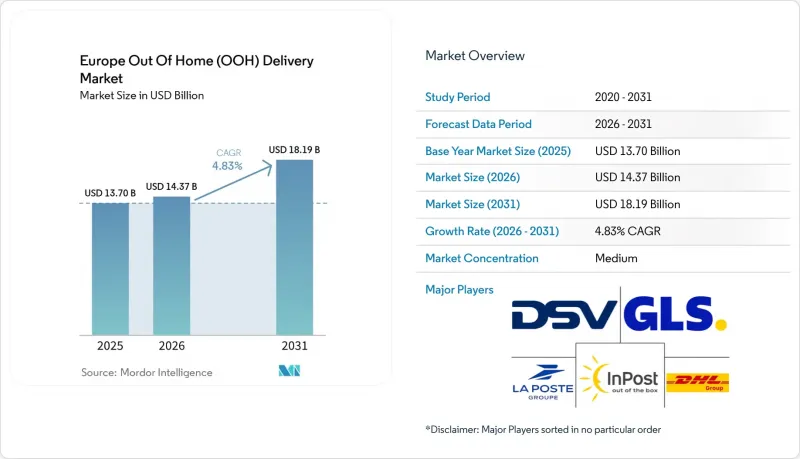
Mordor Intelligence에 의하면, 유럽의 옥외(OOH) 배송 시장 규모는 2025년에 137억 달러로 평가되었습니다. 2026년 143억 7,000만 달러에서 2031년까지 181억 9,000만 달러에 이를 것으로 예상되고 2026년부터 2031년에 걸쳐 CAGR 4.83%로 성장할 전망입니다.
본 보고서는 최종 사용자 산업별(전자상거래, 금융 서비스(BFSI), 헬스케어, 제조업 등), 비즈니스 모델별(기업 간 거래(B2B), 기업 대 소비자 거래(B2C), 소비자 간 거래(C2C)), 그리고 국가별(독일, 프랑스, 폴란드, 이탈리아, 스페인, 영국 및 기타 유럽)별로 분류되어 있습니다. 시장 전망은 금액(달러) 기준으로 제시되어 있습니다.
유럽의 옥외(OOH) 배송 시장 동향 및 인사이트
전자상거래 결제 시 선택 경향은 유연한 배송 방식으로 바뀌고 있습니다.
유럽의 옥외(OOH) 배송 시장은 소비자들이 배송 방법과 장소를 스스로 선택할 수 있기를 기대하게 된 결제 환경의 뒷받침을 받고 있습니다. DHL은 2025년 보고서에서 전 세계 쇼핑객의 81%가 원하는 배송 옵션을 이용할 수 없을 경우 장바구니를 포기하고, 79%는 원하는 반품 방법을 이용할 수 없을 경우 포기한다고 밝혔으며, 이는 전환율과 배송 옵션이 직접적으로 연관되어 있음을 보여줍니다. Geopost는 2025년 ‘E-Shopper Barometer"에 따르면, 유럽의 단골 온라인 구매자 중 46%가 집 이외의 장소에서 상품을 수령하는 것을 선호하며, 이는 2019년 대비 15포인트 증가한 수치일 뿐만 아니라, 택배 보관함이 유럽에서 두 번째로 선호되는 배송 옵션으로 자리 잡았다고 밝혔습니다. DHL의 조사에서도 젊은 사용자일수록 택배 보관함을 이용한 반품에 거부감이 없는 것으로 나타났으며, Z세대는 베이비붐 세대보다 반품 시 택배 보관함을 선택하는 빈도가 높기 때문에 구매층의 변화에 따라 중기적인 수요 동향은 상승세를 유지하고 있습니다. 그 결과, 액세스 포인트의 커버리지 범위가 소매업체의 서비스 계약에 포함되기 시작했습니다. 이는 네트워크의 커버 범위가 제한적일 경우, 구매 기회 손실이나 반품 편의성 저하와 같은 위험이 발생하기 때문입니다. 따라서 유럽의 옥외(OOH) 배송 시장에서는 배송 범위, 계산대에서의 가시성, 그리고 택배가 발송되기 전에 신뢰할 수 있는 집 밖 수령 옵션을 제시할 수 있는 능력이 점점 더 중요시되고 있습니다.
자택 배송 미배달로 인한 운송업체의 비용 부담
유럽의 옥외(OOH) 배송 시장이 확대되고 있는 또 다른 이유는 집으로의 배송에는 여전히 피할 수 있는 재배송, 고객 서비스 업무, 그리고 혼잡한 노선에서의 정차 빈도 저하가 수반되기 때문입니다. 운송업체가 더 많은 화물을 사물함이나 유인 수거 거점으로 전환함으로써, 차량이 한 번 정차할 때마다 더 많은 수취인에게 서비스를 제공할 수 있게 되어, 피크 시간대에는 문 앞 배송으로는 종종 불가능했던 경로 생산성 향상을 도모할 수 있습니다. 이것이 바로 대형 사업자들이 독자적인 주택 배송 모델에만 의존하지 않고, 공유형이나 개방형 시스템을 구축하고 있는 이유 중 하나입니다. DHL은 독일에서 오픈 액세스형 및 확장된 “Packstation"라는 접근 방식을 통해, 공공시설에 대한 접근성과 규모가 향후 전개 과정에서 경제성에 중요한 요소임을 이미 시사하고 있습니다. 한편, DPD와 GLS는 공유 인프라를 통해 배송 물량을 분산시키기 때문에 “inboxx"네트워크를 공동으로 구축하고 있습니다. 그 상업적 논리는 간단명료합니다. 불확실한 자택 수령 과정을 거치지 않고 우회 배송되는 소포 하나하나가 배송 효율을 높이고, 인구 밀도가 높은 도시 지역의 재배송 횟수를 줄여주기 때문입니다. 이러한 운영상의 압박으로 인해, 유럽의 옥외(OOH) 배송 시장은 운송업체와 최종 사용자 모두에게 집 밖에서의 배송을 더욱 매력적으로 만드는 가격 모델과 서비스 설계 방향으로 끊임없이 나아가고 있습니다.
지방 및 인구 밀도가 낮은 지역에서의 사물함 설치 불균형
유럽의 옥외(OOH) 배송 시장은 여전히 도심이나 교외의 주요 통로 이외의 지역에서 실질적인 서비스 커버리지 격차에 직면해 있습니다. 이러한 지역에서는 소포 발송량이 적기 때문에 새로운 접속 지점을 구축하는 데 있어 경제성이 떨어지고 있습니다. 지방 지역에서는 사물함 네트워크가 아직 충분히 보급되지 않아 대규모 행동 변화를 이끌어낼 수 없기 때문에 배송업체들은 비록 해당 배송 경로가 비용이 더 많이 들더라도 여전히 집으로의 배송을 우선시하는 경우가 많습니다. 이로 인해 악순환이 발생하고 있습니다. 즉, 낮은 커버율이 이용을 제한하고, 낮은 이용률이 향후 투자를 위축시키고 있는 것입니다. 유럽의 도입 사례를 비교·검토한 결과, 1인당 사물함 이용률은 여전히 기존 배송 방식에 의존하고 있는 광활한 농촌 지역에 비해, OOH가 가장 성숙한 지역에서 여전히 훨씬 높은 수준을 유지하고 있는 것으로 나타났습니다. 태양광 발전이나 배터리 구동 방식의 하드웨어는 설치 장소의 실현 가능성을 높이는 데 도움이 되지만, 한 곳당 이용자가 적은 외딴 지역의 배송량 문제를 완전히 해결해 주지는 못합니다. 공유 인프라, 공공 지원, 혹은 통신 사업자 간의 보다 광범위한 협력을 통해 지방의 경제성이 개선되지 않는 한, 유럽의 문 앞 배송(OOH 배송) 시장은 지역별로 불균등한 성장세를 이어갈 것입니다.
부문별 분석
2025년, 유럽의 옥외(OOH) 배송 시장 규모 중 전자상거래가 34.91%를 차지했으며, 2031년까지는 5.14%라는 공개된 최종 사용자 시장 중 가장 높은 연평균 성장률(CAGR)을 보일 것으로 전망됩니다. 이러한 우위는 온라인 주문의 행동 패턴과 OOH 배송의 핵심 강점, 즉 유연한 수령 시간, 간편한 반품, 라스트 마일 수거 비용의 저렴함과의 직접적인 부합에서 비롯됩니다. Geopost사의 2025년 쇼핑객 설문조사에 따르면, 유럽의 정기적인 온라인 쇼핑객 중 46%가 OOH 옵션을 선호하고 있으며, 이는 유럽의 옥외(OOH) 배송 업계에서 전자상거래가 차지하는 강력한 위상을 뒷받침하는 것입니다. 패스트 패션, 미용, 가전제품 등의 카테고리는 주문 빈도가 높고 반품률도 높은 경향이 있어 특히 중요하게 여겨지고 있습니다. 이로 인해, 하나의 주문이 동일한 네트워크상에서 배송과 반품의 기회를 모두 창출하게 되므로, 거래당 처리량이 증가합니다.
이러한 구조 덕분에 전자상거래는 구매 과정의 초기 단계에서 액세스 포인트의 가시성을 높일 유인이 가장 뚜렷한 부문이 되었습니다. 소매업체는 인도 실패 감소 및 역물류의 예측 가능성 향상으로 인한 이점을 얻을 수 있으며, 반면 운송업체는 노선 통합 및 1회당 배송 효율 향상으로 인한 이점을 얻을 수 있습니다. 이러한 상호 보완적인 논리가 바로 유럽의 옥외(OOH) 배송 시장에서 OOH 액세스가 단순한 물류 백엔드 기능이 아니라 온라인 쇼핑 제안의 일부로 계속해서 취급되고 있는 이유입니다. 금융 서비스, 의료, 제조업은 여전히 중요한 2차 이용 분야이며, 안전한 문서 교환, 시료 이동, 소형 부품 배송에 있어 통제된 접근이 유용하게 활용되고 있습니다. 1차 산업, 오프라인 도매·소매업, 기타 기관 대상 부문은 여전히 시장 점유율이 낮지만, 예정된 안전하고 긴급성이 없는 소포 운송에 네트워크를 활용함으로써 해당 수요 기반을 확대되고 있습니다.
기타 혜택 :
- 엑셀 형식 시장 예측(ME) 시트
- 3개월간의 애널리스트 지원
자주 묻는 질문
목차
제1장 서론
제2장 조사 방법
제3장 주요 요약
제4장 시장 구도
제5장 시장 규모 및 성장 예측
제6장 경쟁 구도
제7장 시장 기회 및 향후 전망
KTH 26.07.08According to Mordor Intelligence, the europe out-of-home (OOH) delivery market size was valued at USD 13.7 billion in 2025 and is estimated to grow from USD 14.37 billion in 2026 to reach USD 18.19 billion by 2031, growing at a CAGR of 4.83% from 2026 to 2031.
This report is Segmented by End-User Industry (E-Commerce, Financial Services (BFSI), Healthcare, Manufacturing, and More), by Business Model (Business-To-Business (B2B), Business-To-Consumer (B2C), Consumer-To-Consumer (C2C)), and by Country (Germany, France, Poland, Italy, Spain, United Kingdom, and Rest of Europe). The Market Forecasts are Provided in Terms of Value (USD).
Europe Out Of Home (OOH) Delivery Market Trends and Insights
E-Commerce Checkout Preference Shift Toward Flexible Delivery
The Europe out-of-home (OOH) delivery market is gaining support from a checkout environment where shoppers now expect to choose how and where a parcel will be delivered. DHL reported in 2025 that 81% of global shoppers abandon a basket if their preferred delivery option is unavailable, and 79% abandon if their preferred returns method is unavailable, tying conversion directly to delivery choice. Geopost stated in its 2025 E-Shopper Barometer that 46% of European regular online shoppers preferred out-of-home options, up 15 percentage points from 2019, and that parcel lockers had become the second-most-preferred delivery option in Europe. DHL also showed that younger users are more comfortable with locker-based returns, with Gen Z choosing parcel lockers for returns more often than Baby Boomers, which keeps the medium-term demand trend tilted upward as shopping cohorts change. As a result, access-point coverage is moving into retailer service agreements, because limited network reach now risks both checkout loss and lower returns convenience. This is why the European out-of-home (OOH) delivery market is increasingly defined by reach, visibility at checkout, and the ability to present a reliable non-home option before a parcel is even dispatched.
Carrier Cost Pressure From Failed Home Delivery Attempts
The Europe out-of-home (OOH) delivery market is also advancing because home delivery still carries avoidable reattempts, customer service work, and low stop density in congested routes. When carriers move more parcels into lockers or staffed collection points, one vehicle stop can serve many recipients, improving route productivity in a way doorstep delivery often cannot during peak periods. This is one reason large operators are building shared and open-access formats rather than relying solely on proprietary residential delivery models. DHL has already signaled that public access and scale matter to future rollout economics through its open-access and expanded Packstation approach in Germany, while DPD and GLS are jointly building the inboxx network to spread volume across shared infrastructure. The commercial logic is straightforward because every parcel redirected away from an uncertain home handoff improves stop efficiency and reduces the need for repeated attempts in dense cities. That operating pressure keeps pushing the Europe out-of-home (OOH) delivery market toward pricing models and service designs that make non-home delivery more attractive to both carriers and end users.
Uneven Locker Footprint In Rural and Low-Density Areas
The Europe out-of-home (OOH) delivery market still faces a practical coverage gap outside urban and suburban corridors, where lower parcel density weakens the economics of new access-point rollout. In rural districts, carriers often continue to prioritize home delivery even when those routes are more expensive, because the locker network is not yet deep enough to change behavior at scale. This creates a circular problem: thin coverage limits usage, and low usage slows future investment. Evidence from comparative deployment discussions in Europe shows that per-capita locker access remains much stronger in the most mature OOH territories than in large rural areas that still depend on traditional delivery patterns. Solar and battery-based hardware helps with site feasibility, but it does not fully solve the volume challenge in remote areas where each stop serves fewer users. Unless shared infrastructure, public facilitation, or broader carrier collaboration improves rural economics, the Europe out-of-home (OOH) delivery market will keep expanding unevenly across the region.
Other drivers and restraints analyzed in the detailed report include:
- Cross-Border Parcel Growth Increasing OOH Use Cases
- Locker and PUDO Network Densification In Urban Transit Hubs
- Municipal Permitting And Street-Furniture Constraints
For complete list of drivers and restraints, kindly check the Table Of Contents.
Segment Analysis
E-commerce accounted for 34.91% share of the Europe out-of-home (OOH) delivery market size in 2025, and it is expected to post the fastest disclosed end-user CAGR at 5.14% through 2031. That lead comes from a direct fit between online order behavior and the core strengths of OOH delivery, namely flexible pickup timing, easier returns, and lower last-mile consolidation costs. Geopost's 2025 shopper research showed that 46% of European regular online shoppers preferred out-of-home options, which supports the strong positioning of e-commerce within the Europe out-of-home (OOH) delivery industry. Categories such as fast fashion, beauty, and consumer electronics are especially relevant because they tend to combine high order frequency with high return intensity. That increases throughput per transaction, since a single order can generate both a delivery event and a return event over the same network.
The same structure makes e-commerce the segment with the clearest incentive to push access-point visibility earlier in the purchase path. Retailers gain from fewer missed handoffs and more predictable reverse logistics, while carriers gain from route consolidation and higher stop productivity. This mutually reinforcing logic is why the Europe out-of-home (OOH) delivery market keeps seeing OOH access treated as part of the online shopping proposition rather than only as a logistics backend feature. Financial services, healthcare, and manufacturing remain meaningful secondary users where secure document exchange, sample movement, and small-parts distribution benefit from controlled access. Primary industry, offline wholesale and retail trade, and other institutional categories still contribute smaller shares, but they widen the base of addressable demand by using the network for scheduled, secure, and non-urgent parcel movement.
Complete Report Scope:
- By End-User Industry
- E-Commerce
- Financial Services (BFSI)
- Healthcare
- Manufacturing
- Primary Industry
- Wholesale and Retail Trade (Offline)
- Others
- By Business Model
- Business-to-Business (B2B)
- Business-to-Consumer (B2C)
- Consumer-to-Consumer (C2C)
- By Country
- Germany
- France
- Poland
- Italy
- Spain
- United Kingdom
- Rest of Europe
List of Companies Covered in this Report:
- DHL Group
- InPost (including Mondial Relay)
- GLS Group
- Evri Limited
- Poste Italiane
- DSV A/S
- United Parcel Service, Inc.
- PostNord Sverige AB
- Correos
- La Poste (including Geopost)
- Packeta Ltd
- myflexbox
- SwipBox A/S
- Nova Post
- Bpost
- PostNL N.V.
- Osterreichische Post AG (Austrian Post)
- Instabee Group AB
- Sameday
- Swiss Post Ltd
Additional Benefits:
- The market estimate (ME) sheet in Excel format
- 3 months of analyst support
TABLE OF CONTENTS
1 Introduction
- 1.1 Study Assumptions and Market Definition
- 1.2 Scope of the Study
2 Research Methodology
3 Executive Summary
4 Market Landscape
- 4.1 Market Overview
- 4.2 Market Drivers
- 4.2.1 E-Commerce Checkout Preference Shift Toward Flexible Delivery
- 4.2.2 Carrier Cost Pressure From Failed Home Delivery Attempts
- 4.2.3 Cross-Border Parcel Growth Increasing OOH Use Cases
- 4.2.4 Locker and PUDO Network Densification In Urban Transit Hubs
- 4.2.5 Carrier-Neutral Software Orchestration Improving Network Utilization
- 4.2.6 Return-Heavy Shopping Behavior Favoring OOH Drop-Off Points
- 4.3 Market Restraints
- 4.3.1 Uneven Locker Footprint In Rural and Low-Density Areas
- 4.3.2 Municipal Permitting And Street-Furniture Constraints
- 4.3.3 Asset Theft, Vandalism, And Maintenance Downtime
- 4.3.4 Interoperability Gaps Across Carrier Networks And Systems
- 4.4 Value / Supply-Chain Analysis
- 4.5 Regulatory Landscape
- 4.6 Technological Outlook
- 4.7 Porter's Five Forces Analysis
- 4.7.1 Bargaining Power of Suppliers
- 4.7.2 Bargaining Power of Buyers
- 4.7.3 Threat of New Entrants
- 4.7.4 Threat of Substitutes
- 4.7.5 Industry Rivalry
- 4.8 Impact of Geopolitical Events on the Market
5 Market Size & Growth Forecasts (Value in USD)
- 5.1 By End-User Industry
- 5.1.1 E-Commerce
- 5.1.2 Financial Services (BFSI)
- 5.1.3 Healthcare
- 5.1.4 Manufacturing
- 5.1.5 Primary Industry
- 5.1.6 Wholesale and Retail Trade (Offline)
- 5.1.7 Others
- 5.2 By Business Model
- 5.2.1 Business-to-Business (B2B)
- 5.2.2 Business-to-Consumer (B2C)
- 5.2.3 Consumer-to-Consumer (C2C)
- 5.3 By Country
- 5.3.1 Germany
- 5.3.2 France
- 5.3.3 Poland
- 5.3.4 Italy
- 5.3.5 Spain
- 5.3.6 United Kingdom
- 5.3.7 Rest of Europe
6 Competitive Landscape
- 6.1 Market Concentration
- 6.2 Strategic Moves
- 6.3 Market Share Analysis
- 6.4 Company Profiles (includes Global Level Overview, Market Level Overview, Core Segments, Financials as available, Strategic Information, Market Rank/Share, Products and Services, Recent Developments)
- 6.4.1 DHL Group
- 6.4.2 InPost (including Mondial Relay)
- 6.4.3 GLS Group
- 6.4.4 Evri Limited
- 6.4.5 Poste Italiane
- 6.4.6 DSV A/S
- 6.4.7 United Parcel Service, Inc.
- 6.4.8 PostNord Sverige AB
- 6.4.9 Correos
- 6.4.10 La Poste (including Geopost)
- 6.4.11 Packeta Ltd
- 6.4.12 myflexbox
- 6.4.13 SwipBox A/S
- 6.4.14 Nova Post
- 6.4.15 Bpost
- 6.4.16 PostNL N.V.
- 6.4.17 Osterreichische Post AG (Austrian Post)
- 6.4.18 Instabee Group AB
- 6.4.19 Sameday
- 6.4.20 Swiss Post Ltd
7 Market Opportunities & Future Outlook
- 7.1 White-Space and Unmet-Need Assessment