
|
시장보고서
상품코드
2124479
아시아태평양의 DOOH : 시장 점유율 분석, 업계 동향 및 통계, 성장 예측(2026-2031년)Asia-Pacific DOOH - Market Share Analysis, Industry Trends & Statistics, Growth Forecasts (2026 - 2031) |
||||||
 Mordor Intelligence
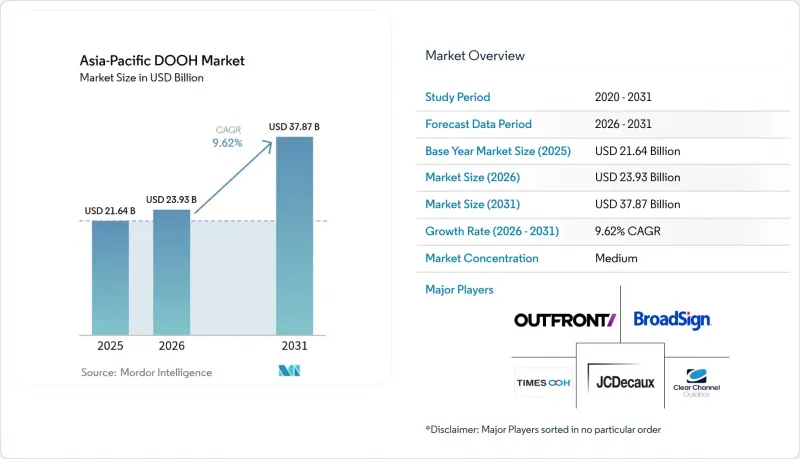
Mordor Intelligence에 의하면, 아시아태평양의 DOOH 시장 규모는 2025년 216억 4,000만 달러로 평가되었습니다. 2026년에는 239억 3,000만 달러로 확대되어 2026년부터 2031년에 걸쳐 CAGR 9.62%로 성장을 지속하여, 2031년에는 378억 7,000만 달러에 이를 것으로 예측됩니다.

본 보고서는 서비스 유형(프로그래매틱·비프로그래매틱), 용도(빌보드, 대중교통, 거리 시설물 등),설치 환경(도로변 옥외, 공항, 쇼핑몰·교통 허브, 매장 내·실내 시설 등), 최종 사용자 산업(자동차, 소매, 헬스케어, BFSI 등), 지역별로 분류되어 있습니다. 시장 예측은 금액(달러) 기준으로 제시되어 있습니다.
아시아태평양의 DOOH 시장 동향 및 인사이트
5G 확산이 광대역 크리에이티브 구현을 가능하게 함
중국에서는 2025년 말까지 360만 기 이상의 5G 기지국이 도입되어, 옥외 스크린에 실시간 데이터 오버레이 및 4K 동영상에 필요한 연결성이 제공되었습니다. 한국도 같은 해 전국적인 5G 커버리지를 달성하여, 이를 통해 대중교통 운영 사업자는 출퇴근 시간대에 모션 그래픽을 전송할 수 있게 되었습니다. 호주의 주요 통신 사업자는 5G를 지방의 주요 노선으로 확대하여, 장거리 여행객을 대상으로 한 도로변 프로그래매틱 동영상 광고판을 지원하고 있습니다. 일본의 NTT 도코모는 5G 위치 정보 서비스와 DOOH 네트워크를 연동하여, 보행자 밀도가 높아지면 캠페인이 자동으로 실행되도록 했습니다. 그 결과, 온라인 동영상과 동등한 화질을 유지하면서도 해당 장소의 맥락을 반영한 창의적인 광고 공간을 구현하게 되었으며, 아시아태평양의 DOOH 시장은 정적 디스플레이 형식에 비해 뚜렷한 우위를 확보했습니다.
도시 철도의 급속한 확장이 프리미엄 광고 공간을 개척
델리 메트로의 455킬로미터에 달하는 네트워크는 2024-25 회계연도에 42억 루피(5,000만 달러)의 광고 수익을 창출했으며, 그 광고 공간의 68%를 디지털 스크린이 차지했습니다. 뭄바이 메트로 3단계 공사에서는 33.5킬로미터의 노선이 연장되었고, 승강장 운영권이 타임즈 이노베이티브 미디어에 부여됨에 따라 인도의 상업 수도에서 디지털 광고 보급률이 향상되었습니다. 중국에서는 2025년까지 도시 철도의 총 연장이 1만 킬로미터를 돌파했으며, 포커스 미디어는 현재 2,000개 이상의 역에서 디지털 광고권을 관리하고 있습니다. 태국의 MRT 블루라인 연장 구간과 자카르타의 MRT 2단계 사업에서는 총 500대 가까운 새로운 스크린이 설치되어, 통근자를 타겟으로 하는 브랜드를 위한 새로운 광고 공간이 창출되었습니다. 역 구내 체류 시간이 길기 때문에 CPM은 도로변 간판보다 40-60% 더 높으며, 이로 인해 대중교통 광고는 아시아태평양의 DOOH 시장에서 가장 빠르게 성장하는 분야가 되었습니다.
미디어 소유권의 세분화가 광고 구매의 복잡성을 가중시키고 있다.
인도에는 200개 이상의 지역 사업자가 존재하지만, 전국 점유율이 8% 이상의 사업자는 없으며, 광고주는 여러 계약 협상을 해야 하고 서로 다른 스크린 사양에 맞추어 광고 소재를 조정해야 합니다. 태국에서도 유사한 분산 현상이 나타나고 있으며, Plan B, Master Ad, VGI가 각각 서로 다른 시설을 관리하며 독립적으로 판매를 진행하고 있습니다. 인도네시아에는 약 150개의 사업자가 존재하지만, 그중 다수는 여전히 온라인화되지 않았으며, 통일된 측정 프로토콜도 부재합니다. 이러한 분산화로 인해 최소 필요한 예산 규모가 커지고, 프로그래매틱 광고의 확대가 둔화되면서 아시아태평양의 DOOH 시장 성장이 저해되고 있습니다. 원활한 광고 구매를 실현하기 위해서는 업계 통합, 혹은 광고 슬롯을 통합하는 제3자 애그리게이터의 활용이 필수적이어지고 있습니다.
부문별 분석
프로그래매틱 인벤토리는 2025년 매출의 32.17%를 차지했으며, 연평균 성장률(CAGR) 10.12%를 고려할 때 2031년까지 아시아태평양의 DOOH 시장 규모에서 점점 더 큰 점유율을 확보할 것으로 예측됩니다. 호주는 도입을 주도하고 있으며, oOh!media와 QMS Media가 셀프 서비스 포털을 출시한 후 국내 광고비의 31%가 프로그래매틱 거래로 이루어지고 있습니다. 싱가포르는 22%로 그 뒤를 잇고 있으며, Moving Walls가 The Trade Desk 및 Google DV360과 제휴하고 있습니다. 중국은 Focus Media가 직접 거래를 선호하기 때문에 10% 미만에 그치고 있지만, AI를 활용한 다이내믹 크리에이티브가 점진적인 변화를 위한 기반을 다지고 있습니다.
프리미엄 공항 및 대중교통 계약의 경우 노출 수 보장이 요구되기 때문에 비프로그래매틱 형식의 점유율은 67.83%를 유지하고 있습니다. JCDecaux가 창이 공항과 홍콩 국제공항에서 보유한 장기 운영권은 이러한 독점권을 중시하는 경향을 상징합니다. 따라서 아시아태평양의 DOOH 시장 점유율 구성은 프로그래매틱이 도로변이나 쇼핑몰에서의 수익 확대를 주도하고, 한편 직접 판매가 고부가가치 거점 확보를 담당하는 하이브리드 모델로 진화하고 있습니다.
2025년 광고비 중 빌보드형 스크린이 45.96%를 차지했으나, 지하철망의 밀도가 높아짐에 따라 대중교통 광고 공간이 그 격차를 빠르게 좁히고 있습니다. 델리 메트로의 286개 역에서는 5,000만 달러의 광고 수익이 창출되었으며, 그 총액의 68%를 디지털 스크린이 차지했습니다. 방콕의 블루 라인과 자카르타의 MRT에서는 지난 2년 동안 500대 가까운 새로운 디스플레이가 추가되었습니다. 그 결과, 아시아태평양의 대중교통용 DOOH 시장 규모는 2031년까지 연평균 성장률(CAGR) 11.67%로 급속히 확대될 것으로 예측됩니다.
역 내 평균 체류 시간은 5분 이상으로, 광고주는 연속적인 스토리 전개나 QR 코드를 활용한 캠페인을 전개할 수 있습니다. 가로 광고의 점유율은 작지만, 초지역적인 공백을 메움으로써 도로변과 대중교통의 도달 범위를 연결하고 있습니다. 이러한 세밀한 타겟팅 덕분에 간판이나 대중교통 광고만큼의 규모에는 미치지 못하더라도 그 존재 의의는 잃지 않습니다.
기타 혜택 :
- 엑셀 형식 시장 예측(ME) 시트
- 3개월간의 애널리스트 지원
자주 묻는 질문
목차
제1장 서론
제2장 조사 방법
제3장 주요 요약
제4장 시장 구도
제5장 시장 규모 및 성장 예측
제6장 경쟁 구도
제7장 시장 기회 및 향후 전망
KTH 26.09.14According to Mordor Intelligence, the Asia-Pacific DOOH market size is expected to grow from USD 21.64 billion in 2025 to USD 23.93 billion in 2026 and is forecast to reach USD 37.87 billion by 2031 at a 9.62% CAGR over 2026-2031.
This report is Segmented by Service Type (Programmatic-OOH, and Non-Programmatic-OOH), Application (Billboard, Transit, Street Furniture, and More), Location Environment (Roadside Outdoor, Airports, Malls and Transit Hubs, In-Store and Indoor Venues, and More), End-User Industry (Automotive, Retail, Healthcare, BFSI and More), and Geography. The Market Forecasts are Provided in Terms of Value (USD).
Asia-Pacific DOOH Market Trends and Insights
5G Roll-Out Enabling High-Bandwidth Creative
China deployed more than 3.6 million 5G base stations by late 2025, giving outdoor screens the connectivity needed for live data overlays and 4K video. South Korea reached nationwide 5G coverage the same year, which allowed transit operators to stream motion graphics during peak commutes. Australia's major carriers extended 5G to regional corridors, supporting roadside programmatic video billboards targeted at long-distance travelers. Japan's NTT Docomo paired 5G positioning services with DOOH networks so campaigns can trigger automatically when pedestrian density rises. The result is a creative canvas that mirrors online video quality while preserving location context, giving the Asia-Pacific DOOH market a distinctive edge over static display formats.
Rapid Urban Rail Expansion Opening Premium Inventory
Delhi Metro's 455-kilometer network generated INR 4.2 billion (USD 50 million) in advertising revenue in FY 2024-25, with digital screens accounting for 68% of inventory. Mumbai Metro Phase III added 33.5 kilometers of track and awarded platform concessions to Times Innovative Media, raising digital penetration in India's commercial capital. China surpassed 10,000 kilometers of urban rail by 2025, and Focus Media now controls digital rights at more than 2,000 stations. Thailand's MRT Blue Line extension and Jakarta's MRT Phase II together installed nearly 500 new screens, creating fresh inventory for brands targeting commuters. High dwell times inside stations are producing CPMs 40-60% above roadside panels, making transit the fastest-growing slice of the Asia-Pacific DOOH market.
Fragmented Media Ownership Inflating Buying Complexity
India hosts more than 200 regional operators, none with more than 8% national share, forcing advertisers to negotiate multiple contracts and adapt artwork for divergent screen specs. Thailand shows similar dispersion, with Plan B, Master Ad and VGI controlling different venues and selling in silos. Indonesia counts roughly 150 operators, many still offline, and lacks uniform measurement protocols. The fragmentation raises the minimum viable budget and slows programmatic scale, tempering growth in the Asia-Pacific DOOH market. Consolidation, or third-party aggregators that pool inventory, is emerging as a prerequisite for frictionless buying.
Other drivers and restraints analyzed in the detailed report include:
- Programmatic DOOH Integration with Retail Media Networks
- LED Cost Decline Accelerating Digital Conversion
- Power-Price Volatility Raising Operating Costs
For complete list of drivers and restraints, kindly check the Table Of Contents.
Segment Analysis
Programmatic inventory represented 32.17% of 2025 revenue, and its 10.12% CAGR positions it to capture a growing slice of the Asia-Pacific DOOH market size through 2031. Australia leads adoption, with 31% of national spend transacted programmatically after oOh!media and QMS Media launched self-serve portals. Singapore follows at 22% as Moving Walls links to The Trade Desk and Google DV360. China remains under 10% because Focus Media favors direct deals, but AI-assisted dynamic creative is laying groundwork for gradual change.
Non-programmatic formats retain 67.83% share because premium airport and transit contracts demand guaranteed impression volumes. JCDecaux's long-term concessions at Changi and Hong Kong International exemplify this preference for exclusivity. The Asia-Pacific DOOH market share split is therefore evolving into a hybrid model where programmatic drives incremental roadside and mall yield while direct sales secure high-value hubs.
Billboard screens accounted for 45.96% of 2025 spend, but transit inventory is closing the gap quickly as metro-rail density rises. Delhi Metro's 286 stations generated USD 50 million in ad revenue, and digital screens supplied 68% of that total. Bangkok's Blue Line and Jakarta's MRT added nearly 500 new displays in the last two years. As a result, the Asia-Pacific DOOH market size for transit is projected to jump at an 11.67% CAGR through 2031.
The captive dwell time in stations averages over five minutes, letting advertisers deliver sequential storytelling or QR-code activations. Street-furniture formats, while smaller in share, knit together roadside and transit reach by filling hyper-local gaps. Their granular targeting will keep them relevant even if they never match the scale of billboards and transit.
Complete Report Scope:
- By Service Type
- Programmatic-DOOH
- Non-Programmatic-DOOH
- By Application
- Billboard
- Transit
- Street Furniture
- Other Applications
- By Location Environment
- Roadside Outdoor
- Airports
- Malls and Transit Hubs
- In-Store and Indoor Venues
- Other Location Environments
- By End-User Industry
- Automotive
- Retail
- Healthcare
- Banking and Financial Services (BFSI)
- Media and Entertainment
- Other End-User Industries
- By Geography
- China
- Japan
- India
- South Korea
- Australia
- Singapore
- Thailand
- Hong Kong
- Rest of Asia-Pacific
List of Companies Covered in this Report:
- JCDecaux SE
- Focus Media Information Technology Co. Ltd.
- Clear Channel Outdoor Holdings Inc.
- oOh!media Limited
- Outfront Media Inc.
- Times Innovative Media Limited
- Plan B Media Public Company Limited
- Asiaray Media Group Limited
- Shanghai Airports Advertisement Co. Ltd.
- Balintimes Media Group Co. Ltd.
- Hivestack Inc.
- Vistar Media Inc.
- Daktronics Inc.
- Broadsign International LLC
- QMS Media Limited
- AdOnMo Private Limited
- Laqshya Media Group
- Moving Walls Pte Ltd.
- Big Tree Outdoor Sdn Bhd
- UP Media (Thailand) Co. Ltd.
Additional Benefits:
- The market estimate (ME) sheet in Excel format
- 3 months of analyst support
TABLE OF CONTENTS
1 INTRODUCTION
- 1.1 Study Assumptions and Market Definition
- 1.2 Scope of the Study
2 RESEARCH METHODOLOGY
3 EXECUTIVE SUMMARY
4 MARKET LANDSCAPE
- 4.1 Market Overview
- 4.2 Market Drivers
- 4.2.1 5G Roll-out Enabling High-Bandwidth Creative
- 4.2.2 Rapid Urban Rail Expansion Opening Premium Inventory
- 4.2.3 Programmatic DOOH Integration with Retail Media Networks
- 4.2.4 LED Cost Decline Accelerating Digital Conversion
- 4.2.5 Carbon-Efficient Screens Appealing to ESG-Driven Advertisers
- 4.2.6 Brand-Safety Shift from Cookies to Location-Verified DOOH
- 4.3 Market Restraints
- 4.3.1 Fragmented Media Ownership Inflating Buying Complexity
- 4.3.2 Power-Price Volatility Raising Operating Costs
- 4.3.3 Data-Privacy Regulations Limiting Mobile Retargeting
- 4.3.4 Shortage of DOOH-Skilled Creatives in Emerging Markets
- 4.4 Impact of Macroeconomic Factors
- 4.5 Regulatory Landscape
- 4.6 Porter's Five Forces Analysis
- 4.6.1 Bargaining Power of Suppliers
- 4.6.2 Bargaining Power of Buyers
- 4.6.3 Threat of New Entrants
- 4.6.4 Threat of Substitutes
- 4.6.5 Intensity of Competitive Rivalry
5 MARKET SIZE AND GROWTH FORECASTS (VALUE)
- 5.1 By Service Type
- 5.1.1 Programmatic-DOOH
- 5.1.2 Non-Programmatic-DOOH
- 5.2 By Application
- 5.2.1 Billboard
- 5.2.2 Transit
- 5.2.3 Street Furniture
- 5.2.4 Other Applications
- 5.3 By Location Environment
- 5.3.1 Roadside Outdoor
- 5.3.2 Airports
- 5.3.3 Malls and Transit Hubs
- 5.3.4 In-Store and Indoor Venues
- 5.3.5 Other Location Environments
- 5.4 By End-User Industry
- 5.4.1 Automotive
- 5.4.2 Retail
- 5.4.3 Healthcare
- 5.4.4 Banking and Financial Services (BFSI)
- 5.4.5 Media and Entertainment
- 5.4.6 Other End-User Industries
- 5.5 By Geography
- 5.5.1 China
- 5.5.2 Japan
- 5.5.3 India
- 5.5.4 South Korea
- 5.5.5 Australia
- 5.5.6 Singapore
- 5.5.7 Thailand
- 5.5.8 Hong Kong
- 5.5.9 Rest of Asia-Pacific
6 COMPETITIVE LANDSCAPE
- 6.1 Market Concentration
- 6.2 Strategic Moves
- 6.3 Market Share Analysis
- 6.4 Company Profiles (includes Global Level Overview, Market Level Overview, Core Segments, Financials as available, Strategic Information, Market Rank/Share, Products and Services, Recent Developments)
- 6.4.1 JCDecaux SE
- 6.4.2 Focus Media Information Technology Co. Ltd.
- 6.4.3 Clear Channel Outdoor Holdings Inc.
- 6.4.4 oOh!media Limited
- 6.4.5 Outfront Media Inc.
- 6.4.6 Times Innovative Media Limited
- 6.4.7 Plan B Media Public Company Limited
- 6.4.8 Asiaray Media Group Limited
- 6.4.9 Shanghai Airports Advertisement Co. Ltd.
- 6.4.10 Balintimes Media Group Co. Ltd.
- 6.4.11 Hivestack Inc.
- 6.4.12 Vistar Media Inc.
- 6.4.13 Daktronics Inc.
- 6.4.14 Broadsign International LLC
- 6.4.15 QMS Media Limited
- 6.4.16 AdOnMo Private Limited
- 6.4.17 Laqshya Media Group
- 6.4.18 Moving Walls Pte Ltd.
- 6.4.19 Big Tree Outdoor Sdn Bhd
- 6.4.20 UP Media (Thailand) Co. Ltd.
7 MARKET OPPORTUNITIES AND FUTURE OUTLOOK
- 7.1 White-Space and Unmet-Need Assessment