

|
시장보고서
상품코드
2097095
중동 및 아프리카의 폴리염화비닐(PVC) : 시장 점유율 분석, 업계 동향 및 통계, 성장 예측(2026-2031년)Middle East and Africa Polyvinyl Chloride (PVC) - Market Share Analysis, Industry Trends & Statistics, Growth Forecasts (2026 - 2031) |
||||||
 Mordor Intelligence
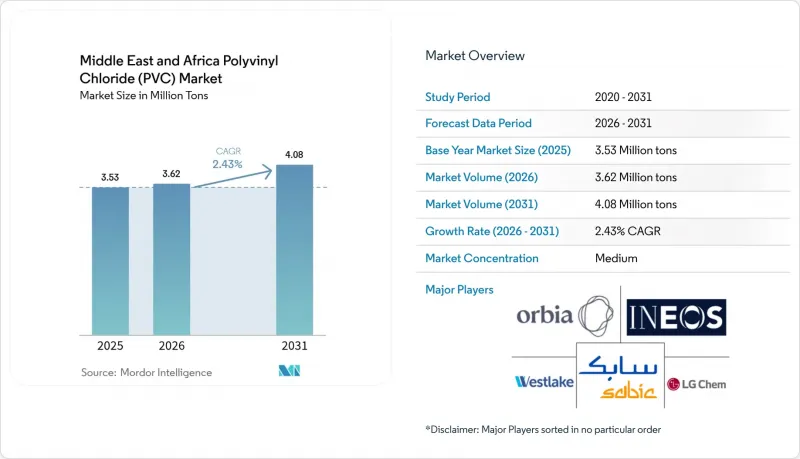
Mordor Intelligence에 의하면, 2026년 중동 및 아프리카의 폴리염화비닐(PVC) 시장 규모는 362만 톤으로 추정되고 2025년 353만 톤으로부터 확대해, 2031년에는 408만 톤에 이를 것으로 예측됩니다.
2026년부터 2031년까지의 연평균 성장률(CAGR)은 2.43%를 나타낼 전망입니다.
본 보고서는 제품 유형(경질 PVC, 연질 PVC, 저연 무할로겐 PVC 등), 용도(파이프·피팅, 필름 및 시트, 전선 및 케이블 등), 최종 사용자 산업(건축 및 건설, 자동차·모빌리티 등), 지역(사우디아라비아, 아랍에미리트, 카타르 등)별로 분류되어 있습니다. 시장 전망은 수량(톤) 기준으로 제시되어 있습니다.
중동 및 아프리카의 폴리염화비닐(PVC) 시장 동향 및 인사이트
공공 부문 인프라 구축 계획의 급속한 확대가 PVC 수요의 지속적인 성장을 견인
수십억 달러 규모의 국가 비전이 중동 및 아프리카의 폴리염화비닐(PVC) 시장의 견고한 수주 잔고를 뒷받침하고 있습니다. 사우디아라비아는 2024년에 수자원 인프라에 12억 달러를 배정했으며, NEOM의 수십 년에 걸친 건설 계획은 배관, 프로파일 및 클래딩에 대한 장기적인 수요를 시사하고 있습니다. 이집트의 109억 달러 규모 수에즈 운하 경제특구에 위치한 석유화학 단지는 유틸리티 및 산업 시설에서의 PVC 하류 활용을 더욱 확대되고 있습니다. 장기적인 자금 조달 구조 덕분에 수요량은 원유 가격 변동의 영향을 덜 받으며, 생산자에게는 예측 가능한 기반이 확립되어 있습니다.
해수 담수화 네트워크의 급속한 확장이 배관 수요를 가속화
수자원이 부족한 GCC 국가들과 북아프리카 국가들은 해수 담수화 능력을 확대하고 있으며, 이는 대량의 배관이 필요한 사업입니다. 베올리아(Veolia)가 UAE에서 수주한 3억 2,000만 달러 규모의 프로젝트나, 모로코 대서양 연안에 위치한 일일 82만 2,000m³ 처리 능력을 갖춘 시설에서는 모두 고압 및 내염수성 PVC 배관이 지정되었습니다. 국제 해수 담수화 협회(IDA)는 2030년까지 해당 지역의 처리 능력이 50% 증가할 것으로 예측하고 있으며, 이는 경질 등급 PVC의 지속적인 소비로 직결됩니다.
ESG에 대한 압박 고조와 PVC 단계적 폐지 조항이 성장의 과제로 부상
LEED 등의 그린 빌딩 인증, 두바이의 ' 알 사파트’와 같은 지역 고유의 인증 제도는 염소계 폴리머 사용을 자제할 것을 요구하고 있어, 기존 등급에 압박을 가하는 한편 중동 및 아프리카의 폴리염화비닐(PVC) 시장을 바이오 대체재로 전환시키고 있습니다. 2024년 11월에 발효되는 유럽연합(EU)의 납 안정제 함량 0.1% 상한 규제로 인해 수출업체들은 무납 배합 개발을 가속화해야 하며, 그 결과 규정 준수 비용이 증가하게 됩니다.
부문 분석
2025년, 중동 및 아프리카의 폴리염화비닐(PVC) 시장 규모의 57.70%를 경질 등급이 차지했으며, 이는 파이프라인 및 건설 관련 수주에 힘입은 결과입니다. 건설업체들이 ESG 기준을 준수하는 대체재를 요구하는 가운데, 바이오 PVC는 연평균 성장률(CAGR) 2.71%로 확대되고 있습니다. 통합형 제조업체의 생산 능력 증강은 지역 내 공급 균형 유지에 기여하고 있으나, 재활용 가능한 첨가제의 도입이 가속화될 경우 2028년 이후에는 저탄소 배합 제품의 점유율이 확대될 가능성이 있습니다. 이 부문의 가격 프리미엄은 중동 및 아프리카의 폴리염화비닐(PVC) 시장 전망을 뒷받침하고 있습니다.
비식량계 바이오매스를 활용한 2세대 바이오 루트는 크래들-투-게이트(Cradle-to-Gate) 배출량을 최대 90%까지 감축하여, GCC(걸프협력회의)의 메가 프로젝트가 스코프 3 목표를 달성하는 데 일조할 것입니다. 한편, 경질 PVC 수요의 견조함은 내식성과 구조적 강성이 요구되는 해수 담수화 파이프라인 및 고층 빌딩의 외벽에 기인합니다. 무연 안정제 기술이 성숙해짐에 따라 경질 등급은 더욱 엄격한 규제 하에서도 판매량을 유지할 수 있을 것으로 전망됩니다.
기타 혜택 :
- 엑셀 형식 시장 예측(ME) 시트
- 3개월간의 애널리스트 지원
자주 묻는 질문
목차
제1장 서론
제2장 조사 방법
제3장 주요 요약
제4장 시장 구도
제5장 시장 규모 및 성장 예측
제6장 경쟁 구도
제7장 시장 기회 및 향후 전망
KTH 26.08.05According to Mordor Intelligence, the middle-East and Africa Polyvinyl Chloride Market size in 2026 is estimated at 3.62 million tons, growing from 2025 value of 3.53 million tons with 2031 projections showing 4.08 million tons, growing at 2.43% CAGR over 2026-2031.
This report is Segmented by Product Type (Rigid PVC, Flexible PVC, Low-Smoke Zero-Halogen PVC, and More), Application (Pipes and Fittings, Films and Sheets, Wires and Cables, and More), End-User Industry (Building and Construction, Automotive and Mobility, and More), and Geography (Saudi Arabia, UAE, Qatar, and More). The Market Forecasts are Provided in Terms of Volume (Tons).
Middle East and Africa Polyvinyl Chloride (PVC) Market Trends and Insights
Booming Public-Sector Infrastructure Programs Drive Sustained PVC Demand
Multi-billion-dollar national visions underpin a robust order book for the Middle-East and Africa Poly Vinyl Chloride (PVC) market. Saudi Arabia allocated USD 1.2 billion to water infrastructure in 2024, and NEOM's multi-decade build-out signals prolonged offtake for conduits, profiles, and cladding. Egypt's USD 10.9 billion Suez Canal Economic Zone petrochemical complex deepens downstream PVC utilization in utilities and industrial structures. Long-term funding structures insulate volumes from oil-price cycles, anchoring a predictable baseline for producers.
Rapid Expansion of Desalination Networks Accelerates Pipe Demand
Water-scarce GCC and North African states are scaling desalination capacity, a pipe-intensive endeavor. Veolia's USD 320 million award in the UAE and Morocco's 822,000 m3/day Atlantic facility both specify high-pressure, saltwater-resistant PVC piping. The International Desalination Association expects regional capacity to climb 50% by 2030, translating directly into sustained rigid-grade consumption.
Escalating ESG Pressure and PVC Phase-Out Clauses Challenge Growth
Green-building certifications, such as LEED and local schemes like Dubai's Al Sa'fat, discourage chlorine-based polymers, pressuring conventional grades and nudging the Middle-East and Africa Poly Vinyl Chloride (PVC) market toward bio-based variants. The European Union's 0.1% lead-stabilizer cap, effective November 2024, requires exporters to accelerate the development of non-lead formulations, thereby increasing compliance costs.
Other drivers and restraints analyzed in the detailed report include:
- Grid-Hardening and Renewable-Energy Cabling Surge
- Medical-Grade PVC Capacity Build-Out in Healthcare Corridors
- Volatile Ethylene and Chlorine Feedstock Pricing Pressures Margins
For complete list of drivers and restraints, kindly check the Table Of Contents.
Segment Analysis
Rigid grades accounted for 57.70% of the Middle-East and Africa Poly Vinyl Chloride (PVC) market size in 2025, driven by pipeline and construction orders. Bio-based PVC advances 2.71% CAGR as builders seek ESG-compliant alternatives. Capacity additions by integrated producers help maintain a balanced regional supply, but the faster adoption of recyclable additives could shift the share toward low-carbon formulations after 2028. The segment's pricing premium supports visibility in the Middle East Africa Poly Vinyl Chloride (PVC) market.
Second-generation bio-routes using non-food biomass cut cradle-to-gate emissions by up to 90%, helping GCC megaprojects meet Scope 3 targets. Rigid's resilience, meanwhile, hinges on desalination pipelines and high-rise facades that demand corrosion resistance and structural rigidity. As lead-free stabilizer technologies mature, rigid grades should defend volume even under stricter codes.
Complete Report Scope:
- By Product Type
- Rigid PVC
- Flexible PVC
- Low-smoke Zero-Halogen PVC
- Chlorinated PVC (CPVC)
- Bio-based PVC
- By Application
- Pipes and Fittings
- Films and Sheets
- Wires and Cables
- Bottles and Containers
- Profiles, Hoses and Tubing
- Others (toys, fabrics, 3-D printing)
- By End-user Industry
- Building and Construction
- Automotive and Mobility
- Electrical and Electronics
- Packaging
- Footwear and Leisurewear
- Healthcare and Life Sciences
- Agriculture and Textiles
- By Geography
- Saudi Arabia
- United Arab Emirates
- Qatar
- Kuwait
- South Africa
- Egypt
- Nigeria
- Morocco
- Rest of Middle-East and Africa
List of Companies Covered in this Report:
- Africa PVC Industries Ltd
- Egyptian Petrochemicals Co. (EPC)
- Formosa Plastics Corporation
- INOVYN
- LG Chem
- Neproplast
- Occidental Petroleum Corporation
- Orbia
- Qatar Petrochemical Company (QAPCO) Q.P.J.S.C
- Reliance Industries Limited.
- SABIC
- SASOL
- Shin-Etsu Chemical Co., Ltd.
- TCI Sanmar Chemicals (S.A.E.)
- Westlake Corporation
Additional Benefits:
- The market estimate (ME) sheet in Excel format
- 3 months of analyst support
TABLE OF CONTENTS
1 Introduction
- 1.1 Study Assumptions
- 1.2 Scope of the Study
2 Research Methodology
3 Executive Summary
4 Market Landscape
- 4.1 Market Overview
- 4.2 Market Drivers
- 4.2.1 Booming public-sector infrastructure programs (GCC Vision 2030, Egypt Vision 2030)
- 4.2.2 Rapid expansion of desalination and water-reuse pipe networks
- 4.2.3 Grid-hardening and renewable-energy cabling demand surge
- 4.2.4 Medical-grade PVC capacity build-out in MEA healthcare corridors (e.g., Dubai Science Park)
- 4.2.5 Local-content mandates driving in-region PVC compounding (Saudi IKTVA, UAE ICV)
- 4.3 Market Restraints
- 4.3.1 Escalating ESG pressure and PVC phase-out clauses in green-building codes
- 4.3.2 Volatile ethylene and chlorine feedstock pricing linked to crude swings
- 4.3.3 Upcoming bans on lead-based stabilisers across GCC and Pan-African standards
- 4.4 Value Chain Analysis
- 4.5 Regulatory Landscape
- 4.6 Porter's Five Forces
- 4.6.1 Bargaining Power of Suppliers
- 4.6.2 Bargaining Power of Buyers
- 4.6.3 Threat of New Entrants
- 4.6.4 Threat of Substitutes
- 4.6.5 Competitive Rivalry
5 Market Size and Growth Forecasts (Volume)
- 5.1 By Product Type
- 5.1.1 Rigid PVC
- 5.1.2 Flexible PVC
- 5.1.3 Low-smoke Zero-Halogen PVC
- 5.1.4 Chlorinated PVC (CPVC)
- 5.1.5 Bio-based PVC
- 5.2 By Application
- 5.2.1 Pipes and Fittings
- 5.2.2 Films and Sheets
- 5.2.3 Wires and Cables
- 5.2.4 Bottles and Containers
- 5.2.5 Profiles, Hoses and Tubing
- 5.2.6 Others (toys, fabrics, 3-D printing)
- 5.3 By End-user Industry
- 5.3.1 Building and Construction
- 5.3.2 Automotive and Mobility
- 5.3.3 Electrical and Electronics
- 5.3.4 Packaging
- 5.3.5 Footwear and Leisurewear
- 5.3.6 Healthcare and Life Sciences
- 5.3.7 Agriculture and Textiles
- 5.4 By Geography
- 5.4.1 Saudi Arabia
- 5.4.2 United Arab Emirates
- 5.4.3 Qatar
- 5.4.4 Kuwait
- 5.4.5 South Africa
- 5.4.6 Egypt
- 5.4.7 Nigeria
- 5.4.8 Morocco
- 5.4.9 Rest of Middle-East and Africa
6 Competitive Landscape
- 6.1 Market Concentration
- 6.2 Strategic Moves
- 6.3 Market Share(%)/Ranking Analysis
- 6.4 Company Profiles (includes Global level Overview, Market level overview, Core Segments, Financials as available, Strategic Information, Market Rank/Share for key companies, Products and Services, and Recent Developments)
- 6.4.1 Africa PVC Industries Ltd
- 6.4.2 Egyptian Petrochemicals Co. (EPC)
- 6.4.3 Formosa Plastics Corporation
- 6.4.4 INOVYN
- 6.4.5 LG Chem
- 6.4.6 Neproplast
- 6.4.7 Occidental Petroleum Corporation
- 6.4.8 Orbia
- 6.4.9 Qatar Petrochemical Company (QAPCO) Q.P.J.S.C
- 6.4.10 Reliance Industries Limited.
- 6.4.11 SABIC
- 6.4.12 SASOL
- 6.4.13 Shin-Etsu Chemical Co., Ltd.
- 6.4.14 TCI Sanmar Chemicals (S.A.E.)
- 6.4.15 Westlake Corporation
7 Market Opportunities and Future Outlook
- 7.1 White-space and Unmet-need Assessment


