|
시장보고서
상품코드
2120648
폴리염화비닐(PVC) : 시장 점유율 분석, 업계 동향과 통계, 성장 예측(2026-2031년)Polyvinyl Chloride (PVC) - Market Share Analysis, Industry Trends & Statistics, Growth Forecasts (2026 - 2031) |
||||||
 Mordor Intelligence
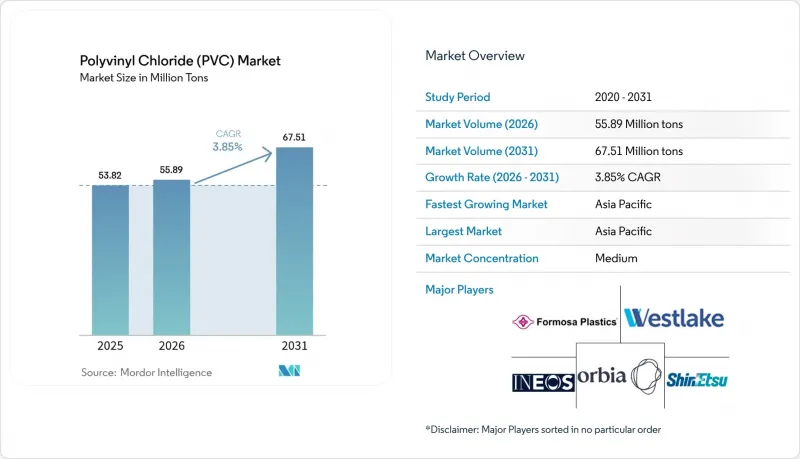
Mordor Intelligence에 의하면, 폴리염화비닐(PVC) 시장 규모는 2025년 5,382만 톤에서 2026년에는 5,589만 톤에 이르고, 2026-2031년 CAGR 3.85%로 성장을 지속하여 2031년에는 6,751만 톤에 달할 것으로 예측됩니다.
본 보고서에서는 업계를 제품 유형(경질 PVC, 연질 PVC 등), 제조 공정(서스펜션법 PVC, 에멀젼법 PVC 등),안정제 유형(칼슘계 안정제, 납계 안정제 등), 용도(파이프·이음쇠, 병 등), 최종 사용자 산업(건축 및 건설, 포장 등), 지역(아시아태평양, 북미 등)별로 분류하고 있습니다.
전 세계 폴리염화비닐(PVC) 시장 동향 및 인사이트
SPAC를 통한 자금 조달을 받은 메가시티의 도시 인프라 급속한 확장
아시아 메가시티의 홍수 대책 및 상수도망에 대한 지속적인 투자로 인해, 기존 주택용 파이프 직경과는 다른 2m를 초과하는 대구경 PVC 파이프의 도입이 촉진되고 있습니다. 인도 및 인도네시아의 프로젝트에서는 PVC 파이프에 통합된 음향식 누수 감지 기술을 통해 수도 유틸리티자가 무수익수 손실을 해결하는 동시에 자산의 수명을 연장할 수 있음이 입증되었습니다. 또한, 각국 정부는 기후 변화에 대한 저항력을 높이기 위한 자금 지원을 수명이 긴 자재에 연계하고 있으며, 이것이 연성 주철이나 콘크리트보다 PVC를 우대하는 요인이 되고 있습니다. 그 결과, 더 높은 압력이나 가혹한 지반 조건에 대응할 수 있는 프리미엄 등급 제품은 범용 파이프보다 높은 이익률을 확보하고 있습니다. 걸프협력회의(GCC) 회원국들의 유사한 인프라 투자 계획은 향후 10년 동안 중동으로 수요 확산을 시사하고 있습니다.
일회용 의료기기의 급증으로 DEHP가 함유되지 않은 PVC 컴파운드 수요 증가
2030년에 캘리포니아주에서 시행될 예정인 DEHP 금지 조치에 따라, 북미의 각 컨버터 기업들은 혈액백, 수액 세트, 복막 투석용 튜브를 위한 표준적인 선택지로 DOTP 가소화 PVC의 채택을 추진하고 있습니다. 예를 들어, Teknor Apex사는 생식 독성 우려가 없고 유연성 목표치를 충족하는 저추출성 APEX 의료용 컴파운드를 상품화했습니다. 동시에, EU가 DEHP 금지 조치를 2030년 중반까지 연기함에 따라, 이미 프탈레이트를 사용하지 않는 배합으로 재인증을 취득한 공급업체에게는 선구자로서의 우위가 주어지고 있습니다. 규정 준수 비용 증가분은 병원의 조달 예산으로 쉽게 흡수될 수 있기 때문에 특수 PVC 등급을 상품화 사이클로부터 보호하는 프리미엄 틈새 시장이 형성되고 있습니다.
EU의 REACH 및 인도의 BIS에 따른 납계 안정제 금지 조치의 가속화
EU 규정 923/2023에서는 2026년 1월부터 PVC 제품의 총 납 함유량을 0.1 wt%로 제한하고 있습니다. 인도 표준국(BIS)도 유사한 기준을 채택하고 있습니다. 칼슘·아연계 안정제로의 배합 변경은 환경적 측면에서는 바람직하지만, 가공 허용 범위를 좁히고 절연 내력을 저하시킬 가능성이 있어, 특히 전선 및 케이블용 등급에서 과제가 되고 있습니다. 특허를 취득한 시너지 효과를 지닌 첨가제 패키지를 보유한 기업들은 가격 면에서 우위를 점하고 있지만, 연구개발 규모가 부족한 중소 압출 성형 제조업체들은 제품 인증 지연에 직면해 있습니다. 가격에 민감한 시장에서는 비용 전가가 여전히 어려워 이익률을 압박하고 있으며, 이는 업계 재편을 촉진하고 있습니다.
부문 분석
2025년, 경질 PVC는 폴리염화비닐 시장 점유율의 61.40%를 차지하며, 그 기반은 건축용 프로파일, 창틀, 인프라용 파이프입니다. 생산량 우위는 표준화된 금형, 풍부한 원자재 확보 가능성, 그리고 비용 효율적인 대량 생산에 의해 뒷받침되고 있습니다. 한편, CPVC는 시장 점유율이 한 자릿수에 그치지만, 호텔, 병원, 데이터센터의 냉온수 음용수 시스템에 대한 뛰어난 내열성 덕분에 2031년까지 4.55%라는 가장 높은 연평균 성장률(CAGR)을 보일 것으로 전망됩니다. CPVC의 성능 면에서의 우위 덕분에 두 자릿수의 가격 차이가 발생하여, 폴리염화비닐 시장의 원자재 가격 변동으로부터 생산자를 보호하고 있습니다. 유연한 PVC는 의료용 백, 자동차 내장재, 소비자용 호스 등에서 계속 사용되고 있으며, DOTP 및 구연산계 가소제의 기술 발전으로 규제상의 우려가 해소되어 이러한 용도가 유지되고 있습니다. 저연기·무할로겐 PVC의 변형 제품은 화재 방지 기준이 엄격해지고 있는 도시 철도 및 공공시설의 배선 분야에서さらなる 성장의 기회를 열어가고 있습니다.
주목할 만한 파급 효과로 CPVC 블렌드를 꼽을 수 있습니다. 이는 파이프-인-파이프 공법에서 순수 CPVC의 전체 비용을 부담하지 않으면서도 내열성을 단계적으로 향상시키는 것입니다. 각 제조업체는 이러한 하이브리드 제품을 활용하여 제품 포트폴리오를 확대하고, 표준 온도 한계를 초과하는 프로젝트를 수주하고 있습니다. 한편, 경질 PVC 공급업체들은 CPVC의 부상에 대응하기 위해 발포 코어와 내충격성 개질 스킨을 갖춘 공압출 파이프를 판매하며, 경량화와 수지 소비량 감축을 도모하고 있습니다. 이러한 혁신들이 맞물리면서, 특수한 틈새 시장에서 높은 가격 책정이 요구되는 상황에서도 폴리염화비닐 시장 전체에서는 경쟁이 지속되고 있습니다.
서스펜션 중합은 2025년 생산량의 74.30%를 차지하며, 타의 추종을 불허하는 규모의 경제와 첨가제와의 폭넓은 호환성을 반영하고 있습니다. 건설용 수지의 대부분은 연간 300 kt를 초과하는 생산 능력을 갖춘 현탁 중합 라인에서 생산되어, 전체 폴리염화비닐 시장에서 비용 리더십을 가능하게 하고 있습니다. 한편, 에멀젼 PVC는 기반 규모는 작지만, 고해상도 캘린더 가공 필름 및 의료용 튜브를 가능하게 하는 미세한 입자 형태를 강점으로 삼아 연평균 성장률(CAGR) 4.38%를 나타낼 것으로 예측됩니다. 에멀젼 공장은 본질적으로 규모가 작고 유연성이 높기 때문에 투명 채혈 필름이나 EV(전기차) 내장용 합성 가죽 등 수익성이 높은 틈새 시장으로의 등급 전환을 신속하게 수행할 수 있습니다.
각 공급업체는 공정의 범용성을 차별화의 수단으로 활용하고 있습니다. 통합형 제조업체는 현탁법과 에멀젼법 양쪽의 설비를 운영하며, 공급 계약과 기술 서비스를 패키지로 묶음으로써 범용 용도와 특수 용도 사이를 오가는 컨버터를 확실하게 확보하고 있습니다. 벌크 중합은 규모는 제한적이지만, 추출물을 최소화해야 하는 반도체 클린룸의 패널 소재 등 초고순도가 요구되는 분야에서 활용되고 있습니다. 규제와 최종 사용자의 요구가 점점 더 엄격해지는 가운데, 공정의 다양화는 수익원을 보호하고 폴리염화비닐(PVC) 시장의 가격 변동을 완화하는 역할을 하고 있습니다.
지역별 분석
아시아태평양은 2025년에도 폴리염화비닐(PVC) 시장에서 59.40%라는 압도적인 점유율을 유지하고 있으며, 2031년까지 연평균 성장률(CAGR) 4.21%를 나타낼 것으로 예측됩니다. 중국이 PVC 수입 관세를 5.5%로 인상하기로 결정한 것은 연간 3,000만 톤의 국내 명목 생산 능력을 활용하는 데 정책의 중점을 두면서, 서스펜션 공법 및 페이스트 공법 생산 라인의 기술적 업그레이드를 촉진하겠다는 의지를 뒷받침합니다. 인도의 ‘잘 지반 미션(Jal Jivan Mission)’은 농촌 지역의 식수 네트워크에 사상 최대 규모의 자금을 투입하고 있으며, 이는 대구경 PVC 파이프 수요와 누수 감지 인프라 구축을 뒷받침하고 있습니다. 2029년부터 시작되는 미국산 에탄 수입으로 가능해질 태국의 원료 다각화는 동남아시아 가공업체들에게 비용 경쟁력을 확보해 줄 것입니다. 이와 병행하여, 지역 생산자들은 비닐 재활용 공장에 투자하고 있으며, 수출 기준을 충족하는 건축자재용 인증된 사용 후 수지를 생산하고 있습니다.
북미에서는 인프라 갱신에 대한 지출과 증가하는 전기차(EV) 조립에 대한 투자 간의 균형이 잘 잡혀 있습니다. 신에츠 화학공업의 루이지애나주에서 진행 중인 12억 5,000만 달러 규모의 병목 현상 해소 프로젝트와 포모사의 배턴루지 확장으로 인해, 2025년부터 2027년에 걸쳐 현탁법 방식의 신규 생산 능력이 연간 80만 톤 이상 증가할 것입니다. 환경 허가 취득은 여전히 엄격하며, 사업자는 염수 채굴과 염화비닐 모노머 배출 저감 기술을 통합해야 합니다. 각 주의 규제에 따라 DEHP가 단계적으로 폐지되는 가운데, 미국의 컴파운더 기업들은 프탈레이트 무첨가 제품공급을 가속화하고 있으며, 이를 통해 톤당 부가가치를 높여 경기 변동이 심한 건설 시장의 침체를 완화하고 있습니다.
유럽은 세계에서 가장 엄격한 첨가제 규제에 직면해 있으며, 이는 칼슘·아연계 안정제 생산에 대한 자본 투자를 촉진하는 한편, 재활용 가능한 단일 소재 프로파일에 대한 연구 개발을 가속화하고 있습니다. VinylPlus는 2025년 자발적 재활용 목표를 5년 앞당겨 달성하여, 해당 지역의 PVC 프로파일 내 재활용 소재 함유율을 20% 이상으로 높였습니다. 한편, 지역 생산자들은 전력 가격 급등 시 생산량을 줄여 가며 운영하고 있으며, 유럽에 대한 계약 이행을 보충하기 위해 미국 멕시코만 연안의 공장에서 PVC를 수출하고 있습니다. OECD 시장 이외의 지역에서는 남미와 아프리카가 폴리머 자급자족을 모색하고 있습니다. 브라질의 사탕수수 유래 에틸렌 프로젝트는 PVC를 위한 독자적인 저탄소 경로를 시사하는 반면, 나이지리아는 수입 의존도를 낮추기 위해 염소-알칼리 사업에 대한 투자를 검토하고 있습니다. 정치적·환율 변동은 여전히 장벽으로 작용하고 있지만, 인프라 부족은 폴리염화비닐 시장에 있어 의심할 여지 없이 해결해야 할 과제로 대두되고 있습니다.
기타 혜택:
- 엑셀 형식 시장 예측(ME) 시트
- 3개월간의 애널리스트 지원
목차
제1장 서론
제2장 조사 방법
제3장 주요 요약
제4장 시장 구도
제5장 시장 규모와 성장 예측
제6장 경쟁 구도
제7장 시장 기회와 향후 전망
LSHAccording to Mordor Intelligence, the polyvinyl chloride market size is expected to grow from 53.82 Million tons in 2025 to 55.89 Million tons in 2026 and is forecast to reach 67.51 Million tons by 2031 at 3.85% CAGR over 2026-2031.
This report Segments the Industry by Product Type (Rigid PVC, Flexible PVC, and More), Manufacturing Process (Suspension PVC, Emulsion PVC, and More), Stabilizer Type (Calcium-Based Stabilizers, Lead-Based Stabilizers, and More), Application (Pipes and Fittings, Bottles, and More), End-User Industry (Building and Construction, Packaging, and More), and Geography (Asia-Pacific, North America, and More).
Global Polyvinyl Chloride (PVC) Market Trends and Insights
Rapid Urban Infrastructure Expansion in SPAC-Financed Megacities
Continued spending on flood management and potable-water grids in Asia's megacities drives specification of large-diameter PVC pipes exceeding 2m, a departure from legacy residential bore sizes. Projects in India and Indonesia illustrate how acoustic leak-detection technology embedded in PVC piping allows utilities to address non-revenue water losses while extending asset life. Governments also link climate-resilience funding to materials with long service lives, which favors PVC over ductile iron or concrete. As a result, premium grades capable of handling higher pressures and aggressive soil conditions obtain stronger margins than commodity pipe. Similar infrastructure commitments across Gulf Cooperation Council states suggest spill-over demand into the Middle East over the next decade.
Surge in Single-Use Medical Devices Favoring DEHP-Free PVC Compounds
California's impending DEHP ban in 2030 prompted North American converters to adopt DOTP-plasticized PVC as the default choice for blood bags, IV sets, and peritoneal-dialysis tubing. Teknor Apex, for instance, commercialized low-extractable APEX medical compounds that match flexibility targets without reproductive-toxicity concerns. Simultaneously, EU postponement of its own DEHP prohibition until mid-2030 offers first-mover advantage to suppliers that have already re-qualified with phthalate-free formulations. Higher compliance costs are readily absorbed by hospital procurement budgets, rounding out a premium niche that shields specialty PVC grades from commodity cycles.
Accelerating Bans on Lead-Based Stabilizers under EU REACH and Indian BIS
EU Regulation 923/2023 limits total lead content in PVC articles to 0.1 wt% starting January 2026. The same threshold is being replicated by India's Bureau of Indian Standards. Re-formulation to calcium-zinc stabilizers, while environmentally favorable, reduces processing windows and can lower dielectric strength-posing particular issues for wire and cable grades. Companies with patented synergistic additive packages secure a pricing premium, yet smaller extruders lacking R&D scale face qualification delays. Cost pass-through remains challenging in price-sensitive markets, compressing margins and encouraging consolidation.
Other drivers and restraints analyzed in the detailed report include:
- Rising Demand for Clean-Water Infrastructure
- OEM Shift Toward Lightweight Flexible PVC Interiors in Electric Vehicles
- Brand-Owner Push for Phthalate-Free Packaging Diminishing Conventional Flexible PVC Demand
For complete list of drivers and restraints, kindly check the Table Of Contents.
Segment Analysis
Rigid PVC accounted for 61.40% of polyvinyl chloride market share in 2025, anchored by construction profiles, window frames, and infrastructure pipe. Volume leadership rests on standardized tooling, wide raw-material availability, and cost-efficient mass production. However, CPVC-while representing a single-digit share-shows the strongest 4.55% CAGR to 2031 thanks to superior temperature tolerance for hot-and-cold potable systems in hotels, hospitals, and data centers. CPVC's performance premium permits double-digit price differentials that cushion producers from commodity swings in the polyvinyl chloride market. Flexible PVC continues to serve medical bags, vehicle interiors, and consumer hoses; advances in DOTP and citrate plasticizers resolve regulatory scrutiny, retaining these applications. Low-smoke zero-halogen PVC variants further unlock growth in metro-rail and public-venue cabling where fire-safety codes tighten.
A notable spill-over effect involves CPVC blends that deliver incremental heat resistance in pipe-in-pipe installations without the full cost of neat CPVC. Producers exploit these hybrids to extend product portfolios and capture projects beyond standard temperature thresholds. Meanwhile, rigid PVC suppliers counter CPVC's rise by marketing co-extruded pipes with foam cores or impact-modified skins that reduce weight and resin consumption. These innovations collectively sustain competition across the polyvinyl chloride market even as specialized niches attract premium pricing.
Suspension polymerization delivered 74.30% of 2025 volume, reflecting unmatched economies of scale and broad compatibility with additives. Most construction-grade resins stem from suspension lines exceeding 300 kt/yr, enabling cost leadership across the polyvinyl chloride market. Yet emulsion PVC, while holding a modest base, is forecast for a 4.38% CAGR driven by its fine-particle morphology which supports high-definition calendared films and medical-grade tubing. Emulsion plants are inherently smaller and more flexible, allowing rapid grade switches toward higher-margin niches such as transparent blood-collection film or synthetic leather for EV interiors.
Suppliers use process versatility as a differentiation lever. Integrated producers operate both suspension and emulsion assets, bundling supply contracts and technical services to lock in converters shifting between commodity and specialty applications. Bulk polymerization, although limited, serves ultra-high-purity segments like semiconductor clean-room paneling where extractables must be minimized. As regulatory and end-user demands become more exacting, process diversification protects revenue streams and tempers price volatility in the polyvinyl chloride market.
Complete Report Scope:
- By Product Type
- Rigid PVC
- Clear Rigid PVC
- Non-clear Rigid PVC
- Flexible PVC
- Clear Flexible PVC
- Non-clear Flexible PVC
- Low-Smoke PVC
- Chlorinated PVC (CPVC)
- Rigid PVC
- By Manufacturing Process
- Suspension PVC
- Emulsion PVC
- Bulk/Mass Polymerized PVC
- By Stabilizer Type
- Calcium-based Stabilizers (Ca-Zn Stabilizers)
- Lead-based Stabilizers (Pb Stabilizers)
- Tin and Organotin-based (Sn Stabilizers)
- Barium-based and Other Stabilizer Types (Liquid Mixed Metals)
- By Application
- Pipes and Fittings
- Films and Sheets
- Wires and Cables
- Bottles
- Profiles, Hoses and Tubings
- Other Applications
- By End-User Industry
- Building and Construction
- Automotive and Transportation
- Electrical and Electronics
- Packaging
- Footwear
- Healthcare
- Other End-User Industries
- By Geography
- Asia-Pacific
- China
- India
- Japan
- South Korea
- Rest of Asia-Pacific
- North America
- United States
- Canada
- Mexico
- Europe
- Germany
- United Kingdom
- Italy
- France
- Spain
- Rest of Europe
- South America
- Brazil
- Argentina
- Rest of South America
- Middle East and Africa
- Saudi Arabia
- South Africa
- Nigeria
- Rest of Middle East and Africa
- Asia-Pacific
Geography Analysis
Asia-Pacific preserved a commanding 59.40% share of the polyvinyl chloride market in 2025 and is forecasting a 4.21% CAGR to 2031. China's decision to raise PVC import tariffs to 5.5% underscores a policy focus on utilizing its 30 million t/yr domestic nameplate capacity while encouraging technological upgrades in suspension and paste lines. India's Jal Jeevan Mission funnels record capital into rural drinking-water networks, supporting large-bore PVC pipe demand alongside leak-detection infrastructure. Thailand's feedstock diversification, enabled by US ethane imports from 2029, secures cost competitiveness for Southeast Asian converters. In parallel, regional producers invest in vinyl recycling plants that create certified post-consumer resin for export-compliant building products.
North America balances infrastructure-renewal spending with rising EV assembly investments. Shin-Etsu's USD 1.25 billion Louisiana debottlenecking project and Formosa's Baton Rouge expansion add over 800 kt/yr of new suspension capacity between 2025 and 2027. Environmental permitting remains strict, compelling operators to integrate brine mining and vinyl chloride monomer emissions-reduction technology. As state regulations phase out DEHP, US compounders expedite phthalate-free offerings, thereby raising value per tonne and cushioning the cyclical construction market.
Europe endures the world's most stringent additive rules, driving capital toward calcium-zinc stabilizer production while accelerating R&D on recyclable mono-material profiles. VinylPlus exceeded its 2025 voluntary recycling target five years early, lifting the region's recycled-content rate in PVC profiles above 20%. Meanwhile, regional producers operate at reduced run-rates when power prices spike, exporting PVC from US Gulf Coast plants to backfill European contract commitments. Beyond OECD markets, South America and Africa seek polymer self-sufficiency; Brazil's sugar-cane-based ethylene project signifies a differentiated low-carbon route to PVC, while Nigeria evaluates chlor-alkali investments to reduce import reliance. Political and currency volatility remains a hurdle, yet infrastructure deficits present an undeniable addressable need for the polyvinyl chloride market.
- Aditya Birla Chemicals
- China National Bluestar (Group) Co,Ltd.
- Ercros, S.A.
- Formosa Plastics Corporation
- Hanwha Solutions
- INEOS
- Inner Mongolia Junzheng Energy & Chemical Group Co., Ltd.
- Kem One SAS
- LG Chem
- Occidental Petroleum Corporation
- Orbia
- Reliance Industries Limited
- SABIC
- Shaanxi Coal & Chemical Industry Group Co., Ltd.
- Shin-Etsu Chemical Co., Ltd.
- Tianye Group
- Westlake Corporation
- Xinjiang Zhongtai Chemical Co., Ltd.
Additional Benefits:
- The market estimate (ME) sheet in Excel format
- 3 months of analyst support
TABLE OF CONTENTS
1 Introduction
- 1.1 Study Assumptions and Market Definition
- 1.2 Scope of the Study
2 Research Methodology
3 Executive Summary
4 Market Landscape
- 4.1 Market Overview
- 4.2 Market Drivers
- 4.2.1 Rapid Urban Infrastructure Expansion in SPAC-Driven Megacities across Asia
- 4.2.2 Surge in Single-Use Medical Devices Favoring DEHP-Free PVC Compounds in North America and Europe
- 4.2.3 Rising Demand for Clean Water Infrastructure:
- 4.2.4 OEM Shift Toward Lightweight Flexible PVC Interiors in Electric Vehicles Produced
- 4.2.5 Chlor-Alkali Capacity Integration by Producers in the US and EU Lowering PVC Production Costs
- 4.3 Market Restraints
- 4.3.1 Accelerating Bans on Lead-Based Stabilizers under EU REACH and Indian BIS Standards
- 4.3.2 Brand-Owner Push for Phthalate-Free Packaging Diminishing Conventional Flexible PVC Demand
- 4.3.3 Ethylene Price Volatility Linked to Crude-Oil Fluctuations Compressing Margins
- 4.4 Value Chain Analysis
- 4.5 Regulatory Outlook
- 4.6 Porter's Five Forces
- 4.6.1 Bargaining Power of Suppliers
- 4.6.2 Bargaining Power of Buyers
- 4.6.3 Threat of New Entrants
- 4.6.4 Threat of Substitutes
- 4.6.5 Competitive Rivalry
5 Market Size and Growth Forecasts (Volume)
- 5.1 By Product Type
- 5.1.1 Rigid PVC
- 5.1.1.1 Clear Rigid PVC
- 5.1.1.2 Non-clear Rigid PVC
- 5.1.2 Flexible PVC
- 5.1.2.1 Clear Flexible PVC
- 5.1.2.2 Non-clear Flexible PVC
- 5.1.3 Low-Smoke PVC
- 5.1.4 Chlorinated PVC (CPVC)
- 5.1.1 Rigid PVC
- 5.2 By Manufacturing Process
- 5.2.1 Suspension PVC
- 5.2.2 Emulsion PVC
- 5.2.3 Bulk/Mass Polymerized PVC
- 5.3 By Stabilizer Type
- 5.3.1 Calcium-based Stabilizers (Ca-Zn Stabilizers)
- 5.3.2 Lead-based Stabilizers (Pb Stabilizers)
- 5.3.3 Tin and Organotin-based (Sn Stabilizers)
- 5.3.4 Barium-based and Other Stabilizer Types (Liquid Mixed Metals)
- 5.4 By Application
- 5.4.1 Pipes and Fittings
- 5.4.2 Films and Sheets
- 5.4.3 Wires and Cables
- 5.4.4 Bottles
- 5.4.5 Profiles, Hoses and Tubings
- 5.4.6 Other Applications
- 5.5 By End-User Industry
- 5.5.1 Building and Construction
- 5.5.2 Automotive and Transportation
- 5.5.3 Electrical and Electronics
- 5.5.4 Packaging
- 5.5.5 Footwear
- 5.5.6 Healthcare
- 5.5.7 Other End-User Industries
- 5.6 By Geography
- 5.6.1 Asia-Pacific
- 5.6.1.1 China
- 5.6.1.2 India
- 5.6.1.3 Japan
- 5.6.1.4 South Korea
- 5.6.1.5 Rest of Asia-Pacific
- 5.6.2 North America
- 5.6.2.1 United States
- 5.6.2.2 Canada
- 5.6.2.3 Mexico
- 5.6.3 Europe
- 5.6.3.1 Germany
- 5.6.3.2 United Kingdom
- 5.6.3.3 Italy
- 5.6.3.4 France
- 5.6.3.5 Spain
- 5.6.3.6 Rest of Europe
- 5.6.4 South America
- 5.6.4.1 Brazil
- 5.6.4.2 Argentina
- 5.6.4.3 Rest of South America
- 5.6.5 Middle East and Africa
- 5.6.5.1 Saudi Arabia
- 5.6.5.2 South Africa
- 5.6.5.3 Nigeria
- 5.6.5.4 Rest of Middle East and Africa
- 5.6.1 Asia-Pacific
6 Competitive Landscape
- 6.1 Market Concentration
- 6.2 Strategic Moves
- 6.3 Market Share Analysis
- 6.4 Company Profiles (includes Global level Overview, Market level overview, Core Segments, Financials as available, Strategic Information, Market Rank/Share for key companies, Products and Services, and Recent Developments)
- 6.4.1 Aditya Birla Chemicals
- 6.4.2 China National Bluestar (Group) Co,Ltd.
- 6.4.3 Ercros, S.A.
- 6.4.4 Formosa Plastics Corporation
- 6.4.5 Hanwha Solutions
- 6.4.6 INEOS
- 6.4.7 Inner Mongolia Junzheng Energy & Chemical Group Co., Ltd.
- 6.4.8 Kem One SAS
- 6.4.9 LG Chem
- 6.4.10 Occidental Petroleum Corporation
- 6.4.11 Orbia
- 6.4.12 Reliance Industries Limited
- 6.4.13 SABIC
- 6.4.14 Shaanxi Coal & Chemical Industry Group Co., Ltd.
- 6.4.15 Shin-Etsu Chemical Co., Ltd.
- 6.4.16 Tianye Group
- 6.4.17 Westlake Corporation
- 6.4.18 Xinjiang Zhongtai Chemical Co., Ltd.
7 Market Opportunities and Future Outlook
- 7.1 White-space and Unmet-Need Assessment
- 7.2 Recycled PVC and Circular Economy Integration
- 7.3 Green Hydrogen-Driven Chlor-Alkali for Carbon-Neutral PVC