

|
시장보고서
상품코드
2097241
독일의 원료의약품(API) : 시장 점유율 분석, 업계 동향과 통계, 성장 예측(2026-2031년)Germany Active Pharmaceutical Ingredients (API) - Market Share Analysis, Industry Trends & Statistics, Growth Forecasts (2026 - 2031) |
||||||
 Mordor Intelligence
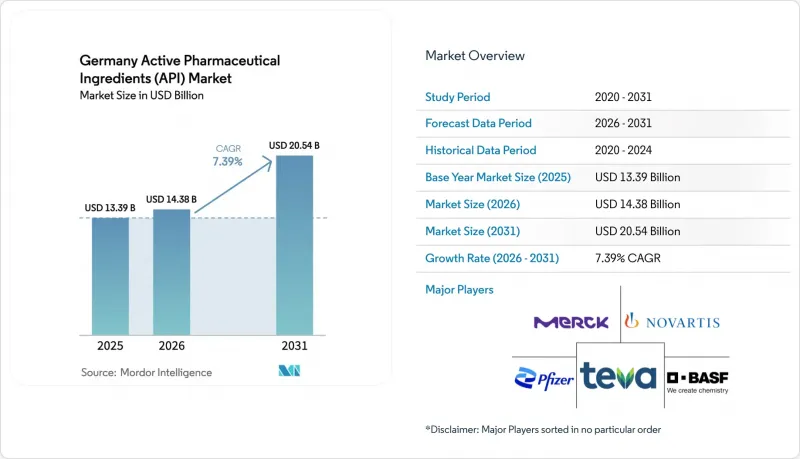
Mordor Intelligence에 의하면, 독일의 원료의약품(API) 시장 규모는 2025년에 133억 9,000만 달러로 평가되었고, 2026년 143억 8,000만 달러에서 2031년까지 205억 4,000만 달러에 이를 것으로 예측되며, 예측 기간(2026-2031년) CAGR은 7.39%를 나타낼 전망입니다.
본 보고서는 비즈니스 모델(자체 생산, 판매/위탁 생산), 합성 유형(합성, 바이오기술), 분자 크기(저분자, 고분자/바이오로직스), 효능(고효능, 저/중효능), 치료 분야(종양학, 심혈관 질환 등), 최종 사용자(제약 및 바이오의약품 기업 등)별로 분류되어 있습니다. 시장 전망은 금액(달러) 기준으로 제시되어 있습니다.
독일의 원료의약품(API) 시장 동향 및 인사이트
종양학 파이프라인에 힘입은 독일의 고효능 API에 대한 견조한 수요
고효능 API(HPAPI)는 엄격한 격리 요건으로 인해 전 세계 생산 능력이 제한되어 있어, 현재 프리미엄 가격이 책정되고 있습니다. Lonza의 HPAPI 격리 기술에 대한 30년에 걸친 실적은 축적된 노하우가 어떻게 경쟁 우위로 작용하는지를 보여줍니다. 독일의 여러 제조업체들도 이 전략을 모방하여, 바이에른주 바이오기술 기업 전체에서 현재 160건이 넘는 개발 프로젝트에 이르는 종양학 파이프라인을 활용하여 장기 계약을 확실하게 확보하고 있습니다. 종양학 분야의 전문 지식이 집중됨에 따른 네트워크 효과로 인해 거래 비용이 절감되고 기술 이전이 가속화되면서, 독일의 원료의약품 시장에서 이 복잡하고 수익성이 높은 분야에 대한 독일의 우위가 더욱 공고해지고 있습니다.
코로나19로 인한 공급 충격에 대응하여, 중요한 API의 니어쇼어링을 촉진하는 EU 차원의 인센티브
EU의 ‘중요 의약품법’은 아시아 공급업체에 대한 의존도를 낮추기 위해 8,000만 유로를 배정하고 있습니다. 이 정책은 독일이 이미 세계 최고 수준의 GMP 인프라를 갖추고 있기 때문에 독일의 원료의약품 시장에 특히 유리하게 작용합니다. 중국의 ‘반스파이법’ 확대에 상징되는 지정학적 리스크 증가는 유럽 수입업체들에게 규정 준수 측면의 불확실성을 높이며, 조달처를 현지 공장으로 전환하는 요인이 되고 있습니다. 검사관들이 아시아에서의 여행 제한이나 법적 위험에 직면하는 가운데, 독일 제조업체들은 ‘보안 프리미엄’을 누리고 있으며, 이는 이익률에 가해지는 압박을 완화하고 있습니다.
부문 분석
2025년 매출 중 자체 생산이 64.62%를 차지하고 있어, 대형 제약사들이 안전하고 수직 통합된 공급망을 선호하는 경향이 두드러지고 있습니다. 독일의 원료의약품 시장에서 자체 생산 라인의 규모는 2025년에 86억 5,000만 달러에 달하며, 기업들이 암 및 당뇨병 치료에 필수적인 화합물의 생산을 사내화하는 움직임이 확대됨에 따라 성장을 이어가고 있습니다. 그러나 CDMO가 전문적인 생산 능력을 확대함에 따라 머천트 라인은 연평균 성장률(CAGR) 7.78%로 성장하고 있습니다. CordenPharma의 9억 유로 규모 펩타이드 프로그램은 이러한 변화를 상징하며, 이를 통해 의약품 개발 기업은 새로운 자본 투자 없이도 생산 능력을 유연하게 조정할 수 있게 됩니다. 단기적으로는 캡티브 모델과 머천트 모델이 공존할 것이며, 개발 기업들은 특허를 취득한 블록버스터 제품을 보호하는 한편, 비핵심 화학 분야는 외부 파트너에게 위탁해 나갈 것입니다.
머천트형 공급업체는 GMP에 대한 깊은 전문 지식, 규제에 대한 정통성, 그리고 임상시험까지의 기간을 단축하는 프로세스를 공동 개발하는 능력을 바탕으로 성공을 거두고 있습니다. 2031년까지 머천트 모델 시장 규모는 74억 달러를 넘어설 것으로 예측되며, 이는 독일이 EU 내에서 규제상의 골드 스탠다드로서의 지위를 반영한 것입니다. 또한, 머천트 모델은 자체 시설 설치를 정당화할 만한 규모를 갖추지 못한 희귀질환 치료제를 개발하는 중소기업을 유치하고 있습니다. 독일의 의약품 원료의약품(API) 시장이 성숙해짐에 따라, 사내 생산과 외부 위탁을 결합한 듀얼 소싱 전략이 위험 완화 조치의 주류가 될 가능성이 높습니다.
2025년, 독일의 원료의약품(API) 시장 규모 중 합성 분자가 지출의 69.74%를 차지했으며, 그 규모는 약 93억 4,000만 달러에 달했습니다. 확립된 화학 기술, 공정 노하우, 그리고 석유화학 전구체의 안정적인 조달 체계가 이러한 우위를 뒷받침하고 있습니다. 한편, 생명공학 유래 API는 연평균 성장률(CAGR) 7.86%로 확대되고 있으며, mRNA, 펩타이드, 바이러스 벡터가 공장의 규모와 형태를 재정의하고 있습니다. Wacker가 하레에 건설한 1억 1,000만 달러 규모의 mRNA 허브는 연간 2억 회분의 백신을 공급할 수 있습니다. 이러한 자산은 일회용 바이오리액터 및 첨단 정제 기술의 도입을 가속화하고 있으며, 이는 다른 곳에서는 쉽게 재현할 수 없는 기술입니다.
바이오의약품이 종양학, 대사 질환, 희귀질환 파이프라인에 침투함에 따라 공정 기술은 고체상 합성에서 세포 배양 최적화 및 크로마토그래피로 전환되고 있습니다. 이러한 전환으로 인해 평균 판매 가격이 상승하여 원자재 비용 인플레이션을 완화하고 있습니다. 2031년까지 바이오기술 기반 API는 독일의 원료의약품(API) 시장 매출의 35% 이상을 차지할 전망이며, 기존 합성 계열 기업과의 역사적인 격차를 서서히 좁혀 나갈 것입니다.
기타 혜택:
- 엑셀 형식 시장 예측(ME) 시트
- 3개월간의 애널리스트 지원
자주 묻는 질문
목차
제1장 서론
제2장 조사 방법
제3장 주요 요약
제4장 시장 구도
제5장 시장 규모 및 성장 예측(금액, 유로)
제6장 경쟁 구도
제7장 시장 기회와 향후 전망
KTH 26.08.06According to Mordor Intelligence, the Germany active pharmaceutical ingredients market size was valued at USD 13.39 billion in 2025 and estimated to grow from USD 14.38 billion in 2026 to reach USD 20.54 billion by 2031, at a CAGR of 7.39% during the forecast period (2026-2031).
This report is Segmented by Business Model (Captive, Merchant/Contract ), Synthesis Type (Synthetic, Biotech), Molecule Size (Small-Molecule, Large-Molecule/Biologic), Potency (High-Potency, Low/Medium Potency), Therapeutic Area (Oncology, Cardiovascular, and More), End-User (Pharma & Biopharma Companies, and More). The Market Forecasts are Provided in Terms of Value (USD).
Germany Active Pharmaceutical Ingredients (API) Market Trends and Insights
Robust German Demand for High-Potency APIs Driven by Oncology Pipelines
High-potency APIs (HPAPIs) now fetch premium pricing because their stringent containment requirements restrict global capacity. Lonza's 30-year record in HPAPI containment illustrates how accumulated know-how becomes a moat. German producers replicate this strategy, leveraging oncology pipelines that now exceed 160 development projects across Bavarian biotech firms to lock in long-term contracts. The network effect of clustered oncology expertise lowers transaction costs and accelerates tech transfer, strengthening Germany's grip on this complex, higher-margin slice of the Germany active pharmaceutical ingredients market.
EU-Level Incentives for Near-Shoring Critical APIs After COVID-19 Supply Shocks
The EU Critical Medicines Act earmarks EUR 80 million to trim reliance on Asian suppliers, a policy that disproportionately favors the Germany active pharmaceutical ingredient market because the country already hosts best-in-class GMP infrastructure. Heightened geopolitical risk, exemplified by China's expanded Anti-Espionage Law, raises compliance uncertainty for European importers and tilts sourcing toward local plants. As inspectors face travel restrictions and legal exposure in Asia, German manufacturers command a "security premium" that cushions margin pressure.
Other drivers and restraints analyzed in the detailed report include:
- Rising Biotech Investment Clusters in Hessen & Bavaria Supporting Biologic API's
- Accelerated Adoption of Continuous-Flow Manufacturing In German CDMOs
- Escalating Natural-Gas & Electricity Costs
- Price Competition from Indian & Chinese Imports
For complete list of drivers and restraints, kindly check the Table Of Contents.
Segment Analysis
Captive operations represented 64.62% of 2025 revenue, underscoring big pharma's preference for secure, vertically integrated supply chains. The Germany active pharmaceutical ingredient market size for captive lines equals USD 8.65 billion in 2025, and growth continues as companies internalize production of mission-critical compounds for oncology and diabetes. However, merchant lines are advancing at a 7.78% CAGR as CDMOs scale specialized capacity. CordenPharma's EUR 900 million peptide program exemplifies this shift, allowing drug sponsors to flex capacity without fresh capital deployments. In the near term, captive and merchant models will coexist, with sponsors carving out non-core chemistries to external partners while shielding patented blockbusters.
Merchant providers thrive on deep GMP expertise, regulatory familiarity, and the ability to co-develop processes that compress time-to-clinic. By 2031, the merchant slice is projected to surpass USD 7.4 billion, reflecting Germany's position as the EU's regulatory gold standard. In addition, merchant lines attract SMEs developing orphan drugs that lack the scale to justify captive facilities. As the Germany active pharmaceutical ingredient market matures, dual-sourcing strategies that mix in-house and outsourced supply are likely to dominate risk-mitigation playbooks.
Synthetic molecules held 69.74% of spending in 2025, or roughly USD 9.34 billion of the Germany active pharmaceutical ingredient market size. Mature chemistries, process know-how, and sound sourcing of petrochemical precursors underpin this lead. Yet biotechnological APIs are expanding at a 7.86% CAGR, with mRNA, peptides, and viral vectors redefining factory footprints. Wacker's USD 110 million mRNA hub in Halle can supply 200 million vaccine doses per year. Such assets accelerate the adoption of single-use bioreactors and advanced purification, skills not easily replicated elsewhere.
As biologics penetrate oncology, metabolic, and rare-disease pipelines, process skill sets transition from solid-phase synthesis to cell-culture optimization and chromatography. This transition pushes average selling prices upward, cushioning inflation in raw-material costs. By 2031, biotech APIs are on track to capture beyond 35% of Germany active pharmaceutical ingredient market revenue, gradually narrowing the historic gap with synthetic incumbents.
Complete Report Scope:
- By Business Model
- Captive API
- Merchant / Contract API
- By Synthesis Type
- Synthetic API
- Biotech API
- By Molecule Size
- Small-Molecule
- Large-Molecule / Biologic
- By Potency
- High-Potency API
- Low/Medium Potency API
- By Therapeutic Area
- Oncology
- Cardiovascular
- Infectious Diseases
- Metabolic Disorders
- CNS & Neurology
- Respiratory
- Others
- By End-User
- Pharma & Biopharma Companies
- CDMOs / CMOs
- CROs & Academia
List of Companies Covered in this Report:
- Merck
- BASF
- Bayer
- Evonik Industries
- Aenova Holding GmbH
- Vetter Pharma-Fertigung GmbH
- Siegfried Holding AG
- Corden Pharma GmbH
- Sanofi Deutschland GmbH
- Novartis Pharma GmbH
- Teva GmbH / ratiopharm
- Lonza Group (German sites)
- Boehringer Ingelheim
- Dr. Reddy's Laboratories - Betapharm
- Sun Pharmaceuticals Industries
- Cambrex Profarmaco
- Catalent Germany Eberbach
- Thermo Fisher Scientific (Patheon)
- WuXi App Tec
- Abbvie
Additional Benefits:
- The market estimate (ME) sheet in Excel format
- 3 months of analyst support
TABLE OF CONTENTS
1 Introduction
- 1.1 Study Assumptions & Market Definition
- 1.2 Scope of the Study
2 Research Methodology
3 Executive Summary
4 Market Landscape
- 4.1 Market Overview
- 4.2 Market Drivers
- 4.2.1 Robust German Demand for High-Potency APIs Driven by Oncology Pipelines
- 4.2.2 EU-Level Incentives for Near-Shoring Critical APIs After COVID-19 Supply Shocks
- 4.2.3 Rising Biotech Investment Clusters in Hessen & Bavaria Supporting Biologic API's
- 4.2.4 Accelerated Adoption of Continuous-Flow Manufacturing In German CDMOs
- 4.2.5 Public Funding for "Green Chemistry" to Meet Stringent German ESG Norms
- 4.2.6 Digital Twin/Industry 4.0 Retrofits Improving Yield at Legacy API Plants
- 4.3 Market Restraints
- 4.3.1 Escalating Natural-Gas & Electricity Costs Squeezing API Margins
- 4.3.2 Intense Price Competition from Indian & Chinese imports in Non-Protected Classes
- 4.3.3 Complex Variation Filing Requirements Under EU EMA & German BfArM
- 4.3.4 Skilled-labor Shortages in High-Containment Facilities
- 4.4 Value / Supply-Chain Analysis
- 4.5 Regulatory Landscape
- 4.6 Technological Outlook
- 4.7 Porter's Five Forces
- 4.7.1 Threat of New Entrants
- 4.7.2 Bargaining Power of Buyers
- 4.7.3 Bargaining Power of Suppliers
- 4.7.4 Threat of Substitutes
- 4.7.5 Competitive Rivalry
5 Market Size & Growth Forecasts (Value, EUR)
- 5.1 By Business Model
- 5.1.1 Captive API
- 5.1.2 Merchant / Contract API
- 5.2 By Synthesis Type
- 5.2.1 Synthetic API
- 5.2.2 Biotech API
- 5.3 By Molecule Size
- 5.3.1 Small-Molecule
- 5.3.2 Large-Molecule / Biologic
- 5.4 By Potency
- 5.4.1 High-Potency API
- 5.4.2 Low/Medium Potency API
- 5.5 By Therapeutic Area
- 5.5.1 Oncology
- 5.5.2 Cardiovascular
- 5.5.3 Infectious Diseases
- 5.5.4 Metabolic Disorders
- 5.5.5 CNS & Neurology
- 5.5.6 Respiratory
- 5.5.7 Others
- 5.6 By End-User
- 5.6.1 Pharma & Biopharma Companies
- 5.6.2 CDMOs / CMOs
- 5.6.3 CROs & Academia
6 Competitive Landscape
- 6.1 Market Concentration
- 6.2 Market Share Analysis
- 6.3 Company Profiles (includes Global Level Overview, Market Level Overview, Core Segments, Financials as Available, Strategic Information, Market Rank/Share for Key Companies, Products & Services, Recent Developments)
- 6.3.1 Merck KGaA
- 6.3.2 BASF SE
- 6.3.3 Bayer AG
- 6.3.4 Evonik Industries AG
- 6.3.5 Aenova Holding GmbH
- 6.3.6 Vetter Pharma-Fertigung GmbH
- 6.3.7 Siegfried Holding AG
- 6.3.8 Corden Pharma GmbH
- 6.3.9 Sanofi Deutschland GmbH
- 6.3.10 Novartis Pharma GmbH
- 6.3.11 Teva GmbH / ratiopharm
- 6.3.12 Lonza Group (German sites)
- 6.3.13 Boehringer Ingelheim
- 6.3.14 Dr. Reddy's Laboratories - Betapharm
- 6.3.15 Sun Pharma
- 6.3.16 Cambrex Profarmaco
- 6.3.17 Catalent Germany Eberbach
- 6.3.18 Thermo Fisher Scientific (Patheon)
- 6.3.19 Wuxi AppTec
- 6.3.20 AbbVie
7 Market Opportunities & Future Outlook
- 7.1 White-space & Unmet-Need Assessment


