|
시장보고서
상품코드
2125561
미국의 API(원료의약품) 시장 : 점유율 분석, 업계 동향과 통계, 성장 예측(2026-2031년)United States Active Pharmaceutical Ingredients (API) - Market Share Analysis, Industry Trends & Statistics, Growth Forecasts (2026 - 2031) |
||||||
 Mordor Intelligence
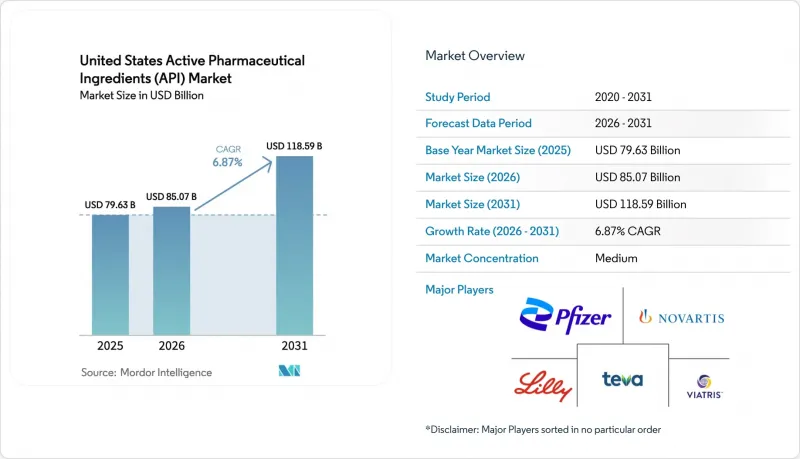
Mordor Intelligence에 의하면, 미국 API(원료의약품) 시장 규모는 2025년에 796억 3,000만 달러로 평가되었고 2026년 850억 7,000만 달러에서 2031년까지 1,185억 9,000만 달러에 이를 것으로 예측되며, 예측 기간(2026-2031년) CAGR은 6.87%를 나타낼 전망입니다.
본 보고서는 비즈니스 모델(캡티브 API, 머천트 API), 합성 유형(합성, 생명공학),분자 크기(저분자, 고분자/바이오로직스), 효능(고약리활성 원료의약품(HPAPI), 저·중약리활성 원료의약품), 용도(순환기, 호흡기 등), 최종 사용자(제약사 등)별로 분류되어 있습니다. 시장 예측은 금액(달러) 기준으로 제시되어 있습니다.
미국 API(원료의약품) 시장 동향 및 인사이트
국내 API 생산을 위한 미국 공급망 다각화에 대한 인센티브
‘BIOSECURE 법안’을 뒷받침하는 연방 의회의 움직임에 따라, 제약 기업의 구매 담당자들은 중국에 대한 의존도를 면밀히 검토하고, 계약을 국내 공장으로 이전할 수밖에 없는 상황에 처해 있습니다. Curia, Cambrex, Amgen 각사는 기존에 아시아에 배치되어 있던 생산 능력을 국내로 이전하기 위해 각각 1억 달러 이상을 투자하고 있습니다. ‘CHIPS and Science 법’은 제약 공정 설비에 대한 세액 공제를 확대하고 있으며, 이로 인해 반응기 설비 투자 비용이 대폭 절감되어 해외에 위치한 배치 제조 설비와의 비용 격차가 줄어들고 있습니다. 각 주에서도 추가적인 지원책을 마련하고 있는데, 노스캐롤라이나주는 앰젠의 10억 달러 규모 바이오의약품 캠퍼스 건설에 공동 출자하고 있으며, 매사추세츠주는 ISO 14001 규격에 부합하는 GMP 허가를 신속하게 취득할 수 있도록 지원하고 있습니다. 이러한 요소를 종합해 보면, 연간 수요가 500Kg을 초과하는 분자의 경우, 누적된 우대 조치로 인해 총 소유 비용이 해외 시설과 동등한 수준 이하로 떨어지게 됩니다.
선진 바이오의약품 및 mRNA 치료제 파이프라인이 급증
2025년 FDA의 신규 분자 실체(NME) 승인 건수의 47%를 바이오의약품과 mRNA 치료제가 차지하여, 2020년의 38%에서 증가했습니다. Moderna사가 18억 달러를 투자하여 미국 3곳에 건설한 시설 덕분에 mRNA의 배치 사이클 시간이 14일에서 7일로 절반으로 단축되었으며, 이 회사는 수탁 생산을 위한 잉여 생산 능력을 확보하게 되었습니다. 론자, 후지필름, 서모피셔는 암 치료용 항체 및 자가면역 질환용 바이오의약품을 대상으로 2만 리터 규모의 포유류 유래 바이오리액터를 도입했습니다. 이중 특이성 항체나 항체-약물 복합체(ADC)의 제조에는 OEB 4-5 수준의 격리 환경이 요구되지만, 이 틈새 시장에서는 카탈렌트(Catalent)사의 서머셋 공장과 론자(Lonza)사의 비스프(Visp) 거점이 주도적인 위치를 차지하고 있습니다. 이러한 시설의 건설로 인해 국내 공급이 탄탄해짐에 따라, 신속한 ‘First-in-Human’ 시험을 목표로 하는 스폰서에게는 임상시험 시작까지의 기간이 단축될 것입니다.
메디케어의 의약품 가격 협상에 따른 가격 하락
2024년에는 고가 의약품 10개 품목의 정가가 대폭 인하되었고, 2025년 협상 주기에 15개 품목이 추가됨에 따라 이러한 저분자 API의 계약 가격이 삭감되었습니다. 의회예산국(CBO)은 2031년까지 연간 250억 달러의 수익 감소가 예상된다고 전망하고 있으며, 다운스트림 공정에서 가격 결정력이 부족한 제네릭 API 공급업체가 가장 큰 타격을 입을 것으로 보입니다. 테바(Teva)는 2025년 미국 내 API 부문 매출이 12% 감소했다고 보고하며, 수익성이 낮은 3개 생산 라인을 폐쇄했습니다. 이에 대응하여 각 CDMO 기업들은 최소 주문 수량을 상향 조정하고, 용매 가격에 연동된 원자재 추가 요금을 도입함으로써 위험의 일부를 의약품 개발 기업에 전가하고 있습니다. 그 결과, 범용 분자는 가격 결정력을 상실하는 반면, 신규 치료법은 높은 이익률을 유지하는 양극화된 시장이 형성되고 있습니다.
부문별 분석
일반용 CDMO는 2025년 매출의 64.58%를 차지하며, 2031년까지 연평균 7.05%의 성장이 예상됩니다. 이는 고정비를 여러 스폰서에게 분산할 수 있는 능력을 반영한 것입니다. 서모피셔(Thermo Fisher)의 그린빌(Greenville) 사업장에서는 연속 제조 도입 라인 수가 6개에 달하고,, 업계 평균인 1.2개를 상회하고 있습니다. 이를 통해 CDMO는 다양한 고객을 대상으로 사이클 타임 단축과 폐기물 감축을 실현하고 있습니다. 오리지널 제조업체가 공급 보장을 요구하는 블록버스터 제품 분야에서는 여전히 캡티브 공장이 지배적입니다. 예를 들어, 화이자(Pfizer)는 비상 시 수요 급증에 대응하기 위해 닐마트레빌(Nirmatrelvir)의 API를 사내에서 제조하고 있습니다. 그러나 업계 벤치마크에 따르면, 머천트 공장의 평균 가동률은 78%인 반면, 캡티브 공장은 62%에 그치고 있어, 이것이 CDMO에 대한 새로운 투자를 촉진하고 있습니다. 지속적인 설비 갱신, 엔드투엔드 서비스 제공, 임상시험으로의 신속한 전환이라는 이점으로 인해, 미국의 API(원료의약품) 시장은 머천트 계열 업체들에게 유리한 상황이 지속되고 있습니다.
제너럴리스트형 CDMO는 많은 바이오테크 기업이 감당하기 어려운 규모의 자본이 필요한 신규 치료법에 공동 투자를 하고 있으며, 이는 외부 수탁 제조업체의 주도적 입지를 더욱 공고히 하고 있습니다. 론자(Lonza)가 10억 달러를 투자해 포츠머스에 건설한 시설은 장기적인 생산량을 확보한 고객들의 공동 출자로 운영되고 있으며, 이러한 모델은 미국 API(원료의약품) 시장 전체로 확산되고 있습니다. 사내 생산량이 안정적이고 지적 재산의 기밀성이 높은 경우에는 전속 시설 운영이 여전히 유효하지만, 대형 원료의약품 제조업체조차도 특수한 격리 설비나 바이오의약품 전용 시설을 이용하기 위해 개발 규모의 로트를 외부에 위탁하고 있습니다.
합성 경로를 통한 매출액은 2025년 시점에서 여전히 70.88%를 차지하고 있지만, 단일클론 항체 및 mRNA 승인을 배경으로 바이오기술 유래 API는 7.14%의 성장률을 보이고 있습니다. 각 합성 제조업체들은 규제상의 진입 장벽이 되는 키랄 중간체나 규제 대상 물질에 주력함으로써 시장 점유율을 지키고 있습니다. 캠브렉스는 DEA 스케줄 II로 분류되는 API의 제조 거점으로서 아이오와주 공장에 3억 달러를 투자하여, 저비용의 아시아 경쟁사들로부터 수익을 지키고 있습니다. 바이오테크용 API에는 1만 리터 규모의 반응기, 다중 컬럼 크로마토그래피, 기술 이전 기간을 연장시키는 바이러스 제거 검증 등이 요구됩니다. 후지필름은 노스캐롤라이나주 공장 건설을 통해 8만 리터의 포유류 세포 배양 생산 능력을 추가하여 암 치료용 항체 수요에 대응했습니다. 이러한 복잡한 요건들이 가격을 유지시켜 주며, 미국 API(원료의약품) 시장에서 바이오테크 제품의 성장을 뒷받침하고 있습니다.
연속 제조는 플로우 케미스트리가 저분자 화합물에 쉽게 적용될 수 있기 때문에 합성 분야에서 더 많이 발전해 있습니다. 버텍스(Vertex)사는 이바카프톨과 루마카프톨의 제조를 연속 공정으로 전환했을 때 용매 사용량을 30% 줄였습니다. 이 성과는 현재 동종 업계의 여러 합성 제조업체들도 모방하고 있습니다. FDA의 ICH Q13 가이드라인은 두 화학 분야 모두에서 연속 제조에 대한 심사 절차를 통일하고 있으며, 배치식 바이오의약품과 플로우 기반 저분자 화합물을 모두 다루는 하이브리드 시설 증가를 촉진하고 있습니다. 합성 의약품 분야의 기존 기업들은 여전히 생산량 측면에서 주도권을 잡고 있지만, 생명공학 기업들의 성장세가 자본 배분을 변화시키고 있습니다.
기타 혜택:
- 엑셀 형식 시장 예측(ME) 시트
- 3개월간의 애널리스트 지원
자주 묻는 질문
목차
제1장 서론
제2장 조사 방법
제3장 주요 요약
제4장 시장 구도
제5장 시장 규모와 성장 예측
제6장 경쟁 구도
제7장 시장 기회와 향후 전망
JHS 26.09.17According to Mordor Intelligence, the United States active pharmaceutical ingredients market size was valued at USD 79.63 billion in 2025 and is estimated to grow from USD 85.07 billion in 2026 to reach USD 118.59 billion by 2031, at a CAGR of 6.87% during the forecast period (2026-2031).
This report is Segmented by Business Mode (Captive API, Merchant API), Synthesis Type (Synthetic, Biotech), Molecule Size (Small-Molecule, Large-Molecule/Biologics), Potency (High-Potency APIs, Low/Medium-Potency APIs), Application (Cardiology, Pulmonology, and More), End User (Pharmaceutical Companies, and More). Market Forecasts are Provided in Terms of Value (USD).
United States Active Pharmaceutical Ingredients (API) Market Trends and Insights
Diversifying U.S. Supply-Chain Incentives for Domestic API Manufacturing
Congressional momentum behind the BIOSECURE Act is forcing pharmaceutical buyers to audit Chinese exposure and shift contracts to domestic plants. Curia, Cambrex, and Amgen have each committed more than USD 100 million to onshore capacity that was previously in Asia. The CHIPS and Science Act extends tax credits to pharmaceutical process equipment, cutting reactor capital costs significantly and narrowing the cost gap with offshore batch assets . States add further support; North Carolina co-financed Amgen's USD 1 billion biologics campus, while Massachusetts fast-tracks GMP permits that meet ISO 14001 standards. All told, stacked incentives bring total-cost-of-ownership below offshore equivalents for molecules that exceed 500 kilograms of annual demand.
Surge in Advanced Biologics & mRNA Therapy Pipelines
Biologics and mRNA therapies accounted for 47% of FDA new molecular entity approvals in 2025, up from 38% in 2020 . Moderna's USD 1.8 billion three-site U.S. build-out halves mRNA batch cycle time from 14 to seven days, giving the firm spare capacity for contract runs. Lonza, Fujifilm, and Thermo Fisher have installed 20,000-liter mammalian bioreactors that target oncology antibodies and autoimmune biologics. Bispecific antibodies and antibody-drug conjugates demand containment at OEB 4-5 levels, a niche where Catalent's Somerset plant and Lonza's Visp site hold leadership. These builds tighten domestic supply and shorten time-to-clinic for sponsors seeking rapid first-in-human studies.
Price Erosion From Medicare Drug-Price Negotiations
Ten high-spend drugs saw list-price cuts of significant amounts in 2024, and 15 more entered the 2025 cycle, trimming contract prices for their small-molecule APIs. The Congressional Budget Office projects a USD 25 billion annual revenue hit by 2031, with generic API suppliers taking the brunt because they lack downstream pricing power. Teva reported a 12% drop in its U.S. API segment during 2025 and shuttered three low-margin lines. CDMOs have responded by raising minimum order quantities and adding raw-material surcharges indexed to solvent prices, shifting some risk back to drug sponsors. The result is a two-tier market where commodity molecules lose pricing power while novel modalities retain premium margins.
Other drivers and restraints analyzed in the detailed report include:
- Federal Funding for Pandemic-Preparedness Stockpiles
- Growing Demand for High-Potency APIs From Oncology Boom
- Environmental Compliance Costs for U.S. API Plants
For complete list of drivers and restraints, kindly check the Table Of Contents.
Segment Analysis
Merchant CDMOs generated 64.58% of 2025 revenue and are forecast to grow at 7.05% through 2031, reflecting their ability to spread fixed costs across multiple sponsors. Continuous-manufacturing penetration reaches six lines at Thermo Fisher's Greenville site versus an industry average of 1.2 lines, letting CDMOs cut cycle time and waste for diverse customers. Captive plants still dominate blockbuster franchises where originators demand supply assurance; Pfizer produces nirmatrelvir API internally to keep pace with emergency surges. However, an industry benchmark shows merchant plants run at 78% average utilization while captive sites languish at 62%, driving new investment toward CDMOs. Continuous upgrades, end-to-end offerings, and speed-to-clinic advantages keep the United States active pharmaceutical ingredients market tilted in favor of merchant players.
Generalist CDMOs co-invest in novel modalities that require capital beyond many biotechs' reach, which further cements merchant leadership. Lonza's USD 1 billion Portsmouth build was co-financed by clients that locked in long-term volume, a model spreading across the United States active pharmaceutical ingredients market. Captive operations remain viable when internal volume is stable and intellectual property is highly sensitive, yet even large originators are outsourcing development-scale lots to access specialized containment or biologics suites.
Synthetic routes still deliver 70.88% of 2025 revenue, but biotech-derived APIs are growing at 7.14% on the back of monoclonal antibody and mRNA approvals. Synthetic manufacturers defend share by focusing on chiral intermediates and controlled substances that carry regulatory moats. Cambrex invested USD 300 million in an Iowa site for DEA Schedule II APIs, shielding that revenue from low-cost Asian competition. Biotech APIs demand 10,000-liter reactors, multicolumn chromatography, and viral-clearance validation that extends tech-transfer timelines. Fujifilm's North Carolina build added 80,000 liters of mammalian capacity to keep pace with oncology antibodies. These complex requirements sustain pricing and reinforce growth for biotech lines within the United States active pharmaceutical ingredients market.
Continuous manufacturing is more advanced on the synthetic side because flow chemistry adapts readily to small molecules. Vertex cut solvent use 30% when it moved ivacaftor and lumacaftor to continuous processing, a performance that synthetic peers now emulate. FDA's ICH Q13 guideline harmonizes review pathways for continuous manufacturing across both chemistries, encouraging more hybrid facilities that host both batch biologics and flow-based small molecules. Synthetic incumbents retain volume leadership, yet biotech's growth trajectory is reshaping capital allocation.
Complete Report Scope:
- By Business Mode
- Captive API
- Merchant API
- By Synthesis Type
- Synthetic
- Biotech
- By Molecule Size
- Small-Molecule
- Large-Molecule / Biologics
- By Potency
- High-Potency APIs (HPAPI)
- Low/Medium-Potency APIs
- By Application
- Cardiology
- Pulmonology
- Oncology
- Ophthalmology
- Neurology
- Orthopedic
- Other Applications
- By End Users
- Pharmaceutical Companies
- CRO and CDMO
- Others
List of Companies Covered in this Report:
- Abbvie
- Amgen
- BASF
- Bristol-Myers Squibb
- Cambrex
- Catalent
- Curia Global, Inc.
- Dr. Reddy's Laboratories Inc.
- Eli Lilly and Company
- Gilead Sciences
- Johnson & Johnson
- Lonza Group
- Lupin
- Mallinckrodt Pharmaceuticals
- Merck
- Novartis Pharmaceuticals Corp.
- Pfizer
- Teva Pharmaceutical Industries
- Thermo Fisher Scientific (Patheon)
- Viatris
Additional Benefits:
- The market estimate (ME) sheet in Excel format
- 3 months of analyst support
TABLE OF CONTENTS
1 Introduction
- 1.1 Study Assumptions & Market Definition
- 1.2 Scope of the Study
2 Research Methodology
3 Executive Summary
4 Market Landscape
- 4.1 Market Overview
- 4.2 Market Drivers
- 4.2.1 Diversifying U.S. Supply-Chain Incentives for Domestic API Manufacturing
- 4.2.2 Surge In Advanced Biologics & mRNA Therapy Pipelines
- 4.2.3 Federal Funding for Pandemic-Preparedness Stockpiles
- 4.2.4 Growing Demand for High-Potency Apis (HPAPIs) From Oncology Boom
- 4.2.5 Adoption Of Continuous Manufacturing Technologies
- 4.2.6 Contract Development & Manufacturing Outsourcing Surge Among Virtual Pharma
- 4.3 Market Restraints
- 4.3.1 Price Erosion from Medicare Drug-Price Negotiations
- 4.3.2 Environmental Compliance Costs for U.S. API Plants
- 4.3.3 Shortage Of Skilled Process Chemists & Engineers
- 4.3.4 Rising Competition from Indian & Chinese Low-Cost Producers
- 4.4 Supply-Chain Analysis
- 4.5 Regulatory Landscape
- 4.6 Technological Outlook
- 4.7 Porter's Five Forces
- 4.7.1 Threat of New Entrants
- 4.7.2 Bargaining Power of Buyers/Consumers
- 4.7.3 Bargaining Power of Suppliers
- 4.7.4 Threat of Substitute Products
- 4.7.5 Intensity of Competitive Rivalry
5 Market Size & Growth Forecasts (Value - USD)
- 5.1 By Business Mode
- 5.1.1 Captive API
- 5.1.2 Merchant API
- 5.2 By Synthesis Type
- 5.2.1 Synthetic
- 5.2.2 Biotech
- 5.3 By Molecule Size
- 5.3.1 Small-Molecule
- 5.3.2 Large-Molecule / Biologics
- 5.4 By Potency
- 5.4.1 High-Potency APIs (HPAPI)
- 5.4.2 Low/Medium-Potency APIs
- 5.5 By Application
- 5.5.1 Cardiology
- 5.5.2 Pulmonology
- 5.5.3 Oncology
- 5.5.4 Ophthalmology
- 5.5.5 Neurology
- 5.5.6 Orthopedic
- 5.5.7 Other Applications
- 5.6 By End Users
- 5.6.1 Pharmaceutical Companies
- 5.6.2 CRO and CDMO
- 5.6.3 Others
6 Competitive Landscape
- 6.1 Market Concentration
- 6.2 Market Share Analysis
- 6.3 Company Profiles (includes Global level Overview, Market level overview, Core Segments, Financials as available, Strategic Information, Market Rank/Share for key companies, Products & Services, and Recent Developments)
- 6.3.1 AbbVie Inc.
- 6.3.2 Amgen Inc.
- 6.3.3 BASF Corporation
- 6.3.4 Bristol-Myers Squibb Company
- 6.3.5 Cambrex Corporation
- 6.3.6 Catalent, Inc.
- 6.3.7 Curia Global, Inc.
- 6.3.8 Dr. Reddy's Laboratories Inc.
- 6.3.9 Eli Lilly and Company
- 6.3.10 Gilead Sciences, Inc.
- 6.3.11 Johnson & Johnson
- 6.3.12 Lonza Group
- 6.3.13 Lupin Pharmaceuticals, Inc.
- 6.3.14 Mallinckrodt Pharmaceuticals
- 6.3.15 Merck & Co., Inc.
- 6.3.16 Novartis Pharmaceuticals Corp.
- 6.3.17 Pfizer Inc.
- 6.3.18 Teva Pharmaceutical Industries Ltd.
- 6.3.19 Thermo Fisher Scientific (Patheon)
- 6.3.20 Viatris Inc.
7 Market Opportunities & Future Outlook
- 7.1 White-space & Unmet-Need Assessment