

|
시장보고서
상품코드
2097323
전해 이산화망간 : 시장 점유율 분석, 업계 동향 및 통계, 성장 예측(2026-2031년)Electrolytic Manganese Dioxide - Market Share Analysis, Industry Trends & Statistics, Growth Forecasts (2026 - 2031) |
||||||
 Mordor Intelligence
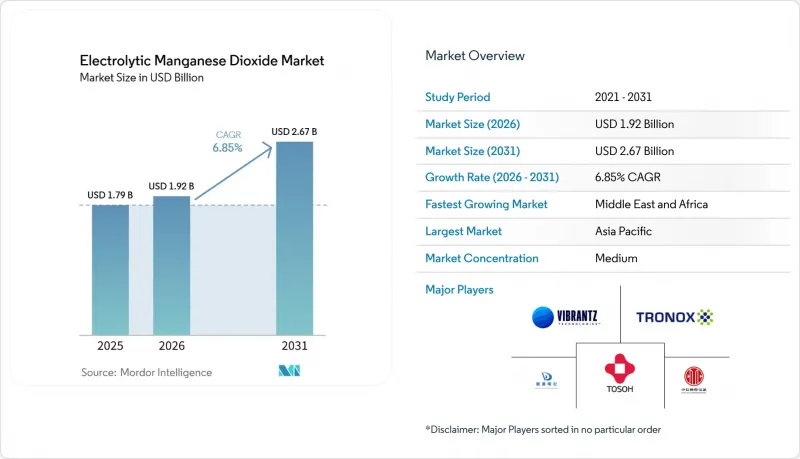
Mordor Intelligence에 의하면, 전해 이산화망간 시장 규모는 2025년에 17억 9,000만 달러로 평가되었습니다. 2026년에 19억 2,000만 달러에 달하고, 2031년까지 26억 7,000만 달러에 이를 것으로 예측되며, 2026년부터 2031년에 걸쳐 CAGR 6.85%로 성장할 전망입니다.
본 보고서는 유형(알칼리용 이산화망간, 리튬 이온 배터리용 이산화망간, 아연-탄소 전지용 이산화망간), 용도(전지, 수처리, 기타), 최종 사용자(자동차, 소비자용 전자기기, 산업용, 기타), 지역(북미, 유럽, 아시아태평양, 남미, 중동 및 아프리카)별로 분류되어 있습니다. 시장 전망은 금액(달러)으로 제시되어 있습니다.
세계의 전해 이산화망간 시장 동향 및 인사이트
고망간 함유 리튬이온 양극재의 급속한 확대
자동차 제조업체와 배터리 제조업체는 코발트에 대한 의존도를 낮추기 위해 NMC 8 시리즈 및 9 시리즈 화학 조성의 채택을 가속화하고 있습니다. 그러나 2030년까지 전 세계 리튬 이온 배터리 생산량이 3 TWh를 넘어설 것으로 예측됨에 따라, 망간 수요 전체는 증가 추세를 보이고 있습니다. CITIC Dameng은 2025년까지 광시에서 연간 3,000톤 규모의 리튬망간산화물(LMO) 생산 능력을 가동했으며, 이 생산 능력을 3배로 확대할 계획입니다. 한편, 한국 및 일본의 전구체 제조업체들은 배터리 등급의 황산망간에 대한 장기 공급 계약을 체결하고 있습니다. NMC 5 시리즈(Mn 함량 20%)에서 NMC 8 시리즈(Mn 함량 10%)로의 전환으로 인해 셀 1개당 망간 함량은 감소하지만, 셀 수준의 에너지 밀도 향상으로 팩의 소형화가 가능해짐에 따라 망간 수요는 계속해서 견조한 추세를 보이고 있습니다. 고망간 배합 재료는 체적 에너지 밀도보다 열 안정성이나 피크 출력이 우선시되는 하이브리드 파워트레인에 특히 적합합니다. 그 결과, 조달 팀은 사이클 수명을 확보하고 보증 위험을 최소화하기 위해 구리 함량 1ppm 미만이나 일관된 D50 입자 직경과 같은 순도 사양에 중점을 두고 있습니다.
미국 IRA 및 EU CRMA에 따른 현지화 인센티브
IRA 제45X조에서는 미국 또는 자유무역협정 체결국에서 조달된 배터리 등급 망간에 대해 10%의 생산 세액 공제가 허용됩니다. 이와 병행하여, CRMA에서는 총액 225억 유로에 달하는 47건의 전략적 프로젝트가 지정되어 있으며, 그 중에는 최대 27개월로 단축된 허가 절차의 혜택을 받는 7개의 망간 허브가 포함되어 있습니다. 유로 망가네즈(Euro Manganez)의 흐바레티체(Hvaletice) 광미 프로젝트와 노스볼트(Northvolt)의 NorthCYCLE 재활용 공장은 규정 준수를 충족하는 공급이 추적성이 없는 자재에 비해 15-20%의 가격 프리미엄을 실현할 수 있음을 보여주고 있습니다. ISO 14001 감사를 통한 온실가스(GHG) 배출 강도 및 노동 관행의 문서화는 완성된 전기차(EV)에 대한 ' 인플레이션 감축법(IRA)’의 세액 공제 적용 자격을 획득하고자 하는 Tier 1 양극재 구매자 및 자동차 OEM에게 점점 더 표준적인 요건이 되고 있습니다.
LFP 및 나트륨 이온계 화학 조성의 급속한 시장 점유율 확대
2025년, 인산철리튬(LFP)은 중국 승용 전기차(EV)용 양극재 시장의 50% 이상을 차지했습니다. 이는 평균 팩 가격이 108달러/kWh까지 하락하여 니켈·망간·코발트(NMC) 양극재에 비해 15%의 비용 우위를 점했기 때문입니다. CATL과 BYD가 상용화한 나트륨 이온 배터리는 저가형 자동차 및 이륜차용 망간을 포함하지 않는 대체재를 제공함으로써 경쟁 압력을 높였습니다. 자동차 제조업체(OEM)가 일단 LFP 또는 나트륨 이온 플랫폼을 채택하면, NMC로 다시 전환하는 데 최대 24개월의 재인증이 필요할 수 있으며, 그 결과 망간을 많이 사용하는 양극재 시장 점유율은 지속적으로 하락하고 있습니다. 나트륨 이온 배터리의 생산량은 2025년에 12GWh에 달할 것으로 예상되며, 이러한 급속한 확장성과 신흥 시장에서 전해 이산화망간(EMD)의 향후 수요를 감소시킬 가능성이 부각되었습니다.
부문 분석
2025년, 알칼리 전지용 등급의 EMD는 전해 이산화망간 시장 점유율의 49.5%를 차지하며, 주로 안정적인 1차 전지 부문을 뒷받침했습니다. 이 등급은 활성 산소 함량이 91-92%, 중금속 함량이 50 ppm 미만인 것이 특징이며, 이를 통해 자가 방전을 최소화할 수 있습니다. 대조적으로, 구리 함량을 1 ppm 미만으로 정제하고 D50 입자 직경을 26µm으로 설계된 리튬 이온 배터리용 EMD는 2031년까지 연평균 성장률(CAGR) 8.4%를 나타낼 것으로 예측되며, 알칼리 배터리용 EMD의 성장률을 상회할 전망입니다. 이러한 성장은 자동차 및 전력 계통용 에너지 저장 용도의 확대에 힘입은 것으로, 기존의 NMC 5 시리즈에서 고니켈 NMC 8 시리즈 배합으로의 전환에 따라 망간 함량이 20%에서 10%로 감소한 영향을 상쇄하고 있습니다.
토소(Tosoh)는 일본과 그리스에 2곳의 생산 거점을 보유하고 있으며, 총 생산 능력은 연간 6만 톤으로 세계 시장 점유율의 약 20%를 차지하고 있습니다. 그러나 Element 25나 Euro Manganese와 같은 기업들이 개발을 진행 중인 새로운 습식 제조법은 전환 비용을 25-30% 절감할 가능성을 내포하고 있어, 기존 전해법에 대한 과제로 대두되고 있습니다. 이러한 대체 공정은 고형 폐기물을 40-60% 줄인 저탄소 EMD를 생산하며, OEM(주문자 상표 제조업체)의 스코프 3 배출량 감축 목표에 부합합니다. 2028년 이후 생산 능력 확대의 향방은 프리미엄 배터리 등급의 가격 책정에 따라 자본 집약적인 전해 라인 도입이 정당화될지, 아니면 황산염 직접 침전법이 기존의 EMD 생산을 대체할지에 따라 결정될 것입니다.
지역별 분석
2025년, 아시아태평양은 전 세계 매출의 52.4%를 차지했으며, 이는 광석 채굴, EMD 전환 및 하류 양극재 조립 분야에서 중국의 주도적인 입지에 힘입은 결과입니다. 광시 좡족 자치구와 후난성은 합쳐서 전 세계 EMD 생산 능력의 60% 가까이를 차지하고 있습니다. 그러나 폐수 배출 규제가 강화되면서 중견 제조업체들이 시장에서 철수하고 있으며, 국내 양극재 수요가 두 자릿수 성장률을 기록하며 확대되는 가운데 공급이 부족해지고 있습니다. 일본과 한국은 중국 및 호주산 배터리 등급 EMD 수입에 크게 의존하고 있어, 반덤핑 관세나 운임 변동의 영향을 받기 쉬운 상황에 놓여 있습니다. 한편, 인도의 MOIL은 수출 가격을 인하하여 대체 구매처를 모색하고 있습니다.
중동 및 아프리카은 2031년까지 연평균 성장률(CAGR) 7.6%를 나타낼 것으로 예측됩니다. 사우디아라비아에서는 Northern Graphite사와 Al Obeikan사가 공동으로 건설하는 2억 달러 규모의 배터리용 활물질 공장이 2028년에 가동을 시작할 예정입니다. 남아프리카공화국의 Manganese Metal Company는 연간 6,000톤 이상의 고순도 황산망간 생산을 향해 착실히 진전을 보이고 있습니다. 가봉에서는 국내 선광을 촉진하기 위해 2029년 이후 원광석 수출 금지를 위한 준비를 진행하고 있습니다. 그러나 이 지역에서는 1kWh당 12센트를 초과하기도 하는 제련소 현금 비용의 40%를 차지하는 높은 전기 요금과 인프라 리스크를 완화하기 위한 다자간 자금 조달의 필요성 등 과제에 직면해 있습니다.
북미 및 유럽에서는 공급망 안보 관련 규제에 대응하기 위해 국내 생산 능력 확대가 추진되고 있습니다. 미국에서는 섹션 45X에 따라 10%의 세액 공제가 제공되고 있으며, 유럽에서는 ‘중요 원자재법(CRMA)’을 통해 허가 절차의 신속화가 도모되고 있습니다. 주요 프로젝트로는 EU 전략 프로젝트로 지정된 유로 망간(Euro Manganese)사의 흐바레티체(Hvale?ice) 광미 재처리 프로젝트와, 사우스32(South 32)사의 애리조나주 헤르모사(Hermosa)에 위치한 배터리용 망간 광상 등이 있습니다. 엘레멘트 25(Element 25)의 버처버드(Butcherbird) 프로젝트는 2024년에 최종 타당성 조사(DFS)를 완료하고, 2026년에 최종 투자 결정(FID)이 이루어질 전망입니다. 이를 통해 미국의 양극 전구체 공장에 자유무역협정(FTA)에 부합하는 원료 공급이 가능해집니다. 중국산 EMD 수입에 대한 최대 149.92%의 반덤핑 관세는 호주, 멕시코, 남아프리카공화국의 생산자들이 활용하고 있으며, 이들은 ‘인플레이션 감축법(IRA)’의 요건을 충족하고 동부 해안의 기가팩토리로의 운송 경로를 단축하는 것을 목표로 하고 있습니다.
기타 혜택 :
- 엑셀 형식 시장 예측(ME) 시트
- 3개월간의 애널리스트 지원
자주 묻는 질문
목차
제1장 서론
제2장 조사 방법
제3장 주요 요약
제4장 시장 구도
제5장 시장 규모 및 성장 예측
제6장 경쟁 구도
제7장 시장 기회 및 향후 전망
KTH 26.08.05According to Mordor Intelligence, the electrolytic manganese dioxide market size is projected to be USD 1.79 billion in 2025, USD 1.92 billion in 2026, and reach USD 2.67 billion by 2031, growing at a CAGR of 6.85% from 2026 to 2031.
This report is Segmented by Type (Alkaline Grade EMD, Lithium-Ion Battery Grade EMD, Zinc-Carbon Grade EMD), Application (Batteries, Water Treatment, Others), End-User (Automotive, Consumer Electronics, Industrial, Others), and Geography (North America, Europe, Asia-Pacific, South America, Middle East and Africa). Market Forecasts are Provided in Value (USD).
Global Electrolytic Manganese Dioxide Market Trends and Insights
Rapid Scale-Up of Lithium-Ion Cathodes with High-Manganese Content
Automakers and battery manufacturers are accelerating the adoption of NMC 8-series and 9-series chemistries to reduce cobalt dependency. However, overall manganese demand is increasing as global lithium-ion cell production is projected to surpass 3 TWh by 2030. CITIC Dameng is set to commission 3,000 tons per year of lithium manganese oxide (LMO) capacity in Guangxi by 2025, with plans to triple this capacity. Meanwhile, South Korean and Japanese precursor manufacturers have secured long-term offtake agreements for battery-grade manganese sulfate. Although the transition from NMC 5-series (20% Mn) to NMC 8-series (10% Mn) reduces manganese content per cell, improvements in cell-level energy density enable pack downsizing, sustaining positive manganese demand. High-manganese blends are particularly suited for hybrid powertrains, where thermal stability and peak power delivery are prioritized over volumetric energy density. As a result, procurement teams are focusing on purity specifications, such as sub-1 ppm copper levels and consistent D50 particle sizes, to ensure cycle life and minimize warranty risks.
Localization Incentives under US IRA & EU CRMA
Section 45X of the IRA grants a 10% production tax credit for battery-grade manganese sourced from the United States or free-trade-agreement nations. In parallel, the CRMA listed 47 strategic projects worth EUR 22.5 billion, including seven manganese hubs that enjoy accelerated permitting capped at 27 months. Euro Manganese's Chvaletice tailings project and Northvolt's NorthCYCLE recycling plant demonstrate how compliant supply can achieve a 15-20% price premium compared to non-traceable materials. The documentation of greenhouse gas (GHG) intensity and labor practices through ISO 14001 audits is increasingly becoming a standard requirement for Tier-1 cathode buyers and automotive OEMs aiming to qualify for Inflation Reduction Act tax credits on finished electric vehicles (EVs).
Rapid Share Gains of LFP & Sodium-Ion Chemistries
In 2025, lithium iron phosphate (LFP) accounted for over 50% of China's passenger electric vehicle (EV) cathode market, driven by a decline in average pack prices to USD 108/kWh, representing a 15% cost advantage compared to nickel manganese cobalt (NMC) cathodes. Sodium-ion cells, introduced commercially by CATL and BYD, added competitive pressure by providing manganese-free alternatives for low-cost vehicles and two-wheelers. Once an original equipment manufacturer (OEM) adopts LFP or sodium-ion platforms, transitioning back to NMC can require up to 24 months for requalification, leading to sustained market share losses for manganese-intensive cathodes. Sodium-ion production reached 12 GWh in 2025, highlighting its rapid scalability and potential to reduce future demand for electrolytic manganese dioxide (EMD) in emerging markets.
Other drivers and restraints analyzed in the detailed report include:
- Demand Surge from Alkaline Batteries in Emerging Economies
- Commercialization of Zinc-ion Stationary Storage Using EMD Cathodes
- Stricter Chinese Environmental Permits Curbing High-Purity Output
For complete list of drivers and restraints, kindly check the Table Of Contents.
Segment Analysis
Alkaline-battery grade EMD represented 49.5% of the Electrolytic Manganese Dioxide market share in 2025, primarily supporting the stable primary-cell segment. This grade is characterized by 91-92% active oxygen content and heavy-metal levels below 50 ppm, which help minimize self-discharge. In contrast, Lithium-Ion Battery Grade EMD, refined to contain less than 1 ppm copper and designed with a D50 particle size of 26 µm, is anticipated to grow at a compound annual growth rate (CAGR) of 8.4% through 2031, outpacing the growth of alkaline-grade EMD. This growth is driven by the expansion of automotive and grid storage applications, which offset the reduction in manganese content from 20% to 10% when transitioning from legacy NMC 5-series to high-nickel NMC 8-series formulations.
Tosoh's dual-site production facilities in Japan and Greece, with a combined capacity of 60,000 tons per year, account for approximately 20% of the global market share. However, emerging hydrometallurgical processes from companies like Element 25 and Euro Manganese have the potential to reduce conversion costs by 25-30%, posing a challenge to traditional electrolytic methods. These alternative processes produce low-carbon EMD with 40-60% less solid waste, aligning with original equipment manufacturers' (OEM) Scope-3 emission reduction targets. The future of capacity deployment beyond 2028 will depend on whether premium battery-grade pricing can justify the capital-intensive electrolysis lines or if direct sulfate precipitation methods will replace conventional EMD production.
Complete Report Scope:
- By Type
- Alkaline Grade EMD
- Lithium-ion Battery Grade EMD
- Zinc-carbon Grade EMD
- By Application
- Batteries
- Water Treatment
- Others
- By End-user
- Automotive
- Consumer Electronics
- Industrial
- Others
- By Geography
- North America
- United States
- Canada
- Mexico
- Europe
- Germany
- United Kingdom
- France
- Italy
- NORDIC Countries
- Russia
- Rest of Europe
- Asia-Pacific
- China
- India
- Japan
- South Korea
- ASEAN Countries
- Rest of Asia-Pacific
- South America
- Brazil
- Argentina
- Rest of South America
- Middle East and Africa
- Saudi Arabia
- United Arab Emirates
- South Africa
- Egypt
- Rest of Middle East and Africa
- North America
Geography Analysis
In 2025, the Asia-Pacific region accounted for 52.4% of global revenue, driven by China's leadership in ore mining, EMD conversion, and downstream cathode assembly. Guangxi and Hunan provinces collectively host nearly 60% of global EMD capacity. However, stricter wastewater regulations are prompting mid-tier producers to exit the market, tightening supply as domestic cathode demand grows at double-digit rates. Japan and South Korea rely heavily on imports of battery-grade EMD from China and Australia, leaving them vulnerable to anti-dumping tariffs and fluctuations in freight rates. Meanwhile, India's MOIL is seeking alternative buyers by reducing export prices.
The Middle East and Africa are projected to grow at a compound annual growth rate (CAGR) of 7.6% through 2031. In Saudi Arabia, a USD 200 million Northern Graphite-Al Obeikan battery active-material plant is planned for start-up in 2028. South Africa's Manganese Metal Company is advancing toward producing over 6,000 tons per year of high-purity manganese sulfate. Gabon is preparing to ban raw ore exports after 2029, aiming to boost domestic beneficiation. However, the region faces challenges such as high electricity tariffs, which can exceed 12 cents per kWh and account for 40% of smelter cash costs, as well as the need for multilateral lending to mitigate infrastructure risks.
North America and Europe are ramping up domestic production capacity in response to supply chain security mandates. In the United States, Section 45X offers a 10% tax credit, while the Critical Raw Materials Act (CRMA) in Europe facilitates fast-track permitting. Key projects include Euro Manganese's Chvaletice tailings reprocessing, designated as an EU Strategic Project, and South32's Hermosa battery-grade manganese deposit in Arizona. Element 25's Butcherbird project completed its definitive feasibility study (DFS) in 2024, with a final investment decision (FID) expected in 2026, enabling free-trade-agreement-compliant feedstock for U.S. cathode precursor plants. Anti-dumping margins of up to 149.92% on Chinese EMD imports are being leveraged by producers in Australia, Mexico, and South Africa, who aim to meet Inflation Reduction Act (IRA) requirements and shorter shipping lanes into East Coast gigafactories.
- American Manganese Inc.
- CITIC Dameng Holdings Limited
- Delta EMD
- Element 25 Limited
- Erachem Comilog S.A.
- Euro Manganese Inc.
- Group Stars Chemical Co., Ltd.
- Guiliu Chemical Co., Ltd.
- Guizhou Dalong Huicheng New Material Co., Ltd.
- Gulf Manganese Corporation Limited
- Mesa Minerals Limited
- MMC Norilsk Nickel
- NantEnergy, Inc.
- Nippon Denko Co., Ltd.
- Prince International (Vibrantz)
- South32 Limited
- Tosoh Corporation
- Tronox Holdings plc
- Urban Electric Power, Inc.
- Xiangtan Electrochemical Scientific Co., Ltd.
Additional Benefits:
- The market estimate (ME) sheet in Excel format
- 3 months of analyst support
TABLE OF CONTENTS
1 Introduction
- 1.1 Study Assumptions & Market Definition
- 1.2 Scope of the Study
2 Research Methodology
3 Executive Summary
4 Market Landscape
- 4.1 Market Overview
- 4.2 Market Drivers
- 4.2.1 Demand surge from alkaline primary batteries in emerging economies
- 4.2.2 Rapid scale-up of lithium-ion cathodes with high-manganese content (NMC, LMO)
- 4.2.3 Localization incentives for battery-grade manganese under US IRA & EU CRMA
- 4.2.4 Commercialization of zinc-ion stationary storage using EMD cathodes
- 4.2.5 Closed-loop recycling streams for spent alkaline & Li-Mn batteries
- 4.2.6 Low-carbon hydrometallurgical EMD from furnace-dust & laterite effluents
- 4.3 Market Restraints
- 4.3.1 Manganese ore & power cost volatility squeezing margins
- 4.3.2 Rapid share gains of LFP and sodium-ion chemistries in entry-level EVs
- 4.3.3 Stricter Chinese environmental permits curbing high-purity EMD output
- 4.3.4 Anti-dumping duties & export controls on EMD in key trade lanes
- 4.4 Supply-Chain Analysis
- 4.5 Regulatory Landscape
- 4.6 Technological Outlook
- 4.7 Porters Five Forces Analysis
- 4.7.1 Threat of New Entrants
- 4.7.2 Bargaining Power of Buyers
- 4.7.3 Bargaining Power of Suppliers
- 4.7.4 Threat of Substitutes
- 4.7.5 Competitive Rivalry
5 Market Size & Growth Forecasts
- 5.1 By Type
- 5.1.1 Alkaline Grade EMD
- 5.1.2 Lithium-ion Battery Grade EMD
- 5.1.3 Zinc-carbon Grade EMD
- 5.2 By Application
- 5.2.1 Batteries
- 5.2.2 Water Treatment
- 5.2.3 Others
- 5.3 By End-user
- 5.3.1 Automotive
- 5.3.2 Consumer Electronics
- 5.3.3 Industrial
- 5.3.4 Others
- 5.4 By Geography
- 5.4.1 North America
- 5.4.1.1 United States
- 5.4.1.2 Canada
- 5.4.1.3 Mexico
- 5.4.2 Europe
- 5.4.2.1 Germany
- 5.4.2.2 United Kingdom
- 5.4.2.3 France
- 5.4.2.4 Italy
- 5.4.2.5 NORDIC Countries
- 5.4.2.6 Russia
- 5.4.2.7 Rest of Europe
- 5.4.3 Asia-Pacific
- 5.4.3.1 China
- 5.4.3.2 India
- 5.4.3.3 Japan
- 5.4.3.4 South Korea
- 5.4.3.5 ASEAN Countries
- 5.4.3.6 Rest of Asia-Pacific
- 5.4.4 South America
- 5.4.4.1 Brazil
- 5.4.4.2 Argentina
- 5.4.4.3 Rest of South America
- 5.4.5 Middle East and Africa
- 5.4.5.1 Saudi Arabia
- 5.4.5.2 United Arab Emirates
- 5.4.5.3 South Africa
- 5.4.5.4 Egypt
- 5.4.5.5 Rest of Middle East and Africa
- 5.4.1 North America
6 Competitive Landscape
- 6.1 Market Concentration
- 6.2 Strategic Moves (M&A, Partnerships, PPAs)
- 6.3 Market Share Analysis (Market Rank/Share for key companies)
- 6.4 Company Profiles (includes Global level Overview, Market level overview, Core Segments, Financials as available, Strategic Information, Products & Services, and Recent Developments)
- 6.4.1 American Manganese Inc.
- 6.4.2 CITIC Dameng Holdings Limited
- 6.4.3 Delta EMD
- 6.4.4 Element 25 Limited
- 6.4.5 Erachem Comilog S.A.
- 6.4.6 Euro Manganese Inc.
- 6.4.7 Group Stars Chemical Co., Ltd.
- 6.4.8 Guiliu Chemical Co., Ltd.
- 6.4.9 Guizhou Dalong Huicheng New Material Co., Ltd.
- 6.4.10 Gulf Manganese Corporation Limited
- 6.4.11 Mesa Minerals Limited
- 6.4.12 MMC Norilsk Nickel
- 6.4.13 NantEnergy, Inc.
- 6.4.14 Nippon Denko Co., Ltd.
- 6.4.15 Prince International (Vibrantz)
- 6.4.16 South32 Limited
- 6.4.17 Tosoh Corporation
- 6.4.18 Tronox Holdings plc
- 6.4.19 Urban Electric Power, Inc.
- 6.4.20 Xiangtan Electrochemical Scientific Co., Ltd.
7 Market Opportunities & Future Outlook
- 7.1 White-space & Unmet-Need Assessment


