

|
시장보고서
상품코드
2097373
은행 산업용 기업 모빌리티 시장 : 시장 점유율 분석, 산업 동향 및 통계 데이터, 성장 예측(2025-2030년)Enterprise Mobility in Banking Industry - Market Share Analysis, Industry Trends & Statistics, Growth Forecasts (2025 - 2030) |
||||||
 Mordor Intelligence
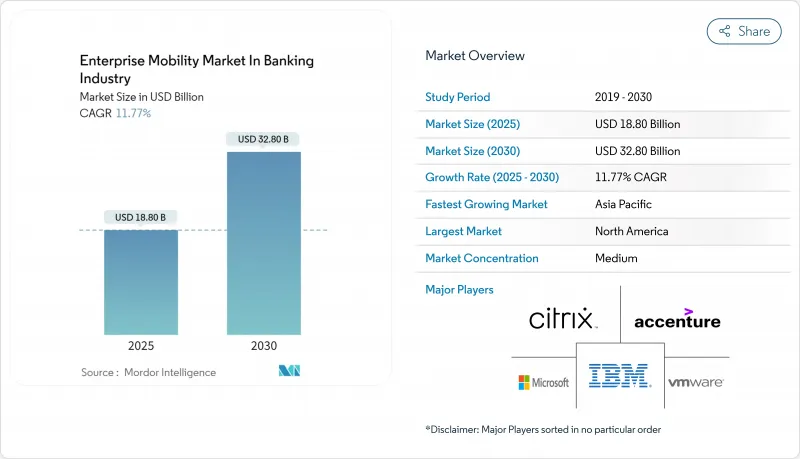
Mordor Intelligence에 의하면, 은행 산업용 기업 모빌리티 시장은 예측 기간(2025-2030년) CAGR 11.77%로 확대될 것으로 예측되며, 2025년 188억 달러에서 2030년에는 328억 달러에 이를 전망입니다.
본 보고서는 컴포넌트별(솔루션, 서비스), 솔루션 유형별(기기 관리, 액세스 관리, 애플리케이션 관리 등), 배포 방식별(온프레미스 및 하이브리드, 클라우드 네이티브), 기기 유형별(노트북 등), 기업 규모별(대형 은행, 중소 은행) 및 지역별로 분류되어 있습니다. 시장 전망은 금액(달러) 기준으로 제시되어 있습니다.
은행 산업용 기업 모빌리티 시장 동향 및 인사이트
제로 트러스트형 엔드포인트 보안에 대한 규제 당국의 추진
현재 전 세계 감독 당국은 은행이 사용자로부터 기기로 전송되는 모든 요청을 실시간으로 검증할 수 있는지 여부를 면밀히 검토하고 있습니다. 미국 연방금융기관검사위원회(FFIEC)는 지속적인 인증 및 기기 건전성 점검을 의무화하는 2024년 지침을 발표했습니다. 한편, 싱가포르 금융관리청(MAS)은 ‘기술 위험 관리 지침’에서 생체 인증을 통한 통제를 요구하고 있습니다. 이러한 규제로 인해 통합 엔드포인트 관리 및 액세스 관리에 대한 지출이 증가하고 있습니다. 이는 규정을 준수하지 못할 경우 강제 조치, 벌금 및 평판 하락이라는 위험이 발생하기 때문입니다. 감사 대응이 완료된 대시보드를 갖추고 ISO/IEC 27001:2022를 준수하는 공급업체가 조달 과정에서 우선적으로 선정되고 있습니다. 규제가 엄격해지는 가운데, 은행 업계를 대상으로 하는 엔터프라이즈 모빌리티 시장에서는 재량적 프로젝트가 일시 중단된 경우에도 꾸준한 예산 배분이 이루어지고 있습니다.
클라우드 네이티브 코어 및 API 퍼스트 플랫폼으로의 전환
COBOL 기반 코어 시스템을 폐지하는 은행은 릴리스 속도 측면에서 우위를 점하고 있습니다. 2024년 맥킨지 조사에 따르면, 클라우드 네이티브 코어 시스템으로 전환함으로써 새로운 모바일 기능 시장 출시까지 소요되는 시간이 40-60% 단축되는 것으로 나타났습니다. API를 공개한 로직은 임베디드 파이낸스(Embedded Finance) 파트너십을 가능하게 하지만, 공격 표면을 확대시키므로 API 호출을 검사하는 런타임 애플리케이션 자가 보호 도구의 도입이 촉진되고 있습니다. 컨테이너화된 모바일 애플리케이션 관리를 통해 은행은 사용자의 조작 없이도 즉시 업데이트를 배포할 수 있습니다. PSD2에 기반한 유럽은행감독청(EBA) 등 규제 당국은 모든 모바일 거래에서 강력한 고객 인증을 의무화함으로써 이러한 추세를 뒷받침하고 있습니다.
멀티 UEM 스택의 총 소유 비용(TCO) 상승
2024년 딜로이트의 분석에 따르면, 3개 이상의 엔드포인트 관리 도구를 운영하는 은행은 비용이 30-40% 더 많이 드는 반면, 정책 불일치로 인해 보안 태세 평가가 낮아지는 것으로 나타났습니다. 통합은 기술적으로는 가능하지만, 각 사업 부문이 자사 부문이 선호하는 기능을 고수하고 있어 조직적인 측면에서는 복잡합니다. 비용 압박으로 인해 금융 기관은 프라이빗 5G 슬라이싱과 같은 고급 기능 도입을 연기할 수밖에 없어, 은행 업계를 대상으로 한 엔터프라이즈 모빌리티 시장 전체의 성장 속도가 둔화되고 있습니다.
부문 분석
2024년에는 솔루션이 매출의 70.22%를 차지했으며, 그 주요 구성 요소는 통합 엔드포인트 관리, 모바일 위협 방어, 그리고 ID 및 액세스 관리 제품군이었습니다. 그러나 서비스 부문은 연평균 성장률(CAGR) 12.22%를 나타낼 것으로 예측되며, 이는 단순한 소프트웨어 도입보다 통합 및 24시간 모니터링이 더 중요시되고 있음을 보여줍니다. 액센츄어(Accenture)나 타타 컨설팅 서비스(TCS)와 같은 시스템 통합사업자들은 은행을 제로 트러스트 프레임워크로 전환하기 위한 다년 계약을 수주하고 있습니다. 이러한 컨설팅 수요의 급증은 은행 업계용 엔터프라이즈 모빌리티 시장의 서비스 부문 규모가 초기 소프트웨어 투자를 보완하고 있음을 여실히 보여줍니다.
관할 구역별 규제 차이가 자문 서비스 수요를 뒷받침하는 한편, 사용량 기반의 클라우드 가격 책정으로 인해 소프트웨어 및 서비스가 단일 구독으로 통합되고 있습니다. 각 은행은 감사 비용을 절감하고 가동 시작을 가속화하는 패키지화된 컴플라이언스 프레임워크를 선호하고 있습니다. 그 결과, 은행 업계를 대상으로 하는 엔터프라이즈 모빌리티 시장에서는 수익원이 라이선스에서 매니지드 서비스로 지속적으로 전환되고 있습니다.
2024년에는 디바이스 관리가 매출의 42.45%를 차지한 것으로 평가되었으며, 이는 기업용 디바이스의 기존 프로비저닝 현황을 반영한 것입니다. 그러나 BYOD(개인 소유 기기의 업무용 활용) 정책의 확산에 힘입어 용도 관리는 연평균 성장률(CAGR) 14.25%로 확대될 것으로 예측됩니다. 컨테이너화된 엔클레이브는 기기가 침해된 경우에도 은행 데이터를 격리하며, 용도 수준의 VPN은 사용 장벽을 낮춥니다. 이 기능을 통해 금융 기관은 사용자의 개인정보 보호와 규제 당국의 감독 요건을 모두 충족할 수 있게 됩니다. 그 결과, 은행 업계를 대상으로 하는 엔터프라이즈 모빌리티 시장에서 컨테이너 솔루션에 할당되는 규모는 기본적인 UEM 프로비저닝보다 빠르게 확대되고 있습니다.
접근 관리 분야의 병행된 성장은 제로 트러스트 원칙에 기인합니다. 생체 인증을 통한 로그인 및 행동 분석이 피싱 공격에 취약한 비밀번호를 대체하고 있습니다. 각 벤더사는 모바일 위협 방지 솔루션과 보안 브라우저를 통합 대시보드에 결합하고 있으며, 이러한 전략을 통해 보안 센터 운영이 간소화될 뿐만 아니라 은행 업계용 엔터프라이즈 모빌리티 시장의 가치 제안이 강화되고 있습니다.
지역별 분석
북미는 2024년 매출의 36.07%를 차지한 것으로 평가되었으며, 이는 FFIEC의 지침과 제로 트러스트의 조기 도입에 힘입은 결과입니다. FBI의 권고에서 조직 범죄가 SMS를 미끼로 이용하고 있다는 점이 지적됨에 따라, 지역 은행들은 피싱 감지에 막대한 투자를 하고 있습니다. 캐나다와 멕시코의 금융 기관들도 마찬가지로, 금융 포용성 목표 달성을 위해 생체 인증 및 모바일 플랫폼을 도입하고 있습니다.
아시아태평양은 2030년까지 연평균 성장률(CAGR) 12.9%를 기록할 전망입니다. 싱가포르, 인도, 중국은 디지털 뱅킹 라이선스, 실시간 결제 인프라, 국영 모바일 OS를 추진하고 있습니다. PwC 보고서에 따르면, 지연에 민감한 애플리케이션을 위해 지점 내 프라이빗 5G 네트워크 도입이 증가하고 있습니다. 일본, 한국, 호주에서는 사이버 보안 기준을 충족하기 위해 모바일 보안 스택 업그레이드가 진행되고 있습니다. 한편, 인도네시아와 베트남에서는 모바일 퍼스트 플랫폼을 도입함으로써 기존의 핵심 시스템을 획기적으로 대체하고 있습니다.
유럽은 PSD2 및 디지털 운영 복원력 법에 따라 여전히 큰 시장 점유율을 유지하고 있습니다. 라틴아메리카에서는 브라질과 멕시코에서 오픈 뱅킹 의무화가 가속화되고 있는 반면, 중동 및 아프리카에서는 웰스 펀드를 통한 자금 조달을 배경으로 자국 주도의 클라우드 엔드포인트가 도입되고 있습니다. 이러한 동향들이 맞물리면서 은행 업계를 위한 엔터프라이즈 모빌리티 시장의 발자취는 전 세계적으로 확대되고 있습니다.
기타 혜택 :
- Excel 형식 시장 예측(ME) 시트
- 3개월간의 애널리스트 지원
자주 묻는 질문
목차
제1장 서론
제2장 분석 방법
제3장 주요 요약
제4장 시장 구도
제5장 시장 규모 및 성장률 예측
제6장 경쟁 구도
제7장 시장 기회 및 향후 전망
AJY 26.08.07According to Mordor Intelligence, the enterprise mobility market in Banking Industry is expected to grow from USD 18.80 billion in 2025 to USD 32.80 billion by 2030, at a CAGR of 11.77% during the forecast period (2025-2030).
This report is Segmented by Component (Solutions, and Services), Solution Type (Device Management, Access Management, Application Management, and More), Deployment (On-Premises/Hybrid, and Cloud-Native), Device Type (Laptops, and More), Enterprise Size (Large Banks, and Small and Mid-Size Banks), and Geography. The Market Forecasts are Provided in Terms of Value (USD).
Insights and Trends of Enterprise Mobility Market in Banking Industry
Regulatory Push for Zero-Trust Endpoint Security
Supervisors worldwide now examine whether banks can verify every user-to-device request in real time. The U.S. Federal Financial Institutions Examination Council issued 2024 guidance that requires continuous authentication and device-health checks, while the Monetary Authority of Singapore demands biometric controls in its Technology Risk Management Guidelines. These rules elevate unified endpoint management and access-management spending, because failure to comply risks enforcement, fines, and reputational loss. Vendors with audit-ready dashboards and ISO/IEC 27001:2022 alignment command procurement preference. As mandates tighten, the enterprise mobility market in banking industry witnesses steady budget allocation even when discretionary projects pause.
Shift to Cloud-Native Core and API-First Platforms
Banks retiring COBOL-based cores gain release velocity advantages: a 2024 McKinsey study showed 40-60% faster time-to-market for new mobile features once moved to cloud-native cores. API-exposed logic enables embedded-finance partnerships but widens the attack surface, prompting adoption of runtime application self-protection tools that inspect API calls. Containerized mobile-application management lets banks push updates instantly without user action. Regulatory bodies, such as the European Banking Authority under PSD2, reinforce the trend by mandating strong customer authentication for every mobile transaction.
Rising Cost-of-Ownership for Multi-UEM Stacks
A 2024 Deloitte analysis found banks running three or more endpoint-management tools spend 30-40% more yet score worse on security posture due to policy inconsistencies. Consolidation is technologically feasible but politically complex as business units guard preferred features. Cost pressure forces institutions to delay advanced capabilities like private-5G slicing, slowing the overall enterprise mobility market in banking industry trajectory.
Other drivers and restraints analyzed in the detailed report include:
- Rising Remote and Hybrid Banking Workforce
- Growth of Instant Real-Time Payments and Embedded Finance Workflows
- Macroeconomic Tech-Budget Compression
For complete list of drivers and restraints, kindly check the Table Of Contents.
Segment Analysis
Solutions held 70.22% revenue in 2024, mainly unified endpoint management, mobile-threat defense, and identity-access suites. Yet services are predicted to grow at a 12.22% CAGR, indicating that integration and 24-hour monitoring trump pure software installations. Systems integrators such as Accenture and Tata Consultancy Services win multi-year contracts to migrate banks to zero-trust frameworks. This consultancy surge underscores how the enterprise mobility market in banking industry size for services complements the initial software outlay.
Regulatory divergence across jurisdictions fuels demand for advisory offerings, while consumption-based cloud pricing merges software and services into a single subscription. Banks prefer packaged compliance frameworks that reduce audit costs and accelerate go-live. As a result, the enterprise mobility market in banking industry continually shifts margin pools from licenses to managed services.
Device management captured 42.45% revenue in 2024, reflecting legacy provisioning of corporate devices. However, application management is forecast to expand at 14.25% CAGR, propelled by bring-your-own-device policies. Containerized enclaves isolate banking data even if the device is compromised, and app-level VPNs reduce friction. This capability allows institutions to satisfy both user privacy and regulator scrutiny. The enterprise mobility market in banking industry size allocated to container solutions is therefore rising faster than base UEM provisioning.
Concurrent growth in access-management stems from zero-trust rules. Biometric logins and behavioral analytics replace passwords prone to phishing. Vendors combine mobile-threat defense and secure browsers into unified dashboards, a strategy that simplifies operations for security centers and strengthens the enterprise mobility market in banking industry market value proposition.
Complete Report Scope:
- By Component
- Solutions
- Services
- By Solution Type
- Device Management
- Access Management
- Application Management
- Other Solution Types
- By Deployment
- On-Premises / Hybrid
- Cloud-Native
- By Device Type
- Laptops
- Smartphones and Tablets
- Other Device Types
- By Enterprise Size
- Large Banks
- Small and Mid-size Banks
- By Geography
- North America
- United States
- Canada
- Mexico
- South America
- Brazil
- Argentina
- Chile
- Rest of South America
- Europe
- United Kingdom
- Germany
- France
- Italy
- Spain
- Rest of Europe
- Asia-Pacific
- China
- Japan
- India
- South Korea
- Australia and New Zealand
- Rest of Asia-Pacific
- Middle East and Africa
- Middle East
- United Arab Emirates
- Saudi Arabia
- Turkey
- Rest of Middle East
- Africa
- South Africa
- Kenya
- Nigeria
- Rest of Africa
- Middle East
- North America
Geography Analysis
North America held 36.07% revenue in 2024, shaped by FFIEC guidance and early zero-trust adoption. Regional banks invest heavily in phishing detection after an FBI advisory highlighted organized crime using SMS lures. Canadian and Mexican institutions likewise deploy biometrics and mobile platforms for inclusion goals.
Asia Pacific is set to record a 12.9% CAGR to 2030. Singapore, India, and China champion digital-banking licenses, real-time payment rails, and sovereign mobile operating systems. PwC reports rising deployment of private 5 G networks in branches for latency-sensitive applications. Japan, South Korea, and Australia upgrade mobile-security stacks to meet cybersecurity codes, while Indonesia and Vietnam leapfrog legacy cores with mobile-first platforms.
Europe maintains a sizable share under PSD2 and the Digital Operational Resilience Act. Latin America accelerates on open-banking mandates in Brazil and Mexico, whereas the Middle East and Africa deploy sovereign-cloud endpoints backed by wealth-fund financing. Together, these developments extend the enterprise mobility in the banking market footprint worldwide.
- Microsoft Corporation
- VMware Inc.
- BlackBerry Limited
- IBM Corporation
- Citrix Systems Inc.
- Accenture plc
- Infosys Limited
- HCL Technologies Limited
- Tata Consultancy Services Limited
- Capgemini SE
- Cisco Systems Inc.
- Samsung Electronics Co. Ltd.
- Jamf Holding Corp.
- Ivanti Inc.
- SOTI Inc.
- Sophos Ltd.
- Palo Alto Networks Inc.
- Broadcom Inc. (Workspace ONE)
- Oracle Corporation
- AT&T Inc. (Managed Mobility)
Additional Benefits:
- The market estimate (ME) sheet in Excel format
- 3 months of analyst support
TABLE OF CONTENTS
1 INTRODUCTION
- 1.1 Study Assumptions and Market Definition
- 1.2 Scope of the Study
2 RESEARCH METHODOLOGY
3 EXECUTIVE SUMMARY
4 MARKET LANDSCAPE
- 4.1 Market Overview
- 4.2 Market Drivers
- 4.2.1 Rising Remote and Hybrid Banking Workforce
- 4.2.2 Shift to Cloud-Native Core and API-First Platforms
- 4.2.3 Regulatory Push for Zero-Trust Endpoint Security
- 4.2.4 5G-SA and Private-Wireless Roll-outs in Branch and Data Center
- 4.2.5 Growth of Instant Real-Time Payments and Embedded Finance Workflows
- 4.2.6 Consumer Mobile-Phishing Surge Forcing In-App RASP Adoption
- 4.3 Market Restraints
- 4.3.1 Rising Cost-of-Ownership for Multi-UEM Stacks
- 4.3.2 Scarcity of Mobile-Security and Dev-Sec-Ops Talent
- 4.3.3 End-User Resistance to Device / Content Controls
- 4.3.4 Macroeconomic Tech-Budget Compression
- 4.4 Industry Value / Supply-Chain Analysis
- 4.5 Impact of Macroeconomic Factors on the Market
- 4.6 Regulatory Landscape
- 4.7 Technological Outlook
- 4.8 Porter's Five Forces Analysis
- 4.8.1 Bargaining Power of Suppliers
- 4.8.2 Bargaining Power of Consumers
- 4.8.3 Threat of New Entrants
- 4.8.4 Intensity of Competitive Rivalry
- 4.8.5 Threat of Substitute Products
5 MARKET SIZE AND GROWTH FORECASTS (VALUE)
- 5.1 By Component
- 5.1.1 Solutions
- 5.1.2 Services
- 5.2 By Solution Type
- 5.2.1 Device Management
- 5.2.2 Access Management
- 5.2.3 Application Management
- 5.2.4 Other Solution Types
- 5.3 By Deployment
- 5.3.1 On-Premises / Hybrid
- 5.3.2 Cloud-Native
- 5.4 By Device Type
- 5.4.1 Laptops
- 5.4.2 Smartphones and Tablets
- 5.4.3 Other Device Types
- 5.5 By Enterprise Size
- 5.5.1 Large Banks
- 5.5.2 Small and Mid-size Banks
- 5.6 By Geography
- 5.6.1 North America
- 5.6.1.1 United States
- 5.6.1.2 Canada
- 5.6.1.3 Mexico
- 5.6.2 South America
- 5.6.2.1 Brazil
- 5.6.2.2 Argentina
- 5.6.2.3 Chile
- 5.6.2.4 Rest of South America
- 5.6.3 Europe
- 5.6.3.1 United Kingdom
- 5.6.3.2 Germany
- 5.6.3.3 France
- 5.6.3.4 Italy
- 5.6.3.5 Spain
- 5.6.3.6 Rest of Europe
- 5.6.4 Asia-Pacific
- 5.6.4.1 China
- 5.6.4.2 Japan
- 5.6.4.3 India
- 5.6.4.4 South Korea
- 5.6.4.5 Australia and New Zealand
- 5.6.4.6 Rest of Asia-Pacific
- 5.6.5 Middle East and Africa
- 5.6.5.1 Middle East
- 5.6.5.1.1 United Arab Emirates
- 5.6.5.1.2 Saudi Arabia
- 5.6.5.1.3 Turkey
- 5.6.5.1.4 Rest of Middle East
- 5.6.5.2 Africa
- 5.6.5.2.1 South Africa
- 5.6.5.2.2 Kenya
- 5.6.5.2.3 Nigeria
- 5.6.5.2.4 Rest of Africa
- 5.6.5.1 Middle East
- 5.6.1 North America
6 COMPETITIVE LANDSCAPE
- 6.1 Market Concentration
- 6.2 Strategic Moves
- 6.3 Market Share Analysis
- 6.4 Company Profiles (includes Global-level Overview, Market-level Overview, Core Segments, Financials as available, Strategic Information, Market Rank / Share for key companies, Products and Services, and Recent Developments)
- 6.4.1 Microsoft Corporation
- 6.4.2 VMware Inc.
- 6.4.3 BlackBerry Limited
- 6.4.4 IBM Corporation
- 6.4.5 Citrix Systems Inc.
- 6.4.6 Accenture plc
- 6.4.7 Infosys Limited
- 6.4.8 HCL Technologies Limited
- 6.4.9 Tata Consultancy Services Limited
- 6.4.10 Capgemini SE
- 6.4.11 Cisco Systems Inc.
- 6.4.12 Samsung Electronics Co. Ltd.
- 6.4.13 Jamf Holding Corp.
- 6.4.14 Ivanti Inc.
- 6.4.15 SOTI Inc.
- 6.4.16 Sophos Ltd.
- 6.4.17 Palo Alto Networks Inc.
- 6.4.18 Broadcom Inc. (Workspace ONE)
- 6.4.19 Oracle Corporation
- 6.4.20 AT&T Inc. (Managed Mobility)
7 MARKET OPPORTUNITIES AND FUTURE OUTLOOK
- 7.1 White-space and Unmet-Need Assessment


