|
시장보고서
상품코드
2114144
기업 모빌리티 관리 : 시장 점유율 분석, 업계 동향과 통계, 성장 예측(2026-2031년)Enterprise Mobility Management - Market Share Analysis, Industry Trends & Statistics, Growth Forecasts (2026 - 2031) |
||||||
 Mordor Intelligence
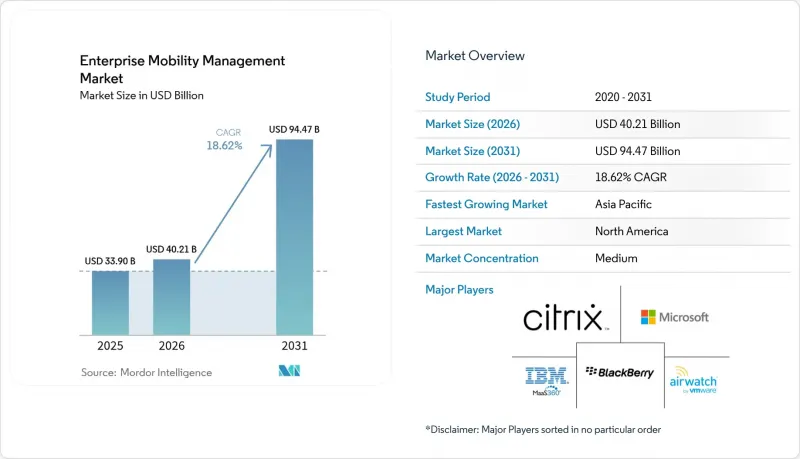
Mordor Intelligence에 따르면 기업 모빌리티 관리(EMM) 시장 규모는 2025년에 339억 달러로 평가되며, 2026년 402억 1,000만 달러에서 2031년까지 944억 7,000만 달러에 달할 것으로 예측되고 있으며, 예측 기간(2026-2031년)에 CAGR은 18.62%에 달할 전망입니다.
이 보고서는 유형(솔루션 및 서비스), 배포 방식(온프레미스, 클라우드 기반, 하이브리드), 조직 규모(대기업 및 중소기업), 최종사용자 산업(BFSI, 헬스케어·생명과학, IT·통신, 제조·산업, 소매·E-Commerce 등), 그리고 지역별로 분류되어 있습니다. 시장 전망은 금액(달러) 기준으로 제시되어 있습니다.
글로벌 기업 모빌리티 관리 시장의 동향 및 인사이트
기업용 모바일 기기 및 앱의 보급
소매업체, 공공사업체 및 공공 기관은 현재 그 규모 면에서 통신 사업자에 필적하는 기기군을 관리하고 있습니다. 세븐일레븐 재팬은 21,000개 매장에 걸쳐 30만 대의 태블릿을 일원화하여 관리하고 있으며, 클라우드 오케스트레이션을 통해 전국 규모로 통일된 정책 적용이 실현되고 있음을 보여주고 있습니다. Microsoft Intune의 Apple Vision Pro용 새로운 정책 세트는 EMM 콘솔이 사용자 경험을 저해하지 않으면서 보호해야 하는 엔드포인트의 다양화가 진행되고 있음을 시사합니다. 디바이스 에이전트에 내장된 예측 분석을 통해 배터리 상태나 업데이트 규정 준수 이상 징후가 다운타임으로 이어지기 전에 탐지됩니다. ‘기업 소유·개인 사용(COPE)’ 모델이 엄격한 락다운 방식을 대체하여, 데이터 관리 권한을 유지하면서도 직원 만족도를 높이고 있습니다.
확대되는 BYOD 및 원격 근무 문화
현재 전 세계 기업의 92%가 어떤 형태로든 원격 액세스를 허용하고 있으며, 이는 2023년의 76%에서 증가한 수치로, 보안 팀은 암호화된 컨테이너를 통해 기업 데이터와 개인 컨텐츠를 분리해야 하는 상황에 직면해 있습니다. 의료 시스템은 HIPAA 규정 준수 및 임상의의 편의성이라는 이중의 압박에 직면해 있으며, 관리 대상 외 스마트폰에 ePHI를 남기지 않고 애플리케이션을 스트리밍하는 가상 워크스페이스 툴의 도입이 진행되고 있습니다. 45개 기관으로 구성된 미국 연방 모빌리티 그룹(U.S. Federal Mobility Group)은 조달을 효율화하고 FedRAMP 승인을 가속화하기 위해 BYOD 평가 체크리스트의 표준화를 추진하고 있습니다. 교대 근무 기반 접근 제어 및 신속한 기업 데이터 삭제 기능은 현재 기본적인 요구 사항이 되었습니다.
높은 도입 및 업그레이드 비용
기업 모빌리티를 처음 도입하는 기업의 경우, 총 소유 비용(TCO)은 여전히 불투명한 상태입니다. 150명의 기업 스마트폰 관리자를 대상으로 한 설문조사에 따르면 31.3%가 플랫폼 선정시 가장 큰 장벽으로 ‘비용 투명성’을 꼽았습니다. 규정 준수 감사, 인증서 갱신, 그리고 사용 종료된 기기의 폐기에 드는 숨겨진 비용은 첫해 구독 요금을 초과하는 경우도 적지 않습니다. 이에 대응하여 벤더들은 기능 분리를 통해 대응하고 있으며, 마이크로소프트는 현재 ‘Enterprise Application Management’의 가격을 사용자 1인당 월 2달러로 책정하고 있습니다. 이를 통해 중소기업도 SKU를 전면적으로 업그레이드하지 않고도 고급 패치 적용 기능을 추가할 수 있게 되었습니다. 클라우드를 통한 제공은 설비 투자(Capex)를 줄여주지만, 예산을 지속적인 운영비(OpEx)로 전환해야 하므로 직원 수가 변동하기 쉬운 조직에게는 과제가 됩니다.
부문 분석
솔루션 부문은 2025년 매출의 62.35%를 차지하며, 기기, 애플리케이션, 컨텐츠 각 계층을 통합하는 핵심으로서의 입지를 공고히 하고 있습니다. ‘보안 관리’ 부문은 연평균 성장률(CAGR) 20.41%로 두드러지며, 끊임없이 진화하는 위협을 반영하고 있습니다. ‘기기 관리’는 신규 고객 유치의 관문으로서의 역할을 유지하면서, AI 기반 수정 기능을 통합하는 사례가 늘고 있습니다. 애플리케이션 컨테이너는 개인 스마트폰에서 기업 데이터를 격리함으로써 유럽 및 캘리포니아주의 개인정보 보호 관련 법규 준수를 실현하고 있습니다. 컨텐츠 및 이메일 관리는 기본적인 암호화에서 무단 공유를 차단하는 정책 주도형 워터마크 기술로 전환되고 있습니다. 통신비 관리는 여전히 틈새 분야이지만, SIM 수준에서의 비용 관리를 요구하는 물류 기업 사이에서 지지를 넓혀가고 있습니다.
서비스 라인은 제품 포트폴리오를 보완하는 역할을 수행합니다. 전문 서비스 팀은 도입 준비 현황 평가 및 단계적 전환 계획을 통해 도입에 수반되는 위험을 완화합니다. 매니지드 서비스는 24시간 텔레메트리 모니터링을 제공하며, 이는 의료 및 소매 업계의 인력 부족으로 어려움을 겪는 IT 부서에 필수적입니다. 마이크로소프트의 ‘Advanced Analytics’ 모듈에는 이상 탐지 API가 포함되어 있으며, 파트너사는 컨설팅 업무를 통해 이를 수익화하고 있습니다. AI가 성숙해짐에 따라 수직 시장의 데이터를 활용하여 모델을 미세 조정할 수 있는 도메인 전문가가 이익률 향상을 실현하며, 기존 사업자에게는 범용적인 MSP에 대한 우위를 가져다줍니다.
클라우드 솔루션은 2025년 지출의 58.10%를 차지하며 연평균 성장률(CAGR) 18.93%라는 가장 높은 성장률을 기록했습니다. 이에 따라 기업 모빌리티 관리 시장은 규정 준수 라이브러리를 자동으로 업데이트하는 확장 가능한 SaaS 콘솔로 전환되고 있습니다. 한 전국 규모의 소매 체인은 5,000개의 엔드포인트에서 개념 증명(PoC)을 실시하여 4주 만에 본격적인 운영으로의 완전한 전환을 달성했습니다. 이는 기존의 온프레미스 환경에서는 상상할 수 없는 속도입니다. 하이브리드 클라우드는 데이터 상주성을 보장해야 하는 은행에게 여전히 가교 역할을 하고 있습니다. 기밀성이 높은 토큰은 온프레미스에 보관되며, 정책 로직은 공급자 지역별로 격리된 클라우드에서 실행됩니다. 온프레미스는 에어 갭이 적용된 서버가 기밀 데이터 요건을 충족하는 국방 용도 도입에 여전히 채택되고 있습니다.
비용의 탄력성이 클라우드 보급을 지원하고 있습니다. 종량제 요금 모델을 통해 중소기업은 대규모 라이선스를 일괄 구매하지 않고도 기기 도입 곡선에 맞춰 유연하게 확장할 수 있습니다. 미국 GSA의 ‘Best-in-Class Mobility’ 계약과 같은 정부의 일괄 구매 계약은 조달을 클라우드 및 5G 지원 서비스 쪽으로 기울이고 있습니다. EU의 디지털 ID 지갑 규정은 회원국들에게 24개월 이내에 클라우드 네이티브 인증 정보 저장소를 구축할 것을 의무화하고 있습니다. 현지 가명화 기준에 대해 사전 인증을 획득한 벤더는 여전히 싱글 테넌트형 서비스에 의존하고 있는 경쟁사들을 앞지를 것입니다.
지역별 분석
북미는 2025년 매출의 32.30%를 차지할 것으로 예상되며, 공공 부문의 정보 유출 관련 규제로 인해 기기 보안상태 점검 및 지속적인 인증에 대한 지출이 가속화되었습니다. 사이버보안 및 인프라 보안국(CISA)의 모바일 체크리스트는 현재 15개 연방 부처에 걸친 조달 템플릿의 기반이 되고 있습니다. 캐나다의 개인정보 보호법 개정에 따라 서비스 제공업체는 개인을 식별할 수 있는 데이터를 국내에 보관해야 할 의무가 부과됨에 따라 국내 SaaS 리전에 대한 수요가 증가하고 있습니다. 멕시코의 자동차 산업 회랑에서는 공장 현장에서 엣지 지원 태블릿이 도입되고 있으며, 이로 인해 산업용 시스템 통합사업자들은 이중 언어 UI 및 현지 통신 사업자용 eSIM 프로파일 인증을 요구받고 있습니다.
아시아태평양은 스마트폰의 보급과 각국의 디지털 전략에 힘입어 21.74%라는 최고 연평균 성장률(CAGR)을 기록하고 있습니다. 일본의 편의점 및 교육 기관에서 진행된 시범 프로젝트에서는 하이퍼스케일 구축이 입증되었으며, 집중형 패치 적용을 통한 운영 효율성 향상이 두드러지게 나타나고 있습니다. 인도의 ‘디지털 개인 데이터 보호법’에서는 정보 유출 보고 기한이 최단 72시간으로 설정되어 있으며, 중소기업은 감사에 대응할 수 있는 로그 기능을 갖춘 정책 엔진의 도입을 서둘러야 합니다. 중국은 기기 대수 측면에서 압도적인 점유율을 차지하고 있지만, 해외 클라우드에 대한 접근을 제한하고 있으며, 다국적 기업은 사이버 보안 심사에 대응하기 위해 하이브리드 아키텍처를 채택하고 있습니다. 호주의 ‘보안 보호 지침 001-2025’에서는 기업 모빌리티 엔드포인트에 필수적인 암호화 알고리즘이 명시되어 있으며, 표준화된 입찰 요건이 마련되어 있습니다.
유럽에서는 ‘사이버 복원력법’을 통해 제품 보안 감독을 강화하고 있으며, 2027년까지 CE 마크 준수 및 사고 대응 프로세스 구축이 의무화되어 있습니다. 독일 BSI(연방정보보안청)의 BlackBerry UEM 인증은 기밀 취급이 필요한 Apple 기기 도입의 길을 열어주었으며, 인증된 솔루션에 대한 각국의 선호도를 입증하고 있습니다. 영국은 브렉시트 이후의 데이터 전송 규정을 세분화하면서도 EU의 적정성 인정 제도와의 상호 운용성을 유지하고 있으며, 국경을 초월한 SaaS 도입을 지원하고 있습니다. 남유럽 국가들은 EMM 암호화 모듈을 기반으로 한 디지털 ID 지갑을 우선적으로 도입하여, 시민 서비스 대기 시간을 단축하고 포용적인 거버넌스를 확대하고 있습니다.
기타 혜택:
- 엑셀 형식의 시장 예측(ME) 시트
- 3개월간의 애널리스트 지원
자주 묻는 질문
목차
제1장 서론
제2장 조사 방법
제3장 개요
제4장 시장 구도
제5장 시장 규모와 성장 예측
제6장 경쟁 구도
제7장 시장 기회와 향후 전망
KSA 26.08.26According to Mordor Intelligence, the enterprise mobility management market size was valued at USD 33.90 billion in 2025 and estimated to grow from USD 40.21 billion in 2026 to reach USD 94.47 billion by 2031, at a CAGR of 18.62% during the forecast period (2026-2031).
This report is Segmented by Type (Solutions, and Services), Deployment Mode (On-Premise, Cloud-Based, and Hybrid), Organization Size (Large Enterprises, and Small and Medium-Sized Enterprises), End-User Industry (BFSI, Healthcare and Life Sciences, IT and Telecom, Manufacturing and Industrial, Retail and E-Commerce, and More), and Geography. The Market Forecasts are Provided in Terms of Value (USD).
Global Enterprise Mobility Management Market Trends and Insights
Proliferation of Enterprise Mobile Devices and Apps
Retailers, utilities, and public-sector agencies now oversee device fleets that rival telecom operators in scale. Seven-Eleven Japan centrally manages 300,000 tablets across 21,000 stores, demonstrating how cloud orchestration delivers uniform policy enforcement at national reach. Microsoft Intune's new policy set for Apple Vision Pro indicates a widening endpoint mix that EMM consoles must secure without sacrificing user experience. Predictive analytics embedded in device agents surface battery-health and update-compliance anomalies before they become downtime events. Corporate-owned-personally-enabled (COPE) models are replacing restrictive lockdowns, boosting employee satisfaction while preserving data custody.
Rising BYOD and Remote-Work Culture
Ninety-two percent of global firms now allow some form of remote access, up from 76% in 2023, forcing security teams to isolate corporate data from personal content through encrypted containers. Healthcare systems face twin pressures of HIPAA compliance and clinician convenience, pushing uptake of virtual workspace tools that stream applications without persisting ePHI on unmanaged phones. The U.S. Federal Mobility Group, comprising 45 agencies, is codifying shared BYOD assessment checklists to streamline procurement and speed FedRAMP approvals. Shift-based access control and rapid enterprise-wipe functions are now baseline requirements.
High Implementation and Upgrade Costs
Total-cost-of-ownership remains opaque for firms new to enterprise mobility. Surveys of 150 corporate phone managers show 31.3% cite "cost clarity" as the top barrier to platform selection. Hidden spend on compliance audits, certificate renewals, and end-of-life device disposal often exceeds the first-year subscription fee. Vendors respond with feature unbundling; Microsoft now prices Enterprise Application Management at USD 2 per user per month so smaller firms can add advanced patching without a full SKU uplift. Cloud delivery lowers capex but converts budgets into recurring opex, challenging organizations with fluctuating headcount.
Other drivers and restraints analyzed in the detailed report include:
- Escalating Mobile Cybersecurity Threats
- Emergence of Zero-Trust EMM Frameworks
- Legacy System Integration Complexity
For complete list of drivers and restraints, kindly check the Table Of Contents.
Segment Analysis
Solutions accounted for 62.35% of 2025 revenue, confirming their role as the control nexus across device, application, and content layers. Security Management stood out with a 20.41% CAGR, reflecting relentless threat evolution. Device Management continues as the entry point for new customers yet increasingly bundles AI-guided remediation. Application containers now isolate corporate data on personal phones, meeting privacy statutes in Europe and California. Content and Email Management shifts from basic encryption to policy-driven watermarking that deters unauthorized sharing. Telecom Expense Management remains niche but gains traction among logistics firms seeking SIM-level cost control.
Service lines complement product portfolios. Professional Services teams de-risk rollouts through readiness assessments and phased cut-over plans. Managed Services supply round-the-clock telemetry review, crucial for understaffed IT groups in healthcare and retail. Microsoft's Advanced Analytics module packages anomaly detection APIs that partners monetize via consulting engagements. As AI matures, domain specialists that can fine-tune models on vertical data will capture margin uplift, giving incumbents an edge over generic MSPs.
Cloud options captured 58.10% of 2025 spend and posted the fastest 18.93% CAGR. The Enterprise mobility management market is therefore gravitating toward scalable SaaS consoles that auto-update compliance libraries. One national retail chain ran a proof of concept across 5,000 endpoints and achieved full production in four weeks, a timeline unthinkable on legacy on-premise stacks. Hybrid-cloud remains the bridge for banks requiring data-residency assurance; sensitive tokens stay on-site while policy logic executes in the provider's regionally fenced cloud. On-premise persists in defense deployments where air-gapped servers satisfy classified-data mandates.
Cost elasticity explains cloud traction. Consumption-based models let SMEs mirror device adoption curves without large license blocks. Government blanket-purchase agreements such as the U.S. GSA's Best-in-Class Mobility contract tilt procurement toward cloud and 5G-ready services. The EU Digital Identity Wallet regulation compels member states to spin up cloud-native credential vaults within 24 months. Vendors that pre-certify for local pseudonymization standards will outpace rivals still reliant on single-tenant offerings.
Complete Report Scope:
- By Type
- Solutions
- Device Management
- Application Management
- Security Management
- Content and Email Management
- Telecom Expense Management
- Services
- Professional Services
- Managed Services
- Solutions
- By Deployment Mode
- On-premise
- Cloud-based
- Hybrid
- By Organization Size
- Large Enterprises
- Small and Medium-sized Enterprises (SMEs)
- By End-user Industry
- BFSI
- Healthcare and Life Sciences
- IT and Telecom
- Manufacturing and Industrial
- Retail and E-commerce
- Government and Public Sector
- Transportation and Logistics
- Other End-user Industry
- By Geography
- North America
- United States
- Canada
- Mexico
- South America
- Brazil
- Argentina
- Rest of South America
- Europe
- Germany
- United Kingdom
- France
- Italy
- Spain
- Russia
- Rest of Europe
- Asia-Pacific
- China
- India
- Japan
- South Korea
- Australia and New Zealand
- ASEAN
- Rest of Asia-Pacific
- Middle East and Africa
- Middle East
- Saudi Arabia
- United Arab Emirates
- Turkey
- Rest of Middle East
- Africa
- South Africa
- Nigeria
- Kenya
- Rest of Africa
- Middle East
- North America
Geography Analysis
North America generated 32.30% of 2025 revenue as public-sector breach mandates accelerated spending on device posture checks and continuous authentication. The Cybersecurity and Infrastructure Security Agency's mobile checklist now underpins procurement templates across 15 federal departments. Canadian privacy law amendments mandate that service providers store identifiable data domestically, raising demand for in-country SaaS regions. Mexico's automotive corridor deploys edge-enabled tablets on factory floors, pushing industrial integrators to certify bilingual UIs and local-telco eSIM profiles.
Asia Pacific posts the highest 21.74% CAGR, propelled by smartphone ubiquity and national digital agendas. Japan's convenience-store and education pilots showcase hyperscale deployments, underscoring operational efficiency gains from centralized patching. India's Digital Personal Data Protection Act adds breach-reporting windows as short as 72 hours, compelling SMBs to adopt policy engines with audit-ready logs. China dominates device volume but restricts foreign cloud ingress, so multinationals operate hybrid architectures to meet cybersecurity reviews. Australia's Protective Security Direction 001-2025 explicitly lists mandatory encryption algorithms for enterprise mobility endpoints, creating standardized tender language.
Europe tightens product-security oversight via the Cyber Resilience Act, requiring CE-mark conformity and incident-response processes by 2027. Germany's BSI clearance for BlackBerry UEM paves the way for classified Apple deployments, evidencing national preference for certified solutions. The U.K. refines its post-Brexit data-transfer rules yet remains interoperable with EU adequacy arrangements, sustaining cross-border SaaS adoption. Southern European states prioritize digital-ID wallets that ride on EMM cryptographic modules, shortening citizen-service queues and expanding inclusive governance.
- VMware, Inc.
- Microsoft Corporation
- International Business Machines Corporation
- BlackBerry Limited
- Citrix Systems, Inc.
- Ivanti, Inc.
- SOTI Inc.
- Sophos Group plc
- Broadcom Inc.
- ManageEngine (Zoho Corporation Pvt. Ltd.)
- Jamf Holding Corp.
- Cisco Systems, Inc.
- Samsung Electronics Co., Ltd.
- Snow Software AB
- 42Gears Mobility Systems Pvt. Ltd.
- Scalefusion (ProMobi Technologies Pvt. Ltd.)
- Hexnode (Mitsogo Inc.)
- Baramundi Software AG
- Matrix42 AG
- Quest Software Inc.
- Absolute Software Corporation
Additional Benefits:
- The market estimate (ME) sheet in Excel format
- 3 months of analyst support
TABLE OF CONTENTS
1 INTRODUCTION
- 1.1 Study Assumptions and Market Definition
- 1.2 Scope of the Study
2 RESEARCH METHODOLOGY
3 EXECUTIVE SUMMARY
4 MARKET LANDSCAPE
- 4.1 Market Overview
- 4.2 Market Drivers
- 4.2.1 Proliferation Of Enterprise Mobile Devices and Apps
- 4.2.2 Rising BYOD and Remote-Work Culture
- 4.2.3 Escalating Mobile Cybersecurity Threats
- 4.2.4 Tightening Data-Protection Regulations (GDPR, CCPA etc.)
- 4.2.5 Emergence Of Zero-Trust EMM Frameworks
- 4.2.6 Mobile Edge Computing Use-Cases in Field Operations
- 4.3 Market Restraints
- 4.3.1 High Implementation and Upgrade Costs
- 4.3.2 Legacy System Integration Complexity
- 4.3.3 Enterprise Data-Sovereignty Concerns
- 4.3.4 Battery/Performance Drain from Heavy EMM Agents
- 4.4 Industry Value Chain Analysis
- 4.5 Regulatory Landscape
- 4.6 Technological Outlook
- 4.7 Porter's Five Forces Analysis
- 4.7.1 Bargaining Power of Suppliers
- 4.7.2 Bargaining Power of Consumers
- 4.7.3 Threat of New Entrants
- 4.7.4 Threat of Substitutes
- 4.7.5 Intensity of Competitive Rivalry
5 MARKET SIZE AND GROWTH FORECASTS (VALUE)
- 5.1 By Type
- 5.1.1 Solutions
- 5.1.1.1 Device Management
- 5.1.1.2 Application Management
- 5.1.1.3 Security Management
- 5.1.1.4 Content and Email Management
- 5.1.1.5 Telecom Expense Management
- 5.1.2 Services
- 5.1.2.1 Professional Services
- 5.1.2.2 Managed Services
- 5.1.1 Solutions
- 5.2 By Deployment Mode
- 5.2.1 On-premise
- 5.2.2 Cloud-based
- 5.2.3 Hybrid
- 5.3 By Organization Size
- 5.3.1 Large Enterprises
- 5.3.2 Small and Medium-sized Enterprises (SMEs)
- 5.4 By End-user Industry
- 5.4.1 BFSI
- 5.4.2 Healthcare and Life Sciences
- 5.4.3 IT and Telecom
- 5.4.4 Manufacturing and Industrial
- 5.4.5 Retail and E-commerce
- 5.4.6 Government and Public Sector
- 5.4.7 Transportation and Logistics
- 5.4.8 Other End-user Industry
- 5.5 By Geography
- 5.5.1 North America
- 5.5.1.1 United States
- 5.5.1.2 Canada
- 5.5.1.3 Mexico
- 5.5.2 South America
- 5.5.2.1 Brazil
- 5.5.2.2 Argentina
- 5.5.2.3 Rest of South America
- 5.5.3 Europe
- 5.5.3.1 Germany
- 5.5.3.2 United Kingdom
- 5.5.3.3 France
- 5.5.3.4 Italy
- 5.5.3.5 Spain
- 5.5.3.6 Russia
- 5.5.3.7 Rest of Europe
- 5.5.4 Asia-Pacific
- 5.5.4.1 China
- 5.5.4.2 India
- 5.5.4.3 Japan
- 5.5.4.4 South Korea
- 5.5.4.5 Australia and New Zealand
- 5.5.4.6 ASEAN
- 5.5.4.7 Rest of Asia-Pacific
- 5.5.5 Middle East and Africa
- 5.5.5.1 Middle East
- 5.5.5.1.1 Saudi Arabia
- 5.5.5.1.2 United Arab Emirates
- 5.5.5.1.3 Turkey
- 5.5.5.1.4 Rest of Middle East
- 5.5.5.2 Africa
- 5.5.5.2.1 South Africa
- 5.5.5.2.2 Nigeria
- 5.5.5.2.3 Kenya
- 5.5.5.2.4 Rest of Africa
- 5.5.5.1 Middle East
- 5.5.1 North America
6 COMPETITIVE LANDSCAPE
- 6.1 Market Concentration
- 6.2 Strategic Moves
- 6.3 Market Share Analysis
- 6.4 Company Profiles (includes Global level Overview, Market level overview, Core Segments, Financials as available, Strategic Information, Market Rank/Share for key companies, Products and Services, and Recent Developments)
- 6.4.1 VMware, Inc.
- 6.4.2 Microsoft Corporation
- 6.4.3 International Business Machines Corporation
- 6.4.4 BlackBerry Limited
- 6.4.5 Citrix Systems, Inc.
- 6.4.6 Ivanti, Inc.
- 6.4.7 SOTI Inc.
- 6.4.8 Sophos Group plc
- 6.4.9 Broadcom Inc.
- 6.4.10 ManageEngine (Zoho Corporation Pvt. Ltd.)
- 6.4.11 Jamf Holding Corp.
- 6.4.12 Cisco Systems, Inc.
- 6.4.13 Samsung Electronics Co., Ltd.
- 6.4.14 Snow Software AB
- 6.4.15 42Gears Mobility Systems Pvt. Ltd.
- 6.4.16 Scalefusion (ProMobi Technologies Pvt. Ltd.)
- 6.4.17 Hexnode (Mitsogo Inc.)
- 6.4.18 Baramundi Software AG
- 6.4.19 Matrix42 AG
- 6.4.20 Quest Software Inc.
- 6.4.21 Absolute Software Corporation
7 MARKET OPPORTUNITIES AND FUTURE OUTLOOK
- 7.1 White-space and Unmet-need Assessment