

|
시장보고서
상품코드
2098455
헬스케어용 통합 엔드포인트 관리(UEM) 시장 : 시장 점유율 분석, 업계 동향 및 통계, 성장 예측(2026-2031년)UEM In Healthcare - Market Share Analysis, Industry Trends & Statistics, Growth Forecasts (2026 - 2031) |
||||||
 Mordor Intelligence
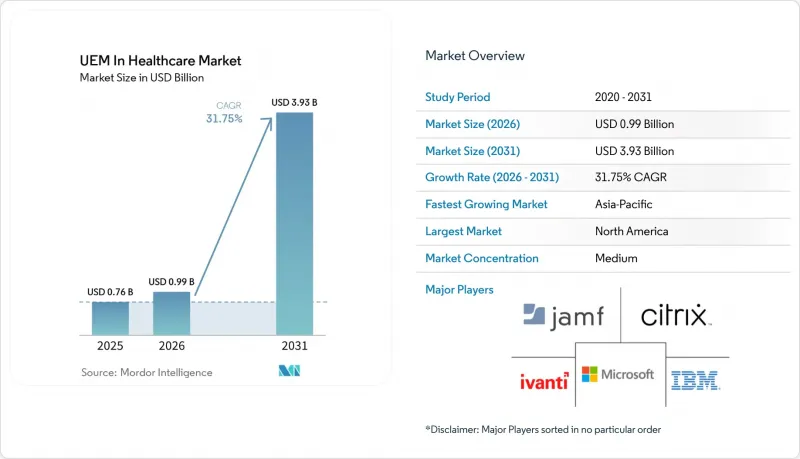
Mordor Intelligence에 의하면, 헬스케어용 통합 엔드포인트 관리(UEM) 시장 규모는 2025년에 7억 6,000만 달러로 평가되었고, 2026년 9억 9,000만 달러에서 2031년까지 39억 3,000만 달러에 이를 것으로 예측되며, 예측 기간(2026-2031년) CAGR은 31.75%를 나타낼 전망입니다.
본 보고서는 컴포넌트별(솔루션(기기 관리, 애플리케이션 관리, 컨텐츠 관리, 보안 및 규정 준수 관리 등) 및 서비스), 배포 모드별(클라우드 기반, 온프레미스형, 하이브리드형), 조직 규모별(대기업, 중소기업), 지역별(북미, 유럽 등)로 분류되어 있습니다. 시장 예측은 금액(달러)으로 제시되어 있습니다.
세계의 헬스케어용 통합 엔드포인트 관리(UEM) 시장 동향 및 인사이트
커넥티드 케어 환경 전반에 걸친 통합 엔드포인트 보안에 대한 수요 증가
헬스케어용 통합 엔드포인트 관리(UEM) 시장에서는 관리 대상에서 벗어난 모든 기기가 기밀성이 높은 환자 데이터나 업무 데이터를 보유한 시스템으로의 침입 경로가 될 수 있기 때문에 강한 수요가 나타나고 있습니다. 버라이즌의 2026년 조사 결과에 따르면, 취약점 악용, 피싱, 인증 정보 도용이 여전히 헬스케어 분야의 주요 침입 경로이며, 단일 플랫폼에서의 패치 적용, 애플리케이션 제어 및 ID 기반 접근 제어의 필요성이 부각되었습니다. 2026년에 실시된 스트라이커(Striker)사에 대한 사이버 공격 조사에 따르면, 공격자들은 ID 및 인증서 관리 계층을 표적으로 삼았습니다. 이는 고급 UEM(통합 엔드포인트 관리) 플랫폼이 관리하기 위해 구축된 것과 동일한 제어 계층입니다. 넷스코프(NetScope)의 보고서에 따르면, 의료 클라우드 환경에서 발생하는 데이터 정책 위반의 82%가 규제 대상 데이터에 해당하며, 엔드포인트의 위험은 네트워크 에지가 아닌 클라우드 애플리케이션의 작동에서 기인하는 경우가 많다는 사실이 밝혀졌습니다. 이러한 변화가 중요한 이유는 병원이 더 이상 기기 보안을 클라우드 액세스 정책, 세션 제어 및 기기 상태 점검과 분리하여 생각할 수 없게 되었기 때문입니다. 그 결과, 헬스케어용 통합 엔드포인트 관리(UEM) 시장은 단순히 기기 등록에 그치지 않고, 임상용 워크스테이션, 모바일 기기 및 원격 의료 엔드포인트에 걸친 보다 광범위한 보안 오케스트레이션으로 전환되고 있습니다.
임상 워크플로우에서 BYOD(개인 소유 기기 지참)의 확산
의료 분야의 UEM(통합 엔드포인트 관리) 시장은 병원 내 개인 기기 사용과 이를 관리하는 데 필요한 공식적인 통제 사이의 격차가 확대되고 있는 점도 촉진요인으로 작용하고 있습니다. Imprivata가 2025년 7월 급성기 의료 분야 리더 400명을 대상으로 실시한 조사에 따르면, 임상의의 81%가 공유 기기를 사용할 수 없는 경우 개인 단말기에 의존하고 있으며, 79%는 접근 권한을 얻기 위해 로그인 인증 정보를 공유한 적이 있다고 인정했는데, 이는 HIPAA 위반의 직접적인 위험을 초래하고 있습니다. 2025년 『JMIR Human Factors』 저널이 빅토리아주의 주요 공립 병원을 대상으로 실시한 조사에서는 BYOD의 보안 성숙도 점수가 5점 만점에 2.04점인 것으로 밝혀졌습니다. 이는 많은 대규모 의료 기관이 여전히 공식적인 엔드포인트 거버넌스 대신 임시방편적인 관행에 의존하고 있음을 보여줍니다. 같은 조사에서 기기 보안 분류 체계 내에서 UEM(통합 엔드포인트 관리)이 가장 높은 성숙도 수준을 보이는 것으로 확인되었습니다. 이를 통해 병원 경영진은 현재의 과제를 명확히 파악하고 우선순위를 정하기 쉬워졌습니다. 즉, 의료 분야의 구매 담당자는 단순히 기기 접근에 자금을 투자하는 것이 아니라, 임상 워크플로우 내에 이미 존재하는 알려진 규정 준수 및 책임성 격차를 해소하는 수단에 자금을 투자하고 있는 것입니다. 따라서 헬스케어용 통합 엔드포인트 관리(UEM) 시장은 BYOD를 단순한 편의성 추세로만 보지 않고, 더 이상 무시할 수 없을 정도로 표면화된 관리상의 문제로 인식함으로써 혜택을 보고 있습니다.
병원의 레거시 정보 시스템과의 통합 복잡성
기존 인프라와의 통합 과정에서 발생하는 마찰은 헬스케어용 통합 엔드포인트 관리(UEM) 시장에 있어 여전히 가장 큰 기술적 제약 요인으로 남아 있습니다. SOTI는 2025년 6월 보고서에서 의료 기관의 65%가 여전히 IoT 및 원격 의료용 의료기기와 통합되지 않은 구식 시스템을 사용하고 있으며, 59%가 레거시 시스템과의 충돌로 인한 가동 중단 및 기술적 문제를 보고하고 있다고 지적했습니다. 많은 검사실, 영상 진단 및 병원 정보 시스템은 여전히 최신 UEM(통합 엔드포인트 관리) 에이전트를 지원하지 않거나, 도입 시 정책 상의 충돌을 일으키는 OS 버전으로 운영되고 있습니다. 또한 병원이 HL7 v2 인터페이스, FHIR 미지원 환경, 또는 맞춤형 미들웨어 계층에 의존하는 경우, 통합은 더욱 어려워지며 도입 기간이 수주에서 수 분기에 달하기도 합니다. 이러한 일정은 일상적인 임상 업무와 충돌하여, 수요가 여전히 높은 상황임에도 불구하고 이미 업무에 쫓기는 IT 팀의 프로젝트를 지연시키게 됩니다. 따라서 헬스케어용 통합 엔드포인트 관리(UEM) 시장은 수요의 문제라기보다는 오히려 타이밍의 문제에 직면해 있습니다. 많은 조직이 이 기능을 원하고 있지만, 레거시 시스템 현대화 일정에 이를 반영하는 데 어려움을 겪고 있기 때문입니다.
부문 분석
2025년, 헬스케어용 통합 엔드포인트 관리(UEM) 시장 점유율의 70.32%를 솔루션이 차지했으며, 수요는 기기 관리, 애플리케이션 관리, 컨텐츠 관리, 보안 및 규정 준수 관리, 그리고 분석 및 자동화 분야에 계속 집중되었습니다. 병원에서는 공유되는 모든 임상용 기기에 걸쳐 암호화, 원격 초기화, 접근 제어, 감사 지원이 여전히 필요하기 때문에 기기 관리, 보안 및 규정 준수 관리는 가장 확고하게 자리 잡은 영역으로 남아 있었습니다. 용도 관리는 특히 AI 지원 진단 및 타사 원격 의료 도구가 보급됨에 따라, 의료 제공업체가 어떤 임상용 앱이 엔드포인트에 도달할지 제어하려고 함에 따라 그 존재감을 높였습니다. 또한 컨텐츠 관리에 대해서도, 다양한 기기군에 걸쳐 방사선과나 병리학 파일의 관리된 배포가 필요한 영상 진단을 많이 활용하는 전문 분야에서 큰 관심을 받았습니다. 의료 분야의 UEM(통합 엔드포인트 관리) 시장에서는 구매자들이 서로 연동되지 않는 도구의 수를 줄이고, 정책 적용에 대한 책임 소재를 더욱 명확히 하고자 했기 때문에 이 부문에서도 광범위한 플랫폼이 계속해서 지지를 받았습니다.
의료 시스템이 엔드포인트의 운영 데이터를 활용하여 이상을 감지하고, 기기 문제를 예측하며, 복구 워크플로를 자동화함에 따라, 분석과 자동화는 솔루션 내에서 가장 빠르게 진화하는 분야로 자리매김했습니다. Ivanti는 2026년 1월, 엔드포인트 감지 및 복구를 자동화하기 위한 에이전트 기반 AI 기능을 플랫폼에 추가했습니다. 이는 제한된 인력으로 대규모 기기군을 관리하는 병원 IT 팀의 인력 배치 현실에 부합하는 것이었습니다. 구축, 관리형 지원, 구축 후 최적화 등을 포함하는 서비스는 헬스케어용 통합 엔드포인트 관리(UEM) 시장의 나머지 점유율을 차지하고 있으며, 여러 시설에 걸친 환경에서의 배포가 복잡해짐에 따라 성장했습니다. 소규모 의료 제공업체 팀은 사내에 전문가를 배치하기보다 외부에 거버넌스를 위탁하는 것을 선호하는 경향이 강했기 때문에 서비스 계층에서 매니지드 서비스 모델이 보급되었습니다. 이러한 구성은 헬스케어용 통합 엔드포인트 관리(UEM) 시장에서 강력한 제품 깊이와 의료 IT 팀의 운영상 제약에 부합하는 제공 모델을 결합할 수 있는 벤더가 높이 평가받고 있음을 보여줍니다.
지역별 분석
2025년, 북미는 헬스케어용 통합 엔드포인트 관리(UEM) 시장 규모의 41.38%를 차지했으며, HIPAA의 엄격한 시행, 밀집된 의료 시스템 네트워크, 그리고 높은 의료 IT 지출을 배경으로 이 지역은 계속해서 선두 자리를 유지했습니다. 미국은 계속해서 주요 견인 역할을 했습니다. 이는 2025년 1월에 제안된 HIPAA 보안 규정 개정안에서 다중 요소 인증, AES-256 암호화, 연 2회 취약점 스캔, 연 1회 침투 테스트와 같은 기술적 통제 수단이 규정되었으며, 이러한 사항들이 UEM(통합 엔드포인트 관리) 기능과 직접적으로 부합하기 때문입니다. 캐나다와 멕시코는 원격 의료의 성장과 노후화된 인프라에 더해, 해결되지 않은 엔드포인트 거버넌스 과제가 여전히 존재하기 때문에 중요한 2차 시장으로서의 지위를 유지했습니다. 많은 병원의 구매 담당자들이 이미 광범위한 기업 환경에서 Microsoft 및 Jamf 제품을 사용하고 있으며, 이를 통해 기기 제어를 확장할 수 있기 때문에 두 회사는 북미 의료 업계 전반에서 두드러진 위치를 차지했습니다. 2026년, Microsoft는 기존 Microsoft 365 구독에 Intune Suite의 가치를 추가함으로써, 그동안 별도의 프리미엄 플랫폼 도입을 정당화하기 어려웠던 중규모 의료 시스템에서도 클라우드 UEM(통합 엔드포인트 관리)에 대한 접근성을 확대했습니다.
헬스케어용 통합 엔드포인트 관리(UEM) 아시아태평양 시장은 2026-2031년 연평균 성장률(CAGR) 32.83%를 나타낼 것으로 예측되며, 현재 예측 기간 동안 가장 빠르게 성장하는 지역 시장이 될 전망입니다. 일본이 주요 견인 역할을 하고 있는 것은 2025년도 의료 사이버 보안 체크리스트에서 2027년도까지 2단계 인증 준수를 위한 명확한 로드맵이 제시되었기 때문이며, 이를 통해 엔드포인트 거버넌스 업그레이드를 위한 구체적인 일정이 수립되었기 때문입니다. 한국 역시 정부 주도의 디지털 헬스 인프라 확충을 통해 공립 병원 시스템 내 연결 엔드포인트 수를 늘려 시장을 견인하고 있습니다. 인도 역시 추가적인 성장 요인으로 작용하고 있습니다. ‘아유슈만 바라트 디지털 미션’에 기반한 정부의 디지털화 노력으로 인해, 더 많은 임상 워크플로우와 엔드포인트 자산이 관리된 디지털 환경으로 임베디드되고 있기 때문입니다. 호주는 데이터 유출에 대한 규제가 강화되고 있으며, 2025년 SOTI 조사에서 레거시 시스템의 77%가 통합되지 않았다는 사실이 규정 준수 압박과 명백한 인프라 격차를 동시에 야기하고 있어, 이 지역의 동향을 뒷받침하고 있습니다.
유럽은 헬스케어용 통합 엔드포인트 관리(UEM) 시장에서 구조적으로 중요한 위치를 계속 차지하고 있습니다. 이는 독일, 영국, 프랑스 및 북유럽 국가에서 규제 압력과 성숙한 병원 IT 환경이 결합된 결과입니다. 2025년 12월 NIS2가 시행된 이후, 독일은 특히 두드러진 존재가 되었습니다. 이는 중요 인프라로 분류되는 병원이 엔드포인트 위험 관리, 보고 및 경영진의 감독과 관련하여 더 엄격한 의무를 지게 되었기 때문입니다. Aagon GmbH나 Baramundi Software와 같은 현지 공급업체들은 세계 플랫폼이 여전히 활발히 활동하고 있는 상황에서도, 지역 특유의 규정 준수 요건이 전문 벤더들을 뒷받침할 수 있음을 보여주고 있습니다. 영국, 중동 및 아프리카, 남미 역시 성장을 견인하고 있으며, 중동에서는 사우디아라비아와 아랍에미리트(UAE)의 병원 디지털화 프로그램이, 남미에서는 브라질의 강화된 규정 준수 요건과 칠레, 아르헨티나, 콜롬비아의 민간 병원 네트워크 확장이 각각 성장을 뒷받침하고 있습니다.
기타 혜택 :
- 엑셀 형식 시장 예측(ME) 시트
- 3개월간의 애널리스트 지원
자주 묻는 질문
목차
제1장 서론
제2장 조사 방법
제3장 주요 요약
제4장 시장 구도
제5장 시장 규모 및 성장 예측
제6장 경쟁 구도
제7장 시장 기회 및 향후 전망
AJY 26.08.07According to Mordor Intelligence, the UEM in Healthcare Market size was valued at USD 0.76 billion in 2025 and estimated to grow from USD 0.99 billion in 2026 to reach USD 3.93 billion by 2031, at a CAGR of 31.75% during the forecast period (2026-2031).
This report is Segmented by Component (Solutions [Device Management, Application Management, Content Management, Security and Compliance Management, and More], and Services), Deployment Mode (Cloud-Based, On-Premise, and Hybrid), Organization Size (Large Enterprises, and Small and Medium Enterprises), and Geography (North America, Europe, and More). The Market Forecasts are Provided in Terms of Value (USD).
Global UEM In Healthcare Market Trends and Insights
Rising Need for Centralized Endpoint Security Across Connected Care Environments
The UEM in Healthcare Market is seeing strong demand because every unmanaged device can become an entry point into systems that hold sensitive patient and operational data. Verizon's 2026 findings showed that vulnerability exploitation, phishing, and stolen credentials remained the leading healthcare access vectors, underscoring the need for patching, application control, and identity-enforced access in a single platform. A 2026 review of the Stryker cyberattack found that attackers targeted identity and certificate management layers, the same control plane that advanced UEM platforms are built to govern. Netskope reported that regulated data accounted for 82% of data policy violations in healthcare cloud environments, indicating that endpoint risk often originates in cloud application behavior rather than at the network edge. That shift matters because hospitals can no longer separate device security from cloud access policy, session control, and device posture checks. As a result, the UEM in Healthcare Market is moving beyond device enrollment and into broader security orchestration across clinical workstations, mobile devices, and remote care endpoints.
Expanding Bring Your Own Device Adoption in Clinical Workflows
The UEM in Healthcare Market is also being driven by the widening gap between personal device use in hospitals and the formal controls needed to govern it. Imprivata's July 2025 survey of 400 acute care leaders found that 81% of clinicians turned to personal devices when shared equipment was unavailable, and 79% admitted to sharing login credentials to gain access, which creates direct HIPAA exposure. A 2025 JMIR Human Factors study at a major public hospital in Victoria found a BYOD security maturity score of 2.04 out of 5, indicating that many large facilities still rely on ad hoc practices rather than formal endpoint governance. The same study identified UEM as the highest maturity level in the device security taxonomy, which makes the current gap easy for hospital leaders to frame and prioritize. That means healthcare buyers are not simply funding device access; they are funding a way to close known compliance and accountability gaps that already exist inside clinical workflows. The UEM in Healthcare Market is therefore benefiting from BYOD not as a convenience trend, but as a control problem that has become too visible to ignore.
Integration Complexity with Legacy Hospital Information Systems
Integration friction with older infrastructure remains the strongest technical restraint on the UEM in Healthcare Market. SOTI reported in June 2025 that 65% of healthcare organizations still used unintegrated, outdated systems for IoT and telehealth medical devices, while 59% reported downtime or technical issues due to legacy system conflicts. Many laboratory, imaging, and hospital information systems still run on operating system versions that either do not support modern UEM agents or create policy conflicts during rollout. Integration also becomes harder when hospitals rely on HL7 v2 interfaces, non-FHIR environments, or custom middleware layers, which can extend deployment from weeks to quarters. Those timelines compete with day-to-day clinical operations and delay projects for already stretched IT teams, even when demand remains strong. The UEM in Healthcare Market therefore faces a timing problem rather than a demand problem, since many organizations want the capability but struggle to fit it into legacy modernization schedules.
Other drivers and restraints analyzed in the detailed report include:
- Increasing Compliance Pressure for Healthcare Data Protection and Auditability
- Growth In Remote Care Delivery and Mobile Clinical Access
- Budget Constraints in Mid-Sized Care Providers and Public Health Networks
For complete list of drivers and restraints, kindly check the Table Of Contents.
Segment Analysis
Solutions held 70.32% of the UEM in Healthcare Market share in 2025, and demand remained concentrated across device management, application management, content management, security and compliance management, and analytics and automation. Device management, security, and compliance management stayed the most established layers because hospitals still need encryption, remote wipe, access control, and audit support across shared clinical devices. Application management gained ground as providers tried to control which clinical apps reached endpoints, especially as AI-assisted diagnostics and third-party telehealth tools became more common. Content management also drew stronger interest from imaging-heavy specialties that needed governed distribution of radiology and pathology files across mixed device fleets. The UEM in Healthcare Market continued to favor broad platforms in this segment because buyers wanted fewer disconnected tools and clearer accountability for policy enforcement.
Analytics and automation remained the fastest-evolving areas within solutions, as health systems began using endpoint behavior data to detect anomalies, predict device issues, and automate remediation workflows. Ivanti expanded its platform in January 2026 with agentic AI capabilities aimed at automating endpoint discovery and remediation, which matched the staffing reality of hospital IT teams that manage large device fleets with limited headcount. Services, which include deployment, managed support, and post-implementation optimization, accounted for the remaining share of the UEM in Healthcare Market and grew alongside rollout complexity in multi-facility environments. Managed service models gained traction inside the services layer because smaller provider teams often preferred outsourced governance over adding internal specialists. This mix shows that the UEM in Healthcare Market is rewarding vendors that can pair strong product depth with a delivery model that matches the operational limits of healthcare IT teams.
Complete Report Scope:
- By Component
- Solutions
- Device Management
- Application Management
- Content Management
- Security and Compliance Management
- Analytics and Automation
- Services
- Solutions
- By Deployment Mode
- Cloud-Based
- On-Premise
- Hybrid
- By Organization Size
- Large Enterprises
- Small and Medium Enterprises
- By Geography
- North America
- United States
- Canada
- Mexico
- South America
- Brazil
- Argentina
- Chile
- Colombia
- Rest of South America
- Europe
- Germany
- United Kingdom
- France
- Italy
- Spain
- Netherlands
- Nordics
- Russia
- Rest of Europe
- Asia-Pacific
- China
- Japan
- India
- South Korea
- Australia and New Zealand
- Southeast Asia
- Rest of Asia-Pacific
- Middle East
- Saudi Arabia
- United Arab Emirates
- Turkey
- Israel
- Rest of Middle East
- Africa
- South Africa
- Egypt
- Nigeria
- Kenya
- Rest of Africa
- North America
Geography Analysis
North America accounted for 41.38% share of the UEM in Healthcare Market size in 2025, which kept the region in the lead on the back of strong HIPAA enforcement, dense health system networks, and high healthcare IT spending. The United States remained the main driver because the January 2025 proposed HIPAA Security Rule update specified technical controls, such as multi-factor authentication, AES-256 encryption, biannual vulnerability scanning, and annual penetration testing, that directly map to UEM capabilities. Canada and Mexico remained meaningful secondary markets because unresolved endpoint governance gaps still sit alongside telehealth growth and older infrastructure. Microsoft and Jamf held visible positions across North American healthcare because many hospital buyers already used their broader enterprise environments and could extend device control from there. In 2026, Microsoft added Intune Suite value within existing Microsoft 365 subscriptions, widening cloud UEM access for mid-sized health systems that were previously less able to justify a separate premium platform.
Asia-Pacific in the UEM in Healthcare Market is projected to grow at a 32.83% CAGR from 2026 to 2031, making it the fastest-growing regional market in the current forecast period. Japan is a key driver because its FY2025 healthcare cybersecurity checklist set a documented path toward two-factor authentication compliance by fiscal year 2027, which creates a direct timetable for endpoint governance upgrades. South Korea is also strengthening the backdrop through government-led digital health infrastructure expansion that increases the number of connected endpoints in public hospital systems. India adds another growth layer because government digitization efforts under the Ayushman Bharat Digital Mission are bringing more clinical workflows and endpoint assets into managed digital environments. Australia reinforces the regional case because tighter data breach expectations and a 77% rate of unintegrated legacy systems in the 2025 SOTI survey combine compliance pressure with clear infrastructure gaps.
Europe remained structurally important in the UEM in Healthcare Market because Germany, the United Kingdom, France, and the Nordics combined regulatory pressure with mature hospital IT estates. Germany stood out after NIS2 came into force in December 2025, because hospitals classified as critical infrastructure now face stronger obligations around endpoint risk management, reporting, and executive oversight. Local providers such as Aagon GmbH and Baramundi Software show that region-specific compliance needs can still support specialized vendors even when global platforms remain active. The United Kingdom, the Middle East and Africa, and South America added supplementary growth, with the Middle East supported by hospital digitization programs in Saudi Arabia and the United Arab Emirates, and South America supported by rising compliance expectations in Brazil and the growth of private hospital networks in Chile, Argentina, and Colombia.
- Microsoft Corporation
- IBM Corporation
- Citrix Systems, Inc.
- Ivanti, Inc.
- Jamf Holding Corp.
- BlackBerry Limited
- Samsung Electronics Co., Ltd.
- Motorola Solutions, Inc.
- SOTI Inc.
- Hexnode Inc.
- Baramundi Software GmbH
- Scality, Inc.
- Workspace ONE
- Google LLC
- Apple Inc.
- Addigy, Inc.
Additional Benefits:
- The market estimate (ME) sheet in Excel format
- 3 months of analyst support
TABLE OF CONTENTS
1 INTRODUCTION
- 1.1 Study Assumptions and Market Definition
- 1.2 Scope of the Study
2 RESEARCH METHODOLOGY
3 EXECUTIVE SUMMARY
4 MARKET LANDSCAPE
- 4.1 Market Overview
- 4.2 Market Drivers
- 4.2.1 Expanding Bring Your Own Device Adoption in Clinical Workflows
- 4.2.2 Rising Need for Centralized Endpoint Security Across Connected Care Environments
- 4.2.3 Growth in Remote Care Delivery and Mobile Clinical Access
- 4.2.4 Increasing Compliance Pressure for Healthcare Data Protection and Auditability
- 4.2.5 Cross-Facility Identity and Session Mobility for Temporary Clinical Staff
- 4.2.6 Rising Demand for Zero Trust Policy Enforcement on Shared Medical Devices
- 4.3 Market Restraints
- 4.3.1 Integration Complexity with Legacy Hospital Information Systems
- 4.3.2 Budget Constraints in Mid-Sized Care Providers and Public Health Networks
- 4.3.3 Clinical Workflow Friction from Overly Restrictive Device Policies
- 4.3.4 Limited Standardization Across Medical Device Operating Environments
- 4.4 Industry Value Chain Analysis
- 4.5 Regulatory Landscape
- 4.6 Technological Outlook
- 4.7 Impact of Macroeconomic Factors on the Market
- 4.8 Porter's Five Forces Analysis
- 4.8.1 Threat of New Entrants
- 4.8.2 Bargaining Power of Buyers
- 4.8.3 Bargaining Power of Suppliers
- 4.8.4 Threat of Substitutes
- 4.8.5 Industry Rivalry
5 MARKET SIZE AND GROWTH FORECASTS (VALUE)
- 5.1 By Component
- 5.1.1 Solutions
- 5.1.1.1 Device Management
- 5.1.1.2 Application Management
- 5.1.1.3 Content Management
- 5.1.1.4 Security and Compliance Management
- 5.1.1.5 Analytics and Automation
- 5.1.2 Services
- 5.1.1 Solutions
- 5.2 By Deployment Mode
- 5.2.1 Cloud-Based
- 5.2.2 On-Premise
- 5.2.3 Hybrid
- 5.3 By Organization Size
- 5.3.1 Large Enterprises
- 5.3.2 Small and Medium Enterprises
- 5.4 By Geography
- 5.4.1 North America
- 5.4.1.1 United States
- 5.4.1.2 Canada
- 5.4.1.3 Mexico
- 5.4.2 South America
- 5.4.2.1 Brazil
- 5.4.2.2 Argentina
- 5.4.2.3 Chile
- 5.4.2.4 Colombia
- 5.4.2.5 Rest of South America
- 5.4.3 Europe
- 5.4.3.1 Germany
- 5.4.3.2 United Kingdom
- 5.4.3.3 France
- 5.4.3.4 Italy
- 5.4.3.5 Spain
- 5.4.3.6 Netherlands
- 5.4.3.7 Nordics
- 5.4.3.8 Russia
- 5.4.3.9 Rest of Europe
- 5.4.4 Asia-Pacific
- 5.4.4.1 China
- 5.4.4.2 Japan
- 5.4.4.3 India
- 5.4.4.4 South Korea
- 5.4.4.5 Australia and New Zealand
- 5.4.4.6 Southeast Asia
- 5.4.4.7 Rest of Asia-Pacific
- 5.4.5 Middle East
- 5.4.5.1 Saudi Arabia
- 5.4.5.2 United Arab Emirates
- 5.4.5.3 Turkey
- 5.4.5.4 Israel
- 5.4.5.5 Rest of Middle East
- 5.4.6 Africa
- 5.4.6.1 South Africa
- 5.4.6.2 Egypt
- 5.4.6.3 Nigeria
- 5.4.6.4 Kenya
- 5.4.6.5 Rest of Africa
- 5.4.1 North America
6 COMPETITIVE LANDSCAPE
- 6.1 Market Concentration
- 6.2 Strategic Moves
- 6.3 Market Share Analysis
- 6.4 Company Profiles (includes Global Level Overview, Market Level Overview, Core Segments, Financials as available, Strategic Information, Market Rank/Share, Products and Services, Recent Developments)
- 6.4.1 Microsoft Corporation
- 6.4.2 IBM Corporation
- 6.4.3 Citrix Systems, Inc.
- 6.4.4 Ivanti, Inc.
- 6.4.5 Jamf Holding Corp.
- 6.4.6 BlackBerry Limited
- 6.4.7 Samsung Electronics Co., Ltd.
- 6.4.8 Motorola Solutions, Inc.
- 6.4.9 SOTI Inc.
- 6.4.10 Hexnode Inc.
- 6.4.11 Baramundi Software GmbH
- 6.4.12 Scality, Inc.
- 6.4.13 Workspace ONE
- 6.4.14 Google LLC
- 6.4.15 Apple Inc.
- 6.4.16 Addigy, Inc.
7 MARKET OPPORTUNITIES AND FUTURE OUTLOOK
- 7.1 White-Space and Unmet-Need Assessment


