

|
시장보고서
상품코드
2098456
제조업용 통합 엔드포인트 관리(UEM) 시장 : 시장 점유율 분석, 업계 동향 및 통계, 성장 예측(2026-2031년)UEM In Manufacturing - Market Share Analysis, Industry Trends & Statistics, Growth Forecasts (2026 - 2031) |
||||||
 Mordor Intelligence
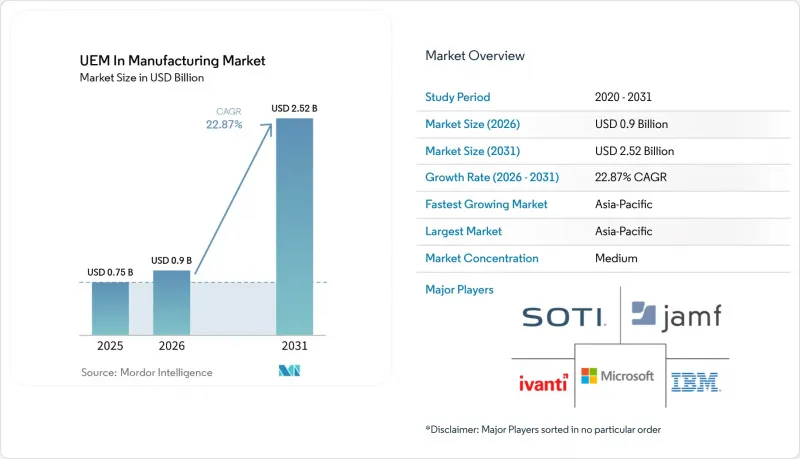
Mordor Intelligence에 의하면, 제조업용 통합 엔드포인트 관리(UEM) 시장 규모는 2025년에 7억 5,000만 달러로 평가되었고, 2026년 9억 달러에서 2031년까지 25억 2,000만 달러에 이를 것으로 예측되며, 예측 기간(2026-2031년) CAGR은 22.87%를 나타낼 전망입니다.
본 보고서는 컴포넌트별(솔루션(기기 관리, 애플리케이션 관리, 컨텐츠 관리, 보안 및 규정 준수 관리 등) 및 서비스), 배포 모드별(클라우드 기반, 온프레미스형 등), 조직 규모별(대기업, 중소기업), 지역별(아시아태평양, 유럽 등)로 분류되어 있습니다. 시장 전망은 금액(달러) 기준으로 제시되어 있습니다.
세계의 제조업용 통합 엔드포인트 관리(UEM) 시장 동향 및 인사이트
공장 업무에서의 BYOD 및 견고한 모바일 단말기 도입 확대
제조업용 통합 엔드포인트 관리(UEM) 시장은 공장 작업자들이 동일한 생산 현장에서 개인용 스마트폰과 러기드 핸드헬드 단말기를 모두 병행하여 사용하게 됨에 따라 혜택을 보고 있습니다. Zebra Technologies 및 Honeywell과 같은 벤더가 제공하는 견고한 기기는 Wi-Fi 6E, eSIM, 프라이빗 5G 이용 사례에 대한 지원을 확대하고 있어, 제조 및 물류 현장의 기기 다양성을 높이고 있습니다. 이러한 소유 형태가 혼재된 모델에서는 특히 공유 키오스크나 Android 기기가 일반적인 경우, 교대 근무 시 인증, 접근 및 데이터 격리와 관련된 문제가 발생합니다. 마이크로소프트는 2026년 4월, Android Enterprise 기기에서 공유 기기 모드와 ID 페더레이션을 지원하도록 현장 작업자용 기능을 업데이트하여, 다중 사용자 환경의 공장에서 발생하는 로그인 및 로그아웃의 격차를 직접 해결했습니다. 추가적인 과제로는 견고한 산업용 핸드헬드 단말기는 3년에서 5년 동안 계속 사용되는 경우가 많은 반면, 소비자용 기기의 교체 주기는 훨씬 빠르기 때문에 제조업용 통합 엔드포인트 관리(UEM)에서는 신구 기기 세대를 모두 단일 정책 모델로 관리할 수 있는 벤더가 우위를 점하고 있습니다.
이종 엔드포인트에 걸친 보안 표준화
제조업용 통합 엔드포인트 관리(UEM) 시장은 단일하고 일관된 정책 구조로 다양한 엔드포인트 유형을 보호해야 할 필요성에 의해 주도되고 있습니다. 제조업체들은 Windows 노트북, Android 스캐너, Linux 산업용 컴퓨터, 그리고 결정론적 프로세스에 영향을 미치지 않으면서 표준 에이전트를 수용할 수 없는 레거시 컨트롤러 등을 운영하고 있습니다. Forescout는 2025년 6월, 산업 조직의 44%가 실시간 사이버 가시성을 보유하고 있다고 응답한 반면, 60% 가까이가 OT 및 IoT 위협 감지에 대해 '신뢰도가 낮다' 또는 '전혀 신뢰하지 않는다'고 응답했다고 보고했습니다. 이는 사일로화된 도구의 한계를 반영합니다. 이와 같은 운영 실태로 인해 시정 조치 주기가 장기화되고 있습니다. 이는 생산 설비에 대한 패치 적용이 표준적인 IT 일정이 아닌, 유지보수 기간이나 관리된 가동 중단 시간에 의존하는 경우가 많기 때문입니다. TeamViewer는 2026년 4월, 하드웨어 게이트웨이 모델을 통해 ‘에이전트리스 액세스’ 접근 방식을 도입하여, 제조업체에 기기에 소프트웨어를 직접 설치하지 않고도 레거시 OT 엔드포인트에 원격으로 액세스하고 제어할 수 있는 실용적인 대안을 제공했습니다. IEC 62443이 조달 및 보안 기준에서 더욱 중요시됨에 따라, 제조업용 통합 엔드포인트 관리(UEM) 시장은 IT, OT, IoT 자산을 아우르는 더 광범위한 엔드포인트 범위로 전환되고 있습니다.
레거시 OT 및 MES 환경과의 통합 복잡성
제조업용 통합 엔드포인트 관리(UEM) 시장은 최신 엔드포인트 플랫폼과 수명이 긴 산업용 시스템 간의 불일치로 인해 여전히 저항에 직면해 있습니다. OT 환경은 안정성과 결정론적 운영을 중시하여 구축된 반면, UEM(통합 엔드포인트 관리) 도구는 빈번한 업데이트, 동적 정책 및 광범위한 에이전트 적용 범위를 전제로 설계되었습니다. 또한 제조 공장에서는 FL-net, OPC-UA, Modbus, MQTT 등의 독자적인 프로토콜이나 산업용 프로토콜이 사용되고 있으며, 이를 통합된 관리 플레인에 통합하기 위해서는 대부분의 경우 전용 커넥터나 변환 레이어가 필요합니다. 파로알토 네트웍스는 2026년에 인터넷에 공개된 OT 디바이스의 수가 332% 증가했으며, 공용 인터넷상에서 확인 가능한 OT 관련 서비스가 2,000만 건에 육박했다고 보고했습니다. 이는 거버넌스가 미흡한 경우, OT 인프라를 클라우드 제어 계층에 연결하려는 시도가 오히려 위험을 확대할 수 있음을 보여줍니다. 이 문제로 인해 도입 지연도 발생하고 있습니다. 벤더는 각 MES의 변형이나 현장에 도입된 자동화 스택과의 호환성을 검증해야 하기 때문입니다. 그 결과, 제조업용 통합 엔드포인트 관리(UEM) 시장은 여전히 사전 구축된 커넥터, OT 프로토콜 지원, 검증된 플랜트 통합 기법을 통해 도입 주기를 단축할 수 있는 벤더에 크게 의존하고 있습니다.
부문 분석
2025년, 제조업용 통합 엔드포인트 관리(UEM) 시장에서 솔루션이 66.47%의 점유율을 차지했으며, 구매자들이 독립형 서비스 계약보다 통합 플랫폼을 선호하는 경향이 나타났습니다. 제조업체들은 디바이스 관리, 애플리케이션 제어, 컨텐츠 배포, 보안 및 규정 준수, 그리고 분석 기반 자동화를 하나의 콘솔에서 관리하는 방식을 점점 더 많이 선택하게 되었습니다. 솔루션 계층에서 가장 강력한 수요를 견인한 것은 디바이스 관리, 보안 및 규정 준수 관리였으며, 이는 제조업체들이 노트북, 스캐너, 키오스크, 프린터, RFID 자산 전반에 걸쳐 일관된 구성 기준선을 요구했기 때문입니다.
또한 2025년에는 각 벤더사가 보다 광범위한 IoT 기능과 시정 조치 기능을 추가함에 따라 솔루션 부문의 범위도 확대되었습니다. Omnissa는 2025년 9월 ‘Workspace ONE Vulnerability Defense’를 도입하여, AI 기반 시정 조치와 CrowdStrike Falcon Exposure Management를 연동함으로써 물리적 및 가상 엔드포인트 전반에 걸친 예방적 취약점 관리에 한 걸음 더 다가섰습니다. 또한 Omnissa는 Workspace ONE Intelligence를 통해 Zebra 프린터 및 견고한 기기에 대한 MQTT 지원을 표준화했습니다. 이는 플랫폼의 적용 범위가 엔드포인트 설정에 그치지 않고 공장 내 IoT 연동으로 확대되고 있음을 보여줍니다. 제조업용 통합 엔드포인트 관리(UEM)에서는 여전히 서비스가 중요한 역할을 수행하고 있습니다. 이는 기업 도입 시 MES, ERP, 산업용 미들웨어에 걸친 통합, 배포 및 변경 대응이 필요한 경우가 많기 때문입니다. 또한, 이러한 서비스의 역할은 전환 비용을 높이기 때문에 인증을 받은 지역 통합 업체를 보유한 벤더는 제조 업계의 UEM(통합 엔드포인트 관리) 시장에서 고객을 장기적으로 유지할 수 있습니다.
지역별 분석
2025년, 아시아태평양은 제조업용 통합 엔드포인트 관리(UEM) 시장 규모의 37.26%를 차지하며, 지역별로는 가장 큰 기여도를 보였습니다. 이 지역은 중국, 일본, 한국, 인도, 동남아시아의 대규모 제조 활동으로부터 혜택을 받고 있으며, 이들 지역에서는 자동차, 전자, 중공업 및 수출 지향형 생산 분야에서 연결 기기가 점점 더 보급되고 있습니다. 중국은 스마트 제조의 추진과 광범위한 제조거점을 바탕으로, 시설 간 일관된 정책 관리가 필요한 대규모 엔드포인트 환경이 형성되어 있어 계속해서 지역 수요의 중심이 되고 있습니다. 아시아태평양 제조업 시장의 UEM(통합 엔드포인트 관리)은 많은 기업에서 ‘모바일 우선’ 운영 방식이 정착되고 있다는 점에서도 혜택을 받고 있으며, 이는 ‘클라우드 우선’ 도입 및 그린필드 구축 모델에 적합합니다. 인도는 대규모 중소기업 및 소규모 제조업(MSME) 기반이 대규모 레거시 시스템과의 통합을 필요로 하지 않는 복잡성이 낮은 클라우드 주도형 온보딩 모델과 잘 부합하기 때문에 더욱 강력한 수요층을 형성하고 있습니다.
북미와 유럽은 합쳐서 제조업용 통합 엔드포인트 관리(UEM) 시장에서 상당한 점유율을 차지하고 있으며, 계속해서 엔터프라이즈 플랫폼 개발의 주요 거점으로 자리 잡고 있습니다. 북미는 조기 클라우드 도입, 제로 트러스트 원칙과의 견고한 부합성, 그리고 자동차, 항공우주, 방위 전자기기, 제약 분야의 밀집된 제조 활동이라는 이점을 가지고 있습니다. 유럽에서는 2022년에 NIS2 지침이 발효되었고, 2025년 및 2026년까지 적극적인 도입과 감사 활동이 이미 진행되어 왔기 때문에 보다 명확한 규정 준수 주기 하에서 움직임이 진행되고 있습니다. 이러한 환경 하에서 분산된 사업 거점 전반에 걸쳐 엔드포인트 가시화, 정책 적용, 그리고 증거로 활용 가능한 보고서 작성을 필요로 하는 제조업체들 수요가 증가하고 있습니다. 따라서 유럽 제조업용 통합 엔드포인트 관리(UEM) 시장은 현대화 목표뿐만 아니라 산업 부문 전반에 걸친 규제상 책임에 의해서도 견인되고 있습니다.
남미, 중동 및 아프리카 각 지역은 여전히 매출 기준 비중이 작지만, 중기적으로는 이들 지역의 제조업 UEM(통합 엔드포인트 관리) 시장에 큰 성장 여지가 있습니다. 남미에서는 브라질이 가장 명확한 성장 경로를 보이고 있습니다. 스마트 팩토리 투자와 MES(제조 실행 시스템)의 보급으로 인해 공장 네트워크상에서 관리되는 엔드포인트의 수가 자연스럽게 증가하고 있기 때문입니다. 사우디아라비아와 아랍에미리트(UAE)도 매력적인 환경을 보이고 있습니다. 새로운 산업 프로젝트에서는 나중에 구형 기기 자산을 개조하는 대신, 시운전 단계부터 클라우드 네이티브 엔드포인트 거버넌스를 도입할 수 있기 때문입니다. 아프리카는 연결성 격차와 산업 디지털화의 지연이 여전히 광범위한 확장을 제약하고 있어 도입 진척도가 다른 지역에 비해 뒤처지고 있지만, 다국적 제조업체들은 이미 전 세계적인 엔드포인트 정책을 일부 현지 사업으로 확대되고 있습니다. 인프라와 공장의 디지털화가 진행됨에 따라, 이 지역 제조업용 통합 엔드포인트 관리(UEM) 시장은 고립된 도입 단계에서 벗어나, 보다 표준화된 다중 거점 프로그램으로 발전해 나갈 것으로 전망됩니다.
기타 혜택 :
- 엑셀 형식 시장 예측(ME) 시트
- 3개월간의 애널리스트 지원
자주 묻는 질문
목차
제1장 서론
제2장 조사 방법
제3장 주요 요약
제4장 시장 구도
제5장 시장 규모 및 성장 예측
제6장 경쟁 구도
제7장 시장 기회 및 향후 전망
AJY 26.08.07According to Mordor Intelligence, the UEM in manufacturing market size was valued at USD 0.75 billion in 2025 and estimated to grow from USD 0.90 billion in 2026 to reach USD 2.52 billion by 2031, at a CAGR of 22.87% during the forecast period (2026-2031).
This report is Segmented by Component (Solutions [Device Management, Application Management, Content Management, Security and Compliance Management, and More], and Services), Deployment Mode (Cloud-Based, On-Premise, and More), Organization Size (Large Enterprises, and Small and Medium Enterprises), and Geography (Asia-Pacific, Europe, and More). The Market Forecasts are Provided in Terms of Value (USD).
Global UEM In Manufacturing Market Trends and Insights
Rising BYOD and Rugged Mobile Adoption in Factory Operations
The UEM in manufacturing market is benefiting from the way factory workers now use both personal smartphones and rugged handhelds on the same production floor. Rugged devices from vendors such as Zebra Technologies and Honeywell increasingly support Wi-Fi 6E, eSIM, and private 5G use cases, expanding device variety in manufacturing and logistics settings. This mixed-ownership model creates authentication, access, and data separation issues during shift handovers, especially when shared kiosks and Android devices are common. Microsoft updated frontline worker capabilities in April 2026 to support shared device mode and identity federation on Android Enterprise devices, directly addressing sign-in and sign-out gaps in multi-user factory environments. A further challenge is that hardened industrial handhelds often remain in use for 3 to 5 years, while consumer devices turn over much faster, so the UEM in the manufacturing market favors vendors that can govern both old and new device generations under a single policy model.
Security Standardization Across Heterogeneous Endpoints
The UEM in manufacturing market is also being driven by the need to secure diverse endpoint types with a single, consistent policy structure. Manufacturers operate Windows laptops, Android scanners, Linux industrial computers, and legacy controllers that cannot always accept standard agents without affecting deterministic processes. Forescout reported in June 2025 that 44% of industrial organizations said they had real-time cyber visibility, yet nearly 60% had low to no confidence in OT and IoT threat detection, which reflects the limits of siloed tools. The same operating reality creates long remediation cycles because patching production equipment often depends on maintenance windows and controlled downtime rather than standard IT timing. TeamViewer introduced its Agentless Access approach in April 2026 through a hardware gateway model, offering manufacturers a practical option for remote access and control of legacy OT endpoints without installing software directly on the devices. As IEC 62443 becomes more visible in procurement and security baselines, the UEM in manufacturing market is moving toward broader endpoint coverage that spans IT, OT, and IoT assets.
Integration Complexity with Legacy OT and MES Environments
The UEM in manufacturing market still faces resistance from the mismatch between modern endpoint platforms and long-life industrial systems. OT environments were built for stability and deterministic operation, while UEM tools were designed around frequent updates, dynamic policies, and broad agent coverage. Manufacturing plants also run proprietary and industrial protocols such as FL-net, OPC-UA, Modbus, and MQTT, which often require specialized connectors or translation layers to fit into a unified management plane. Palo Alto Networks reported in 2026 a 332% increase in unique internet-exposed OT devices and nearly 20 million OT-related services visible on the public internet, which shows how attempts to connect OT estates to cloud control layers can widen exposure if governance is weak. The same problem slows deployment because vendors often need to validate compatibility with each MES variant and the automation stack present at a site. As a result, the UEM in manufacturing market still depends heavily on vendors that can shorten rollout cycles through pre-built connectors, OT protocol support, and proven plant integration methods.
Other drivers and restraints analyzed in the detailed report include:
- Remote Management Needs Across Distributed Plants
- Cloud Migration of Device Lifecycle Workflows
- Budget Friction in Mid-Market Manufacturing Plants
For complete list of drivers and restraints, kindly check the Table Of Contents.
Segment Analysis
Solutions held 66.47% of UEM in manufacturing market share in 2025, which showed that buyers preferred integrated platforms over stand-alone service engagements. Manufacturers increasingly chose one console for device management, application control, content delivery, security and compliance, and analytics-based automation. The strongest pull within the solutions layer came from device management and security, as well as compliance management, as manufacturers sought consistent configuration baselines across laptops, scanners, kiosks, printers, and RFID assets.
The solutions segment also expanded its scope in 2025 as vendors added broader IoT and remediation capabilities. Omnissa introduced Workspace ONE Vulnerability Defense in September 2025, linking AI-driven remediation with CrowdStrike Falcon Exposure Management to move the offering closer to proactive vulnerability management across physical and virtual endpoints. Omnissa also standardized MQTT support for Zebra printers and rugged devices through Workspace ONE Intelligence, which showed that platform scope was moving beyond endpoint setup into factory IoT coordination. Services still mattered in the UEM in manufacturing industry because enterprise rollouts often needed integration, deployment, and change support across MES, ERP, and industrial middleware. That service role also raises switching costs, so vendors with certified regional integrators can hold accounts longer in the UEM in manufacturing market.
Complete Report Scope:
- By Component
- Solutions
- Device Management
- Application Management
- Content Management
- Security and Compliance Management
- Analytics and Automation
- Services
- Solutions
- By Deployment Mode
- Cloud-Based
- On-Premise
- Hybrid
- By Organization Size
- Large Enterprises
- Small and Medium Enterprises
- By Geography
- North America
- United States
- Canada
- Mexico
- South America
- Brazil
- Argentina
- Chile
- Colombia
- Rest of South America
- Europe
- Germany
- United Kingdom
- France
- Italy
- Spain
- Netherlands
- Nordics
- Russia
- Rest of Europe
- Asia-Pacific
- China
- Japan
- India
- South Korea
- Australia and New Zealand
- Southeast Asia
- Rest of Asia-Pacific
- Middle East
- Saudi Arabia
- United Arab Emirates
- Turkey
- Israel
- Rest of Middle East
- Africa
- South Africa
- Egypt
- Nigeria
- Kenya
- Rest of Africa
- North America
Geography Analysis
Asia-Pacific accounted for 37.26% of the UEM in manufacturing market size in 2025, which made it the leading regional contributor. The region benefits from large-scale manufacturing activity across China, Japan, South Korea, India, and Southeast Asia, where connected devices are becoming more common in automotive, electronics, heavy industry, and export-oriented production. China remains central to regional demand because its smart manufacturing push and broad installed manufacturing base create large endpoint estates that need policy consistency across facilities. The UEM in the manufacturing market in Asia-Pacific also benefits from a mobile-first operating mindset in many enterprises, which fits cloud-first deployments and greenfield rollout models. India adds another strong demand layer, as its large MSME manufacturing base aligns well with lower-complexity, cloud-led onboarding models that do not require extensive legacy integration.
North America and Europe together represented a substantial share of the UEM in manufacturing market and remain the main centers of enterprise platform development. North America benefits from earlier cloud adoption, stronger alignment with zero-trust principles, and dense manufacturing activity in automotive, aerospace, defense electronics, and pharmaceuticals. Europe is moving under a clearer compliance cycle because the NIS2 Directive entered force in 2022 and active implementation and audit activity had already progressed by 2025 and 2026. That environment raises demand from manufacturers that need endpoint visibility, policy enforcement, and evidence-ready reporting across distributed operations. The UEM in manufacturing market in Europe is therefore being pushed not only by modernization goals, but also by regulatory accountability across industrial sectors.
South America, the Middle East, and Africa still contribute a smaller revenue base, but the UEM in manufacturing market has meaningful room to expand in these regions over the medium term. Brazil provides the clearest South American path because smart factory investment and wider MES use naturally increase the number of managed endpoints on plant networks. Saudi Arabia and the United Arab Emirates also present an attractive setup because new industrial projects can deploy cloud-native endpoint governance from the commissioning stage rather than retrofit old device estates later. Africa remains earlier in the curve because connectivity gaps and slower industrial digitalization still constrain broader rollout, although multinational manufacturers are already extending global endpoint policies into select local operations. As infrastructure and plant digitalization improve, the UEM in manufacturing market in these regions is likely to deepen from isolated deployments into more standardized multi-site programs.
- Microsoft Corporation
- IBM Corporation
- Ivanti, Inc.
- SOTI Inc.
- Jamf Holding Corp.
- Omnissa, Inc.
- Cisco Systems, Inc.
- Miradore Ltd.
- 42Gears Mobility Systems Pvt. Ltd.
- TeamViewer SE
- Samsung Electronics Co., Ltd.
- Google LLC
- Apple Inc.
Additional Benefits:
- The market estimate (ME) sheet in Excel format
- 3 months of analyst support
TABLE OF CONTENTS
1 INTRODUCTION
- 1.1 Study Assumptions and Market Definition
- 1.2 Scope of the Study
2 RESEARCH METHODOLOGY
3 EXECUTIVE SUMMARY
4 MARKET LANDSCAPE
- 4.1 Market Overview
- 4.2 Market Drivers
- 4.2.1 Rising BYOD and Rugged Mobile Adoption in Factory Operations
- 4.2.2 Remote Management Needs Across Distributed Plants
- 4.2.3 Security Standardization Across Heterogeneous Endpoints
- 4.2.4 Cloud Migration of Device Lifecycle Workflows
- 4.2.5 Multi-OS Endpoint Sprawl in Production Environments
- 4.2.6 Compliance Pressure for Audit-Ready Endpoint Controls
- 4.3 Market Restraints
- 4.3.1 Integration Complexity with Legacy OT and MES Environments
- 4.3.2 Budget Friction in Mid-Market Manufacturing Plants
- 4.3.3 Endpoint Change-Management Resistance From Plant Operators
- 4.3.4 Limited IT Visibility Into Shared Shop-Floor Devices
- 4.4 Industry Value Chain Analysis
- 4.5 Regulatory Landscape
- 4.6 Technological Outlook
- 4.7 Impact of Macroeconomic Factors on the Market
- 4.8 Porter's Five Forces Analysis
- 4.8.1 Threat of New Entrants
- 4.8.2 Bargaining Power of Buyers
- 4.8.3 Bargaining Power of Suppliers
- 4.8.4 Threat of Substitutes
- 4.8.5 Industry Rivalry
5 MARKET SIZE AND GROWTH FORECASTS (VALUE)
- 5.1 By Component
- 5.1.1 Solutions
- 5.1.1.1 Device Management
- 5.1.1.2 Application Management
- 5.1.1.3 Content Management
- 5.1.1.4 Security and Compliance Management
- 5.1.1.5 Analytics and Automation
- 5.1.2 Services
- 5.1.1 Solutions
- 5.2 By Deployment Mode
- 5.2.1 Cloud-Based
- 5.2.2 On-Premise
- 5.2.3 Hybrid
- 5.3 By Organization Size
- 5.3.1 Large Enterprises
- 5.3.2 Small and Medium Enterprises
- 5.4 By Geography
- 5.4.1 North America
- 5.4.1.1 United States
- 5.4.1.2 Canada
- 5.4.1.3 Mexico
- 5.4.2 South America
- 5.4.2.1 Brazil
- 5.4.2.2 Argentina
- 5.4.2.3 Chile
- 5.4.2.4 Colombia
- 5.4.2.5 Rest of South America
- 5.4.3 Europe
- 5.4.3.1 Germany
- 5.4.3.2 United Kingdom
- 5.4.3.3 France
- 5.4.3.4 Italy
- 5.4.3.5 Spain
- 5.4.3.6 Netherlands
- 5.4.3.7 Nordics
- 5.4.3.8 Russia
- 5.4.3.9 Rest of Europe
- 5.4.4 Asia-Pacific
- 5.4.4.1 China
- 5.4.4.2 Japan
- 5.4.4.3 India
- 5.4.4.4 South Korea
- 5.4.4.5 Australia and New Zealand
- 5.4.4.6 Southeast Asia
- 5.4.4.7 Rest of Asia-Pacific
- 5.4.5 Middle East
- 5.4.5.1 Saudi Arabia
- 5.4.5.2 United Arab Emirates
- 5.4.5.3 Turkey
- 5.4.5.4 Israel
- 5.4.5.5 Rest of Middle East
- 5.4.6 Africa
- 5.4.6.1 South Africa
- 5.4.6.2 Egypt
- 5.4.6.3 Nigeria
- 5.4.6.4 Kenya
- 5.4.6.5 Rest of Africa
- 5.4.1 North America
6 COMPETITIVE LANDSCAPE
- 6.1 Market Concentration
- 6.2 Strategic Moves
- 6.3 Market Share Analysis
- 6.4 Company Profiles (includes Global Level Overview, Market Level Overview, Core Segments, Financials as available, Strategic Information, Market Rank/Share, Products and Services, Recent Developments)
- 6.4.1 Microsoft Corporation
- 6.4.2 IBM Corporation
- 6.4.3 Ivanti, Inc.
- 6.4.4 SOTI Inc.
- 6.4.5 Jamf Holding Corp.
- 6.4.6 Omnissa, Inc.
- 6.4.7 Cisco Systems, Inc.
- 6.4.8 Miradore Ltd.
- 6.4.9 42Gears Mobility Systems Pvt. Ltd.
- 6.4.10 TeamViewer SE
- 6.4.11 Samsung Electronics Co., Ltd.
- 6.4.12 Google LLC
- 6.4.13 Apple Inc.
7 MARKET OPPORTUNITIES AND FUTURE OUTLOOK
- 7.1 White-Space and Unmet-Need Assessment


