

|
시장보고서
상품코드
2097399
종양학 임상시험 수탁기관 : 시장 점유율 분석, 업계 동향 및 통계, 성장 예측(2026-2031년)Oncology Contract Research Organization (CRO) - Market Share Analysis, Industry Trends & Statistics, Growth Forecasts (2026 - 2031) |
||||||
 Mordor Intelligence
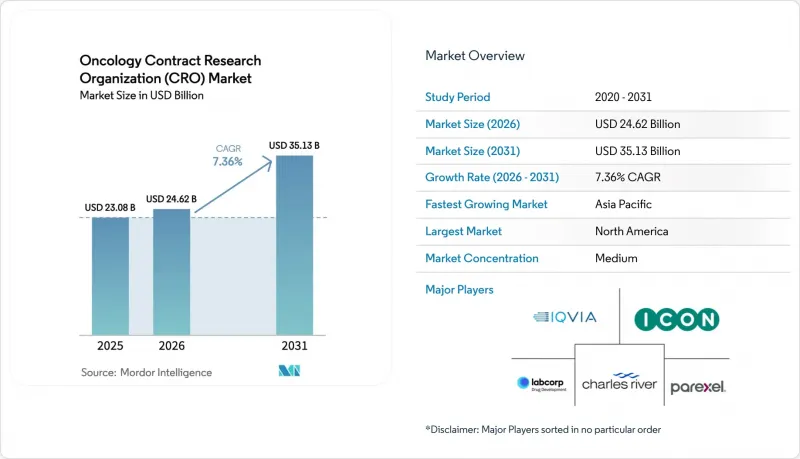
Mordor Intelligence에 의하면, 종양학 임상시험 수탁기관 시장 규모는 2025년 230억 8,000만 달러로 평가되었습니다. 2026년 246억 2,000만 달러에서 2031년까지 351억 3,000만 달러로 확대되어 2026년부터 2031년에 걸쳐 CAGR 7.36%를 나타낼 것으로 예측됩니다.
본 보고서는 임상 단계(전임상, 제1상 등), 서비스 유형(신약 개발·트랜스레이셔널 리서치 서비스 등), 적응증(고형암, 혈액 악성 종양 등), 최종 사용자(제약사 및 바이오의약품 기업 등), 지역(북미, 유럽, 아시아태평양 등)별로 분류되어 있습니다. 시장 전망은 금액(달러)으로 표시되어 있습니다.
세계의 종양학 임상시험 수탁기관 시장 동향 및 인사이트
정밀 종양학 파이프라인이 아웃소싱 수요를 견인
항체-약물 복합체(ADC), CAR-T 치료법, 이중 특이성 T세포 엔게이저 등의 분자 표적 치료제에는 바이오마커에 기반한 좁은 범위의 피험자 집단이 필요하지만, 후원 기업이 단독으로 이 정도의 피험자를 모집할 수 있는 경우는 거의 없습니다. FDA는 2024년에 16종의 정밀 종양학 의약품을 승인했으며, 2025년 초 전 세계적으로 1,200종 이상의 표적 치료제가 개발 파이프라인에 존재해, 중개 연구, 동반 진단 및 분산형 임상시험 센터 역량을 갖춘 CRO에 대한 수요가 지속되고 있습니다. 스폰서는 전임상 단계에서의 바이오마커 검증, 적응형 용량 설정 시험의 실시, 그리고 진단제 개발 기업과의 협력을 유지할 수 있는 벤더를 점점 더 선호하고 있습니다. 규제 프로세스가 성숙해짐에 따라 현재 활동은 북미와 유럽이 주도하고 있지만, 아시아태평양의 연구소들도 지역 내 임상시험을 지원하기 위해 빠르게 규모를 확대되고 있습니다. 새로운 표적이 하나 등장할 때마다 수많은 병용 요법 및 내성 메커니즘에 관한 연구가 이루어진다는 점을 감안할 때, 암 분야의 계약연구기관(CRO) 시장에 대한 장기적인 수요는 계속해서 견조할 것입니다.
복잡한 적응형 임상시험 설계의 활용 확대
바스켓 임상시험, 엄브렐라 임상시험 및 원활한 1/2상 프로토콜을 통해 스폰서는 투여량이나 코호트 구성을 실시간으로 최적화할 수 있으며, 표본 크기와 개발 주기 모두를 단축할 수 있습니다. FDA는 2024년에 마스터 프로토콜에 관한 지침 초안을 공표했으며, EMA도 2025년에 권고 사항을 발표했습니다. 이를 통해 스폰서는 적응형 종양학 임상시험 설계에 관한 보다 명확한 규칙을 확보할 수 있게 되었습니다. 적응형 임상시험을 수행하려면 고도의 생물통계학, 지속적인 데이터 검토, 유연한 예산 관리가 필요하며, 이미 이러한 역량을 갖춘 CRO에 업무를 위탁하는 추세가 확산되고 있습니다. IQVIA는 2025년 자사의 ‘Decentralized Trials’ 플랫폼을 12건의 적응형 종양학 임상시험에 적용하여 상업적 성과를 입증했습니다. 도입 사례의 대부분은 규제 당국의 수용도와 초기 단계 파이프라인이 일치하는 미국, 유럽 및 일본에 집중되어 있습니다.
성숙한 지역에서의 종양학에 정통한 임상시험 책임의사 부족
미국 및 서유럽의 임상시험 밀도가 연구자 공급량을 초과하고 있습니다. ACRP의 조사에 따르면, 2024년 미국 종양학 연구시설의 62%가 수용 능력 제약에 직면해 있으며, 계약 체결까지 소요되는 기간은 2022년의 45일에서 68일로 연장되었습니다. 소아 고형암과 같은 세부 전문 분야에서는 그 영향이 가장 두드러지게 나타나고 있습니다. 스폰서와 CRO는 이러한 압박을 완화하기 위해 시험 실시 시설 네트워크를 동유럽 및 라틴아메리카로 확대하고 있지만, 이러한 지역에서는 복잡한 바이오마커 검사에 필요한 검사 인프라가 부족한 경우가 많습니다. 새로운 임상시험 책임의사 양성 체계가 마련되지 않으면, 이러한 병목 현상이 피험자 등록 속도를 늦추고 종양학 분야 CRO 시장의 성장을 저해할 가능성이 있습니다.
부문 분석
3상 프로그램은 2025년 매출의 39.5%를 차지했으며, 이는 여전히 대규모 무작위 배정 생존 종결점에 의존하는 많은 후기 단계의 면역요법 및 항체-약물 복합체(ADC) 임상시험을 반영합니다. 그러나 정밀 의학 자산은 분자 수준에서 정의된 용량 증량 코호트를 필요로 하기 때문에 1상 임상시험과 관련된 종양학 CRO 시장 규모는 2031년까지 연평균 성장률(CAGR) 7.89%로 가장 빠르게 확대될 전망입니다. FDA 및 EMA 지침에서 권장하는 원활한 1/2상 임상시험 설계를 통해, 후원사는 임계값이 충족되는 즉시 안전성 평가군에서 유효성 평가군으로 직접 전환할 수 있게 됩니다. 이러한 변화는 적응형 피험자 등록 및 신속한 바이오마커 분석에 강점을 가진 초기 단계 전문 부서를 보유한 CRO에 유리하게 작용할 것입니다.
전임상 단계의 아웃소싱 확대도 초기 단계의 성장세를 뒷받침하고 있습니다. 스폰서는 표적 검증, 중개 연구, GLP 준수 독성 시험을 결합한 ‘신약 개발부터 IND 신청까지’의 통합 패키지를 활용함으로써 IND 신청까지 소요되는 기간을 수개월 단축하고 있습니다. 니어쇼어링의 물결로 인해 미국의 동물 실험 시설 공급은 부족해졌지만, 한편으로는 찰스 리버(Charles River)와 래보코프(LabCorp)의 설비 투자 프로젝트가 촉진되어 2026년에는 새로운 수용 능력이 확보될 전망입니다. 이러한 동향들이 맞물려, 인간 대상 첫 임상시험에서 종양학 분야의 계약연구기관(CRO) 시장의 장기적인 확대를 확고히 하고 있습니다.
2025년에는 전 세계 네트워크를 활용한 임상시험 시설 관리, 데이터 모니터링, 피험자 모집에 힘입어 임상 서비스가 매출의 30%를 차지했습니다. 그럼에도 불구하고, 전임상 및 신약 개발 활동은 여전히 선두를 달리고 있으며, 각각 2031년까지 연평균 성장률(CAGR) 7.5%를 나타낼 것으로 예측됩니다. 이는 제약 기업들이 표적 검증, 동물 대상 유효성 데이터 생성, IND 신청에 필요한 안전성 시험 실시와 같은 통합적인 지원을 중시하고 있기 때문입니다. WuXi AppTec의 플랫폼은 2025년에 45건의 종양학 프로그램을 신약 개발 단계에서 1상 임상시험 단계까지 이끌며, 통합형 서비스에 대한 수요가 증가하고 있음을 보여주었습니다. 중앙 검사실 및 바이오마커 관련 업무는 2025년 매출에서 상당한 비중을 차지했으며, 규제 당국이 표적 치료제에 대해 적극적인 바이오마커 개발 계획을 요구해 계속해서 확대되었습니다. 대규모 검체 처리 업체는 작년에 수천만 건의 종양학 검체를 처리했으며, 수요에 선제적으로 대응하기 위해 유전체 시퀀싱 및 유세포 분석 장비를 구축했습니다. 또한, 보험사에 제출할 자료 작성에 활용되는 청구 데이터 및 전자건강기록(EHR) 집계 도구의 지원에 힘입어, 리얼 월드 에비던스(RWE) 서비스도 성장하고 있습니다. 이러한 상호 보완적인 기능을 통해 풀서비스형 벤더는 교차 판매를 촉진하며, 종양학 분야에서의 계약 연구 기관(CRO)으로서 시장 점유율을 확대되고 있습니다.
지역별 분석
북미는 밀집된 임상시험 책임의사 네트워크, FDA와의 근접성, 그리고 국내에서 중추 임상시험을 촉진하는 상환 모델에 힘입어 2025년 매출의 47.78%를 차지했습니다. 미국에서는 2024년에 1,800건 이상의 종양학 임상시험이 시작되었으며, 이는 전 세계 활동량의 약 40%에 해당합니다. 캐나다와 멕시코는 ICH 준수 규제와 비용 효율적인 시험 시설을 제공함으로써 지역 내 연구를 유지하고, 시험 건수의 추가 증가에 기여하고 있습니다. BIOSECURE법에 따른 독성 시험의 니어쇼어링으로 인해 초기 단계 자금이 미국 및 유럽 허브로 더욱 유입되어 2025년 중반에는 수용 능력에 한계가 예상되지만, 현지 공급업체에게는 장기적인 성장 여지가 기대됩니다.
아시아태평양은 가장 빠르게 성장하는 지역으로, 2031년까지 연평균 성장률(CAGR) 8%가 예상됩니다. 중국의 국가약품감독관리국(NMPA)은 2024년에 23종의 항암제를 승인했으며, 승인 후 시험을 병행하여 실시하면서 조건부 판매를 계속 허용함으로써 개발 일정을 가속화하고 있습니다. 인도에서는 2024년에 임상시험 심사 기간의 중앙값을 9개월로 절반으로 단축했습니다. 또한, 치료를 받지 않은 환자층이 방대하기 때문에 많은 피험자 등록이 필요한 3상 임상시험 실시지로 매우 매력적입니다. 일본과 한국은 고품질의 데이터 세트와 FDA 및 EMA와의 신청 절차 연계를 제공합니다. 한편, 호주의 초기 단계 임상시험을 위한 패스트트랙 제도와 연구개발 세액 환급 제도 덕분에, 첫 인체 임상시험이 호주로 집중되고 있습니다.
2025년에는 독일, 영국, 프랑스를 중심으로 유럽이 수익의 큰 비중을 차지했습니다. 2025년에 전면 시행된 EU 임상시험 규정에 따라 다국간 승인 절차가 간소화되었으며, EMA의 PRIME 제도를 통해 지난해 14건의 종양학 프로젝트에 우선 심사 지위가 부여되었습니다. 신흥 지역도 이 지도를 다채롭게 만들고 있습니다. 걸프협력회의(GCC)는 암 연구 거점에 대한 투자를 추진하고 있으며, 남아프리카공화국은 다양한 유전자 풀을 제공하고, 브라질과 아르헨티나는 경험이 풍부한 임상시험 책임 의사를 보유한 비용 효율적인 임상시험 거점을 제공합니다. 현재는 규모가 작지만, 성숙한 시장이 포화 상태에 이르면서 이러한 지역들은 향후 피험자 모집 부담을 줄이는 데 기여할 것입니다.
기타 혜택 :
- 엑셀 형식 시장 예측(ME) 시트
- 3개월간의 애널리스트 지원
자주 묻는 질문
목차
제1장 서론
제2장 조사 방법
제3장 주요 요약
제4장 시장 구도
제5장 시장 규모 및 성장 예측
제6장 경쟁 구도
제7장 시장 기회 및 향후 전망
KTH 26.08.05According to Mordor Intelligence, the oncology contract research organization market size is projected to expand from USD 23.08 billion in 2025 and USD 24.62 billion in 2026 to USD 35.13 billion by 2031, registering a CAGR of 7.36% between 2026 to 2031.
This report is Segmented by Clinical Phase (Pre-Clinical, Phase I and More), Service Type (Discovery & Translational Research Services and More), Indication (Solid Tumors, Hematologic Malignancies, and More), End Users (Pharmaceuticals and Biopharmaceutical Companies and More), and Geography (North America, Europe, Asia-Pacific, and More). Market Forecasts are in Value (USD).
Global Oncology Contract Research Organization (CRO) Market Trends and Insights
Precision-Oncology Pipelines Boosting Outsourcing Demand
Molecularly targeted assets such as antibody-drug conjugates, CAR-T therapies, and bispecific T-cell engagers require narrow biomarker-based cohorts that few sponsors can recruit alone. The FDA cleared 16 precision-oncology medicines in 2024, and more than 1,200 targeted agents were in the global pipeline by early 2025, sustaining demand for CROs with translational research, companion diagnostic, and decentralized-site capabilities. Sponsors increasingly choose vendors that verify biomarkers during pre-clinical work, execute adaptive dose-finding designs, and maintain relationships with diagnostics developers. North America and Europe dominate current activity thanks to mature regulatory pathways, but Asia-Pacific labs are scaling fast to support regional trials. Given every new target spawns numerous combination and resistance-mechanism studies, the long-term pull on the oncology contract research organization (CRO) market remains strong.
Rising Use of Complex Adaptive Trial Designs
Basket, umbrella, and seamless Phase I/II protocols let sponsors refine dose and cohort composition in real time, cutting both sample size and development cycles. The FDA released draft guidance on master protocols in 2024, while the EMA followed with recommendations in 2025, giving sponsors clearer rules for adaptive oncology designs . Adaptive execution demands sophisticated biostatistics, continuous data review, and flexible budgets, pushing work to CROs that already own these capabilities. IQVIA applied its Decentralized Trials platform to 12 adaptive oncology studies during 2025, demonstrating commercial traction. Most uptake centers on the United States, Europe, and Japan, where regulatory acceptance and early-stage pipelines align.
Scarcity of Oncology-Savvy Investigators in Mature Regions
High trial density in the United States and Western Europe has overtaken investigator supply. An ACRP survey reported 62% of U.S. oncology sites faced capacity constraints in 2024, lengthening contract-signature cycles to 68 days, up from 45 days in 2022 . Sub-specialty fields like pediatric solid tumors feel the pinch most. Sponsors and CROs are widening site networks into Eastern Europe and Latin America to ease pressure, but those regions often lack the lab infrastructure necessary for complex biomarker assays. Without new investigator training pipelines, bottlenecks could moderate enrollment speed and temper growth in the oncology contract research organization (CRO) market.
Other drivers and restraints analyzed in the detailed report include:
- Scale-Out of Decentralized / Hybrid Oncology Trials
- AI-Enabled Patient-Matching & Site-Selection Efficiencies
- Sponsor Concerns Over Cross-Border Data Security
For complete list of drivers and restraints, kindly check the Table Of Contents.
Segment Analysis
Phase III programs captured 39.5% of 2025 revenue, reflecting many late-stage immunotherapy and antibody-drug conjugate studies that still rely on large, randomized survival endpoints. However, the oncology contract research organization (CRO) market size associated with Phase I work is set to rise fastest at a 7.89% CAGR to 2031 as precision assets demand molecularly defined dose-escalation cohorts. Seamless Phase I/II designs, endorsed by FDA and EMA guidance, let sponsors jump directly from safety to efficacy arms once a threshold is met. This evolution favors CROs with early-phase units skilled in adaptive enrollment and rapid biomarker turnaround.
Growth in pre-clinical outsourcing also supports early-phase momentum. Sponsors leverage integrated discovery-to-IND packages that combine target validation, translational research, and GLP toxicology, cutting months off IND submission timelines. The near-shoring wave tightened U.S. vivarium supply yet spurred capital projects by Charles River and Labcorp that will unlock fresh capacity in 2026. Together, these developments anchor long-run expansion of the oncology contract research organization (CRO) market in first-in-human studies.
Clinical services delivered 30% of revenue in 2025, driven by site management, data monitoring, and patient recruitment across global networks. Still, pre-clinical and discovery activities are pacing ahead, each forecast at 7.5% CAGR through 2031, as drug makers value single-vendor support that validates targets, produces animal efficacy data, and handles IND-enabling safety assays. WuXi AppTec's platform shepherded 45 oncology programs from discovery to Phase I in 2025, illustrating the pull toward integrated offerings. Central laboratory and biomarker work captured notable share of 2025 revenue and continues to expand as regulators insist on prospective biomarker-development plans for targeted drugs. Large sample-processing players processed tens of millions of oncology specimens last year and have built genomic sequencing and flow-cytometry suites to keep ahead of demand. Real-world evidence services also grow, powered by claims and EHR aggregation tools that feed payer submission packages. These complementary capabilities help full-service vendors cross-sell, boosting their oncology contract research organization (CRO) market share.
Complete Report Scope:
- By Clinical Phase
- Pre-clinical
- Phase I
- Phase II
- Phase III
- Phase IV
- By Service Type
- Discovery & Translational Research Services
- Pre-clinical Services
- Clinical Services
- Central Laboratory & Biomarker Services
- Real-World Evidence & Late-Phase
- Others
- By Indication
- Solid Tumors
- Hematologic Malignancies
- Rare & Pediatric Cancers
- By End Users
- Pharmaceuticals and Biopharmaceutical companies
- Academic & Research Institutes
- Others
- By Geography
- North America
- United States
- Canada
- Mexico
- Europe
- Germany
- United Kingdom
- France
- Italy
- Spain
- Rest of Europe
- Asia-Pacific
- China
- India
- Japan
- South Korea
- Australia
- Rest of Asia-Pacific
- Middle East and Africa
- GCC
- South Africa
- Rest of Middle East and Africa
- South America
- Brazil
- Argentina
- Rest of South America
- North America
Geography Analysis
North America commanded 47.78% of 2025 revenue, supported by dense investigator networks, proximity to the FDA, and reimbursement models that encourage domestic pivotal trials. The United States recorded more than 1,800 oncology trial starts in 2024, equal to around 40% of global activity. Canada and Mexico add incremental volume, offering ICH-aligned regulations and cost-efficient sites that keep studies within the region. Near-shoring of toxicology work under the BIOSECURE Act pushed even more early-phase dollars into U.S. and European hubs, straining capacity in mid-2025 but promising long-term upside for local vendors.
Asia-Pacific is the fastest-growing geography, projected at an 8% CAGR through 2031. China's NMPA approved 23 oncology agents in 2024 and continues to permit conditional marketing while post-approval studies run in parallel, accelerating timelines. India halved median clinical-trial review time to nine months in 2024, and its vast treatment-naive patient pool makes it highly attractive for enrollment-intensive Phase III work. Japan and South Korea bring high-quality data sets and synchronized submissions with the FDA and EMA, while Australia's fast-track early-phase schemes and R&D tax rebates pull first-in-human work southward.
Europe held significant share of revenue in 2025, anchored by Germany, the United Kingdom, and France. The EU Clinical Trials Regulation, fully operational in 2025, simplified multi-country approvals, and the EMA PRIME scheme granted priority status to 14 oncology projects last year. Emerging regions round out the map: the Gulf Cooperation Council invests in oncology research hubs, South Africa provides diverse genetic pools, and Brazil and Argentina supply cost-efficient sites paired with experienced investigators. Although smaller today, these regions offer future enrollment relief as mature markets saturate.
- Altasciences
- BioAgilytix Labs
- Charles River
- Eurofins
- Frontage Laboratories
- Genscript Biotech
- ICON
- IQVIA
- Jubilant Biosys
- KBI Biopharma
- LabCorp
- Lonza Bioscience Solutions
- Medpace Holdings
- Parexel International
- PPD (Thermo Fisher Scientific)
- Rentschler Biopharma
- Samsung Biologics CRO Services
- SGS
- Syneos Health
- WuXi App Tec
Additional Benefits:
- The market estimate (ME) sheet in Excel format
- 3 months of analyst support
TABLE OF CONTENTS
1 Introduction
- 1.1 Study Assumptions & Market Definition
- 1.2 Scope of the Study
2 Research Methodology
3 Executive Summary
4 Market Landscape
- 4.1 Market Overview
- 4.2 Market Drivers
- 4.2.1 Precision-Oncology Pipelines Boosting Outsourcing Demand
- 4.2.2 Rising Use of Complex Adaptive Trial Designs
- 4.2.3 Scale-Out of Decentralized / Hybrid Oncology Trials
- 4.2.4 AI-Enabled Patient-Matching & Site-Selection Efficiencies
- 4.2.5 Near-Shoring of Toxicology Capacity After Biosecurity Rules
- 4.2.6 Convergence Of CRO-CDMO One-Stop Oncology Offerings
- 4.3 Market Restraints
- 4.3.1 Scarcity of Oncology-Savvy Investigators in Mature Regions
- 4.3.2 Sponsor Concerns Over Cross-Border Data Security
- 4.3.3 Escalating Vivarium-Compliance & Animal-Welfare Costs
- 4.3.4 Heightened FDORA Inspection Frequency for Oncology Trials
- 4.4 Value Chain Analysis
- 4.5 Regulatory Landscape
- 4.6 Technological Outlook
- 4.7 Porter's Five Forces
- 4.7.1 Bargaining Power of Suppliers
- 4.7.2 Bargaining Power of Buyers
- 4.7.3 Threat of Substitutes
- 4.7.4 Threat of New Entrants
- 4.7.5 Competitive Rivalry
5 Market Size & Growth Forecasts (Value, USD)
- 5.1 By Clinical Phase
- 5.1.1 Pre-clinical
- 5.1.2 Phase I
- 5.1.3 Phase II
- 5.1.4 Phase III
- 5.1.5 Phase IV
- 5.2 By Service Type
- 5.2.1 Discovery & Translational Research Services
- 5.2.2 Pre-clinical Services
- 5.2.3 Clinical Services
- 5.2.4 Central Laboratory & Biomarker Services
- 5.2.5 Real-World Evidence & Late-Phase
- 5.2.6 Others
- 5.3 By Indication
- 5.3.1 Solid Tumors
- 5.3.2 Hematologic Malignancies
- 5.3.3 Rare & Pediatric Cancers
- 5.4 By End Users
- 5.4.1 Pharmaceuticals and Biopharmaceutical companies
- 5.4.2 Academic & Research Institutes
- 5.4.3 Others
- 5.5 By Geography
- 5.5.1 North America
- 5.5.1.1 United States
- 5.5.1.2 Canada
- 5.5.1.3 Mexico
- 5.5.2 Europe
- 5.5.2.1 Germany
- 5.5.2.2 United Kingdom
- 5.5.2.3 France
- 5.5.2.4 Italy
- 5.5.2.5 Spain
- 5.5.2.6 Rest of Europe
- 5.5.3 Asia-Pacific
- 5.5.3.1 China
- 5.5.3.2 India
- 5.5.3.3 Japan
- 5.5.3.4 South Korea
- 5.5.3.5 Australia
- 5.5.3.6 Rest of Asia-Pacific
- 5.5.4 Middle East and Africa
- 5.5.4.1 GCC
- 5.5.4.2 South Africa
- 5.5.4.3 Rest of Middle East and Africa
- 5.5.5 South America
- 5.5.5.1 Brazil
- 5.5.5.2 Argentina
- 5.5.5.3 Rest of South America
- 5.5.1 North America
6 Competitive Landscape
- 6.1 Market Concentration
- 6.2 Market Share Analysis
- 6.3 Company Profiles (includes Global level Overview, Market level overview, Core Segments, Financials as available, Strategic Information, Market Rank/Share for key companies, Products & Services, and Recent Developments)
- 6.3.1 Altasciences
- 6.3.2 BioAgilytix Labs
- 6.3.3 Charles River Laboratories
- 6.3.4 Eurofins Scientific
- 6.3.5 Frontage Laboratories
- 6.3.6 Genscript Biotech
- 6.3.7 ICON plc
- 6.3.8 IQVIA
- 6.3.9 Jubilant Biosys
- 6.3.10 KBI Biopharma
- 6.3.11 Labcorp Drug Development
- 6.3.12 Lonza Bioscience Solutions
- 6.3.13 Medpace Holdings
- 6.3.14 Parexel International
- 6.3.15 PPD (Thermo Fisher Scientific)
- 6.3.16 Rentschler Biopharma
- 6.3.17 Samsung Biologics CRO Services
- 6.3.18 SGS SA
- 6.3.19 Syneos Health
- 6.3.20 WuXi AppTec
7 Market Opportunities & Future Outlook
- 7.1 White-space & Unmet-Need Assessment


