

|
시장보고서
상품코드
2097400
희귀질환 전문수탁연구기관(CRO) : 시장 점유율 분석, 업계 동향과 통계, 성장 예측(2026-2031년)Rare Disease Contract Research Organization (CRO) - Market Share Analysis, Industry Trends & Statistics, Growth Forecasts (2026 - 2031) |
||||||
 Mordor Intelligence
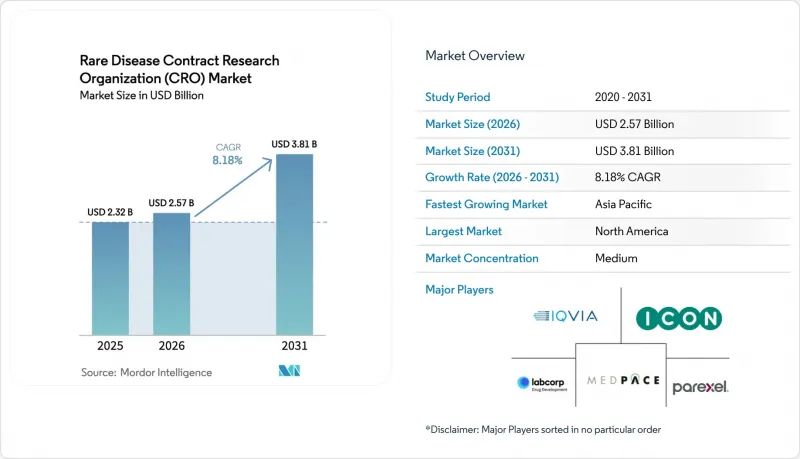
Mordor Intelligence에 의하면, 희귀질환 전문수탁연구기관(CRO) 시장 규모는 2025년 23억 2,000만 달러, 2026년 25억 7,000만 달러에서 2031년까지 38억 1,000만 달러에 달할 것으로 예측되며, 2026-2031년 연평균 복합 성장률(CAGR)은 8.18%를 나타낼 전망입니다.
본 보고서는 서비스 유형별(의약품 개발 전략, 임상시험 관리 등), 치료 분야별(순환기, 신경과학, 안과 등), 단계별(전임상, 제1상 등), 최종 사용자별(제약·바이오기술 기업 등), 지역별(북미, 유럽 등)로 분류되어 있습니다. 시장 전망은 금액(달러)으로 표시되어 있습니다.
전 세계 희귀질환 계약연구기관(CRO) 시장 동향 및 인사이트
희귀질환의 유병률 및 인지도 상승
환자 지원 네트워크 및 신생아 선별 검사 프로그램 덕분에 평균 진단까지 걸리는 기간이 2015년의 7년에서 2025년에는 3년 미만으로 단축되어, CRO가 대상으로 하는 임상시험 적격자층이 확대되고 있습니다. 미국 희귀질환기구(NORD)의 보고서에 따르면, 2023년부터 2025년에 걸쳐 회원들의 문의가 42% 증가했으며, 이는 간병인 및 임상의들 사이에서 질환에 대한 이해가 깊어지고 있음을 보여줍니다. EveryLife Foundation의 보고에 따르면, 2024년에는 희귀질환 환자의 68%가 적어도 하나의 레지스트리에 등록되어 있으며, 이는 2022년의 51%에서 증가한 수치입니다. 이에 따라 CRO는 타당성 조사를 위해 쉽게 검색 가능한 코호트를 활용할 수 있게 되었습니다. 업계 후원자가 관리하는 고셰병 중앙 집중형 등록부에는 현재 전 세계적으로 1만 명 이상의 환자가 등록되어 있어, 3상 임상시험의 피험자 등록을 기존 36개월에서 18개월 만에 완료할 수 있게 되었습니다. 신생아 중환자실(NICU)에서의 유전자 검사 신속화로 인해 방향족 L-아미노산 탈카르복실화효소 결핍증과 같은 초희귀질환의 표현형이 점차 밝혀지고 있으며, CRO가 조정 역할을 맡은 효소 보충 요법 및 유전자 강화 요법에 관한 새로운 연구 파이프라인이 생겨나고 있습니다.
희귀질환 치료제에 대한 규제상 인센티브
2024년 6월에 최종 확정된 FDA의 ‘희귀질환 증거 원칙’에 따라, 피험자 수가 200명 미만인 임상시험에서 후원사는 병행 대조군 대신 엄선된 자연 경과 데이터를 사용할 수 있게 되어, 개발 기간을 추정치로 1년 단축할 수 있게 되었습니다. 유럽에서는 희귀질환용 의약품 지정을 통해 10년간의 독점권과 무료 프로토콜 지원이 제공되며, 2024년에는 312건의 신청이 접수되어 2023년 대비 19% 증가했습니다. 일본에서는 2025년부터 ‘SAKIGAKE’ 신속 심사 프로그램의 대상을 초희귀 대사 질환 및 신경근 질환까지 확대하고, 해당 치료법에 대한 심사 기간을 절반으로 줄여 6개월로 정했습니다. 이러한 체계는 규제 장벽을 낮추고 자본 투자를 촉진하는 동시에, CRO가 서비스를 제공할 수 있는 대상 시장을 확대합니다.
피험자 모집의 어려움과 분산
세계 유병 수가 5,000건 미만인 초희귀질환의 경우, 피험자 모집에 48개월 이상이 소요되므로 신청이 지연되고 CRO의 예산이 증가하게 됩니다. FDA의 2024년 희귀질환 의약품 승인에 관한 분석에 따르면, 10만 명당 1명 미만의 환자 수에 영향을 미치는 질환의 임상시험에서는 첫 번째 피험자 등록부터 데이터베이스 잠금까지 평균 4.2년이 소요된 반면, 유병 수가 더 많은 희귀질환의 경우 2.8년이 소요되었습니다. 분산형 임상시험 설계는 이동 부담을 줄여주지만, 그럼에도 시설 내 평가 지표와의 동등성 시험을 통과해야 하므로 프로토콜 수립 기간이 6-9개월 연장됩니다. 환자 지원 단체는 이러한 마찰을 완화하고 있습니다. 2025년에는 대사성 질환 피험자의 73%가 이러한 경로를 통해 임상시험을 알게 되었으나, 암 분야의 피험자 모집은 뒤처져 있어 희귀암 환자 중 환자 지원 단체의 소개에 의존하는 비율은 고작 41%에 그치고 있습니다. 초희귀질환의 3상 프로그램에서 피험자 1인당 CRO 비용은 전문 내비게이터 배치 및 시설 구축 주기의 장기화로 인해 표준 암 임상시험의 2.5배에 달할 전망입니다.
부문 분석
2025년 매출 중 임상시험 관리가 55.10%를 차지했습니다. 이는 희귀질환 CRO 시장에서 분산형 시험 물류 및 실시간 감독에 대한 수요를 반영한 것입니다. FDA의 원격 데이터 수집에 관한 지침에 따라 재택 환경에서의 종점 검증이 의무화되어 6-9개월 분량의 업무가 추가되었으나, 그 부담은 CRO가 흡수하고 있습니다. 데이터 관리 및 생물통계학은 절대 금액으로는 작지만, 베이즈 적응형 설계나 단일 코호트 내에서 여러 치료법을 평가하는 마스터 프로토콜에 힘입어 연평균 성장률(CAGR) 9.20%를 기록하며 가장 빠르게 성장하는 사업 분야입니다. 규제 및 컨설팅 서비스는 유럽의 단일 포털 제도 하에서 중요성이 커지고 있지만, 아이러니하게도 국가별 윤리 심사 수정 사항이 잇따르면서 복잡성이 증가하고 있습니다. 의약품 개발 전략 업무(약물감시 및 환자 레지스트리 설계 포함)는 상업적 수명을 연장하고 장기적인 증거를 요구하는 IRA(인플레이션 억제법)의 희귀질환용 생물학적 제제 면제 조치에 힘입어 가속화되고 있습니다.
유전자·세포 치료제는 희귀질환 의약품 승인 건수의 27%를 차지하고 있으며, CRO에는 바이러스 벡터 취급, 동일성 관리 물류, 그리고 15년간의 추적 조사에 관한 전문 지식이 요구됩니다. 블루버드 바이오(Bluebird Bio)의 ‘Lyfgenia’는 이러한 부담을 여실히 보여줍니다. FDA가 의무화한 10년 이상의 모니터링 업무를, 스폰서는 혈액학 레지스트리 전문 업체에 위탁했습니다. 희귀질환을 대상으로 하는 저분자 화합물 프로그램은 기존의 모니터링 및 규제 관련 컨설팅에 의존하는 경향이 강합니다. NIH의 자금 지원을 받는 ‘Bespoke Gene Therapy Consortium’은 단 30명의 환자로 구성된 코호트에서 맞춤형 벡터 개발을 전적으로 CRO에 맡기고 있습니다. 따라서 스폰서는 치료법에 특화된 전문 지식을 중시하며, 제너럴리스트보다는 ‘Precision for Medicine’이나 ‘Novotech’과 같은 중견 기업을 선호하는 경향이 있습니다.
희귀질환 CRO 시장의 2025년 매출 중 35.1%를 종양학 분야가 차지하고 있으며, 이는 CAR-T 요법이나 발병률이 낮은 암을 대상으로 한 정밀 의학 프로그램에 힘입은 것입니다. 다발성 골수종 치료제인 브리스톨-마이어스 스퀴브사의 ‘아베크마(Abecma)’와 대세포형 B세포 림프종 치료제인 길리어드사의 ‘예스카르타(Yescarta)’의 경우의 경우, 20곳 이상의 의료기관에 걸친 백혈구 분리 채혈의 물류 및 안전성 모니터링이 필요하며, 이에 따라 CRO에 대한 의존도가 높아지고 있습니다. 듀쉔형 근이영양증 및 척수성 근위축증의 유전자 치료를 필두로 하는 신경과학 분야는 2031년까지 연평균 성장률(CAGR) 9.15%를 나타낼 것으로 예측됩니다. 2023년 6월 FDA가 ‘엘레비디스(Elevidis)’를 승인했을 당시, 15개국에 걸친 피험자 등록이 필요했으며, CRO가 제공하는 지리적 커버리지 범위가 주목받았습니다.
안과 분야는 여전히 틈새 시장이지만 수익성이 높은 분야입니다. Spark Therapeutics사의 ‘Luxturna’는 망막 유전자 치료의 유효성을 입증했으며, CRO의 관리 하에 현재 제II/III상 임상시험 단계에 있는 후속 파이프라인을 촉진했습니다. 2024년 타파미디스 메글루민이 승인됨에 따라, 기존 5년이 소요되던 개발 기간이 30개월로 단축되면서 심혈관계 희귀질환 분야가 다시 주목받고 있습니다. 대사성 질환 분야에서는 AAV를 이용한 임상시험에서 생리학적 수준을 초과하는 효소 농도가 확인됨에 따라 유전자 증강 요법으로의 전환이 진행되고 있으며, 벡터 전달 물류에 대한 수요가 증가하고 있습니다. 또한 CRO가 관리하는 10년간의 레지스트리에 대한 수요도 증가하고 있습니다. 모든 범주에서 바이오마커에 기반한 피험자 선정 기준으로 인해 피험자 등록 수는 감소하는 반면, 스크리닝 비용은 상승하고 있습니다. 전체 엑솜 시퀀싱을 실시하는 임상시험에서는 표현형만을 기준으로 하는 임상시험에 비해 비용이 3.2배 더 높습니다.
지역별 분석
2025년, 북미는 희귀질환 CRO 시장의 47.5% 점유율을 차지했습니다. 이는 적격 임상시험 비용의 25%를 상쇄하는 미국 ‘희귀질환 의약품법(Orphan Drug Act)’에 따른 세액 공제 및 보스턴, 샌프란시스코, 리서치 트라이앵글에 집적된 유전자 치료 혁신 기업들의 지원 덕분입니다. 2024년 1분기에 FDA가 34건의 희귀질환 지정을 승인한 것은 규제 당국이 이 분야에 지속적으로 높은 우선순위를 두고 있음을 뒷받침합니다. IRA(인플레이션 억제법)의 면세 조치로 인해 대상 생물학적 제제의 상업적 수명이 13년 연장되어, 4상 임상시험에 대한 적극적인 투자가 촉진되고 있습니다. 캐나다는 ‘희귀질환 의약품 프레임워크’를 통해 신속한 심사를 제공하고 있으며, 멕시코는 라틴아메리카 인구를 대상으로 한 비용 대비 효율적인 피험자 모집 기회를 제공합니다.
아시아태평양은 중국 NMPA의 희귀질환 신속 심사 제도와 인도의 2024년 가속 승인 프레임워크에 힘입어 2031년까지 연평균 성장률(CAGR) 9.50%라는 가장 빠른 성장률을 달성할 것으로 예측됩니다. 중국은 2024년 상반기에 12건의 희귀질환 의약품 지정을 실시하여 전년 동기 대비 50% 증가했으며, 이는 CRO에 대한 수요를 뒷받침하고 있습니다. 일본의 ‘SAKIGAKE’ 제도 확대로 심사 주기가 절반으로 단축됨에 따라, CRO의 임상시험 기관 네트워크에 대한 투자가 촉진되고 있습니다. 호주와 한국에서는 1상·2상 임상시험의 윤리 심사 승인 절차가 간소화되어 유럽 및 미국의 스폰서를 유치하고 있습니다. 중국의 ‘개인정보 보호법’에 따른 데이터 현지화로 인해 CRO는 병렬 서버를 유지해야만 하며, 데이터베이스 잠금 기간이 6주 연장되었습니다.
유럽은 안정적인 상황이 지속되고 있으며, 독일, 영국, 프랑스, 이탈리아, 스페인이 지역 전체 지출의 대부분을 차지하고 있습니다. EMA(유럽의약품청)의 희귀질환 지정 신청 건수는 2024년에 312건을 기록했습니다. EU 임상시험 규정은 신청 절차를 간소화하면서도 각국의 수정 권한은 유지되고 있어, 이에 따라 규제 컨설팅에 대한 수요가 증가하고 있습니다. 브렉시트 이후 데이터 전송에는 표준 계약 조항이 필요해져, 일정에 4-6주 정도의 지연이 발생하고 있습니다. 중동 및 아프리카 및 남미는 주로 피험자 모집을 보완하는 지역으로 기능하고 있습니다. 남아프리카공화국은 2024년에 희귀질환 지정을 위한 특별 심사 절차를 도입했고, 브라질의 ANVISA는 희귀질환 심사 기간을 12개월로 단축했으나, 환율 변동이 열의를 식히고 있습니다.
기타 혜택:
- 엑셀 형식 시장 예측(ME) 시트
- 3개월간의 애널리스트 지원
자주 묻는 질문
목차
제1장 서론
제2장 조사 방법
제3장 주요 요약
제4장 시장 구도
제5장 시장 규모와 성장 예측
제6장 경쟁 구도
제7장 시장 기회와 향후 전망
KTH 26.08.06According to Mordor Intelligence, the rare disease contract research organization market size is projected to expand from USD 2.32 billion in 2025 and USD 2.57 billion in 2026 to USD 3.81 billion by 2031, registering a CAGR of 8.18% between 2026 to 2031.
This report is Segmented by Service Type (Drug Development Strategy, Clinical Trial Management, and More), Therapeutic Area (Cardiovascular, Neuroscience, Ophthalmology, and More), Phase (Pre-Clinical, Phase I, and More), End-Users (Pharma & Biotech, and More), and Geography (North America, Europe, and More). Market Forecasts are in Value (USD).
Global Rare Disease Contract Research Organization (CRO) Market Trends and Insights
Growing Prevalence & Awareness of Rare Diseases
Patient advocacy networks and newborn-screening programs have cut the average diagnostic journey from seven years in 2015 to under three years in 2025, enlarging the trial-eligible population for CROs. The National Organization for Rare Disorders logged a 42% rise in member inquiries between 2023 and 2025, evidencing better disease literacy among caregivers and clinicians . EveryLife Foundation reported that 68% of rare-disease patients joined at least one registry in 2024, up from 51% in 2022, giving CROs readily searchable cohorts for feasibility work. Centralized Gaucher disease registries maintained by industry sponsors now aggregate more than 10,000 patients worldwide, enabling Phase III studies to complete enrollment in 18 months rather than the historical 36. Accelerated genetic testing in neonatal intensive-care units is surfacing ultra-rare phenotypes such as aromatic L-amino-acid decarboxylase deficiency, creating fresh pipelines of enzyme-replacement and gene-augmentation studies that CROs coordinate.
Regulatory Incentives for Orphan Therapeutics
The FDA's Rare Disease Evidence Principles, finalized in June 2024, permit sponsors to replace concurrent control arms with curated natural-history data in trials enrolling fewer than 200 patients, trimming an estimated year from development timelines . In Europe, orphan designation confers 10 years of exclusivity and free protocol assistance, spurring 312 applications in 2024, up 19% from 2023. Japan widened its SAKIGAKE fast-track program in 2025 to include ultra-rare metabolic and neuromuscular disorders, halving review cycles to six months for qualifying therapies. These frameworks collectively lower regulatory friction, catalyze capital deployment, and expand the serviceable addressable market for CROs.
Patient-Recruitment Scarcity & Dispersion
Ultra-rare disorders with worldwide prevalence below 5,000 cases require recruitment timelines exceeding 48 months, delaying submissions and inflating CRO budgets. FDA analysis of orphan approvals in 2024 showed trials for diseases affecting fewer than 1 in 100,000 people took an average of 4.2 years from first-patient-in to database lock, versus 2.8 years for more prevalent rare disorders. Decentralized designs reduce travel but must still pass equivalence testing against in-clinic endpoints, extending protocol build by six to nine months. Advocacy groups mitigate friction 73% of metabolic-disorder participants learned of trials via such channels in 2025, but oncology recruitment lags, as only 41% of rare-cancer patients rely on advocacy referrals . Per-patient CRO costs for ultra-rare Phase III programs run 2.5 times higher than standard oncology trials owing to specialized navigators and elongated site-startup cycles.
Other drivers and restraints analyzed in the detailed report include:
- Surge in Gene & Cell Therapy Pipelines
- Rising Outsourcing of Complex Orphan Trials
- High Cost of Multi-Regional Micro-Cohort Trials
For complete list of drivers and restraints, kindly check the Table Of Contents.
Segment Analysis
Clinical Trial Management contributed 55.10% of 2025 revenue, a reflection of decentralized trial logistics and real-time oversight needs in the rare disease CRO market. The FDA's remote-data-capture guidance obliges validation of home-based endpoints, adding six to nine months of effort that CROs absorb. Data Management & Biostatistics, while smaller in absolute terms, is the fastest-growing line at 9.20% CAGR, propelled by Bayesian adaptive designs and master protocols evaluating multiple therapies within a single cohort. Regulatory & Consulting services gain relevance under Europe's single-portal system, which paradoxically elevates complexity as country-specific ethics amendments proliferate. Drug-development strategy work, including pharmacovigilance and patient-registry design, has accelerated under the IRA orphan-biologics exemption that extends commercial life and demands long-term evidence.
Gene and cell therapies account for 27% of orphan drug approvals and require CRO fluency in viral-vector handling, chain-of-identity logistics, and 15-year follow-up. Bluebird Bio's Lyfgenia illustrates the burden: the FDA-mandated decade-plus surveillance that the sponsor outsourced to a hematology-registry specialist. Small-molecule rare-disease programs rely more on classic monitoring and regulatory consulting. The NIH-funded Bespoke Gene Therapy Consortium bets entirely on CROs for individualized vectors in cohorts as small as 30 patients. Sponsors therefore gravitate toward modality-specific expertise, favoring mid-tier players such as Precision for Medicine and Novotech over generalists.
Oncology controlled 35.1% of 2025 revenue in the rare disease CRO market, buoyed by CAR-T and precision programs targeting low-incidence cancers. Bristol Myers Squibb's Abecma for multiple myeloma and Gilead's Yescarta for large B-cell lymphoma demand leukapheresis logistics and safety oversight across 20-plus sites, reinforcing CRO reliance. Neuroscience, led by Duchenne muscular dystrophy and spinal muscular atrophy gene therapies, is projected to grow at a 9.15% CAGR through 2031. The FDA's approval of Elevidys in June 2023 required enrollment across 15 countries, spotlighting the geographic reach CROs supply.
Ophthalmology remains niche yet lucrative; Spark Therapeutics' Luxturna validated retinal gene therapy and catalyzed follow-on pipelines now in Phase II/III under CRO stewardship. Cardiovascular rare diseases are re-emerging after tafamidis meglumine's 2024 approval shortened typical timelines from five years to 30 months. Metabolic disorders are transitioning toward gene-augmentation as AAV trials show supraphysiologic enzyme levels, increasing demand for vector-distribution logistics, and 10-year registries that CROs manage. Across categories, biomarker-driven eligibility compresses enrollment but lifts screening costs; whole-exome sequencing adds a 3.2-fold premium relative to phenotype-only trials.
Complete Report Scope:
- By Service Type
- Drug Development Strategy
- Clinical Trial Management
- Data Managemet & Biostatistics
- Regulatory & Consulting
- Other Specialist Services
- By Therapeutic Area
- Cardiovascular
- Neuroscience
- Ophthalmology
- Oncology
- Metabolic & Other
- By Phase
- Pre-clinical
- Phase I
- Phase II
- Phase III
- Phase IV
- By End-Users
- Pharma & Biotech Companies
- Non-profit & Gov't Sponsors
- Academic & Research Institutes
- Others
- By Geography
- North America
- United States
- Canada
- Mexico
- Europe
- Germany
- United Kingdom
- France
- Italy
- Spain
- Rest of Europe
- Asia-Pacific
- China
- India
- Japan
- South Korea
- Australia
- Rest of Asia-Pacific
- Middle East and Africa
- GCC
- South Africa
- Rest of Middle East and Africa
- South America
- Brazil
- Argentina
- Rest of South America
- North America
Geography Analysis
North America held a 47.5% share of the rare disease CRO market in 2025, supported by the U.S. Orphan Drug Act tax credit that offsets 25% of qualified trial spending and by clusters of gene-therapy innovators in Boston, San Francisco, and the Research Triangle. The FDA's 34 orphan designations in Q1 2024 underscore continuing regulatory priority. The IRA exemption extends commercial life by 13 years for qualifying biologics, encouraging robust Phase IV investment. Canada contributes expedited review through its Orphan Drug Framework, while Mexico offers cost-effective enrollment for Latin American populations.
Asia-Pacific is forecast to achieve the most rapid 9.50% CAGR through 2031, propelled by China's NMPA fast-track rare-disease pathway and India's 2024 accelerated-approval framework. China issued 12 orphan designations in H1 2024, up 50% year on year, reinforcing CRO demand. Japan's SAKIGAKE expansion halves review cycles, prompting CRO site-network investment. Australia and South Korea streamline Phase I/II ethics approvals, attracting Western sponsors. Data-localization under China's Personal Information Protection Law forces CROs to maintain parallel servers and prolongs database lock by six weeks.
Europe remains steady, with Germany, the United Kingdom, France, Italy, and Spain accounting for the majority of regional spend. EMA orphan designation recorded 312 applications in 2024. The EU Clinical Trials Regulation simplifies submission yet preserves national amendment authority, reinforcing demand for regulatory consulting. Post-Brexit data transfer now requires standard contractual clauses, adding four to six weeks to timelines. The Middle East & Africa and South America act chiefly as supplemental enrollment regions; South Africa introduced an orphan pathway in 2024, while Brazil's ANVISA shortened rare-disease reviews to 12 months, though currency volatility tempers enthusiasm.
- Allucent
- Caidya
- Charles River Labs
- Ergomed
- Fortrea
- ICON
- IQVIA
- LabCorp
- Linical
- MedPace
- Novotech
- Orphan-Reach
- Parexel International
- Precision for Medicine
- PROMETRIKA
- Quanticate
- Simbec Orion
- Syneos Health
- Thermo Fisher Scientific
- Veristat
- Worldwide Clinical Trials
Additional Benefits:
- The market estimate (ME) sheet in Excel format
- 3 months of analyst support
TABLE OF CONTENTS
1 Introduction
- 1.1 Study Assumptions & Market Definition
- 1.2 Scope of the Study
2 Research Methodology
3 Executive Summary
4 Market Landscape
- 4.1 Market Overview
- 4.2 Market Drivers
- 4.2.1 Growing Prevalence & Awareness of Rare Diseases
- 4.2.2 Regulatory Incentives (Orphan Drug Act, EU)
- 4.2.3 Surge In Gene- & Cell-Therapy Pipelines
- 4.2.4 Rising Outsourcing of Complex Orphan Trials
- 4.2.5 AI-Driven Patient-Matching Registries
- 4.2.6 IRA-Exemption Expansion Via OBBB Act
- 4.3 Market Restraints
- 4.3.1 Patient-Recruitment Scarcity & Dispersion
- 4.3.2 High Cost of Multi-Regional Micro-Cohort Trials
- 4.3.3 Stringent ESG Compliance for Suppliers
- 4.3.4 Cross-Border Genomic-Data Privacy Barriers
- 4.4 Value Chain Analysis
- 4.5 Regulatory Landscape
- 4.6 Technological Outlook
- 4.7 Porter's Five Forces
- 4.7.1 Threat of New Entrants
- 4.7.2 Bargaining Power of Suppliers
- 4.7.3 Bargaining Power of Buyers
- 4.7.4 Threat of Substitutes
- 4.7.5 Competitive Rivalry
5 Market Size & Growth Forecasts (Value, USD)
- 5.1 By Service Type
- 5.1.1 Drug Development Strategy
- 5.1.2 Clinical Trial Management
- 5.1.3 Data Managemet & Biostatistics
- 5.1.4 Regulatory & Consulting
- 5.1.5 Other Specialist Services
- 5.2 By Therapeutic Area
- 5.2.1 Cardiovascular
- 5.2.2 Neuroscience
- 5.2.3 Ophthalmology
- 5.2.4 Oncology
- 5.2.5 Metabolic & Other
- 5.3 By Phase
- 5.3.1 Pre-clinical
- 5.3.2 Phase I
- 5.3.3 Phase II
- 5.3.4 Phase III
- 5.3.5 Phase IV
- 5.4 By End-Users
- 5.4.1 Pharma & Biotech Companies
- 5.4.2 Non-profit & Gov't Sponsors
- 5.4.3 Academic & Research Institutes
- 5.4.4 Others
- 5.5 By Geography
- 5.5.1 North America
- 5.5.1.1 United States
- 5.5.1.2 Canada
- 5.5.1.3 Mexico
- 5.5.2 Europe
- 5.5.2.1 Germany
- 5.5.2.2 United Kingdom
- 5.5.2.3 France
- 5.5.2.4 Italy
- 5.5.2.5 Spain
- 5.5.2.6 Rest of Europe
- 5.5.3 Asia-Pacific
- 5.5.3.1 China
- 5.5.3.2 India
- 5.5.3.3 Japan
- 5.5.3.4 South Korea
- 5.5.3.5 Australia
- 5.5.3.6 Rest of Asia-Pacific
- 5.5.4 Middle East and Africa
- 5.5.4.1 GCC
- 5.5.4.2 South Africa
- 5.5.4.3 Rest of Middle East and Africa
- 5.5.5 South America
- 5.5.5.1 Brazil
- 5.5.5.2 Argentina
- 5.5.5.3 Rest of South America
- 5.5.1 North America
6 Competitive Landscape
- 6.1 Market Concentration
- 6.2 Market Share Analysis
- 6.3 Company Profiles (includes Global level Overview, Market level overview, Core Segments, Financials as available, Strategic Information, Market Rank/Share for key companies, Products & Services, and Recent Developments)
- 6.3.1 Allucent
- 6.3.2 Caidya
- 6.3.3 Charles River Labs
- 6.3.4 Ergomed
- 6.3.5 Fortrea
- 6.3.6 ICON plc
- 6.3.7 IQVIA
- 6.3.8 Labcorp Drug Development
- 6.3.9 Linical
- 6.3.10 Medpace
- 6.3.11 Novotech
- 6.3.12 Orphan-Reach
- 6.3.13 Parexel
- 6.3.14 Precision for Medicine
- 6.3.15 PROMETRIKA
- 6.3.16 Quanticate
- 6.3.17 Simbec Orion
- 6.3.18 Syneos Health
- 6.3.19 Thermo Fisher
- 6.3.20 Veristat
- 6.3.21 Worldwide Clinical Trials
7 Market Opportunities & Future Outlook
- 7.1 White-space & Unmet-need Assessment


