

|
시장보고서
상품코드
2097434
창문형 에어컨 : 시장 점유율 분석, 업계 동향 및 통계, 성장 예측(2026-2031년)Window Air Conditioner (AC) - Market Share Analysis, Industry Trends & Statistics, Growth Forecasts (2026 - 2031) |
||||||
 Mordor Intelligence
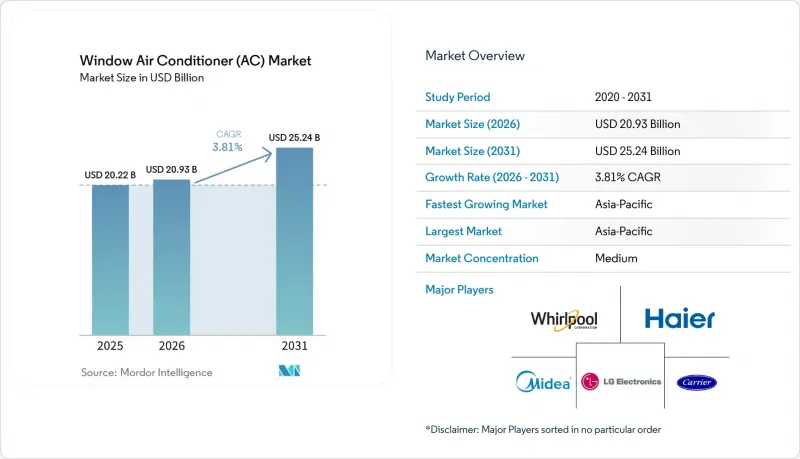
Mordor Intelligence에 의하면, 창문형 에어컨 시장 규모는 2025년에 202억 2,000만 달러로 평가되었습니다. 2026년 209억 3,000만 달러에서 2031년까지 252억 4,000만 달러에 이를 것으로 예상되며, 2026년부터 2031년까지 예측 기간 CAGR은 3.81%를 나타낼 전망입니다.
본 보고서는 제품 유형(표준형, 스마트형, 인버터형, 휴대용, 기타), 용량(5,000 BTU 미만, 5,000-8,000 BTU, 기타), 기술(인버터식, 비인버터식), 최종 사용자, 유통 채널 및 지역(북미, 남미, 유럽, 아시아태평양, 중동 및 아프리카)별로 분류되어 있습니다. 시장 전망은 금액(달러)으로 표시되어 있습니다.
세계의 창문형 에어컨 시장 동향 및 인사이트
열 스트레스 증가 및 냉방 시즌 장기화
일부 인구 밀집 지역에서 고온 기간이 빈번해짐에 따라, 냉방 수요 증가가 창문형 에어컨 시장을 견인하고 있습니다. 2026년, 델리 및 그 주변 지역에서는 실외 기온이 46°C에 달하는 최고치를 기록했으며, 이로 인해 실내 냉방 수요가 높은 수준을 유지하는 동시에 계절적 구매에 대한 시급성이 높아졌습니다. 국제에너지기구(IEA)는 인도의 실외 기온이 1°C 상승할 때마다 피크 시간대 전력 수요가 약 7기가와트 증가한다고 밝혔으며, 이는 더위의 심각성과 냉방 수요가 얼마나 밀접하게 연관되어 있는지를 여실히 보여줍니다. 냉방 시즌의 장기화는 실내 에어컨 구매를 촉진하는 요인이 되고 있습니다. 사용 기간이 길어짐에 따라 많은 가정에서 실질적인 투자 회수 기간이 단축되기 때문입니다. 이러한 추세는 창문형 에어컨 시장을 뒷받침하고 있습니다. 이 카테고리는 초기 비용이 낮고 설치가 신속하다는 점이 중시되는 ‘첫 구매 수요’에서 여전히 유리한 입장에 있기 때문입니다. 또한, 신규 구매자가 향후 교체 주기에 접어들어 더 고성능 기종으로 전환함에 따라, 장래의 교체 수요도 강화될 것입니다.
노후화된 실내용 냉방 기기에 따른 교체 수요
창문형 에어컨 시장은 기존 실내용 냉방 기기가 다수 존재하는 성숙국에서의 교체 수요에 의해서도 뒷받침되고 있습니다. 미국에서는 에너지부가 제정한 실내용 에어컨 개정 기준이 2026년 5월 26일 이후 제조 또는 수입되는 기종에 대해 시행됨에 따라, 기준에 부합하지 않는 구형 기종에서 신형 기종으로의 전환이 가속화되고 있습니다. 이에 따라 수요는 단순한 교체에서 더 뛰어난 에너지 효율과 최신 제어 기능을 갖춘 모델로 이동하고 있습니다. 인도에서도 2026년형 모델의 출시는 마찬가지로 새로운 규제 주기와 주요 공급업체의 계절별 제품 라인업 갱신과 연동되었습니다. 그 결과, 교체 수요는 창문형 에어컨 시장의 매출을 유지할 뿐만 아니라 해당 카테고리의 평균적인 기술 사양 향상에도 기여하고 있습니다. 이는 현지 실내 면적, 전압 조건 및 효율 기준에 제품을 동시에 적응시킬 수 있는 브랜드에게 유리하게 작용합니다.
스플릿형, 휴대용형 및 중앙 공조 시스템과의 경쟁
창문형 에어컨 시장의 주요 제약 요인은 여전히 구매자의 다양한 우선순위에 부응하는 다른 냉방 방식으로부터의 압박입니다. 스플릿형 시스템은 설치 편의성보다는 저소음과 실내의 깔끔한 외관을 중시하는 고소득 도시 가구를 계속해서 끌어들이고 있습니다. 이동식 모델 또한 구매 의향이 낮은 계층에서 압박을 가하고 있으며, 미국 연방 관보에는 EPCA(에너지 효율 및 절약법)의 대상 제품 범주에서 이동식 에어컨을 제외하는 2025년 제안이 공표되었습니다(최종 결정될 경우). 이에 따라 창문형 에어컨 시장은 프리미엄층에서는 더 뛰어난 디자인, 가성비층에서는 더 높은 기동성이라는 측면에서 경쟁하게 될 것입니다. 각 제조업체는 카테고리로서의 존재감을 유지하기 위해 인버터 제어, 스마트 연결 기능, 에너지 성능 향상 및 저소음화 등의 대책으로 대응하고 있습니다. 그럼에도 불구하고 이 카테고리는 도시 시장 내에서 대체 위험에 계속 직면하고 있습니다. 도시 지역에서는 소득 증가에 따라 다른 형태의 제품으로의 전환이 용이해지고 있기 때문입니다.
부문 분석
2025년, 표준형 창문형 에어컨은 제품 유형별 매출의 62.3%를 차지하며 창문형 에어컨 시장에서 가장 큰 점유율을 기록했습니다. 이는 인도, 중국, 북미의 설치 대수가 여전히 기존 실내 에어컨의 교체를 중심으로 크게 편중되어 있기 때문입니다. 이러한 압도적인 점유율은 기술적 정체라기보다는 규모의 크기와 친숙함을 반영한 것입니다. 많은 기본 모델이 에너지 효율 향상 및 제어 시스템 업데이트를 통해 여전히 지속적으로 개선되고 있기 때문입니다. 미국과 인도의 규제 변경으로 인해 주류 모델이라 하더라도 기술적 최저 기준이 점차 상향 조정되고 있으며, 표준 카테고리는 가격 주도적 역할을 잃지 않으면서도 성능이 향상되고 있습니다. 실제로, 과거에는 기본적인 교체용 모델을 선택하던 구매자들도 현재는 규제 준수성이 더 높고, 기류 관리가 우수하거나 디지털 제어가 간소화된 제품을 선택할 가능성이 높아지고 있습니다. 이로 인해 프리미엄 하위 부문이 확대되는 상황에서도 창문형 에어컨 업계에서 표준 모델의 존재 의의가 유지되고 있습니다.
스마트 창문형 에어컨은 2031년까지 연평균 성장률(CAGR) 4.89%를 나타낼 것으로 예측되며, 연결성이 프리미엄 기능에서 중급 모델의 표준 기능으로 전환됨에 따라 창문형 에어컨 시장에서 가장 빠르게 확대될 제품 하위 부문이 될 전망입니다. TCL은 2026년, Alexa, Google Assistant, Apple HomeKit을 지원하는 Matter 인증을 획득한 스마트 인버터 창문형 에어컨을 발표하며 이러한 변화를 부각시켰습니다. 이는 상호 운용성이 주류 제품 포지셔닝의 일부가 되어가고 있음을 보여줍니다. GE Appliances도 비슷한 방향성을 보여주며, 고효율과 커넥티드 제어를 결합한 인버터식 스마트 모델을 출시했습니다. 이는 스마트 기능과 인버터 기능이 별도의 업그레이드 형태로 판매되는 것이 아니라, 점점 더 통합되어 출시되고 있음을 보여줍니다. 샤프 역시 냉방 성능뿐만 아니라 건강 측면에서의 부가가치를 제공하는 ‘Ryohu’ 시리즈를 출시하며, 인도 내 프리미엄 창문형 에어컨의 제안 범위를 확대했습니다. 벽 관통형 모델이나 휴대용 창문형 에어컨은 여전히 제한적인 이용 사례에 그치고 있습니다. 하지만 창문형 에어컨 시장의 대규모 기존 설치 기반이나 계속 성장하는 스마트 부문에 비하면, 그 역할은 여전히 미미한 수준입니다.
2025년에는 5,000-8,000 BTU 용량대가 용량 부문 매출의 58.1%를 차지하며, 아파트나 도시 지역의 소규모 주택에서 흔히 볼 수 있는 일반적인 방 크기에 부합하기 때문에 창문형 에어컨 시장에서 가장 큰 판매량을 자랑하는 주력 부문이 되었습니다. 이 용량 대는 폭넓은 주거 이용 사례에 적합하며, 특히 침실, 아담한 거실, 소규모 사무 공간을 냉방할 수 있는 최소한의 실용적인 용량을 찾는 구매자에게 적합합니다. 이러한 강점은 창문형 에어컨 시장이 첫 구매 수요에 크게 의존하고 있다는 점도 반영하고 있습니다. 첫 구매 시에는 냉방 속도를 우선시하여 용량을 과도하게 선택하기보다는 합리적인 가격을 중시하는 경향이 있습니다. 따라서 고효율화나 스마트 제어 기능이 이 용량대에도 보급되고 있는 상황에서도 중용량 기종은 계속해서 이 카테고리의 핵심을 차지하고 있습니다. 그 결과, 창문형 에어컨 업계의 핵심 부문에서는 판매 대수가 안정적으로 유지되는 한편, 그 주변 부문에서는 기술적 부가가치가 높아지고 있습니다.
2만 BTU를 초과하는 용량 대역은 2031년까지 연평균 성장률(CAGR) 4.54%를 나타낼 것으로 예측되며, 특정 구역을 대상으로 한 고출력 실내 냉방을 채택하는 상업시설이 늘어남에 따라 창문형 에어컨 시장에서 가장 빠르게 성장하는 용량 대역이 될 전망입니다. 소매점, 호텔 복도, 대기실 및 기타 소규모 상업 공간에서는 중앙 공조 시스템 확장에 비용이 많이 들거나 공사로 인한 지장이 발생할 경우, 여러 대의 소형 유닛을 설치하는 것보다 1대의 대형 창문형 에어컨을 선호하는 경향이 있습니다. 9,000-1만 2,000 BTU 대역의 성장도 여전히 중요합니다. 이는 방의 크기에 대한 기대가 높아지면서, 소형 1톤 상당 기종에서 더 높은 냉방 능력을 가진 기종으로 전환하고 있는 일반 가정에 대응하기 때문입니다. 저용량 대역은 매우 좁은 방에서는 여전히 역할을 하고 있지만, 수익에 대한 기여도는 제한적이며 적용 범위도 좁아지고 있습니다. 또한, 미국의 에너지 효율 규제도 여기서 중요한 요소가 됩니다. CEER(에너지 효율 비율)의 기준값은 용량 등급에 따라 상향 조정되고 있으며, 기업들은 구형 대형 유닛을 시대에 뒤떨어진 기기로 계속 사용하는 대신, 규정을 준수하는 후속 기종으로 교체하도록 권장받고 있기 때문입니다.
지역별 분석
북미는 주거용 실내 에어컨의 설치 대수가 많고, 수요의 대부분이 교체 수요에 치우쳐 있기 때문에 창문형 에어컨 시장의 핵심을 계속 이루고 있습니다. 2026년 미국 에너지부(DOE)의 에너지 효율 기준 개정은 이미 판매 채널 동향에 영향을 미치고 있으며, 소매업체들은 구형 재고를 처분하고 개정된 성능 기준을 충족하는 인버터식 스마트 모델로의 전환을 추진하고 있습니다. 따라서 북미 시장은 변동성은 낮지만, 디지털 제어 및 저소음 기능을 강점으로 내세워 프리미엄 교체 수요에 효율적으로 대응할 수 있는 공급업체에게 여전히 중요한 수익원이 되고 있습니다. 한편, 남미 시장은 합리적인 가격을 중시하는 경향이 강하며, 도시화와 중산층 가정의 냉방 수요 증가로 인해 간편한 설치와 합리적인 가격을 여전히 우선시하는 환경 속에서 창문형 에어컨 시장은 중요한 위치를 차지하고 있습니다.
유럽에서는 많은 고소득 국가에서 스플릿 시스템이나 히트 펌프가 구조적으로 선호되는 경향이 있어, 창문형 에어컨 시장의 성장률은 낮은 임베디드니다. 동시에, 창문형 에어컨은 외관상의 제약이나 건축기준법의 제약에도 직면해 있습니다. 남유럽의 폭염은 여전히 계절적 수요를 창출하고 있지만, 이 지역에서는 아시아태평양과 같은 광범위한 첫 구매 수요는 보이지 않습니다. 2026년부터 시행되는 EU의 F가스 규제 개정에 따라 추가적인 변화가 발생할 것입니다. GWP 값이 높은 기존 제품은 더욱 엄격한 규제 환경에 직면하는 반면, 나머지 이용 사례에서는 GWP 값이 낮은 대체 제품의 중요성이 커질 것입니다. 중동 및 아프리카에서는 걸프 연안 국가들의 건설 활동 활성화에 따른 높은 성장과 사하라 이남 아프리카 일부 지역의 낮은 기초 수요가 뚜렷한 대조를 이룹니다. 후자의 경우, 여전히 가격 및 인프라 제약으로 인해 에어컨으로의 전환이 진전되지 않고 있습니다.
아시아태평양은 2025년에 41.3%의 시장 점유율로 창문형 에어컨 시장을 주도했으며, 2031년까지 연평균 성장률(CAGR) 5.23%를 나타낼 것으로 예측되어 가장 크고 가장 빠르게 성장하는 지역 시장이 될 전망입니다. 인도는 에어컨 보급률이 낮고, 주택이 소형이며, 가격에 대한 민감도가 맞물려 창문형 에어컨에 대한 지속적인 첫 구매 수요를 뒷받침하고 있어, 이 지역에서 여전히 가장 중요한 성장 동력으로 자리 잡고 있습니다. 중국은 해안 지역의 일부 도시에서는 이미 성숙한 교체 단계에 있는 반면, 내륙 지역에서는 여전히 대중 시장 가격대의 신규 가정 도입 여지가 있어, 시장에 대한 기여도는 지역에 따라 천차만별입니다. 일본과 한국에서는 스플릿형 에어컨이 더 큰 역할을 하고 있어 판매 대수 증가폭은 제한적이지만, 건축 연수가 오래된 공동 주택에서는 여전히 창문형 에어컨 설치를 위한 특정 기회가 존재합니다. 동남아시아는 고밀도 도시 개발, 가처분 소득 증가, 그리고 여전히 낮은 보급률이 판매 대수의 안정적인 기반이 되고 있어, 창문형 에어컨 시장에서의 입지를 더욱 공고히 하고 있습니다. 2026년 신제품 출시 현황을 보아도, 각 기업이 단순히 서유럽 제품을 뒤늦게 적용하는 것이 아니라, 공기 여과 기능을 강화한 프리미엄 창문형 에어컨이나 좁은 방용 모델 등 인도 및 아시아 도시 지역 수요에 직접 부응하는 제품 설계를 추진하고 있음을 알 수 있습니다.
기타 혜택 :
- 엑셀 형식 시장 예측(ME) 시트
- 3개월간의 애널리스트 지원
자주 묻는 질문
목차
제1장 서론
제2장 조사 방법
제3장 주요 요약
제4장 시장 구도
제5장 시장 규모 및 성장 예측
제6장 경쟁 구도
제7장 시장 기회 및 향후 전망
KTH 26.08.05According to Mordor Intelligence, the window air conditioner market size was valued at USD 20.22 billion in 2025 and is estimated to grow from USD 20.93 billion in 2026 to reach USD 25.24 billion by 2031, at a CAGR of 3.81% during the forecast period 2026-2031.
This report is Segmented by Product Type (Standard, Smart, Inverter, Portable and Others), Capacity (Below 5000 BTU, 5000 To 8000 BTU and Others), Technology (Inverter and Non-Inverter), End-User, Distribution Channel, and Geography (North America, South America, Europe, Asia-Pacific, Middle East and Africa). Market Forecasts are in Value (USD).
Global Window Air Conditioner (AC) Market Trends and Insights
Rising Heat Stress And Longer Cooling Seasons
The window air conditioner market is benefiting from stronger cooling demand as high-temperature periods become more frequent across several large population centers. Delhi and nearby areas recorded peak outdoor temperatures of 46°C in 2026, which kept room-cooling demand elevated and heightened urgency around seasonal purchases. The International Energy Agency stated that each 1°C rise in India's outdoor temperatures adds nearly 7 gigawatts to peak electricity demand, underscoring how closely heat intensity and cooling demand now move together. Longer active cooling seasons also strengthen the case for buying room air conditioners, as more months of use shorten the effective payback period for many households. This pattern supports the window air conditioner market because the category remains well-positioned for first-purchase demand, where lower upfront costs and faster setup matter. It also strengthens future replacement demand as new buyers enter later upgrade cycles and shift toward better-rated units.
Replacement Demand From Aging Room Cooling Stock
The window air conditioner market is also supported by replacement demand in mature countries with large existing room-cooling fleets. In the United States, revised Department of Energy standards for room air conditioners took effect for units manufactured or imported on or after May 26, 2026, accelerating the move away from older, non-compliant stock . This is shifting demand from simple replacement purchases toward models that also offer stronger energy performance and updated controls. In India, 2026 model launches were similarly tied to fresh compliance cycles and seasonal portfolio updates from major suppliers. As a result, replacement demand not only preserves sales volume in the window air conditioner market but also upgrades the average technical specification of the category. This favors brands that can adapt products to local room sizes, voltage conditions, and efficiency thresholds simultaneously.
Competition From Split, Portable, And Central HVAC Systems
The main restraint on the window air conditioner market remains pressure from other cooling formats that appeal to different buyer priorities. Split systems continue to attract higher-income urban households that value lower noise and a cleaner indoor appearance more than ease of installation. Portable units also create pressure at the low-commitment end of the category, and the U.S. Federal Register published a 2025 proposal to withdraw portable ACs from the covered product category under EPCA, if finalized . This leaves the window air conditioner market competing with better aesthetics at the premium end and greater mobility at the value end. Manufacturers are responding with inverter controls, smart connectivity, improved energy performance, and quieter operation to protect category relevance. Even so, the category continues to face substitution risk in urban markets, where rising incomes make alternative formats easier to adopt.
Other drivers and restraints analyzed in the detailed report include:
- Energy Efficiency Standards Pushing Technology Upgrades
- Space-Constrained Urban Housing Favoring Window ACs
- Grid Instability And Voltage Fluctuation In Emerging Markets
For complete list of drivers and restraints, kindly check the Table Of Contents.
Segment Analysis
Standard window units accounted for 62.3% of product type revenue in 2025, giving them the largest share in the window air conditioner market, as the installed base in India, China, and North America still leans heavily toward conventional room AC replacements. This leading share reflects scale and familiarity more than technical stagnation, because many basic units are still being refreshed with better energy performance and updated control systems. Regulatory changes in the United States and India are gradually raising the technical floor for even mainstream models, meaning the standard category is improving without losing its price-led role. In practical terms, buyers who once chose a basic replacement are now more likely to receive a unit with stronger compliance credentials, better airflow management, or simplified digital control. This helps preserve the relevance of standard units inside the window air conditioner industry even as premium subsegments expand.
Smart window units are projected to grow at a 4.89% CAGR through 2031, making them the fastest-expanding product subsegment in the window air conditioner market as connectivity shifts from a premium feature to a mid-tier expectation. TCL highlighted this shift in 2026 with a Matter-certified smart inverter window AC that works with Alexa, Google Assistant, and Apple HomeKit, showing how interoperability is becoming part of mainstream product positioning . GE Appliances followed the same direction with an inverter smart model that combined high efficiency with connected controls, which shows that smart and inverter features are increasingly being launched together rather than sold as separate upgrades. Sharp also widened the premium window proposition in India by launching the Ryohu series with active air purification, which adds health-related value beyond cooling output alone. Through-the-wall models and portable window-mounted variants still serve narrower use cases. Still, their roles remain smaller than the large standard installed base and the rising smart segment in the window air conditioner market.
The 5,000 to 8,000 BTU band accounted for 58.1% of capacity segment revenue in 2025, making it the largest-volume anchor in the window air conditioner market, as it matches common room sizes across apartments and smaller urban homes. This range fits a broad set of residential use cases, especially where buyers want the lowest workable capacity that can still cool bedrooms, compact living rooms, and small office spaces. Its strength also reflects the window air conditioner market's heavy exposure to first-purchase demand, where affordability tends to outweigh oversizing for faster cooldown. Mid-range units, therefore, continue to hold the center of mass for the category even while higher efficiency and smart control features move down into these bands. The result is steady volume retention at the core of the window air conditioner industry while technical value rises around it.
The above 20,000 BTU band is forecast to grow at a 4.54% CAGR through 2031, making it the fastest-growing capacity tier in the window air conditioner market as more commercial sites adopt high-output room cooling for targeted zones. Retail outlets, hotel corridors, waiting areas, and other light commercial spaces often prefer a single larger window unit over multiple smaller installations when a central HVAC extension is expensive or disruptive. Growth in the 9,000 to 12,000 BTU band remains important as well, because it serves households that are upgrading room size expectations and shifting from smaller one-ton equivalents to higher cooling output. Lower capacity bands still have a role in very compact rooms, but they remain limited in revenue contribution and have a narrower application range. United States efficiency rules also matter here, because CEER thresholds increase by capacity class and encourage businesses to replace older large units with compliant successors rather than continue running outdated equipment.
Complete Report Scope:
- By Product Type
- Standard Window Units
- Smart Window Units
- Inverter Window Units
- Portable Window-Mounted Systems
- Through-the-Wall Models
- By Capacity
- Below 5,000 BTU
- 5,000 to 8,000 BTU
- 9,000 to 12,000 BTU
- 13,000 to 16,000 BTU
- 17,000 to 20,000 BTU
- Above 20,000 BTU
- By Technology
- Inverter
- Non-Inverter
- By End-User
- Residential
- Commercial
- Hospitality
- Healthcare
- Retail
- Corporate Offices
- Educational Institutes
- Other Commercial Applications
- By Distribution Channel
- B2B/Direct from the Manufacturers
- B2C/Retail Consumers
- Multi-Brand Stores
- Exclusive Brand Stores (EBOs)
- Online
- Other Distribution Channels
- By Region
- North America
- Canada
- United States
- Mexico
- South America
- Brazil
- Peru
- Chile
- Argentina
- Rest of South America
- Europe
- United Kingdom
- Germany
- France
- Spain
- Italy
- BENELUX (Belgium, Netherlands, and Luxembourg)
- NORDICS (Denmark, Finland, Iceland, Norway, and Sweden)
- Rest of Europe
- Asia-Pacific
- India
- China
- Japan
- Australia
- South Korea
- South East Asia (Singapore, Malaysia, Thailand, Indonesia, Vietnam, and the Philippines)
- Rest of Asia-Pacific
- Middle East and Africa
- United Arab Emirates
- Saudi Arabia
- South Africa
- Nigeria
- Rest of the Middle East and Africa
- North America
Geography Analysis
North America remains a core part of the window air conditioner market because the region has a large installed base of residential room ACs and a demand profile heavily weighted toward replacement activity. The 2026 DOE efficiency update is now shaping channel behavior, as retailers are moving away from older stock and toward inverter-smart models that meet the revised performance baseline. This makes North America a less volatile but still important revenue pool for suppliers that can serve premium replacement demand more efficiently, with digital controls and lower-noise positioning. South America follows a more affordability-led path, where urbanization and rising middle-class household cooling needs keep the window air conditioner market relevant in settings that still prioritize simpler installation and accessible pricing.
Europe shows a lower growth profile in the window air conditioner market because split systems and heat pumps are more structurally favored in many higher-income countries. At the same time, window-mounted units also face visual and building code constraints. Southern European heatwaves still create seasonal demand, but the region does not show the same broad first-purchase depth as Asia-Pacific. The updated EU F-Gas framework from 2026 adds another layer of change, as higher-GWP legacy products face a tighter compliance environment and low-GWP alternatives become more relevant in remaining use cases. In the Middle East and Africa, the window air conditioner market shows a sharper contrast between higher growth in Gulf construction activity and lower base demand in parts of Sub-Saharan Africa, where affordability and infrastructure still limit conversion.
Asia-Pacific led the window air conditioner market with a 41.3% market share in 2025 and is expected to grow at a 5.23% CAGR through 2031, making it both the largest and the fastest-growing regional market. India remains the single most important growth engine in this region because low AC penetration, compact housing, and price sensitivity together support sustained first purchase demand for window formats. China contributes through a mixed pattern, with some coastal cities already in a more mature replacement phase. At the same time, inland areas still offer room for new household adoption at mass-market price points. Japan and South Korea offer more limited upside in volume because split systems play a stronger role there, but older multi-family housing still offers selected opportunities for window installations. Southeast Asia continues to strengthen its position in the window air conditioner market, as dense urban development, rising disposable incomes, and still-low penetration rates create a steady base for unit sales. Product launches in 2026 also show that companies are designing more directly for Indian and Asian urban needs, including premium window units with enhanced air filtration and models for compact rooms, rather than simply adapting Western products later.
- LG Electronics Inc.
- Midea Group Co., Ltd.
- Haier Smart Home Co., Ltd.
- Whirlpool Corporation
- Carrier Global Corporation
- Friedrich Air Conditioning Co.
- Gree Electric Appliances Inc. of Zhuhai
- Daikin Industries, Ltd.
- Panasonic Holdings Corporation
- Samsung Electronics Co., Ltd.
- Electrolux AB
- GE Appliances, a Haier company
- Voltas Limited
- Blue Star Limited
- TCL Industries Holdings Co., Ltd.
- Hitachi, Ltd.
- Hisense Home Appliances Group Co., Ltd.
- Chigo Holding Limited
- Amana Corporation
- Gradient Comfort
Additional Benefits:
- The market estimate (ME) sheet in Excel format
- 3 months of analyst support
TABLE OF CONTENTS
1 Introduction
- 1.1 Study Assumptions and Market Definition
- 1.2 Scope of the Study
2 Research Methodology
3 Executive Summary
4 Market Landscape
- 4.1 Market Overview
- 4.2 Market Drivers
- 4.2.1 Rising Heat Stress and Longer Cooling Seasons
- 4.2.2 Replacement Demand From Aging Room Cooling Stock
- 4.2.3 Energy Efficiency Standards Pushing Technology Upgrades
- 4.2.4 Space-Constrained Urban Housing Favoring Window ACs
- 4.2.5 Rental Housing and Temporary Occupancy Demand
- 4.2.6 Low-GWP Refrigerant Transition Unlocking Premium Replacements
- 4.3 Market Restraints
- 4.3.1 Competition From Split, Portable, and Central HVAC Systems
- 4.3.2 High Noise and Aesthetics Sensitivity in Urban Households
- 4.3.3 Grid Instability and Voltage Fluctuation in Emerging Markets
- 4.3.4 Retrofit Constraints in Older Window Frames and Building Codes
- 4.4 Industry Value Chain Analysis
- 4.5 Porter's Five Forces Analysis
- 4.5.1 Bargaining Power of Suppliers
- 4.5.2 Bargaining Power of Buyers
- 4.5.3 Threat of New Entrants
- 4.5.4 Threat of Substitutes
- 4.5.5 Industry Rivalry
- 4.6 Insights into the Latest Trends and Innovations in the Industry
- 4.7 Insights into the Recent Developments (New Product Launches, Strategic Initiatives, Investments, Partnerships, JVs, Expansion, M&As, etc.) in the Industry
5 Market Size & Growth Forecasts
- 5.1 By Product Type
- 5.1.1 Standard Window Units
- 5.1.2 Smart Window Units
- 5.1.3 Inverter Window Units
- 5.1.4 Portable Window-Mounted Systems
- 5.1.5 Through-the-Wall Models
- 5.2 By Capacity
- 5.2.1 Below 5,000 BTU
- 5.2.2 5,000 to 8,000 BTU
- 5.2.3 9,000 to 12,000 BTU
- 5.2.4 13,000 to 16,000 BTU
- 5.2.5 17,000 to 20,000 BTU
- 5.2.6 Above 20,000 BTU
- 5.3 By Technology
- 5.3.1 Inverter
- 5.3.2 Non-Inverter
- 5.4 By End-User
- 5.4.1 Residential
- 5.4.2 Commercial
- 5.4.2.1 Hospitality
- 5.4.2.2 Healthcare
- 5.4.2.3 Retail
- 5.4.2.4 Corporate Offices
- 5.4.2.5 Educational Institutes
- 5.4.2.6 Other Commercial Applications
- 5.5 By Distribution Channel
- 5.5.1 B2B/Direct from the Manufacturers
- 5.5.2 B2C/Retail Consumers
- 5.5.2.1 Multi-Brand Stores
- 5.5.2.2 Exclusive Brand Stores (EBOs)
- 5.5.2.3 Online
- 5.5.2.4 Other Distribution Channels
- 5.6 By Region
- 5.6.1 North America
- 5.6.1.1 Canada
- 5.6.1.2 United States
- 5.6.1.3 Mexico
- 5.6.2 South America
- 5.6.2.1 Brazil
- 5.6.2.2 Peru
- 5.6.2.3 Chile
- 5.6.2.4 Argentina
- 5.6.2.5 Rest of South America
- 5.6.3 Europe
- 5.6.3.1 United Kingdom
- 5.6.3.2 Germany
- 5.6.3.3 France
- 5.6.3.4 Spain
- 5.6.3.5 Italy
- 5.6.3.6 BENELUX (Belgium, Netherlands, and Luxembourg)
- 5.6.3.7 NORDICS (Denmark, Finland, Iceland, Norway, and Sweden)
- 5.6.3.8 Rest of Europe
- 5.6.4 Asia-Pacific
- 5.6.4.1 India
- 5.6.4.2 China
- 5.6.4.3 Japan
- 5.6.4.4 Australia
- 5.6.4.5 South Korea
- 5.6.4.6 South East Asia (Singapore, Malaysia, Thailand, Indonesia, Vietnam, and the Philippines)
- 5.6.4.7 Rest of Asia-Pacific
- 5.6.5 Middle East and Africa
- 5.6.5.1 United Arab Emirates
- 5.6.5.2 Saudi Arabia
- 5.6.5.3 South Africa
- 5.6.5.4 Nigeria
- 5.6.5.5 Rest of the Middle East and Africa
- 5.6.1 North America
6 Competitive Landscape
- 6.1 Market Concentration
- 6.2 Strategic Moves
- 6.3 Market Share Analysis
- 6.4 Company Profiles {(includes Global level Overview, Market level overview, Core Segments, Financials as available, Strategic Information, Market Rank/Share for key companies, Products & Services, and Recent Developments)}
- 6.4.1 LG Electronics Inc.
- 6.4.2 Midea Group Co., Ltd.
- 6.4.3 Haier Smart Home Co., Ltd.
- 6.4.4 Whirlpool Corporation
- 6.4.5 Carrier Global Corporation
- 6.4.6 Friedrich Air Conditioning Co.
- 6.4.7 Gree Electric Appliances Inc. of Zhuhai
- 6.4.8 Daikin Industries, Ltd.
- 6.4.9 Panasonic Holdings Corporation
- 6.4.10 Samsung Electronics Co., Ltd.
- 6.4.11 Electrolux AB
- 6.4.12 GE Appliances, a Haier company
- 6.4.13 Voltas Limited
- 6.4.14 Blue Star Limited
- 6.4.15 TCL Industries Holdings Co., Ltd.
- 6.4.16 Hitachi, Ltd.
- 6.4.17 Hisense Home Appliances Group Co., Ltd.
- 6.4.18 Chigo Holding Limited
- 6.4.19 Amana Corporation
- 6.4.20 Gradient Comfort
7 Market Opportunities & Future Outlook
- 7.1 Smart and inverter technology integration
- 7.2 Heat pump window AC units


