

|
시장보고서
상품코드
2098548
자동차용 첨단 DRAM 시장 : 점유율 분석, 업계 동향 및 통계, 성장 예측(2026-2031년)Automotive Advanced DRAM - Market Share Analysis, Industry Trends & Statistics, Growth Forecasts (2026 - 2031) |
||||||
 Mordor Intelligence
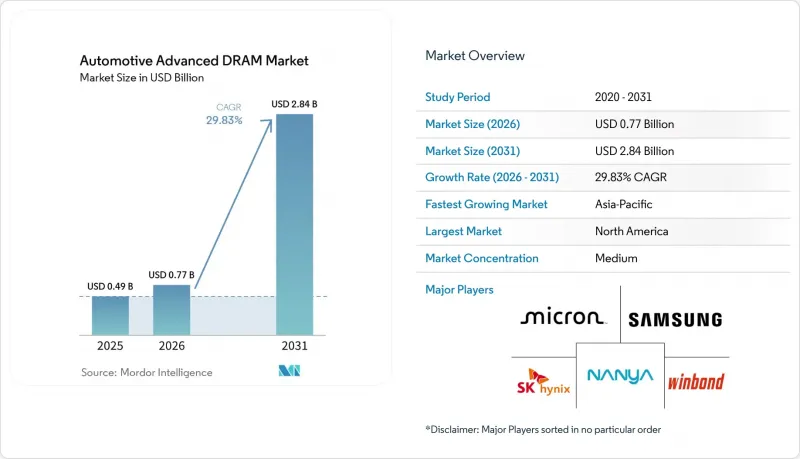
Mordor Intelligence에 의하면, 자동차용 첨단 DRAM 시장 규모는 2025년 4억 9,000만 달러에서 2026년에는 7억 7,000만 달러로 확대되어 2026년부터 2031년까지 CAGR 29.83%로 성장을 지속하여, 2031년에는 28억 4,000만 달러에 이를 것으로 예측됩니다.
본 보고서는 메모리 기술(LPDDR5, LPDDR5X, DDR5 SDRAM 등), 메모리 용량(16GB, 24GB, 32GB, 64GB, 96GB, 128GB 이상), 용도(ADAS 및 자율주행, 디지털 콕핏 및 IVI, 계기판 및 HUD 등), 차량 유형(승용차 및 상용차), 지역별로 분류되어 있습니다. 시장 전망은 금액(달러) 기준으로 제시되어 있습니다.
전 세계 자동차용 첨단 DRAM 시장 동향 및 인사이트
ADAS 센서 퓨전의 메모리 집약도
ADAS 워크로드는 자동차용 첨단 DRAM 시장에서 여전히 단기 수요를 견인하는 가장 큰 요인으로 작용하고 있습니다. 이는 카메라, 레이더, LiDAR 시스템이 지연 없이 저장 및 처리되어야 하는 지속적이고 고속의 데이터 흐름을 생성하기 때문입니다. 마이크론(Micron)은 자사의 자동차 공학 연구에서 레벨 4 이상의 자율주행 시스템에는 1 TB/s를 초과하는 DRAM 대역폭이 필요할 수 있다고 밝혔으며, 차량에 센싱 및 추론 레이어가 추가됨에 따라 메모리 수요가 얼마나 급속히 증가할지를 강조하고 있습니다. 이는 설계 주기에도 변화를 가져옵니다. 메모리 채널 수, 버스 폭, 토폴로지는 차량이 양산 단계에 진입하기 훨씬 전인 SoC 정의 단계에서 확정되어야 하기 때문입니다. JEDEC은 9,600 Mbps의 LPDDR5X가 이미 자동차 용도로 자리 잡았음을 확인했으나, GDDR7의 자동차 인증은 2026년 중반 현재 아직 보류 중입니다. 이러한 순서가 중요한 이유는 현재 공급업체의 약속이 수년 후 출하될 차량의 메모리 아키텍처와 직결되기 때문입니다. 자동차용 첨단 동적 랜덤 액세스 메모리(DRAM) 시장에서는 생산 개시 전에 아키텍처가 거의 확정되기 때문에 공급업체는 최종 조달 단계보다 서브시스템 설계 단계에서 더 큰 영향력을 행사하게 됩니다.
중앙 집중형 및 구역형 컴퓨팅으로의 전환
자동차용 첨단 DRAM 시장은 다수의 분산형 제어 장치에서 소수의 중앙 집중형 및 구역형 컴퓨팅 플랫폼으로의 전환에 의해서도 견인되고 있습니다. NXP는 2025년 3월, 존형 SDV 아키텍처용으로 MRAM을 내장한 자동차 업계 최초의 16nm FinFET MCU인 S32K5 MCU 제품군을 발표했습니다. 이는 공급업체들이 이미 이러한 시스템 전환을 염두에 두고 제품 개발을 진행하고 있음을 보여줍니다. 이 플랫폼은 LPDDR5 및 LPDDR5X 인터페이스를 지원하며, 이를 통해 컨트롤러 프로그램에서 첨단 자동차용 메모리에 대한 잠재적 수요 기반이 직접적으로 확대됩니다. 이 아키텍처가 보급됨에 따라 메모리 관련 의사 결정은 다수의 ECU 프로그램에서 소수의 Tier 1 및 도메인 컨트롤러 플랫폼으로 이동하게 되며, 설계상의 관여 지점은 감소하는 반면 각 지점의 가치는 높아집니다. 또한, 과거에는 다수의 소형 전자 모듈에 분산되어 있던 기능이 단일 중앙 집중형 컨트롤러로 대체됨에 따라 연산 유닛당 DRAM 탑재량도 증가합니다. 자동차용 고급 DRAM 시장에서 이는 기존의 분산형 조달 모델과 비교하여, 단일 플랫폼에서의 채택이 더 대규모이자 장기적인 수량 약정을 수반함을 의미합니다.
HBM 주도 웨이퍼 배분 부족
자동차용 첨단 DRAM 시장공급 측면에서 가장 큰 제약 요인은 AI 가속기용 HBM으로의 첨단 노드 웨이퍼 생산 능력 전환입니다. S&P Global Automotive Insights는 2025년 12월, HBM 생산이 이미 전 세계 DRAM 웨이퍼 생산량의 약 23%를 차지하고 있으며, 삼성, 마이크론, SK하이닉스가 첨단 공정 생산 능력의 80% 이상을 HBM으로 전환했다고 밝혔습니다. 그 결과, 자동차용 DRAM 확보 여지가 좁아지고 있습니다. 자동차용 DRAM은 소비자용 메모리보다 온도, 추적성, 신뢰성에 대한 요구 사항이 엄격하여 표준 부품으로 쉽게 대체할 수 없습니다. S&P 세계의 보고서에 따르면, 2026년 자동차용 DRAM 가격은 2025년 계약 수준보다 70%-100% 상승할 것으로 예상되며, 이는 공급 상황이 얼마나 핍박하고 있는지를 보여줍니다. 이는 가격 문제 이상의 심각한 사태를 초래하고 있습니다. 2027년 이후 DDR4 및 LPDDR4공급이 감소함에 따라, 플랫폼 변경 준비가 완료되지 않은 차량 프로그램조차도 전환을 피할 수 없게 될 것이기 때문입니다. 자동차용 첨단 DRAM 시장에서 OEM 및 Tier 1 공급업체는 차세대 제품으로의 재설계를 진행하면서, 향후 인증된 메모리를 확보해야 하므로 현재 공급 안정성은 성능과 거의 동등한 중요성을 띠고 있습니다.
부문 분석
LPDDR5는 성숙한 인증 범위, 폭넓은 공급 기반, 그리고 현재의 ADAS 및 콕핏 SoC 프로그램과의 긴밀한 연계를 바탕으로 2025년 자동차용 첨단 DRAM 시장에서 54.82%의 점유율을 차지했습니다. 이러한 선두 위상은 대역폭, 전력 효율, 그리고 여러 차량 플랫폼에 걸쳐 입증된 자동차용 적합성 사이에서 실용적인 균형을 이루고 있음을 반영합니다. LPDDR5X는 집중형 컴퓨팅 및 AI를 많이 사용하는 콕핏 프로그램이 양산 단계로 전환됨에 따라 2026년부터 2031년까지 연평균 성장률(CAGR) 30.82%를 나타낼 것으로 예측되며, 메모리 기술 부문에서 가장 빠르게 성장하는 분야가 될 전망입니다. Samsung Electronics는 자사의 12nm급 자동차용 LPDDR5X가 256비트 버스에서 307.2 GB/s의 전송 속도를 실현할 수 있으며, 카메라, 레이더, AI 워크로드를 동시에 처리하는 컨트롤러의 처리량 요구 사항을 충족한다고 밝혔습니다. 따라서 자동차용 첨단 DRAM 시장은 2단계의 경로를 따르고 있으며, LPDDR5는 기존의 광범위한 도입 기반을 유지하고, LPDDR5X는 더 높은 대역폭이 필요한 시스템을 위한 업그레이드 경로 역할을 하고 있습니다.
DDR5 SDRAM은 강력한 연산 성능이 필요하고 다양한 열 및 전력 프로파일에 대응할 수 있는 차량용 플랫폼에서 계속해서 보완적인 역할을 수행하고 있습니다. 한편, GDDR6는 보다 전문적인 용도를 위한 것으로, 저전력 소비보다는 렌더링 대역폭이 중시되는 첨단 HUD나 증강현실(AR) 디스플레이 시스템과 같은 그래픽 집약적 용도에 가장 적합합니다. 기타 DRAM 및 신흥 고급 DRAM 카테고리는 현재 생산 규모상 여전히 작지만, 2025년 JEDEC이 LPDDR6를 발표함에 따라 시장에 LPDDR5X 이후의 명확한 로드맵 목표가 제시됨에 따라 전략적 중요성이 높아지고 있습니다. 이는 자동차용 고급 DRAM 시장에 중요한 의미를 지닙니다. 왜냐하면 2028년 이후의 차량 설계 주기는 현재 진행 중인 인증 시기 및 인터페이스 준비 상황에 대한 결정에 따라 점점 더 구체화될 것이기 때문입니다. 저밀도 계층을 다루는 대만의 제조업체를 포함한 소규모 메모리 공급업체에게는 피크 대역폭보다 비용, 지속성 및 인증의 깊이가 중시되는 분야에서 여전히 활약할 여지가 있지만, 시장의 중심은 분명히 LPDDR5X급 플랫폼으로 이동하고 있습니다.
2025년 시점에서 32GB급이 고급차용 DRAM 시장의 33.49%를 차지하고 있으며, 이는 현재 양산 중인 프리미엄 콕핏 컨트롤러 및 중앙 연산 플랫폼과의 호환성을 입증합니다. 이 등급은 모든 플랫폼을 최고 비용의 밀도 등급으로 밀어 넣지 않으면서도, 오늘날의 멀티 디스플레이, 커넥티비티 및 중간 수준의 ADAS 작업에 대응하기에 충분한 여유를 제공합니다. 128GB 이상의 계층은 2031년까지 연평균 성장률(CAGR) 31.03%로 확대될 것으로 예상되며, 자율주행 스택이 더 대규모의 메모리 풀을 필요로함에 따라 가장 빠르게 성장하는 밀도 대역이 될 전망입니다. 이러한 성장은 컨트롤러 통합과 밀접한 관련이 있습니다. 중앙 연산 시스템이 과거에는 수많은 개별 모듈에 의해 처리되던 작업을 통합하고 있기 때문입니다. 따라서 자동차용 고급 DRAM 시장에서는 특히 향후 더욱 정교한 센싱 및 AI 추론을 지원하기 위한 아키텍처에서 밀도에 대한 수요가 ‘플랫폼 요구 사항 충족’에서 ‘향후 소프트웨어 확장 여지’로 전환되고 있습니다.
16GB 및 24GB 계층은 자동차 제조업체들이 안정적이고 표준화된 하드웨어 기준을 선호하는 양산형 IVI(차량용 인포테인먼트) 및 디지털 클러스터 용도에서 여전히 중요한 위치를 차지하고 있습니다. 한편, 64GB 및 96GB 계층은 L2+ 및 L3 프로그램에서 입지를 넓혀가고 있습니다. 이러한 프로그램에서는 최고 밀도 등급으로 즉시 전환하지 않으면서도, 더 까다로운 ADAS와 콕핏 조합을 지원하기 위해 추가 메모리가 필요합니다. Samsung Electronics는 자사의 12nm급 LPDDR5X가 다이당 3GB에서 24GB 용량으로 제공되며, 멀티 다이 스케일링을 통해 SoC의 전면적인 재설계가 필요 없이 시스템 전체의 밀도를 확장할 수 있다고 지적했습니다. 이러한 모듈성은 자동차용 고급 DRAM 시장에서 중요합니다. 이를 통해 공급업체는 여러 트림 및 컴퓨팅 패키지 간에 하드웨어 재사용을 유지하면서 메모리 구성을 차량 프로그램의 요구 사항에 맞출 수 있기 때문입니다. 또한, 자동차용 작동 온도 및 장기 신뢰성과 관련된 인증 요건 역시 양산 규모에서 최고 밀도 등급을 지원할 수 있는 공급업체의 선택지를 좁히고 있으며, 이는 해당 카테고리의 상위 시장에서 집중화가 더욱 심화되는 요인이 되고 있습니다.
지역별 분석
2025년, 아시아태평양은 자동차용 첨단 DRAM 시장의 56.89%를 차지하며, 다른 지역을 크게 앞지르고 최대 기여 지역이 되었습니다. 이러한 위상은 전기차(EV) 생산 호조, 해당 지역의 강력한 전자기기 제조거점, 그리고 세계 최대 DRAM 공급업체가 해당 지역에 거점을 두고 있는 점 등이 복합적으로 작용하여 구축된 것입니다. 중국은 메모리 공급 부족과 원자재 비용 상승에도 불구하고, 현지 자동차 제조업체들이 ADAS, AI 콕핏, 전기차 플랫폼의 확장을 지속적으로 추진함에 따라 해당 지역 내 주요 수요 거점으로 자리매김했습니다. 2026년 1월, SK하이닉스가 TUV SUD를 통해 자동차용 LPDDR5X의 ASIL-D 인증을 획득함에 따라, 한국은 그 역할을 강화하고 차세대 메모리의 기능 안전 대응 능력 측면에서 해당 지역의 우위를 더욱 공고히 했습니다. 일본은 Tier 1 공급업체 기반을 통해 계속해서 인증 및 통합 주기를 주도하고 있는 반면, 대만은 LPDDR5X 기반 자동차 시스템과 관련된 첨단 패키징 및 멀티칩 모듈(MCM) 조립 분야에서 여전히 중요한 역할을 수행하고 있습니다.
유럽은 가장 빠르게 성장하는 지역 부문이며, 이 지역의 자동차용 첨단 DRAM 시장 규모는 2031년까지 연평균 성장률(CAGR) 30.59%로 확대될 것으로 예측됩니다. 소프트웨어 정의 차량(SDV) 프로그램, 프리미엄 차량 아키텍처, 그리고 안전 및 규정 준수에 대한 강력한 집중이 이 지역 수요 동향을 주도하고 있습니다. ISO 26262는 메모리 인증 및 시스템 설계에서 여전히 핵심적인 역할을 수행하고 있으며, 차기 버전을 위한 위원회의 지속적인 작업은 규제 기준의 완화가 아닌 반도체 수준에서의 안전 요구 사항이 더욱 엄격해지는 방향성을 계속해서 보여주고 있습니다. 이러한 환경 속에서 구세대 메모리가 수명 주기의 종말을 맞이하는 가운데, 독일과 프랑스의 자동차 제조업체들은 LPDDR5 및 LPDDR5X로의 전환을 가속화하려 하고 있습니다. 또한, 유럽은 다른 많은 시장에 비해 장기 공급 계약을 체결하려는 의향이 강하여, 이로 인해 가격이 계속 변동하는 상황에서도 메모리 공급업체에게는 보다 안정적인 수요 신호가 전달되고 있습니다.
북미는 자동차용 첨단 DRAM 시장에서 여전히 중요한 지역으로 자리 잡고 있습니다. 이는 미국을 거점으로 하는 전기차(EV), 첨단 운전자 보조 시스템(ADAS), 소프트웨어 정의 차량(SDV) 프로그램이 차량용 컴퓨팅에 대해 높은 기준을 지속적으로 제시하고 있기 때문입니다. 이 지역의 차량 플랫폼은 센서 퓨전, 콕핏 소프트웨어 및 중앙 집중형 컨트롤러를 위한 더 대용량의 작업 메모리 채택을 정착시키는 데 기여하고 있으며, 이를 통해 다른 지역의 설계 방향에도 영향을 미치고 있습니다. 세계 기타 지역은 여전히 가장 규모가 작은 지역 부문이지만, 커넥티드카 기능과 전기차 라인업이 남미, 중동 및 아프리카, 동남아시아의 소규모 시장으로 확대되고 있어 수요는 서서히 증가하고 있습니다. 남미는 여전히 주기의 초기 단계에 있지만, 수입된 고급 차량과 ADAS의 조기 도입으로 인해 이전 세대 차량보다 더 높은 메모리 탑재 용량에 대한 명확한 수요가 생기기 시작하고 있습니다.
기타 혜택:
- 엑셀 형식 시장 예측(ME) 시트
- 3개월간의 애널리스트 지원
자주 묻는 질문
목차
제1장 서론
제2장 조사 방법
제3장 주요 요약
제4장 시장 구도
제5장 시장 규모와 성장 예측
제6장 경쟁 구도
제7장 시장 기회와 향후 전망
JHS 26.08.07According to Mordor Intelligence, the automotive advanced DRAM market size is expected to grow from USD 0.49 billion in 2025 to USD 0.77 billion in 2026 and is forecast to reach USD 2.84 billion by 2031 at 29.83% CAGR over 2026-2031.
This report is Segmented by Memory Technology (LPDDR5, LPDDR5X, DDR5 SDRAM, and More), Memory Density (16 GB, 24 GB, 32 GB, 64 GB, 96 GB, and 128 GB and Above), Application (ADAS and Automated Driving, Digital Cockpit and IVI, Instrument Cluster and HUD, and More), Vehicle Type (Passenger Cars, and Commercial Vehicles), and Geography. The Market Forecasts are Provided in Terms of Value (USD).
Global Automotive Advanced DRAM Market Trends and Insights
ADAS Sensor-Fusion Memory Intensity
ADAS workloads remain the sharpest near-term demand engine in the automotive advanced DRAM market, as camera, radar, and LiDAR systems generate continuous, high-speed data flows that must be stored and processed without delay. Micron stated in its automotive engineering research that Level 4 and higher autonomous systems can require DRAM bandwidth exceeding 1 TB/s, underscoring how quickly memory demand rises as vehicles add more sensing and inference layers. This also changes the design cycle, because memory channel count, bus width, and topology need to be fixed during SoC definition, well before the vehicle reaches production. JEDEC confirmed that LPDDR5X at 9,600 Mbps is already positioned for automotive use, while automotive certification for GDDR7 remained pending as of mid-2026. That sequencing matters because it ties present supplier commitments to the memory architecture of vehicles that will ship several years from now. In the automotive advanced dynamic random access memory (DRAM) market, this gives suppliers more leverage at the subsystem design stage than at the final procurement stage, since the architecture is largely set before production starts.
Centralized And Zonal Compute Migration
The automotive advanced DRAM market is also being pulled higher by the shift from many distributed control units to fewer centralized and zonal compute platforms. NXP introduced the S32K5 MCU family in March 2025 as the automotive sector's first 16 nm FinFET MCU with embedded MRAM for zonal SDV architectures, which shows how suppliers are already building around this system shift. The platform supports LPDDR5 and LPDDR5X interfaces, which directly widens the addressable demand base for advanced automotive memory in controller programs. As this architecture spreads, memory decisions move upward from many ECU programs to fewer Tier-1 and domain controller platforms, reducing the number of design touchpoints but increasing the value of each. It also raises DRAM content per computing unit because a single centralized controller replaces functions that were once spread across many smaller electronic modules. In the automotive advanced DRAM market, this means that one platform win now carries a larger, longer-term volume commitment than under older distributed procurement models.
HBM-Led Wafer Allocation Squeeze
The strongest supply-side restraint on the automotive advanced DRAM market is the shift of advanced-node wafer capacity toward HBM for AI accelerators. S&P Global Automotive Insights stated in December 2025 that HBM production was already consuming around 23% of global DRAM wafer output, and that Samsung, Micron, and SK Hynix had moved more than 80% of advanced process capacity toward HBM. That leaves less room for automotive-grade DRAM, which has stricter temperature, traceability, and reliability requirements than consumer memory and cannot be easily replaced with standard parts. The same S&P Global source said automotive DRAM prices in 2026 were expected to rise by 70%-100% above 2025 contract levels, indicating how tight the supply position had become. This creates a deeper problem than pricing, because the decline of DDR4 and LPDDR4 availability after 2027 forces migration even for vehicle programs that were not ready to change platforms. In the automotive advanced DRAM market, supply security now matters almost as much as performance, since OEMs and Tier-1 suppliers must secure future-qualified memory while redesigning around newer generations.
Other drivers and restraints analyzed in the detailed report include:
- Digital Cockpit And In-Cabin AI Expansion
- EV Power-Budget Preference For Low-Power DRAM
- Long Automotive Qualification Cycles
For complete list of drivers and restraints, kindly check the Table Of Contents.
Segment Analysis
LPDDR5 held 54.82% of the automotive advanced DRAM market share in 2025, supported by mature qualification coverage, a broader supply base, and close alignment with current ADAS and cockpit SoC programs. That lead reflected a practical balance between bandwidth, power efficiency, and proven automotive readiness across multiple vehicle platforms. LPDDR5X is projected to grow at a 30.82% CAGR from 2026 to 2031, making it the fastest-growing memory technology segment as centralized compute and AI-heavy cockpit programs move into production. Samsung stated that its 12 nm-class automotive LPDDR5X can deliver 307.2 GB/s on a 256-bit bus, which meets the throughput needs of controllers handling camera, radar, and AI workloads simultaneously. The automotive advanced DRAM market is therefore moving along a two-step path, with LPDDR5 maintaining the large installed base and LPDDR5X serving as the upgrade path for higher-bandwidth systems.
DDR5 SDRAM continues to fill a complementary role on vehicle platforms that need strong compute performance and can accommodate different thermal and power profiles. GDDR6 remains more specialized, with its strongest fit in graphics-intensive applications such as advanced HUD and augmented reality display systems, where rendering bandwidth matters more than low power. The others and emerging advanced DRAM category remain small in current production, but they are gaining strategic importance because JEDEC's LPDDR6 publication in 2025 provides the market with a clear post-LPDDR5X roadmap target. That matters for the automotive advanced DRAM market because 2028 and later vehicle design cycles will increasingly be shaped by decisions being made now around qualification timing and interface readiness. Smaller memory suppliers, including Taiwanese houses serving lower-density tiers, still have room where cost, continuity, and qualification depth matter more than peak bandwidth, but the center of gravity is clearly moving toward LPDDR5X-class platforms.
The 32 GB tier accounted for 33.49% of the automotive advanced DRAM market in 2025, underscoring its fit with current premium cockpit controllers and central compute platforms already in production. It offers enough headroom for today's multi-display, connectivity, and moderate ADAS tasks without forcing every platform into the highest-cost density class. The 128 GB and above tier is projected to expand at a 31.03% CAGR through 2031, making it the fastest-growing density band as automated driving stacks require larger pools of memory. That growth is closely tied to controller consolidation, because central compute systems combine tasks that were once handled by many separate modules. The automotive advanced DRAM market is therefore seeing density demand shift from platform adequacy toward future software headroom, especially in architectures meant to support richer sensing and AI inference over time.
The 16 GB and 24 GB tiers remain important in volume IVI and digital cluster applications where automakers prefer stable, standardized hardware baselines. The 64 GB and 96 GB tiers are gaining ground in L2+ and L3 programs, where additional memory is needed for more demanding ADAS and cockpit combinations without moving straight to the top-density class. Samsung noted that its 12 nm-class LPDDR5X is available in capacities from 3 GB to 24 GB per die, and that multi-die scaling can extend total system density without requiring a full SoC redesign. That modularity is important for the automotive advanced DRAM market because it lets suppliers match memory content to vehicle program requirements while preserving hardware reuse across several trims and compute packages. Qualification requirements linked to automotive operating temperature and long-life reliability also narrow the field of suppliers that can serve the highest-density tiers at production scale, supporting continued concentration at the upper end of the category.
Complete Report Scope:
- By Memory Technology
- LPDDR5
- LPDDR5X
- DDR5 SDRAM
- GDDR6
- Others / Emerging Advanced DRAM
- By Memory Density
- 16 GB
- 24 GB
- 32 GB
- 64 GB
- 96 GB
- 128 GB and above
- By Application
- ADAS and Automated Driving
- Digital Cockpit and IVI
- Instrument Cluster and HUD
- Telematics and Connectivity
- Central Compute, Domain and Zonal Controllers
- By Vehicle Type
- Passenger Cars
- Commercial Vehicles
- By Geography
- North America
- Europe
- Asia-Pacific
- China
- Japan
- South Korea
- Taiwan
- Rest of Asia-Pacific
- Rest of the World
Geography Analysis
Asia-Pacific held 56.89% of the automotive advanced DRAM market in 2025, making it the largest regional contributor by a wide margin. That position stems from a combination of strong EV production, deep regional electronics manufacturing, and the presence of the world's largest DRAM suppliers. China remained the main demand center inside the region, because local automakers continued to push ADAS, AI cockpit, and EV platform rollouts despite tighter memory supply and higher input costs. South Korea strengthened its role in January 2026 when SK Hynix completed ASIL-D certification for automotive LPDDR5X through TUV SUD, reinforcing the region's lead in functional safety readiness for next-generation memory. Japan continued to shape qualification and integration cycles through its Tier-1 supplier base, while Taiwan remained important for advanced packaging and multi-chip module assembly tied to LPDDR5X-based automotive systems.
Europe is the fastest-growing regional segment, and the automotive advanced DRAM market size in the region is projected to expand at a 30.59% CAGR through 2031. Software-defined vehicle programs, premium vehicle architectures, and a strong focus on safety and compliance are pushing the region's demand profile. ISO 26262 remained central to memory qualification and system design, and ongoing committee work toward the next edition continued to signal tighter semiconductor-level safety expectations rather than a weaker rule base. That environment is encouraging German and French automakers to move faster on LPDDR5 and LPDDR5X transitions as older memory generations approach end-of-life. Europe is also more willing than many markets to lock in long-term supply agreements, which gives memory suppliers a steadier demand signal even when pricing remains volatile.
North America remained a key region in the automotive advanced DRAM market because U.S.-based EV, ADAS, and software-defined vehicle programs continue to set high baseline expectations for in-vehicle computing. Vehicle platforms in the region have helped normalize larger working-memory footprints for sensor fusion, cockpit software, and centralized controllers, thereby influencing design direction in other geographies. The rest of the world remained the smallest regional segment, but demand is gradually widening as connected vehicle features and EV portfolios spread into South America, the Middle East, Africa, and smaller Southeast Asian markets. South America is still early in the cycle, yet imported premium vehicles and early ADAS adoption are beginning to create a measurable pull for more advanced memory content than earlier vehicle generations required.
- Micron Technology, Inc.
- Samsung Electronics Co., Ltd.
- SK hynix Inc.
- Nanya Technology Corporation
- Innodisk Corporation
- ATP Electronics, Inc.
- Apacer Technology Inc.
- Transcend Information, Inc.
- ADATA Technology Co., Ltd. / ADATA Industrial
- SMART Modular Technologies, Inc.
- Cervoz Technology Co., Ltd.
- Advantech Co., Ltd.
Additional Benefits:
- The market estimate (ME) sheet in Excel format
- 3 months of analyst support
TABLE OF CONTENTS
1 INTRODUCTION
- 1.1 Study Assumptions and Market Definition
- 1.2 Scope of the Study
2 RESEARCH METHODOLOGY
3 EXECUTIVE SUMMARY
4 MARKET LANDSCAPE
- 4.1 Market Overview
- 4.2 Market Drivers
- 4.2.1 ADAS Sensor-Fusion Memory Intensity
- 4.2.2 Centralized and Zonal Compute Migration
- 4.2.3 Digital Cockpit and In-Cabin AI Expansion
- 4.2.4 EV Power-Budget Preference for Low-Power DRAM
- 4.2.5 Functional-Safety-Certified LPDDR5 Adoption
- 4.2.6 SoC Memory-Bus Co-Design Around 256-Bit and 512-Bit Nodes
- 4.3 Market Restraints
- 4.3.1 HBM-Led Wafer Allocation Squeeze
- 4.3.2 Long Automotive Qualification Cycles
- 4.3.3 Thermal Derating in High-Density Edge Placements
- 4.3.4 Limited Second-Source Options for ASIL-D LPDDR5
- 4.4 Industry Supply Chain Analysis
- 4.5 Regulatory Landscape
- 4.6 Technological Outlook
- 4.7 Impact of Macroeconomic Factors
- 4.8 Porter's Five Forces Analysis
- 4.8.1 Bargaining Power of Suppliers
- 4.8.2 Bargaining Power of Buyers
- 4.8.3 Threat of New Entrants
- 4.8.4 Threat of Substitutes
- 4.8.5 Intensity of Competitive Rivalry
5 MARKET SIZE AND GROWTH FORECASTS (VALUE)
- 5.1 By Memory Technology
- 5.1.1 LPDDR5
- 5.1.2 LPDDR5X
- 5.1.3 DDR5 SDRAM
- 5.1.4 GDDR6
- 5.1.5 Others / Emerging Advanced DRAM
- 5.2 By Memory Density
- 5.2.1 16 GB
- 5.2.2 24 GB
- 5.2.3 32 GB
- 5.2.4 64 GB
- 5.2.5 96 GB
- 5.2.6 128 GB and above
- 5.3 By Application
- 5.3.1 ADAS and Automated Driving
- 5.3.2 Digital Cockpit and IVI
- 5.3.3 Instrument Cluster and HUD
- 5.3.4 Telematics and Connectivity
- 5.3.5 Central Compute, Domain and Zonal Controllers
- 5.4 By Vehicle Type
- 5.4.1 Passenger Cars
- 5.4.2 Commercial Vehicles
- 5.5 By Geography
- 5.5.1 North America
- 5.5.2 Europe
- 5.5.3 Asia-Pacific
- 5.5.3.1 China
- 5.5.3.2 Japan
- 5.5.3.3 South Korea
- 5.5.3.4 Taiwan
- 5.5.3.5 Rest of Asia-Pacific
- 5.5.4 Rest of the World
6 COMPETITIVE LANDSCAPE
- 6.1 Market Concentration
- 6.2 Strategic Moves
- 6.3 Market Share Analysis
- 6.4 Company Profiles (includes Global Level Overview, Market Level Overview, Core Segments, Financials as available, Strategic Information, Market Rank/Share, Products and Services, Recent Developments)
- 6.4.1 Micron Technology, Inc.
- 6.4.2 Samsung Electronics Co., Ltd.
- 6.4.3 SK hynix Inc.
- 6.4.4 Nanya Technology Corporation
- 6.4.5 Innodisk Corporation
- 6.4.6 ATP Electronics, Inc.
- 6.4.7 Apacer Technology Inc.
- 6.4.8 Transcend Information, Inc.
- 6.4.9 ADATA Technology Co., Ltd. / ADATA Industrial
- 6.4.10 SMART Modular Technologies, Inc.
- 6.4.11 Cervoz Technology Co., Ltd.
- 6.4.12 Advantech Co., Ltd.
7 MARKET OPPORTUNITIES AND FUTURE OUTLOOK
- 7.1 White-Space and Unmet-Need Assessment


