

|
시장보고서
상품코드
2098454
미국의 헬스케어 콜드체인 물류 시장 : 시장 점유율 분석, 업계 동향 및 통계, 성장 예측(2026-2031년)United States Healthcare Cold Chain Logistics - Market Share Analysis, Industry Trends & Statistics, Growth Forecasts (2026 - 2031) |
||||||
 Mordor Intelligence
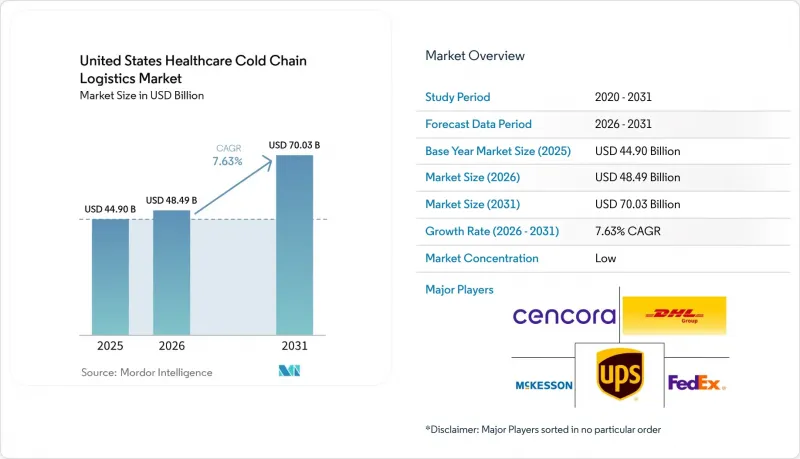
Mordor Intelligence에 의하면, 미국의 헬스케어 콜드체인 물류 시장 규모는 2025년에 449억 달러로 평가되었고, 2026년 484억 9,000만 달러에서 2031년까지 700억 3,000만 달러에 이를 것으로 예측되며, 예측 기간(2026-2031년) CAGR은 7.63%를 나타낼 전망입니다.
미국의 헬스케어 콜드체인 물류 시장은 바이오의약품 출시 기반의 확대, 세포 및 유전자 치료의 상용화 가속화, 그리고 GLP-1 주사제의 재고 보충 주기에 힘입어 약국 및 전문 의료 네트워크 전반에서 냉장 배송 빈도가 증가하고 있는 것이 성장 동력이 되고 있습니다. 본 보고서는 물류 기능별(운송 등), 온도대별(냉장, 냉동, 상온, 초저온), 제품 유형별(의약품, 바이오의약품, 백신, 기타), 배송지(국내, 국제), 최종 사용자(제약 및 바이오의약품 제조업체, 기타), 지역(북동부, 남동부, 기타)별로 분류되어 있습니다. 시장 전망은 금액(달러)으로 표시되어 있습니다.
미국의 헬스케어 콜드체인 물류 시장 동향 및 인사이트
바이오의약품 및 전문의약품에 대한 콜드체인 수요 증가
미국의 헬스케어 콜드체인 물류 시장은 기존 의약품 유통을 위해 구축된 시스템보다 규모가 더 크며, 온도에 대한 민감도가 높은 바이오의약품 파이프라인을 포함하고 있습니다. Cencora사는 2025년 11월, 2027년까지 전 세계적으로 출시되는 모든 제품의 절반이 콜드체인 보관을 필요로 하게 될 것이라고 밝혔습니다. 이는 2013년부터 2017년까지의 37%에서 증가한 수치이며, 이 회사는 이러한 전망을 바탕으로 미국 내 유통 네트워크를 확대하기 위한 10억 달러 규모의 계획을 발표했습니다. 이러한 변화가 중요한 이유는 항암제 주사제, 면역 제제 및 이와 유사한 전문 제품들이 지속적인 모니터링이 수반되는 2℃-8℃의 검증된 운송 경로에 의존하고 있기 때문이며, 이로 인해 일반 화물 운송업체에 비해 프리미엄 운송업체의 가치가 높아지고 있기 때문입니다. 또한, 바이오시밀러의 승인도 많은 구매자들이 당초 예상했던 것보다 취급 부담을 증가시키고 있습니다. 이는 새롭게 병행 출시되는 SKU가 경쟁하는 원조 의약품과 동일한 냉장 처리를 필요로 하는 경우가 많기 때문입니다. 21 CFR Part 211에 기반한 FDA의 보관 및 유통 요건에 따르면, 온도 관리는 공장 내부뿐만 아니라 운송 전 과정에 걸쳐 제품의 품질과 밀접하게 연계되어 있습니다. 실제로 이로 인해 규정 준수 기준을 충족하는 콜드체인 역량은 미국 헬스케어 콜드체인 물류 시장에서 단순한 백엔드 지원 기능이 아닌 핵심 서비스 라인으로 자리 잡고 있습니다.
세포 및 유전자 치료의 상용화
미국의 헬스케어 콜드체인 물류 시장은 세포 및 유전자 치료로 인해 기존과는 크게 다른 운영 모델로 변화하고 있습니다. 그 이유는 이러한 운송의 상당수가 환자마다 다르며, 시간적 제약이 엄격하기 때문입니다. 기존의 배치 제제와 달리, 많은 자가 유래 치료법은 ‘유일무이’한 제품이며, 채취 센터, 제조업체, 치료 시설 사이를 이동하기 때문에 배송 실패는 임상적 가치와 상업적 가치 모두를 상실하는 결과로 이어집니다. 필요한 온도 조건은 대부분의 경우 -70°C에서 -150°C 범위이며, 이는 표준 제약 시설의 한계를 초과하기 때문에 영구적인 보관 능력이 아직 확보되지 않은 지역에서는 모듈식 의료용 극저온 설비에 대한 수요가 증가하고 있습니다. DHL은 2025년 이러한 변화를 인식하고, 임상시험 및 세포 및 유전자 치료 물류 전문 기업인 CryoPDP와 200개 이상의 거점을 보유한 미국의 광범위한 라스트 마일 네트워크를 보완하는 SDS Rx를 인수했습니다. 치료에 대한 접근성이 극소수의 엘리트 학술 기관의 범위를 넘어 확대됨에 따라, 미국의 헬스케어 콜드체인 물류 시장은 극저온 관리 경험이 제한적인 병원에도 극저온 관리 서비스 제공 범위를 확대해야 합니다. 이러한 확대는 미국 지방 시장에서 여전히 가장 두드러진 운영상의 과제 중 하나입니다.
높은 설비 투자, 에너지 비용 및 검증 비용
미국의 헬스케어 콜드체인 물류 시장은 규정을 준수하는 초저온 보관 능력을 구축하기 위한 높은 비용으로 인해 여전히 제약을 받고 있습니다. -80°C--150°C에서 가동되는 극저온 보관에는 전용 기계 시스템, 비상 전원 및 지속적인 모니터링이 필요하며, 시설 건설 비용은 표준 냉장 보관 비용보다 30%-50% 더 높을 것으로 추정됩니다. 또한, 초저온 보관 구역에서는 팔레트 1개당 비용이 냉장 보관의 3-5배에 달하기 때문에 운영 비용도 높아집니다. FDA의 우수 제조 관리 기준(GMP) 규정 및 USP 일반장 1079.4에 따른 적합성 평가 요건도 추가적인 장벽이 되고 있습니다. 각 시설은 상업적 운영을 시작하기 전에 온도 매핑과 성능 적합성 평가를 완료해야 하기 때문입니다. 이로 인해 설비 투자부터 수익 창출까지 12-24개월의 시간 차가 발생하는 경우가 많아, 재무 기반이 탄탄한 사업자에게만 시장 진입의 문이 좁아지고 있습니다. 이러한 비용 장벽으로 인해 미국 헬스케어 콜드체인 물류 시장에서는 공급 부족 상태가 지속되고 있지만, 한편으로는 기존 사업자들에게는 가격 결정력을 유지하는 요인이 되고 있습니다.
부문 분석
2025년 물류 기능별 미국 헬스케어 콜드체인 물류 시장 규모에서 운송 부문은 46.25%를 차지하며, 해당 카테고리에서 가장 큰 기능 분야가 되었습니다. 수송 부문 내에서는 도로 화물 수송이 주도적인 위치를 차지했습니다. 이는 의약품의 일상적인 보충이 여전히 도매업체, 약국, 전문 유통업체를 연결하는 고밀도 트럭 네트워크와 온도 관리된 수송 경로에 의존하고 있기 때문입니다. 항공 화물 운송은 운송 부문 내에서 편당 수익이 가장 높았습니다. 이는 시간적 제약이 엄격한 생물학적 제제나 세포 및 유전자 치료제의 운송에 있어 여전히 최고 수준의 속도와 엄격한 취급 체계가 요구되기 때문입니다. 해상 운송 및 내륙 수로 운송은 의료용 콜드체인 가치에서 차지하는 비중이 여전히 작으며, 주로 연안 지역의 제조 거점과 유통 허브 사이를 이동하는 대량 혈장 단백질 및 대량 원료의약품의 유통과 관련이 있습니다. 철도 역시 특정 운송 노선에서 실질적인 중요성을 드러내기 시작했으며, 특히 2025년 J.B. 헌트사가 검사 불필요 온도 관리가 필요한 상품을 대상으로 멕시코 몬테레이와 펜실베이니아주를 연결하는 인터모달 냉장 서비스를 시작한 이후 그 추세가 두드러지고 있습니다.
부가가치 서비스는 2031년까지 연평균 성장률(CAGR) 8.38%로 확대될 것으로 예측되며, 이에 따라 미국 헬스케어 콜드체인 물류 시장에서 가장 빠르게 성장하는 기능 부문이 될 전망입니다. 이러한 성장은 2차 포장, 키트화, 일련번호 부여 지원, 임상 보류 관리, 반품 처리에 기인하며, 이 모든 서비스는 번들화된 지원 업무가 아닌 유료 서비스로 제공되고 있습니다. 창고 및 유통은 여전히 2위 규모를 차지하고 있는데, 이는 특수 의약품 포트폴리오에서 동일한 건물 내에 냉장, 냉동 및 관리된 상온 구역이 필요하기 때문입니다. 더 중요한 변화는 질적인 것으로, 사업자들은 더 이상 단순히 바닥 면적이나 냉각 능력만을 판매하는 것이 아닙니다. 미국 헬스케어 콜드체인 물류 업계에서 창고 업무는 정보가 풍부한 서비스로 전환되고 있으며, 실시간 재고 가시화, 감사 대응이 가능한 기록, 그리고 예측에 기반한 재고 관리가 가격 책정 및 고객 유지 결정에 기여하고 있습니다.
2025년 온도 구역별 미국 헬스케어 콜드체인 물류 시장 점유율에서 상온 취급 분야는 46.62%를 차지했으며, 이는 미국의 헬스케어 콜드체인이 여전히 냉장 생물학적 제제에만 국한되지 않음을 보여줍니다. 취급량의 대부분은 일반의약품(OTC), 통제된 상온 환경에서 엄격히 관리되며 냉장 환경이 아닌 상태로 운송되는 치료제, 그리고 경구 제제로 구성되어 있습니다. 0℃-5℃의 냉장 구간과 -18℃-0℃의 냉동 구간이 그 다음을 차지하며, 백신, 혈장 단백질, 그리고 기존의 특수 의약품 운송에 의해 뒷받침되고 있습니다. 이러한 구성은 미국 헬스케어 콜드체인 물류 시장이 단일 온도 프로파일이 아닌 유연한 다중 온도 인프라에 계속 의존하고 있는 이유를 설명해 줍니다. 또한, 네트워크 설계가 대량의 재고 보충과 높은 무결성이 요구되는 특수 의약품의 운송을 동시에 지원해야 하는 이유도 보여줍니다.
-20°C 이하의 초저온 및 극저온 구역은 2031년까지 연평균 성장률(CAGR) 11.55%를 나타낼 것으로 예측되며, 이는 미국 헬스케어 콜드체인 물류 시장의 온도 구역 중 가장 빠른 성장 속도입니다. 이러한 성장은 세포 및 유전자 치료의 상용화 물결을 반영한 것으로, 이러한 제품의 품질 유지를 위해서는 기존 생물학적 제제에서 사용되는 범위를 훨씬 밑도는 조건이 필요한 경우가 많습니다. 이러한 성장 가속화의 한 요인은 과거 기준이 낮았기 때문이지만, 승인된 첨단 치료법이 상업 유통에 진입하고 있다는 점에서 그 근본적인 방향성은 여전히 구조적인 것입니다. 크라이오포트(CryoPort)사의 2026년 1분기 실적 및 2026년 4분기에 캘리포니아주 산타아나에 세계 공급망 센터를 개설할 계획은 수요가 본격화되기 전에 인프라 제공업체들이 초저온 운송 역량을 확대하고 있음을 보여줍니다. 미국 헬스케어 콜드체인 물류 시장에서 초저온 분야 시장 규모는 현재 상온 및 냉장 분야보다 작지만, 향후 성장에 있어 전략적으로 가장 중요한 분야 중 하나로 부상하고 있습니다.
기타 혜택 :
- 엑셀 형식 시장 예측(ME) 시트
- 3개월간의 애널리스트 지원
자주 묻는 질문
목차
제1장 서론
제2장 조사 방법
제3장 주요 요약
제4장 시장 구도
제5장 시장 규모 및 성장 예측
제6장 경쟁 구도
제7장 시장 기회 및 향후 전망
AJY 26.08.07According to Mordor Intelligence, the United States healthcare cold chain logistics market size was valued at USD 44.9 billion in 2025 and is estimated to grow from USD 48.49 billion in 2026 to reach USD 70.03 billion by 2031, at a CAGR of 7.63% during the forecast period (2026-2031).
The United States healthcare cold chain logistics market is supported by a broader biologics launch base, faster commercialization of cell and gene therapies, and a replenishment cycle for GLP-1 injectables that has increased the frequency of chilled deliveries across pharmacy and specialty networks. This report is Segmented by Logistics Function (Transportation, and More), by Temperature Type (Chilled, Frozen, Ambient, Ultra-Low), by Product Type (Pharma, Biopharma, Vaccines, and More), by Destination (Domestic, International), by End User (Pharma/Biopharma Manufacturers, and More), and by Geography (Northeast, Southeast, and More). The Market Forecasts are Provided in Value (USD).
United States Healthcare Cold Chain Logistics Market Trends and Insights
Rising Biologics and Specialty-Pharma Cold-Chain Demand
The United States healthcare cold chain logistics market is absorbing a biologics pipeline that is larger and more temperature sensitive than the system built for traditional drug distribution. Cencora said in November 2025 that half of all products launched globally through 2027 would require cold-chain storage, up from 37% during 2013 to 2017, and paired that view with a USD 1 billion plan to expand its United States distribution network. That shift matters because oncology injectables, immunologics, and similar specialty products depend on validated 2 °C to 8 °C lanes with continuous monitoring, which raises the value of premium operators over general freight providers. Biosimilar approvals are also adding more handling intensity than many buyers first expected, because new parallel SKUs often need the same refrigerated treatment as the originator products they compete against. FDA storage and distribution expectations under 21 CFR Part 211 tie temperature control to product quality throughout the journey rather than only at the factory gate. In practice, that makes compliance-grade cold-chain capability a core service line in the United States healthcare cold-chain logistics market rather than a back-end support function.
Cell and Gene Therapy Commercialization
The United States healthcare cold chain logistics market is being pushed into a very different operating model by cell and gene therapies, because many of these shipments are patient-specific and time-critical. Unlike conventional batch drugs, many autologous therapies are one-of-one products that move between collection centers, manufacturers, and treatment sites, so a failed delivery can erase both clinical and commercial value. Required temperature conditions often fall between -70 °C and -150 °C, which exceed the limits of standard pharmaceutical buildings and increase demand for modular medical cryogenic setups where permanent capacity is not yet available. DHL recognized this shift in 2025 when it acquired CryoPDP, a specialist in clinical-trial and cell and gene therapy logistics, and SDS Rx, which added a large United States final-mile footprint with more than 200 locations. As treatment access spreads beyond a small set of elite academic centers, the United States healthcare cold chain logistics market must extend ultra-cold reach to hospitals that have limited cryogenic experience. That expansion remains one of the clearest operating gaps across secondary United States markets.
High Capex, Energy, and Validation Costs
The United States healthcare cold chain logistics market remains constrained by the high cost of building compliant ultra-cold capacity. Cryogenic storage that operates at -80 °C to -150 °C requires specialized mechanical systems, backup power, and continuous monitoring, and the estimates indicate that facility construction costs can run 30% to 50% above standard cold storage costs. Operating costs are also higher because deep-freezing and ultra-low zones can cost 3 to 5 times as much per pallet as refrigerated storage. Qualification expectations under FDA good manufacturing practice rules and USP General Chapter 1079.4 add another layer, since each site must complete temperature mapping and performance qualification before commercial handling begins. That often creates a 12- to 24-month gap between capital commitment and revenue generation, narrowing the field to operators with stronger balance sheets. This cost barrier keeps supply tight in the United States healthcare cold chain logistics market, even while it protects pricing power for established providers.
Other drivers and restraints analyzed in the detailed report include:
- Outsourcing to Specialist 3PLs and Digital Visibility Stacks
- Vaccine, Plasma, and Other High-Integrity Temperature-Sensitive Flows
- Skilled-Labor Shortages and Temperature-Excursion Risk
For complete list of drivers and restraints, kindly check the Table Of Contents.
Segment Analysis
Transportation accounted for 46.25% of the United States healthcare cold chain logistics market size by logistics function in 2025, making it the largest functional pool in the category. Road freight held the leading position within transportation because daily pharmaceutical replenishment still depends on dense truck networks and temperature-controlled lanes serving wholesalers, pharmacies, and specialty distributors. Air freight generated the highest revenue per shipment within transportation because time-sensitive biologics and cell and gene therapy movements still require premium speed and handling discipline. Sea and inland waterway transport remained a small part of healthcare cold-chain value, mostly tied to bulk plasma proteins and bulk drug substance flows moving between coastal manufacturing sites and distribution hubs. Rail also began to show practical relevance on selected corridors, especially after J.B. Hunt launched an intermodal refrigerated service in 2025 between Monterrey, Mexico, and Pennsylvania for non-inspection-required temperature-sensitive commodities.
Value-added services are forecast to expand at an 8.38% CAGR through 2031, which makes them the fastest-growing functional segment in the United States healthcare cold chain logistics market. Growth is coming from secondary packaging, kitting, serialization support, clinical hold management, and returns processing, all of which are becoming billable services rather than bundled support tasks. Warehousing and distribution remains the second-largest function because specialty drug portfolios now require refrigerated, frozen, and controlled room-temperature zones inside the same building. The more important change is qualitative, because operators are no longer selling only square footage and cooling capacity. In the United States healthcare cold chain logistics industry, warehousing is shifting toward an information-rich service where real-time inventory visibility, audit-ready records, and predictive stock management help decide pricing and customer retention.
Ambient handling held 46.62% of the United States healthcare cold chain logistics market share by temperature type in 2025, which shows that the healthcare cold chain in the United States still spans more than refrigerated biologics alone. A large share of volume includes OTC products, controlled room-temperature therapies, and oral formulations that move in tightly managed ambient settings instead of chilled environments. Chilled 0 °C to 5 °C and frozen -18 °C to 0 °C bands formed the next tier, supported by vaccines, plasma proteins, and traditional specialty-drug traffic. This mix explains why the United States healthcare cold chain logistics market continues to depend on flexible multi-temperature infrastructure rather than a single cold profile. It also shows why network design must support both high-volume replenishment and high-integrity specialty movements at the same time.
Deep-frozen and ultra-low bands below -20 °C are projected to grow at an 11.55% CAGR through 2031, the fastest pace among temperature types in the United States healthcare cold chain logistics market. That growth reflects the commercialization wave in cell and gene therapy, where product integrity often depends on conditions far below the range used for traditional biologics. Part of the acceleration comes from a low historical base, but the underlying direction is still structural because more approved advanced therapies are entering commercial distribution. Cryoport's first quarter 2026 results and its planned fourth quarter 2026 opening of a Global Supply Chain Center in Santa Ana, California, show that infrastructure providers are scaling ultra-cold capacity before demand fully lands. The United States healthcare cold chain logistics market size for ultra-low lanes remains smaller than ambient and chilled categories today, but it is becoming one of the most strategically important pockets of future expansion.
Complete Report Scope:
- By Logistics Function
- Transportation
- Road
- Air
- Sea and Inland Waterways
- Rail
- Warehousing and Distribution
- Value-added Services and Others
- Transportation
- By Temperature Type
- Chilled (0-5 °C)
- Frozen (-18-0 °C)
- Ambient
- Deep-Frozen / Ultra-Low (less than-20 °C)
- By Product Type
- Pharmaceuticals
- Prescription and Specialty Drugs
- OTC Drugs
- Biopharmaceuticals (Biologics and Biosimilars)
- Vaccines
- Clinical Trial Materials
- Cell and Gene Therapies
- Medical Devices
- Veterinary Medicine
- Blood, Plasma and Blood Components
- Diagnostic and Laboratory Products
- Organs and Human Tissues
- Others
- Pharmaceuticals
- By Destination
- Domestics
- International
- By End User
- Pharmaceutical Manufacturers
- Biopharmaceutical Manufacturers
- Hospitals and Clinics
- Hospitals and Retail Pharmacies
- Healthcare Distributors and Wholesalers
- Others
- By Region
- Northeast
- Southeast
- Midwest
- Southwest
- West
List of Companies Covered in this Report:
- United Parcel Service of America, Inc. (UPS)
- FedEx
- DHL Group
- Cencora
- McKesson Corporation
- Cardinal Health
- Kuehne+Nagel
- DSV A/S
- CMA CGM Group (Including CEVA Logistics)
- Cryoport, Inc.
- Thermo Fisher Scientific
- Americold
- Lineage, Inc.
- GEODIS
- AIT Worldwide Logistics, Inc.
- Owens and Minor
- Catalent
- LifeScience Logistics
- EVERSANA
- Knipper Health
- SEKO Logistics
Additional Benefits:
- The market estimate (ME) sheet in Excel format
- 3 months of analyst support
TABLE OF CONTENTS
1 Introduction
- 1.1 Study Assumptions and Market Definition
- 1.2 Scope of the Study
2 Research Methodology
3 Executive Summary
4 Market Landscape
- 4.1 Market Overview and Role of Cold Chain Logistics in Healthcare
- 4.2 Healthcare Spending Trends
- 4.3 Market Drivers
- 4.3.1 Rising Biologics and Specialty-Pharma Cold-Chain Demand
- 4.3.2 Cell and Gene Therapy Commercialization
- 4.3.3 Outsourcing to Specialist 3PLs and Digital Visibility Stacks
- 4.3.4 Vaccine, Plasma, and Other High-Integrity Temperature-Sensitive Flows
- 4.3.5 Home Infusion and Specialty-Pharmacy Direct-To-Patient Fulfillment
- 4.3.6 GLP-1 Injectable Replenishment Intensity and Tighter Cold-Chain Turns
- 4.4 Market Restraints
- 4.4.1 High Capex, Energy, and Validation Costs
- 4.4.2 Skilled-Labor Shortages and Temperature-Excursion Risk
- 4.4.3 USP Route Qualification and Data-Integrity Burden
- 4.4.4 Site-of-Care Cryogenic Readiness Gaps for Advanced Therapies
- 4.5 Regulatory Framework
- 4.6 Value Chain and Distribution Channel Architecture Analysis
- 4.7 Technology Innovations Outlook
- 4.8 Porter's Five Forces Analysis
- 4.8.1 Threat of New Entrants
- 4.8.2 Bargaining Power of Suppliers
- 4.8.3 Bargaining Power of Buyers
- 4.8.4 Threat of Substitutes
- 4.8.5 Rivalry Among Competitors
- 4.9 Evolution of Healthcare Cold Chain Logistics Requirements
- 4.10 Impact of Geo-Political Events on Supply Chain Shifts
5 Market Size and Growth Forecasts
- 5.1 By Logistics Function
- 5.1.1 Transportation
- 5.1.1.1 Road
- 5.1.1.2 Air
- 5.1.1.3 Sea and Inland Waterways
- 5.1.1.4 Rail
- 5.1.2 Warehousing and Distribution
- 5.1.3 Value-added Services and Others
- 5.1.1 Transportation
- 5.2 By Temperature Type
- 5.2.1 Chilled (0-5 °C)
- 5.2.2 Frozen (-18-0 °C)
- 5.2.3 Ambient
- 5.2.4 Deep-Frozen / Ultra-Low (less than-20 °C)
- 5.3 By Product Type
- 5.3.1 Pharmaceuticals
- 5.3.1.1 Prescription and Specialty Drugs
- 5.3.1.2 OTC Drugs
- 5.3.2 Biopharmaceuticals (Biologics and Biosimilars)
- 5.3.3 Vaccines
- 5.3.4 Clinical Trial Materials
- 5.3.5 Cell and Gene Therapies
- 5.3.6 Medical Devices
- 5.3.7 Veterinary Medicine
- 5.3.8 Blood, Plasma and Blood Components
- 5.3.9 Diagnostic and Laboratory Products
- 5.3.10 Organs and Human Tissues
- 5.3.11 Others
- 5.3.1 Pharmaceuticals
- 5.4 By Destination
- 5.4.1 Domestics
- 5.4.2 International
- 5.5 By End User
- 5.5.1 Pharmaceutical Manufacturers
- 5.5.2 Biopharmaceutical Manufacturers
- 5.5.3 Hospitals and Clinics
- 5.5.4 Hospitals and Retail Pharmacies
- 5.5.5 Healthcare Distributors and Wholesalers
- 5.5.6 Others
- 5.6 By Region
- 5.6.1 Northeast
- 5.6.2 Southeast
- 5.6.3 Midwest
- 5.6.4 Southwest
- 5.6.5 West
6 Competitive Landscape
- 6.1 Market Concentration
- 6.2 Key Strategic Moves
- 6.3 Market Share Analysis
- 6.4 Company Profiles (Includes Global Level Overview, Market Level Overview, Core Segments, Financials as Available, Strategic Information, Market Rank/Share for Key Companies, Products and Services, and Recent Developments)
- 6.4.1 United Parcel Service of America, Inc. (UPS)
- 6.4.2 FedEx
- 6.4.3 DHL Group
- 6.4.4 Cencora
- 6.4.5 McKesson Corporation
- 6.4.6 Cardinal Health
- 6.4.7 Kuehne+Nagel
- 6.4.8 DSV A/S
- 6.4.9 CMA CGM Group (Including CEVA Logistics)
- 6.4.10 Cryoport, Inc.
- 6.4.11 Thermo Fisher Scientific
- 6.4.12 Americold
- 6.4.13 Lineage, Inc.
- 6.4.14 GEODIS
- 6.4.15 AIT Worldwide Logistics, Inc.
- 6.4.16 Owens and Minor
- 6.4.17 Catalent
- 6.4.18 LifeScience Logistics
- 6.4.19 EVERSANA
- 6.4.20 Knipper Health
- 6.4.21 SEKO Logistics
7 Market Opportunities and Future Outlook
- 7.1 White-space and Unmet-Need Assessment


