

|
시장보고서
상품코드
2116353
아시아태평양의 헬스케어 콜드체인 물류 : 시장 점유율 분석, 업계 동향 및 통계, 성장 예측(2026-2031년)Asia-Pacific Healthcare Cold Chain Logistics - Market Share Analysis, Industry Trends & Statistics, Growth Forecasts (2026 - 2031) |
||||||
 Mordor Intelligence
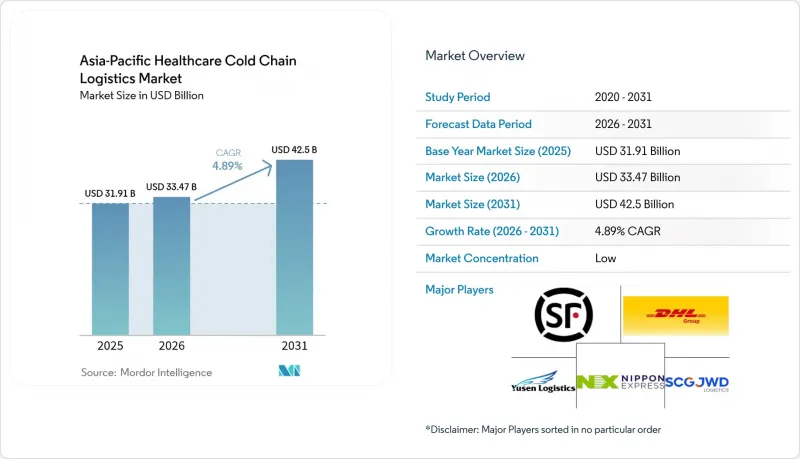
Mordor Intelligence에 의하면, 아시아태평양의 헬스케어 콜드체인 물류 시장 규모는 2025년 319억 1,000만 달러로 평가되었습니다. 2026년에는 334억 7,000만 달러로 확대되어 2026년부터 2031년에 걸쳐 CAGR 4.89%로 성장을 지속하여, 2031년까지 425억 달러에 이를 것으로 예측됩니다.
본 보고서는 서비스별(운송, 창고·유통, 부가가치 서비스, 기타), 온도대별(냉장, 기타), 제품별(바이오의약품, 백신, 세포 및 유전자 치료, 기타), 최종 사용자별(제약 제조업체, 기타), 지역별(중국, 일본, 기타)로 분류되어 있습니다. 시장 예측은 금액(달러) 기준으로 제시되어 있습니다.
아시아태평양의 헬스케어 콜드체인 물류 시장 동향 및 인사이트
코로나19 이후의 강력한 백신 접종 프로그램
팬데믹 대응 백신을 위해 구축된 콜드체인 인프라는 현재 아시아태평양의 헬스케어 콜드체인 물류 시장에서 일반 의약품을 위해 재배치되고 있습니다. 인도에서는 바이오 경제의 확장에 따라 새로운 바이알 처리 허브, GDP 인증을 받은 크로스독, 대규모 충전 및 포장 라인을 바탕으로 2025년 백신 매출 170억 달러를 달성했습니다. 필리핀의 클라크 자유무역지대는 10억 달러 이상의 물류 자본을 유치하고 있으며, 일반 예방접종 캠페인과 향후 감염병 발생 시 대응 모두에 활용할 수 있는 냉동고 용량을 제공합니다. DHL의 20억 유로(22억 달러) 규모의 세계 헬스케어 프로그램 중 25%가 아시아태평양에 배정되어 있어, 바이오 의약품의 지속 가능한 유통에 대한 기업의 확신을 엿볼 수 있습니다. 이러한 투자를 통해 예측적 온도 모니터링, 운송 경로의 적합성 평가 및 중복성이 확보되어 백신, 인슐린, 특수 주사제의 서비스 신뢰성이 확고해집니다. 한편, 각국 정부는 장기 조달 계약을 체결하고 있으며, 이를 통해 수요량이 안정화되어 네트워크 밀도가 향상되고 있습니다.
가속화되는 생물학적 제제 및 세포 및 유전자 치료제 파이프라인
일본에서는 2025년에 43건의 신약이 승인되었으며, 그 중에는 -20℃ 이하의 보관이 필요한 유전자 치료제도 여러 건 포함되어 있어, 이에 따라 항만에 인접한 창고나 택배 집배 거점에서 전문적인 보관 능력 확충이 촉진되고 있습니다. 한국의 KoBIA는 인천 근교에 위치한 수출 대응형 바이오의약품 클러스터를 지원하고 있으며, GMP 준수 제조와 GDP 준수 유통 경로를 연계하고 있습니다. 싱가포르의 임상시험 생태계는 자가 유래 CAR-T 세포의 당일 배송인 ‘화이트 글러브’ 운송에 의존하고 있으며, 이에 따라 공급업체들은 극저온 듀어, 데이터 로거, 그리고 신원 추적용 블록체인 태그를 통합해야 하는 압박을 받고 있습니다. 호주는 아시아 제약 허브와의 근접성을 활용하여, 시간적 제약이 엄격한 라스트 마일 배송을 위해 장거리 바이오의약품 운송 경로를 시드니와 멜버른을 경유하도록 우회하고 있습니다. 이러한 변화들이 합쳐지면서 초저온 팔레트, 수동형 PCM 포장 및 검증된 드라이 쉬퍼 차량에 대한 수요가 증가하여 아시아태평양의 헬스케어 콜드체인 물류 시장을 강화하고 있습니다.
아세안(ASEAN) 지역의 GDP 인증 냉장 트럭 운전사 부족
인도네시아와 태국에서는 포장 도로의 연장이 진행되고 있지만, GDP 인증을 받은 인력을 트레일러 운전사로 확보하는 데 어려움을 겪고 있어, 백신 수요가 정점에 달하는 성수기에는 운송 능력을 제약하는 기술 격차가 발생하고 있습니다. 인증 과정에서는 온도 매핑, 데이터 로거 취급, 편차 보고에 관한 SOP 습득이 요구되어, 드라이밴 운송에 비해 교육 기간이 길어집니다. 필리핀 시장도 유사한 과제를 안고 있습니다. 클라크 프보고서에 현대적인 부두가 추가되었음에도 불구하고, 높은 임금으로 인해 운전기사들이 전자상거래(e-커머스) 업계로 유출되면서 제약 업계에서 일하는 운전기사 수가 감소하고 있습니다. 이에 따라 물류 기업들은 단기 집중 교육, 텔레매틱스를 활용한 운전자 지도, 근속 장려금 등에 투자하고 있지만, 단기적으로는 인력 부족이 지속되어 처리 능력이 저하되고 있으며, 이는 아시아태평양의 헬스케어 콜드체인 물류 시장의 잠재력을 저해하고 있습니다.
부문별 분석
2025년, 아시아태평양의 헬스케어 콜드체인 물류 시장에서 운송 부문은 시장 점유율의 50.70%를 차지했습니다. 이는 35,000킬로미터에 달하는 육해 국경을 넘는 육상, 항공, 해상, 철도 운송이 필수적임을 반영합니다. 시간적 제약이 엄격한 생물학적 제제 운송에서는 항공 화물이 여전히 주도적인 위치를 차지하고 있으며, 대한항공만으로도 전 세계 온도 관리형 항공 화물 운송량의 6%를 차지하고 있습니다. 해상 물류는 중국과 인도의 공장에서 아세안(ASEAN)의 구매자에게 운송되는 대량의 백신 및 점적용 용액을 처리하고 있으며, 한편 중국에서 급성장하고 있는 고속철도망은 국내 의약품 운송을 24시간 체제로 뒷받침하고 있습니다. 창고 및 유통은 장거리 운송의 거점을 뒷받침하고 있으며, 온도 관리 포장, 규제 관련 서류, 컨트롤 타워형 분석과 같은 부가가치 서비스는 연평균 성장률(CAGR) 4.95%로 성장하고 있으며, 화주가 비핵심적인 규정 준수 업무를 외부에 위탁함에 따라 시장 점유율을 확대될 전망입니다.
서비스 제공업체의 차별화 요소는 복합 운송 조정, GDP(적정 보관·배송 기준)에 기반한 운영 비용 관리, 그리고 기술을 활용한 가시화에 있습니다. UPS는 2024년 싱가포르와 호주에서 콜드체인 수용 능력을 2만 2,000제곱미터 확대하고, 사전 조정된 소포 포장을 위한 현장 실험실을 병설했습니다. DHL은 mySupplyChain 포털에 운송 경로별 리스크 대시보드를 통합하여 예상 도착 시간(ETA) 및 온도 이탈 경보를 제공합니다. 각 스타트업은 패시브 및 액티브 태그 데이터를 통합하는 SaaS 오버레이를 제공하여, 아시아태평양의 헬스케어 콜드체인 물류 시장에서 수요가 증가하고 있는 서비스 수준인 실시간 개입을 가능하게 하고 있습니다.
2025년, 0°C에서 5°C의 냉장 솔루션은 아시아태평양의 헬스케어 콜드체인 물류 시장 규모의 40.60%를 차지했습니다. 이는 2-8°C라는 좁은 온도 범위가 필요한 백신, 인슐린, GLP-1 작용제가 시장을 견인했기 때문입니다. -18°C-0°C의 냉동 제품은 기존 생물학적 제제에 계속해서 사용되고 있지만, -20°C 이하의 초저온 하위 부문은 세포 및 유전자 치료 임상시험 건수 증가에 힘입어 2031년까지 연평균 성장률(CAGR) 4.12%라는 견조한 성장세를 보이고 있습니다. -150°C를 10일간 유지하는 Cryoport사의 드라이 쉬퍼 기술은 환자별로 맞춤화된 투여량을 운송하는 CAR-T 치료의 후원사들 사이에서 널리 채택되고 있습니다.
시설 업그레이드에서는 이중화 전원 공급 장치, 낮은 GWP 냉매, 그리고 배치 간 편차를 해결하기 위한 모듈식 급속 냉동고에 중점을 두고 있습니다. 중국의 냉매 단계적 폐지 조치는 자본 지출(CAPEX)을 증가시키고 있지만, 에너지 집약도를 낮추고 ESG 목표에 부합하는 R32 및 CO₂ 트랜스크리티컬 시스템의 도입을 가속화하고 있습니다. 아시아태평양의 헬스케어 콜드체인 물류 시장 전반에 걸쳐, 각 사업자는 자본 지출(CAPEX)의 효율성과 엄격한 매핑 간의 균형을 유지하면서, 보관 기간의 안정성을 유지하기 위한 스마트 압축기 분석 및 신속한 제상 주기를 실현하기 위해 OEM 제조업체와의 제휴를 추진하고 있습니다.
기타 혜택 :
- 엑셀 형식 시장 예측(ME) 시트
- 3개월간의 애널리스트 지원
자주 묻는 질문
목차
제1장 서론
제2장 조사 방법
제3장 개요
제4장 시장 구도
제5장 시장 규모 및 성장 예측
제6장 경쟁 구도
제7장 시장 기회 및 향후 전망
KTH 26.08.31According to Mordor Intelligence, the Asia-Pacific healthcare cold chain logistics market size is expected to grow from USD 31.91 billion in 2025 to USD 33.47 billion in 2026 and is forecast to reach USD 42.5 billion by 2031 at 4.89% CAGR over 2026-2031.
This report is Segmented by Services (Transportation, Warehousing and Distribution, Value-Added Services and Others), Temperature Type (Chilled, and More), Product (Biopharmaceuticals, Vaccines and Cell & Gene Therapies, and More), End User (Pharmaceutical Manufacturers, and More), and Geography (China, Japan, and More). The Market Forecasts are Provided in Terms of Value (USD).
Asia-Pacific Healthcare Cold Chain Logistics Market Trends and Insights
Strong Vaccine-Immunization Programs Post-COVID-19
Cold chain infrastructure built for pandemic vaccines is now redeployed for routine pharmaceuticals across the Asia Pacific healthcare cold chain logistics market. India targets USD 17 billion in vaccine revenue for 2025 amid bioeconomy expansion, supported by new vial-handling hubs, GDP-certified cross-docks, and large-scale fill-finish lines. The Philippines' Clark Freeport zone attracts more than USD 1 billion in logistics capital, providing dual-use freezer capacity for routine immunization drives and future outbreak response. DHL's global EUR 2 billion (USD 2.20 billion) healthcare program allocates 25% to Asia Pacific, underscoring corporate confidence in sustained biologics flow. These investments ensure predictive temperature monitoring, lane qualification, and redundancy, anchoring service reliability for vaccines, insulin, and specialty injectables. Governments, meanwhile, lock in long-term procurement contracts that stabilize volume demand and drive network density.
Accelerated Biologics & Cell/Gene-Therapy Pipelines
Japan cleared 43 new drugs in 2025, several being gene therapies that require below--20 °C storage, spurring specialized capacity additions at port-adjacent warehouses and express courier depots. South Korea's KoBIA supports export-ready biologics clusters near Incheon, pairing GMP manufacturing with GDP-compliant distribution corridors. Singapore's clinical-trial ecosystem relies on same-day "white-glove" transport for autologous CAR-T cells, pushing providers to integrate cryogenic dewars, data loggers, and chain-of-identity blockchain tags. Australia leverages its proximity to Asian pharma hubs, rerouting long-haul biologics freight through Sydney and Melbourne for time-critical last-mile dispatch. Collectively, these shifts elevate demand for ultra-low pallets, passive PCM packaging, and validated dry-shipper fleets, reinforcing the Asia Pacific healthcare cold chain logistics market.
Shortage of GDP-Qualified Reefer Drivers in ASEAN
Indonesia and Thailand expand paved road length yet struggle to staff trailers with GDP-trained personnel, creating a skills gap that constrains capacity during peak vaccine seasons. Certification courses demand mastery of SOPs for temperature mapping, data-logger handling, and deviation reporting, lengthening onboarding cycles compared to dry-van trucking. The Philippine market mirrors the challenge even as Clark Freeport adds modern docks; higher wages lure drivers into e-commerce, leaving fewer for pharma. Logistics firms therefore invest in accelerated training, telematics-enabled driver coaching, and retention bonuses, but near-term tightness persists, shaving throughput and damping the Asia Pacific healthcare cold chain logistics market's potential.
Other drivers and restraints analyzed in the detailed report include:
- Government Mandates on GDP-Compliant Distribution
- AI-Enabled Lane-Risk Modeling for Shipment Integrity
- High Inter-Island Freight Costs in Archipelagic Nations
For complete list of drivers and restraints, kindly check the Table Of Contents.
Segment Analysis
Transportation commanded 50.70% of Asia Pacific healthcare cold chain logistics market share in 2025, reflecting the indispensability of road, air, sea, and rail movement across 35,000 kilometers of maritime and land borders. Airfreight retains primacy for time-critical biologics, with Korean Air alone holding 6% of global temperature-sensitive air cargo lift. Sea logistics cater to bulk vaccines and IV solutions moving from Chinese or Indian factories to ASEAN buyers, while China's burgeoning high-speed rail corridors support 24-hour domestic pharma transits. Warehousing and distribution underpin long-haul nodes, yet value-added services temperature-validated packaging, regulatory paperwork, and control-tower analytics are slated to outpace at a 4.95% CAGR, capturing share as shippers outsource non-core compliance tasks.
Provider differentiation hinges on multimodal orchestration, GDP op-ex discipline, and tech-enabled visibility. UPS expanded cold-chain capacity by 22,000 square meters across Singapore and Australia in 2024, embedding on-site labs for pre-conditioned parcel packs. DHL integrates lane-risk dashboards into its mySupplyChain portal, delivering predictive ETA and excursion alerts. Start-ups supply SaaS overlays that consolidate passive and active tag data, enabling real-time interventions a service tier increasingly demanded across the Asia Pacific healthcare cold chain logistics market.
Chilled solutions between 0 °C and 5 °C represented 40.60% of Asia Pacific healthcare cold chain logistics market size in 2025, driven by the dominance of vaccines, insulin, and GLP-1 agonists that require narrow 2-8 °C ranges. Frozen products at -18 °C to 0 °C continue serving classical biologics, yet the ultra-low sub-segment below -20 °C registers a brisk 4.12% CAGR through 2031, propelled by cell and gene therapy clinical trial volumes. Cryoport's dry-shipper technology, which maintains -150 °C for 10 days, is in wide adoption among CAR-T sponsors shipping patient-specific doses.
Facility upgrades focus on redundant power, low-GWP refrigerants, and modular blast freezers to handle batch variability. China's refrigerant phase-out inflates CAPEX, yet accelerates adoption of R32 and CO2 trans-critical systems that offer lower energy intensity, aligning with ESG goals. Across the Asia Pacific healthcare cold chain logistics market, providers balance CAPEX efficiency with stringent mapping, pushing partnerships with OEMs for smart compressor analytics and rapid defrost cycles that preserve shelf life integrity.
Complete Report Scope:
- By Services
- Transportation
- Road
- Air
- Sea
- Rail
- Warehousing and Distribution
- Value-added Services and Others
- Transportation
- By Temperature Type
- Chilled (0-5 °C)
- Frozen (-18-0 °C)
- Ambient
- Deep-Frozen / Ultra-Low (less than-20 °C)
- By Product
- Biopharmaceuticals
- Vaccines and Cell and Gene Therapies
- Clinical Trial Materials
- Diagnostic and Laboratory Products
- Blood and Blood Products
- Others
- By End User
- Pharmaceutical Manufacturers
- Biotech and Biosimilar Manufacturers
- Hospitals and Retail Pharmacies
- Healthcare Distributors and Wholesalers
- Others
- By Country (Value)
- China
- Japan
- India
- South Korea
- Australia
- Thailand
- Indonesia
- Singapore
- Vietnam
- Rest of ASEAN
List of Companies Covered in this Report:
- DHL Group
- Yusen Logistics
- SF Express
- JWD Group
- Nippon Express
- Kerry Logistics
- Nichirei Logistics Group
- Kintetsu World Express
- YCH Group
- Sinotrans
- Sagawa Express Co., Ltd.
- Itochu Logistics Corp.
- JD Logistics
- Kuehne + Nagel
- UPS
- CEVA Logistics
- DSV
- Yamato Holdings Co., Ltd.
- Mitsubishi Logistics
- F2 Logistics Philippines
Additional Benefits:
- The market estimate (ME) sheet in Excel format
- 3 months of analyst support
TABLE OF CONTENTS
1 Introduction
- 1.1 Study Assumptions and Market Definition
- 1.2 Scope of the Study
2 Research Methodology
3 Executive Summary
4 Market Landscape
- 4.1 Market Overview
- 4.2 Market Drivers
- 4.2.1 Strong vaccine?immunization programs post-COVID-19
- 4.2.2 Accelerated biologics and cell-/gene-therapy pipelines
- 4.2.3 Government mandates on GDP-compliant distribution
- 4.2.4 Expansion of GDP-certified pharma hubs
- 4.2.5 AI-enabled lane-risk modelling for shipment integrity
- 4.2.6 Rapid GLP-1 drug boom needing 2-8 °C logistics
- 4.3 Market Restraints
- 4.3.1 Shortage of GDP-qualified reefer drivers in ASEAN
- 4.3.2 High inter-island freight costs in archipelagic nations
- 4.3.3 China's fluorocarbon-phase-out raising CAPEX
- 4.3.4 Vial-level e-pedigree compliance inflating costs
- 4.4 Value / Supply-Chain Analysis
- 4.5 Regulatory Landscape
- 4.6 Technological Outlook
- 4.7 Porter's Five Forces
- 4.7.1 Bargaining Power of Suppliers
- 4.7.2 Bargaining Power of Buyers
- 4.7.3 Threat of New Entrants
- 4.7.4 Threat of Substitutes
- 4.7.5 Intensity of Competitive Rivalry
5 Market Size and Growth Forecasts
- 5.1 By Services
- 5.1.1 Transportation
- 5.1.1.1 Road
- 5.1.1.2 Air
- 5.1.1.3 Sea
- 5.1.1.4 Rail
- 5.1.2 Warehousing and Distribution
- 5.1.3 Value-added Services and Others
- 5.1.1 Transportation
- 5.2 By Temperature Type
- 5.2.1 Chilled (0-5 °C)
- 5.2.2 Frozen (-18-0 °C)
- 5.2.3 Ambient
- 5.2.4 Deep-Frozen / Ultra-Low (less than-20 °C)
- 5.3 By Product
- 5.3.1 Biopharmaceuticals
- 5.3.2 Vaccines and Cell and Gene Therapies
- 5.3.3 Clinical Trial Materials
- 5.3.4 Diagnostic and Laboratory Products
- 5.3.5 Blood and Blood Products
- 5.3.6 Others
- 5.4 By End User
- 5.4.1 Pharmaceutical Manufacturers
- 5.4.2 Biotech and Biosimilar Manufacturers
- 5.4.3 Hospitals and Retail Pharmacies
- 5.4.4 Healthcare Distributors and Wholesalers
- 5.4.5 Others
- 5.5 By Country (Value)
- 5.5.1 China
- 5.5.2 Japan
- 5.5.3 India
- 5.5.4 South Korea
- 5.5.5 Australia
- 5.5.6 Thailand
- 5.5.7 Indonesia
- 5.5.8 Singapore
- 5.5.9 Vietnam
- 5.5.10 Rest of ASEAN
6 Competitive Landscape
- 6.1 Market Concentration
- 6.2 Strategic Moves
- 6.3 Market Share Analysis
- 6.4 Company Profiles (includes Global Level Overview, Market Level overview, Core Segments, Financials as available, Strategic Information, Market Rank/Share for key companies, Products and Services, and Recent Developments)
- 6.4.1 DHL Group
- 6.4.2 Yusen Logistics
- 6.4.3 SF Express
- 6.4.4 JWD Group
- 6.4.5 Nippon Express
- 6.4.6 Kerry Logistics
- 6.4.7 Nichirei Logistics Group
- 6.4.8 Kintetsu World Express
- 6.4.9 YCH Group
- 6.4.10 Sinotrans
- 6.4.11 Sagawa Express Co., Ltd.
- 6.4.12 Itochu Logistics Corp.
- 6.4.13 JD Logistics
- 6.4.14 Kuehne + Nagel
- 6.4.15 UPS
- 6.4.16 CEVA Logistics
- 6.4.17 DSV
- 6.4.18 Yamato Holdings Co., Ltd.
- 6.4.19 Mitsubishi Logistics
- 6.4.20 F2 Logistics Philippines
7 Market Opportunities and Future Outlook
- 7.1 White-Space and Unmet-Need Assessment


