

|
시장보고서
상품코드
2098499
가속 컴퓨팅 시장 : 점유율 분석, 업계 동향 및 통계, 성장 예측(2026-2031년)Accelerated Computing - Market Share Analysis, Industry Trends & Statistics, Growth Forecasts (2026 - 2031) |
||||||
 Mordor Intelligence
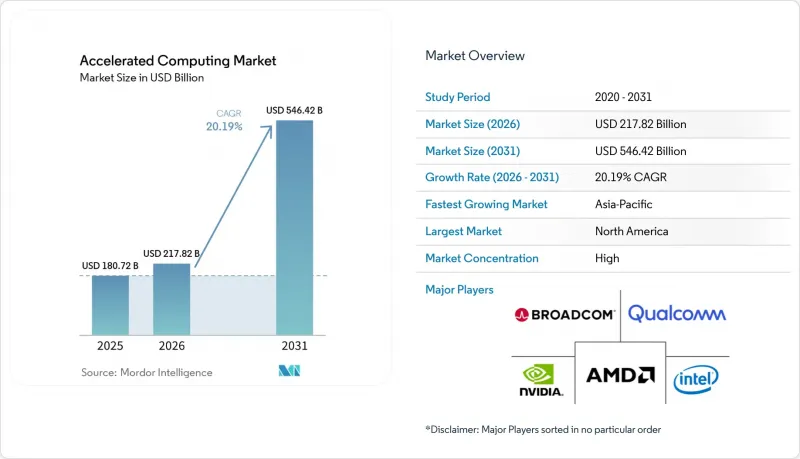
Mordor Intelligence에 의하면, 가속 컴퓨팅 시장 규모는 2025년 1,807억 2,000만 달러에서 2026년에는 2,178억 2,000만 달러로 확대되어 2026년부터 2031년까지 CAGR 20.19%로 성장을 지속하여, 2031년에는 5,464억 2,000만 달러에 이를 것으로 예측됩니다.
본 보고서는 프로세서 유형(그래픽 처리 장치(GPU), 특정 용도용 집적 회로(ASIC) 등), 배포 방식(On-Premise 및 데이터센터, 엣지 및 임베디드 등), 기능(훈련 및 추론), 최종 사용자(하이퍼스케일 클라우드 서비스 제공업체, 기업 및 코로케이션 데이터센터 등), 그리고 지역별로 분류되어 있습니다. 시장 전망은 금액(달러) 기준으로 제시되어 있습니다.
세계 가속 컴퓨팅 시장 동향 및 인사이트
대규모 언어 모델 훈련 수요 증가
최첨단 모델의 훈련은 현재 가속 컴퓨팅 시장 전체에서 자본 배분의 중심에 위치하고 있습니다. Epoch AI의 데이터에 따르면, 최첨단 언어 모델 훈련에 소요되는 연산량은 2020년 이후 매년 5배의 속도로 증가하고 있으며, 같은 기간 동안 전력 수요도 매년 2배씩 증가하고 있습니다. 2026년 중반까지 수행된 것으로 알려진 최대 규모의 훈련에서는 5×10²? FLOPs가 소비되었으며, 이는 GPT-4에 사용된 연산량의 24배에 해당합니다. 이 추세가 중요한 이유는 베이스 모델 구축 후에도 파인 튜닝, 프루닝, 강화 학습과 같은 사후 훈련 단계를 통해 연산 주기가 지속적으로 연장되기 때문에 하드웨어 수요가 더 이상 사전 학습의 규모만으로 증가하는 것이 아니기 때문입니다. NVIDIA의 Blackwell 플랫폼은 2026년 6월, 이러한 변화를 뒷받침하는 결과를 보여주었습니다. MLPerf Training v6.0 테스트 결과에 따르면, CoreWeave의 8,192개 GB300 NVL72 GPU에서 DeepSeek-V3 671B가 2.02분 만에 훈련을 완료한 것으로 나타났습니다. 따라서 고속 컴퓨팅 시장에서는 칩 수준의 고성능화뿐만 아니라 랙 수준의 확장성을 제공할 수 있는 벤더가 계속해서 지지를 받고 있습니다.
엣지 추론 워크로드의 급속한 확대
추론 워크로드가 모든 작업에서 원격 클라우드 용량에 의존할 수 없는 디바이스 및 시스템으로 확대됨에 따라, 가속 컴퓨팅 시장은 성장하고 있습니다. 이러한 변화로 인해 지연 시간, 로컬 응답성 및 전력 효율성이 더욱 중요시되고 있으며, 그 결과 자동차, 산업, 의료 각 분야에서 ASIC, FPGA 및 전용 추론 엔진의 위상이 높아지고 있습니다. 에이전트형 AI로의 전환은 여기에 또 다른 차원을 더하고 있습니다. 프리필 단계와 디코딩 단계를 분리함으로써, 동일한 워크플로우의 서로 다른 부분을 서로 다른 프로세서가 처리할 여지가 생기기 때문입니다. NVIDIA는 2025년 12월, Groq사와의 200억 달러 규모의 라이선싱 계약을 통해 이러한 방향성을 입증했으며, LPU 데이터 플로우 엔진을 수냉식 Rubin 세대 LPX 랙에 도입하여 저지연 추론을 실현했습니다. 또한 AWS도 2026년 6월, NVIDIA RTX PRO 4500 Blackwell Server Edition GPU를 탑재한 EC2 G7 인스턴스의 일반 제공을 시작하여, 이전 세대에 비해 최대 4.6배 높은 AI 추론 성능을 실현함으로써 추론 주기를 가속화했습니다. 이러한 도입이 확대됨에 따라, 가속 컴퓨팅 시장에서는 거의 모든 가치가 중앙 집중식 훈련 클러스터에 집중되는 것이 아니라, 보다 광범위한 하드웨어 구성으로 지출이 분산될 전망입니다.
5nm 미만 생산 능력의 집중
가속 컴퓨팅 시장은 최첨단 공정 노드에서 여전히 공급 기반이 좁다는 과제에 직면해 있습니다. 2026년 6월, Wei 씨는 최첨단 노드에 대한 수요가 가용 생산 능력을 25-30% 상회하고 있으며, 적어도 2027년까지는 상황 개선이 기대되지 않는다는 견해를 밝혔습니다. 이러한 제약은 로직 생산에만 국한된 것이 아니라, 가속기 다이와 HBM을 연결하기 위한 첨단 패키징 능력도 계속해서 부족한 상태입니다. 즉, 일부 칩 설계자들은 제품 설계를 완료한 후에도 파운드리나 패키징 할당을 확보하지 못하면 출하 규모를 확대할 수 없기 때문에 여전히 현실적인 장벽에 직면해 있습니다. 그 결과, 최종 사용자 수요가 견조하더라도 가속 컴퓨팅 시장에서의 조달이 지연될 가능성이 있습니다. 또한 이로 인해 소규모 가속기 공급업체들이 설계 수주를 실질적인 수익으로 전환하는 속도도 둔화되어, 제조 접근성을 확보한 주요 기업들 사이에 공급이 집중된 상태가 지속되고 있습니다.
부문 분석
2025년, GPU는 가속 컴퓨팅 시장에서 55.34%의 점유율을 차지했습니다. 이는 NVIDIA의 CUDA 생태계의 깊이와 AI 프레임워크, 엔터프라이즈 스택, 클라우드 서비스에 대한 폭넓은 통합을 반영한 것입니다. 이 점유율은 단순히 칩 성능만으로 설명될 수 없습니다. 조달 팀은 소프트웨어의 성숙도, 개발자의 친숙도, 그리고 기존 GPU 워크플로우에 따른 전환 비용이 낮다는 점도 중요하게 여기기 때문입니다. 실제로, 높은 처리량의 AI 훈련이나 범용 추론에 대한 즉각적인 접근을 원하는 조직에게 GPU는 여전히 기본 선택지로 자리 잡고 있습니다. 또한 구매자가 맞춤형 칩 설계를 위한 안정적인 워크로드 프로파일을 조기에 확정하지 못하는 경우에도 GPU는 여전히 유리한 위치에 있습니다. 이 때문에 대체 기술이 발전하고 있음에도 불구하고, 가속 컴퓨팅 시장의 프로세서 계층은 여전히 GPU를 중심으로 구성되어 있습니다.
맞춤형 ASIC은 2031년까지 연평균 성장률(CAGR) 21.32%를 나타낼 것으로 예측되며, 가속 컴퓨팅 시장에서 가장 빠르게 성장하는 프로세서 부문이 될 전망입니다. 이러한 성장세는 주로 높은 가동률과 보다 엄격한 소프트웨어 제어를 특징으로 하는 사내 워크로드를 중심으로 설계된 하이퍼스케일러의 프로그램에서 비롯됩니다. 구글의 TPU 로드맵이나 마이크로소프트의 Maia 200 도입 사례는 이 모델이 왜 매력적인지를 보여줍니다. 두 프로그램 모두 광범위한 타사 제품과의 호환성보다는 와트당 및 달러당 성능을 우선시하고 있기 때문입니다. FPGA는 저지연 및 재구성 가능한 이용 사례에서 규모는 작지만 유용한 역할을 계속하고 있습니다. 반면, CPU와 NPU는 최대 처리량보다 비용과 효율이 중시되는 엣지 추론 분야에서 입지를 넓혀가고 있습니다. 가속 컴퓨팅 업계에서는 광범위한 도입에 있어 여전히 GPU가 선호되고 있습니다. 그러나 워크로드가 대규모이고 반복성이 높으며 경제적으로 안정적인 분야에서는 맞춤형 실리콘의 활약 무대가 꾸준히 확대되고 있습니다.
2025년에는 On-Premise 및 데이터센터 도입이 가속 컴퓨팅 시장의 51.48%를 차지하고, 이는 고밀도 및 중앙 집중식 인프라가 여전히 최대의 수익 기반임을 뒷받침합니다. 이러한 상황은 최첨단 모델 훈련, 대규모 배치 추론, 그리고 안전한 내부 도입을 위해 클러스터화된 시스템을 필요로 하는 하이퍼스케일러 및 대기업과 밀접하게 관련되어 있습니다. 높은 랙 밀도, 전력 공급 능력, 냉각 체계, 소프트웨어 오케스트레이션과 같은 요소들은 모두 자사의 인프라를 관리할 수 있거나 전문적인 코로케이션 모델을 활용할 수 있는 구매자에게 유리하게 작용합니다. 따라서 On-Premise 및 데이터센터 환경은 가속 컴퓨팅 시장 전체에서 현재의 수익 기반을 형성하고 있습니다. 또한 이것이 공급업체들이 여전히 제품 스택의 상위 단계에서 대규모 시스템 통합 및 패키징 규모를 우선시하는 이유이기도 합니다.
엣지 및 임베디드 환경으로의 도입은 2031년까지 연평균 성장률(CAGR) 21.51%를 나타낼 것으로 예측되며, 이는 가속 컴퓨팅 시장에서 가장 빠르게 성장하는 도입 모델이 될 것입니다. 이러한 성장은 클라우드와의 왕복 통신에 의존하기보다는 결정론적인 로컬 처리가 필요한 자율주행차, 산업용 로봇 및 커넥티드 의료 시스템에서 비롯됩니다. 많은 엔드포인트 시나리오에서 피크 시간대의 부동소수점 연산 성능보다 낮은 지연 시간과 전력 효율이 더 중요하게 여겨지기 때문에 이러한 도입 형태는 하드웨어 선정 기준을 변화시키고 있습니다. 프라이빗 클러스터 도입 자금을 확보할 수 없는 기업 사용자에게는 클라우드가 여전히 중요하지만, 이용률이 장기간 높은 수준을 유지할 수 있는 경우 자체 소유의 경제성이 더욱 매력적으로 다가옵니다. 추론 워크로드가 더 많은 실제 환경으로 확산됨에 따라, 가속 컴퓨팅 시장에서는 중앙 집중형 용량과 분산형 컴퓨팅 환경 간의 균형이 더욱 잘 잡힌 구성이 될 것으로 전망됩니다.
지역별 분석
2025년, 북미는 가속 컴퓨팅 시장 점유율의 41.26%를 차지하며, 지역별로는 가장 큰 기여를 한 지역이 되었습니다. 이 지역은 하이퍼스케일러의 자본이 가장 집중되어 있고, 성숙한 AI 소프트웨어 생태계를 갖추고 있으며, 기업 AI 사용자의 도입 기반이 가장 광범위하다는 장점을 가지고 있습니다. 또한, 가속 컴퓨팅 시장 전체의 조달 기준, 벤치마크 기대치, 상용 도입 모델에 영향을 미치는 플랫폼 리더에게 여전히 주요 거점으로 자리 잡고 있습니다. 미국은 대규모 데이터센터 건설을 통해 이러한 입지를 주도하고 있으며, 캐나다는 온타리오주와 퀘벡주를 통해 용량을 확대되고 있습니다. 또한 멕시코는 니어쇼어(near-shore)로공급망 전환으로 그 중요성이 높아지고 있습니다. 2026년 1월 BIS(미국 상무부 산업안보국)의 새로운 규정이 미국에 기반을 둔 공급업체의 해외 판매 및 고객 인증 체계에 영향을 미치므로, 수출 규정 준수는 계속해서 이 지역의 사업 환경의 일부로 남아 있습니다.
아시아태평양은 2031년까지 연평균 성장률(CAGR) 21.65%를 나타낼 것으로 예측되며, 이에 따라 가속 컴퓨팅 시장에서 가장 빠르게 성장하는 지역 블록이 될 것입니다. 이러한 성장은 정책 선언 단계에서 자금 지원을 받는 인프라 프로젝트로 전환되고 있는 각국 정부 주도의 AI 컴퓨팅 프로그램에 의해 뒷받침되고 있습니다. 일본은 경제산업성(METI)을 통해 반도체 및 산업용 AI 프로그램에 130억 달러를 투자하겠다고 약속했으며, 마이크로소프트는 지역 내 AI 인프라가 확대되는 가운데, 2026년부터 2029년까지 일본에 1조 6,000억 엔(103억 달러)을 투자하겠다고 발표했습니다. 한국 금융위원회는 2026년 5월, 1만 5,000대의 GPU를 갖춘 국가 AI 컴퓨팅 센터와 네이버 클라우드, 삼성SDS, 엘리스 그룹이 주도하는 운영 그룹을 포함한 국가 AI 인프라 구축을 위해 57억 달러의 예산을 승인했습니다. 중국은 여전히 큰 수요 거점이지만, 수출 규제로 인해 국내 가속기 공급업체의 입지가 더욱 강화되면서 다른 공급 체제 하에서 발전하고 있습니다.
유럽 및 기타 지역은 독일, 영국, 프랑스가 주도하는 가속 컴퓨팅 시장의 나머지 부분을 차지하고 있습니다. 유럽 수요는 ADAS 및 자율 주행을 위한 자동차용 컴퓨팅, 제조 거점에서의 산업 자동화, 그리고 영국의 금융 서비스 분야에서의 활용 사례에 의해 뒷받침되고 있습니다. 남미, 중동 및 아프리카, 그리고 아시아태평양의 소규모 국가들은 각국의 디지털화 프로그램과 데이터센터에 대한 투자로 인해 AI 인프라에 대한 수요가 증가하고 있는 신흥 시장입니다. 이 지역들에서 가속 컴퓨팅 시장은 하이퍼스케일러에 의한 중앙 집중화뿐만 아니라, 공공 부문 프로그램, 데이터 국내 보유 요건, 그리고 기업들의 선택적 도입이 결합되어 발전해 나갈 것으로 보입니다.
기타 혜택:
- 엑셀 형식 시장 예측(ME) 시트
- 3개월간의 애널리스트 지원
자주 묻는 질문
목차
제1장 서론
제2장 조사 방법
제3장 주요 요약
제4장 시장 구도
제5장 시장 규모와 성장 예측
제6장 경쟁 구도
제7장 시장 기회와 향후 전망
JHS 26.08.07According to Mordor Intelligence, the accelerated computing market size is expected to grow from USD 180.72 billion in 2025 to USD 217.82 billion in 2026 and is forecast to reach USD 546.42 billion by 2031 at 20.19% CAGR over 2026-2031.
This report is Segmented by Processor Type (Graphics Processing Unit (GPU), Application-Specific Integrated Circuit, and More), Deployment (On-Premises and Data Center, Edge and Embedded, and More), Function (Training, and Inference), End User (Hyperscale Cloud Service Providers, Enterprise and Colocation Data Centers, and More), and Geography. The Market Forecasts are Provided in Terms of Value (USD).
Global Accelerated Computing Market Trends and Insights
Rising Large Language Model Training Intensity
Frontier model training now sits at the center of capital allocation across the accelerated computing market. Epoch AI data showed that training compute for frontier language models grew 5x per year since 2020, and power requirements doubled annually over the same period. The largest known training run by mid-2026 consumed 5X1026 FLOPs, which was 24 times the compute used for GPT-4. That pattern matters because hardware demand no longer rises only with pre-training volume, as post-training steps such as fine-tuning, pruning, and reinforcement learning continue to extend the compute cycle after the base model is built. NVIDIA's Blackwell platform reinforced this shift in June 2026, when MLPerf Training v6.0 results showed DeepSeek-V3 671B trained in 2.02 minutes on 8,192 GB300 NVL72 GPUs at CoreWeave. The accelerated computing market, therefore, continues to favor vendors that can deliver scale at the rack level, not just higher performance at the chip level.
Rapid Expansion of Edge Inference Workloads
The accelerated computing market is expanding as inference workloads are spreading across devices and systems that cannot rely on distant cloud capacity for every task. That change gives greater weight to latency, local responsiveness, and power efficiency, thereby improving the position of ASICs, FPGAs, and specialized inference engines in automotive, industrial, and medical settings. The move toward agentic AI adds another layer, because separating prefill and decode stages creates room for different processors to handle different parts of the same workflow. NVIDIA validated that direction in December 2025 through a USD 20 billion licensing agreement with Groq, bringing LPU dataflow engines into liquid-cooled Rubin-generation LPX racks for low-latency inference. AWS also accelerated the inference cycle in June 2026 by making EC2 G7 instances generally available with NVIDIA RTX PRO 4500 Blackwell Server Edition GPUs, delivering up to 4.6x higher AI inference performance than the earlier generation. As these deployments scale, the accelerated computing market is likely to spread spending across a broader hardware mix instead of concentrating nearly all value in centralized training clusters.
Sub-5 Nm Capacity Concentration
The accelerated computing market remains exposed to a narrow supply base at the most advanced process nodes. In June 2026, Wei said demand for advanced nodes exceeded available capacity by 25-30%, and relief was not expected until at least 2027. The constraint is not limited to logic production, because advanced packaging capacity for linking accelerator dies with HBM has also remained under pressure. That means some chip designers still face a practical barrier even after completing product design, because they cannot scale shipments without foundry and packaging allocation. The result is that procurement in the accelerated computing market can be delayed even when end demand remains strong. This also slows the pace at which smaller accelerator vendors can convert design wins into meaningful revenue, keeping supply concentrated among players with secured manufacturing access.
Other drivers and restraints analyzed in the detailed report include:
- Hyperscaler Custom Silicon Adoption
- Growing Adoption of Energy-Efficient Accelerator Architectures
- Export-Control Uncertainty for Advanced Accelerators
For complete list of drivers and restraints, kindly check the Table Of Contents.
Segment Analysis
GPUs held a 55.34% share of the accelerated computing market in 2025, reflecting the depth of NVIDIA's CUDA ecosystem and its broad integration into AI frameworks, enterprise stacks, and cloud services. That share was not based solely on chip performance, because procurement teams also value software maturity, developer familiarity, and the lower switching costs that come with existing GPU workflows. In practice, GPUs remain the default choice for organizations seeking immediate access to high-throughput AI training and general-purpose inference. They also continue to benefit when buyers cannot commit early enough to a stable workload profile for custom chip design. This keeps the processor layer of the accelerated computing market centered on GPUs even as alternatives improve.
Custom ASICs are projected to grow at a 21.32% CAGR through 2031, making them the fastest-growing processor segment in the accelerated computing market. Their momentum comes mainly from hyperscaler programs that are designed around internal workloads with high utilization and tighter software control. Google's TPU roadmap and Microsoft's Maia 200 deployment show why the model is attractive, as both programs prioritize performance per watt and per dollar rather than broad third-party compatibility. FPGAs continue to hold a smaller but useful role in low-latency and reconfigurable use cases, while CPUs and NPUs are gaining relevance in edge inference where cost and efficiency matter more than maximum throughput. The accelerated computing industry still favors GPUs for broad deployment, but the accelerated computing market is steadily making more room for custom silicon where workloads are large, repeatable, and economically stable.
On-premises and data center deployments accounted for 51.48% of the accelerated computing market in 2025, underscoring that dense, centralized infrastructure still has the largest revenue base. This position is tied to hyperscalers and large enterprises that need clustered systems for frontier model training, large-batch inference, and secure internal deployments. High rack density, power delivery, cooling readiness, and software orchestration all favor buyers who can control their own infrastructure or work through specialized colocation models. That makes on-premises and data center environments the anchor for current revenue across the accelerated computing market. It also explains why suppliers still prioritize large-system integration and packaging scale at the top end of the product stack.
Edge and embedded deployment is forecast to grow at a 21.51% CAGR through 2031, which makes it the fastest-growing deployment model in the accelerated computing market. Growth comes from autonomous vehicles, industrial robots, and connected medical systems that require deterministic local processing rather than round-trip cloud reliance. These deployments are changing hardware selection because low latency and power efficiency matter more than peak floating-point output in many endpoint scenarios. Cloud remains important for enterprise buyers that cannot fund private clusters, but ownership economics become more attractive when utilization stays high for long periods. As inference workloads spread across more real-world environments, the accelerated computing market is likely to see a more balanced mix between centralized capacity and distributed compute footprints.
Complete Report Scope:
- By Processor Type
- Graphics Processing Unit (GPU)
- Application-Specific Integrated Circuit (ASIC)
- Field-Programmable Gate Array (FPGA)
- Central Processing Unit (CPU) and Neural Processing Unit (NPU)
- By Deployment
- On-Premises and Data Center
- Cloud-Based
- Edge and Embedded
- By Function
- Training
- Inference
- By End User
- Hyperscale Cloud Service Providers
- Enterprise and Colocation Data Centers
- Automotive OEMs and Tier-1 Suppliers
- Healthcare and Life Sciences
- Financial Services
- Telecom and 5G Infrastructure
- Government, Defense, and Research
- Manufacturing and Industrial Automation
- By Geography
- North America
- United States
- Canada
- Mexico
- Europe
- Germany
- United Kingdom
- France
- Italy
- Rest of Europe
- Asia-Pacific
- China
- Japan
- South Korea
- India
- Southeast Asia
- Rest of Asia-Pacific
- South America
- Middle East and Africa
- North America
Geography Analysis
North America accounted for 41.26% of the accelerated computing market share in 2025, making it the largest regional contributor. The region benefits from the deepest concentration of hyperscaler capital, mature AI software ecosystems, and the broadest installed base of enterprise AI users. It also remains the main operating base for platform leaders that influence procurement standards, benchmark expectations, and commercial deployment models across the accelerated computing market. The United States leads this position through large-scale data center buildouts, while Canada adds capacity through Ontario and Quebec, and Mexico is gaining relevance from nearshore supply-chain shifts. Export compliance remains part of the regional operating picture because the January 2026 BIS framework affects how U.S.-based suppliers structure overseas sales and customer certifications.
Asia-Pacific is projected to grow at a 21.65% CAGR through 2031, which makes it the fastest-growing regional block in the accelerated computing market. Growth is being supported by sovereign AI compute programs that are moving from policy statements into funded infrastructure projects. Japan committed USD 13 billion through METI to semiconductor and industrial AI programs, and Microsoft said it would invest JPY 1.6 trillion (USD 10.3 billion) in Japan between 2026 and 2029 as regional AI infrastructure expands. South Korea's Financial Services Commission approved USD 5.7 billion for national AI infrastructure in May 2026, including a national AI compute center with 15,000 GPUs and an operator group led by Naver Cloud, Samsung SDS, and Ellis Group. China remains a large demand center but is developing under a different supply framework, as export restrictions continue to push domestic accelerator vendors into a stronger position.
Europe and the remaining regions account for the balance of the accelerated computing market, led by Germany, the United Kingdom, and France. European demand is being supported by automotive compute for ADAS and autonomous driving, industrial automation in manufacturing centers, and financial services use cases in the United Kingdom. South America, the Middle East and Africa, and smaller Asia-Pacific countries represent emerging pockets where national digital programs and data center investment are increasing demand for AI infrastructure. In these regions, the accelerated computing market is likely to develop through a mix of public-sector programs, sovereign data requirements, and selective enterprise adoption rather than through hyperscaler concentration alone.
- NVIDIA Corporation
- Advanced Micro Devices, Inc.
- Intel Corporation
- Qualcomm Incorporated
- Broadcom Inc.
- Marvell Technology, Inc.
- Cerebras Systems, Inc.
- Groq, Inc.
- Tenstorrent Inc.
- Graphcore Limited
- SambaNova Systems, Inc.
- Rebellions Inc.
- Hailo Technologies Ltd.
Additional Benefits:
- The market estimate (ME) sheet in Excel format
- 3 months of analyst support
TABLE OF CONTENTS
1 INTRODUCTION
- 1.1 Study Assumptions and Market Definition
- 1.2 Scope of the Study
2 RESEARCH METHODOLOGY
3 EXECUTIVE SUMMARY
4 MARKET LANDSCAPE
- 4.1 Market Overview
- 4.2 Market Drivers
- 4.2.1 Rising Large Language Model Training Intensity
- 4.2.2 Rapid Expansion of Edge Inference Workloads
- 4.2.3 Hyperscaler Custom Silicon Adoption
- 4.2.4 Growing Adoption of Energy-Efficient Accelerator Architectures
- 4.2.5 Advanced Cooling and Rack Density Optimization
- 4.2.6 Silicon Photonics and Optical Interconnect Integration
- 4.3 Market Restraints
- 4.3.1 Sub-5 Nm Capacity Concentration
- 4.3.2 High Total Cost of Ownership for Liquid-Cooled Clusters
- 4.3.3 Export-Control Uncertainty for Advanced Accelerators
- 4.3.4 HBM and Advanced Packaging Bottlenecks
- 4.4 Industry Value Chain Analysis
- 4.5 Regulatory Landscape
- 4.6 Technological Outlook
- 4.7 Impact of Macroeconomic Factors on the Market
- 4.8 Porter's Five Forces Analysis
- 4.8.1 Threat of New Entrants
- 4.8.2 Bargaining Power of Suppliers
- 4.8.3 Bargaining Power of Buyers
- 4.8.4 Threat of Substitutes
- 4.8.5 Competitive Rivalry
5 MARKET SIZE AND GROWTH FORECASTS (VALUE)
- 5.1 By Processor Type
- 5.1.1 Graphics Processing Unit (GPU)
- 5.1.2 Application-Specific Integrated Circuit (ASIC)
- 5.1.3 Field-Programmable Gate Array (FPGA)
- 5.1.4 Central Processing Unit (CPU) and Neural Processing Unit (NPU)
- 5.2 By Deployment
- 5.2.1 On-Premises and Data Center
- 5.2.2 Cloud-Based
- 5.2.3 Edge and Embedded
- 5.3 By Function
- 5.3.1 Training
- 5.3.2 Inference
- 5.4 By End User
- 5.4.1 Hyperscale Cloud Service Providers
- 5.4.2 Enterprise and Colocation Data Centers
- 5.4.3 Automotive OEMs and Tier-1 Suppliers
- 5.4.4 Healthcare and Life Sciences
- 5.4.5 Financial Services
- 5.4.6 Telecom and 5G Infrastructure
- 5.4.7 Government, Defense, and Research
- 5.4.8 Manufacturing and Industrial Automation
- 5.5 By Geography
- 5.5.1 North America
- 5.5.1.1 United States
- 5.5.1.2 Canada
- 5.5.1.3 Mexico
- 5.5.2 Europe
- 5.5.2.1 Germany
- 5.5.2.2 United Kingdom
- 5.5.2.3 France
- 5.5.2.4 Italy
- 5.5.2.5 Rest of Europe
- 5.5.3 Asia-Pacific
- 5.5.3.1 China
- 5.5.3.2 Japan
- 5.5.3.3 South Korea
- 5.5.3.4 India
- 5.5.3.5 Southeast Asia
- 5.5.3.6 Rest of Asia-Pacific
- 5.5.4 South America
- 5.5.5 Middle East and Africa
- 5.5.1 North America
6 COMPETITIVE LANDSCAPE
- 6.1 Market Concentration
- 6.2 Strategic Moves
- 6.3 Vendor Positioning Analysis
- 6.4 Company Profiles (includes Global Level Overview, Market Level Overview, Core Segments, Financials as available, Strategic Information, Market Rank/Share, Products and Services, Recent Developments)
- 6.4.1 NVIDIA Corporation
- 6.4.2 Advanced Micro Devices, Inc.
- 6.4.3 Intel Corporation
- 6.4.4 Qualcomm Incorporated
- 6.4.5 Broadcom Inc.
- 6.4.6 Marvell Technology, Inc.
- 6.4.7 Cerebras Systems, Inc.
- 6.4.8 Groq, Inc.
- 6.4.9 Tenstorrent Inc.
- 6.4.10 Graphcore Limited
- 6.4.11 SambaNova Systems, Inc.
- 6.4.12 Rebellions Inc.
- 6.4.13 Hailo Technologies Ltd.
7 MARKET OPPORTUNITIES AND FUTURE OUTLOOK
- 7.1 White-Space and Unmet-Need Assessment


