

|
시장보고서
상품코드
2098500
이기종 컴퓨팅 시장 : 점유율 분석, 업계 동향 및 통계, 성장 예측(2026-2031년)Heterogeneous Computing - Market Share Analysis, Industry Trends & Statistics, Growth Forecasts (2026 - 2031) |
||||||
 Mordor Intelligence
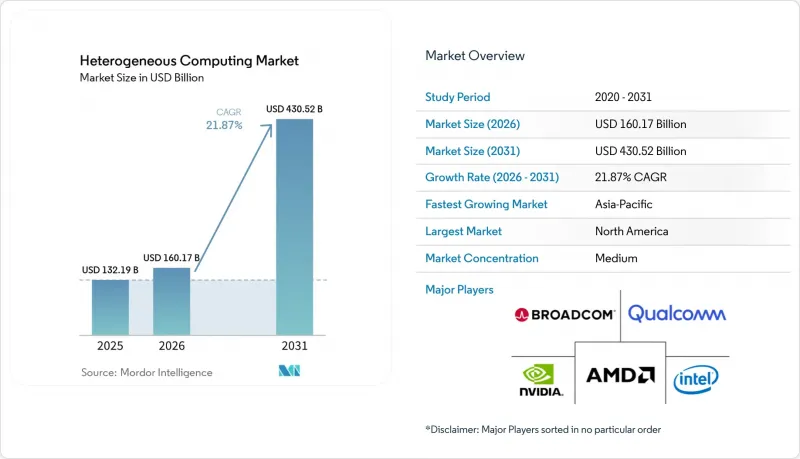
Mordor Intelligence에 의하면, 이기종 컴퓨팅 시장 규모는 2025년 1,321억 9,000만 달러에서 2026년에는 1,601억 7,000만 달러로 확대되어 2031년까지 4,305억 2,000만 달러에 이를 것으로 예상되고 있어 2026년부터 2031년까지 CAGR 21.87%로 성장할 전망입니다.
본 보고서는 구성 요소(하드웨어, 소프트웨어, 서비스), 배포 방식(On-Premise, 클라우드, 하이브리드), 프로세서 유형(CPU, GPU, FPGA, ASIC 등), 용도(인공지능·머신러닝, 데이터센터·클라우드 컴퓨팅 등), 최종 사용자(정부·공공 부문 등), 지역별로 분류되어 있습니다. 시장 전망은 금액(달러) 기준으로 제시되어 있습니다.
세계 이기종 컴퓨팅 시장 동향 및 인사이트
생성형 AI 및 대규모 언어 모델 워크로드 증가
생성형 AI 워크로드는 이기종 컴퓨팅 시장을 견인하는 단기적인 최대 동력이며, 구매자들이 고밀도 훈련용 가속기와 대용량 추론 처리에 최적화된 하드웨어를 결합하도록 유도하고 있습니다. 대규모 언어 모델은 모델 훈련을 통해서만 수요를 창출하는 것이 아닙니다. 또한, 도입 시작 후에도 장기간에 걸쳐 토큰 처리량, 메모리 액세스 및 레이턴시 요구 사항을 증가시키는 지속적인 서빙 부하를 초래합니다. 그 결과, 단일 프로세서 전략의 실용성은 떨어지고 있습니다. 왜냐하면 단일 아키텍처만으로 AI 워크플로우 전반에 걸쳐 성능, 이용률, 전력 효율의 최적의 조합을 실현하는 경우는 드물기 때문입니다. 2026년 4월 구글이 발표한 TPU 8t와 TPU 8i는 이러한 분화를 명확히 보여줍니다. 한쪽 설계는 대규모 훈련을 위해, 다른 한쪽은 병렬 추론과 네트워크 지연 시간 감소를 위해 최적화되어 있습니다. 따라서 이기종 컴퓨팅 시장은 칩의 순수한 처리 속도뿐만 아니라, 서로 다른 가속기의 특성을 통합할 수 있는 플랫폼에 의해 형성되고 있습니다. 이러한 요구에 맞추어 실리콘, 상호 연결, 메모리, 소프트웨어를 조화시킬 수 있는 벤더는 기업들의 지속적인 채택에 한 걸음 더 가까워지고 있습니다.
AI 훈련 및 추론에서 병렬 처리 수요 증가
병렬 처리에 대한 수요가 증가함에 따라, 이기종 컴퓨팅 시장의 역할은 하이퍼스케일 AI의 범위를 넘어 시뮬레이션, 연구, 금융, 산업용 컴퓨팅 분야로 확대되고 있습니다. 어떤 디바이스 클래스도 모든 단계를 효율적으로 처리할 수 있는 것은 아니기 때문에 이러한 워크로드는 CPU, GPU 및 전용 가속기에 걸친 협업 처리에 대한 의존도를 점점 더 높이고 있습니다. 2026년에 발표된 아마존의 Graviton5는 4개의 칩렛 구조, 420 GB/s의 칩렛 간 대역폭, 그리고 강화된 머신러닝 추론 성능을 갖추고 있어, CPU급 제품조차 현재 병렬 AI 처리 특성에 맞추어 재설계되고 있음을 보여줍니다. 비슷한 추세는 소프트웨어 분야에서도 나타나고 있으며, MLPerf Inference 6.0에서 AMD가 제출한 최초의 3개 GPU 이기종 제출 사례는 서로 다른 프로세서 리소스 간의 오케스트레이션이 얼마나 직접적인 성능 향상 요인이 될 수 있는지를 여실히 보여주었습니다. 학술 연구도 이러한 방향성을 뒷받침하고 있으며, 『Scientific Reports』에 게재된 연구에 따르면 하이브리드 클라우드·엣지 시스템에서 학습 기반 스케줄링이 워크로드를 사용 가능한 하드웨어에 동적으로 적응시킴으로써 서비스 품질을 향상시킨다는 사실이 밝혀졌습니다. 그 결과, 이기종 컴퓨팅 시장은 시스템 수준의 최적화로 전환되고 있으며, 그 가치는 개별 칩의 사양이 아니라 프로세서가 어떻게 협력하여 작동하는지에 있습니다.
이기종 시스템 설계 및 검증에 따른 높은 자본 집약도
멀티프로세서 시스템은 단일 아키텍처 도입에 비해 훨씬 더 많은 검증 작업이 필요하기 때문에 높은 자본 집약성은 여전히 이기종 컴퓨팅 시장의 큰 걸림돌로 작용하고 있습니다. 비용 압박은 실리콘 설계, 기판 개발, 상호 연결 튜닝, 메모리 통합, 소프트웨어 호환성 테스트, 시스템 인증 등 모든 단계에서 발생합니다. 이러한 부담이 가장 크게 작용하는 곳은 매우 대규모의 안정적인 컴퓨팅 볼륨에 엔지니어링 비용을 분산시킬 수 없는 중견 기업이나 신흥 시장 사업자들입니다. 그 결과, 워크로드 가시성이 명확하고 재무 기반이 탄탄한 하이퍼스케일러, 대기업, 공공 기관에 도입이 집중되는 시장이 되었습니다. 고도의 패키징 요구 사항은 추가적인 비용과 실행 위험을 초래하며, 생산 규모로 도입을 지원할 수 있는 공급업체의 수를 제한하고 있습니다.
부문 분석
2025년 이기종 컴퓨팅 시장에서 하드웨어가 58.41%를 차지하고 있으며, 현재 지출이 가속기, 서버, 메모리 및 지원 인프라 구매에 얼마나 크게 치우쳐 있는지를 여실히 보여줍니다. 단기적으로 가장 큰 수익원은 여전히 GPU를 많이 사용하는 데이터센터 확장과 관련되어 있으며, 구매자들은 소프트웨어의 완전한 표준화에 집중하기 전에 계속해서 컴퓨팅 성능 확보를 우선시해 왔습니다. 이러한 지출 패턴은 시기적 측면에서도 반영되었는데, 대규모 하드웨어 도입이 상용 규모에 도달하는 속도가 오케스트레이션 및 스케줄링 소프트웨어가 광범위한 기업 환경 전반에서 수익을 창출하는 속도를 앞질렀기 때문입니다. 따라서 이기종 컴퓨팅 시장은 장기적인 차별화가 스택의 상위 단계로 이동하고 있음에도 불구하고, 2026년에 들어서도 여전히 하드웨어가 인식된 가치에서 가장 큰 비중을 차지하는 상황이 되었습니다.
GPU, FPGA, ASIC, CPU 각 제품은 모두 도입 대수가 증가했으나, 훈련 및 많은 추론 작업 모두에서 여전히 중심적인 역할을 수행했기 때문에 절대적인 수익 기여도 측면에서는 GPU가 가장 컸습니다. 과학 및 AI 워크로드를 위해 발표된 AMD의 'Instinct MI430X'(432 GB의 HBM4 메모리와 19.6 TB/s의 대역폭 탑재)는 하드웨어 공급업체들이 연구용 AI와 상용 AI 두 분야 모두에서 동시에 그 역할을 확대하려 하고 있음을 보여줍니다. 소프트웨어는 2026년부터 2031년까지 연평균 성장률(CAGR) 23.16%를 나타낼 것으로 예측되며, 이는 가장 빠르게 성장하는 분야임을 나타낼 뿐만 아니라 오케스트레이션 프레임워크, 스케줄러, 추상화 계층 및 메모리 관리 도구의 가치가 높아지고 있음을 시사합니다. 많은 고객이 도입 실수를 최소화하면서 혼합 환경을 운영하기 위해 여전히 통합 지원을 필요로 하고 있기 때문에 서비스의 중요성은 계속해서 높아지고 있습니다. 이기종 컴퓨팅 업계에서 이러한 구성 비율은 하드웨어가 여전히 지출의 출발점인 반면, 소프트웨어 및 서비스가 지속적인 수익 창출 및 고객 유지율 향상을 위한 주요 경로로 자리 잡고 있음을 시사합니다.
2025년 이기종 컴퓨팅 시장에서 On-Premise가 50.48%를 차지하고 있으며, 클라우드에 막대한 투자가 이루어지고 있음에도 불구하고 로컬 인프라가 여전히 가장 큰 도입 기반임을 뒷받침합니다. 이러한 상황은 이미 수년에 걸쳐 설비 투자가 이루어져 온 엔터프라이즈용 GPU 클러스터, 대학 시스템, 그리고 국립 연구소 환경에서의 도입 실적을 반영한 것입니다. 또한, 실시간 추론 워크로드의 경우 원격지 클라우드 리전이 안정적으로 제공할 수 있는 수준보다 더 낮은 지연 시간이 요구되는 경우가 많기 때문에 이 부문은 실용적인 제약 조건에서도 혜택을 받고 있습니다. 데이터 관리 요건 또한 로컬 배포를 더욱 촉진했습니다. 특히 금융, 의료, 정부 기관과 같은 분야에서는 모델 가중치, 훈련 데이터, 기밀성이 높은 출력 결과에 대해 더 엄격한 취급 규정이 적용되기 때문입니다.
클라우드는 2031년까지 연평균 성장률(CAGR) 22.78%를 나타낼 것으로 예측되며, 이기종 컴퓨팅 시장에서 가장 빠르게 성장하는 도입 형태가 될 전망입니다. 이러한 성장을 주도하는 것은 하이퍼스케일러들이 GPU와 ASIC을 결합한 환경에 투자하고 있다는 점이며, 이를 통해 고객은 초기 설비 투자 없이도 전용 프로세서를 활용할 수 있게 됩니다. 하이브리드 배포는 이러한 추세를 넘어 확대되고 있습니다. 기업들은 모든 작업에 단일 환경을 사용하는 대신, 지연 시간, 규정 준수, 비용 조건에 따라 On-Premise와 클라우드 리소스 간에 워크로드를 분배하고 있기 때문입니다. 주요 On-Premise 인프라와 더 빠르게 성장하고 있는 클라우드 부문이 공존하고 있다는 사실은 이기종 컴퓨팅 시장이 단일 방향으로의 전환 경로를 따르고 있는 것은 아니라는 점을 시사합니다. 오히려 워크로드 배치는 더욱 선택적으로 이루어지고 있으며, 이로 인해 이기종 컴퓨팅 업계 전반에 걸쳐 배포 유연성에 대한 수요가 유지되고 있습니다.
지역별 분석
2025년, 북미는 이기종 컴퓨팅 시장의 40.83%를 차지했으며, 이러한 우위는 하이퍼스케일 데이터센터, 선진적인 AI 개발자, 그리고 국방 관련 컴퓨팅 프로그램이 해당 지역에 고도로 집중되어 있었기 때문에 뒷받침되었습니다. 미국은 정책적 입장과 상업 인프라가 AI 클러스터 및 관련 반도체 생산 능력의 신속한 확장을 지속적으로 뒷받침함에 따라 이 지위의 핵심으로 남아 있었습니다. 2025년 1월에 발령된 ‘AI 인프라 분야에서 미국의 리더십 추진에 관한 대통령령’은 연방 정부의 정책이 이미 대규모 컴퓨팅 확장을 둘러싼 건설 속도, 공급 안정성 및 허가·인가 방향성을 조율하고 있음을 보여주었습니다. 캐나다는 2026년 4월, 캐나다 기업이 소유한 AI 최적화 고성능 시스템을 지원하는 ‘AI 주권 컴퓨팅 인프라 프로그램’을 출범시켜 지역 전체의 입지를 강화했습니다. 이기종 컴퓨팅 시장에서 민간 규모와 공공 지원의 이러한 조합 덕분에 북미는 도입 용량과 단기 조달 모멘텀 양면에서 계속해서 우위를 점했습니다.
아시아태평양은 2031년까지 연평균 성장률(CAGR) 22.36%를 나타낼 것으로 예측되며, 이기종 컴퓨팅 시장에서 가장 두드러진 성장을 보일 것으로 전망됩니다. 이 지역의 성장은 정부의 컴퓨팅 지원 프로그램, 국내 반도체 개발에 대한 의욕 고조, 그리고 메모리, 패키징 및 더 광범위한 반도체 공급망에서 차지하는 중심적인 역할에 힘입고 있습니다. 이 점이 중요한 이유는 첨단 패키징 및 고대역폭 메모리 등 이기종 시스템을 뒷받침하는 핵심 기술의 상당 부분이 아시아태평양의 생산 네트워크에 집중되어 있기 때문입니다. 이러한 집중으로 인해 현지 구매자들의 도입은 가속화되는 한편, 이 지역의 성장은 가속기, 서버 및 관련 부품에 대한 전 세계적 수요와 밀접하게 연결됩니다. 따라서 이기종 컴퓨팅 시장에서 아시아태평양은 향후 시스템 확장을 위한 수요의 중심지이자 공급 측면의 중추로서 그 존재감을 더욱 강화해 나갈 것으로 보입니다.
유럽은 공공 정책 및 산업 현대화를 통해 AI 인프라가 더 많은 분야에 도입되고 있어, 이기종 컴퓨팅 시장에서 여전히 중요한 위치를 차지하고 있습니다. 특히, 영국이 2026년 6월에 발표한 ‘AI 하드웨어 계획’은 연산 능력에 대한 투자와 국내 반도체 기업에 대한 지원, 기술 역량 육성을 결합한 점에서 두드러졌습니다. 남미, 중동 및 아프리카는 2026년 시점에서 아직 초기 단계에 있는 지역이었으나, 각국 정부 및 기관이 자국의 연산 능력과 현지 AI 인프라 수요를 평가함에 따라 시장 전망은 여전히 개선되는 추세를 보였습니다. 이러한 지역에서는 자본 집약도, 전력 시스템, 엔지니어링 인력 확보와 같은 측면에서 더 높은 장벽에 직면해 있어, 그로 인해 AI 도입은 북미나 아시아태평양에서 볼 수 있는 것과 같은 속도가 아닌, 단계적으로 진행될 가능성이 있습니다. 그렇지만 공공 프로그램, 통신 인프라 현대화, 그리고 기업 내 AI 도입 간의 연계가 더욱 강화된다면, 이러한 지역에서도 이기종 컴퓨팅 시장은 더욱 확대될 여지가 있습니다.
기타 혜택:
- 엑셀 형식 시장 예측(ME) 시트
- 3개월간의 애널리스트 지원
자주 묻는 질문
목차
제1장 서론
제2장 조사 방법
제3장 주요 요약
제4장 시장 구도
제5장 시장 규모와 성장 예측
제6장 경쟁 구도
제7장 시장 기회와 향후 전망
JHS 26.08.07According to Mordor Intelligence, the heterogeneous computing market size is expected to increase from USD 132.19 billion in 2025 to USD 160.17 billion in 2026 and reach USD 430.52 billion by 2031, growing at a CAGR of 21.87% over 2026-2031.
This report is Segmented by Component (Hardware, Software, and Services), Deployment Mode (On-Premises, Cloud, and Hybrid), Processor Type (CPU, GPU, FPGA, ASIC, and More), Application (Artificial Intelligence and Machine Learning, Data Center and Cloud Computing, and More), End User (Government and Public Sector, and More), and Geography. The Market Forecasts are Provided in Terms of Value (USD).
Global Heterogeneous Computing Market Trends and Insights
Rising Generative AI and Large Language Model Workloads
Generative AI workloads are the strongest near-term force driving the heterogeneous computing market, pushing buyers to combine dense training accelerators with hardware optimized for high-volume inference. Large language models do not create demand solely through model training; they also impose a lasting serving burden that increases token throughput, memory access, and latency requirements long after deployment begins. That is making single-processor strategies less practical, since one architecture rarely delivers the best mix of performance, utilization, and power efficiency across the full AI workflow. Google's TPU 8t and TPU 8i launch in April 2026 clearly showed this split, with one design tuned for large-scale training and the other for concurrent inference and lower network latency. The heterogeneous computing market is therefore being shaped by platforms that can integrate different accelerator profiles rather than by raw chip speed alone. Vendors that can align silicon, interconnect, memory, and software around those needs are moving closer to repeat enterprise adoption.
Growing Need for Parallel Processing in AI Training and Inference
The growing need for parallel processing is widening the role of the heterogeneous computing market beyond hyperscale AI and into simulation, research, finance, and industrial computing. These workloads increasingly depend on coordinated processing across CPUs, GPUs, and specialized accelerators because no single device class handles every stage efficiently. Amazon's Graviton5 design, introduced in 2026 with a 4-chiplet structure, 420 GB/s inter-chiplet bandwidth, and stronger machine learning inference performance, showed that even CPU-class products are now being redesigned around parallel AI behavior. The same pattern is visible in software, where AMD's first 3-GPU heterogeneous submission in MLPerf Inference 6.0 highlighted how orchestration across different processor resources can become a direct performance lever. Academic work also supports this direction, with research published in Scientific Reports showing that learning-based scheduling on hybrid cloud-edge systems improves service quality by dynamically matching workloads to available hardware. As a result, the heterogeneous computing market is moving toward system-level optimization, where the value lies in how processors work together rather than in isolated chip specifications.
High Capital Intensity for Heterogeneous System Design and Validation
High capital intensity remains a major brake on the heterogeneous computing market because multi-processor systems require far more validation work than single-architecture deployments. Cost pressure appears at every stage, including silicon design, board development, interconnect tuning, memory integration, software compatibility testing, and system qualification. That burden is hardest on mid-sized enterprises and emerging-market operators that cannot spread engineering costs across very large, stable compute volumes. The result is a market where adoption can cluster among hyperscalers, large enterprises, and public institutions that have clearer workload visibility and stronger balance sheets. Advanced packaging requirements add another layer of cost and execution risk, narrowing the number of suppliers able to support production-scale deployment.
Other drivers and restraints analyzed in the detailed report include:
- Expansion of Sovereign AI and National Compute Infrastructure
- Shift Toward Energy-Efficient and Performance-Per-Watt Architectures
- Scarcity of Parallel Programming and Hardware-Software Co-Design Talent
For complete list of drivers and restraints, kindly check the Table Of Contents.
Segment Analysis
Hardware accounted for 58.41% of the heterogeneous computing market in 2025, underscoring how strongly current spending still leans toward accelerator purchases, servers, memory, and supporting infrastructure. The largest near-term revenue pool remained tied to GPU-dense data center expansion, where buyers continued to prioritize access to computing capacity before focusing on full software standardization. That spending pattern also reflected timing, since large hardware rollouts reached commercial scale faster than orchestration and scheduling software could be monetized across broad enterprise environments. The heterogeneous computing market, therefore, entered 2026 with hardware still carrying the largest share of recognized value, even though long-term differentiation is moving higher in the stack.
GPU, FPGA, ASIC, and CPU products all expanded their installed base, but GPUs drove the largest absolute revenue contribution because they remained central to both training and many inference tasks. AMD's Instinct MI430X, presented for scientific and AI workloads with 432 GB of HBM4 memory and 19.6 TB/s bandwidth, illustrated how hardware suppliers are trying to widen their role across research and commercial AI at the same time. Software is projected to grow at a 23.16% CAGR from 2026 to 2031, which makes it the fastest-growing component and points to increasing value in orchestration frameworks, schedulers, abstraction layers, and memory management tools. Services continue to matter because many customers still need integration support to operate mixed environments with fewer deployment errors. Within the heterogeneous computing industry, this mix suggests that hardware is still the entry point for spending, while software and services are becoming the main path to recurring revenue and tighter customer retention.
On-premises accounted for 50.48% of the heterogeneous computing market in 2025, underscoring that local infrastructure remained the largest deployment base despite heavy cloud investment. That position reflected the installed footprint of enterprise GPU clusters, university systems, and national laboratory environments that had already absorbed several years of capital spending. The segment also benefited from practical constraints, since real-time inference workloads often require lower latency than distant cloud regions can consistently deliver. Data control requirements added further support for local deployment, especially in finance, healthcare, and government settings, where model weights, training data, and sensitive outputs are subject to stricter handling rules.
Cloud is projected to grow at a 22.78% CAGR through 2031, making it the fastest-growing deployment mode in the heterogeneous computing market. This growth is being driven by hyperscaler investment in mixed GPU and ASIC environments that allow customers to access specialized processors without upfront capital commitments. Hybrid deployment is expanding beyond that trend, as enterprises route workloads between local and cloud resources based on latency, compliance, and cost conditions rather than using one environment for every task. The coexistence of a leading on-premises base and a faster-growing cloud segment suggests that the heterogeneous computing market is not following a one-way migration path. Instead, workload placement is becoming more selective, which sustains demand for deployment flexibility across the broader heterogeneous computing industry.
Complete Report Scope:
- By Component
- Hardware
- Software
- Services
- By Deployment Mode
- On-Premises
- Cloud
- Hybrid
- By Processor Type
- Central Processing Unit (CPU)
- Graphics Processing Unit (GPU)
- Field-Programmable Gate Array (FPGA)
- Application-Specific Integrated Circuit (ASIC)
- Other Processor Types
- By Application
- Artificial Intelligence and Machine Learning
- Data Center and Cloud Computing
- Scientific Simulation and Modeling
- Edge Computing
- Automotive and Autonomous Systems
- Other Applications
- By End User
- Enterprises
- Government and Public Sector
- Research Institutes and Academia
- Telecommunications and Network Operators
- Other End Users
- By Geography
- North America
- United States
- Canada
- Mexico
- Europe
- Germany
- United Kingdom
- France
- Italy
- Rest of Europe
- Asia-Pacific
- China
- Japan
- South Korea
- India
- Southeast Asia
- Rest of Asia-Pacific
- South America
- Middle East and Africa
- North America
Geography Analysis
North America held 40.83% of the heterogeneous computing market in 2025, and that lead rested on its deep concentration of hyperscale data centers, advanced AI developers, and defense-linked computing programs. The United States remained the core of this position because its policy stance and commercial infrastructure continued to support the fast deployment of AI clusters and related semiconductor capacity. The January 2025 executive order on advancing U.S. leadership in AI infrastructure showed that federal policy was already aligning build-out speed, supply security, and permitting direction around large-scale compute expansion. Canada strengthened the regional picture in April 2026 by launching its AI Sovereign Compute Infrastructure Program to support Canadian-owned AI-optimized high-performance systems. In the heterogeneous computing market, that combination of private scale and public support kept North America ahead on both installed capacity and near-term procurement momentum.
Asia-Pacific is projected to grow at a 22.36% CAGR through 2031, making it the fastest-growing region in the heterogeneous computing market. The region's growth is being supported by government compute programs, rising domestic chip ambitions, and its central role in memory, packaging, and broader semiconductor supply chains. This matters because many of the core enabling technologies for heterogeneous systems, including advanced packaging and high-bandwidth memory, are concentrated in Asia-Pacific production networks. That concentration can speed deployment for local buyers while also tying regional growth to global demand for accelerators, servers, and supporting components. The heterogeneous computing market is therefore likely to see Asia-Pacific strengthen both as a demand center and as a supply-side backbone for future system scaling.
Europe remained an important part of the heterogeneous computing market because public policy and industrial modernization are pushing AI infrastructure into more sectors. The United Kingdom's June 2026 AI Hardware Plan stood out because it paired compute capacity spending with support for domestic chip firms and technical skills development. South America and Middle East and Africa were earlier-stage regions in 2026, but the market direction there was still improving as governments and institutions evaluated sovereign compute capacity and local AI infrastructure needs. These regions face higher barriers around capital intensity, power systems, and engineering availability, which means adoption may move in steps rather than at the same pace seen in North America or Asia-Pacific. Even so, the heterogeneous computing market has room to deepen in these regions when public programs, telecom modernization, and enterprise AI deployment become more coordinated.
- NVIDIA Corporation
- Advanced Micro Devices, Inc.
- Intel Corporation
- Qualcomm Incorporated
- Broadcom Inc.
- Marvell Technology, Inc.
- MediaTek Inc.
- Arm Holdings plc
- Samsung Electronics Co., Ltd.
- Huawei Technologies Co., Ltd.
- Graphcore Limited
- Cerebras Systems, Inc.
- Groq, Inc.
- Tenstorrent Inc.
- SiFive, Inc.
- Cambricon Technologies Corporation Limited
- Biren Technology (Shanghai) Co., Ltd.
- Ampere Computing LLC
- SambaNova Systems, Inc.
- Untether AI Corp.
Additional Benefits:
- The market estimate (ME) sheet in Excel format
- 3 months of analyst support
TABLE OF CONTENTS
1 INTRODUCTION
- 1.1 Study Assumptions and Market Definition
- 1.2 Scope of the Study
2 RESEARCH METHODOLOGY
3 EXECUTIVE SUMMARY
4 MARKET LANDSCAPE
- 4.1 Market Overview
- 4.2 Market Drivers
- 4.2.1 Rising Generative AI and Large Language Model Workloads
- 4.2.2 Growing Need for Parallel Processing in AI Training and Inference
- 4.2.3 Expansion of Sovereign AI and National Compute Infrastructure
- 4.2.4 Shift Toward Energy-Efficient and Performance-per-Watt Architectures
- 4.2.5 Growth of Multimodal and Real-Time Analytics Workloads
- 4.2.6 Edge-to-Cloud Orchestration for Low-Latency Compute
- 4.3 Market Restraints
- 4.3.1 High Capital Intensity for Heterogeneous System Design and Validation
- 4.3.2 Scarcity of Parallel Programming and Hardware-Software Co-Design Talent
- 4.3.3 Thermal and Power Delivery Constraints in Dense Compute Environments
- 4.3.4 Supply Chain Dependence on Advanced Nodes, HBM, and Packaging Capacity
- 4.4 Industry Value Chain Analysis
- 4.5 Regulatory Landscape
- 4.6 Technological Outlook
- 4.7 Impact of Macroeconomic Factors on the Market
- 4.8 Porter's Five Forces Analysis
- 4.8.1 Threat of New Entrants
- 4.8.2 Bargaining Power of Suppliers
- 4.8.3 Bargaining Power of Buyers
- 4.8.4 Threat of Substitutes
- 4.8.5 Competitive Rivalry
5 MARKET SIZE AND GROWTH FORECASTS (VALUE)
- 5.1 By Component
- 5.1.1 Hardware
- 5.1.2 Software
- 5.1.3 Services
- 5.2 By Deployment Mode
- 5.2.1 On-Premises
- 5.2.2 Cloud
- 5.2.3 Hybrid
- 5.3 By Processor Type
- 5.3.1 Central Processing Unit (CPU)
- 5.3.2 Graphics Processing Unit (GPU)
- 5.3.3 Field-Programmable Gate Array (FPGA)
- 5.3.4 Application-Specific Integrated Circuit (ASIC)
- 5.3.5 Other Processor Types
- 5.4 By Application
- 5.4.1 Artificial Intelligence and Machine Learning
- 5.4.2 Data Center and Cloud Computing
- 5.4.3 Scientific Simulation and Modeling
- 5.4.4 Edge Computing
- 5.4.5 Automotive and Autonomous Systems
- 5.4.6 Other Applications
- 5.5 By End User
- 5.5.1 Enterprises
- 5.5.2 Government and Public Sector
- 5.5.3 Research Institutes and Academia
- 5.5.4 Telecommunications and Network Operators
- 5.5.5 Other End Users
- 5.6 By Geography
- 5.6.1 North America
- 5.6.1.1 United States
- 5.6.1.2 Canada
- 5.6.1.3 Mexico
- 5.6.2 Europe
- 5.6.2.1 Germany
- 5.6.2.2 United Kingdom
- 5.6.2.3 France
- 5.6.2.4 Italy
- 5.6.2.5 Rest of Europe
- 5.6.3 Asia-Pacific
- 5.6.3.1 China
- 5.6.3.2 Japan
- 5.6.3.3 South Korea
- 5.6.3.4 India
- 5.6.3.5 Southeast Asia
- 5.6.3.6 Rest of Asia-Pacific
- 5.6.4 South America
- 5.6.5 Middle East and Africa
- 5.6.1 North America
6 COMPETITIVE LANDSCAPE
- 6.1 Market Concentration
- 6.2 Strategic Moves
- 6.3 Vendor Positioning Analysis
- 6.4 Company Profiles (includes Global Level Overview, Market Level Overview, Core Segments, Financials as available, Strategic Information, Market Rank/Share, Products and Services, Recent Developments)
- 6.4.1 NVIDIA Corporation
- 6.4.2 Advanced Micro Devices, Inc.
- 6.4.3 Intel Corporation
- 6.4.4 Qualcomm Incorporated
- 6.4.5 Broadcom Inc.
- 6.4.6 Marvell Technology, Inc.
- 6.4.7 MediaTek Inc.
- 6.4.8 Arm Holdings plc
- 6.4.9 Samsung Electronics Co., Ltd.
- 6.4.10 Huawei Technologies Co., Ltd.
- 6.4.11 Graphcore Limited
- 6.4.12 Cerebras Systems, Inc.
- 6.4.13 Groq, Inc.
- 6.4.14 Tenstorrent Inc.
- 6.4.15 SiFive, Inc.
- 6.4.16 Cambricon Technologies Corporation Limited
- 6.4.17 Biren Technology (Shanghai) Co., Ltd.
- 6.4.18 Ampere Computing LLC
- 6.4.19 SambaNova Systems, Inc.
- 6.4.20 Untether AI Corp.
7 MARKET OPPORTUNITIES AND FUTURE OUTLOOK
- 7.1 White-Space and Unmet-Need Assessment


