

|
시장보고서
상품코드
2118201
하이브리드 양자 및 고전 컴퓨팅 소프트웨어 시장 : 시장 점유율 분석, 업계 동향 및 통계, 성장 예측(2026-2031년)Hybrid Quantum-Classical Computing Software - Market Share Analysis, Industry Trends & Statistics, Growth Forecasts (2026 - 2031) |
||||||
 Mordor Intelligence
Mordor Intelligence에 의하면, 하이브리드 양자 및 고전 컴퓨팅 소프트웨어 시장 규모는 2025년 3억 2,000만 달러로 평가되었고, 2026년에는 4억 1,000만 달러로 추정되고, 2031년까지 14억 4,000만 달러에 이를 것으로 예상되며, 2026-2031년 CAGR 28.56%로 성장할 전망입니다.
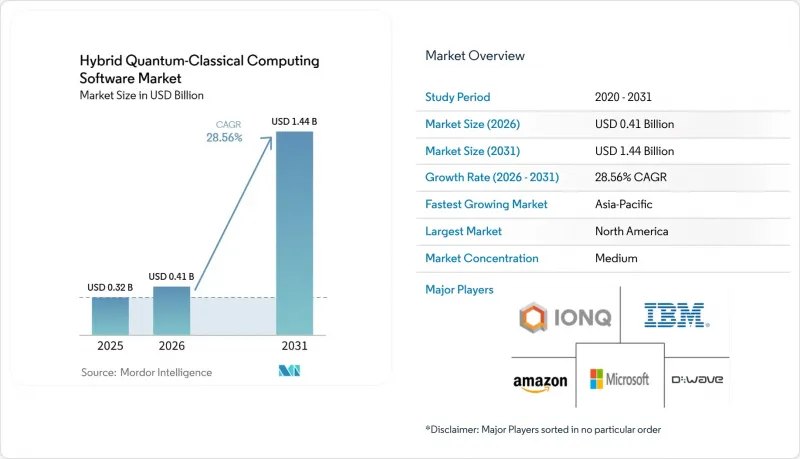
본 보고서는 구성 요소별(소프트웨어 및 서비스), 배포 방식별(클라우드 및 온프레미스), 기술별(초전도 큐비트, 트랩 이온 등), 용도별(최적화, 시뮬레이션 및 모델링 등), 최종 사용자 산업별(은행, 금융서비스 및 보험(BFSI), 헬스케어 및 생명과학 등), 그리고 지역별로 분류되어 있습니다. 시장 전망은 금액(달러) 기준으로 제시되어 있습니다.
세계의 하이브리드 양자 및 고전 컴퓨팅 소프트웨어 시장 동향 및 인사이트
하드웨어에 구애받지 않는 하이브리드 워크플로우 오케스트레이션에 대한 기업 수요 증가
기업들은 이식성을 중시하여 양자 워크플로우를 구축하고 있으며, 그 결과 하이브리드 양자 및 고전 컴퓨팅 소프트웨어 시장에서 오케스트레이션이 주요 구매 기준이 되고 있습니다. 구매자들은 주변 비즈니스 로직을 대폭 수정하지 않고도 초전도, 트랩 이온, 어닐링 각 환경에서 실행 가능한 용도를 점점 더 많이 요구하고 있습니다. 이러한 추세로 인해 밀접하게 결합된 소프트웨어 스택의 중요성은 낮아지고, 하드웨어 상위 계층에 위치한 컴파일러, 스케줄러, 워크플로우 계층의 가치가 높아지고 있습니다. IBM은 2026년 6월, 자사의 양자 네트워크에 340개 이상의 조직이 참여하고 있다고 발표하며, 보다 광범위한 보급에 필요한 소프트웨어 및 생태계 계층을 위해 100억 달러 이상의 로드맵 투자를 약속했습니다. 오케스트레이션이 하드웨어에 독립적일 경우, 지속적인 소프트웨어 수익이 특정 프로세서의 출시 시기에 좌우되기 어려워지므로 이는 중요한 의미를 지닙니다. 또한 이는 하이브리드 양자 및 고전 컴퓨팅 소프트웨어 시장에서 기존 기업 환경 내에서 이식성과 워크플로우의 연속성을 용이하게 하는 벤더가 높이 평가받고 있음을 의미합니다.
양자 개발 환경에 대한 클라우드 접근성 확대
클라우드 접근성 덕분에 하이브리드 양자 및 고전 컴퓨팅 소프트웨어 시장에서 조사 단계부터 기업의 파일럿 활동에 이르기까지의 과정이 단축되었습니다. 기업은 워크플로우를 테스트하기 위해 극저온 하드웨어나 전문 운영 팀, 혹은 전용 사내 인프라에 자금을 투자할 필요가 없어졌습니다. IBM은 자사의 양자 클라우드 서비스가 초기 5큐비트에서 120큐비트 ‘Nighthawk’ 프로세서를 포함한 100큐비트를 넘는 시스템으로 확장되었다고 밝혔습니다. 또한 AWS는 2026년 6월 QuEra와의 제휴를 강화하고, Amazon Braket에 ‘Megaquop’ 규모의 디바이스 로드맵을 도입했습니다. 그 목표는 2028년까지 수백 개의 논리 큐비트로 100만 회의 양자 연산을 실현하는 것입니다. 클라우드 접근성이 확대됨에 따라, 최종 사용자뿐만 아니라 기존 엔터프라이즈 용도 내에 양자 호출을 통합하고자 하는 시스템 통합사업자 및 소프트웨어 벤더들 사이에서도 수요가 확대되고 있습니다. 이러한 추세는 하이브리드 양자 및 고전 컴퓨팅 소프트웨어 시장을 뒷받침할 것입니다. 기업이 하드웨어를 직접 소유하는 것이 현실화되기 전에 소프트웨어 도입이 확대될 가능성이 있기 때문입니다.
대부분의 워크로드에서 실제 운영 수준의 우위가 제한적
하이브리드 양자 및 고전 컴퓨팅 소프트웨어 시장의 가장 큰 제약은 여전히 최적화된 고전적 기법에 비해 일관된 실용적 수준의 우위를 입증할 수 있는 워크로드의 범위가 좁다는 점입니다. 많은 시범 프로젝트가 기술적 가능성을 보여주고 있지만, 이것이 반드시 사업 부서가 여러 예산 주기에 걸쳐 정당화할 수 있는 조달 프로젝트로 이어지는 것은 아닙니다. 문제는 성능뿐만 아니라 효과의 귀속에도 있습니다. 하이브리드 워크플로우에서는 계산 부하의 대부분을 고전 시스템에 의존하는 경우가 많기 때문입니다. 그로 인해 구매자가 가치를 평가할 때, 양자 소프트웨어 계층이 직접적으로 기여한 부분을 파악하기 어렵습니다. 이러한 신뢰성 격차로 인해 파일럿 계약에서 정기 라이선스나 관리형 서비스 계약으로의 전환이 지연되고 있습니다. 또한 이는 내결함성 시스템이 신뢰할 수 있는 우위에 대해 더 광범위한 주장을 뒷받침할 수 있게 될 때까지, 하이브리드 양자 및 고전 컴퓨팅 소프트웨어 시장이 수년에 걸쳐 상업적 관심을 유지해야 함을 의미합니다.
부문 분석
2025년에는 소프트웨어가 매출의 76.82%를 차지하며 하이브리드 양자 및 고전 컴퓨팅 소프트웨어 시장에서 가장 큰 점유율을 기록했습니다. 현재 사이클에서 기업 고객들은 실행을 완전히 아웃소싱하는 모델보다 개발 프레임워크, 컴파일러, 워크플로우 계층, 오케스트레이션 플랫폼에 대한 투자를 여전히 우선시하고 있습니다. 이러한 추세는 많은 구매자가 사내에서 양자 기술에 대한 이해를 심화하고, 양자 워크플로가 보다 광범위한 디지털 및 분석 프로그램에 어떻게 적용될 수 있는지 검증하고 있는 시장 단계를 반영합니다. IBM의 Qiskit 생태계는 전 세계 양자 개발자의 약 70%가 이용하고 있으며, 하드웨어의 광범위한 표준화가 진행되기 전에 소프트웨어에 대한 숙련도가 어떻게 지속적인 우위를 확보할 수 있는지를 보여주고 있습니다. 실제로, 강력한 소프트웨어 커뮤니티를 보유한 벤더들은 초기 파일럿 프로젝트를 중심으로 교육, 도구, 워크플로우 라이브러리의 확충을 보다 수월하게 진행할 수 있습니다.
하이브리드 양자 및 고전 컴퓨팅 소프트웨어 시장의 서비스 부문 규모는 2031년까지 연평균 성장률(CAGR) 30.54%로 확대될 것으로 예측되며, 서비스는 가장 빠르게 성장하는 부문이 될 전망입니다. 이러한 변화는 단순한 상업적 현실을 반영한 것입니다. 많은 기업이 양자 관련 이니셔티브를 후원할 수는 있지만, 아직 사내에 전문 팀을 구성하여 대응할 수는 없기 때문입니다. 따라서 매니지드 딜리버리, 통합 지원, 워크플로우 튜닝, 용도 설계는 계약 구조와 벤더의 수익 구성에서 점점 더 중요해지고 있습니다. 하이브리드 양자 및 고전 컴퓨팅 소프트웨어 업계에서는 맞춤형 컨설팅 형태의 계약에만 의존하지 않고, 이러한 서비스를 표준화하여 반복 가능한 제공 모델에 통합할 수 있는 벤더가 주목받기 시작하고 있습니다. 이러한 변화는 중요한 의미를 지닙니다. 왜냐하면 소프트웨어의 직접적인 셀프 서비스가 처음 도입하는 기업에게는 여전히 어려울지라도, 지속적인 매니지드 지원을 통해 도입을 촉진할 수 있기 때문입니다. 시간이 지남에 따라 하이브리드 양자 및 고전 컴퓨팅 소프트웨어 시장에서는 초기 도입 단계에 비해 플랫폼 수익과 서비스 주도형 운영 간의 균형이 더욱 광범위해질 가능성이 높다고 볼 수 있습니다.
2025년에는 클라우드 제공이 매출의 72.14%를 차지했으며, 도입 방식별 하이브리드 양자 및 고전 컴퓨팅 소프트웨어 시장 점유율에서 1위를 차지하고 있습니다. 벤더 간 하드웨어 품질, 가동률, 장기적인 아키텍처 선택지가 여전히 진화하고 있기 때문에 기업들은 종량제 기반 액세스를 선호합니다. 또한 클라우드 플랫폼은 액세스, 개발 도구, 워크플로우 제어, 오류 완화 기능을 단일 상용 경로로 통합함으로써 사내 마찰을 줄여줍니다. IBM은 지난 10년 동안 클라우드 액세스 가능 시스템의 확장을 강조한 반면, AWS는 Amazon Braket 및 확장된 QuEra 로드맵을 통해 관리형 양자 액세스를 지속적으로 심화해 왔습니다. 이러한 구조는 파일럿 프로젝트의 신속한 시작을 지원할 뿐만 아니라, 구매자가 단일 소유 모델에 얽매이지 않고 다양한 백엔드 유형을 넘나들며 실험을 수행할 수 있는 수단을 제공합니다.
또한, 클라우드는 가장 빠르게 성장하는 도입 경로이기도 하며, 하이브리드 양자 및 고전 컴퓨팅 소프트웨어 시장에서 2026년부터 2031년까지 연평균 성장률(CAGR) 29.82%가 예상됩니다. 클라우드의 상업적 우위는 단순한 접근성에 그치지 않습니다. 보다 광범위한 기업 환경 내에서 HPC, AI 도구, 양자 루틴을 연동할 수 있는 하이브리드 아키텍처도 지원하고 있기 때문입니다. 온프레미스 배포는 현재로서는 아직 소규모 채널에 그치고 있지만, 예측 기간 후반에는 주권, 국방 및 엄격한 데이터 처리 규정이 비용 효율성보다 우선시되는 상황에서 그 중요성이 높아질 것으로 예측됩니다. 온프레미스에 대한 수요가 증가하더라도 실험, 확장성 및 멀티 백엔드 이식성을 실현하는 데 있어 클라우드가 여전히 가장 쉬운 수단이기 때문에 하이브리드 양자 및 고전 컴퓨팅 소프트웨어 시장은 계속해서 클라우드 주도적인 추세를 유지할 전망입니다.
지역별 분석
북미는 2025년 매출의 42.88%를 차지했으며, 지역별로는 하이브리드 양자 및 고전 컴퓨팅 소프트웨어 시장에서 가장 큰 점유율을 기록했습니다. 미국은 양자 클라우드 인프라의 집중, 기업의 조기 도입, 그리고 소프트웨어 개발 인재의 집적을 통해 수요의 대부분을 주도했습니다. IBM이 2026년 6월에 발표한 로드맵에는 올버니 나노테크 콤플렉스의 제조 거점 확장 및 시카고와 아마라바티에서의 신규 시스템 도입이 포함되어 있어, 이를 통해 해당 지역공급 기반이 더욱 탄탄해지고 생태계에 대한 인지도가 더욱 높아졌습니다. 캐나다는 포토닉스 생태계를 통해 이러한 추세를 가속화했으나, 남미는 상용 도입 단계가 아직 초기 단계에 머물러 있어 현지 하드웨어를 보유하기보다는 클라우드 기반 실험에 의존하는 경향이 강했습니다.
유럽은 2025년에도 경쟁력을 유지하며, 하이브리드 양자 및 고전 컴퓨팅 소프트웨어 시장에서 정책에 뒷받침된 상용 개발이 가장 활발한 지역 중 하나로 남아 있었습니다. 영국, 독일, 프랑스는 딥테크 벤더, 파일럿 프로그램, 공공 지원 메커니즘을 결합하여 지역 활동을 지속적으로 주도했습니다. 독일에서는 여전히 현저한 도입 격차가 관찰되었으며, Bitkom의 2026년 보고서에 따르면 기업의 69%가 파일럿 프로젝트에 대한 재정 지원을 요청했고, 67%는 클라우드 플랫폼에 대한 간소화된 접근을 원했습니다. 이러한 추세는 해당 지역의 광범위한 영역에서 인지도 향상이 운영 준비 상태보다 빠른 속도로 진행되고 있음을 시사합니다. 또한 유럽에서는 구매자가 벤더나 도입 모델을 평가할 때 개방형 생태계, 이식성 및 주권과 관련된 고려 사항을 계속해서 중시했습니다.
아시아태평양은 2031년까지 연평균 성장률(CAGR) 31.92%로 확대될 것으로 예측되며, 하이브리드 양자 및 고전 컴퓨팅 소프트웨어 시장에서 지역별 가장 높은 성장률을 보일 것으로 전망됩니다. 일본은 이 지역의 주요 견인차 역할을 하고 있으며, 리켄(RIKEN)은 ‘IBM Quantum System Two’를 운영하며 양자 프로세서와 HPC 인프라를 연계하는 양자 중심 슈퍼컴퓨팅 연구를 추진하고 있습니다. 2026년 6월, 후지쯔와 다이이치 생명 그룹은 후지쯔의 1,024노드 양자 시뮬레이터 클러스터 및 양자 하드웨어를 활용한 자산 배분 최적화에 관한 공동 연구를 시작했습니다. 중국과 한국도 국가 차원의 양자 프로그램을 통해 국내 소프트웨어 역량 구축을 지속하고 있습니다. 중동은 도입 단계에서 여전히 선도 지역에 뒤처져 있었으나, 파트너십 주도형 개발과 현지에서 관리되는 디지털 인프라에 대한 관심이 높아짐에 따라 진전을 이루었습니다. 아프리카은 여전히 초기 단계에 있지만, 클라우드 접근 장벽이 낮기 때문에 지역 내 디지털 프로그램이 성숙해짐에 따라 향후 참여 범위는 점차 확대될 가능성이 있습니다.
기타 혜택 :
- 엑셀 형식 시장 예측(ME) 시트
- 3개월간의 애널리스트 지원
자주 묻는 질문
목차
제1장 서론
제2장 조사 방법
제3장 주요 요약
제4장 시장 구도
제5장 시장 규모 및 성장 예측
제6장 경쟁 구도
제7장 시장 기회 및 향후 전망
AJY 26.09.03According to Mordor Intelligence, the hybrid quantum-classical computing software market size is expected to increase from USD 0.32 billion in 2025 to USD 0.41 billion in 2026 and reach USD 1.44 billion by 2031, growing at a CAGR of 28.56% over 2026-2031.
This report is Segmented by Component (Software, and Services), Deployment Mode (Cloud, and On-Premises), Technology (Superconducting Qubits, Trapped Ions, and More), Application (Optimization, Simulation and Modeling, and More), End-User Industry (BFSI, Healthcare and Life Sciences, and More), and Geography. The Market Forecasts are Provided in Terms of Value (USD).
Global Hybrid Quantum-Classical Computing Software Market Trends and Insights
Rising Enterprise Demand for Hardware-Agnostic Hybrid Workflow Orchestration
Enterprises are organizing quantum work around portability, and that has made orchestration a central buying criterion in the hybrid quantum-classical computing software market. Buyers increasingly want applications that can run across superconducting, trapped-ion, and annealing environments without major rewrites to the surrounding business logic. This preference weakens tightly coupled software stacks and raises the value of compilers, schedulers, and workflow layers that sit above the hardware. IBM stated in June 2026 that its quantum network included more than 340 organizations and tied its more than USD 10 billion roadmap commitment to the software and ecosystem layers needed for broader adoption. That matters because recurring software revenue becomes less dependent on the release timing of specific processors when orchestration is hardware-agnostic. It also means the hybrid quantum-classical computing software market is rewarding vendors that make portability and workflow continuity easier inside existing enterprise environments.
Expanding Cloud Access to Quantum Development Environments
Cloud access has shortened the path from research interest to enterprise pilot activity in the hybrid quantum-classical computing software market. Companies no longer need to fund cryogenic hardware, specialist operating teams, or dedicated in-house infrastructure before they can test a workflow. IBM noted that its quantum cloud offering has expanded from a 5-qubit starting point to systems with more than 100 qubits, including the 120-qubit Nighthawk processor. AWS also deepened its collaboration with QuEra in June 2026 to bring a Megaquop-scale device roadmap to Amazon Braket, with the goal of one million quantum operations across hundreds of logical qubits by 2028. Wider cloud access is broadening demand not only among end users, but also among system integrators and software vendors that want to embed quantum calls inside classical enterprise applications. That pattern supports the hybrid quantum-classical computing software market because software adoption can grow before direct enterprise ownership of hardware becomes practical.
Limited Production-Grade Advantage Across Most Workloads
The largest restraint in the hybrid quantum-classical computing software market is still the narrow range of workloads that can prove a consistent production-grade advantage over optimized classical methods. Many pilots show technical promise, but that does not always translate into a procurement case that a business unit can defend over several budget cycles. The issue is not only performance, but also attribution, because hybrid workflows often rely on classical systems for most of the computational burden. That makes it harder for buyers to isolate the direct contribution of the quantum software layer when they assess value. This credibility gap slows the movement from pilot contracts to recurring licenses and managed service commitments. It also means the hybrid quantum-classical computing software market must sustain commercial interest for several years before fault-tolerant systems can support broader claims of dependable advantage.
Other drivers and restraints analyzed in the detailed report include:
- Growth Of Quantum Error Mitigation and Error Correction Toolchains
- Increasing Use of Quantum Software in Optimization and Simulation Workloads
- Fragmented Toolchain Interoperability Across Backends
For complete list of drivers and restraints, kindly check the Table Of Contents.
Segment Analysis
Software accounted for 76.82% of revenue in 2025, which gave it the largest share of the hybrid quantum-classical computing software market. In the current cycle, enterprise customers are still investing first in development frameworks, compilers, workflow layers, and orchestration platforms rather than fully outsourced execution models. That preference reflects a market stage where many buyers are building internal familiarity and testing how quantum workflows fit within broader digital and analytics programs. IBM's Qiskit ecosystem has been used by around 70% of quantum developers globally, which shows how software familiarity can become a durable advantage before broad hardware standardization takes shape. In practice, the vendors with strong software communities have had an easier time expanding training, tooling, and workflow libraries around early pilots.
The hybrid quantum-classical computing software market size for services is projected to expand at a 30.54% CAGR through 2031, making services the fastest-growing component segment. This shift reflects a simple commercial reality, because many enterprises can sponsor quantum work but cannot yet staff it with specialized in-house teams. Managed delivery, integration support, workflow tuning, and application design are therefore becoming more important to contract structure and vendor revenue mix. The hybrid quantum-classical computing software industry is starting to reward vendors that can standardize these services into repeatable delivery models rather than relying only on custom consulting-style engagements. That change matters because recurring managed support can lift adoption even when direct software self-service remains difficult for first-time buyers. Over time, the hybrid quantum-classical computing software market is likely to show a broader mix between platform revenue and service-led execution than it did in the earliest adoption phase.
Cloud delivery captured 72.14% of revenue in 2025, giving it the leading position in the hybrid quantum-classical computing software market share by deployment mode. Enterprises have favored pay-as-you-go access because hardware quality, uptime, and long-term architecture choices are still evolving across vendors. Cloud platforms also reduce internal friction by combining access, development tools, workflow controls, and error mitigation functions within one commercial path. IBM highlighted the scaling of cloud-accessible systems over the last decade, while AWS continued to deepen managed quantum access through Amazon Braket and its expanded QuEra roadmap. This structure supports faster pilot initiation and gives buyers a way to experiment across backend types without committing to a single ownership model.
Cloud is also the faster-growing deployment path, with a 29.82% CAGR projected for 2026-2031 in the hybrid quantum-classical computing software market. The commercial advantage of cloud is not limited to access alone, because it also supports hybrid architectures where HPC, AI tools, and quantum routines can be coordinated within broader enterprise environments. On-premises deployment remains a smaller channel today, but it is expected to gain relevance later in the forecast period where sovereignty, defense, and strict data handling rules outweigh cost efficiency. Even as on-premises demand grows, the hybrid quantum-classical computing software market is likely to remain cloud-led because cloud is still the easiest route to experimentation, scaling, and multi-backend portability.
Complete Report Scope:
- By Component
- Software
- Services
- By Deployment Mode
- Cloud
- On-Premises
- By Technology
- Superconducting Qubits
- Trapped Ions
- Quantum Annealing
- Other Technologies
- By Application
- Optimization
- Simulation and Modeling
- Cryptography and Security
- Data Analytics and Financial Modeling
- Other Applications
- By End-User Industry
- BFSI
- Healthcare and Life Sciences
- Retail and E-Commerce
- IT and Telecom
- Media and Entertainment
- Industrial Manufacturing
- Energy and Utilities
- Government and Public Administration
- Other End-User Industries
- By Geography
- North America
- United States
- Canada
- Mexico
- South America
- Brazil
- Argentina
- Rest of South America
- Europe
- Germany
- United Kingdom
- France
- Spain
- Italy
- Russia
- Rest of Europe
- Asia-Pacific
- China
- India
- Japan
- South Korea
- Australia and New Zealand
- Rest of Asia-Pacific
- Middle East
- Saudi Arabia
- United Arab Emirates
- Turkey
- Rest of Middle East
- Africa
- South Africa
- Nigeria
- Egypt
- Rest of Africa
- North America
Geography Analysis
North America accounted for 42.88% of 2025 revenue, which gave it the largest hybrid quantum-classical computing software market share by region. The United States drove most of that demand through its concentration of quantum cloud infrastructure, enterprise early adopters, and software development talent. IBM's June 2026 roadmap commitment included manufacturing expansion at the Albany NanoTech Complex and new system deployments in Chicago and Amaravati, which reinforced the region's supply-side depth and ecosystem visibility. Canada added to this profile through its photonic ecosystem, while South America remained earlier in commercial adoption and relied more on cloud-based experimentation than on local hardware ownership.
Europe held a competitive position in 2025 and remained one of the most active regions for policy-backed commercial development in the hybrid quantum-classical computing software market. The United Kingdom, Germany, and France continued to shape regional activity through a mix of deep-tech vendors, pilot programs, and public support mechanisms. Germany still showed a meaningful implementation gap, with Bitkom reporting in 2026 that 69% of firms sought financial support for pilot projects and 67% wanted simplified cloud platform access. This pattern suggests that awareness has moved faster than operational readiness across large parts of the region. Europe also continued to place weight on open ecosystems, portability, and sovereignty considerations when buyers evaluated vendors and deployment models.
Asia-Pacific is projected to expand at a 31.92% CAGR through 2031, giving it the fastest regional growth profile in the hybrid quantum-classical computing software market. Japan has been a major regional anchor, with RIKEN operating IBM Quantum System Two and advancing quantum-centric supercomputing work that links quantum processors with HPC infrastructure. June 2026, Fujitsu and Daiichi Life Group launched joint research on asset allocation optimization using Fujitsu's 1,024-node quantum simulator cluster and quantum hardware. China and South Korea also continued to build domestic software capability through national quantum programs. The Middle East remained earlier in adoption but moved forward through partnership-led development and a stronger interest in locally controlled digital infrastructure. Africa was still nascent, yet lower barriers to cloud access can gradually widen future participation as regional digital programs mature.
- IBM Corporation
- IonQ, Inc.
- Microsoft Corporation
- Amazon.com, Inc.
- D-Wave Quantum Inc.
- Rigetti Computing, Inc.
- Alphabet Inc.
- Quantinuum Ltd.
- Xanadu Quantum Technologies Inc.
- Pasqal SAS
- QC Ware Corp.
- Riverlane Limited
- Classiq Technologies Ltd.
- Kipu Quantum
- Quantum Machines Ltd.
- QBraid
- QuEra Computing Inc.
- Infleqtion Inc.
- Algorithmiq Oy
- Phasecraft Ltd.
Additional Benefits:
- The market estimate (ME) sheet in Excel format
- 3 months of analyst support
TABLE OF CONTENTS
1 INTRODUCTION
- 1.1 Study Assumptions and Market Definition
- 1.2 Scope of the Study
2 RESEARCH METHODOLOGY
3 EXECUTIVE SUMMARY
4 MARKET LANDSCAPE
- 4.1 Market Overview
- 4.2 Market Drivers
- 4.2.1 Rising Enterprise Demand for Hardware-Agnostic Hybrid Workflow Orchestration
- 4.2.2 Expanding Cloud Access to Quantum Development Environments
- 4.2.3 Growth of Quantum Error Mitigation and Error Correction Toolchains
- 4.2.4 Increasing Use of Quantum Software in Optimization and Simulation Workloads
- 4.2.5 Quantum-Ready Talent Shortage Accelerating Managed Software Adoption
- 4.2.6 Emerging Need for Quantum Intermediate Representation and Compiler Standardization
- 4.3 Market Restraints
- 4.3.1 Limited Production-Grade Advantage Across Most Workloads
- 4.3.2 Fragmented Toolchain Interoperability Across Backends
- 4.3.3 High Integration Burden With Classical HPC and Enterprise IT Stacks
- 4.3.4 Procurement Delays Driven by Unclear ROI and Vendor Lock-In Risk
- 4.4 Industry Value Chain Analysis
- 4.5 Impact of Macroeconomic Factors on the Market
- 4.6 Technological Outlook
- 4.7 Regulatory Landscape
- 4.8 Porter's Five Forces Analysis
- 4.8.1 Bargaining Power of Suppliers
- 4.8.2 Bargaining Power of Buyers
- 4.8.3 Threat of New Entrants
- 4.8.4 Threat of Substitutes
- 4.8.5 Intensity of Competitive Rivalry
5 MARKET SIZE AND GROWTH FORECASTS (VALUE)
- 5.1 By Component
- 5.1.1 Software
- 5.1.2 Services
- 5.2 By Deployment Mode
- 5.2.1 Cloud
- 5.2.2 On-Premises
- 5.3 By Technology
- 5.3.1 Superconducting Qubits
- 5.3.2 Trapped Ions
- 5.3.3 Quantum Annealing
- 5.3.4 Other Technologies
- 5.4 By Application
- 5.4.1 Optimization
- 5.4.2 Simulation and Modeling
- 5.4.3 Cryptography and Security
- 5.4.4 Data Analytics and Financial Modeling
- 5.4.5 Other Applications
- 5.5 By End-User Industry
- 5.5.1 BFSI
- 5.5.2 Healthcare and Life Sciences
- 5.5.3 Retail and E-Commerce
- 5.5.4 IT and Telecom
- 5.5.5 Media and Entertainment
- 5.5.6 Industrial Manufacturing
- 5.5.7 Energy and Utilities
- 5.5.8 Government and Public Administration
- 5.5.9 Other End-User Industries
- 5.6 By Geography
- 5.6.1 North America
- 5.6.1.1 United States
- 5.6.1.2 Canada
- 5.6.1.3 Mexico
- 5.6.2 South America
- 5.6.2.1 Brazil
- 5.6.2.2 Argentina
- 5.6.2.3 Rest of South America
- 5.6.3 Europe
- 5.6.3.1 Germany
- 5.6.3.2 United Kingdom
- 5.6.3.3 France
- 5.6.3.4 Spain
- 5.6.3.5 Italy
- 5.6.3.6 Russia
- 5.6.3.7 Rest of Europe
- 5.6.4 Asia-Pacific
- 5.6.4.1 China
- 5.6.4.2 India
- 5.6.4.3 Japan
- 5.6.4.4 South Korea
- 5.6.4.5 Australia and New Zealand
- 5.6.4.6 Rest of Asia-Pacific
- 5.6.5 Middle East
- 5.6.5.1 Saudi Arabia
- 5.6.5.2 United Arab Emirates
- 5.6.5.3 Turkey
- 5.6.5.4 Rest of Middle East
- 5.6.6 Africa
- 5.6.6.1 South Africa
- 5.6.6.2 Nigeria
- 5.6.6.3 Egypt
- 5.6.6.4 Rest of Africa
- 5.6.1 North America
6 COMPETITIVE LANDSCAPE
- 6.1 Market Concentration
- 6.2 Strategic Moves
- 6.3 Market Share Analysis
- 6.4 Company Profiles (includes Global Level Overview, Market Level Overview, Core Segments, Financials as available, Strategic Information, Market Rank/Share, Products and Services, Recent Developments)
- 6.4.1 IBM Corporation
- 6.4.2 IonQ, Inc.
- 6.4.3 Microsoft Corporation
- 6.4.4 Amazon.com, Inc.
- 6.4.5 D-Wave Quantum Inc.
- 6.4.6 Rigetti Computing, Inc.
- 6.4.7 Alphabet Inc.
- 6.4.8 Quantinuum Ltd.
- 6.4.9 Xanadu Quantum Technologies Inc.
- 6.4.10 Pasqal SAS
- 6.4.11 QC Ware Corp.
- 6.4.12 Riverlane Limited
- 6.4.13 Classiq Technologies Ltd.
- 6.4.14 Kipu Quantum
- 6.4.15 Quantum Machines Ltd.
- 6.4.16 QBraid
- 6.4.17 QuEra Computing Inc.
- 6.4.18 Infleqtion Inc.
- 6.4.19 Algorithmiq Oy
- 6.4.20 Phasecraft Ltd.
7 MARKET OPPORTUNITIES AND FUTURE OUTLOOK
- 7.1 White Space and Unmet Need Assessment


