|
시장보고서
상품코드
2099048
인도의 그린 물류 : 시장 점유율 분석, 업계 동향 및 통계, 성장 예측(2026-2031년)India Green Logistics - Market Share Analysis, Industry Trends & Statistics, Growth Forecasts (2026 - 2031) |
||||||
 Mordor Intelligence
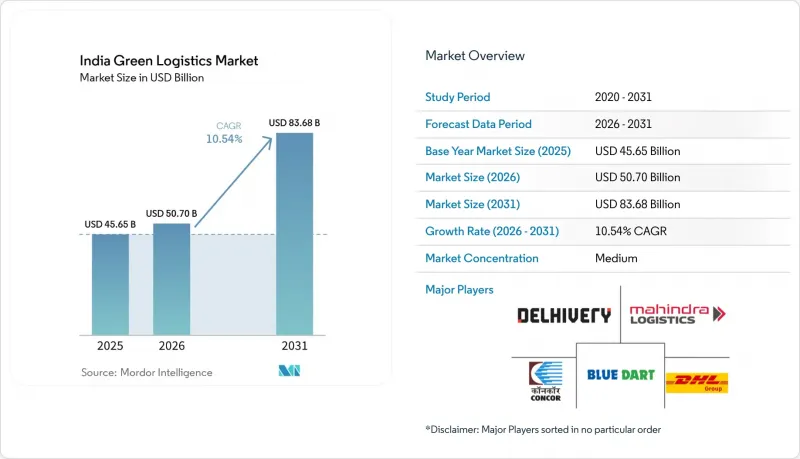
Mordor Intelligence에 의하면, 인도의 그린 물류 시장 규모는 2025년 456억 5,000만 달러로 평가되었습니다. 2026년에는 507억 달러로 확대되어 2031년까지 836억 8,000만 달러에 이를 것으로 예상되고 2026년부터 2031년에 걸쳐 CAGR 10.54%로 성장할 전망입니다.
인도의 그린 물류 시장은 보다 공식적인 운영 단계로 전환되고 있습니다. 이는 화물 운송의 탈탄소화가 더 이상 단순한 자발적인 지속가능성 목표에 그치지 않고, 규정 준수, 네트워크 설계 및 조달 결정과 밀접하게 연결되어 있기 때문입니다. 본 보고서는 물류 기능별(친환경 운송, 친환경 창고·배송, 기타), 연료·에너지 유형별(전기 구동형, 바이오연료 기반, 수소 구동형), 최종 사용자 산업별(소매 및 전자상거래, 식품 및 음료, 기타), 지역별(북부, 중부, 서부, 동부, 남부)로 분류되어 있습니다. 시장 전망은 금액(달러) 기준으로 제시되어 있습니다.
인도의 그린 물류 시장 동향과 인사이트
ESG 주도형 화물 조달 증가
인도의 그린 물류 시장의 대기업들은 현재 화물 운송의 탈탄소화를 단순한 ESG의 선택적 부가 요소가 아닌 조달 기준으로 자리매김하고 있습니다. SEBI(인도 증권거래위원회)의 BRSR 핵심 프레임워크에 따라, 2025-26 회계연도부터 상위 250개 상장 기업에 대해 밸류체인 관련 공시 의무가 자발적으로 확대됨에 따라, 기업들은 사업 거점의 대부분에 걸친 공급업체 측의 배출 강도를 보다 상세하게 검토해야 하는 압박을 받고 있습니다. 화주가 화물 관련 스코프 3 배출량 측정을 시작하면, 운송 파트너는 계약을 유지하기 위해 더 친환경적인 운영, 데이터 수집 개선, 그리고 신뢰할 수 있는 보고를 입증해야 합니다. 이는 대형 소비재 기업들이 홍보용 수단이 아닌 실용적인 물류 대안으로서 전기차(EV) 차량, 철도 운송, 재생에너지를 활용한 사업을 적극적으로 도입하기 시작하고 있다는 점에서도 분명합니다. 그 결과, 인도의 그린 물류 시장에서는 기존의 디젤 차량 중심 사업자만큼 전국적인 규모를 갖추지 못한 경우에도 탄소 성과를 문서화할 수 있는 중규모 그린 운송업체에게 더 많은 진입 여지가 생겨나고 있습니다.
정부 주도의 복합 운송 탈탄소화 추진
인도의 그린 물류 시장은 인프라 효율성과 운송 배출량 감축을 연계하게 된 정책 환경의 혜택을 받고 있습니다. PM Gati Shakti를 통해 57개 중앙 부처 및 부서를 1,700개 이상의 데이터 레이어를 보유한 단일 지리 공간 플랫폼으로 통합하여 도로, 철도, 항만, 유틸리티, 산업 단지의 계획 수립을 개선했습니다. 예산 조치 및 회랑 정비 정책을 통해 이 접근 방식은 화물 운송 분야로도 확대되어, 새로운 전용 화물 회랑(Dedicated Freight Corridors)의 정비, 국가 수로 계획의 확충, 연안 화물 운송 목표의 강화 등이 추진되고 있으며, 이러한 조치들이 결합되어 장기적으로 더 깨끗한 운송 수단의 조합을 뒷받침하고 있습니다. Gati Shakti Cargo Terminals는 2026년 초까지 이미 민간 투자를 유치했습니다. 이는 철도 주도의 화물 운송 전환을 통해 상당한 탄소 감축이 예상을 보여주며, 사업자들이 현재 그린 물류 자산을 실험적인 플랫폼이 아닌 상업적으로 활용 가능한 인프라로 간주하고 있는 이유를 설명해 줍니다. 이러한 일관성은 중요합니다. 동일한 공공 투자 파이프라인이 비용 절감과 탈탄소화를 모두 지원함으로써, 인도의 그린 물류 시장이 더욱 빠르게 확대될 수 있기 때문입니다.
차량 및 인프라 전환에 수반되는 막대한 설비 투자
자본은 여전히 인도의 그린 물류 시장의 큰 걸림돌로 작용하고 있습니다. 이는 트럭 보유 대수의 대부분이 저비용 자금 조달에 쉽게 접근할 수 없는 소규모 사업자에게 집중되어 있기 때문입니다. 인도에서는 400만 대 이상의 트럭이 운행되고 있지만, 그 대부분은 소유 구조가 세분화되어 있어 더 깨끗한 차량이나 지원 인프라에 대한 투자 능력이 제한되어 있습니다. 또한, 공공 충전 인프라 구축도 2030년까지 요구되는 수준에 미치지 못하고 있어, 사업자들은 새로운 차량 구매를 검토할 때 네트워크 가용성을 항상 기대할 수 있는 것은 아닙니다. 이러한 상황으로 인해 사업자의 세분화가 진행되고 있으며, 조기 인프라 투자를 정당화할 만큼 자산 이용률이 아직 충분히 높지 않은 운송 노선에서 인도의 그린 물류 시장 성장이 가장 둔화되고 있습니다.
부문 분석
2025년, 친환경 운송은 인도 친환경 물류 시장 점유율의 58.07%를 차지하며, 도로, 철도, 연안, 내륙 화물 운송 전반에 걸쳐 지배적인 운송 수단이 되었습니다. 이러한 규모는 탈탄소화의 성과 대부분이 여전히 화물 운송 방식, 노선 설계, 그리고 각 회랑에서 어떤 운송 수단 조합이 채택되느냐에 달려 있다는 사실을 반영하고 있습니다. 화물 터미널 및 전용 화물 회랑을 통해 자동차, 화학, 철강 등의 부문에서 산업용 화물이 저배출 철도 네트워크로 유도됨에 따라, 철도 연계형 화물 취급이 이 분야에서 점점 더 중요해지고 있습니다. 또한 인도의 그린 물류 시장에서는 규정 준수가 운송 수단 선택에 영향을 미치는 경향도 나타납니다. 이는 화주들이 탄소 공시에 대응하고 톤킬로미터당 배출량을 감축할 수 있는 화물 시스템을 점점 더 필요로 하고 있기 때문입니다.
그린 부가가치 서비스 등은 2031년까지 연평균 성장률(CAGR) 15.13%를 나타낼 것으로 예측되며, 이는 물리적 화물 운송 네트워크 전반에 걸쳐 소프트웨어, 탄소 회계, 경로 최적화, 배출량 보고에 대한 수요가 증가하고 있음을 보여줍니다. 이러한 서비스는 가시성과 감사 가능성을 높이는 것이며, 계약 선정 및 수출 규정 준수 측면에서 그 중요성이 점점 더 커지고 있기 때문에 이 성장은 매우 중요합니다. 친환경 창고 및 배송은 여전히 두 번째 주요 기능으로, 인증된 창고 공간 확장 계획과 체계화된 공급망에 대규모로 대응할 수 있는 대규모 통합 프로젝트에 의해 뒷받침되고 있습니다. 또한, 재생에너지 장비 제조업체들의 창고 수요도 증가하고 있으며, 청정 에너지 생산 확대에 따라 인도의 친환경 물류 업계에는 구조적으로 적합한 새로운 고객 기반이 형성되고 있습니다.
기타 혜택 :
- 엑셀 형식 시장 예측(ME) 시트
- 3개월간의 애널리스트 지원
자주 묻는 질문
목차
제1장 서론
제2장 조사 방법
제3장 주요 요약
제4장 시장 구도
제5장 시장 규모 및 성장 예측(금액, 2026-2031년)
제6장 경쟁 구도
제7장 시장 기회 및 향후 전망
KTH 26.08.10According to Mordor Intelligence, the India green logistics market size is expected to increase from USD 45.65 billion in 2025 to USD 50.70 billion in 2026 and reach USD 83.68 billion by 2031, growing at a CAGR of 10.54% over 2026-2031.
The India green logistics market is moving into a more formal operating phase, as freight decarbonization is now tied to compliance, network design, and procurement decisions rather than solely to voluntary sustainability goals. This report is Segmented by Logistics Function (Green Transportation, Warehousing and Distribution, and More), by Fuel and Energy Type (Electric-Powered Logistics, Biofuel-Based Logistics, Hydrogen-Powered Logistics), by End-User Industry (Retail and E-Commerce, Food and Beverages, and More), and by Region (North, Central, West, East, and South). The Market Forecasts are Provided in Terms of Value (USD).
India Green Logistics Market Trends and Insights
Rising ESG-Led Freight Procurement
Large enterprises in the India green logistics market are now treating freight decarbonization as a procurement standard, not as an optional ESG add-on. Under SEBI's BRSR Core framework, value chain disclosure obligations widened voluntarily for the top 250 listed entities from FY 2025-26, pushing companies to look more closely at supplier-side emission intensity across large parts of their operating base. Once a shipper begins measuring freight-related Scope 3 emissions, transport partners must demonstrate cleaner operations, improved data capture, and credible reporting to retain access to the contract. This is evident in the way major consumer companies have begun using EV fleets, rail transport, and renewable energy-backed operations as practical logistics choices rather than public relations signals. The result is that the India green logistics market is opening up more space for mid-sized green carriers that can document their carbon performance, even when they do not match the national scale of older diesel-led operators.
Government-Backed Multimodal Decarbonization Push
The India green logistics market is benefiting from a policy environment that now links infrastructure efficiency with lower transport emissions. PM Gati Shakti has integrated 57 central ministries and departments onto a single geospatial platform with more than 1,700 data layers, improving the planning of roads, rail lines, ports, utilities, and industrial zones. Budget and corridor measures have extended that approach into freight through new Dedicated Freight Corridors, added national waterway plans, and stronger coastal cargo targets, which together support a cleaner modal mix over time. Gati Shakti Cargo Terminals had already attracted private investment by early 2026. They were associated with large estimated carbon savings from rail-led freight shifts, which shows why operators now see green logistics assets as commercially usable infrastructure rather than experimental platforms. This alignment matters because the India green logistics market can expand faster when the same public investment pipeline supports cost reduction and decarbonization.
High Capex for Fleet and Infrastructure Transition
Capital remains a major brake on the India green logistics market because a large part of the truck base still sits with small operators that do not have easy access to low-cost finance. More than 4 million trucks operate in India, many of them tied to fragmented ownership structures that limit investment capacity for cleaner fleets and supporting infrastructure. Public charging deployment is also behind what will be needed by 2030, meaning operators cannot always count on network availability when evaluating new fleet purchases. These conditions slow the India green logistics market most in corridors where operator fragmentation is high, and asset utilization is not yet strong enough to justify early infrastructure bets.
Other drivers and restraints analyzed in the detailed report include:
- Rapid Electrification of Last-Mile and Urban Freight
- Solarized and Energy-Efficient Warehousing Adoption
- Limited Public Charging and Alternate Fuel Refueling Density
For complete list of drivers and restraints, kindly check the Table Of Contents.
Segment Analysis
Green transportation held 58.07% of the India green logistics market share in 2025, making it the dominant mode across road, rail, coastal, and inland freight movements. Its scale reflects the fact that most decarbonization gains still depend on how freight is moved, how routes are designed, and which modal combinations are used for each corridor. Rail-linked cargo handling is becoming increasingly important within the function, as cargo terminals and dedicated freight corridors are diverting industrial traffic toward lower-emission rail networks in sectors such as automotive, chemicals, and steel. The India green logistics market is also seeing modal choice shaped by compliance, since shippers increasingly need freight systems that can support carbon disclosure and lower emissions per ton-kilometer.
Green value-added services and others are projected to grow at a 15.13% CAGR through 2031, indicating rising demand for software, carbon accounting, route optimization, and emissions reporting across the physical freight network. That growth is significant because these services add visibility and auditability, which are becoming more important in contract selection and export compliance. Green warehousing and distribution remains the second major function, supported by the planned expansion of certified warehouse space and by large integrated projects that can serve organized supply chains at scale. Renewable energy equipment manufacturers are also increasing warehouse demand, which gives the India green logistics industry another structurally aligned customer base as clean energy manufacturing expands.
Complete Report Scope:
- By Logistics Function
- Green Transportation
- Road
- Air
- Sea and Inland Waterways
- Rail
- Green Warehousing & Distribution
- Green Value-added Services and Others
- Green Transportation
- By Fuel / Energy Type
- Electric-Powered Logistics
- Biofuel-Based Logistics
- Hydrogen-Powered Logistics
- Others
- By End-user Industry
- Retail & E-commerce
- Manufacturing & Industrial
- Automotive
- Healthcare & Pharmaceuticals
- Food & Beverages
- Chemicals & Hazardous Materials
- Others
- By Region
- North
- Central
- West
- East
- South
List of Companies Covered in this Report:
- DHL Group
- Delhivery Limited
- Mahindra Logistics Limited
- Blue Dart Express Limited
- Container Corporation of India (CONCOR)
- Transport Corporation of India (TCI)
- TVS Supply Chain Solutions
- Allcargo Gati
- DP World Logistics India
- GreenLine Mobility Solutions
- FedEx
- DSV
- Kuehne + Nagel
- Safexpress
- TCI Express
- UPS
- Adani Logistics
- Gateway Distriparks (Gateway Rail)
- Xpressbees
- Ecom Express
- Shadowfax
- Ekart Logistics
Additional Benefits:
- The market estimate (ME) sheet in Excel format
- 3 months of analyst support
TABLE OF CONTENTS
1 Introduction
- 1.1 Study Assumptions & Market Definition
- 1.2 Scope of the Study
2 Research Methodology
3 Executive Summary
4 Market Landscape
- 4.1 Market Overview and Role of Green Logistics in Logistics
- 4.2 ESG Spending Trends
- 4.3 Market Drivers
- 4.3.1 Rising ESG-Led Freight Procurement
- 4.3.2 Government-Backed Multimodal Decarbonization Push
- 4.3.3 Rapid Electrification of Last-Mile and Urban Freight
- 4.3.4 Solarized and Energy-Efficient Warehousing Adoption
- 4.3.5 Carbon Reporting Pressure From Export-Oriented Supply Chains
- 4.3.6 Demand for Low-Emission Cold Chain Logistics
- 4.4 Market Restraints
- 4.4.1 High Capex for Fleet and Infrastructure Transition
- 4.4.2 Limited Public Charging and Alternate Fuel Refueling Density
- 4.4.3 Fragmented Operator Base and Uneven Technology Adoption
- 4.4.4 Land, Power, and Permitting Constraints for Green Warehousing
- 4.5 Regulatory Framework
- 4.6 Value Chain and Distribution Channel Architecture Analysis
- 4.7 Technology Innovations Outlook
- 4.8 Porter's Five Forces
- 4.8.1 Threat of New Entrants
- 4.8.2 Bargaining Power of Suppliers
- 4.8.3 Bargaining Power of Buyers
- 4.8.4 Threat of Substitutes
- 4.8.5 Rivalry Among Competitors
- 4.9 Evolution of Green Logistics Requirements
- 4.10 Impact of Geo-Political Events on Supply Chain Shifts
5 Market Size & Growth Forecasts (Value, 2026-2031)
- 5.1 By Logistics Function
- 5.1.1 Green Transportation
- 5.1.1.1 Road
- 5.1.1.2 Air
- 5.1.1.3 Sea and Inland Waterways
- 5.1.1.4 Rail
- 5.1.2 Green Warehousing & Distribution
- 5.1.3 Green Value-added Services and Others
- 5.1.1 Green Transportation
- 5.2 By Fuel / Energy Type
- 5.2.1 Electric-Powered Logistics
- 5.2.2 Biofuel-Based Logistics
- 5.2.3 Hydrogen-Powered Logistics
- 5.2.4 Others
- 5.3 By End-user Industry
- 5.3.1 Retail & E-commerce
- 5.3.2 Manufacturing & Industrial
- 5.3.3 Automotive
- 5.3.4 Healthcare & Pharmaceuticals
- 5.3.5 Food & Beverages
- 5.3.6 Chemicals & Hazardous Materials
- 5.3.7 Others
- 5.4 By Region
- 5.4.1 North
- 5.4.2 Central
- 5.4.3 West
- 5.4.4 East
- 5.4.5 South
6 Competitive Landscape
- 6.1 Market Concentration
- 6.2 Key Strategic Moves
- 6.3 Market Share Analysis
- 6.4 Company Profiles (includes Global level Overview, Market level overview, Core Segments, Financials as available, Strategic Information, Market Rank/Share for key companies, Products & Services, and Recent Developments)
- 6.4.1 DHL Group
- 6.4.2 Delhivery Limited
- 6.4.3 Mahindra Logistics Limited
- 6.4.4 Blue Dart Express Limited
- 6.4.5 Container Corporation of India (CONCOR)
- 6.4.6 Transport Corporation of India (TCI)
- 6.4.7 TVS Supply Chain Solutions
- 6.4.8 Allcargo Gati
- 6.4.9 DP World Logistics India
- 6.4.10 GreenLine Mobility Solutions
- 6.4.11 FedEx
- 6.4.12 DSV
- 6.4.13 Kuehne + Nagel
- 6.4.14 Safexpress
- 6.4.15 TCI Express
- 6.4.16 UPS
- 6.4.17 Adani Logistics
- 6.4.18 Gateway Distriparks (Gateway Rail)
- 6.4.19 Xpressbees
- 6.4.20 Ecom Express
- 6.4.21 Shadowfax
- 6.4.22 Ekart Logistics
7 Market Opportunities & Future Outlook
- 7.1 White-space & Unmet-Need Assessment