

|
시장보고서
상품코드
2099095
북미의 거푸집 시장 : 시장 점유율 분석, 업계 동향 및 통계, 성장 예측(2026-2031년)North America Formwork - Market Share Analysis, Industry Trends & Statistics, Growth Forecasts (2026 - 2031) |
||||||
 Mordor Intelligence
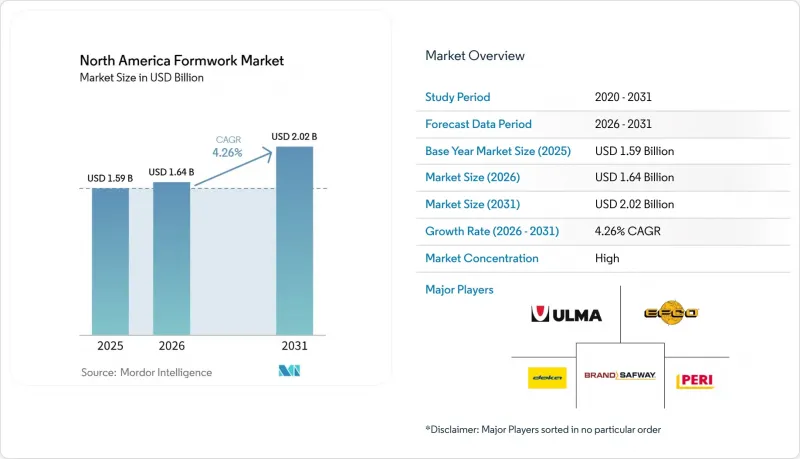
Mordor Intelligence에 의하면, 북미의 거푸집 시장 규모는 2025년에 15억 9,000만 달러로 평가되었고, 2026년 16억 4,000만 달러에서 2031년까지 20억 2,000만 달러에 이를 것으로 예측되며, 예측 기간(2026-2031년) CAGR은 4.26%를 나타낼 전망입니다.
본 보고서는 유형별(기존/전통형 및 모듈형/시스템형), 구성별(정형, 클라이밍형, 슬립폼형, 터널형), 비즈니스 모델별(판매 및 임대), 부문별(주택, 상업, 산업 및 물류, 인프라), 소재별(목재/합판 등), 지역별(미국, 캐나다, 멕시코)로 분류되어 있습니다. 시장 예측은 금액(달러) 기준으로 제시되어 있습니다.
북미의 거푸집 시장 동향 및 인사이트
교량, 대중교통, 유틸리티에 대한 인프라 지출 증가
예측 기간 동안 연방 정부의 인프라 지출은 북미의 거푸집 시장에 있어 가장 직접적인 수요 견인 요인으로 계속 작용할 것입니다. 2026년 4월까지 각 주 정부는 ‘인프라 투자 및 고용법(IIJA)’에 따라 고속도로 및 교량 배정 자금으로, 1만 9,000건의 교량 개보수를 포함한 12만 860건 이상의 프로젝트에 275억 달러를 지원하기로 결정했습니다. 이러한 추세는 연방 대중교통청이 2026 회계연도에 대중교통 자본 공사, 양호한 유지 관리 상태 확보를 위한 프로젝트, 그리고 버스 시설 개보수를 위해 206억 달러를 배정함으로써 더욱 가속화되고 있습니다. 또한, 연방도로청(FHWA)에 따르면, 고속도로 및 교량에 10억 달러를 투자할 때마다 미국 경제 전반에서 약 1만 3,000개의 일자리가 창출되고 있으며, 이를 통해 도급업체의 활동과 프로젝트 착수가 광범위하게 유지되고 있습니다. 2026년과 2027년에 걸쳐 이러한 교량, 도로, 대중교통 프로젝트의 실행이 더욱 진행됨에 따라, 북미 거푸집 시장은 임대 이용 증가와 엔지니어링 시스템의 교체 주기 정착으로 인해 계속해서 혜택을 볼 것으로 전망됩니다.
프로젝트 자본 지출(CAPEX) 절감을 위한 임대 및 재사용 모델로의 전환
임대는 초기 소유 위험을 경감하고 불규칙한 프로젝트 일정에도 유연하게 대응할 수 있기 때문에 북미 거푸집 시장의 대부분에서 선호되는 이용 모델이 되고 있습니다. 이러한 경향은 여러 프로젝트를 동시에 관리하며, 인건비, 자재비, 운전 자금 수요를 충당하기 위해 자본을 보존하고자 하는 중규모 건설업체에서 특히 두드러집니다. 또한 이 모델을 통해 건설사는 사내 유지보수 체계를 구축할 필요 없이 최신 시스템 설계 및 기술 지원을 활용할 수 있어, 보다 신속한 현장 투입이 가능해집니다. 임대용 장비의 소유권이 대형 업체로 집중됨에 따라, 가격 결정권과 서비스 차별화는 더욱 광범위한 보관소 네트워크와 강력한 현장 지원을 갖춘 업체로 점점 더 이동하고 있습니다. 따라서 MEVA, ULMA, PERI, Doka와 같은 공급업체들의 최근 동향은 북미 거푸집 시장에서 ‘서비스 주도형’ 전략을 시사하고 있습니다. 이 시장에서는 임대 체계의 충실도나 기술 지원이 하드웨어 자체만큼이나 중요하게 여겨지고 있습니다.
엔지니어링형 거푸집 시스템의 높은 초기 비용
엔지니어링형 시스템의 높은 초기 비용은 북미 거푸집 시장에서 도입을 가로막는 명백한 장벽이 되고 있습니다. 재사용 주기가 거듭될수록 비용 측면의 이점은 커지지만, 중소 건설업체나 단발성 프로젝트 사용자들은 일괄 구매를 정당화할 수 있을 만큼의 자금 계획 가시성이 부족한 경우가 많습니다. 이것이 건설업체가 소유에 따른 장기적인 경제성을 선호하는 경우에도 렌탈 시장이 여전히 견조한 이유 중 하나입니다. 관세와 관련된 압박도 비용 리스크를 가중시키고 있습니다. 건설 기업의 41%가 관세 대응 차원에서 가격을 인상했고, 39%는 예상되는 가격 인상에 앞서 구매 시기를 앞당겼기 때문입니다. 또한, 설계, 감독 요건, 지지 구조물의 규제 준수는 복잡한 공사에 추가적인 비용 요소를 더하며, 대규모 장비 보유 기업이나 자금력이 풍부한 사업자에게 소유권이 집중되는 요인이 되고 있습니다.
부문 분석
2025년 기준, 모듈러 및 시스템형 거푸집은 북미 거푸집 시장의 58%를 차지했으며, 2031년까지 연평균 성장률(CAGR) 5.4%를 나타낼 것으로 예측됩니다. 이로 인해 해당 시장에서 가장 규모가 크고 성장 속도가 가장 빠른 유형이 되었으며, 이는 북미의 거푸집 시장이 단기적인 선호도의 변화가 아닌 구조적인 전환기를 맞이하고 있음을 보여줍니다. 모듈러 시스템의 매력은 높은 재현성, 설치 시간 단축, 그리고 현장에서의 노동 집약적 작업에 대한 제어성 향상에 있습니다. 또한, 이러한 시스템은 유틸리티이나 기관 대상 공사에서 요구되는 안전 실적의 문서화 및 보다 표준화된 시공 방법에도 적합합니다. 2025년 1월 PERI USA가 출시한 ‘SKYFLEX’ 및 ‘LEVO’는 가벼운 취급성, 임페리얼 단위 기반 크기 설정, 그리고 미국 현장 조건에 맞추어 설계된 조립 방식을 채택하여 이러한 방향성을 반영하고 있습니다.
기존 및 전통적인 거푸집은 여전히 맞춤형 기초 공사, 반복성이 낮은 작업, 그리고 시공업체가 익숙한 목재 기반 공법에 의존하는 소규모 주택용 콘크리트 타설에 활용되고 있습니다. 이러한 상황에서는 모듈식 장비의 설치 비용이 시스템 도입으로 인한 생산성 향상을 상회할 가능성이 있습니다. 따라서 이 부문은 반복성이 낮고 설계 변형이 많은 상황에서 여전히 중요한 역할을 수행하고 있습니다. 그러나 숙련된 작업자, 설계 부서, 그리고 빌딩 정보 모델링(BIM) 대응 컴포넌트 라이브러리를 통해 더 많은 프로젝트 유형에서 모듈식 거푸집의 도입이 용이해짐에 따라, 북미 거푸집 시장은 목수의 수작업 공법에서 꾸준히 전환되고 있습니다. 이러한 전환기에 모듈식 및 시스템식 거푸집은 규모와 향후 성장 측면 모두에서 이미 주도적인 위치를 차지하고 있어, 유형별 시장 규모 측면에서 북미 거푸집 시장의 기반을 계속 형성하고 있습니다.
2025년, 정적 거푸집은 북미 거푸집 시장의 46%를 차지했으며, 슬래브, 벽, 기둥, 기초 공사 각 분야에서 선두를 유지했습니다. 상업시설, 주택, 토목 공사의 타설 대부분은 여전히 고도로 전문화된 이동식 시스템을 필요로 하지 않기 때문에 정적 거푸집은 기본 구성으로 자리 잡았습니다. 기하학적으로 단순한 조건에서는 정적 시스템이 익숙하고, 입수하기도 쉬우며, 작업자 배치도 용이합니다. 이 때문에 북미 거푸집 시장의 일상적인 시공 기반에서 여전히 중심적인 위치를 차지하고 있습니다. 한편, 클라이밍 거푸집은 2031년까지 연평균 성장률(CAGR) 4.56%를 나타낼 것으로 예측되어 가장 빠르게 성장하는 구성 요소가 되고 있습니다.
클라이밍 시스템이 성장하고 있는 배경에는 고층 빌딩의 코어 부분, 도시 지역의 밀집된 건설 현장, 그리고 크레인에 의존하지 않고도 공사 기간을 확보할 수 있는 현장이 있습니다. 도카(Doka)사가 2026년 미국에서 'FormDrive'를 탑재한 'Shear Wall Climber SCP'를 출시한 것은 유압식 승강, 원격 모니터링, 신속한 재배치를 통해 이 제품 카테고리가 얼마나 진화하고 있는지를 보여줍니다. 슬립폼은 연속 타설이 요구되는 사일로, 탱크, 공공시설에서 여전히 필수적입니다. 또한, 교통 기관 및 유틸리티 프로젝트가 효율적이고 반복성이 높은 내벽 공사에 대한 수요를 지속적으로 견인하고 있기 때문에 터널용 거푸집도 실질적인 역할을 수행하고 있습니다. 이 부문에서 북미 거푸집 시장 점유율은 여전히 정적 시스템이 주를 이루고 있지만, 고부가가치가 요구되는 도시 지역 용도에서는 성장의 주도권이 클라이밍 기술로 이동하고 있습니다.
기타 혜택 :
- 엑셀 형식 시장 예측(ME) 시트
- 3개월간의 애널리스트 지원
자주 묻는 질문
목차
제1장 서론
제2장 조사 방법
제3장 주요 요약
제4장 시장 구도
제5장 시장 규모 및 성장 예측
제6장 경쟁 구도
제7장 시장 기회 및 향후 전망
AJY 26.08.07According to Mordor Intelligence, the North America formwork market size was valued at USD 1.59 billion in 2025 and is estimated to grow from USD 1.64 billion in 2026 to reach USD 2.02 billion by 2031, at a CAGR of 4.26% during the forecast period (2026-2031).
This report is Segmented by Type (Conventional / Traditional and Modular / System Formwork), Configuration (Static, Climbing, Slipform, and Tunnel), Business Model (Sales and Rental), Sector (Residential, Commercial, Industrial & Logistics, and Infrastructure), Material (Timber / Plywood, and More), and Geography (United States, Canada, and Mexico). The Market Forecasts are Provided in Terms of Value (USD).
North America Formwork Market Trends and Insights
Rising Infrastructure Spend on Bridges, Transit, and Public Works
Federal infrastructure spending remains the most direct demand driver for the North America formwork market over the forecast period. Through April 2026, states had committed USD 275 billion in the Infrastructure Investment and Jobs Act (IIJA) highway and bridge formula funds across more than 120,860 projects, including 19,000 bridge upgrades. The same cycle is reinforced by the Federal Transit Administration's FY2026 apportionment of USD 20.6 billion for transit capital work, state-of-good-repair projects, and bus facility upgrades. The Federal Highway Administration also states that every USD 1 billion in highway and bridge investment supports around 13,000 jobs across the United States economy, which keeps contractor activity and project mobilization broad-based. As these bridge, roadway, and transit projects move deeper into execution during 2026 and 2027, the North America formwork market continues to benefit from stronger rental utilization and a firmer replacement cycle for engineered systems.
Shift Toward Rental and Reuse Models to Reduce Project CAPEX
Rental has become the preferred access model across a large part of the North America formwork market because it reduces upfront ownership risk and aligns better with uneven project schedules. This shift is strongest among mid-sized contractors that manage several projects at once and prefer to keep capital free for labor, materials, and working capital needs. The model also gives contractors access to newer system designs, engineering support, and faster mobilization without the need to build internal maintenance capacity. As rental fleet ownership becomes more concentrated among large operators, pricing power and service differentiation increasingly move toward players with deeper depot networks and stronger field support. That is why recent moves by suppliers such as MEVA, ULMA, PERI, and Doka point to a service-led playbook in the North America formwork market, where rental depth and engineering support matter as much as the hardware itself.
High Upfront Cost of Engineered Formwork Systems
The higher initial cost of engineered systems remains a clear brake on adoption in the North America formwork market. The cost case improves over many reuse cycles, but smaller contractors and single-project users often lack the capital visibility to justify an outright purchase. This is one reason rental remains strong even when contractors prefer the long-run economics of ownership. Tariff-related pressures also add cost risk, as 41% of construction firms raised prices in response to tariffs and 39% accelerated purchases ahead of expected increases. Engineering design, supervision requirements, and shoring compliance add another cost layer to complex jobs, concentrating ownership among larger fleets and well-capitalized operators.
Other drivers and restraints analyzed in the detailed report include:
- Adoption of Engineered and Modular Systems for Faster Cycle Times
- Demand for Safer Forming Solutions in High-Rise and Deep Foundation Work
- Skilled Labor Shortages for Safe Assembly and On-Site Engineering
For complete list of drivers and restraints, kindly check the Table Of Contents.
Segment Analysis
Modular / system formwork held 58% of the North America formwork market in 2025 and is projected to grow at a 5.4% CAGR through 2031. This made it both the largest and fastest-growing type, which shows that the North America formwork market is moving through a structural shift rather than a short-cycle preference change. The appeal of modular systems lies in repeatability, shorter setup time, and greater control over labor-intensive activities on active jobs. These systems also fit well with the demand for documented safety performance and more standardized execution on public and institutional work. PERI USA's SKYFLEX and LEVO launch in January 2025 reflected this direction through lightweight handling, imperial sizing, and assembly methods designed for the United States jobsite conditions.
Conventional / traditional formwork still serves custom foundations, low-repetition work, and smaller residential pours where contractors rely on familiar timber-based practices. In those settings, the setup cost of modular equipment can still outweigh the productivity gain from system adoption. The segment, therefore, remains relevant where repetition is low and design variation is high. Even so, the North America formwork market is steadily shifting away from carpenter-built methods as trained crews, engineering desks, and Building Information Modeling (BIM)-ready component libraries make modular adoption easier across more project types. Within this transition, modular and system formwork continues to anchor the North America formwork market size at the type level because it already leads on both scale and future growth.
Static formwork held 46% of the North America formwork market in 2025, which kept it in the lead across slabs, walls, columns, and foundation work. It remains the default configuration because a large share of commercial, residential, and civil pours still do not require highly specialized movement systems. In simple geometric conditions, static systems offer familiarity, broad availability, and easier crew deployment. This keeps them central to the day-to-day execution base of the North America formwork market. At the same time, climbing formwork is forecast to grow at a 4.56% CAGR through 2031, which makes it the fastest-growing configuration.
The growth case for climbing systems comes from high-rise cores, dense urban sites, and jobs where crane independence can protect schedules. Doka's 2026 United States launch of the Shear Wall Climber SCP with FormDrive showed how this product class is evolving through hydraulic lifting, remote monitoring, and faster repositioning. Slipform remains essential in silos, tanks, and utility structures where continuous casting is required. Tunnel formwork also plays a practical role, as transit and utility projects continue to drive demand for efficient, repetitive lining work. In this segment, the North America formwork market share is still anchored by static systems, while the growth premium is shifting toward climbing technology in higher-value urban applications.
Complete Report Scope:
- By Type
- Conventional and Traditional
- Modular and System Formwork
- By Configuration
- Static
- Climbing
- Slipform
- Tunnel
- By Business Model
- Sales
- Rental
- By Sector
- Residential
- Commercial
- Industrial and Logistics
- Infrastructure
- By Material
- Timber / Plywood
- Steel
- Aluminum
- Plastic / Fibreglass
- Others
- By Country
- United States
- Canada
- Mexico
List of Companies Covered in this Report:
- PERI Formwork Systems, Inc.
- Doka USA Ltd.
- BrandSafway
- EFCO Corp.
- ULMA Construction
- MEVA Formwork Systems, Inc.
- Acrow
- Alsina Group
- FORSA S.A.
- MFE Formwork Technology Sdn Bhd
- PASCHAL-Werk G. Maier GmbH
- Aluma Systems
- North American Formworx
- Forming America
- Wharton Hardware and Supply Company
- Trekker Group
- Alkus North America Inc.
- Patent Construction Systems, LLC
- Symons
- Hunnebeck
Additional Benefits:
- The market estimate (ME) sheet in Excel format
- 3 months of analyst support
TABLE OF CONTENTS
1 Introduction
- 1.1 Study Assumptions and Market Definition
- 1.2 Scope of the Study
2 Research Methodology
3 Executive Summary
4 Market Landscape
- 4.1 Market Overview
- 4.2 Market Drivers
- 4.2.1 Rising Infrastructure Spend on Bridges, Transit, and Public Works
- 4.2.2 Shift Toward Rental and Reuse Models to Reduce Project CAPEX
- 4.2.3 Adoption of Engineered and Modular Systems for Faster Cycle Times
- 4.2.4 Demand for Safer Forming Solutions in High-Rise and Deep Foundation Work
- 4.2.5 Digital Takeoff, BIM, and Prefabrication Integration
- 4.2.6 Reuse Economics Under Carbon and Waste Reporting Pressure
- 4.3 Market Restraints
- 4.3.1 High Upfront Cost of Engineered Formwork Systems
- 4.3.2 Skilled Labor Shortages for Safe Assembly and On-Site Engineering
- 4.3.3 Project Delays from Permitting, Weather, and Seasonal Construction Windows
- 4.3.4 Inventory Fragmentation Across Rental Fleets and Job Sites
- 4.4 Value and Supply-Chain Analysis
- 4.5 Regulatory Landscape
- 4.6 Technological Outlook
- 4.7 Cost Structure Analysis
- 4.8 Porter's Five Forces Analysis
- 4.8.1 Threat of New Entrants
- 4.8.2 Bargaining Power of Suppliers
- 4.8.3 Bargaining Power of Buyers
- 4.8.4 Threat of Substitutes
- 4.8.5 Intensity of Competitive Rivalry
- 4.9 Impact of Geopolitics
- 4.10 Raw Material Price Volatility
- 4.11 Supply Chain Disruptions and Longer Lead Times
- 4.12 Rising Energy and Logistics Costs
- 4.13 Infrastructure, Energy Security, and Defense-Led Demand
5 Market Size & Growth Forecasts (Value, USD)
- 5.1 By Type
- 5.1.1 Conventional and Traditional
- 5.1.2 Modular and System Formwork
- 5.2 By Configuration
- 5.2.1 Static
- 5.2.2 Climbing
- 5.2.3 Slipform
- 5.2.4 Tunnel
- 5.3 By Business Model
- 5.3.1 Sales
- 5.3.2 Rental
- 5.4 By Sector
- 5.4.1 Residential
- 5.4.2 Commercial
- 5.4.3 Industrial and Logistics
- 5.4.4 Infrastructure
- 5.5 By Material
- 5.5.1 Timber / Plywood
- 5.5.2 Steel
- 5.5.3 Aluminum
- 5.5.4 Plastic / Fibreglass
- 5.5.5 Others
- 5.6 By Country
- 5.6.1 United States
- 5.6.2 Canada
- 5.6.3 Mexico
6 Competitive Landscape
- 6.1 Market Concentration
- 6.2 Strategic Moves
- 6.3 Market Share Analysis
- 6.4 Company Profiles (includes Global Level Overview, Market Level Overview, Core Segments, Financials as available, Strategic Information, Market Rank/Share, Products and Services, Recent Developments)
- 6.4.1 PERI Formwork Systems, Inc.
- 6.4.2 Doka USA Ltd.
- 6.4.3 BrandSafway
- 6.4.4 EFCO Corp.
- 6.4.5 ULMA Construction
- 6.4.6 MEVA Formwork Systems, Inc.
- 6.4.7 Acrow
- 6.4.8 Alsina Group
- 6.4.9 FORSA S.A.
- 6.4.10 MFE Formwork Technology Sdn Bhd
- 6.4.11 PASCHAL-Werk G. Maier GmbH
- 6.4.12 Aluma Systems
- 6.4.13 North American Formworx
- 6.4.14 Forming America
- 6.4.15 Wharton Hardware and Supply Company
- 6.4.16 Trekker Group
- 6.4.17 Alkus North America Inc.
- 6.4.18 Patent Construction Systems, LLC
- 6.4.19 Symons
- 6.4.20 Hunnebeck
7 Market Opportunities & Future Outlook
- 7.1 White-Space and Unmet-Need Assessment


