

|
시장보고서
상품코드
2099170
중국의 거푸집 시장 : 점유율 분석, 업계 동향 및 통계, 성장 예측(2026-2031년)China Formwork - Market Share Analysis, Industry Trends & Statistics, Growth Forecasts (2026 - 2031) |
||||||
 Mordor Intelligence
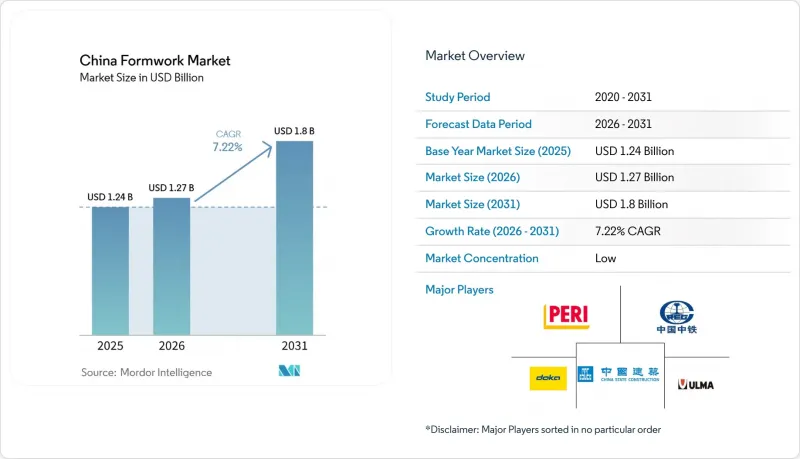
Mordor Intelligence에 의하면, 중국 거푸집 시장 규모는 2025년에 12억 4,000만 달러, 2026년에 12억 7,000만 달러가 되고, 2031년까지 18억 달러에 이를 것으로 예측되며, 2026년부터 2031년까지 CAGR 7.22%로 성장할 전망입니다.
본 보고서는 유형(기존/전통형 및 모듈형/시스템형 거푸집), 구성(정형, 클라이밍형, 슬립폼형, 터널형), 비즈니스 모델(판매 및 임대), 부문(주택, 상업, 산업·물류, 인프라), 소재(목재/합판 등), 지역(화북, 화동 등)별로 분류되어 있습니다. 시장 전망은 금액(달러) 기준으로 제시되어 있습니다.
중국 거푸집 시장 동향과 인사이트
인프라 현대화와 도시 재생이 거푸집 수요를 견인
건설 업계의 주요 원동력은 민간 주택 고층 빌딩에서 공공 자금에 의한 인프라 프로젝트로 이동하고 있으며, 이러한 변화로 인해 중국 거푸집 시장 수요 질이 향상되고 있습니다. 인프라 공사에서는 일반적으로 주택 프로젝트에서 흔히 볼 수 있는 합판을 많이 사용한 단순한 구조가 아니라, 교각용 클라이밍 리그, 타워 및 사일로용 슬립폼 솔루션, 지하철 및 고속도로 공사용 터널 거푸집 등 내구성이 더 높고 전문적인 시스템이 요구됩니다. 2026년부터 2030년까지의 제15차 5개년 계획에서는 총 연장 77만 킬로미터에 달하는 가스·상수도·배수·난방 파이프라인 개보수에 5조 위안(1조 달러), 또한 전력망 확장 및 성 간 송전 회랑에 5조 위안(1조 달러)을 투자하겠다고 약속하고 있어, 이에 따라 여러 프로젝트 부문에서 콘크리트를 많이 사용하는 공사가 계속해서 활발히 진행되고 있습니다. 인프라 투자는 2026년 1월-2월에 11.4%, 2026년 1분기에 8.9% 증가하여 전체 고정자산 투자 증가율을 상회하는 성장세를 보였습니다. 이에 따라 거푸집 공급업체에게는 민간 건축 부문이 제공할 수 있는 것보다 더 우수한 다년간의 전망이 제시되고 있습니다. 도시 재생은 추가적인 수요층을 형성하고 있습니다. 지하 파이프라인 개보수나 ‘스펀지 도시’ 사업에서는 공간 효율성과 예측 가능한 조립이 중요한 협소한 현장에서 재사용이 가능한 모듈식 시스템이 선호되기 때문입니다.
'이산화탄소 배출 정점 달성 및 탄소 중립' 목표가 재사용형 거푸집 시스템 도입을 가속화
탄소 정책은 프로젝트 수준의 자재 선정 방식을 변화시키고 있으며, 중국의 거푸집 시장을 초기 비용이 저렴하다는 이유만으로 선택되는 제품이 아닌 재사용 가능한 시스템으로 이끌고 있습니다. 2024년에는 프리팹 건축의 착공 면적이 6억 7,200만 제곱미터에 달했으며, 이는 전체 신축 건축 연면적의 30% 이상을 차지하여, 산업화된 건축 기법이 현재 건설 시스템에 얼마나 깊이 침투해 있는지를 여실히 보여주고 있습니다. 2026년 3월 1일에 시행된 업계 표준 T/CCIAT 0104-2025에서는 건설 단계의 배출량 산정 방법 및 거푸집 사용 주기의 공식적인 산정을 포함한 건축 공학 분야의 탄소 감축 절차가 규정되었습니다. 또한, 그린빌딩 평가 기준인 GB/T 50378-2024에서는 프리미엄 프로젝트의 적합 기준이 상향 조정되어, 3성급 인증을 취득하는 건물에서는 재사용 가능한 거푸집의 사용률을 최소 70%로 해야 하므로, 고급 개발 프로젝트에서 일회용 기존 합판의 역할은 축소되고 있습니다. 이러한 상황에서 알루미늄 시스템은 규제 준수 및 수명 주기 경제성 양면에서 우위를 점하고 있습니다. 그 이유는 목재에 비해 재사용 가능성이 훨씬 높고, 표준화된 프로젝트 실행 체계와의 적합성도 더 뛰어나기 때문입니다.
부동산 부문의 침체가 민간 주택 건설 활동을 억제
민간 주택은 여전히 중국 거푸집 시장에서 가장 큰 걸림돌로 작용하고 있습니다. 부동산 시장의 조정 국면이 2026년까지 지속되면서 신규 프로젝트 착공, 건설사의 현금 흐름, 그리고 기존 슬래브·벽 시스템에 대한 수요에 계속해서 큰 부담을 주고 있기 때문입니다. 가장 큰 압박은 목재와 합판을 많이 사용하는 분야에 미치고 있습니다. 이러한 자재들은 공공 인프라의 비중이 확대되기 전, 역사적으로 최대 수요원이었던 중층 및 대량 생산형 주택 건설에서 가장 많이 사용되었기 때문입니다. 이 점이 중요한 이유는 2025년에도 주택 건설이 여전히 부문별 점유율에서 가장 큰 비중을 차지했기 때문에 민간 건설 수요가 서서히 약화되는 것만으로도 많은 지역 공급업체의 설비 가동률, 재고 보충 결정, 그리고 장비 배치에 영향을 미치기 때문입니다. 정부가 지원하는 저렴한 주택, 도시 지역의 마을 재개발, 그리고 공공·민간 복합형 인프라가 그 영향을 부분적으로 상쇄하고 있습니다. 그렇지만 이러한 요소들은 과거 민간 주도의 고층 빌딩 개발이 창출했던 수요의 구성이나 시기를 완전히 대체할 수는 없습니다. 따라서 국비 지원 프로젝트와의 연계가 강한 기업은 도입 실적이나 고객 관계가 여전히 민간 자금에 의한 주택 건설에 집중되어 있는 사업자보다 더 탄탄한 입지를 확보하고 있습니다.
부문 분석
2025년 시점에서 모듈식/시스템형 거푸집은 중국 거푸집 시장 점유율의 55%를 차지하고 있으며, 이 부문은 2031년까지 연평균 성장률(CAGR) 8.60%로 가장 빠른 속도로 확대될 것으로 예측됩니다. 이러한 선두 위상은 조립 시간을 단축하고, 사이클의 예측 가능성을 높이며, 반복적인 구조 작업에서 수작업에 대한 의존도를 낮추는 엔지니어링 시스템에 대해 건설업체들이 명확한 호감을 보이고 있음을 반영합니다. 모듈식/시스템 거푸집의 매력이 높아지고 있는 배경에는 노동력 확보가 용이했던 시대나 주택 건설이 시장의 주도적인 속도를 결정하던 시절에 비해, 현재는 프로젝트 소유주나 원청업체가 생산성, 보다 엄격한 품질 관리, 그리고 재사용 효율을 더욱 중시하게 되었기 때문입니다. 중국 거푸집 시장에서 이러한 경향은 빈번하게 반복되는 인프라 공사, 대규모 복합 용도 프로젝트, 그리고 반복 도입의 이점을 누리기 쉬운 표준화된 공공 개발 프로젝트에서 모듈형 플랫폼에 구조적인 우위를 가져다주고 있습니다. 또한 단순한 패널이나 부속품뿐만 아니라, 설계 지원, 현장에서의 신속한 대응, 충실한 사후 서비스를 제공할 수 있는 공급업체의 경쟁력도 높이고 있습니다.
2025년에도 기존/전통적인 거푸집은 여전히 수요의 45%를 차지하고 있으며, 오랜 기간 쌓아온 도입 실적, 현지 조달 관행, 그리고 시공업체의 익숙함이 국내 광범위한 지역에서 여전히 큰 영향력을 행사하고 있음을 보여줍니다. 이 부문은 목재를 구하기 쉽고, 공사 범위가 단순하며, 소규모 프로젝트에서는 첨단 시스템에 필요한 자본 투자를 정당화하기 어려운 지방 도시나 농촌 지역의 프로젝트에서 여전히 가장 중요한 위치를 차지하고 있습니다. 그러나 그린 빌딩 요건, 건설 산업화 정책, 그리고 조립식 공법의 보급으로 인해 사양이 엄격한 프로젝트에서 일회용 솔루션이 실질적으로 채택될 여지가 점차 좁아지고 있어, 그 동향은 변화하고 있습니다. 2025년에 발표된 조사에 따르면, 조립식화율의 상승, 정책 시행 강화, 그리고 특허 활동의 활성화는 건설 분야의 에너지 효율 향상과 관련이 있으며, 이는 건축 실무의 추가적인 산업화를 향한 광범위한 움직임을 뒷받침합니다. 중국 거푸집 시장에 있어 이는 기존 수요가 갑작스럽게 붕괴되는 것이 아니라, 인력, 규정 준수 및 산업화 우선순위에 더 부합하는 재사용 가능한 시스템으로 프리미엄 용도에서 꾸준히 전환되어 가고 있음을 의미합니다.
2025년에는 클라이밍 시스템이 이 부문 시장 점유율의 30%를 차지하고, 2031년까지 연평균 8.54%라는 가장 높은 성장률을 기록하며 중국 거푸집 시장에서 더욱 전문적인 분야로 자리매김했습니다. 이러한 성장은 초고층 빌딩, 교각, 댐 코어 및 기타 수직 콘크리트 구조물과 관련이 있으며, 이러한 현장에서는 자동 클라이밍 시스템이 크레인에 대한 의존도를 낮추고, 어려운 현장에서도 생산성을 향상시키고 있습니다. 높이 200미터를 초과하는 구조물을 위한 공중 건축 거푸집 설비 전반에 대한 조사에 따르면, 일체형 경량 클라이밍 플랫폼은 초고층 건축 현장에서 뛰어난 공학적 성능과 더 높은 시공 생산성을 실현하는 것으로 밝혀졌습니다. 이는 수직 인프라나 고층 빌딩의 코어 부분이 단순한 패널 공급 이상의 것을 필요로 한다는 현실과 일치합니다. 이러한 구조물은 시스템 엔지니어링, 현장 안전 조정, 그리고 장기간에 걸친 프로젝트 주기 전반에 걸친 재현 가능한 리프팅 성능에 의존하고 있기 때문입니다. 또한 이러한 구조에서 다국적 전문 기업과 선진적인 국내 기업이 보다 표준화된 제품보다 강력한 가격 결정력을 갖는 이유도 설명할 수 있습니다.
정적 거푸집은 바닥, 벽, 기둥에 이르는 광범위한 기존 주거 및 상업용 콘크리트 공사에 대응합니다. 슬립폼이나 터널용 솔루션은 시장 점유율이 작지만, 공공 투자 프로그램 하에서 에너지 시설, 교통 회랑, 지하 공사가 확대됨에 따라 모두 그 중요성이 커지고 있습니다. 이러한 구성의 변화가 중요한 이유는 특히 기술적 설정이나 엔지니어링 감독이 필요한 경우, 특수 구성은 일반적으로 표준 정적 시스템보다 사이클당 임대료나 서비스 수익이 더 높기 때문입니다. 이러한 카테고리가 성장함에 따라 중국 거푸집 시장의 평균 수익 질은 향상되고 있습니다. 이는 총 판매량 증가세가 여전히 완만한 수준에 머물고 있음에도 불구하고 나타나는 현상입니다. 또한 이러한 변화로 인해 장비의 고도화와 기술 지원 체계의 중요성도 높아지고 있습니다. 왜냐하면 이러한 용도의 고객들은 하드웨어를 임대하는 것뿐만 아니라 확실한 시공도 요구하고 있기 때문입니다.
기타 혜택:
- 엑셀 형식 시장 예측(ME) 시트
- 3개월간의 애널리스트 지원
자주 묻는 질문
목차
제1장 서론
제2장 조사 방법
제3장 주요 요약
제4장 시장 구도
제5장 시장 규모와 성장 예측
제6장 경쟁 구도
제7장 시장 기회와 향후 전망
JHS 26.08.07According to Mordor Intelligence, the China formwork market size is projected to be USD 1.24 billion in 2025, USD 1.27 billion in 2026, and reach USD 1.8 billion by 2031, growing at a CAGR of 7.22% from 2026 to 2031.
This report is Segmented by Type (Conventional / Traditional and Modular / System Formwork), Configuration (Static, Climbing, Slipform, and Tunnel), Business Model (Sales and Rental), Sector (Residential, Commercial, Industrial & Logistics and Infrastructure), Material (Timber / Plywood, and More), and Region (North China, East China, and More). The Market Forecasts are Provided in Terms of Value (USD).
China Formwork Market Trends and Insights
Infrastructure Modernization and Urban Renewal Drive Formwork Demand
The main construction engine has shifted from private residential towers to publicly funded infrastructure, and that change has improved the quality of demand in the China formwork market. Infrastructure jobs usually require more durable, specialized systems, including climbing rigs for bridge piers, slipform solutions for towers and silos, and tunnel formwork for metro and highway works, rather than the simpler, plywood-heavy setups common in housing projects. The 15th Five-Year Plan for 2026 to 2030 commits CNY 5 trillion (USD 1 trillion) to gas, water, drainage, and heating pipeline upgrades across 770,000 kilometers, and another CNY 5 trillion (USD 1 trillion) to power grid expansion and inter-provincial transmission corridors, which keeps concrete-intensive work elevated across several project categories. Infrastructure investment increased 11.4% in January and February 2026 and 8.9% in Q1 2026, outpacing broader fixed-asset investment and providing formwork suppliers with better multi-year visibility than the private building segment could offer. Urban renewal adds another layer of demand because underground pipeline rehabilitation and sponge-city works favor modular systems that can be cycled repeatedly in tight sites where space efficiency and predictable assembly matter.
Dual Carbon Goals Accelerate Adoption of Reusable Formwork Systems
Carbon policy is changing project-level material choices, pushing the China formwork market toward reusable systems rather than products chosen only for low initial cost. Prefabricated building construction reached 672 million square meters under construction in 2024, representing more than 30% of all new building floor area, underscoring how deeply industrialized building methods are now embedded in the construction system. The industry standard T/CCIAT 0104-2025, which took effect on March 1, 2026, set out carbon-reduction procedures for building engineering, including calculation methods for construction-phase emissions and the formal accounting of formwork use cycles. The green building evaluation standard GB/T 50378-2024 also raises the compliance threshold for premium projects, as three-star-certified buildings must use reusable formwork at a rate of at least 70%, thereby narrowing the role of single-use conventional plywood in high-grade developments. Within that setting, aluminum systems benefit from both regulatory alignment and lifecycle economics, as their reuse potential is materially higher than timber's and their fit with standardized project delivery is stronger.
Property Sector Weakness Reduces Private Residential Construction Activity
Private housing remains the main drag on the China formwork market because the property adjustment has continued into 2026 and continues to weigh on new project starts, contractor cash flow, and demand for conventional slab and wall systems. The heaviest pressure falls on timber and plywood-heavy applications, since those materials are most exposed in mid-rise and volume residential construction, which had been the largest historical outlet before public infrastructure gained share. This matters because residential work still represented the largest sectoral share in 2025, so even a gradual weakening in private builds affects equipment utilization, replenishment decisions, and fleet deployment across many local suppliers. Government-supported affordable housing, urban village renovation, and dual-use public infrastructure provide partial offsets. Still, they do not fully replace the mix or timing of demand previously generated by private high-rise development. Companies with stronger links to state-funded projects are therefore in a more resilient position than operators whose installed base and customer relationships remain concentrated in privately financed residential construction.
Other drivers and restraints analyzed in the detailed report include:
- Labor Shortages and Productivity Needs Boost Engineered Formwork Usage
- Digital Formwork Planning and Asset Tracking Improve Project Efficiency
- High Upfront Cost of Aluminum and Steel Formwork Limits Adoption
For complete list of drivers and restraints, kindly check the Table Of Contents.
Segment Analysis
Modular / system formwork held 55% of the China formwork market share in 2025, and this segment is also projected to expand at the fastest pace with an 8.60% CAGR through 2031. That lead reflects a clear contractor preference for engineered systems that shorten assembly time, improve cycle predictability, and reduce dependence on manual labor in repetitive structural work. Modular / system formwork has become more attractive because project owners and main contractors now place greater value on productivity, tighter quality control, and reuse efficiency than they did when labor was easier to source, and residential builds set the dominant pace. In the China formwork market, this gives modular platforms a structural edge in high-cycle infrastructure work, large mixed-use projects, and standardized public developments where the benefits of repeat deployment are easier to capture. It also strengthens the case for suppliers that can provide design support, faster site turnaround, and stronger after-sales service, rather than only panels and accessories.
Conventional / traditional formwork still accounted for 45% of demand in 2025, indicating that the installed base, local sourcing habits, and contractor familiarity built over many years still carry weight across broad parts of the country. This segment remains most relevant in lower-tier cities and rural projects where timber is accessible, work scopes are simpler, and the capital required for advanced systems can be hard to justify at a small project scale. Even so, the direction of travel is changing because green building requirements, construction industrialization policies, and the wider use of prefabricated methods are gradually reducing the practical space for single-use solutions in better-specified projects. Research published in 2025 found that higher prefabrication rates, stronger policy implementation, and greater patent activity are linked to better energy-efficiency outcomes in construction, which supports the broader move toward more industrialized building practices. The implication for the China formwork market is not a sudden collapse in conventional demand, but a steady shift away from premium applications toward reusable systems that better align with labor, compliance, and industrialization priorities.
Climbing systems held 30% of the segment share in 2025 and posted the fastest growth rate of 8.54% through 2031, placing them at the more specialized end of the China formwork market. Their expansion is tied to supertall buildings, bridge piers, dam cores, and other vertical concrete structures where self-climbing systems reduce crane dependence and improve productivity on difficult sites. Research on overall aerial building formwork equipment for structures above 200 meters found that integrated lightweight climbing platforms deliver strong engineering performance and better construction productivity in extreme-height applications. This aligns with the reality that vertical infrastructure and high-rise cores require more than simple panel supply, as they depend on system engineering, site safety coordination, and repeatable lifting performance across long project cycles. It also explains why multinational specialists and advanced domestic players have stronger pricing power in this configuration than in more standardized products.
Static formwork supports a broad range of conventional residential and commercial concrete applications across floors, walls, and columns. Slipform and tunnel solutions occupy smaller positions, but both are gaining relevance as energy facilities, transport corridors, and underground works expand under public investment programs. This mix shift matters because specialized configurations usually deliver higher rental rates and service revenue per cycle than standard static systems, especially when they require technical setup and engineering supervision. As those categories grow, average revenue quality in the China formwork market improves, even as headline volume growth remains measured. That shift also raises the importance of fleet sophistication and technical support capability, because customers in these applications are buying reliable execution as much as they are renting hardware.
Complete Report Scope:
- By Type
- Conventional / Traditional
- Modular / System Formwork
- By Configuration
- Static
- Climbing
- Slipform
- Tunnel
- By Business Model
- Sales
- Rental
- By Sector
- Residential
- Commercial
- Industrial and Logistics
- Infrastructure
- By Material
- Timber / Plywood
- Steel
- Aluminium
- Plastic / Fiberglass
- Other Materials
- By Region
- North China
- East China
- South China
- Central China
- Southwest China
- Northwest China
- Northeast China
List of Companies Covered in this Report:
- Doka (China) Co., Ltd.
- PERI (China) Co., Ltd.
- ULMA Construction
- China State Construction Engineering Corporation
- China Railway Group Limited
- China Railway Construction Corporation
- Beijing Zulin Formwork and Scaffolding Co., Ltd.
- Zhejiang Jinggong Steel Building Group Co., Ltd.
- Zhejiang Zhongnan Construction Group Co., Ltd.
- Guangdong Jinma Aluminum Co., Ltd.
- Shandong Fangyuan Formwork Co., Ltd.
- Qingdao Alulite Formwork Scaffolding Co., Ltd.
- Shanghai Construction Group
- Zhejiang Yili Formwork Scaffolding Co., Ltd.
- Nanjing Dadi Engineering Technology Co., Ltd.
- Sichuan Huashi Group Co., Ltd.
- Guangzhou Kangtai Formwork and Scaffolding Co., Ltd.
- Suzhou TECON Construction Technology Co., Ltd.
- Zhongtian Construction Group Co., Ltd.
- Beijing Chengdong International Formwork Co., Ltd.
- Shenzhen Vanke New Materials Co., Ltd.
Additional Benefits:
- The market estimate (ME) sheet in Excel format
- 3 months of analyst support
TABLE OF CONTENTS
1 Introduction
- 1.1 Study Assumptions and Market Definition
- 1.2 Scope of the Study
2 Research Methodology
3 Executive Summary
4 Market Landscape
- 4.1 Market Overview
- 4.2 Market Drivers
- 4.2.1 Infrastructure Modernization and Urban Renewal Drive Formwork Demand
- 4.2.2 Dual Carbon Goals Accelerate Adoption of Reusable Formwork Systems
- 4.2.3 Labor Shortages and Productivity Needs Boost Engineered Formwork Usage
- 4.2.4 Digital Formwork Planning and Asset Tracking Improve Project Efficiency
- 4.2.5 Urbanization in Lower-Tier Cities Supports Replacement Construction Demand
- 4.2.6 Belt and Road Projects Expand Export Demand for Formwork Systems
- 4.3 Market Restraints
- 4.3.1 Property Sector Weakness Reduces Private Residential Construction Activity
- 4.3.2 High Upfront Cost of Aluminum and Steel Formwork Limits Adoption
- 4.3.3 Fragmented Rental Market Restricts Nationwide Standardization
- 4.3.4 Steel and Aluminum Price Volatility Pressures Manufacturer Margins
- 4.4 Value and Supply-Chain Analysis
- 4.5 Regulatory Landscape
- 4.6 Technological Outlook
- 4.7 Cost Structure Analysis
- 4.8 Porter's Five Forces
- 4.8.1 Threat of New Entrants
- 4.8.2 Bargaining Power of Suppliers
- 4.8.3 Bargaining Power of Buyers
- 4.8.4 Threat of Substitutes
- 4.8.5 Intensity of Competitive Rivalry
- 4.9 Impact of Geopolitics
- 4.9.1 Raw Material Price Volatility
- 4.9.2 Supply Chain Disruptions and Longer Lead Times
- 4.9.3 Rising Energy and Logistics Costs
- 4.9.4 Infrastructure, Energy Security, and Defense-Led Demand
5 Market Size and Growth Forecasts (Value, USD)
- 5.1 By Type
- 5.1.1 Conventional / Traditional
- 5.1.2 Modular / System Formwork
- 5.2 By Configuration
- 5.2.1 Static
- 5.2.2 Climbing
- 5.2.3 Slipform
- 5.2.4 Tunnel
- 5.3 By Business Model
- 5.3.1 Sales
- 5.3.2 Rental
- 5.4 By Sector
- 5.4.1 Residential
- 5.4.2 Commercial
- 5.4.3 Industrial and Logistics
- 5.4.4 Infrastructure
- 5.5 By Material
- 5.5.1 Timber / Plywood
- 5.5.2 Steel
- 5.5.3 Aluminium
- 5.5.4 Plastic / Fiberglass
- 5.5.5 Other Materials
- 5.6 By Region
- 5.6.1 North China
- 5.6.2 East China
- 5.6.3 South China
- 5.6.4 Central China
- 5.6.5 Southwest China
- 5.6.6 Northwest China
- 5.6.7 Northeast China
6 Competitive Landscape
- 6.1 Market Concentration
- 6.2 Strategic Moves
- 6.3 Market Share Analysis
- 6.4 Company Profiles (Includes Global Level Overview, Market Level Overview, Core Segments, Financials as Available, Strategic Information, Products & Services, and Recent Developments)
- 6.4.1 Doka (China) Co., Ltd.
- 6.4.2 PERI (China) Co., Ltd.
- 6.4.3 ULMA Construction
- 6.4.4 China State Construction Engineering Corporation
- 6.4.5 China Railway Group Limited
- 6.4.6 China Railway Construction Corporation
- 6.4.7 Beijing Zulin Formwork and Scaffolding Co., Ltd.
- 6.4.8 Zhejiang Jinggong Steel Building Group Co., Ltd.
- 6.4.9 Zhejiang Zhongnan Construction Group Co., Ltd.
- 6.4.10 Guangdong Jinma Aluminum Co., Ltd.
- 6.4.11 Shandong Fangyuan Formwork Co., Ltd.
- 6.4.12 Qingdao Alulite Formwork Scaffolding Co., Ltd.
- 6.4.13 Shanghai Construction Group
- 6.4.14 Zhejiang Yili Formwork Scaffolding Co., Ltd.
- 6.4.15 Nanjing Dadi Engineering Technology Co., Ltd.
- 6.4.16 Sichuan Huashi Group Co., Ltd.
- 6.4.17 Guangzhou Kangtai Formwork and Scaffolding Co., Ltd.
- 6.4.18 Suzhou TECON Construction Technology Co., Ltd.
- 6.4.19 Zhongtian Construction Group Co., Ltd.
- 6.4.20 Beijing Chengdong International Formwork Co., Ltd.
- 6.4.21 Shenzhen Vanke New Materials Co., Ltd.
7 Market Opportunities and Future Outlook
- 7.1 White-Space and Unmet-Need Assessment


