

|
시장보고서
상품코드
2099173
인도의 거푸집 시장 : 점유율 분석, 업계 동향 및 통계, 성장 예측(2026-2031년)India Formwork - Market Share Analysis, Industry Trends & Statistics, Growth Forecasts (2026 - 2031) |
||||||
 Mordor Intelligence
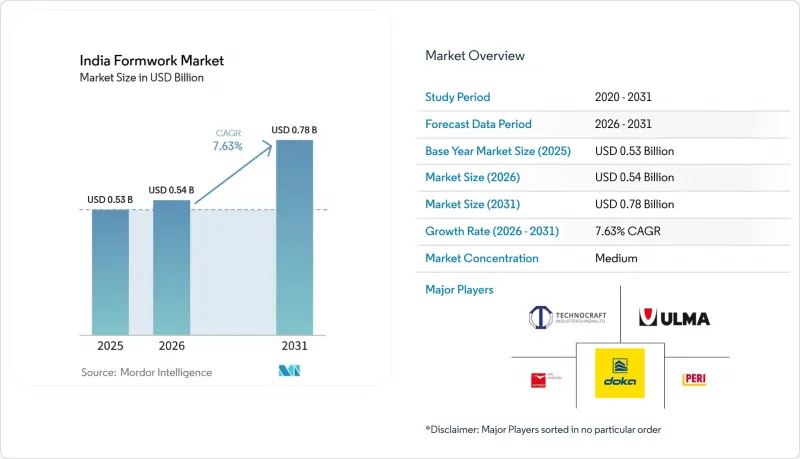
Mordor Intelligence에 의하면, 인도 거푸집 시장 규모는 2025년 5억 3,000만 달러에서 2026년에는 5억 4,000만 달러로 확대되어 2031년까지 7억 8,000만 달러에 이를 것으로 예상되고 있어 2026년부터 2031년까지 CAGR 7.63%로 성장할 전망입니다.
본 보고서는 유형별(기존/전통형 및 모듈형/시스템형 거푸집), 구성별(정형, 클라이밍형, 슬립폼형, 터널형), 비즈니스 모델별(판매 및 임대), 부문별(주택, 상업, 산업·물류, 인프라), 소재별(목재/합판 등), 도시별(뭄바이 대도시권 등)로 분류되어 있습니다. 시장 전망은 금액(달러) 기준으로 제시되어 있습니다.
인도 거푸집 시장 동향과 인사이트
주택 및 상업 건축 증가
대규모 콘크리트 공사에서는 다수의 타워 동에서 슬래브, 벽, 기둥의 시공 주기를 안정적으로 유지해야 하므로, 주택 인도 일정이 인도의 거푸집 시장을 활성화시키고 있습니다. 특히, 착공 및 인도 기한이 엄격하게 정해져 있는 프로젝트의 경우, 구조 공사의 상당한 지연을 허용할 수 없기 때문에 그 영향이 가장 두드러지게 나타나고 있습니다. 상업 건축도 인도의 거푸집 시장을 지탱하고 있습니다. 사무실이나 복합 용도 자산의 경우, 밀집된 도시 지역에서 규칙적인 바닥 슬래브, 코어 벽, 전환 구조물, 그리고 반복되는 콘크리트 타설 공정이 요구되기 때문입니다. 이에 따라 조립의 편차를 줄이고 타설 간격을 단축할 수 있는 시스템의 가치가 높아지고 있습니다. 그 결과, 고급 주택 및 상업 지역에 서비스를 제공하는 공급업체의 경우, 수요는 단순한 단위 수뿐만 아니라 일정 확실성, 반복 작업 빈도, 그리고 여러 현장에서 작업자의 생산성을 유지할 수 있는 능력에 따라 좌우되고 있습니다.
인프라 및 메가 프로젝트의 성장
대규모 인프라 계획에 힘입어 인도의 거푸집 시장 수요 기반은 주거용 타워 외에도 확대되고 있습니다. 통계·프로그램 이행부(MoSPI)의 집계에 따르면, 2026년 4월 기준으로 중앙정부 관할 인프라 프로젝트는 1,981건이며, 수정된 총 사업비는 42.78락 크롤(5,130억 달러)에 달할 전망입니다. 또한, 2026 회계연도 4분기에는 신규 프로젝트가 급증했으며, 추가된 사업비 중 도로 및 고속도로가 가장 큰 비중을 차지했습니다. 이 비중이 중요한 이유는 교량의 데크, 고가교, 교각 및 교통 구조물에는 일반적인 슬래브 공사보다 전문성이 높은 시스템이 필요하기 때문입니다. 2025년 7월 도카(Doka)사가 뭄바이-푸네 고속도로의 ‘미싱 링크’ 구간에서 수행한 시공 사례는 기술적으로 고도의 정밀성을 요하는 교량 공사에서 단순한 거푸집 공급이 아닌, 클라이밍 시스템, 대면적 거푸집, 그리고 설계에 기반한 지지 구조가 필요함을 보여주었습니다. 이에 따라 인프라는 인도 거푸집 시장에 있어 가장 명확한 장기적 수요의 축 중 하나로 계속 자리 잡고 있습니다.
엔지니어링 시스템의 높은 초기 설비 투자(CAPEX)
인도의 거푸집 시장은 여전히 큰 진입 장벽에 직면해 있습니다. 이는 엔지니어링 시스템이 기존의 합판 기반 방식보다 높은 초기 비용을 필요로 하기 때문입니다. 알루미늄 거푸집의 비용은 일반적으로 1제곱미터당 8,000-9,000루피(1제곱미터당 96-108달러)이며, 중소규모 개발업자나 도급업자가 자금 조달 없이 이 초기 투자를 감당하기는 어렵습니다. 이러한 비용 격차로 인해, 반복적인 공사에서 모듈식 시스템이 장기적으로 더 경제적일지라도 시장 규모의 대부분은 여전히 기존 공법에 의존하고 있습니다. 또한, 가설 구조물의 설계나 거푸집 해체에 관한 기준도 도입 부담을 가중시키고 있어, 시공업체는 이러한 시스템을 적절히 사용하기 위해 사내 전문 지식이나 유료 기술 지원 중 하나를 필요로 합니다. 자금 조달 및 리스 이용 환경이 더 폭넓게 개선되기 전까지는 시스템 도입 시 발생하는 고액의 초기 비용이 인도 거푸집 시장의 완전한 전환을 계속해서 저해할 것입니다.
부문 분석
2025년 기준, 모듈식/시스템형 거푸집은 인도 거푸집 시장의 55%를 차지하고 있으며, 2031년까지 연평균 8.20%의 성장률이 예상되어 시장 전체의 성장 속도를 상회할 전망입니다. 이러한 선도적 위상은 초기 비용 최소화보다 반복성, 품질 관리, 속도를 중시하는 프로젝트에서 현장 제작 목재 거푸집으로부터의 꾸준한 전환을 반영하고 있습니다. 조직화된 건설업체와 EPC(설계·조달·시공) 기업이 이러한 변화의 주요 원동력이 되고 있습니다. 이들은 대규모 프로젝트를 수행하고 있으며, 표준화를 통해 지연이나 현장 수정을 줄일 수 있기 때문입니다. 따라서 인도의 거푸집 시장에서는 여러 프로젝트 주기에 걸쳐 설계된 레이아웃, 기술 지원, 재사용 가능한 재고를 제공할 수 있는 공급업체에게 더 유리한 환경이 조성되고 있습니다. 반면, 건물 높이가 낮고 프로젝트의 반복성이 제한적인 지역에서는 기존/전통적인 거푸집이 여전히 중요한 역할을 하고 있습니다.
이러한 기존 시스템의 역할이 가장 강하게 남아 있는 곳은 티어 II 및 티어 III 지역입니다. 이 지역에서는 시공업체가 현지 목공 기술이나 저예산 현장 시공 기법에 의존하는 경우가 많기 때문입니다. 기존 기법은 특수 주문형 형상이나 소규모 구조물, 혹은 층수가 너무 적어 모듈식 시스템의 비용을 회수할 수 없는 프로젝트에는 여전히 적합하기 때문에 대체 과정은 완만하게 진행되고 있습니다. 하지만 고객의 기대가 골조 조기 완공 및 더 매끄러운 콘크리트 마감으로 이동함에 따라, 이 부문의 상대적 위상은 점차 약화되고 있습니다. 2025년에 실시된 동료 심사를 거친 비교 연구에 따르면, 반복성이 높은 고층 구조물에서 모듈식 시스템은 공사 기간을 45% 단축하고 프로젝트 총 비용을 최대 3% 절감하는 것으로 나타났습니다. 이는 대규모 주택 및 주거 건설 프로그램에서 실행 계획에 모듈식 시스템이 더 빈번하게 포함되게 된 이유를 설명하는 한 가지 요인이 되고 있습니다. 인도의 거푸집 시장에서 이는 자재에 대한 익숙함뿐만 아니라, 구조의 반복성, 규정 준수의 철저함, 그리고 재사용을 계획하는 시공사의 역량에 의해 현재 거푸집의 유형 구성이 형성되고 있음을 의미합니다.
2025년에는 클라이밍 거푸집이 34%라는 최대 점유율을 차지하고, 이는 인도 거푸집 시장에서 수직 방향 콘크리트 공사의 중요성이 부각되었음을 보여줍니다. 이러한 위상은 고층 주택의 코어 부분, 교량의 파이론, 댐 구조물, 그리고 연속적인 높이 상승을 위해 제어된 승강 및 안정적인 작업 플랫폼이 요구되는 기타 프로젝트와 밀접하게 관련되어 있습니다. 또한, 이러한 시스템은 크레인이 적절한 설치 장소에 의존하는 정도를 줄여주며, 타워 크레인 사용 시간이 치열하게 경쟁하는 상황에서 공정 효율화를 도모할 수 있습니다. 실제로 클라이밍형 솔루션은 장비, 엔지니어링, 현장 시공 방법의 지원을 단일 제안으로 통합하고 있어 시장의 프리미엄 부문에 위치하고 있습니다. 그 역할은 복합 용도 타워의 부상과 교통 인프라의 기술적 난이도가 높아짐에 따라 확대되고 있습니다.
터널 거푸집은 가장 빠르게 성장하는 부문으로, 2031년까지 연평균 성장률(CAGR)이 8.00%를 나타낼 것으로 예측되며, 이러한 성장은 반복적인 주택 프로젝트의 실행과 밀접한 관련이 있습니다. 정부의 ‘라이트하우스 프로젝트’ 시범 사업을 통해 터널 시스템은 틈새 공법에서 대규모 주택 프로그램의 주목할 만한 표준으로 자리매김하게 되었습니다. 조사에 따르면, 인도의 조건 하에서 터널 시스템은 450-500회의 재사용 주기를 달성할 수 있으며, 이는 동종 분석에서 일반적으로 보고되는 알루미늄 거푸집의 200-250회를 크게 상회합니다. 탱크, 사일로 및 유틸리티 구조물의 경우, 수요는 적지만 기술적 난이도가 높기 때문에 정적 거푸집이나 슬립폼 공법이 여전히 채택되고 있습니다. 그 결과, 인도 거푸집 시장의 구성 선택은 ‘하나의 시스템으로 모든 것을 해결한다’는 접근 방식이 아니라, 각 프로젝트의 콘크리트 형상 및 반복성 프로파일을 반영하는 방향으로 변화하고 있습니다.
기타 혜택:
- 엑셀 형식 시장 예측(ME) 시트
- 3개월간의 애널리스트 지원
자주 묻는 질문
목차
제1장 서론
제2장 조사 방법
제3장 주요 요약
제4장 시장 구도
제5장 시장 규모와 성장 예측
제6장 경쟁 구도
제7장 시장 기회와 향후 전망
JHS 26.08.07According to Mordor Intelligence, the India formwork market size is expected to increase from USD 0.53 billion in 2025 to USD 0.54 billion in 2026 and reach USD 0.78 billion by 2031, growing at a CAGR of 7.63% over 2026-2031.
This report is Segmented by Type (Conventional / Traditional and Modular / System Formwork), Configuration (Static, Climbing, Slipform, and Tunnel), Business Model (Sales and Rental), Sector (Residential, Commercial, Industrial & Logistics and Infrastructure), Material (Timber / Plywood, and More), and City (Mumbai Metropolitan Region, and More). The Market Forecasts are Provided in Terms of Value (USD).
India Formwork Market Trends and Insights
Rising Residential and Commercial Construction
Housing delivery schedules are keeping the India formwork market active because large concrete programs need steady slab, wall, and column cycles across many parallel towers. The strongest effect is visible where completion discipline is stricter, since projects with fixed launch and handover commitments cannot absorb long delays in structure work. Commercial construction also supports the India formwork market, as office and mixed-use assets require regular floor plates, core walls, transfer structures, and repeated concrete sequencing in dense urban areas. This raises the value of systems that can reduce assembly variability and shorten the gap between pours. The result is that suppliers serving premium residential and commercial corridors are seeing demand shaped less by unit count alone and more by schedule certainty, repetition intensity, and the ability to keep crews productive across multiple active fronts.
Growth in Infrastructure and Mega Projects
Large infrastructure programs are widening the demand base of the India formwork market beyond residential towers. The Ministry of Statistics and Programme Implementation (MoSPI) tracked 1,981 central sector infrastructure projects with a revised cost of INR 42.78 lakh crore (USD 513 billion), as of April 2026, and project additions in the final quarter of FY2026 rose sharply, with roads and highways taking the largest share of added project cost. That mix matters because bridge decks, viaducts, pylons, and transport structures need more specialized systems than ordinary slab work. Doka's July 2025 deployment on the Mumbai-Pune Expressway Missing Link showed how technically demanding bridge packages require climbing systems, large-area formwork, and engineered support rather than simple shuttering supply. This keeps infrastructure as one of the clearest long-run demand anchors for the India formwork market.
High Initial CAPEX for Engineered Systems
The India formwork market still faces a significant entry barrier because engineered systems require higher upfront costs than conventional plywood-based approaches. Aluminum formwork typically costs INR 8,000-9,000 per square meter (USD 96-108 per square meter), making it difficult for smaller developers and contractors to absorb the upfront investment without financing. This cost gap keeps a large share of the volume base tied to traditional methods, even when modular systems offer better long-term economics for repetitive jobs. Standards for falsework design and stripping practice also increase the implementation burden, as contractors need either internal competence or paid technical support to use these systems properly. Until financing or leasing access improves more broadly, high upfront system cost will continue to slow full conversion in the India formwork market.
Other drivers and restraints analyzed in the detailed report include:
- Faster Project Execution Accelerates Engineered Formwork Adoption
- Shift Toward Reusable and Modular Systems
- Price Sensitivity across the Construction Sector
For complete list of drivers and restraints, kindly check the Table Of Contents.
Segment Analysis
Modular / system formwork held 55% of the India formwork market in 2025 and is forecast to grow at 8.20% through 2031, keeping it ahead of the overall market pace. This lead reflects the steady move away from jobsite-fabricated timber on projects where repetition, quality control, and speed matter more than the lowest initial spend. Organized contractors and Engineering, Procurement, and Construction (EPC) firms have been the main force behind this shift because they work on larger packages where standardization reduces delays and site rework. The India formwork market has therefore become more favorable to suppliers that can provide engineered layouts, technical support, and reusable inventory across several project cycles. Conventional / traditional formwork remains relevant where building heights are lower and project repetition is limited.
That continued role for traditional systems is strongest in Tier II and Tier III locations, where contractors often rely on local carpentry skills and lower-budget site practices. The replacement process is gradual because conventional methods still suit custom shapes, smaller structures, and projects with too few floors to recover the cost of a modular system. Even so, the relative position of this segment is weakening as customer expectations move toward faster shell completion and cleaner concrete finish. A 2025 peer-reviewed comparison found that modular systems reduced project time by 45% and cut total project costs by up to 3% for repetitive high-rise structures, which helps explain why large residential and housing programs are writing modular systems into execution plans more often. In the India formwork market, this means the type mix is now being shaped by structural repetition, compliance discipline, and contractor ability to plan reuse rather than by material familiarity alone.
Climbing formwork held the largest 34% share in 2025, underscoring the importance of vertical concrete work in the India formwork market. Its position is tied to high-rise residential cores, bridge pylons, dam structures, and other projects where continuous height progression requires controlled lifting and stable working platforms. These systems also reduce the crane's dependence on suitable sites, improving sequencing when tower crane time is heavily contested. In practice, climbing solutions sit at the premium end of the market because they combine equipment, engineering, and site-method support in a single offer. Their role has expanded with the rise of mixed-use towers and the increasingly technical nature of transport infrastructure.
Tunnel formwork is the fastest-growing configuration, with an 8.00% CAGR through 2031, and its growth is linked to the execution of repetitive housing projects. Government Light House Project demonstrations helped move tunnel systems from a niche method into a visible reference point for larger housing programs. Studies indicate that tunnel systems can achieve 450-500 reuse cycles under Indian conditions, far exceeding the 200-250 reuse cycles typically reported for aluminum formwork in comparable analyses. Static and slipform configurations remain in place in tanks, silos, and utility structures, where demand is lower but the work is technically challenging. As a result, configuration choices in the India formwork market increasingly reflect the concrete geometry and repetition profile of each job rather than a one-system-fits-all approach.
Complete Report Scope:
- By Type
- Conventional / Traditional
- Modular / System Formwork
- By Configuration
- Static
- Climbing
- Slipform
- Tunnel
- By Business Model
- Sales
- Rental
- By Sector
- Residential
- Commercial
- Industrial & Logistics
- Infrastructure
- By Material
- Timber / Plywood
- Steel
- Aluminum
- Plastic / Fiberglass
- Others
- By City
- Mumbai Metropolitan Region
- Delhi NCR
- Pune
- Bengaluru
- Rest of India
List of Companies Covered in this Report:
- PERI India Pvt. Ltd.
- Doka India Private Limited
- ULMA Formwork and Scaffolding Systems India Pvt. Ltd.
- RMD Kwikform India Private Limited
- Technocraft Industries (India) Ltd.
- MEVA Formwork Systems India Pvt. Ltd.
- PASCHAL Formwork India Pvt. Ltd.
- Acrow India Ltd.
- JRS Scaffoldings Pvt. Ltd.
- Finomax Scaffolding (I) Pvt. Ltd.
- Expee Engineering Private Limited
- Iron Ridge Scaffolding and Engineering (I) Pvt. Ltd.
- AMCO Exports
- Hindustan Scaffolding and Formwork Pvt. Ltd.
- Safeway Scaffolding and Formwork Pvt. Ltd.
- Nova Formworks Pvt. Ltd.
- Bharat Scaffolding Co.
- Waco India Pvt. Ltd.
- PeeKay Structural Equipments Pvt. Ltd.
- Ananta Formwork Pvt. Ltd.
Additional Benefits:
- The market estimate (ME) sheet in Excel format
- 3 months of analyst support
TABLE OF CONTENTS
1 Introduction
- 1.1 Study Assumptions & Market Definition
- 1.2 Scope of the Study
2 Research Methodology
3 Executive Summary
4 Market Landscape
- 4.1 Market Overview
- 4.2 Market Drivers
- 4.2.1 Rising Residential and Commercial Construction
- 4.2.2 Growth In Infrastructure and Mega Projects
- 4.2.3 Faster Project Execution Accelerates Engineered Formwork Adoption
- 4.2.4 Shift Toward Reusable and Modular Systems
- 4.2.5 Increasing High-Rise Construction
- 4.2.6 Labor Productivity and Quality Requirements
- 4.3 Market Restraints
- 4.3.1 High Initial CAPEX for Engineered Systems
- 4.3.2 Price Sensitivity across the Construction Sector
- 4.3.3 Skilled Labor and Installation Dependency
- 4.3.4 Project-Based Demand Volatility
- 4.4 Value / Supply-Chain Analysis
- 4.5 Regulatory Landscape
- 4.6 Technological Outlook
- 4.7 Cost Structure Analysis
- 4.8 Porter's Five Forces
- 4.8.1 Threat of New Entrants
- 4.8.2 Bargaining Power of Suppliers
- 4.8.3 Bargaining Power of Buyers
- 4.8.4 Threat of Substitutes
- 4.8.5 Intensity of Competitive Rivalry
- 4.9 Impact of Geopolitics
- 4.9.1 Raw Material Price Volatility
- 4.9.2 Supply Chain Disruptions and Longer Lead Times
- 4.9.3 Rising Energy and Logistics Costs
- 4.9.4 Infrastructure, Energy Security, and Defense-Led Demand
5 Market Size & Growth Forecasts (Value, USD)
- 5.1 By Type
- 5.1.1 Conventional / Traditional
- 5.1.2 Modular / System Formwork
- 5.2 By Configuration
- 5.2.1 Static
- 5.2.2 Climbing
- 5.2.3 Slipform
- 5.2.4 Tunnel
- 5.3 By Business Model
- 5.3.1 Sales
- 5.3.2 Rental
- 5.4 By Sector
- 5.4.1 Residential
- 5.4.2 Commercial
- 5.4.3 Industrial & Logistics
- 5.4.4 Infrastructure
- 5.5 By Material
- 5.5.1 Timber / Plywood
- 5.5.2 Steel
- 5.5.3 Aluminum
- 5.5.4 Plastic / Fiberglass
- 5.5.5 Others
- 5.6 By City
- 5.6.1 Mumbai Metropolitan Region
- 5.6.2 Delhi NCR
- 5.6.3 Pune
- 5.6.4 Bengaluru
- 5.6.5 Rest of India
6 Competitive Landscape
- 6.1 Market Concentration
- 6.2 Strategic Moves
- 6.3 Market Share Analysis
- 6.4 Company Profiles (Includes Global Level Overview, Market Level Overview, Core Segments, Financials as Available, Strategic Information, Products & Services, and Recent Developments)
- 6.4.1 PERI India Pvt. Ltd.
- 6.4.2 Doka India Private Limited
- 6.4.3 ULMA Formwork and Scaffolding Systems India Pvt. Ltd.
- 6.4.4 RMD Kwikform India Private Limited
- 6.4.5 Technocraft Industries (India) Ltd.
- 6.4.6 MEVA Formwork Systems India Pvt. Ltd.
- 6.4.7 PASCHAL Formwork India Pvt. Ltd.
- 6.4.8 Acrow India Ltd.
- 6.4.9 JRS Scaffoldings Pvt. Ltd.
- 6.4.10 Finomax Scaffolding (I) Pvt. Ltd.
- 6.4.11 Expee Engineering Private Limited
- 6.4.12 Iron Ridge Scaffolding and Engineering (I) Pvt. Ltd.
- 6.4.13 AMCO Exports
- 6.4.14 Hindustan Scaffolding and Formwork Pvt. Ltd.
- 6.4.15 Safeway Scaffolding and Formwork Pvt. Ltd.
- 6.4.16 Nova Formworks Pvt. Ltd.
- 6.4.17 Bharat Scaffolding Co.
- 6.4.18 Waco India Pvt. Ltd.
- 6.4.19 PeeKay Structural Equipments Pvt. Ltd.
- 6.4.20 Ananta Formwork Pvt. Ltd.
7 Market Opportunities & Future Outlook
- 7.1 White-Space & Unmet-Need Assessment


