

|
시장보고서
상품코드
2099166
독일의 거푸집 시장 : 점유율 분석, 업계 동향 및 통계, 성장 예측(2026-2031년)Germany Formwork - Market Share Analysis, Industry Trends & Statistics, Growth Forecasts (2026 - 2031) |
||||||
 Mordor Intelligence
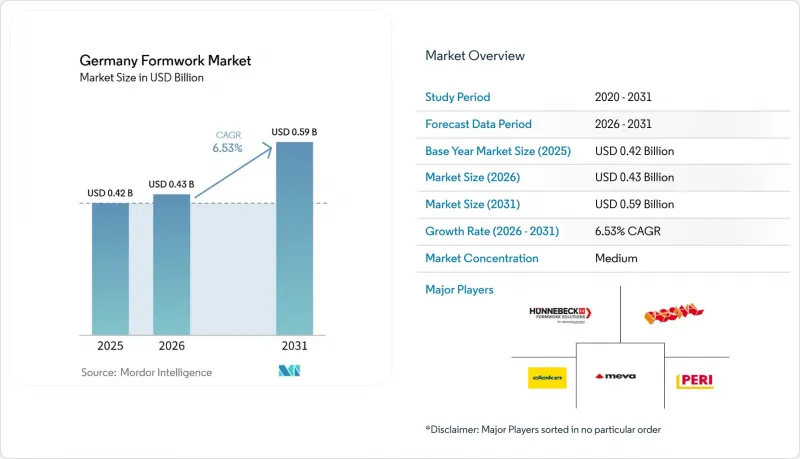
Mordor Intelligence에 의하면, 독일 거푸집 시장 규모는 2025년에 4억 2,000만 달러, 2026년에 4억 3,000만 달러가 되고, 2031년까지 5억 9,000만 달러에 이를 것으로 예측되며, 2026년부터 2031년까지 CAGR 6.53%로 성장할 전망입니다.
본 보고서는 유형(기존/전통형 및 모듈형/시스템형 거푸집), 구성(정형, 클라이밍형, 슬립폼형, 터널형), 비즈니스 모델(판매 및 임대), 부문(주택, 상업, 산업·물류, 인프라), 소재(목재/합판 등), 도시(베를린, 뮌헨, 프랑크푸르트, 라이프치히 등)별로 분류되어 있습니다. 시장 전망은 금액(달러) 기준으로 제시되어 있습니다.
독일 거푸집 시장 동향과 인사이트
공공 인프라 경기 부양책 및 철도 현대화
공공 인프라 투자는 독일 거푸집 시장에 있어 가장 강력한 중기적 수요 견인 요인으로 작용하고 있습니다. 이는 철도, 도로, 수로 프로젝트가 장기간에 걸친 콘크리트 공사를 수반하기 때문입니다. 독일은 2029년까지 철도 인프라에 1,070억 유로(1,166억 달러)를 투자하기로 결정했으며, 철도, 도로, 수로를 아우르는 인프라 지출 총액은 1,660억 유로(1,809억 달러)에 달했습니다. 독일 철도(Deutsche Bahn)의 2026년 투자 계획에는 철도망의 유지 관리 및 현대화에 230억 유로(253억 달러) 이상이 배정되어 있으며, 이를 통해 교각, 옹벽, 역 구내 공사, 터널 입구 부분에 대한 지속적인 수요가 뒷받침되고 있습니다. 이러한 용도에서는 일반적으로 현장에서의 임시방편적인 해결책보다 내구성이 뛰어난 강철 시스템, 클라이밍식 구조, 그리고 가동률이 높은 임대 장비가 선호되므로, 이는 독일 거푸집 시장에 중요한 의미를 지닙니다. DB InfraGO의 회랑 프로그램은 현재 2036년까지 시행되고 있으며, 공급업체에 향후 수요에 대한 이례적인 가시성을 제공할 뿐만 아니라, 장비 용량 및 서비스 네트워크에 대한 투자를 촉진하고 있습니다. 2026년 5월 독일 연방의회가 추가 철도 프로젝트를 승인함에 따라 해당 파이프라인은 더욱 확대되었으며, 독일 거푸집 시장의 중기 전망이 강화되었습니다.
주택 부족과 아파트 건설의 회복
독일의 주택 부족으로 인해 전체 건설 사이클이 불안정한 상황에서도, 공동주택 건설은 독일 거푸집 시장에 있어 중요한 위치를 계속 차지하고 있습니다. 수요는 주택 수요가 가장 절실한 주요 도시에 집중되어 있으며, 그곳에서는 대규모 주택 단지에서 슬래브, 벽, 코어 부분의 콘크리트 공사가 반복적으로 필요합니다. 허가를 받았거나 일부 공사가 진행 중인 다수의 주택 프로젝트는 거푸집 공급업체에게 초기 단계의 토지 계획보다 이미 진척된, 명확한 수주 건의 풀을 제공합니다. 또한, 사회주택에 대한 공공 지원도 수요의 하한선을 지탱하는 역할을 하고 있어, 이를 통해 독일 거푸집 시장은 민간 부문 전반의 경기 둔화로부터 어느 정도 보호받고 있습니다. 실제로 모듈식 벽 시스템, 슬래브 시스템, 재사용 가능한 패널은 가장 먼저 착공될 가능성이 높은 프로젝트 유형과 계속해서 잘 부합하고 있습니다. 따라서 인프라 및 주요 도시 프로젝트의 성장이 여전히 견조하더라도, 주택 수요는 독일 거푸집 시장에 있어 중요한 위치를 계속 차지하고 있습니다.
설계형 거푸집 시스템의 높은 초기 비용
엔지니어링형 시스템의 높은 구매 비용은 여전히 독일 거푸집 시장 전체, 특히 중소규모 건설업체의 도입 확대를 제한하고 있습니다. 많은 중소 건설업체는 시스템 거푸집이 가져다주는 노동력 및 품질 측면의 이점을 인식하고 있습니다. 그러나 프로젝트에서 재사용 기간이 짧은 경우, 경제적 이점은 희미해집니다. 이는 공사 규모가 비교적 작고 프로젝트의 반복 빈도가 낮은 소규모 주택 건설이나 지역 리노베이션 공사에서 특히 두드러집니다. 자금 조달 조건은 최악의 시기보다 개선되었지만, 많은 건설업체는 여전히 자사 소유 설비로 인한 대차대조표상의 큰 부담을 피하는 것을 선호합니다. 이것이 바로 렌탈에 운송, 계획, 반납 처리 비용이 추가로 발생함에도 불구하고, 렌탈이 독일 거푸집 시장에서 계속해서 확고한 입지를 유지하고 있는 이유 중 하나입니다. 그 결과, 선진적인 시스템이 입지를 다져가고 있는 반면, 그 도입은 여전히 렌탈 네트워크에 대한 접근성이나 프로젝트 규모에 크게 좌우되는 시장입니다.
부문 분석
2025년, 모듈식/시스템 거푸집은 독일 거푸집 시장 점유율의 57%를 차지했으며, 이 부문은 2031년까지 연평균 성장률(CAGR) 6.90%로 확대될 것으로 예측됩니다. 이러한 상황은 독일 거푸집 시장에서 엔지니어링 솔루션이 더 이상 최대 규모의 프로젝트에만 국한되지 않음을 보여줍니다. 건설업체들은 사이클 시간 단축, 치수 관리의 일관성 향상, 그리고 1회 타설당 노동력 절감을 가능하게 하기 위해 재사용 가능한 시스템을 점점 더 선호하고 있습니다. 이러한 경향은 재현성과 공정의 확실성이 중요한 주택 단지 및 대규모 인프라 공사 모두에서 관찰됩니다. 2025년 1월 PERI가 DataB와 합작 투자를 통해 DataForm.Work GmbH를 설립한 것은 주요 공급업체들이 디지털 계획과 제조 속도의 연계를 강화하고 있음을 보여주는 명확한 사례입니다.
이러한 움직임이 중요한 이유는 모델에서 생산으로의 전환이 가속화됨에 따라, 과거에는 수작업 방식이 선호되던 맞춤형 콘크리트 타설 분야에서도 설계된 거푸집의 도입이 용이해지기 때문입니다. 독일 거푸집 시장에서 이로 인해 비정형 용도에서 기존 목재 솔루션이 가졌던 실용적 우위가 약화되고 있습니다. 기존 거푸집은 비표준 타설, 재사용 횟수가 적은 프로젝트, 그리고 현장 조달 자재가 여전히 경제적인 지방 현장에서는 계속해서 활용되고 있습니다. 또한, 운송 거리가 긴 경우나 반복 사용이 적은 경우 등 시스템 전체 도입이 경제적으로 불리해지는 현장에서도 여전히 그 존재 의의는 사라지지 않았습니다. 그렇지만 독일 거푸집 시장의 전반적인 방향성은 명확합니다. 공사의 복잡화, 인력 확보의 어려움 가중, 그리고 품질에 대한 기대감의 고조로 인해 수요가 모듈식 및 시스템식 형태로 지속적으로 전환되고 있기 때문입니다.
클라이밍 시스템은 독일 거푸집 시장에서 가장 빠르게 성장하고 있는 부문으로, 2026년부터 2031년까지 연평균 성장률(CAGR) 7.80%가 예상됩니다. 이러한 성장은 고층 주택, 에너지 관련 구조물, 옹벽, 그리고 수직 방향으로 반복적인 토목 공사 등 현재 시장을 주도하고 있는 공사 유형을 반영하고 있습니다. 이러한 용도에서는 모든 단계에서 대형 크레인에 의존하지 않고도 안전하고 효율적으로 상향 이동할 수 있는 시스템이 요구됩니다. 훈네베크(Hunnebeck)사의 ‘SCF 60’ 자동 승강 시스템은 크레인 조작에 더해 유압식 자동 승강 방식을 채택하고, 표준 부품을 통한 유연한 플랫폼 확장을 지원함으로써 이러한 요구 사항을 충족합니다. 독일 거푸집 시장에서 이 시스템은 인력 부족 완화에 기여하며, 수직 방향의 진척이 중요한 프로젝트의 공정 관리를 지원합니다.
2025년에도 창고, 물류, 주택 건설 각 분야에서 슬래브 및 저층 벽 공사가 여전히 널리 이루어지고 있기 때문에 정적 거푸집이 41%로 가장 큰 점유율을 차지하고 있습니다. 이로 인해 독일 거푸집 시장에는 여전히 기존 방식의 수평 용도에 의존하는 광범위한 도입 기반이 형성되어 있습니다. 슬립폼 및 터널 시스템은 연속적이거나 고도로 반복적인 구조 공사에 적합하기 때문에 철도 및 토목 공학 분야에서 중요한 역할을 계속하고 있습니다. DB InfraGO의 회랑 계획은 주요 노선에서 이미 본격적인 건설 단계에 접어들었으며, 이것이 터널 관련 및 옹벽용 거푸집에 대한 현재 수요를 뒷받침하고 있습니다. 그 결과, 정적 시스템이 여전히 시장 규모의 기반을 형성하는 한편, 클라이밍 거푸집 솔루션이 독일 거푸집 시장의 성장을 주도하는 구조를 이루고 있습니다.
기타 혜택:
- 엑셀 형식 시장 예측(ME) 시트
- 3개월간의 애널리스트 지원
자주 묻는 질문
목차
제1장 서론
제2장 조사 방법
제3장 주요 요약
제4장 시장 구도
제5장 시장 규모와 성장 예측
제6장 경쟁 구도
제7장 시장 기회와 향후 전망
JHS 26.08.07According to Mordor Intelligence, the Germany formwork market size is projected to be USD 0.42 billion in 2025, USD 0.43 billion in 2026, and reach USD 0.59 billion by 2031, growing at a CAGR of 6.53% from 2026 to 2031.
This report is Segmented by Type (Conventional / Traditional and Modular / System Formwork), Configuration (Static, Climbing, Slipform, and Tunnel), Business Model (Sales and Rental), Sector (Residential, Commercial, Industrial & Logistics and Infrastructure), Material (Timber / Plywood, and More), and City (Berlin, Munich, Frankfurt, Leipzig, and More). The Market Forecasts are Provided in Terms of Value (USD).
Germany Formwork Market Trends and Insights
Public Infrastructure Stimulus and Rail Modernization
Public infrastructure investment is the strongest medium-term demand driver for the Germany formwork market because rail, road, and water projects create long-duration concrete packages. Germany committed EUR 107 billion (USD 116.6 billion) for rail infrastructure through 2029, and total infrastructure spending across rail, roads, and waterways reached EUR 166 billion (USD 180.9 billion). Deutsche Bahn's 2026 investment plan exceeded EUR 23 billion (USD 25.3 billion) for rail network maintenance and modernization, which supports ongoing demand for bridge abutments, retaining walls, station works, and tunnel portals. This matters for the Germany formwork market because those applications usually favor durable steel systems, climbing configurations, and high-utilization rental fleets rather than ad hoc site-built solutions. DB InfraGO's corridor program now runs through 2036, providing suppliers with unusual visibility into future demand and supporting investment in fleet capacity and service networks. The Bundestag's approval of additional railway projects in May 2026 extends that pipeline further and strengthens the medium-term outlook for the Germany formwork market.
Housing Shortage and Multi-Family Construction Recovery
Germany's housing shortage keeps multi-family building relevant for the Germany formwork market even when the wider construction cycle remains uneven. Demand is concentrated in major cities where housing pressure is strongest and where larger residential blocks require repeated slab, wall, and core concrete work. The large stock of permitted and partially advanced housing projects provides formwork suppliers with a visible pool of work that is already more advanced than early-stage land planning. Public support for social housing also adds a demand floor that helps protect the Germany formwork market from a fully private-sector slowdown. The practical effect is that modular wall systems, slab systems, and reusable panels remain well aligned with the kinds of projects that are most likely to move first. This keeps residential demand important for the Germany formwork market even if growth remains stronger in infrastructure and major urban projects.
High Upfront Cost of Engineered Formwork Systems
The high purchase cost of engineered systems still limits faster adoption across the Germany formwork market, especially among smaller contractors. Many Small- and Medium-Sized Enterprise builders can see the labor and quality benefits of system formwork. Still, the financial case is less attractive when a project offers only a short reuse window. This is particularly relevant in small residential and local renovation work where job sizes are modest, and project repetition is limited. Financing conditions have improved from their worst levels, yet many contractors still prefer to avoid large balance-sheet commitments for owned fleets. That is one reason rental continues to hold a strong position in the Germany formwork market, even though rental also adds transport, planning, and return-handling costs. The result is a market where advanced systems gain ground, but adoption still depends heavily on access to rental networks and project scale.
Other drivers and restraints analyzed in the detailed report include:
- Shift Toward Reusable and Low-Waste Formwork Systems
- Labor Scarcity Accelerating Productivity-Focused Formwork Adoption
- Weak Residential New-Build Starts in Smaller Municipalities
For complete list of drivers and restraints, kindly check the Table Of Contents.
Segment Analysis
Modular / system formwork held 57% of Germany formwork market share in 2025, and the segment is projected to expand at a 6.90% CAGR through 2031. That position shows that engineered solutions are no longer limited to only the largest projects in the Germany formwork market. Contractors increasingly prefer reusable systems because they support faster cycles, more consistent dimensional control, and lower labor input per pour. The same preference is visible in both residential blocks and major infrastructure jobs where repeatability and schedule certainty matter. PERI's January 2025 joint venture with DataB, which established DataForm.Work GmbH, is a clear example of how leading suppliers are strengthening the link between digital planning and fabrication speed..
That move matters because faster model-to-production conversion makes engineered formwork easier to deploy on bespoke pours that once favored more manual methods. In the Germany formwork market, this reduces the practical advantage that conventional timber solutions held in irregular applications. Conventional formwork still serves non-standard pours, short reuse projects, and rural jobs where site-sourced materials remain economical. It also remains relevant where transport distances or low repetition weaken the economics of full system deployment. Even so, the broader direction of the Germany formwork market remains clear because higher complexity, tighter labor availability, and stronger quality expectations continue to shift demand toward modular and system formats.
Climbing systems are the fastest-growing configuration in the Germany formwork market, with a projected 7.80% CAGR from 2026 to 2031. Their growth reflects the types of work now driving the market, including high-rise housing, energy structures, retaining walls, and vertically repetitive civil works. These applications reward systems that can move upward safely and efficiently without relying on heavy crane usage at every stage. Hunnebeck's SCF 60 self-climbing system fits that requirement because it uses hydraulic self-climbing in addition to crane operation and supports flexible platform expansion with standard components. For the Germany formwork market, that lowers labor pressure and supports schedule control on projects where vertical progress is critical.
Static formwork still held the largest share at 41% in 2025, as slab and low-rise wall work remain widespread across warehousing, logistics, and residential construction. This gives the Germany formwork market a broad installed base that still depends on more conventional horizontal applications. Slipform and tunnel systems remain important in rail and civil engineering because they suit continuous or highly repetitive structural work. DB InfraGO's corridor program has already entered an intensive construction phase on key routes, which supports current demand for tunnel-related and retaining-wall formwork applications. The result is a configuration mix where static systems still anchor volume, while climbing solutions define the growth edge of the Germany formwork market.
Complete Report Scope:
- By Type
- Conventional / Traditional
- Modular / System Formwork
- By Configuration
- Static
- Climbing
- Slipform
- Tunnel
- By Business Model
- Sales
- Rental
- By Sector
- Residential
- Commercial
- Industrial and Logistics
- Infrastructure
- By Material
- Timber / Plywood
- Steel
- Aluminum
- Plastic / Fiberglass
- Other Material Types
- By City
- Berlin
- Munich
- Frankfurt
- Leipzig
- Rest of Germany
List of Companies Covered in this Report:
- PERI GmbH
- Doka GmbH
- MEVA Schalungssysteme GmbH
- PASCHAL-Werk G. Maier GmbH
- Hunnebeck GmbH
- ULMA Construction
- Alsina Formwork
- BrandSafway
- Altrad RMD Kwikform
- EFCO Corp.
- NOE-Schaltechnik GmbH
- MAX FRANK GmbH and Co. KG
- RINGER GmbH
- form-on GmbH
- KERN Schalungsservice GmbH
- Ischebeck GmbH
- Geoplast S.p.A.
- Condor Spezialbau GmbH
- Faresin Formwork S.p.A.
- Mevaform GmbH
Additional Benefits:
- The market estimate (ME) sheet in Excel format
- 3 months of analyst support
TABLE OF CONTENTS
1 Introduction
- 1.1 Study Assumptions and Market Definition
- 1.2 Scope of the Study
2 Research Methodology
3 Executive Summary
4 Market Landscape
- 4.1 Market Overview
- 4.2 Market Drivers
- 4.2.1 Public Infrastructure Stimulus and Rail Modernization
- 4.2.2 Housing Shortage and Multi-Family Construction Recovery
- 4.2.3 Shift Toward Reusable and Low-Waste Formwork Systems
- 4.2.4 Labor Scarcity Accelerating Productivity-Focused Formwork Adoption
- 4.2.5 Renovation, Retrofit, and Energy-Efficiency Works Expanding Formwork Demand
- 4.2.6 Growth of Complex Urban Projects Requiring Climbing and Slipform Solutions
- 4.3 Market Restraints
- 4.3.1 High Upfront Cost of Engineered Formwork Systems
- 4.3.2 Weak Residential New-Build Starts in Smaller Municipalities
- 4.3.3 Project Delays From Permitting, Financing, and Procurement Complexity
- 4.3.4 High Logistics Burden and Return-Handling Costs for Rental Equipment
- 4.4 Value and Supply-Chain Analysis
- 4.5 Regulatory Landscape
- 4.6 Technological Outlook
- 4.7 Cost Structure Analysis
- 4.8 Porter's Five Forces
- 4.8.1 Threat of New Entrants
- 4.8.2 Bargaining Power of Suppliers
- 4.8.3 Bargaining Power of Buyers
- 4.8.4 Threat of Substitutes
- 4.8.5 Intensity of Competitive Rivalry
- 4.9 Impact of Geopolitics
- 4.9.1 Raw Material Price Volatility
- 4.9.2 Supply Chain Disruptions and Longer Lead Times
- 4.9.3 Rising Energy and Logistics Costs
- 4.9.4 Infrastructure, Energy Security, and Defense-Led Demand
5 Market Size and Growth Forecasts (Value, USD)
- 5.1 By Type
- 5.1.1 Conventional / Traditional
- 5.1.2 Modular / System Formwork
- 5.2 By Configuration
- 5.2.1 Static
- 5.2.2 Climbing
- 5.2.3 Slipform
- 5.2.4 Tunnel
- 5.3 By Business Model
- 5.3.1 Sales
- 5.3.2 Rental
- 5.4 By Sector
- 5.4.1 Residential
- 5.4.2 Commercial
- 5.4.3 Industrial and Logistics
- 5.4.4 Infrastructure
- 5.5 By Material
- 5.5.1 Timber / Plywood
- 5.5.2 Steel
- 5.5.3 Aluminum
- 5.5.4 Plastic / Fiberglass
- 5.5.5 Other Material Types
- 5.6 By City
- 5.6.1 Berlin
- 5.6.2 Munich
- 5.6.3 Frankfurt
- 5.6.4 Leipzig
- 5.6.5 Rest of Germany
6 Competitive Landscape
- 6.1 Market Concentration
- 6.2 Strategic Moves
- 6.3 Market Share Analysis
- 6.4 Company Profiles (includes Global Level Overview, Market Level Overview, Core Segments, Financials as available, Strategic Information, Market Rank/Share, Products and Services, Recent Developments)
- 6.4.1 PERI GmbH
- 6.4.2 Doka GmbH
- 6.4.3 MEVA Schalungssysteme GmbH
- 6.4.4 PASCHAL-Werk G. Maier GmbH
- 6.4.5 Hunnebeck GmbH
- 6.4.6 ULMA Construction
- 6.4.7 Alsina Formwork
- 6.4.8 BrandSafway
- 6.4.9 Altrad RMD Kwikform
- 6.4.10 EFCO Corp.
- 6.4.11 NOE-Schaltechnik GmbH
- 6.4.12 MAX FRANK GmbH and Co. KG
- 6.4.13 RINGER GmbH
- 6.4.14 form-on GmbH
- 6.4.15 KERN Schalungsservice GmbH
- 6.4.16 Ischebeck GmbH
- 6.4.17 Geoplast S.p.A.
- 6.4.18 Condor Spezialbau GmbH
- 6.4.19 Faresin Formwork S.p.A.
- 6.4.20 Mevaform GmbH
7 Market Opportunities and Future Outlook
- 7.1 White-Space and Unmet-Need Assessment


