

|
시장보고서
상품코드
2099125
단백질체학 분야 AI 시장 : 점유율 분석, 업계 동향 및 통계, 성장 예측(2026-2031년)AI In Proteomics - Market Share Analysis, Industry Trends & Statistics, Growth Forecasts (2026 - 2031) |
||||||
 Mordor Intelligence
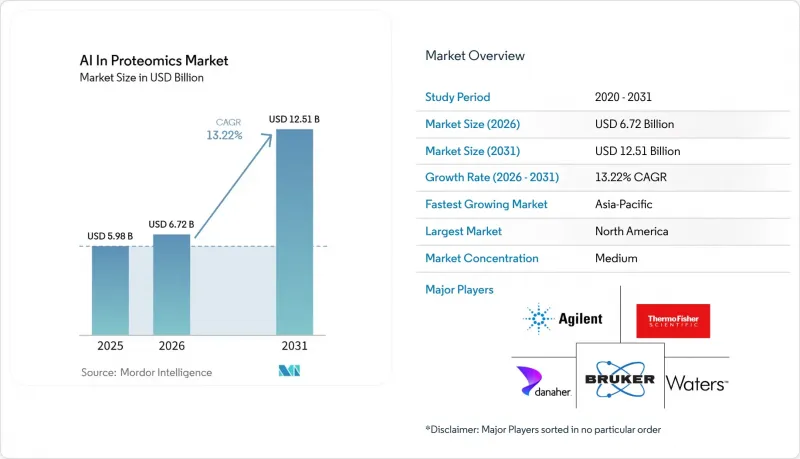
Mordor Intelligence에 의하면, 단백질체학 분야 AI 시장은 2025년 59억 8,000만 달러에서 2026년에는 67억 2,000만 달러로 확대되어 2026년부터 2031년까지 CAGR 13.22%로 성장을 지속하여, 2031년에는 125억 1,000만 달러에 이를 것으로 예측됩니다.
본 보고서는 구성 요소(소프트웨어, 서비스), 기술(질량 분석, 단백질 마이크로어레이, 기타), 용도(바이오마커 발견, 신약·의약품 개발, 기타), 최종 사용자(제약·바이오기술 기업, 기타), 지역(북미, 유럽, 아시아태평양, 중동 및 아프리카, 남미)별로 분류되어 있습니다. 시장 전망은 금액(달러) 기준으로 제시되어 있습니다.
전 세계 단백질체학 분야 AI 시장 동향 및 인사이트
정밀 의학 및 중개 바이오마커에 대한 수요 증가
대규모 바이오뱅크는 단백질체학 분야 AI 시장 내 바이오마커 연구의 경제성을 변화시켰습니다. 이는 대규모 코호트가 더 강력한 모델의 개발 및 검증에 필요한 훈련의 깊이를 제공하게 되었기 때문입니다. UK Biobank 및 FinnGen과 관련된 연구를 포함하여 5,000-50,000개 샘플에 이르는 코호트를 기반으로 한 연구에 따르면, 더 광범위하고 심층적인 단백질체학 데이터셋 덕분에 몇년전만 해도 달성하기 어려웠던 속도로 임상적으로 관련성이 높은 바이오마커 패널의 개발이 가능해졌음을 보여줍니다. 서모피셔 사이언티픽과 프리시전 헬스 리서치 싱가포르 간의 ‘PRECISE-SG100K’ 이니셔티브에서의 협력은 Olink 어세이와 Orbitrap 질량 분석 워크플로우를 결합하여 프로파일링된 1만 건의 혈장 샘플을 통해, 이러한 추세를 아시아로도 확대되고 있습니다. 이는 단백질체학 분야 AI 시장에 중요한 의미를 지닙니다. 검증된 패널이 연구 논문 발표 주기를 넘어 동반 진단 및 규제 대상 임상 개발 프로그램으로 전환되고 있기 때문입니다. 이러한 변화로 인해 상업적 수요는 일회성 발견 프로젝트에서 연구의 각 단계에 걸친 소프트웨어의 지속적인 활용, 모델 개선 및 워크플로우 모니터링으로 확대되고 있습니다. 단백질체학 분야 AI 시장이 임상 도입에 가까워짐에 따라, 더 강력한 바이오마커 분석 도구와 더 명확한 감사 추적을 갖춘 공급업체가 지속적인 지출에서 더 큰 점유율을 확보할 수 있는 위치에 있습니다.
AI를 활용한 고차원 단백질체학 데이터의 디콘볼루션
단백질체학 분야 AI 시장은 모델 성능이 모델 자체뿐만 아니라 기반이 되는 단백질체학 데이터 세트의 품질, 구조, 상호 운용성에 크게 의존하기 때문에 여전히 데이터와 관련된 근본적인 과제에 직면해 있습니다. 2026년 『Proteomes』 저널의 논평에서는 AI 도입 준비는 데이터 수집 단계부터 시작해야 한다고 주장하고 있으며, 또한 프로테오폼별로 분해된 입력 데이터는 경로 추론이나 코호트 간 일반화에서 더 광범위한 단백질 그룹에 기반한 접근 방식보다 우수한 성능을 발휘할 수 있다고 지적하고 있습니다. 단백질체학 분야 AI 시장에서 이러한 유형의 도구가 중요하게 여겨지는 이유는 데이터베이스에 의존하지 않는 해석을 통해 연구자가 주석이 불충분한 생물, 희귀한 질병 상태 및 복잡한 면역 펩티도믹스 샘플을 다룰 때 도움이 되기 때문입니다. 또한, 신경망 기반의 스펙트럼 예측을 통해 고품질 참조 라이브러리를 구축하는 데 필요한 노력이 줄어들고, 새로운 프로그램의 설정 시간을 단축할 수 있게 됩니다. 그 결과, 단백질체학 분야 AI 시장에서는 원시 데이터의 품질을 표준화하고, 후속 생물학적 해석에 대한 신뢰성을 높일 수 있는 소프트웨어 환경으로 가치가 이동하고 있습니다.
다중 모드 장비 및 컴퓨팅 인프라의 높은 비용
단백질체학 분야 AI 시장은 여전히 큰 도입 장벽에 직면해 있습니다. 그 이유는 차세대 질량 분석 시스템, 이를 뒷받침하는 컴퓨팅 계층, 그리고 관리된 데이터 인프라에 막대한 설비 투자가 필요하기 때문입니다. 단일 세포 단백질체학나 공간 프로테오폼 분석은 고사양 장비에 의존하고 있으며, 장비, 컴퓨팅, 데이터 처리의 총 비용은 북미나 서유럽 이외의 많은 병원 및 학술 기관의 연간 단백질체학 예산을 초과할 가능성이 있습니다. 이러한 비용 문제는 단백질체학 분야 AI 시장에서 중요한 과제입니다. 왜냐하면 시장 성장 전망은 연구 예산이나 조달에 있어 유연성이 더 제한적인 국가들을 포함하여, 더 광범위한 지역 시장 진입을 전제로 하고 있기 때문입니다. 리스 모델이나 클라우드 기반 실험실 서비스 구조를 통해 초기 비용 부담은 일부 완화되지만, 엔드투엔드 AI 단백질체학 워크플로우의 비용 격차를 완전히 해소하기에는 아직 미치지 못하고 있습니다. 가장 빠른 성장이 예상되는 아시아태평양에서도, 현 시점에서는 완전히 균형 잡힌 비용 구조라기보다는 여전히 강력한 공공 투자 의지가 반영되어 있습니다. 총 도입 비용이 더욱 낮아질 때까지는 단백질체학 분야 AI 시장이 중견 기관보다는 자금력이 풍부한 바이오의약품 기업, 국가 프로그램 및 최상위 연구센터에 더 이용하기 쉬운 상태가 지속될 것입니다.
부문 분석
2025년, 단백질체학 분야 AI 시장 점유율 중 60.37%를 소프트웨어가 차지하고 있으며, 이는 가치 창출이 하드웨어에만 국한되지 않고 해석, 워크플로우 조정, 의사결정 지원으로 이동하고 있음을 보여줍니다. 단백질체학 분야 AI 시장에서 이러한 수익 구성은 구매 우선순위에 있어 명확한 변화를 반영하고 있습니다. 연구자나 바이오의약품 기업 팀은 대규모 단백질체학 데이터 세트를 신약 개발 및 중개 연구 프로그램 전반에 걸쳐 활용할 수 있는 결과물로 변환할 수 있는 도구를 필요로 하기 때문입니다. 지역에 뿌리를 둔 전문 기업들도 경쟁의 여지를 넓혀가고 있으며, aiwell Japan의 통합 단백질체학 분석 플랫폼은 질량 분석, 친화도 분석, 경로 분석을 위한 통합된 인터페이스가 대형 OEM이 완전히 충족시키지 못하는 고객의 요구를 어떻게 충족시킬 수 있는지를 보여주고 있습니다. 이로 인해 소프트웨어 계층은 일상적인 워크플로우의 활용 현황, 데이터 이식성 및 고객 전환 비용을 좌우하기 때문에 단백질체학 분야 AI 시장에서 가장 방어력이 높은 카테고리가 되고 있습니다.
단백질체학 분야 AI 서비스 시장은 2026년부터 2031년까지 연평균 성장률(CAGR) 13.49%로 확대될 것으로 예측되며, 이는 고객이 아웃소싱형 및 성과 기반 운영 모델을 얼마나 강력하게 선호하고 있는지를 보여줍니다. 제약 기업 팀은 사내 플랫폼 구축 없이도 프로젝트 초기 단계를 단축할 수 있기 때문에 시료 전처리부터 AI를 활용한 분석에 이르기까지 종합적인 지원을 점점 더 요구하고 있습니다. 앞으로 단백질체학 분야 AI 시장에서는 소프트웨어 구독, 관리형 분석, 프로젝트 기반의 과학적 지원이 개별 서비스가 아닌 세트로 판매되는 하이브리드 모델의 구성이 더욱 확대될 것으로 보입니다.
2025년에는 질량 분석이 매출의 41.83%를 차지하며, 이러한 우위는 단백질체학 분야 AI 시장에서 여전히 중심적인 위치를 차지하고 있습니다. 이는 프로테옴의 깊이, 번역 후 변형의 가시성, 그리고 폭넓은 신약 개발 유용성을 동등하게 겸비한 경쟁 플랫폼이 존재하지 않기 때문입니다. 이 기술은 특히 연구자가 수천 유형의 단백질을 병렬로 정량화하고 상세한 분자 분해능을 유지해야 하는 경우, 신약 개발에 중점을 둔 프로그램의 기준이 되는 계층으로 자리 잡고 있습니다.
차세대 시퀀싱(NGS)을 위한 단백질체학 분야 AI 시장은 단백질체학와 유전체학의 운영적 융합이 진전되는 것을 배경으로 2026년부터 2031년까지 연평균 성장률(CAGR) 13.76%로 확대될 것으로 예측됩니다. 일루미나(Illumina)가 2026년 1월 소마로직(SomaLogic) 인수를 완료함에 따라, 표준 NovaSeq 인프라 상에서 아프타머 시퀀싱을 활용해 최대 11,000종의 단백질을 측정할 수 있는 NGS 기반 단백질체학 플랫폼이 탄생했습니다. 이러한 움직임은 기존 시퀀싱 워크플로우에 단백질체학 측정 기능을 결합하여 대량의 샘플에 대해 비용 효율성을 향상시킬 수 있기 때문에 단백질체학 분야 AI 시장에서 중요한 의미를 지닙니다. 또한, 이를 통해 멀티오믹스 프로그램에 대해 보다 통합된 장비 기반이 제공되어, 집단 연구나 대규모 트랜스레이셔널 데이터셋에 매력적인 선택지가 될 것입니다. 단백질 마이크로어레이, 크로마토그래피, X선 결정 구조 분석, 마이크로플루이딕스 기술은 여전히 뚜렷한 틈새 역할을 계속하고 있으며, 특히 마이크로플루이딕스 기술은 소형화된 단백질체학 워크플로가 현장 진단(Point-of-Care)이나 시료량이 제한된 이용 사례에 가까워짐에 따라 점점 더 주목받고 있습니다.
지역별 분석
2025년, 북미는 단백질체학 분야 AI 시장 점유율 50.14%를 차지했으며, 주요 바이오의약품 기업의 본사, 학술 의료 센터, 그리고 확립된 AI 소프트웨어 생태계가 하나의 밀집된 사업 환경에 집적되어 있어, 지역별 최대 기여 지역으로서의 지위를 계속 유지했습니다. 또한, 이 지역은 보다 명확한 규제 정책의 혜택도 받고 있습니다. 이는 지속적으로 발전하고 있는 FDA의 ‘의료기기로서의 소프트웨어(Software as a Medical Device)’에 관한 지침을 통해, 제약 업계 사용자에게 소프트웨어의 출력을 규제 대상 개발 워크플로우에 통합하기 위한 보다 체계적인 로드맵이 제시되고 있기 때문입니다. 유럽은 ‘호라이즌 유럽(Horizon Europe)’의 자금 지원, 탄탄한 제약 산업 기반, 그리고 GDPR(EU 개인정보보호규정)로 인한 On-Premise 및 페더레이티드(federated) 배포에 대한 관심으로 인해 현지 수요 패턴이 지속적으로 뒷받침되고 있어 2위 지역으로서의 지위를 유지했습니다.
아시아태평양은 2026년부터 2031년까지 연평균 성장률(CAGR) 16.34%를 나타낼 것으로 예측되며, 정부 주도의 바이오 뱅킹, 국내 AI 투자, 그리고 위탁 연구의 확대가 병행되고 있어 단백질체학 분야 AI 시장에서 가장 빠르게 성장하는 지역 블록이 될 것입니다. 이 지역의 성장 양상은 국가 차원의 협력적 노력과 인프라 구축 프로그램에 대한 의존도가 더 두드러진다는 점에서 북미와 다릅니다. 중국 톈진에 위치한 국가 슈퍼컴퓨터 센터는 2026년 5월 'GalaxyVS' AI 플랫폼을 출시했습니다. 이 플랫폼은 칭화대학교의 딥러닝 프레임워크 ‘DrugCLIP’을 활용하여 1,000억 유형의 합성 가능한 화합물에 대한 가상 스크리닝을 가능하게 함으로써, 표적 검증 파이프라인의 가속화를 지원하고 있습니다. 싱가포르의 ‘PRECISE-SG100K’ 공동 프로젝트도 중요한 이니셔티브입니다. 이는 아시아 인구 집단에서 바이오마커 모델의 타당성을 향상시킬 수 있는 대규모이자 민족적으로 다양한 혈장 프로테옴 참조 세트를 구축하고 있기 때문입니다. 아시아태평양의 단백질체학 분야 AI 시장이 확대됨에 따라, 구매자들은 현지 데이터 관리, 지역별 도입 옵션, 그리고 CRO 및 학술 네트워크와의 확장 가능한 파트너십을 점점 더 중요하게 여기게 될 것입니다.
중동 및 아프리카는 단백질체학 분야 AI 시장에서 여전히 초기 단계에 있지만, 정밀의료 프로그램과 연계된 정부 주도의 의료 투자를 통해 단백질체학 인프라와 분석 수요의 초기 기반이 형성되고 있습니다. 남미에서는 브라질과 아르헨티나의 대학 그룹이 종양학 바이오마커 프로그램과 관련된 활발한 연구를 지속적으로 지원하고 있지만, 여전히 높은 장비 수입 비용과 국내 단백질체학 인력 부족이라는 제약에 직면해 있습니다. 두 지역 모두 단백질체학 분야 AI 시장은 낮은 수준에서 성장하고 있으며, 그 진전은 초기 투자를 절감할 수 있는 클라우드 네이티브 제공 모델에 크게 의존하고 있습니다. 이러한 추세는 대규모 실험실 구축에 앞서 플랫폼 숙련도 향상 및 기술 개발이 진행될 가능성을 시사하며, 이는 이전 도입 주기에서 다른 첨단 생명과학 워크플로가 해당 지역에 보급되었던 경위와 유사합니다.
기타 혜택:
- 엑셀 형식 시장 예측(ME) 시트
- 3개월간의 애널리스트 지원
자주 묻는 질문
목차
제1장 서론
제2장 조사 방법
제3장 주요 요약
제4장 시장 구도
제5장 시장 규모와 성장 예측
제6장 경쟁 구도
제7장 시장 기회와 향후 전망
JHS 26.08.07According to Mordor Intelligence, the AI in proteomics market is expected to grow from USD 5.98 billion in 2025 to USD 6.72 billion in 2026 and is forecasted to reach USD 12.51 billion by 2031 at 13.22% CAGR over 2026-2031.
This report is Segmented by Component (Software, Services), Technology (Mass Spectrometry, Protein Microarrays, and Others), Application (Biomarker Discovery, Drug Discovery and Development, Others), End-User (Pharmaceutical and Biotechnology Companies, and Others), and Geography (North America, Europe, Asia-Pacific, Middle East and Africa, South America). The Market Forecasts are Provided in Terms of Value (USD).
Global AI In Proteomics Market Trends and Insights
Rising Demand for Precision Medicine and Translational Biomarkers
Population-scale biobanking has changed the economics of biomarker work in the AI in proteomics market because large cohorts now provide the training depth needed for stronger model development and validation. Studies built on cohorts ranging from 5,000 to 50,000 samples, including work linked to UK Biobank and FinnGen, show that broader and deeper proteomic datasets can support clinically relevant biomarker panel development at a pace that was harder to achieve a few years earlier.Thermo Fisher Scientific's collaboration with Precision Health Research Singapore for the PRECISE-SG100K initiative extends the same pattern into Asia through 10,000 plasma samples profiled with complementary Olink assay and Orbitrap mass spectrometry workflows.This matters for the AI in proteomics market because validated panels are moving beyond research publication cycles and into companion diagnostic and regulated clinical development programs. That shift expands commercial demand from one-time discovery projects toward repeat software usage, model refinement, and workflow monitoring across study stages. As the AI in proteomics market moves closer to clinical deployment, vendors with stronger biomarker interpretation tools and cleaner audit trails are positioned to capture a larger share of recurring spending.
AI-Enabled Deconvolution of High-Dimensional Proteomics Data
The AI in proteomics market continues to face a core data challenge because model performance depends on the quality, structure, and interoperability of the underlying proteomics datasets as much as on the model itself. A 2026 Proteomes commentary argued that AI readiness should begin at the point of data capture, and it also noted that proteoform-resolved inputs can outperform broader protein-group approaches in pathway inference and cross-cohort generalization. In the AI in proteomics market, this kind of tool matters because database-independent interpretation helps researchers work with poorly annotated organisms, rare disease states, and complex immunopeptidomics samples. Neural network-based spectral prediction is also lowering the effort required to build high-quality reference libraries, which can shorten setup times for new programs. As a result, the AI in proteomics market is seeing more value move toward software environments that can standardize raw input quality and improve confidence in downstream biological interpretation.
High Cost of Multimodal Instrumentation and Compute Infrastructure
The AI in proteomics market still faces a meaningful adoption barrier because next-generation mass spectrometry systems, supporting compute layers, and managed data infrastructure require large capital commitments. Single-cell proteomics and spatial proteoform analysis depend on high-specification instrumentation, and the combined cost of instruments, compute, and data handling can exceed the annual proteomics budgets of many hospitals and academic centers outside North America and Western Europe. That cost issue matters in the AI in proteomics market because growth assumptions rely on broader geographic participation, including countries where research budgets and procurement flexibility are more limited. Leasing models and cloud-based laboratory service structures reduce some of the upfront burden, but they do not yet remove the full cost gap for end-to-end AI proteomics workflows. The region with the fastest projected growth, Asia-Pacific, still reflects strong public investment ambition rather than a fully balanced cost structure today. Until the total deployment cost falls further, the AI in proteomics market will remain more accessible to well-funded biopharma groups, national programs, and top research centers than to mid-tier institutions.
Other drivers and restraints analyzed in the detailed report include:
- Expansion of Single-Cell and Spatial Proteomics Workflows
- Rising Demand for Automated Drug Discovery Target Validation
- Lack of Cross-Platform Data Standardization for AI Model Training
For complete list of drivers and restraints, kindly check the Table Of Contents.
Segment Analysis
Software held 60.37% of AI in proteomics market share in 2025, which shows that value creation has moved toward interpretation, workflow orchestration, and decision support rather than remaining centered on hardware alone. In the AI in proteomics market, this revenue mix reflects a clear change in buying priorities because researchers and biopharma teams need tools that can turn large proteomic datasets into usable outputs across discovery and translational programs. Regional specialists are also gaining room to compete, and aiwell Japan's integrated proteomics analytics platform shows how unified interfaces for mass spectrometry, affinity assays, and pathway analysis can answer customer demand that larger OEMs have not fully addressed. This makes the software layer the most defensible category in the AI in proteomics market because it shapes daily workflow use, data portability, and customer switching costs.
The AI in proteomics market for services is projected to expand at a 13.49% CAGR from 2026 to 2031, which shows how strongly customers are leaning toward outsourced and outcome-based operating models. Pharmaceutical teams increasingly want support that runs from sample preparation through AI-assisted interpretation, because this can shorten early-stage project timelines without requiring internal platform buildout. Over time, the AI in proteomics market is likely to see a wider mix of hybrid models where software subscriptions, managed analytics, and project-based scientific support are sold together rather than as separate offers.
Mass spectrometry accounted for 41.83% of revenue in 2025, and that lead remains central to the AI in proteomics market because no competing platform offers the same combination of proteome depth, post-translational modification visibility, and broad discovery utility. The technology remains the reference layer for discovery-heavy programs, especially where researchers need to quantify thousands of proteins in parallel and retain detailed molecular resolution
The AI in proteomics market for next-generation sequencing is projected to expand at a 13.76% CAGR from 2026 to 2031, driven by closer operational convergence between proteomics and genomics. Illumina's completed acquisition of SomaLogic in January 2026 created an NGS-based proteomics platform that can measure up to 11,000 proteins using aptamer sequencing on standard NovaSeq infrastructure. That move matters in the AI in proteomics market because it overlays proteomic measurement on existing sequencing workflows and can improve cost efficiency at high sample volumes. It also gives multiomics programs a more unified instrument layer, which is attractive for population studies and large translational datasets. Protein microarrays, chromatography, X-ray crystallography, and microfluidics continue to hold defined niche roles, and microfluidics is gaining more attention as smaller-format proteomics workflows move closer to point-of-care and constrained-sample use cases.
Complete Report Scope:
- By Component
- Software
- Services
- By Technology
- Mass Spectrometry
- Protein Microarrays
- Chromatography
- Next-Generation Sequencing
- X-Ray Crystallography
- Microfluidics
- Other Technologies
- By Application
- Biomarker Discovery
- Drug Discovery and Development
- Clinical Diagnostics
- Precision and Personalized Medicine
- Agricultural and Environmental Proteomics
- Other Applications
- By End-User
- Pharmaceutical and Biotechnology Companies
- Academic and Research Institutes
- Contract Research Organizations
- Other End-Users
- By Geography
- North America
- United States
- Canada
- Mexico
- Europe
- Germany
- United Kingdom
- France
- Italy
- Spain
- Rest of Europe
- Asia-Pacific
- China
- Japan
- India
- Australia
- South Korea
- Rest of Asia-Pacific
- Middle East and Africa
- GCC
- South Africa
- Rest of Middle East and Africa
- South America
- Brazil
- Argentina
- Rest of South America
- North America
Geography Analysis
North America accounted for 50.14% of AI in proteomics market share in 2025, which kept it as the leading regional contributor because it combines major biopharma headquarters, academic medical centers, and established AI software ecosystems in one dense operating environment. The region also benefits from clearer regulatory direction, because evolving FDA Software as a Medical Device guidance gives pharmaceutical users a more structured route for integrating software outputs into regulated development workflows. Europe remained the second-largest region because Horizon Europe funding, a dense pharmaceutical base, and GDPR-driven interest in on-premise and federated deployments continue to support local demand patterns.
Asia-Pacific is projected to grow at a 16.34% CAGR from 2026 to 2031, which makes it the fastest-growing regional block in the AI in proteomics market because government biobanking, domestic AI investment, and contract research expansion are moving in parallel. The region's growth pattern differs from North America because it relies more visibly on coordinated national initiatives and infrastructure-building programs. China's National Supercomputer Center in Tianjin launched the GalaxyVS AI platform in May 2026, using the DrugCLIP deep learning framework from Tsinghua University to enable virtual screening of 100 billion synthesizable compounds in support of faster target validation pipelines. Singapore's PRECISE-SG100K collaboration is also important because it is building a large and ethnically diverse plasma proteome reference set that can improve biomarker model relevance for Asian populations. As the AI in proteomics market expands in Asia-Pacific, buyers are likely to put increasing weight on local data control, regional deployment options, and scalable partnerships with CROs and academic networks.
Middle East and Africa remains an early-stage part of the AI in proteomics market, but sovereign health investments tied to precision medicine programs are creating an initial base for proteomics infrastructure and analytics demand. South America is still constrained by high instrument import costs and limited domestic proteomics talent, even though university groups in Brazil and Argentina continue to support active research linked to oncology biomarker programs. Both regions are growing from a low base in the AI in proteomics market, and their progress depends more heavily on cloud-native delivery models that can reduce upfront capital needs. This pattern suggests that platform familiarity and skills development may arrive before large-scale laboratory buildout, which is similar to how other advanced life science workflows spread into these regions over earlier adoption cycles.
- Agilent Technologies
- Bio-Rad Laboratories
- Bio-Techne
- Bruker
- Creative Proteomics
- Danaher
- GE HealthCare Technologies Inc.
- Illumina
- Merck
- Olink Holding AB
- Oxford Nanopore Technologies plc
- Promega
- Proteome Sciences plc
- QIAGEN
- Revvity, Inc.
- Seer, Inc.
- Shimadzu
- SomaLogic, Inc.
- Thermo Fisher Scientific
- Waters Corporation
Additional Benefits:
- The market estimate (ME) sheet in Excel format
- 3 months of analyst support
TABLE OF CONTENTS
1 Introduction
- 1.1 Study Assumptions and Market Definition
- 1.2 Scope of the Study
2 Research Methodology
3 Executive Summary
4 Market Landscape
- 4.1 Market Overview
- 4.2 Market Drivers
- 4.2.1 Rising Demand for Precision Medicine and Translational Biomarkers
- 4.2.2 AI-Enabled Deconvolution of High-Dimensional Proteomics Data
- 4.2.3 Expansion of Single-Cell and Spatial Proteomics Workflows
- 4.2.4 Rising Demand for Automated Drug Discovery Target Validation
- 4.2.5 Cloud-Native Bioinformatics and Federated Analytics Adoption
- 4.2.6 Sovereign Data Infrastructure and On-Premise AI Deployment Requirements
- 4.3 Market Restraints
- 4.3.1 High Cost of Multimodal Instrumentation and Compute Infrastructure
- 4.3.2 Lack of Cross-Platform Data Standardization for AI Model Training
- 4.3.3 Shortage of Proteomics-Bioinformatics Talent
- 4.3.4 Data Provenance, Privacy, and IP Ambiguity in AI Model Development
- 4.4 Supply/Value Chain Analysis
- 4.5 Regulatory Landscape
- 4.6 Technological Outlook
- 4.7 Porter's Five Forces
- 4.7.1 Threat of New Entrants
- 4.7.2 Bargaining Power of Suppliers
- 4.7.3 Bargaining Power of Buyers
- 4.7.4 Threat of Substitutes
- 4.7.5 Competitive Rivalry
5 Market Size & Growth Forecasts (Value, USD)
- 5.1 By Component
- 5.1.1 Software
- 5.1.2 Services
- 5.2 By Technology
- 5.2.1 Mass Spectrometry
- 5.2.2 Protein Microarrays
- 5.2.3 Chromatography
- 5.2.4 Next-Generation Sequencing
- 5.2.5 X-Ray Crystallography
- 5.2.6 Microfluidics
- 5.2.7 Other Technologies
- 5.3 By Application
- 5.3.1 Biomarker Discovery
- 5.3.2 Drug Discovery and Development
- 5.3.3 Clinical Diagnostics
- 5.3.4 Precision and Personalized Medicine
- 5.3.5 Agricultural and Environmental Proteomics
- 5.3.6 Other Applications
- 5.4 By End-User
- 5.4.1 Pharmaceutical and Biotechnology Companies
- 5.4.2 Academic and Research Institutes
- 5.4.3 Contract Research Organizations
- 5.4.4 Other End-Users
- 5.5 By Geography
- 5.5.1 North America
- 5.5.1.1 United States
- 5.5.1.2 Canada
- 5.5.1.3 Mexico
- 5.5.2 Europe
- 5.5.2.1 Germany
- 5.5.2.2 United Kingdom
- 5.5.2.3 France
- 5.5.2.4 Italy
- 5.5.2.5 Spain
- 5.5.2.6 Rest of Europe
- 5.5.3 Asia-Pacific
- 5.5.3.1 China
- 5.5.3.2 Japan
- 5.5.3.3 India
- 5.5.3.4 Australia
- 5.5.3.5 South Korea
- 5.5.3.6 Rest of Asia-Pacific
- 5.5.4 Middle East and Africa
- 5.5.4.1 GCC
- 5.5.4.2 South Africa
- 5.5.4.3 Rest of Middle East and Africa
- 5.5.5 South America
- 5.5.5.1 Brazil
- 5.5.5.2 Argentina
- 5.5.5.3 Rest of South America
- 5.5.1 North America
6 Competitive Landscape
- 6.1 Market Concentration
- 6.2 Market Share Analysis
- 6.3 Company Profiles (includes Global level Overview, Market level overview, Core Segments, Financials as available, Strategic Information, Market Rank/Share for key companies, Products & Services, and Recent Developments)
- 6.3.1 Agilent Technologies, Inc.
- 6.3.2 Bio-Rad Laboratories, Inc.
- 6.3.3 Bio-Techne Corporation
- 6.3.4 Bruker Corporation
- 6.3.5 Creative Proteomics
- 6.3.6 Danaher Corporation
- 6.3.7 GE HealthCare Technologies Inc.
- 6.3.8 Illumina, Inc.
- 6.3.9 Merck KGaA
- 6.3.10 Olink Holding AB
- 6.3.11 Oxford Nanopore Technologies plc
- 6.3.12 Promega Corporation
- 6.3.13 Proteome Sciences plc
- 6.3.14 QIAGEN N.V.
- 6.3.15 Revvity, Inc.
- 6.3.16 Seer, Inc.
- 6.3.17 Shimadzu Corporation
- 6.3.18 SomaLogic, Inc.
- 6.3.19 Thermo Fisher Scientific Inc.
- 6.3.20 Waters Corporation
7 Market Opportunities & Future Outlook
- 7.1 White-space & Unmet-need Assessment


