

|
시장보고서
상품코드
2122162
단백질체학 : 시장 점유율 분석, 업계 동향 및 통계, 성장 예측(2026-2031년)Proteomics - Market Share Analysis, Industry Trends & Statistics, Growth Forecasts (2026 - 2031) |
||||||
 Mordor Intelligence
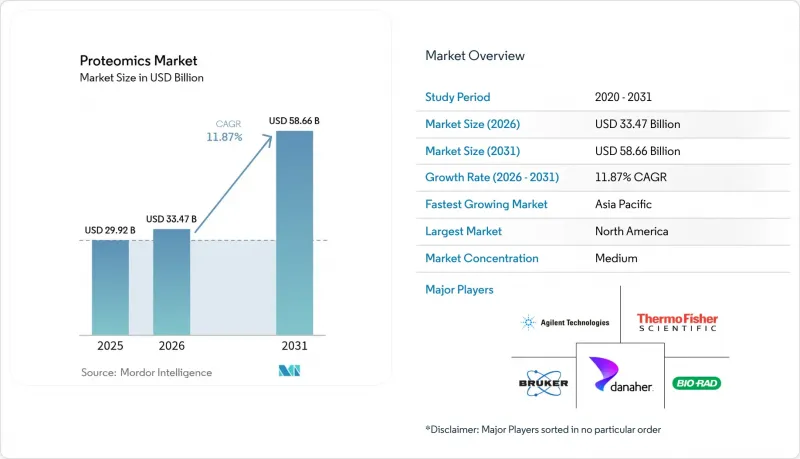
Mordor Intelligence에 의하면, 단백질체학 시장 규모는 2025년에 299억 2,000만 달러로 평가되었습니다. 2026년 334억 7,000만 달러에서 2031년까지 586억 6,000만 달러에 이를 것으로 예상되며, 예측 기간(2026-2031년) CAGR은 11.87%를 나타낼 전망입니다.
본 보고서는 구성 요소(장비 등), 기술(질량 분석법 등), 용도(신약·의약품 개발 등), 최종 사용자(제약·바이오기술 기업 등), 지역(북미, 유럽, 아시아태평양 등)별로 분류되어 있습니다. 시장 예측은 금액(미 달러) 기준으로 제시되어 있습니다.
세계의 단백질체학 시장 동향 및 인사이트
맞춤형 의료 및 정밀의료에 대한 수요 증가
단백질 기반 바이오마커와 질병의 계층화를 연결하는 임상적 증거가 증가하고 있으며, 대규모 코호트 연구에서 단백질체학 패널이 일상적으로 채택되고 있습니다. 서모피셔 사이언티픽(Thermo Fisher Scientific)의 Olink 플랫폼이 60만 개의 샘플에서 5,400종의 단백질을 프로파일링하는 영국 바이오뱅크(UK Biobank) 프로그램에 채택된 것은 이러한 변화를 여실히 보여주며, 치료법 선택을 이끌어내는 다차원 데이터 세트의 구축으로 이어지고 있습니다. 단백질체학를 통한 건강 점수는 현재 유전적 위험 지표를 보완하는 역할을 하며, 생활 습관 개선에 대한 반응성이 입증되어 예방 의료 계획에서의 가치가 강조되고 있습니다. 순환 단백질 시그니처에서 도출된 장기 특이적 노화 시계는 조기 개입 전략의 지침이 되고 있습니다. 제약 업계의 이해관계자들은 이러한 인사이트력을 동반 진단제 개발에 있어 매우 중요한 요소로 간주하고 있으며, 차세대 분석 플랫폼에 대한 지속적인 수요를 뒷받침하고 있습니다.
연구개발비 및 공공 자금 증가
바이오의약품 기업과 공공 자금을 통합하는 컨소시엄형 자금 조달 모델을 통해, 과거에는 일류 학술 기관으로만 제한되었던 인프라가 확대되고 있습니다. 14개 바이오의약품 기업으로부터 자금을 지원받고 있는 영국 바이오뱅크의 단백질체학 이니셔티브는 업계의 협력을 통해 이전에는 실현 불가능했던 대규모 단백질체학 연구를 추진한다는 패러다임의 전환을 구현하고 있습니다. 중국, 일본, 한국의 정부 보조금은 고분해능 질량 분석기 및 클라우드 기반 데이터 허브에 대한 지원을 통해 신생 연구소의 진입 장벽을 낮추고 있습니다. 벤처 캐피탈은 AI 네이티브 단백질체학 소프트웨어 기업으로 유입되고 있으며, 분석 시간을 며칠에서 몇 분으로 단축하고 사용자의 접근성을 확대하는 자동 패턴 인식 도구 개발을 가속화하고 있습니다.
장비의 높은 자본 비용 및 운영 비용
최상위급 Orbitrap 및 트랩드 이온 모빌리티(TIM) 플랫폼은 일반적으로 시스템당 100만 달러를 초과하며, 연간 유지보수 계약에 구매 가격의 10%가 추가될 수 있습니다. 또한 연구소는 소모품, 진공 인프라, 환경 제어를 위한 예산도 확보해야 합니다. E3법 등 대학 차원의 노력을 통해 시료 전처리 비용은 절감되고 있지만, 하드웨어에 대한 지출은 중견 기관에게 여전히 장벽으로 작용하고 있습니다. 공동 이용 시설 모델이나 CRO(계약 연구 기관)에 대한 아웃소싱은 도입 비용을 경감시켜 주지만, 실험의 유연성을 제한할 가능성이 있습니다.
부문별 분석
2025년 단백질체학 시장 점유율 중 시약이 69.22%를 차지했습니다. 이는 시약이 소모품일 뿐만 아니라, 시료의 용해, 농축, 표지, 정량과 같은 각 공정에서 필수적이라는 특성을 반영한 것입니다. 검출 특이성을 향상시키는 바이오오르토고날 태그의 채택이 확대됨에 따라 재주문량은 견조한 추세를 보이고 있습니다. 장비 하위 부문은 단일 세포 분석용으로 설계된 초고분해능 분광계의 높은 가격 책정 덕분에 혜택을 보고 있습니다. 소프트웨어 및 서비스 부문은 연평균 성장률(CAGR) 13.31%로 성장하고 있습니다. 이는 연구소가 데이터 양 증가에 직면함에 따라, 바이오정보학의 병목 현상을 해소해 줄 AI 기반 분석 플랫폼을 필요로 하고 있기 때문입니다. 품질 관리 대시보드와 자동 주석 기능을 통합한 클라우드 네이티브 파이프라인은 전문가가 아닌 사용자층의 접근성을 확대하여 단백질체학 시장 전체의 성장을 뒷받침하고 있습니다.
구독형 라이선싱 도입으로 공급업체의 수익이 가속화되는 한편, 관리형 서비스 계약에서는 장비 모니터링, 데이터 저장, 규정 준수 보고가 예측 가능한 요금으로 통합되어 있습니다. CRO(의약품 개발 수탁 기관)는 모듈식 소프트웨어를 활용하여 신속한 처리 시간을 실현하는 시험을 제공하고 있으며, 이를 통해 소규모 생명공학 기업도 고가의 하드웨어를 도입하지 않고도 신약 개발 연구를 수행할 수 있게 되었습니다. 멀티오믹스 통합이 일상화되는 가운데, 트랜스크립토믹스와 단백질체학 계층을 공동으로 분석하는 하이브리드 워크플로는 이종 데이터 세트를 조화시킬 수 있는 미들웨어에 의존하고 있으며, 이로 인해 단백질체학 시장에서 전문적인 분석 솔루션에 대한 수요가 더욱 높아지고 있습니다.
2025년에는 질량 분석 플랫폼이 단백질체학 시장의 30.28% 점유율을 차지했습니다. 이는 이온 광학계 및 검출기 설계의 지속적인 혁신으로 인해 80 kDa까지의 단백질에 대해 분해능이 20만을 초과했기 때문입니다. 비행시간형(TOF)과 오비트랩(Orbitrap) 하이브리드 장치는 서브 ppm 수준의 질량 정확도를 실현함과 동시에, 집단 규모의 코호트 연구를 처리할 수 있는 스캔 속도를 갖추고 있습니다. 차세대 시퀀싱과 관련된 단백질체학 시장 규모는 단백질 상호작용 네트워크 매핑에서 DNA 인코딩 라이브러리와 리보솜 디스플레이 시스템의 유용성이 융합되고 있음을 반영하여, 연평균 성장률(CAGR) 13.55%로 확대될 것으로 예측됩니다. 시퀀싱에 기반한 측정 결과는 번역 후 변형의 직교적 검증을 제공하며, 고다중 정량화를 가능하게 합니다.
마이크로플루이딕스 기반 분리 및 공간 분해능을 갖춘 단백질 어레이와 같은 보완적인 기법은 조직 맥락 분석에서 주목을 받고 있습니다. 초고압형을 포함한 크로마토그래피 업그레이드를 통합함으로써 프런트엔드 분리 성능이 향상되고 시료의 캐리오버가 감소하여, 저농도 펩타이드의 동정에 대한 신뢰성이 높아집니다. 현재 각 공급업체는 LC-MS, 모세관 전기영동 및 이미징 기반 워크플로우 간의 전환을 효율화하는 크로스 플랫폼 키트를 제공하여, 단백질체학 시장에서 종단적 연구를 위한 방법의 연속성을 보장하고 있습니다.
지역별 분석
북미는 확고한 입지를 갖춘 바이오의약품 기업, 미국 국립보건원(NIH)의 지속적인 자금 지원, 그리고 대규모 정밀 의학 코호트 덕분에 2025년 전 세계 매출의 44.02%를 차지했습니다. 미국에는 기술 범위를 확대하기 위해 54건의 전략적 인수(평균 30억 9,000만 달러)를 완료한 서모피셔 사이언티픽(Thermo Fisher Scientific)과 같은 주요 공급업체가 기반을 두고 있습니다. 캐나다는 민관 협력 유전체 이니셔티브를 통해 사업을 확장하고 있는 반면, 멕시코는 지역 제네릭 의약품 제조업체에 서비스를 제공하는 틈새 CRO(의약품 개발 수탁 기관) 기능을 구축하고 있습니다.
유럽은 연평균 성장률(CAGR) 11.72%를 기록했으며, 독일, 영국, 프랑스가 주요 기여국으로 꼽힙니다. 영국 바이오뱅크의 프로테옴 프로그램은 범유럽적 협력의 모범 사례로, 제약 기업 후원사를 대상으로 멀티오믹스 데이터 세트를 분석하는 위탁 분석 제공업체 생태계를 뒷받침하고 있습니다. 독일은 국내 정밀 기기 공학을 활용하여 고성능 LC-MS 시스템을 수출하는 한편, 프랑스와 이탈리아는 단백질체학 종결점을 통합한 임상시험 네트워크를 확대하여 유럽 전역의 단백질체학 시장을 강화하고 있습니다.
아시아태평양은 2031년까지 연평균 성장률(CAGR)이 13.62%로, 가장 빠르게 성장하는 지역으로 평가받고 있습니다. 중국의 5개년 계획에서는 생명공학이 전략적 축 중 하나로 자리 잡고 있으며, 신규 진단 패널에 대한 특허 부여는 국내 혁신 역량을 뒷받침하고 있습니다. 인도는 비용 대비 효율이 높은 CRO 허브에 대한 투자를 유치하는 한편, 인력 부족을 해소하기 위해 프로테오유전체학 분야의 공동 학위 프로그램을 설립하고 있습니다. 일본은 로봇 기술을 활용한 검체 전처리를 선도하고 있는 반면, 한국은 AI 기반 바이오인포매틱스 스타트업에 보조금을 지급하고 있습니다. 호주의 중개 연구 협력은 아그리유전체학와 희귀질환 진단에 초점을 맞추고 있으며, 단백질체학 시장의 잠재적 규모를 확대되고 있습니다. 중동 및 아프리카에서는 3차 의료기관에서의 도입이 진행되고 있으며, 브라질은 백신 관련 단백질체학 연구를 통해 남미 지역 내 보급을 주도하고 있습니다.
기타 혜택 :
- 엑셀 형식 시장 예측(ME) 시트
- 3개월간의 애널리스트 지원
자주 묻는 질문
목차
제1장 서론
제2장 조사 방법
제3장 주요 요약
제4장 시장 구도
제5장 시장 규모 및 성장 예측
제6장 경쟁 구도
제7장 시장 기회 및 향후 전망
KTH 26.09.04According to Mordor Intelligence, the proteomics market size was valued at USD 29.92 billion in 2025 and estimated to grow from USD 33.47 billion in 2026 to reach USD 58.66 billion by 2031, at a CAGR of 11.87% during the forecast period (2026-2031).
This report is Segmented by Component (Instruments and More), Technology (Mass Spectrometry and More), Application (Drug Discovery & Development and More), End-User (Pharmaceutical & Biotechnology Companies and More), and Geography (North America, Europe, Asia-Pacific, and More). The Market Forecasts are Provided in Terms of Value (USD).
Global Proteomics Market Trends and Insights
Rising Demand for Personalized & Precision Medicine
Growing clinical evidence links protein-based biomarkers with disease stratification, fostering routine inclusion of proteomic panels in large cohort studies. Thermo Fisher Scientific's Olink platform's selection for the UK Biobank's programme to profile 5,400 proteins across 600,000 samples exemplifies this shift, creating multidimensional datasets that guide therapeutic selection. Proteomic fitness scores now complement genetic risk metrics and have demonstrated responsiveness to lifestyle interventions, underscoring value for preventive-care planning. Organ-specific ageing clocks derived from circulating protein signatures are informing early intervention strategies. Pharma stakeholders view these insights as pivotal for companion-diagnostic development, reinforcing sustained demand for next-generation assay platforms.
Increasing R&D Expenditure and Public Funding
Consortia funding models that pool biopharma and public financing are scaling infrastructure once limited to elite academic centres. The UK Biobank's proteomics initiative, funded by 14 biopharmaceutical companies, represents a paradigm shift where industry collaboration drives large-scale proteomic studies that were previously unfeasible. Government grants across China, Japan, and Korea subsidize high-resolution mass-spectrometry installations and cloud-based data hubs, lowering barriers for start-up laboratories. Venture capital flows toward AI-native proteomic software firms, accelerating automated pattern-recognition tools that cut analysis times from days to minutes and broaden user access.
High Capital & Operating Cost of Instruments
Top-tier Orbitrap or trapped-ion-mobility platforms routinely exceed USD 1 million per system, and annual service contracts may add 10% of purchase price. Labs must also budget for consumables, vacuum infrastructure, and environmental controls. Although university-level initiatives such as the E3 method reduce sample-prep costs, hardware outlays remain a hurdle for mid-tier institutions. Shared-facility models and CRO outsourcing mitigate entry costs yet can constrain experimental flexibility.
Other drivers and restraints analyzed in the detailed report include:
- Rapid Advances in High-Throughput MS & LC-MS Platforms
- Growing Adoption in Drug-Discovery Pipelines
- Shortage of Skilled Bioinformaticians & Proteomics Experts
For complete list of drivers and restraints, kindly check the Table Of Contents.
Segment Analysis
Reagents accounted for 69.22% of the proteomics market share in 2025, reflecting their consumable nature and indispensability across sample lysis, enrichment, labelling, and quantitation steps. High adoption of bioorthogonal tags that improve detection specificity sustains robust reorder volumes. The instruments sub-segment benefits from premium pricing on ultrahigh-resolution spectrometers designed for single-cell assays. Software and services are growing at a 13.31% CAGR as laboratories confront rising data volumes and seek AI-driven analytics platforms that remove bioinformatics bottlenecks. Cloud-native pipelines that integrate quality-control dashboards with automated annotation broaden accessibility for non-specialists, supporting overall proteomics market expansion.
Adoption of subscription licensing accelerates vendor revenue, while managed-service contracts bundle instrument monitoring, data storage, and compliance reporting into predictable fees. CROs leverage modular software to offer rapid-turnaround studies, allowing smaller biotech companies to conduct discovery without installing costly hardware. As multi-omics integration becomes routine, hybrid workflows that co-analyze transcriptomic and proteomic layers rely on middleware capable of harmonizing heterogeneous datasets, further fueling demand for specialized analytics solutions within the proteomics market.
Mass-spectrometry platforms captured 30.28% of the proteomics market share in 2025, owing to continuous innovation in ion-optics and detector design that extends resolving power past 200,000 for proteins up to 80 kDa. Time-of-flight-Orbitrap hybrids deliver sub-ppm mass accuracy at scan speeds supporting population-scale cohort studies. The proteomics market size tied to next-generation sequencing is forecast to expand at 13.55% CAGR, reflecting the converging utility of DNA-encoded libraries and ribosome-display systems in mapping protein-interaction networks. Sequencing-based readouts provide orthogonal validation of post-translational modifications and support high-multiplex quantitation.
Complementary methods such as microfluidic-based separation and spatially resolved protein arrays gain traction for tissue-context analysis. Integration of chromatography upgrades, including ultra-high-pressure variants, enhances front-end separation and reduces sample carry-over, boosting confidence in low-abundance peptide identification. Vendors now package cross-platform kits that streamline transfer between LC-MS, capillary electrophoresis, and imaging-based workflows, ensuring method continuity for longitudinal studies within the proteomics market.
Complete Report Scope:
- By Component
- Instruments
- Reagents
- Software and Services
- By Technology
- Mass Spectrometry
- Spectroscopy
- Chromatography
- Next-Generation Sequencing
- Protein Microarrays
- Microfluidics
- X-ray Crystallography
- Other Technologies
- By Application
- Drug Discovery & Development
- Clinical Diagnostics
- Biomarker Discovery
- Precision and Personalized Medicine
- Agricultural & Environmental Proteomics
- Other Applications
- By End-User
- Pharmaceutical & Biotechnology Companies
- Academic & Research Institutes
- Contract Research Organizations
- Other End-Users
- By Geography
- North America
- United States
- Canada
- Mexico
- Europe
- Germany
- United Kingdom
- France
- Italy
- Spain
- Rest of Europe
- Asia-Pacific
- China
- India
- Japan
- Australia
- South Korea
- Rest of Asia-Pacific
- Middle East and Africa
- GCC
- South Africa
- Rest of Middle East and Africa
- South America
- Brazil
- Argentina
- Rest of South America
- North America
Geography Analysis
North America retained 44.02% of global revenue in 2025 due to an entrenched biopharma enterprise, sustained National Institutes of Health funding, and large-scale precision-medicine cohorts. The United States hosts leading vendors such as Thermo Fisher Scientific, which has closed 54 strategic acquisitions, averaging USD 3.09 billion, to deepen technology breadth. Canada expands through public-private genomics initiatives, while Mexico builds niche CRO capabilities serving regional generics manufacturers.
Europe recorded 11.72% CAGR with Germany, the United Kingdom, and France as principal contributors. The UK Biobank's proteome programme exemplifies pan-European collaboration and underpins an ecosystem of contract-analysis providers that interpret multi-omic datasets for pharma sponsors. Germany leverages domestic precision-instrument engineering to export high-performance LC-MS systems, whereas France and Italy scale clinical trial networks that integrate proteomics endpoints, strengthening the proteomics market across the continent.
Asia-Pacific is positioned as the fastest-growing region at 13.62% CAGR through 2031. China's Five-Year Plan earmarks biotechnology as a strategic pillar, and patent grants for novel diagnostic panels validate domestic innovation capacity. India draws investment into cost-effective CRO hubs and establishes joint-degree programmes in proteogenomics to alleviate talent shortages. Japan pioneers robotics-enabled sample preparation, while South Korea subsidizes AI-native bio-informatics start-ups. Australia's translational research alliances focus on agrigenomics and rare-disease diagnostics, broadening the addressable proteomics market. Middle East and Africa show progressive adoption in tertiary hospitals, and Brazil leads South American uptake through vaccine-related proteome studies.
- Agilent Technologies
- Alamar Biosciences, Inc.
- Bioneer
- Bioinformatics Solutions Inc.
- Bio-Rad Laboratories
- Bruker
- Creative Proteomics
- Danaher
- Evosep
- GE Healthcare
- Illumina
- Merck
- Nautilus Biotechnology
- Olink Holding AB
- Oxford Nanopore Technologies
- Promega
- Proteome Factory AG
- Proteome Sciences PLC
- QIAGEN
- Revvity, Inc.
- Seer
- Shimadzu
- SomaLogic
- Thermo Fisher Scientific
- Waters Corporation
Additional Benefits:
- The market estimate (ME) sheet in Excel format
- 3 months of analyst support
TABLE OF CONTENTS
1 Introduction
- 1.1 Study Assumptions & Market Definition
- 1.2 Scope of the Study
2 Research Methodology
3 Executive Summary
4 Market Landscape
- 4.1 Market Overview
- 4.2 Market Drivers
- 4.2.1 Rising demand for personalized & precision medicine
- 4.2.2 Increasing R&D expenditure and public funding
- 4.2.3 Rapid advances in high-throughput MS & LC-MS platforms
- 4.2.4 Growing adoption of proteomics in drug discovery pipelines
- 4.2.5 AI-enabled single-cell proteomics breakthroughs
- 4.2.6 Expanding use of proteomics in agri-genomics & food safety
- 4.3 Market Restraints
- 4.3.1 High capital & operating cost of instruments
- 4.3.2 Shortage of skilled bioinformaticians & proteomics experts
- 4.3.3 Data-analysis complexity & lack of workflow standards
- 4.3.4 Limited throughput for native membrane-protein studies
- 4.4 Supply Chain Analysis
- 4.5 Regulatory Landscape
- 4.6 Technological Outlook
- 4.7 Porter's Five Forces Analysis
- 4.7.1 Threat of New Entrants
- 4.7.2 Bargaining Power of Buyers
- 4.7.3 Bargaining Power of Suppliers
- 4.7.4 Threat of Substitutes
- 4.7.5 Intensity of Competitive Rivalry
5 Market Size & Growth Forecasts (Value)
- 5.1 By Component
- 5.1.1 Instruments
- 5.1.2 Reagents
- 5.1.3 Software and Services
- 5.2 By Technology
- 5.2.1 Mass Spectrometry
- 5.2.2 Spectroscopy
- 5.2.3 Chromatography
- 5.2.4 Next-Generation Sequencing
- 5.2.5 Protein Microarrays
- 5.2.6 Microfluidics
- 5.2.7 X-ray Crystallography
- 5.2.8 Other Technologies
- 5.3 By Application
- 5.3.1 Drug Discovery & Development
- 5.3.2 Clinical Diagnostics
- 5.3.3 Biomarker Discovery
- 5.3.4 Precision and Personalized Medicine
- 5.3.5 Agricultural & Environmental Proteomics
- 5.3.6 Other Applications
- 5.4 By End-User
- 5.4.1 Pharmaceutical & Biotechnology Companies
- 5.4.2 Academic & Research Institutes
- 5.4.3 Contract Research Organizations
- 5.4.4 Other End-Users
- 5.5 By Geography
- 5.5.1 North America
- 5.5.1.1 United States
- 5.5.1.2 Canada
- 5.5.1.3 Mexico
- 5.5.2 Europe
- 5.5.2.1 Germany
- 5.5.2.2 United Kingdom
- 5.5.2.3 France
- 5.5.2.4 Italy
- 5.5.2.5 Spain
- 5.5.2.6 Rest of Europe
- 5.5.3 Asia-Pacific
- 5.5.3.1 China
- 5.5.3.2 India
- 5.5.3.3 Japan
- 5.5.3.4 Australia
- 5.5.3.5 South Korea
- 5.5.3.6 Rest of Asia-Pacific
- 5.5.4 Middle East and Africa
- 5.5.4.1 GCC
- 5.5.4.2 South Africa
- 5.5.4.3 Rest of Middle East and Africa
- 5.5.5 South America
- 5.5.5.1 Brazil
- 5.5.5.2 Argentina
- 5.5.5.3 Rest of South America
- 5.5.1 North America
6 Competitive Landscape
- 6.1 Market Concentration
- 6.2 Competitive Benchmarking
- 6.3 Market Share Analysis
- 6.4 Company Profiles (includes Global level Overview, Market level overview, Core Segments, Financials as available, Strategic Information, Market Rank/Share for key companies, Products & Services, and Recent Developments)
- 6.4.1 Agilent Technologies Inc.
- 6.4.2 Alamar Biosciences, Inc.
- 6.4.3 Bioneer Corporation
- 6.4.4 Bioinformatics Solutions Inc.
- 6.4.5 Bio-Rad Laboratories Inc.
- 6.4.6 Bruker Corporation
- 6.4.7 Creative Proteomics
- 6.4.8 Danaher Corporation
- 6.4.9 Evosep
- 6.4.10 GE Healthcare
- 6.4.11 Illumina Inc.
- 6.4.12 Merck KGaA
- 6.4.13 Nautilus Biotechnology
- 6.4.14 Olink Holding AB
- 6.4.15 Oxford Nanopore Technologies
- 6.4.16 Promega Corporation
- 6.4.17 Proteome Factory AG
- 6.4.18 Proteome Sciences PLC
- 6.4.19 QIAGEN N.V.
- 6.4.20 Revvity, Inc.
- 6.4.21 Seer Inc.
- 6.4.22 Shimadzu Corporation
- 6.4.23 SomaLogic Inc.
- 6.4.24 Thermo Fisher Scientific Inc.
- 6.4.25 Waters Corporation
7 Market Opportunities & Future Outlook
- 7.1 White-space & Unmet-Need Assessment


