

|
시장보고서
상품코드
2099188
디지털 트윈 지속가능성 플랫폼 시장 : 점유율 분석, 업계 동향 및 통계, 성장 예측(2026-2031년)Digital Sustainability Twin Platform - Market Share Analysis, Industry Trends & Statistics, Growth Forecasts (2026 - 2031) |
||||||
 Mordor Intelligence
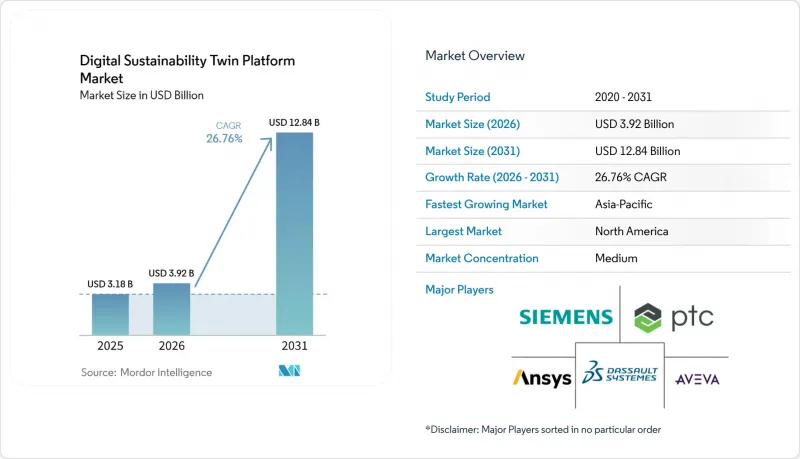
Mordor Intelligence에 의하면, 디지털 트윈 지속가능성 플랫폼 시장 규모는 2025년에 31억 8,000만 달러로 평가되었고 2026년에는 39억 2,000만 달러, 2031년까지 128억 4,000만 달러에 이를 것으로 예상되고 있어 2026년부터 2031년까지 CAGR 26.76%로 성장할 전망입니다.
본 보고서는 구성 요소(플랫폼 및 서비스), 배포 방식(클라우드 기반 등), 기업 규모(대기업 및 중소기업), 최종 사용 산업(산업 제조, 에너지·유틸리티, 건축·부동산, 물류 및 운송, 정부·스마트시티 등), 그리고 지역별로 분류되어 있습니다. 시장 전망은 금액(달러) 기준으로 제시되어 있습니다.
세계 디지털 트윈 지속가능성 플랫폼 시장 동향 및 인사이트
지속가능성 보고 및 탄소 회계에 대한 압박
EU의 ‘기업 지속가능성 보고 지침’에 따라 감사에 대응 가능한 지속가능성 데이터에 대한 필요성이 높아졌으며, 또한 ‘탄소 국경 조정 메커니즘’ 으로 인해 2026년 이후 탄소 보고가 재무적 위험과 더욱 직접적으로 연계됨에 따라, 디지털 트윈 지속가능성 플랫폼 시장의 규정 준수 필요성이 급격히 높아졌습니다. 이로 인해 수작업으로 처리되는 파일이나 단편화된 보고 체인에 의존하는 대신, 더 강력한 추적성을 바탕으로 배출량을 추적할 수 있는 플랫폼의 가치가 높아졌습니다. 2025년 12월 『Systems』지에 게재된 논문에 따르면, 지속가능성에 초점을 맞춘 디지털 트윈을 도입한 기업의 평균 ESG 점수는 0.79였던 반면, 도입하지 않은 기업은 0.72였습니다. 이 차이는 중요한 의미를 지닙니다. 투자자, 감사인, 규제 당국이 공개된 데이터의 양뿐만 아니라 데이터의 계보, 모델의 투명성, 보고 결과의 재현성에도 점점 더 주목하고 있기 때문입니다. 스프레드시트에 의존하는 방식을 고수하는 기업은 정적인 파일에서는 실시간 모델 환경만큼 운영상의 맥락이 명확하게 유지되지 않기 때문에 검증 작업의 부담이 커집니다. 따라서 각 배출량 값을 원자산, 공정 단계, 타임스탬프와 연계할 수 있는 벤더는 디지털 트윈 지속가능성 플랫폼 시장에서 규정 준수 주도형 수요를 확보하는 데 유리한 입장에 있습니다.
실시간 에너지 및 배출량 최적화에 대한 수요
디지털 트윈 지속가능성 플랫폼 시장 수요가 증가한 배경에는 구매자들이 단순히 지속가능성 보고의 투명성을 높일 뿐만 아니라, 측정 가능한 운영상의 이점을 체감하기 시작했다는 점도 꼽힙니다. 『Scientific Reports』지에 게재된 2026년 연구에 따르면, 전력 시스템 자산 관리 분야의 AI 기반 디지털 트윈은 송전망의 유연성을 저해하지 않으면서 변동성이 큰 재생에너지 도입률 97%를 지원함과 동시에 투자 ROI를 9.8% 향상시킨 것으로 나타났습니다. 시설 수준에서는 지멘스가 암베르크 스마트 팩토리에 도입한 AI 강화형 디지털 트윈을 통해 에너지 소비량을 25% 절감하고, CO2 배출량을 20% 감축했다고 보고했습니다. 이러한 성과는 운영 책임자 및 재무 팀에 도입에 대한 보다 직접적인 경제적 근거를 제공함으로써 구매자층을 확대하는 결과로 이어졌습니다. 특히 탄소 가격이나 공식 보고 요건이 주요 도입 요인이 되기 전부터, 에너지 절감 효과나 처리량 향상을 통해 투자를 정당화할 수 있는 경우 그 매력은 한층 더 높아집니다. 이것이 바로 디지털 트윈 지속가능성 플랫폼 시장이 지속가능성 도구로서뿐만 아니라 운영 도구로서도 주목받고 있는 이유입니다.
OT 시스템과 IT 시스템을 아우르는 고도의 통합 복잡성
디지털 트윈 지속가능성 플랫폼 시장에서 가장 어려운 운영상의 과제는 여전히 플랜트 시스템, 기업 소프트웨어 및 지속가능성 모델을 하나의 신뢰할 수 있는 환경으로 통합하는 작업입니다. 지속가능성 트윈에는 에너지 계량기, 설비 원격 측정 데이터, 공정 히스토리안 및 외부 탄소 요인으로부터의 시간 동기화된 데이터가 필요하지만, 이러한 데이터 스트림은 원래 연동되어 작동하도록 설계되지 않았습니다. 이는 제어 계층, 보고 도구 및 보안 조치가 수년에 걸쳐 별도의 단계로 구축되어 온 오래된 산업 시설에서는 더욱 어려워집니다. IEC 62443과 같은 표준은 사이버 보안 심사와 같은 필수적인 계층을 추가하지만, 동시에 연결된 산업 환경에서의 도입 일정을 연장하고 구현 부담을 가중시킵니다. 그 결과, 많은 프로젝트에서 가시화 단계에서 의사결정 지원 단계로 전환하는 데 구매자가 당초 예상했던 것보다 더 오랜 시간이 소요됩니다. 이 때문에 디지털 트윈 지속가능성 플랫폼 시장에서 통합 작업은 비용, 일정, 도입 위험의 핵심 요인으로 남아 있습니다.
부문 분석
2025년, 플랫폼 부문은 시장의 83.14%를 차지하며, 디지털 트윈 지속가능성 플랫폼 시장에서 기업의 구매 결정에 있어 핵심적인 위치를 계속 차지했습니다. 그 가치의 상당 부분은 시뮬레이션 엔진, 데이터 수집 도구, 워크플로우 제어, 탄소 모델링 프레임워크와 같은 핵심 소프트웨어 계층에 집중되어 있었습니다. 플랫폼은 운영 데이터, 지속가능성 지표 및 보고서 출력이 향후 어떻게 연계될지를 결정하기 때문에 구매자는 대개 이 단계에서 초기 투자의 대부분을 투입합니다. 지멘스는 2026년 1월, 실시간 OT 데이터 통합, 물리 기반 AI 시뮬레이션 및 지속가능성 KPI 대시보드를 단일 환경으로 통합한 ‘디지털 트윈 컴포저(Digital Twin Composer)’를 발표하며 이러한 접근 방식을 입증했습니다. 초기 고객 사례에서는 가상 시운전을 통해 설비 투자 비용을 10-15% 절감할 수 있었다고 보고되었으며, 이는 대규모 초기 플랫폼 계약 체결을 뒷받침하는 요인이 되었습니다.
서비스 시장은 2031년까지 연평균 성장률(CAGR) 30.28%를 나타낼 것으로 예측되며, 디지털 트윈 지속가능성 플랫폼 시장 규모 중 가장 빠르게 확대될 분야가 될 전망입니다. 이러한 추세는 도입 후 상황에 기인한 것입니다. 기반 시스템이 구축되면 모델 보정, 배출량 매핑, 시나리오 설계 및 보고 체계의 일관성이 더욱 중요해지기 때문입니다. 기업이 단일 거점에서 여러 거점으로 확장하고, 각 운영 환경에 따라 가정, 임계값, 거버넌스를 조정해야 할 필요가 생기면 서비스의 비즈니스 기회는 더욱 확대됩니다. 이러한 상황에서 서비스에 대한 지출은 일회성 도입 단계가 아닌 지속적인 요건이 됩니다. 스프링거 네이처는 2026년, 순환 경제의 디지털 트윈 프레임워크에서 운영 데이터를 실용적인 지속가능성 인텔리전스로 전환하기 위해서는 전문가에 의한 지속적인 설정이 필요하다고 보고했습니다. 이 조사 결과는 디지털 트윈 지속가능성 플랫폼 시장에서 서비스의 성장이 일시적인 도입 지원뿐만 아니라 구조적인 성숙도에 대한 요구와도 연결되어 있다는 견해를 뒷받침합니다.
2025년에는 클라우드 기반 도입이 시장의 66.83%를 차지하며, 디지털 트윈 지속가능성 플랫폼 시장 전체에서 가장 인기 있는 아키텍처 옵션이 되었습니다. 이러한 우위는 인프라 오버헤드가 낮고, 여러 거점에 걸친 확장이 용이하며, 통합된 탄소 데이터 및 운영 데이터의 집계를 보다 적절하게 지원할 수 있다는 점에서 비롯됩니다. 클라우드 환경은 기업이 분산된 자산 간에 공통된 보고 생성 로직을 적용하거나 시나리오 모델링 기능에 대한 접근을 신속하게 하고자 할 때 특히 유용합니다. 마이크로소프트는 2025년 4월, Enerjisa Uretim사가 Azure 디지털 트윈을 활용하여 수력, 풍력, 태양광 발전소에서 초당 5만 건 이상의 신호를 처리하는 동시에 실시간 모니터링과 발전 예측을 결합한 사례를 발표하며 이 모델의 규모를 보여주었습니다. 이 사례는 광범위한 자산에 대한 가시성과 통합된 지속가능성 로직이 필요한 조직에게 클라우드 아키텍처가 여전히 매력적인 이유를 여실히 보여줍니다.
하이브리드 배포는 2031년까지 연평균 성장률(CAGR) 31.46%를 나타낼 것으로 예측되며, 많은 사용자가 On-Premise 시스템에서 완전히 전환하기보다는 혼합 아키텍처를 선택하고 있음을 알 수 있습니다. 자산 집약적 운영에서는 특히 지연, 프로세스 안정성, 플랜트 안전성이 여전히 중요한 경우, 시간적 제약이 있는 의사결정을 위해 강력한 On-Premise 제어가 여전히 필요합니다. 반면, 클라우드 리소스는 탄소 배출량 시뮬레이션, 시나리오 테스트 및 사업장 간 지속가능성 보고에 유용합니다. 즉, 가장 빠르게 성장하고 있는 이 모델에서는 운영 관리를 자산 근처에 유지하면서, 부하가 높은 분석 및 정보 공개 워크로드를 공유 컴퓨팅을 통해 확장하기 쉬운 곳에 배치하고 있습니다. 따라서 디지털 트윈 지속가능성 플랫폼 시장은 모든 최종 사용자에게 획일적인 아키텍처를 강요하기보다는 산업별 고유한 제약 조건에 적응해 나가고 있습니다. 운영 환경이 복잡하고 가동 시간 요건이 까다로운 부문에서의 도입이 확대됨에 따라, 이러한 균형은 앞으로도 계속 중요할 것입니다.
지역별 분석
2025년, 북미는 디지털 트윈 지속가능성 플랫폼 시장 점유율의 36.26%를 차지했으며, 그 수요의 대부분은 미국에서 비롯되었습니다. 에너지, 산업 제조, 상업용 부동산 분야의 대규모 도입이 이러한 우위를 뒷받침했습니다. 또한, 이 지역은 하이퍼스케일러가 제공하는 탄탄한 인프라의 혜택을 받아, 이를 통해 여러 거점에 걸친 클라우드 기반 도입의 장벽이 낮아졌습니다. AVEVA와 Amazon Web Services는 2026년 5월, 디지털 트윈 기능 및 공동 마이그레이션 프로그램을 포함하는 클라우드 기반 산업 인텔리전스에 초점을 맞춘 다년간의 제휴를 통해 그 입지를 강화했습니다. 캐나다와 멕시코의 기여도는 여전히 미미하지만, 공급망 투명성에 대한 요구 사항이 해당 지역의 성장을 지속적으로 뒷받침하고 있습니다.
아시아태평양은 2031년까지 연평균 성장률(CAGR) 29.24%를 나타낼 것으로 예측되며, 디지털 트윈 지속가능성 플랫폼 시장에서 가장 빠르게 확장되는 지역이 될 전망입니다. 중국의 ‘이산화탄소 배출 정점 달성 및 탄소 중립’ 정책은 대규모 도입 기회를 창출하고 있으며, 신화통신 보도에 따르면 하이얼의 ‘Kaoshu COSMOPlat’은 에너지 이용률이 80%를 초과하고, 시설당 연간 3만 2,600톤의 CO2 감축을 실현하는 제로카본 산업단지를 지원했습니다. 일본도 그 입지를 강화하고 있으며, 히타치 에너지는 2026년 4월, 송배전망 인프라 전체의 수명 주기 동안의 환경적 영향을 가시화하는 ‘EcoSpace’를 출시했습니다. 인도, 한국, 호주, 뉴질랜드에서는 산업용 AI, 스마트 빌딩, 에너지 전환 프로그램이 더 우수한 지속가능성 데이터와 자산 가시성에 대한 수요를 창출하며 시장에 활력을 불어넣고 있습니다.
2025년, 유럽은 지역별 점유율에서 2위를 차지했으며, 독일, 영국, 프랑스가 계속해서 주요 기여 시장으로 자리매김했습니다. 이 지역의 강점은 규제 밀도에 있으며, CSRD, CBAM, EU 택소노미, ESPR 및 공급망 실사 규정이 산업 밸류체인 전반에 걸쳐 감사 가능한 지속가능성 데이터의 가치를 높였기 때문입니다. 프랑스에서는 2026년 4월 각 지역을 대상으로 한 국가 디지털 트윈 프로그램을 통해 공공 부문의 성장 동력이 더해졌습니다. 한편, 지역 전체의 보급은 규정 준수에 대한 강력한 수요에 의해 지속적으로 뒷받침되었습니다. 남미, 중동 및 아프리카는 절대적 규모로는 여전히 작았으나, 스마트 시티 프로그램 및 에너지 전환에 대한 지출로 인해 중요한 성장 분야로서의 위상을 유지했습니다. 이 지역들에서는 광범위한 민간 부문에서의 확산보다는 유틸리티, 인프라, 공공 투자와 같은 이용 사례에 도입이 집중되는 경향이 나타났습니다.
기타 혜택:
- 엑셀 형식 시장 예측(ME) 시트
- 3개월간의 애널리스트 지원
자주 묻는 질문
목차
제1장 서론
제2장 조사 방법
제3장 주요 요약
제4장 시장 구도
제5장 시장 규모와 성장 예측
제6장 경쟁 구도
제7장 시장 기회와 향후 전망
JHS 26.08.07According to Mordor Intelligence, the digital sustainability twin platform market size was valued at USD 3.18 billion in 2025 and is expected to reach USD 3.92 billion in 2026 and USD 12.84 billion by 2031, growing at a CAGR of 26.76% from 2026 to 2031.
This report is Segmented by Component (Platform, and Services), Deployment Mode (Cloud-Based, and More), Enterprise Size (Large Enterprises, and SMEs), End-User Industry (Industrial Manufacturing, Energy and Utilities, Buildings and Real Estate, Logistics and Transportation, Government and Smart Cities, and More), and Geography. The Market Forecasts are Provided in Terms of Value (USD).
Global Digital Sustainability Twin Platform Market Trends and Insights
Sustainability Reporting and Carbon Accounting Pressure
The compliance case for the digital sustainability twin platform market strengthened sharply as the EU Corporate Sustainability Reporting Directive increased the need for audit-ready sustainability data, and the Carbon Border Adjustment Mechanism tied carbon reporting more directly to financial exposure from 2026 onward. This raised the value of platforms that can track emissions with stronger traceability rather than rely on manual files and fragmented reporting chains. A December 2025 paper in Systems reported that companies using sustainability-focused digital twins had an average ESG score of 0.79, compared with 0.72 for non-adopters. That gap matters because investors, auditors, and regulators increasingly look beyond disclosure volume and focus more on data lineage, model transparency, and repeatability of reported results. Companies that stay with spreadsheet-heavy methods face higher verification effort because static files do not preserve operational context as clearly as live model environments. Vendors that can connect each emissions value to the source asset, process step, and time stamp are therefore better placed to win compliance-led demand in the digital sustainability twin platform market.
Real-Time Energy and Emissions Optimization Demand
Demand in the digital sustainability twin platform market also rose because buyers started to see measurable operating gains, not just cleaner sustainability reporting. A 2026 study in Scientific Reports showed that AI-driven digital twins in power system asset management improved investment ROI by 9.8% while supporting 97% variable renewable energy penetration without reducing grid flexibility. At the facility level, Siemens reported that its AI-enhanced digital twin deployment at the Amberg Smart Factory reduced energy consumption by 25% and cut CO2 emissions by 20%. These results widened the buyer base because they gave operations leaders and finance teams a more direct economic case for adoption. The appeal is especially strong when energy savings and throughput gains can justify investment even before carbon prices or formal reporting requirements become the main trigger. This is why the digital sustainability twin platform market is gaining traction as an operations tool as much as a sustainability tool.
High Integration Complexity Across OT And IT Systems
The hardest operating challenge in the digital sustainability twin platform market remains the job of bringing plant systems, enterprise software, and sustainability models into one dependable environment. Sustainability twins require time-synchronized data from energy meters, equipment telemetry, process historians, and external carbon factors, and those data streams were not originally designed to work together. This becomes more difficult in older industrial sites where control layers, reporting tools, and security practices were built in separate stages over many years. Standards such as IEC 62443 add a necessary layer of cybersecurity review, but they also extend deployment timelines and increase implementation effort for connected industrial environments. The result is that many projects take longer to move from visibility to decision support than buyers first expect. This keeps integration work near the center of cost, timing, and adoption risk in the digital sustainability twin platform market.
Other drivers and restraints analyzed in the detailed report include:
- Industry 4.0 Expansion Across Asset-Intensive Operations
- Cloud and AI-Enabled Simulation Scalability
- Shortage of Simulation, Data Fusion, and Sustainability Modeling Talent
For complete list of drivers and restraints, kindly check the Table Of Contents.
Segment Analysis
The platform segment held 83.14% of the market in 2025, which kept it at the center of enterprise buying decisions in the digital sustainability twin platform market. Much of that value sat in core software layers such as simulation engines, data ingestion tools, workflow controls, and carbon modeling frameworks. Buyers often commit most of their initial spend at this stage because the platform determines how operating data, sustainability metrics, and reporting outputs will connect later. Siemens illustrated this approach in January 2026 when it introduced Digital Twin Composer with real-time OT data integration, physics-based AI simulation, and sustainability KPI dashboards in a single environment. Early customer use reported 10-15% capital expenditure reductions through virtual commissioning, which helped support large upfront platform contracts.
Services are projected to grow at 30.28% CAGR through 2031, making them the faster-moving part of the digital sustainability twin platform market size. This pattern reflects what happens after deployment, because model calibration, emissions mapping, scenario design, and reporting alignment become more important once the base system is in place. The services opportunity expands further when companies move from one site to many sites and need to adjust assumptions, thresholds, and governance across each operating context. In that setting, service spending becomes a recurring requirement rather than a one-time implementation step. Springer Nature reported in 2026 that circular economy digital twin frameworks require ongoing expert configuration to turn operational data into actionable sustainability intelligence. That finding supports the view that services growth in the digital sustainability twin platform market is tied to structural maturity needs, not just temporary rollout support.
Cloud-based deployment accounted for 66.83% of the market in 2025, making it the most popular architecture choice across the digital sustainability twin platform market. Its lead came from lower infrastructure overhead, easier scaling across multiple sites, and better support for centralized carbon and operational data aggregation. Cloud environments are especially useful when companies want shared reporting logic across distributed assets and faster access to scenario modeling capacity. Microsoft showed the scale of this model in April 2025 when it said Enerjisa Uretim used Azure Digital Twins to process more than 50,000 signals per second from hydropower, wind, and solar plants while combining real-time monitoring with production forecasting. That example highlights why cloud architecture remains attractive for organizations that need broad asset visibility and consolidated sustainability logic.
Hybrid deployment is projected to grow at 31.46% CAGR through 2031, which shows that many users are choosing a mixed architecture instead of a full move away from local systems. Asset-intensive operations still need strong local control for time-sensitive decisions, especially where latency, process stability, and plant safety remain critical. At the same time, cloud resources are useful for carbon simulation, scenario testing, and cross-site sustainability reporting. This means the fastest-growing model keeps operational control close to the asset while placing heavier analytics and disclosure workloads where shared computing is easier to scale. The digital sustainability twin platform market is therefore adapting to industrial constraints rather than forcing a uniform architecture on every end user. That balance should remain important as adoption expands in sectors with complex operating environments and strict uptime requirements.
Complete Report Scope:
- By Component
- Platform
- Services
- By Deployment Mode
- Cloud-Based
- On-Premises
- Hybrid
- By Enterprise Size
- Large Enterprises
- SMEs
- By End-User Industries
- Industrial Manufacturing
- Energy and Utilities
- Buildings and Real Estate
- Logistics and Transportation
- Government and Smart Cities
- Other End-User Industries
- By Geography
- North America
- United States
- Canada
- Mexico
- South America
- Brazil
- Argentina
- Rest of South America
- Europe
- Germany
- United Kingdom
- France
- Spain
- Italy
- Russia
- Rest of Europe
- Asia-Pacific
- China
- India
- Japan
- South Korea
- Australia and New Zealand
- Rest of Asia-Pacific
- Middle East
- Saudi Arabia
- United Arab Emirates
- Turkey
- Rest of Middle East
- Africa
- South Africa
- Nigeria
- Egypt
- Rest of Africa
- North America
Geography Analysis
North America held 36.26% of the digital sustainability twin platform market share in 2025, with the United States accounting for most of the region's demand. Large deployments in energy, industrial manufacturing, and commercial real estate supported this lead. The region also benefited from deep hyperscaler infrastructure, which reduced friction for multi-site cloud-based implementations. AVEVA and Amazon Web Services strengthened that position in May 2026 through a multi-year collaboration focused on industrial intelligence in the cloud, including digital twin capabilities and joint migration programs. Canada and Mexico remained smaller contributors, but supply chain transparency requirements continued to support regional expansion.
Asia-Pacific is projected to grow at 29.24% CAGR through 2031, making it the fastest-expanding geography in the digital sustainability twin platform market. China's dual-carbon policy is creating large-scale deployment opportunities, and Xinhua reported that Haier's Kaoshu COSMOPlat supported zero-carbon industrial parks with energy utilization rates above 80% and annual CO2 reductions of 32,600 tonnes per installation. Japan is also strengthening its position, and Hitachi Energy launched EcoSpace in April 2026 to visualize lifecycle environmental impacts across transmission and distribution grid infrastructure. India, South Korea, Australia, and New Zealand are adding momentum as industrial AI, smart building, and energy transition programs create demand for better sustainability data and asset visibility.
Europe held the second-largest regional share in 2025, and Germany, the United Kingdom, and France remained the main contributor markets. The region's strength came from regulatory density because CSRD, CBAM, the EU Taxonomy, ESPR, and supply chain due diligence rules all increased the value of auditable sustainability data across industrial value chains. France added a public-sector growth layer in April 2026 through its national digital twin program for territories, while broader regional adoption continued to benefit from strong compliance demand. South America, the Middle East, and Africa remained smaller in absolute value, but smart city programs and energy transition spending kept them relevant growth pockets. In these regions, adoption stayed more concentrated in utility, infrastructure, and public investment use cases than in broad private-sector rollouts.
- Siemens AG
- Dassault Systemes SE
- PTC Inc.
- Ansys, Inc.
- AVEVA Group Limited
- Bentley Systems, Incorporated
- Autodesk, Inc.
- IBM Corporation
- Microsoft Corporation
- Amazon Web Services, Inc.
- SAP SE
- Schneider Electric SE
- GE Vernova Inc.
- Rockwell Automation, Inc.
- Cognite AS
- Hitachi, Ltd.
- Oracle Corporation
- Altair Engineering Inc.
- AspenTech
- Honeywell International, Inc.
Additional Benefits:
- The market estimate (ME) sheet in Excel format
- 3 months of analyst support
TABLE OF CONTENTS
1 INTRODUCTION
- 1.1 Study Assumptions and Market Definition
- 1.2 Scope of the Study
2 RESEARCH METHODOLOGY
3 EXECUTIVE SUMMARY
4 MARKET LANDSCAPE
- 4.1 Market Overview
- 4.2 Market Drivers
- 4.2.1 Sustainability Reporting and Carbon Accounting Pressure
- 4.2.2 Real-Time Energy and Emissions Optimization Demand
- 4.2.3 Industry 4.0 Expansion Across Asset-Intensive Operations
- 4.2.4 Cloud and AI-Enabled Simulation Scalability
- 4.2.5 Digital Twin Readiness for Smart Buildings and Smart Cities
- 4.2.6 Operational Resilience Planning Under Climate and Supply Chain Volatility
- 4.3 Market Restraints
- 4.3.1 High Integration Complexity Across OT and IT Systems
- 4.3.2 Shortage of Simulation, Data Fusion, and Sustainability Modeling Talent
- 4.3.3 Data Governance, Cybersecurity, and Model Assurance Concerns
- 4.3.4 Long Payback Period for Multi-Site Sustainability Twin Deployments
- 4.4 Industry Value Chain Analysis
- 4.5 Impact of Macroeconomic Factors on the Market
- 4.6 Regulatory Landscape
- 4.7 Technological Outlook
- 4.8 Porter's Five Forces Analysis
- 4.8.1 Bargaining Power of Suppliers
- 4.8.2 Bargaining Power of Buyers
- 4.8.3 Threat of New Entrants
- 4.8.4 Threat of Substitutes
- 4.8.5 Intensity of Competitive Rivalry
5 MARKET SIZE AND GROWTH FORECASTS (VALUE)
- 5.1 By Component
- 5.1.1 Platform
- 5.1.2 Services
- 5.2 By Deployment Mode
- 5.2.1 Cloud-Based
- 5.2.2 On-Premises
- 5.2.3 Hybrid
- 5.3 By Enterprise Size
- 5.3.1 Large Enterprises
- 5.3.2 SMEs
- 5.4 By End-User Industries
- 5.4.1 Industrial Manufacturing
- 5.4.2 Energy and Utilities
- 5.4.3 Buildings and Real Estate
- 5.4.4 Logistics and Transportation
- 5.4.5 Government and Smart Cities
- 5.4.6 Other End-User Industries
- 5.5 By Geography
- 5.5.1 North America
- 5.5.1.1 United States
- 5.5.1.2 Canada
- 5.5.1.3 Mexico
- 5.5.2 South America
- 5.5.2.1 Brazil
- 5.5.2.2 Argentina
- 5.5.2.3 Rest of South America
- 5.5.3 Europe
- 5.5.3.1 Germany
- 5.5.3.2 United Kingdom
- 5.5.3.3 France
- 5.5.3.4 Spain
- 5.5.3.5 Italy
- 5.5.3.6 Russia
- 5.5.3.7 Rest of Europe
- 5.5.4 Asia-Pacific
- 5.5.4.1 China
- 5.5.4.2 India
- 5.5.4.3 Japan
- 5.5.4.4 South Korea
- 5.5.4.5 Australia and New Zealand
- 5.5.4.6 Rest of Asia-Pacific
- 5.5.5 Middle East
- 5.5.5.1 Saudi Arabia
- 5.5.5.2 United Arab Emirates
- 5.5.5.3 Turkey
- 5.5.5.4 Rest of Middle East
- 5.5.6 Africa
- 5.5.6.1 South Africa
- 5.5.6.2 Nigeria
- 5.5.6.3 Egypt
- 5.5.6.4 Rest of Africa
- 5.5.1 North America
6 COMPETITIVE LANDSCAPE
- 6.1 Market Concentration
- 6.2 Strategic Moves
- 6.3 Market Share Analysis
- 6.4 Company Profiles (includes Global Level Overview, Market Level Overview, Core Segments, Financials as available, Strategic Information, Market Rank/Share, Products and Services, Recent Developments)
- 6.4.1 Siemens AG
- 6.4.2 Dassault Systemes SE
- 6.4.3 PTC Inc.
- 6.4.4 Ansys, Inc.
- 6.4.5 AVEVA Group Limited
- 6.4.6 Bentley Systems, Incorporated
- 6.4.7 Autodesk, Inc.
- 6.4.8 IBM Corporation
- 6.4.9 Microsoft Corporation
- 6.4.10 Amazon Web Services, Inc.
- 6.4.11 SAP SE
- 6.4.12 Schneider Electric SE
- 6.4.13 GE Vernova Inc.
- 6.4.14 Rockwell Automation, Inc.
- 6.4.15 Cognite AS
- 6.4.16 Hitachi, Ltd.
- 6.4.17 Oracle Corporation
- 6.4.18 Altair Engineering Inc.
- 6.4.19 AspenTech
- 6.4.20 Honeywell International, Inc.
7 MARKET OPPORTUNITIES AND FUTURE OUTLOOK
- 7.1 White-Space and Unmet-Need Assessment


