

|
시장보고서
상품코드
2099769
공항 및 항만 연결용 광섬유 인프라 : 시장 점유율 분석, 업계 동향 및 통계, 성장 예측(2026-2031년)Fiber Optic Infrastructure For Airports and Seaports Connectivity - Market Share Analysis, Industry Trends & Statistics, Growth Forecasts (2026 - 2031) |
||||||
 Mordor Intelligence
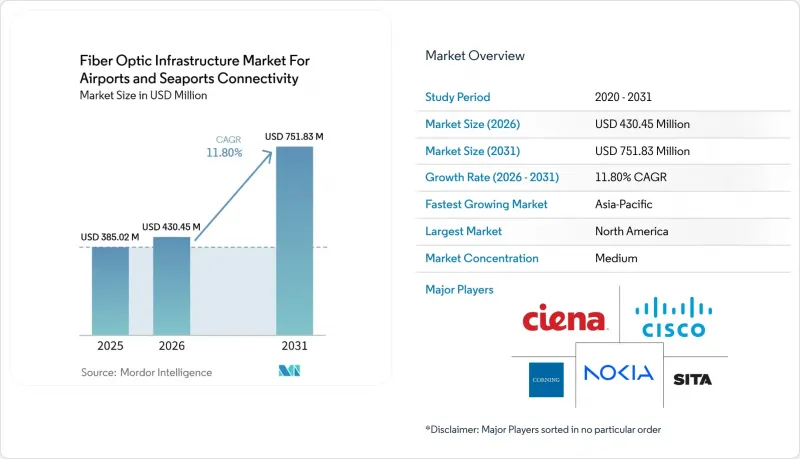
Mordor Intelligence에 의하면, 공항 및 항만 연결용 광섬유 인프라 시장은 2025년 3억 8,502만 달러로 평가되었습니다. 2026년에는 4억 3,045만 달러로 확대되어 2031년까지 7억 5,183만 달러에 이를 것으로 예상되고 2026년부터 2031년에 걸쳐 CAGR 11.80%로 성장할 전망입니다.
본 보고서는 구성 요소별(광섬유 케이블, 커넥터 및 어댑터 등), 연결 유형별(패시브 광 LAN, 액티브 광 네트워크 등), 용도별(여객 터미널 연결 등), 최종 사용자별(공항 및 항만 운영 사업자 등), 지역별로 분류되어 있습니다. 시장 전망은 금액(달러) 기준으로 제시되어 있습니다.
공항 및 항만 연결용 광섬유 인프라 시장 인사이트 및 동향
공항 및 항만의 디지털 전환이 네트워크 투자를 주도
공항 및 항만 연결용 광섬유 인프라 시장은 터미널, 화물 구역, 제어 시스템 전반에 걸친 연결형 운영으로의 광범위한 전환의 혜택을 받고 있습니다. 공항에서는 더 많은 서비스를 공유 디지털 플랫폼으로 이전하고 있으며, 이러한 전환으로 인해 여러 미션 크리티컬 기능을 동시에 지원할 수 있는 대용량 광섬유 백본의 가치가 높아지고 있습니다. 항만에서도 유사한 추세가 나타나고 있으며, 디지털 물류, 설비 모니터링, 스마트 항만 용도는 부지 전체에 걸친 안정적이고 지연 시간이 짧은 연결에 의존하고 있습니다. 발렌시아 항구는 2025년 1월, 자사의 ‘스마트포트 4.0’ 프레임워크를 지원하기 위해 독자적인 프라이빗 5G 네트워크를 가동했습니다. 이는 항만에서의 디지털 전환이 더욱 견고한 기반이 되는 연결 인프라와 밀접하게 연관되어 있음을 보여줍니다. 항공 분야에서는 FAA(연방항공청)의 2026년도 예산안에서 통신 현대화와 IP 기반 인프라가 중점적으로 다루어지고 있으며, 이는 공항 환경 전반에 걸친 광범위한 백본 업그레이드의 필요성을 뒷받침하고 있습니다. 공항 및 항만 운영 사업자들이 여러 시스템을 동시에 현대화하고 있기 때문에 공항 및 항만 연결용 광섬유 인프라 시장에서는 완만하고 꾸준한 업데이트 주기가 아닌 집중적인 조달 활동이 나타나고 있습니다.
내결함성 요건이 항공 허브에서의 구리선에서 광섬유로의 전환을 가속화
공항 및 항만 연결용 광섬유 인프라 시장은 주요 항공 허브에서 더 탄력적인 통신에 대한 수요에 의해서도 뒷받침되고 있습니다. 기존의 구리선 네트워크는 유지 관리가 어렵고, 사업자가 더 높은 용량, 더 깨끗한 신호 성능, 그리고 간섭에 대한 더 뛰어난 내성을 필요로 할 경우 선택지가 제한됩니다. FAA의 2026년도 예산 자료에서는 통신 인프라, 음성 교환 및 공항 케이블 루프 유지 관리에 대한 지속적인 투자가 강조되고 있으며, 이 모든 것이 백본 현대화를 위한 긴 여정을 시사하고 있습니다. L3Harris는 2026년 5월, FAA의 통신 현대화 사업의 50% 이상을 완료했으며, 기존의 구리선 및 시분할 다중(TDM) 기술을 고속 광섬유, 무선, 위성 링크로 대체하고 있다고 발표했습니다. 이 회사는 또한 이 프로그램을 통해 매달 150-200개의 새로운 네트워크 경로가 구축되고 있으며, 2027년 완료를 향해 순조롭게 진행되고 있다고 밝혔습니다. 이는 내결함성을 중시한 업그레이드가 단순한 계획의 주제가 아니라 이미 본격적으로 진행 중임을 보여줍니다. 이에 따라 공항 및 항만 연결용 광섬유 인프라 시장은 단순한 대역폭 확대뿐만 아니라 신뢰성 향상이라는 과제와도 밀접하게 연결되어 있습니다.
고액의 토목 공사 및 부지 정비 비용이 도입 속도를 제한
공항 및 항만 연결용 광섬유 인프라 시장은 가동 중인 공항이나 항만 내 설치 시 비용이 많이 들고 운영에 지장을 초래하기 때문에 여전히 근본적인 실행상의 과제에 직면해 있습니다. 시공사는 활주로, 유도로, 컨테이너 야드, 보안 구역 및 포장 면을 피해서 작업을 수행해야 하며, 이로 인해 공사가 지연되고 설치 비용이 케이블 자체의 비용을 훨씬 상회하는 수준으로 치솟고 있습니다. FAA(연방항공청)의 예산 문서에 따르면, 공항의 케이블 루프 시스템에는 전용 유지 관리 자금이 필요하다는 점이 명시되어 있으며, 이는 운영 중인 공항에서의 지하 통신 공사가 일회성 사업이 아니라 지속적인 인프라 부담임을 여실히 보여줍니다. 소규모 지방 시설의 경우, 이러한 현장 상황으로 인해 현대화가 지연될 수 있습니다. 이는 일반적으로 자금이 우선적으로 안전 대책, 에이프런 또는 터미널의 필요에 배정되기 때문입니다. 따라서 공항 및 항만 연결용 광섬유 인프라 시장은 운영자가 통신 설비 업그레이드를 대규모 재개발 계획과 결합할 수 있는 지역에서 가장 빠르게 확대되고 있습니다. 비용 제약이 있는 환경에서는 가동 중인 운영을 방해하지 않도록 작업을 단계적으로 진행해야 하므로, 도입 속도는 잠재 수요에 미치지 못하는 상태입니다.
부문 분석
2025년, 공항 및 항만 연결용 광섬유 인프라 시장에서 광섬유 케이블은 45.12%의 점유율을 차지했습니다. 이는 공항 및 항만 시스템 전체에서 기반이 되는 물리 계층으로서의 역할을 반영한 것입니다. 케이블 부문은 여전히 교체 수요에 힘입고 있습니다. 이는 오래된 교통 허브가 여전히 유지보수가 어렵고 현재의 데이터 부하에 적합하지 않은 구리선 기반 통신 자산에 의존하고 있기 때문입니다. 또한, 공항 및 항만 연결용 광섬유 인프라 시장에서도 케이블이 선호되는 경향이 있습니다. 이는 공항이나 항만에서 장거리에 걸친 신호의 무결성, 간섭에 대한 내성, 그리고 향후 용량 확장을 위한 여유가 요구되기 때문입니다. 커넥터, 스플리터, 증폭기 등의 수동형 장비는 사업자가 터미널, 주변 지역, 장비 구역 전체에 링크를 얼마나 효율적으로 확장할 수 있는지를 결정짓기 때문에 중요한 중간적 위치를 차지하고 있습니다. 사업자가 설비 설계를 간소화하고 광대한 부지 내의 능동 연결 지점을 줄이려고 노력함에 따라, 이러한 장비의 역할은 점점 더 중요해지고 있습니다.
트랜시버 및 광 모듈은 가장 빠르게 성장하는 부품군으로, 2026년부터 2031년까지 연평균 성장률(CAGR) 11.23%를 나타낼 것으로 전망됩니다. 공항 및 항만 연결용 광섬유 인프라 시장에서 이 분야는 더욱 스마트한 교통 처리, 더욱 풍부한 모니터링 스트림, 그리고 더욱 고도로 연결된 현장 자산으로의 전환이라는 이점을 누리고 있으며, 이 모든 요소가 능동형 광 성능의 가치를 높이고 있습니다. 이전 업그레이드 주기에서 이미 광섬유를 설치한 사업자들은 현재, 설치된 설비에서 더 많은 처리량을 끌어내기 위해 능동 계층을 재검토하고 있습니다. 코닝(Corning)과 노키아(Nokia)는 2025년 11월, EMEA 및 APAC 지역을 대상으로 패시브 및 액티브 광 LAN 제품을 통합한 공동 솔루션을 발표했습니다. 이는 벤더들이 네트워크 스택 전반에 걸친 통합의 격차를 최소화하고자 하는 고객을 타겟으로 삼고 있음을 보여줍니다. 코닝은 또한 이 통합 솔루션이 1Gbps에서 100Gbps 속도를 지원하며, 기존 구리선과 비교해 배선 비용 및 총 소유 비용을 절감할 수 있다고 밝혔는데, 이는 복잡한 캠퍼스 환경에서 능동형 광 업그레이드를 도입해야 할 이유를 더욱 확고히 하고 있습니다. 그 결과, 공항 및 항만 연결용 광섬유 인프라 시장은 단순한 케이블 수량을 넘어, 지능화, 관리, 수명 주기 갱신에 따른 수익을 포함하는 더 높은 부가가치를 지닌 구조로 전환되고 있습니다.
2025년에는 메트로 및 백홀용 광섬유가 35.03%의 점유율을 차지하며, 공항 및 항만 연결용 광섬유 인프라 시장에서 여전히 최대 연결 계층으로서의 지위를 유지했습니다. 공항과 항만은 현장 운영, 광역 네트워크, 그리고 외부 제어 및 물류 시스템 간의 견고한 연결에 의존하고 있기 때문에 이러한 위상은 타당합니다. 또한, 공항 및 항만 연결용 광섬유 인프라에서 메트로 및 백홀 회선은 화물 조정, 지휘 기능, 원격 액세스, 그리고 더 광범위한 기업 간 데이터 교환의 기반이 되기 때문에 전략적인 역할을 담당하고 있습니다. 해저 케이블 및 잠수 케이블 회선은 연결 자산과 물류 인프라가 겹치기 시작하는 항만 환경에서 전략적 중요성이 높아지고 있습니다. 이러한 중첩으로 인해 동일한 장소에서 운영 트래픽과 더 광범위한 네트워크 상호 연결 요구를 모두 지원할 수 있으므로, 항만 측의 디지털 인프라에 대한 비즈니스 사례가 강화될 가능성이 있습니다.
패시브 광 LAN은 2031년까지 연평균 성장률(CAGR)이 12.34%를 나타낼 것으로 예측되어 가장 빠른 성장이 전망됩니다. 공항 및 항만 연결용 광섬유 인프라 시장에서는 이 모델이 지지를 받고 있습니다. 이는 터미널 운영 사업자들이 더 단순한 아키텍처, 능동형 플로어 스위치의 감소, 그리고 건물 전체 및 원격 지원 영역에 걸친 중앙 집중식 관리의 용이성을 요구하고 있기 때문입니다. 코닝(Corning)은 노키아(Nokia)와의 제휴가 Wi-Fi 7, 클라우드, IoT, 스마트 빌딩 이용 사례를 위해 기존의 구리선을 단일 고속 광섬유 네트워크로 대체하는 것을 목표로 하며, 이는 공항 터미널 및 물류 캠퍼스의 요구 사항과 밀접하게 부합한다고 밝혔습니다. 해당 보도자료에 따르면, 이 솔루션은 구리선 기반 설계에 비해 배선을 70% 줄이고 총 소유 비용(TCO)을 50% 절감할 수 있다고 합니다. 이는 자산의 장기적인 수명과 유지보수 부담 감소를 추구하는 복잡한 교통 허브에서 광 LAN이 매력적인 이유를 설명해 줍니다. 실제로 패시브 광 LAN은 공항 및 항만 연결용 광섬유 인프라 시장에 신규 터미널 프로젝트나 기존 시설의 대규모 배선 교체 프로그램에 진입할 기회를 제공합니다. 또한 패시브 장비, 능동형 전자 기기, 네트워크 관리를 단일 제안으로 패키지화할 수 있는 벤더의 입지를 강화하는 데에도 기여합니다.
지역별 분석
2025년, 북미는 32.13%라는 최대의 지역 점유율을 차지하며, 공항 및 항만 연결용 광섬유 인프라 시장에서 최대의 입지를 확립했습니다. 이 지역을 주도하는 것은 미국이며, 미국에서는 항공 통신 현대화가 초기 계획 단계가 아닌, 이미 활발하게 전개되고 있습니다. 2026년도 FAA(연방항공청) 예산 자료에서는 통신 인프라, 음성 교환 및 공항 케이블 루프 유지 관리에 대한 대규모 지출이 강조되었으며, 이 모든 것은 항공 자산 전반에 걸친 지속적인 업그레이드 주기를 뒷받침하는 것입니다. L3Harris는 2026년 5월, 전미 규모의 FAA 현대화 사업 진행률이 50%를 넘어섰다고 발표하며, 2027년 완료를 목표로 프로그램을 순조롭게 진행하기 위해 해당 연도 내에 175명의 인력을 증원할 것이라고 밝혔습니다. 이러한 진전에 힘입어 북미는 지출 전망, 실행 규모, 그리고 확고한 공급업체 기반을 모두 갖추고 있어 공항 및 항만 연결용 광섬유 인프라 시장의 핵심으로 자리매김하고 있습니다.
아시아태평양은 2031년까지 12.34%라는 지역별 최고 연평균 성장률(CAGR)을 보일 것으로 예측됩니다. 이 지역에서는 신규 공항 건설, 스마트 항만 투자, 그리고 전체 교통 인프라에 걸친 디지털 운영 모델 도입에 대한 의욕 고조가 맞물려 공항 및 항만 연결용 광섬유 인프라 시장이 급속히 확대되고 있습니다. 발렌시아 항구는 이 지역 외부에 위치하지만, 해당 항구의 프라이빗 5G 사례는 아시아태평양 항만들이 운영 기술의 현대화를 추진하는 과정에서 우선시하고 있는 컨테이너, 설비, 감시에 관한 활용 사례 중 하나를 보여줍니다. 또한, 이 지역의 성장 추세는 그린필드 인프라에 의해서도 뒷받침되고 있습니다. 이를 통해 사업자는 오래된 시설을 개조하는 대신, 처음부터 광섬유 기반 아키텍처를 구축할 수 있게 됩니다.
2025년에는 유럽, 중동 및 아프리카, 남미가 기타 지역 기반을 형성했으며, 그중에서도 유럽은 북미를 제외한 지역 중 기술적으로 가장 성숙한 지역으로 두각을 나타냈습니다. 유럽의 공항 및 항만 연결용 광섬유 인프라 시장은 표준의 적극적인 채택, 대규모 캠퍼스 환경, 그리고 광 LAN 및 액티브 계층 업데이트 프로그램에 대응 가능한 기존 시설 기반의 혜택을 받고 있습니다. 코닝(Corning)은 노키아(Nokia)와의 기업용 광통신 분야 제휴가 EMEA 및 APAC 전역에서 이용 가능하다고 발표했습니다. 이는 각 벤더들이 유럽 및 인근 시장을 대규모 캠퍼스 내 광통신 현대화의 적극적인 목표로 삼고 있음을 보여줍니다. 싱가포르에서는 해운항만청이 광섬유 케이블 부설 작업에 관한 ‘2025년 항만 해양 공고 제119호’를 발간했습니다. 이는 세계 유수의 주요 항만 생태계 중 하나에서 연결 인프라 구축이 지속되고 있음을 시사합니다. 남미와 중동 및 아프리카의 일부 지역에서는 여전히 프로젝트 주도형 경향이 강한 반면, 공항 확장, 항만 자동화, 디지털 회랑 계획이 추진되고 있어 공항 및 항만의 연결 인프라 시장에 대한 기여는 계속되고 있습니다. 따라서 이 지역의 상황은 선진 시장의 성숙한 갱신 수요와 개발도상 시장의 선택적 확장 수요가 결합된 형태를 띠고 있습니다.
기타 혜택 :
- 엑셀 형식 시장 예측(ME) 시트
- 3개월간의 애널리스트 지원
자주 묻는 질문
목차
제1장 서론
제2장 조사 방법
제3장 주요 요약
제4장 시장 구도
제5장 시장 규모 및 성장 예측
제6장 경쟁 구도
제7장 시장 기회 및 향후 전망
KTH 26.08.10According to Mordor Intelligence, the fiber optic infrastructure market for airports and seaports connectivity is expected to increase from USD 385.02 million in 2025 to USD 430.45 million in 2026 and reach USD 751.83 million by 2031, growing at a CAGR of 11.80% over 2026-2031.
This report is Segmented by Component (Fiber Optic Cable, Connectors and Adapters, and More), Connectivity Type (Passive Optical LAN, Active Optical Network, and More), Application (Passenger Terminal Connectivity, and More), End User (Airports and Ports Operators, and More), and Geography. The Market Forecasts are Provided in Terms of Value (USD).
Insights and Trends of Fiber Optic Infrastructure Market For Airports and Seaports Connectivity
Airport and Seaport Digital Transformation Drives Network Investment
The fiber optic infrastructure market for airports and seaports connectivity is benefiting from a broad shift toward connected operations across terminals, cargo areas, and control systems. Airports are moving more services onto shared digital platforms, and this shift raises the value of high-capacity fiber backbones that can support multiple mission-critical functions simultaneously. The same pattern is visible at ports, where digital logistics, equipment monitoring, and smart-port applications depend on stable low-latency connectivity across the site. Valenciaport activated its own private 5G network in January 2025 to support its Smart Port 4.0 framework, showing how digital transformation at ports is tied to stronger underlying connectivity infrastructure. In aviation, the FAA's 2026 budget materials placed major emphasis on telecommunications modernization and IP-based infrastructure, which supports the case for broad backbone upgrades across airport environments. Because airport and port operators are modernizing several systems simultaneously, the fiber-optic infrastructure market for airports and seaports connectivity is seeing concentrated procurement activity rather than a slow, steady replacement cycle.
Resiliency Requirements Accelerate Copper-To-Fiber Migration at Aviation Hubs
The fiber optic infrastructure market for airports and seaports connectivity is also being pushed by the need for more resilient communications at major aviation hubs. Legacy copper networks are harder to maintain, and they leave fewer options when operators need higher capacity, cleaner signal performance, and better resistance to interference. FAA budget documents for 2026 highlighted continued investment in telecommunications infrastructure, voice switching, and sustainment of airport cable loops, all of which point to a long runway for backbone modernization. L3Harris stated in May 2026 that it had completed more than 50% of the FAA telecommunications modernization effort and was replacing legacy copper and time division multiplexing technology with high-speed fiber, wireless, and satellite links. The company also said the program was deploying 150 to 200 new network paths each month and remained on track for completion in 2027, indicating that resiliency-led replacement is already well underway rather than a planning theme. This keeps the fiber-optic infrastructure market for airports and seaports connectivity closely tied to the reliability agenda, not just to bandwidth growth.
High Civil Works and Site Preparation Costs Limit Deployment Velocity
The fiber optic infrastructure market for airports and seaports connectivity still faces a fundamental execution challenge because installation within active airports and seaports is expensive and disruptive. Contractors often need to work around runways, taxiways, container yards, security zones, and sealed surfaces, which slows progress and raises the installed cost far above the cost of cable itself. FAA budget documents show that airport cable loop systems require dedicated sustainment funding, which underlines that underground telecom work at operating airports is a continuing infrastructure burden rather than a one-time event. For smaller regional facilities, those site conditions can delay modernization because capital is usually directed first toward safety, apron, or terminal needs. The fiber optic infrastructure market for airports and seaports connectivity, therefore, expands fastest where operators can combine telecom upgrades with larger redevelopment programs. In cost-constrained settings, the need to stage work around live operations keeps deployment velocity below underlying demand.
Other drivers and restraints analyzed in the detailed report include:
- Expansion of Private 5G at Ports Creates Sustained Fiber Backhaul Demand
- Lifecycle Replacement of Aging Copper Infrastructure Generates Replacement Wave
- Cybersecurity And Physical Threats To Fiber Assets Increase Total Cost Of Ownership
For complete list of drivers and restraints, kindly check the Table Of Contents.
Segment Analysis
In 2025, fiber optic cable accounted for 45.12% share of the fiber optic infrastructure market for airports and seaports connectivity industry, reflecting its role as the base physical layer across airport and seaport systems. The cable segment remains anchored by replacement demand, since older transport hubs still rely on copper-based telecom assets that are harder to maintain and less suitable for present data loads. The fiber-optic infrastructure market for airports and seaports connectivity also favors cable because airports and ports require long-distance signal integrity, immunity to interference, and room for future capacity upgrades. Passive items such as connectors, splitters, and amplifiers hold an important middle position because they determine how efficiently operators can extend links across terminals, perimeters, and equipment zones. Their role becomes more important as operators try to simplify plant design and reduce the number of active touchpoints across large sites.
Transceivers and optical modules are the fastest-growing component group, with an 11.23% CAGR expected from 2026 to 2031. This part of the fiber-optic infrastructure market for airports and seaports connectivity benefits from the shift toward smarter traffic handling, richer surveillance streams, and more connected field assets, all of which raise the value of active optical performance. Operators that already laid fiber in earlier upgrade cycles are now revisiting active layers to unlock additional throughput from their installed plant. Corning and Nokia announced in November 2025 that they were combining passive and active optical LAN offerings in a joint solution for EMEA and APAC, which shows how vendors are targeting customers that want fewer integration gaps across the network stack. Corning also said the combined offer supports speeds from 1 Gbps to 100 Gbps and reduces cabling and total ownership cost against legacy copper, which strengthens the case for active optical upgrades in complex campus environments. As a result, the fiber optic infrastructure market for airports and seaports connectivity is moving beyond cable volume alone and toward a higher-value mix that includes intelligence, management, and lifecycle refresh revenue.
Metro and backhaul fiber held a 35.03% share in 2025, keeping it the largest connectivity layer in the fiber optic infrastructure market for airports and seaports connectivity. That position is logical because airports and seaports depend on strong connections between local operations, metropolitan networks, and external control or logistics systems. The fiber optic infrastructure for airports and seaports connectivity also gives metro and backhaul links a strategic role because they sit underneath cargo coordination, command functions, remote access, and wider enterprise data exchange. Subsea and submarine cable links are gaining strategic visibility around port environments where connectivity assets and logistics infrastructure are starting to overlap. That overlap can strengthen the business case for port-side digital infrastructure because the same location can support operational traffic and wider network interconnection needs.
Passive optical LAN is expected to deliver the fastest growth, with a 12.34% CAGR through 2031. The fiber optic infrastructure market for airports and seaports connectivity is favoring this model because terminal operators want simpler architectures, fewer active floor switches, and easier centralized management across buildings and remote support areas. Corning said its collaboration with Nokia was designed to replace legacy copper with a single high-speed fiber network for Wi-Fi 7, cloud, IoT, and smart-building use cases, which aligns closely with airport terminal and logistics campus needs. The same release said the solution can reduce cabling by 70% and total cost of ownership by 50% against copper-based designs, which explains why optical LAN is attractive in complex transport campuses that want long asset life and lower maintenance load. In practice, passive optical LAN gives the fiber optic infrastructure market for airports and seaports connectivity a route into both new terminal projects and major rewiring programs at older facilities. It also strengthens the position of vendors that can package passive plant, active electronics, and network management under one offer.
Complete Report Scope:
- By Component
- Fiber Optic Cable
- Connectors and Adapters
- Splitters and Couplers
- Transceivers and Optical Modules
- Other Components
- By Connectivity Type
- Passive Optical LAN
- Active Optical Network
- Metro and Backhaul Fiber Connectivity
- Subsea and Coastal Link Connectivity
- By Application
- Passenger Terminal Connectivity
- Air Traffic Control and Operational Communications
- Cargo Terminal and Logistics Connectivity
- Security, Surveillance, and Access Control Connectivity
- Other Applications
- By End User
- Airports
- Seaports and Container Terminals
- Airport and Port Operators
- System Integrators and Managed Service Providers
- By Geography
- North America
- United States
- Canada
- Mexico
- South America
- Brazil
- Argentina
- Rest of South America
- Europe
- United Kingdom
- Germany
- France
- Italy
- Rest of Europe
- Asia-Pacific
- China
- Japan
- India
- South Korea
- Rest of Asia-Pacific
- Middle East and Africa
- Middle East
- Israel
- Saudi Arabia
- United Arab Emirates
- Turkey
- Rest of Middle East
- Africa
- South Africa
- Egypt
- Rest of Africa
- Middle East
- North America
Geography Analysis
North America held the largest regional share at 32.13% in 2025, which gave it the largest position in the fiber optic infrastructure market for airports and seaports connectivity share. The region is led by the United States, where aviation telecom modernization is already in active rollout rather than in early planning. FAA budget materials for 2026 highlighted major spending on telecommunications infrastructure, voice switching, and airport cable loop sustainment, all of which support a durable upgrade cycle across aviation assets. L3Harris said in May 2026 that it had surpassed 50% completion in the nationwide FAA modernization effort and was adding 175 positions during the year to keep the program on track for 2027 completion. That progress keeps North America at the center of the fiber optic infrastructure market for airports and seaports connectivity because it combines spending visibility, execution scale, and a strong base of established vendors.
Asia Pacific is expected to post the fastest regional CAGR at 12.34% through 2031. The fiber optic infrastructure market for airports and seaports connectivity industry is expanding quickly in the region because it combines new airport builds, smart-port investment, and a wider willingness to adopt digital operating models across transport infrastructure. Valenciaport is outside the region, but its private 5G example shows the type of container, equipment, and surveillance use cases that Asia Pacific ports are also prioritizing as they modernize operational technology. The region's growth profile is also supported by greenfield infrastructure, which lets operators specify fiber-native architectures from the start instead of retrofitting older facilities.
Europe, the Middle East and Africa, and South America formed the remaining regional base in 2025, with Europe standing out as the most technically mature area outside North America. The fiber-optic infrastructure market for airports and seaports connectivity in Europe benefits from strong standards adoption, large campus environments, and an installed base that is ready for optical LAN and active-layer refresh programs. Corning said its enterprise optical collaboration with Nokia was available across EMEA and APAC, which shows that vendors view Europe and nearby markets as active targets for large campus optical modernization. In Singapore, the Maritime and Port Authority issued Port Marine Notice No. 119 of 2025 for a fiber optic cable laying operation, which points to continuing connectivity work inside one of the world's key port ecosystems. South America and parts of the Middle East and Africa remain more project-driven, but they still add to the fiber optic infrastructure market for airports and seaports connectivity industry where airport expansion, port automation, and digital corridor plans are moving forward. The regional picture therefore combines mature replacement demand in advanced markets with selective build-out demand in developing ones.
- Cisco Systems, Inc.
- Nokia Corporation
- SITA
- Corning Incorporated
- Ciena Corporation
- Huawei Technologies Co., Ltd.
- Tellabs, Inc.
- CommScope Holding Company, Inc.
- Prysmian S.p.A.
- AFL
- TE Connectivity Ltd.
- Furukawa Electric Co., Ltd.
- Nexans S.A.
- Adtran Holdings, Inc.
- Juniper Networks, Inc.
- ZTE Corporation
- Sterlite Technologies Limited
- Infinera Corporation
- Belden Inc.
- Fujitsu Limited
Additional Benefits:
- The market estimate (ME) sheet in Excel format
- 3 months of analyst support
TABLE OF CONTENTS
1 INTRODUCTION
- 1.1 Study Assumptions and Market Definition
- 1.2 Scope of the Study
2 RESEARCH METHODOLOGY
3 EXECUTIVE SUMMARY
4 MARKET LANDSCAPE
- 4.1 Market Overview
- 4.2 Market Drivers
- 4.2.1 Airport and Seaport Digitization Requiring High-Bandwidth Backbones
- 4.2.2 Network Convergence Across Passenger, Cargo, Safety, and Operations Systems
- 4.2.3 Expansion of Private 5G, Wi-Fi 7, and Edge Compute Architectures
- 4.2.4 Resiliency Requirements for Mission-Critical Operational Technology
- 4.2.5 Lifecycle Replacement of Copper and Legacy Multimode Networks
- 4.2.6 Interoperability Demand Across Multi-Vendor Transportation Campuses
- 4.3 Market Restraints
- 4.3.1 High Civil Works and Shutdown Coordination Costs
- 4.3.2 Complex Permitting and Operational Downtime Constraints
- 4.3.3 Cybersecurity and Physical Security Exposure Across Critical Infrastructure
- 4.3.4 Long Upgrade Cycles and Budget Competition with Other Port and Airport Projects
- 4.4 Value Chain Analysis
- 4.5 Regulatory Landscape
- 4.6 Technological Outlook
- 4.7 Porter's Five Forces Analysis
- 4.7.1 Bargaining Power of Suppliers
- 4.7.2 Bargaining Power of Buyers
- 4.7.3 Threat of New Entrants
- 4.7.4 Threat of Substitutes
- 4.7.5 Industry Rivalry
5 MARKET SIZE AND GROWTH FORECASTS (VALUE)
- 5.1 By Component
- 5.1.1 Fiber Optic Cable
- 5.1.2 Connectors and Adapters
- 5.1.3 Splitters and Couplers
- 5.1.4 Transceivers and Optical Modules
- 5.1.5 Other Components
- 5.2 By Connectivity Type
- 5.2.1 Passive Optical LAN
- 5.2.2 Active Optical Network
- 5.2.3 Metro and Backhaul Fiber Connectivity
- 5.2.4 Subsea and Coastal Link Connectivity
- 5.3 By Application
- 5.3.1 Passenger Terminal Connectivity
- 5.3.2 Air Traffic Control and Operational Communications
- 5.3.3 Cargo Terminal and Logistics Connectivity
- 5.3.4 Security, Surveillance, and Access Control Connectivity
- 5.3.5 Other Applications
- 5.4 By End User
- 5.4.1 Airports
- 5.4.2 Seaports and Container Terminals
- 5.4.3 Airport and Port Operators
- 5.4.4 System Integrators and Managed Service Providers
- 5.5 By Geography
- 5.5.1 North America
- 5.5.1.1 United States
- 5.5.1.2 Canada
- 5.5.1.3 Mexico
- 5.5.2 South America
- 5.5.2.1 Brazil
- 5.5.2.2 Argentina
- 5.5.2.3 Rest of South America
- 5.5.3 Europe
- 5.5.3.1 United Kingdom
- 5.5.3.2 Germany
- 5.5.3.3 France
- 5.5.3.4 Italy
- 5.5.3.5 Rest of Europe
- 5.5.4 Asia-Pacific
- 5.5.4.1 China
- 5.5.4.2 Japan
- 5.5.4.3 India
- 5.5.4.4 South Korea
- 5.5.4.5 Rest of Asia-Pacific
- 5.5.5 Middle East and Africa
- 5.5.5.1 Middle East
- 5.5.5.1.1 Israel
- 5.5.5.1.2 Saudi Arabia
- 5.5.5.1.3 United Arab Emirates
- 5.5.5.1.4 Turkey
- 5.5.5.1.5 Rest of Middle East
- 5.5.5.2 Africa
- 5.5.5.2.1 South Africa
- 5.5.5.2.2 Egypt
- 5.5.5.2.3 Rest of Africa
- 5.5.5.1 Middle East
- 5.5.1 North America
6 COMPETITIVE LANDSCAPE
- 6.1 Market Concentration
- 6.2 Strategic Moves
- 6.3 Market Share Analysis
- 6.4 Company Profiles (includes Global Level Overview, Market Level Overview, Core Segments, Financials as available, Strategic Information, Market Rank/Share, Products and Services, Recent Developments)
- 6.4.1 Cisco Systems, Inc.
- 6.4.2 Nokia Corporation
- 6.4.3 SITA
- 6.4.4 Corning Incorporated
- 6.4.5 Ciena Corporation
- 6.4.6 Huawei Technologies Co., Ltd.
- 6.4.7 Tellabs, Inc.
- 6.4.8 CommScope Holding Company, Inc.
- 6.4.9 Prysmian S.p.A.
- 6.4.10 AFL
- 6.4.11 TE Connectivity Ltd.
- 6.4.12 Furukawa Electric Co., Ltd.
- 6.4.13 Nexans S.A.
- 6.4.14 Adtran Holdings, Inc.
- 6.4.15 Juniper Networks, Inc.
- 6.4.16 ZTE Corporation
- 6.4.17 Sterlite Technologies Limited
- 6.4.18 Infinera Corporation
- 6.4.19 Belden Inc.
- 6.4.20 Fujitsu Limited
7 MARKET OPPORTUNITIES AND FUTURE OUTLOOK
- 7.1 White-Space and Unmet-Need Assessment


