
|
시장보고서
상품코드
2099209
인도의 절단기 및 절단 장비 시장 : 점유율 분석, 업계 동향 및 통계, 성장 예측(2026-2031년)India Cutting Machine and Equipment - Market Share Analysis, Industry Trends & Statistics, Growth Forecasts (2026 - 2031) |
||||||
 Mordor Intelligence
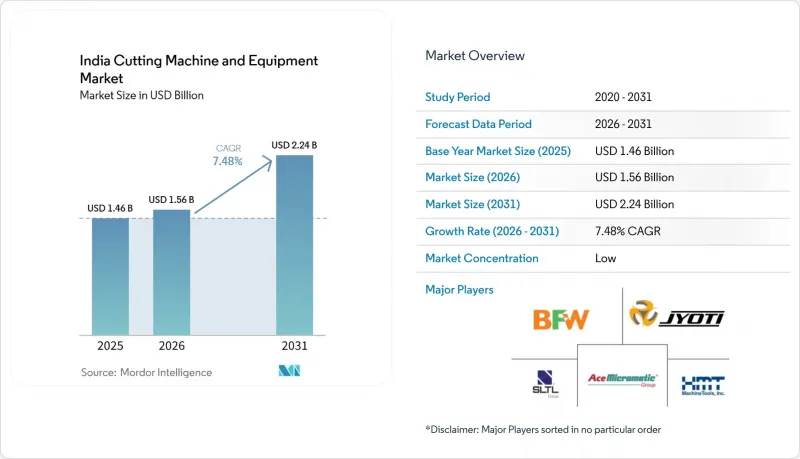
Mordor Intelligence에 의하면, 인도 절단기 및 절단 장비 시장 규모는 2025년 14억 6,000만 달러, 2026년 15억 6,000만 달러에서 2031년까지 22억 4,000만 달러로 확대되어 2026년부터 2031년까지 CAGR 7.48%를 나타낼 것으로 예측됩니다.
본 보고서는 용도별(판금, 플레이트, 튜브·파이프 등), 기술별(레이저, 플라즈마, 워터젯 등), 자동화 수준별(수동, 반자동, 로봇/완전 자동), 최종 사용 산업별(자동차, 항공우주 및 방위, 전기 및 전자 등)로 분류되어 있습니다. 시장 전망은 금액(달러) 및 수량(단위)으로 제시되어 있습니다.
인도 절단기 및 절단 장비 시장 동향과 인사이트
국내 제조업의 성장과 산업 확대
인도의 제조거점은 급속히 확대되고 있으며, 산업용 절단 시스템에 대한 새로운 수요를 창출하고 있습니다. 2024-25 회계연도의 공작기계 생산액은 17억 달러에 달했고, 동 연도의 공작기계 소비액은 37억 달러에 달하여 모두 사상 최고치를 기록했습니다. 최종 사용자 공장에서 본격적인 생산이 시작되기 전에 일반적으로 가공 능력이 추가되기 때문에 이러한 수요 패턴은 인도의 절단기 및 절단 장비 시장에 있어 중요합니다. PLI 프로그램은 2026년 3월까지 14개 부문에서 총 2670억 달러 상당의 생산 및 매출을 창출하여, 절삭 능력이 필요한 핵심 공장 및 공급업체 기업의 기반을 확대했습니다. 따라서 인도의 절단기 및 절단 장비 시장은 공장에 대한 직접 투자와 이러한 시설을 중심으로 형성되는 광범위한 공급업체 생태계 양쪽 모두로부터 지원을 받고 있습니다.
제조 현지화를 지원하는 정부의 이니셔티브
제조 현지화 정책은 인도의 절단기 및 절단 장비 시장에서 몇 가지 상호 연관된 경로를 통해 설비 수요를 뒷받침하고 있습니다. IMTMA에 따르면, PLI 프로그램은 2026년 3월까지 누적 282억 달러의 투자를 유치했으며, 이는 가공 및 금속 가공 설비가 필요한 분야에서 자본 형성이 여전히 활발함을 보여줍니다. 이는 더 많은 국내 생산 라인, 더 정교한 정밀 가공, 그리고 부품 리드타임의 엄격한 관리와 같은 현지 생산의 요구를 뒷받침하는 것입니다. 또한, ‘Invest India’는 국내 자본재 기반을 강화하는 데 있어 공작기계, 공구실 및 첨단 제조 지원 시스템이 수행하는 역할을 강조하고 있으며, 이는 현지 공급 절삭 시스템의 도입을 뒷받침하는 근거가 되고 있습니다. 그 결과, 인도의 절단기 및 절단 장비 시장은 설비 구매뿐만 아니라 국내 생산 능력을 한층 더 강화하는 정책 환경에 의해서도 뒷받침되고 있습니다.
첨단 절단기 및 절단 장비의 높은 비용
높은 도입 비용은 인도의 절단기 및 절단 장비 시장에서 특히 중소규모 가공업체에게 여전히 명백한 장벽으로 작용하고 있습니다. 고급 레이저 시스템, 자동 플라즈마 절단 장치, 다축 CNC 플랫폼에는 많은 중소·영세 기업(MSME)이 한 번에 감당할 수 있는 범위를 훨씬 초과하는 막대한 설비 투자가 필요합니다. 이러한 비용 문제는 설비 자체에만 국한되지 않습니다. 설치 작업, 가스 시스템, 유지보수 계약, 작업자 교육 등이 총 소유 비용을 더욱 끌어올리고 있습니다. 그 결과, 인도 절단기 및 절단 장비 시장의 대부분은 여전히 수동 또는 기본적인 반자동 시스템에서 보다 고도화된 플랫폼으로의 단계적 업그레이드에 의존하고 있습니다. 수요가 견조한 상황임에도 불구하고, 많은 구매자들은 가동률, 자금 조달, 서비스 전망이 더 확실해질 때까지 구매를 계속 미루고 있습니다.
부문 분석
2025년, 인도의 절단기 및 절단 장비 시장에서 판금 부문은 42.6%의 점유율을 차지했습니다. 이는 자동차, 전기 기기 외장, 백색 가전, 그리고 태양광 발전 구조물 제조에서 판금이 중심적인 역할을 하고 있음을 반영합니다. 이 부문은 단일 수요원에 의존하지 않고 광범위한 산업용도에 의해 뒷받침되고 있어, 인도의 절단기 및 절단 장비 시장에서 안정적인 기반을 구축하고 있습니다. 자동차 생산은 여전히 중요한 버팀목이며, 차체 구조, 브래킷, 패널 및 케이스는 여러 공급업체 Tier에 걸친 일관된 판금 가공에 의존하고 있습니다. 또한, 더 매끄러운 모서리 품질로의 전환과 2차 마감 공정의 축소 역시 이 용도에서 고정밀 절단 시스템의 도입을 촉진하고 있습니다.
이러한 선도적 지위는 여러 제조 분야에 걸친 산업 투자의 동시적 확대로 인해 더욱 공고해지고 있습니다. PLI(생산 연계 인센티브)에 따른 공장 증설로 인해, 생산 부품 및 공급업체 측 제조 과정에서 재현성이 높은 판금 가공을 필요로 하는 공장의 수가 증가하고 있습니다. 또한, 판금은 자동 네스팅, 블랭킹, 라인 밸런싱 워크플로우에 통합하기 쉬워 기계 가동률 향상에 기여하고 있습니다. 대조적으로, 구조용 강재는 운송 및 건설 분야의 견조한 인프라 수요와 프로젝트용 가공 수요에 힘입어 2031년까지 연평균 성장률(CAGR) 9.1%를 나타낼 것으로 예측됩니다. 따라서 인도의 절단기 및 절단 장비 시장에서는 판금이 여전히 판매량의 주축을 이루고 있는 반면, 공공 및 산업 프로젝트의 활성화에 힘입어 구조용 강철의 성장세가 가속화되고 있습니다.
2025년 시점에서 레이저는 인도 절단기 및 절단 장비 시장의 38.4%를 차지하고 있으며, 2031년까지 연평균 성장률(CAGR) 10.4%라는 가장 높은 성장률을 나타낼 것으로 예측됩니다. 이러한 상황은 기존의 절단 방식에서 더 높은 효율, 고속 절단, 폭넓은 소재 대응성을 제공하는 파이버 레이저 플랫폼으로의 전환이 진행되고 있음을 반영합니다. 인도의 절단기 및 절단 장비 시장에서 이러한 전환은 여러 소재를 가공하고 더 정밀한 치수 관리가 필요한 구매자에게 특히 중요합니다. 또한, 레이저 시스템은 더 깨끗한 생산 공정을 실현하고 많은 판금 용도에서 2차 가공의 필요성을 줄일 수 있어 지지를 넓혀가고 있습니다.
각 공급업체들이 기계의 성능과 출력 범위를 향상시켜 감에 따라 기술적 우위가 더욱 두드러지고 있습니다. 아마다는 2026년 4월부터 최대 26kW 모델을 포함한 신형 파이버 레이저 시리즈 ‘REGIUS-AJe’, ‘ENSIS-AJe’, ‘VENTIS-AJe’의 공식 수주를 시작했으며, 이는 고성능 레이저 플랫폼으로의 본격적인 진출을 보여줍니다. 플라즈마는 여전히 도입 비용의 저렴함이 중시되는 두꺼운 판재 가공에서 중요한 역할을 하고 있는 반면, 워터젯은 열에 민감한 재료나 특수한 가공에 적합합니다. 프레임 절단 및 산소 연료 절단은 고속성과 비용 중시가 정밀 가공 용도와는 다른 우선순위를 갖는 두꺼운 판재 절단 분야에서 여전히 그 입지를 유지하고 있습니다. 그러나 처리 능력, 정밀도, 에너지 효율이 더욱 중시되는 용도에서 인도의 절단기 및 절단 장비 시장은 분명히 레이저 기술을 우선 기술로 채택하는 방향으로 움직이고 있습니다.
기타 혜택:
- 엑셀 형식 시장 예측(ME) 시트
- 3개월간의 애널리스트 지원
자주 묻는 질문
목차
제1장 서론
제2장 조사 방법
제3장 주요 요약
제4장 시장 구도
제5장 시장 규모와 성장 예측
제6장 경쟁 구도
제7장 시장 기회와 향후 전망
JHSAccording to Mordor Intelligence, the India cutting machine and equipment market size is projected to expand from USD 1.46 billion in 2025 and USD 1.56 billion in 2026 to USD 2.24 billion by 2031, registering a CAGR of 7.48% between 2026 to 2031.
This report is Segmented by Application (Sheet Metal, Plate, Tube & Pipe, and More), by Technology (Laser, Plasma, Waterjet, and More), by Automation Level (Manual, Semi-Automated, and Robotic/Fully-automated), by End-User Industry (Automotive, Aerospace & Defense, Electrical & Electronics, and More). The Market Forecasts are Provided in Terms of Value (USD) and Volume (Units).
India Cutting Machine and Equipment Market Trends and Insights
Growth in Domestic Manufacturing and Industrial Expansion
India's manufacturing base is expanding rapidly, creating new demand for industrial cutting systems. Machine tool production reached USD 1.7 billion in FY2024-25, while machine tool consumption reached USD 3.7 billion in the same year, setting a record for both measures. That demand pattern matters for the India cutting machine and equipment market because fabrication capacity is usually added before full production ramps up at end-user plants. The PLI program had generated production and sales worth USD 267 billion by March 2026 across 14 sectors, creating a larger base of anchor plants and supplier units that require cutting capability. The India cutting machine and equipment market is therefore drawing support from both direct factory investment and from the wider supplier ecosystems that form around those facilities.
Government Initiatives Supporting Manufacturing Localization
The manufacturing localization policy is supporting equipment demand through several linked channels in the India cutting machine and equipment market. The PLI program had attracted cumulative investments of USD 28.2 billion by March 2026, as per IMTMA, indicating that capital formation remains active in sectors that require fabrication and metal-processing equipment. This supports localized production needs more domestic fabrication lines, more precision processing, and tighter control over component lead times. Invest India also highlighted the role of machine tools, tool rooms, and advanced manufacturing support systems in strengthening the domestic capital goods base, which supports the case for locally supplied cutting systems. As a result, the India cutting machine and equipment market is being supported not only by equipment purchases but also by a policy environment that favors deeper domestic production capability.
High Cost of Advanced Cutting Machine and Equipment
High acquisition costs remain a clear barrier in the India cutting machine and equipment market, especially for small- and mid-sized fabricators. Advanced laser systems, automated plasma cells, and multi-axis CNC platforms require much larger capital commitments than many MSMEs can absorb in one cycle. This cost issue is not limited to the equipment itself; installation needs, gas systems, maintenance contracts, and operator training further raise total ownership costs. That is why a large part of the India cutting machine and equipment market still depends on a gradual upgrade path from manual or basic semi-automated systems to more advanced platforms. Even when demand conditions are strong, many buyers continue to delay purchases until utilization, financing, and service visibility become more certain.
Other drivers and restraints analyzed in the detailed report include:
- Increasing Adoption of CNC and Automated Cutting Systems
- Expansion of Automotive, Infrastructure, and Heavy Engineering Sectors
- Dependence on Imported High-End Components
For complete list of drivers and restraints, kindly check the Table Of Contents.
Segment Analysis
Sheet metal held 42.6% of the India cutting machine and equipment market share in 2025, reflecting its central role across automotive, electrical enclosures, white goods, and solar structure fabrication. The segment benefits from broad industrial use rather than dependence on a single demand center, giving it a stable base in the India cutting machine and equipment market. Automotive production remains an important support, as body structures, brackets, panels, and enclosures rely on consistent sheet processing across multiple tiers of suppliers. The shift toward cleaner edge quality and fewer secondary finishing steps is also encouraging the use of more precise cutting systems in this application.
This lead position is reinforced by the simultaneous spread of industrial investments across several manufacturing categories. PLI-backed factory additions are expanding the number of plants that need repeatable sheet processing for production parts and supplier-side fabrication. Sheet metal is also easier to integrate into automated nesting, blanking, and line balancing workflows, which supports higher machine utilization. In contrast, structural steel is forecast to grow at a 9.1% CAGR through 2031, supported by strong infrastructure and project fabrication needs in transport and construction. The India cutting machine and equipment market is therefore seeing sheet metal remain the volume anchor, while structural steel is rising faster on the back of public and industrial project activity.
Laser accounted for 38.4% of the India cutting machine and equipment market in 2025 and is also projected to record the fastest CAGR of 10.4% through 2031. This position reflects the ongoing shift from older cutting formats to fiber laser platforms that offer greater efficiency, faster cutting, and broader material compatibility. In the India cutting machine and equipment market, this shift is especially relevant for buyers who process mixed materials and need tighter dimensional control. Laser systems are also gaining traction because they support cleaner production flow and can reduce the need for secondary finishing in many sheet applications.
The technology lead is becoming more visible as suppliers raise machine capability and power range. Amada began formal order acceptance in April 2026 for the new REGIUS-AJe, ENSIS-AJe, and VENTIS-AJe fiber laser series, including models up to 26 kW, indicating a broader push toward higher-performance laser platforms. Plasma remains relevant in thicker plate work where lower acquisition cost still matters, while waterjet serves heat-sensitive materials and specialty jobs. Flame and oxy-fuel continue to hold their place in heavy plate cutting, where speed and cost priorities differ from those in fine-precision applications. Even so, the India cutting machine and equipment market is clearly moving toward laser technology as the preferred technology in applications where throughput, precision, and energy efficiency carry greater weight.
Complete Report Scope:
- By Application
- Sheet Metal
- Plate
- Tube & Pipe
- Structural Steel
- Others
- By Technology
- Laser
- Fiber
- CO2
- Others
- Plasma
- High-definition
- Conventional
- Waterjet
- Abrasive
- Pure
- Flame / Oxy-fuel
- Ultrasonic & Emerging
- Laser
- By Automation Level
- Manual
- Semi-automated
- Robotic / Fully-automated
- By End-User Industry
- Automotive
- Aerospace & Defense
- Electrical & Electronics
- Construction & Infrastructure
- Metal-Fabrication Job Shops
- Shipbuilding
- Energy & Power
- Others (Medical Devices, etc.)
List of Companies Covered in this Report:
- Bharat Fritz Werner Limited
- Jyoti CNC Automation Limited
- Ace Micromatic Group
- SLTL Group
- Hindustan Machine Tools Limited
- Electronica Group
- Lancer Laser Tech Ltd.
- Koike Aronson Ransome India Pvt. Ltd.
- Sigma Mechotronics Pvt. Ltd.
- HGTECH (HGLaser)
- TRUMPF India Private Limited
- Bystronic India Private Limited
- Amada India Private Limited
- Mazak India Private Limited
- Hypertherm India Thermal Cutting Pvt. Ltd.
- Messer Cutting Systems India Private Limited
- Lincoln Electric India Private Limited
- Ador Welding Limited
- Prima Power India Pvt. Ltd.
- Mitsubishi Electric India Pvt. Ltd.
Additional Benefits:
- The market estimate (ME) sheet in Excel format
- 3 months of analyst support
TABLE OF CONTENTS
1 Introduction
- 1.1 Study Assumptions & Market Definition
- 1.2 Scope of the Study
2 Research Methodology
3 Executive Summary
4 Market Landscape
- 4.1 Market Overview
- 4.2 Market Drivers
- 4.2.1 Growth in Domestic Manufacturing and Industrial Expansion
- 4.2.2 Government Initiatives Supporting Manufacturing Localization
- 4.2.3 Increasing Adoption of CNC and Automated Cutting Systems
- 4.2.4 Expansion of Automotive, Infrastructure, and Heavy Engineering Sectors
- 4.2.5 Rising Demand for Laser-Based Precision Cutting Technologies
- 4.2.6 Growth of Metal Fabrication and Contract Manufacturing Industries
- 4.3 Market Restraints
- 4.3.1 High Cost of Advanced Cutting Machine and Equipment
- 4.3.2 Dependence on Imported High-End Components
- 4.3.3 Limited Adoption Among Small and Medium Enterprises
- 4.3.4 Shortage of Skilled CNC and Automation Operators
- 4.4 Value / Supply-Chain Analysis
- 4.4.1 Raw Material & Critical Component Ecosystem
- 4.4.2 OEM Manufacturing & System Integration
- 4.4.3 Distribution, Channel Partners & Aftermarket Network
- 4.4.4 End-User Adoption & Lifecycle Value Creation
- 4.5 Regulatory Landscape
- 4.6 Technological Outlook & Innovation Investment Landscape
- 4.6.1 CNC Automation & Smart Cutting Technology
- 4.6.2 Plasma Cutting Technology
- 4.7 Global Manufacturing-Sector Snapshot
- 4.8 Pricing Analysis
- 4.8.1 Average Selling Price (ASP) Benchmarking of Key Market Participants
- 4.8.2 Average Selling Price (ASP) Analysis, by Automation Level
- 4.8.3 Average Selling Price (ASP) Analysis, by Technology
- 4.9 Buying Criteria & Procurement Analysis
- 4.10 Porter's Five Forces Analysis - Industry Attractiveness Scoring
- 4.10.1 Threat of New Entrants
- 4.10.2 Bargaining Power of Suppliers
- 4.10.3 Bargaining Power of Buyers
- 4.10.4 Threat of Substitutes
- 4.10.5 Industry Rivalry
- 4.11 Impact of Geopolitical Events on the Market
5 Market Size & Growth Forecasts
- 5.1 By Application
- 5.1.1 Sheet Metal
- 5.1.2 Plate
- 5.1.3 Tube & Pipe
- 5.1.4 Structural Steel
- 5.1.5 Others
- 5.2 By Technology
- 5.2.1 Laser
- 5.2.1.1 Fiber
- 5.2.1.2 CO2
- 5.2.1.3 Others
- 5.2.2 Plasma
- 5.2.2.1 High-definition
- 5.2.2.2 Conventional
- 5.2.3 Waterjet
- 5.2.3.1 Abrasive
- 5.2.3.2 Pure
- 5.2.4 Flame / Oxy-fuel
- 5.2.5 Ultrasonic & Emerging
- 5.2.1 Laser
- 5.3 By Automation Level
- 5.3.1 Manual
- 5.3.2 Semi-automated
- 5.3.3 Robotic / Fully-automated
- 5.4 By End-User Industry
- 5.4.1 Automotive
- 5.4.2 Aerospace & Defense
- 5.4.3 Electrical & Electronics
- 5.4.4 Construction & Infrastructure
- 5.4.5 Metal-Fabrication Job Shops
- 5.4.6 Shipbuilding
- 5.4.7 Energy & Power
- 5.4.8 Others (Medical Devices, etc.)
6 Competitive Landscape
- 6.1 Market Concentration
- 6.2 Strategic Moves
- 6.3 Market Share Analysis
- 6.4 Competitive Benchmarking Analysis
- 6.5 Company Profiles (Includes Global Level Overview, Market Level Overview, Core Segments, Financials as Available, Strategic Information, Products & Services, and Recent Developments)
- 6.5.1 Bharat Fritz Werner Limited
- 6.5.2 Jyoti CNC Automation Limited
- 6.5.3 Ace Micromatic Group
- 6.5.4 SLTL Group
- 6.5.5 Hindustan Machine Tools Limited
- 6.5.6 Electronica Group
- 6.5.7 Lancer Laser Tech Ltd.
- 6.5.8 Koike Aronson Ransome India Pvt. Ltd.
- 6.5.9 Sigma Mechotronics Pvt. Ltd.
- 6.5.10 HGTECH (HGLaser)
- 6.5.11 TRUMPF India Private Limited
- 6.5.12 Bystronic India Private Limited
- 6.5.13 Amada India Private Limited
- 6.5.14 Mazak India Private Limited
- 6.5.15 Hypertherm India Thermal Cutting Pvt. Ltd.
- 6.5.16 Messer Cutting Systems India Private Limited
- 6.5.17 Lincoln Electric India Private Limited
- 6.5.18 Ador Welding Limited
- 6.5.19 Prima Power India Pvt. Ltd.
- 6.5.20 Mitsubishi Electric India Pvt. Ltd.
7 Market Opportunities & Future Outlook
- 7.1 White-Space & Unmet-Need Assessment