
|
시장보고서
상품코드
2099243
미국의 절단기 및 절단 설비 시장 : 점유율 분석, 업계 동향 및 통계, 성장 예측(2026-2031년)United States Cutting Machine and Equipment - Market Share Analysis, Industry Trends & Statistics, Growth Forecasts (2026 - 2031) |
||||||
 Mordor Intelligence
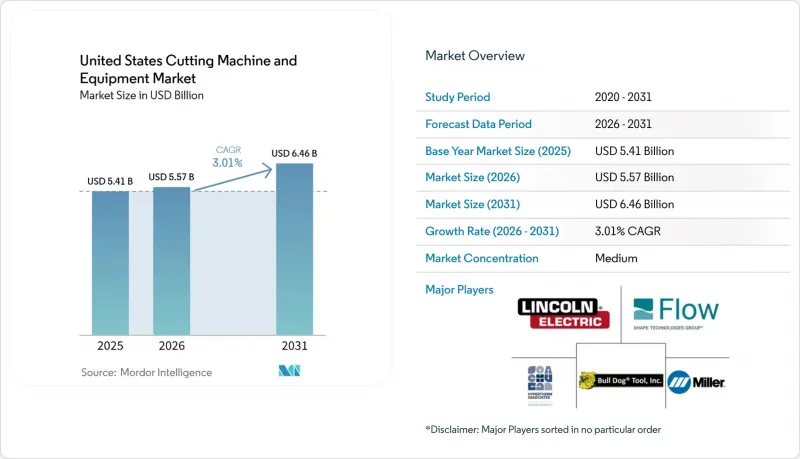
Mordor Intelligence에 의하면, 미국 절단기 및 절단 설비 시장 규모는 2025년에 54억 1,000만 달러로 평가되었고 2026년 55억 7,000만 달러에서 2031년까지 64억 6,000만 달러에 이를 것으로 예측되며, 예측 기간(2026-2031년) CAGR은 3.01%를 나타낼 전망입니다.
본 보고서는 용도별(판금, 플레이트, 튜브·파이프 등), 기술별(레이저, 플라즈마, 워터젯 등), 자동화 수준별(수동, 반자동, 로봇/완전 자동), 최종 사용 산업별(자동차, 항공우주 및 방위, 전기 및 전자 등)로 분류되어 있습니다. 시장 전망은 금액(달러) 및 수량(단위)으로 제시되어 있습니다.
미국 절단기 및 절단 설비 시장 동향과 인사이트
리쇼어링과 국내 제조 확대
연방 정부의 산업 정책에 따라, 리쇼어링은 미국 절단기 및 절단 설비 시장에서 구조적인 수요의 견인 요인이 되고 있습니다. MEP 내셔널 네트워크에서는 2026년 3월 기준으로 44건의 국내 공급업체 발굴 프로젝트가 진행 중이며, 이는 OEM 수요가 국내 하청업체공급 능력을 초과하고 있음을 보여줍니다. 이러한 불균형으로 인해 새로운 Tier 2 및 Tier 3 공급업체, 잡숍, 지역 가공업체들이 OEM의 조달 거점과 가까운 곳에 절단 시스템을 도입하도록 촉진되고 있습니다. Manufacturing USA의 보고서에 따르면, 해당 조직의 17개 연구소는 2023 회계연도에 자동화, 디지털 제조, 재료 가공에 중점을 둔 첨단 제조 프로그램에 5억 4,000만 달러를 투자하여, 규모 확대 단계에서의 공정 개발 및 설비 활용을 지원했습니다. 연방 정부 계약의 ‘바이 아메리칸(Buy American)’ 준수 요건은 국내 가공 활동을 더욱 강화하는 동시에, 미국의 절단기 및 설비 시장에 설치된 설비의 가동 기반을 확대되고 있습니다.
항공우주, 방위, 자동차 생산의 성장
항공우주, 방위, 자동차 생산은 미국 절단기 및 절단 설비 시장에 대해 견고한 수요 기반을 지속적으로 형성하고 있습니다. 미국의 항공우주 및 방위 부문은 2024년에 총 사업 활동액으로 9,950억 달러 이상을 창출하고, 4,430억 달러의 경제적 가치를 창출하며, 1,386억 달러의 수출을 기록하여 무역 수지가 흑자를 기록하고 있는 유일한 미국 제조업 부문입니다. 2026 회계연도 조정법에서는 우주 관련 방위 프로젝트에 216억 달러가 배정되었으며, 그중 138억 달러는 우주군(미국 우주군은 미군의 6번째이자 가장 최근에 창설된 군종입니다)을 위한 것입니다. 이를 통해 정밀 가공된 추진용 및 구조용 부품에 대한 수요가 뒷받침되고 있습니다. AIA(항공우주산업협회)와 카니(Carney)사가 2025년에 실시한 조사에 따르면, 미국 항공우주 및 방위 기업의 60% 가까이가 국내 공급망의 현지화를 검토하고 있으며, 15%는 이미 구체적인 조치를 취하고 있는 것으로 밝혀졌습니다. 이러한 상황이 맞물려 티타늄, 인코넬, 복합재료를 생산 규모에 맞추어 가공할 수 있는 파이버 레이저 및 정밀 연마 워터젯 시스템에 대한 수요가 유지되고 있습니다. 한편, 자동차 제조 분야에서는 관세 관련 압박 속에서도 생산량이 계속 증가하고 있습니다.
설비 도입·설치 비용의 높음
높은 설비 구입·설치 비용은 특히 중소규모 가공업체에게 있어 미국 절단기 및 절단 설비 시장에서 지속적인 직접적인 제약 요인으로 작용하고 있습니다. 연방준비제도이사회(FRB)는 2025년 4월, 불확실성이 높아지는 시기에는 기업이 대규모이며 되돌릴 수 없는 설비 투자를 연기할 가능성이 높다고 밝혔으며, 이는 20만 달러에서 100만 달러 범위의 절단 시스템 구매에 직접적으로 해당됩니다. 'CHIPS and Science Act'에 따른 25%의 첨단 제조 투자 세액 공제는 반도체 관련 제조로 한정되어 있으며, 더 광범위한 금속 가공 분야를 포괄하지 않기 때문에 이러한 부담을 부분적으로만 상쇄할 수 있습니다. 기존 공장을 로봇 절단 셀용으로 개조하려면 구조적 변경, 규격에 부합하는 인클로저, 환기 시스템도 필요하며, 이는 생산 개시 전 기본 시스템 비용에 15%에서 30%를 가산하게 됩니다. ANSI(미국 국가표준협회) Z136 레이저 안전 기준 준수 및 관련 교육 요건은 추가적인 간접비 부담이 되며, 소규모 사업자는 이를 효율적으로 관리하는 데 어려움을 겪는 경우가 많습니다.
부문 분석
2025년, 미국 절단기 및 설비 시장 점유율 중 판금 가공이 41.2%를 차지하며 최대 용도 부문이 되었습니다. 이러한 우위는 HVAC 시스템, 전기 인클로저, 자동차 차체 패널, 가전제품 케이스, 건설용 클래딩 등 광범위한 분야 수요에 힘입은 것입니다. 많은 제조 현장에서 박판 금속 가공이 요구되기 때문에 이러한 폭넓은 산업용도로 인해 설비 가동률은 높은 수준을 유지하고 있습니다. 또한, 중장비, 에너지, 구조물 제조 분야에서도 프로젝트 주기가 안정적인 설비 수요를 뒷받침하고 있어, 판재 절단은 계속해서 중요한 위치를 차지하고 있습니다.
'튜브·파이프' 분야는 2026년부터 2031년까지 연평균 성장률(CAGR) 3.8%를 나타낼 것으로 예측되며, 미국 절단기 및 절단 설비 시장 전망에서 가장 빠르게 성장하는 용도 분야가 될 것으로 보입니다. 이러한 성장은 파이프라인 사업, 재생에너지 지지 구조물, 수소 수송 시스템, 그리고 강관을 더 많이 사용하는 자동차 섀시 설계에 힘입은 것입니다. TRUMPF사가 2026년 3월 북미에서 'TruLaser Tube 7000'을 출시한 것은 관재 가공 수요 및 고처리량 레이저 용도에 대한 OEM 업체들의 지속적인 신뢰를 반영합니다. 또한, 리쇼어링 주도형 공장 건설과 방위 관련 제조가 다양한 절단 요구 사항을 지속적으로 뒷받침하고 있기 때문에 구조용 강재와 특수 소재도 여전히 중요한 위치를 차지하고 있습니다.
2025년, 레이저는 미국 절단기 및 절단 설비 시장에서 44.3%의 점유율을 차지하며 최대 기술 부문이 되었습니다. 이러한 위상은 속도, 절단 품질, 디지털 제어가 중요시되는 판금, 관재, 정밀 부품, 열간 성형 부품 등 폭넓은 분야에서 활발히 활용되고 있음을 반영합니다. 또한, 레이저 시스템은 많은 기존 대체 기술에 비해 소모품 사용량이 적고, 네트워크화된 CNC 환경과의 통합성이 뛰어나다는 장점도 있습니다. NIST(미국 국립표준기술연구소)는 레이저 가공을 국가 첨단 제조 프레임워크의 중요한 기반 기술로 규정하며, 산업 생산에서 그 장기적인 역할을 강조하고 있습니다.
또한, 레이저는 가장 빠르게 성장하고 있는 기술 분야이기도 하며, 2026년부터 2031년까지 연평균 성장률(CAGR) 4.2%로 확대될 것으로 예측됩니다. 이러한 성장은 CO₂ 시스템의 지속적인 대체와 정밀도, 에너지 효율, 높은 처리량이 요구되는 용도에서의 채택 확대를 반영하고 있습니다. TRUMPF사는 2026년 5월, 자사의 ‘X-Blast 2.0’ 솔루션을 통해 자동차 산업의 열간 성형 분야에서 부품 비용을 최대 20% 절감할 수 있다고 발표했습니다. 이는 레이저 장비 제조업체가 생산 워크플로우에서 그 역할을 더욱 공고히 하고 있음을 보여줍니다. 플라즈마, 워터젯, 화염 및 신기술은 두꺼운 재료, 열에 민감한 기판, 틈새 제조 환경에서 여전히 중요한 역할을 담당하고 있습니다.
기타 혜택:
- 엑셀 형식 시장 예측(ME) 시트
- 3개월간의 애널리스트 지원
자주 묻는 질문
목차
제1장 서론
제2장 조사 방법
제3장 주요 요약
제4장 시장 구도
제5장 시장 규모와 성장 예측
제6장 경쟁 구도
제7장 시장 기회와 향후 전망
JHSAccording to Mordor Intelligence, the United States cutting machine and equipment market size was valued at USD 5.41 billion in 2025 and is estimated to grow from USD 5.57 billion in 2026 to reach USD 6.46 billion by 2031, at a CAGR of 3.01% during the forecast period (2026-2031).
This report is Segmented by Application (Sheet Metal, Plate, Tube & Pipe, and More), by Technology (Laser, Plasma, Waterjet, and More), by Automation Level (Manual, Semi-Automated, and Robotic/Fully-automated), by End-User Industry (Automotive, Aerospace & Defense, Electrical & Electronics, and More). The Market Forecasts are Provided in Terms of Value (USD) and Volume (Units).
United States Cutting Machine and Equipment Market Trends and Insights
Reshoring and Domestic Manufacturing Expansion
Federal industrial policy has turned reshoring into a structural demand driver in the United States cutting machine and equipment market. The MEP National Network had 44 active domestic supplier-scouting opportunities open in March 2026, indicating that OEM demand remained ahead of available domestic sub-tier capacity. That imbalance is encouraging new Tier 2 and Tier 3 suppliers, job shops, and regional fabricators to commission cutting systems closer to OEM sourcing hubs. Manufacturing USA reported that its 17 institutes invested USD 540 million in FY 2023 across advanced manufacturing programs focused on automation, digital manufacturing, and materials processing, supporting process development and equipment use at scale-up stages. Buy American compliance requirements in federal contracts are further reinforcing domestic processing activity and expanding the operating base for equipment installed within the United States cutting machine and equipment market.
Growth in Aerospace, Defense, and Automotive Production
Aerospace, defense, and automotive output continue to create a durable demand base for the United States cutting machine and equipment market. The United States aerospace and defense sector generated more than USD 995 billion in total business activity in 2024, contributed USD 443 billion in economic value, and produced USD 138.6 billion in exports, making it the only United States manufacturing sector with a net-positive trade balance. The FY 2026 reconciliation act designated USD 21.6 billion for space-focused defense projects, including USD 13.8 billion for the Space Force (The United States Space Force is the sixth and newest branch of the United States Armed Forces), which supports demand for precision-cut propulsion and structural components. A 2025 study by AIA (Aerospace Industries Association) and Kearney found that nearly 60% of United States aerospace and defense companies are exploring domestic supply chain localization, and 15% are already taking concrete action. This combination is sustaining demand for fiber laser and precision abrasive waterjet systems that can process titanium, Inconel, and composites at production scale. At the same time, automotive fabrication continues to add volume even under tariff-related pressure.
High Equipment Acquisition and Installation Costs
High acquisition and installation costs remain a direct restraint on the United States cutting machine and equipment market, especially for small and medium fabricators. The Federal Reserve stated in April 2025 that firms are most likely to delay large irreversible capital expenditures during periods of elevated uncertainty, which directly applies to cutting system purchases in the USD 200,000 to USD 1 million range. The 25% Advanced Manufacturing Investment Credit under the CHIPS and Science Act only partly offsets this burden because it is limited to semiconductor-adjacent manufacturing and does not cover the broader metal fabrication base. Retrofitting existing plants for robotic cutting cells also requires structural modifications, compliant enclosures, and ventilation systems, which can add 15% to 30% to the base system cost before production starts. ANSI (American National Standard Institute) Z136 laser safety compliance and related training requirements add another layer of overhead that smaller operators often struggle to manage efficiently.
Other drivers and restraints analyzed in the detailed report include:
- Increasing Adoption of Automated CNC Cutting Systems
- Rising Demand for High-Precision Fiber Laser Cutting
- Shortage of Skilled Machine Operators
For complete list of drivers and restraints, kindly check the Table Of Contents.
Segment Analysis
Sheet Metal accounted for 41.2% of the United States cutting machine and equipment market share in 2025, which made it the largest application segment. Its lead came from broad demand across HVAC systems, electrical enclosures, automotive body panels, appliance housings, and construction cladding. This broad industrial use keeps utilization high because thin-gauge metal processing is required across many fabrication settings. Plate cutting also remained important in heavy equipment, energy, and structural fabrication, where project cycles support steady equipment demand.
Tube & Pipe is projected to grow at a 3.8% CAGR from 2026 to 2031, making it the fastest-growing application in the United States cutting machine and equipment market outlook. Growth is being supported by pipeline activity, renewable energy support structures, hydrogen transport systems, and automotive chassis designs that use more tubular steel. TRUMPF's March 2026 launch of the TruLaser Tube 7000 in North America reflected continued OEM confidence in tube-processing demand and higher-throughput laser applications. Structural steel and specialty materials also remain relevant because reshoring-led factory construction and defense-linked fabrication continue to support varied cutting requirements.
Laser held 44.3% of the United States cutting machine and equipment market share in 2025, making it the largest technology segment. Its position reflects strong use across sheet metal, tube, precision parts, and hot-formed components where speed, cut quality, and digital control matter. Laser systems also benefit from lower consumable intensity and better integration with connected CNC environments than many legacy alternatives. NIST identified laser processing as a critical enabling technology within the national advanced manufacturing framework, underscoring its long-term role in industrial production.
Laser is also the fastest-growing technology segment, projected to expand at a 4.2% CAGR from 2026 to 2031. This growth reflects continued replacement of CO2 systems and broader adoption in applications that require precision, energy efficiency, and higher throughput. TRUMPF stated in May 2026 that its X-Blast 2.0 solution can reduce component costs by up to 20% in automotive hot-forming applications, which shows how laser suppliers are deepening their role in production workflows. Plasma, waterjet, flame, and emerging technologies still retain important roles in thick materials, thermally sensitive substrates, and niche fabrication environments.
Complete Report Scope:
- By Application
- Sheet Metal
- Plate
- Tube & Pipe
- Structural Steel
- Others
- By Technology
- Laser
- Fiber
- CO2
- Others
- Plasma
- High-definition
- Conventional
- Water-Jet
- Abrasive
- Pure
- Flame/Oxy-fuel
- Ultrasonic & Emerging
- Laser
- By Automation Level
- Manual
- Semi-automated
- Robotic/Fully-automated
- By End-User Industry
- Automotive
- Aerospace & Defense
- Electrical & Electronics
- Construction & Infrastructure
- Metal-Fabrication Job Shops
- Shipbuilding
- Energy & Power
- Others (Medical Devices, etc.)
List of Companies Covered in this Report:
- Hypertherm Associates
- Lincoln Electric Holdings, Inc.
- Flow International Corporation
- Bully Dog Cutting Systems
- Miller Electric Mfg. LLC
- Koike Aronson, Inc.
- ESAB Corporation
- TRUMPF Inc.
- Bystronic Inc.
- Mazak Corporation
- AKS Cutting Systems, Inc.
- KMT Waterjet Systems Inc.
- Hornet Cutting Systems
- Messer Cutting Systems, Inc.
- Jet Edge Inc.
- Epilog Laser
- Cincinnati Incorporated
- Thermal Dynamics Corporation
- MultiCam Inc.
- ShopSabre CNC
Additional Benefits:
- The market estimate (ME) sheet in Excel format
- 3 months of analyst support
TABLE OF CONTENTS
1 Introduction
- 1.1 Study Assumptions & Market Definition
- 1.2 Scope of the Study
2 Research Methodology
3 Executive Summary
4 Market Landscape
- 4.1 Market Overview
- 4.2 Market Drivers
- 4.2.1 Reshoring and Domestic Manufacturing Expansion
- 4.2.2 Growth in Aerospace, Defense, and Automotive Production
- 4.2.3 Increasing Adoption of Automated CNC Cutting Systems
- 4.2.4 Rising Demand for High-Precision Fiber Laser Cutting
- 4.2.5 Investments in Smart Manufacturing and Industry 4.0
- 4.2.6 Growing Demand for Customized Metal Fabrication
- 4.3 Market Restraints
- 4.3.1 High Equipment Acquisition and Installation Costs
- 4.3.2 Shortage of Skilled Machine Operators
- 4.3.3 High Maintenance and Operating Expenses
- 4.3.4 Volatility in Industrial Manufacturing Investments
- 4.4 Value / Supply-Chain Analysis
- 4.4.1 Raw Material & Critical Component Ecosystem
- 4.4.2 OEM Manufacturing & System Integration
- 4.4.3 Distribution, Channel Partners & Aftermarket Network
- 4.4.4 End-User Adoption & Lifecycle Value Creation
- 4.5 Regulatory Landscape
- 4.6 Technological Outlook & Innovation Investment Landscape
- 4.6.1 CNC Automation & Smart Cutting Technology
- 4.6.2 Plasma Cutting Technology
- 4.7 Global Manufacturing-Sector Snapshot
- 4.8 Pricing Analysis
- 4.8.1 Average Selling Price (ASP) Benchmarking of Key Market Participants
- 4.8.2 Average Selling Price (ASP) Analysis, by Automation Level
- 4.8.3 Average Selling Price (ASP) Analysis, by Technology
- 4.9 Buying Criteria & Procurement Analysis
- 4.10 Porter's Five Forces Analysis - Industry Attractiveness Scoring
- 4.10.1 Threat of New Entrants
- 4.10.2 Bargaining Power of Suppliers
- 4.10.3 Bargaining Power of Buyers
- 4.10.4 Threat of Substitutes
- 4.10.5 Industry Rivalry
- 4.11 Impact of Geopolitical Events on the Market
5 Market Size & Growth Forecasts
- 5.1 By Application
- 5.1.1 Sheet Metal
- 5.1.2 Plate
- 5.1.3 Tube & Pipe
- 5.1.4 Structural Steel
- 5.1.5 Others
- 5.2 By Technology
- 5.2.1 Laser
- 5.2.1.1 Fiber
- 5.2.1.2 CO2
- 5.2.1.3 Others
- 5.2.2 Plasma
- 5.2.2.1 High-definition
- 5.2.2.2 Conventional
- 5.2.3 Water-Jet
- 5.2.3.1 Abrasive
- 5.2.3.2 Pure
- 5.2.4 Flame/Oxy-fuel
- 5.2.5 Ultrasonic & Emerging
- 5.2.1 Laser
- 5.3 By Automation Level
- 5.3.1 Manual
- 5.3.2 Semi-automated
- 5.3.3 Robotic/Fully-automated
- 5.4 By End-User Industry
- 5.4.1 Automotive
- 5.4.2 Aerospace & Defense
- 5.4.3 Electrical & Electronics
- 5.4.4 Construction & Infrastructure
- 5.4.5 Metal-Fabrication Job Shops
- 5.4.6 Shipbuilding
- 5.4.7 Energy & Power
- 5.4.8 Others (Medical Devices, etc.)
6 Competitive Landscape
- 6.1 Market Concentration
- 6.2 Strategic Moves
- 6.3 Market Share Analysis
- 6.4 Competitive Benchmarking Analysis
- 6.5 Company Profiles (Includes Global Level Overview, Market Level Overview, Core Segments, Financials as Available, Strategic Information, Products & Services, and Recent Developments)
- 6.5.1 Hypertherm Associates
- 6.5.2 Lincoln Electric Holdings, Inc.
- 6.5.3 Flow International Corporation
- 6.5.4 Bully Dog Cutting Systems
- 6.5.5 Miller Electric Mfg. LLC
- 6.5.6 Koike Aronson, Inc.
- 6.5.7 ESAB Corporation
- 6.5.8 TRUMPF Inc.
- 6.5.9 Bystronic Inc.
- 6.5.10 Mazak Corporation
- 6.5.11 AKS Cutting Systems, Inc.
- 6.5.12 KMT Waterjet Systems Inc.
- 6.5.13 Hornet Cutting Systems
- 6.5.14 Messer Cutting Systems, Inc.
- 6.5.15 Jet Edge Inc.
- 6.5.16 Epilog Laser
- 6.5.17 Cincinnati Incorporated
- 6.5.18 Thermal Dynamics Corporation
- 6.5.19 MultiCam Inc.
- 6.5.20 ShopSabre CNC
7 Market Opportunities & Future Outlook
- 7.1 White-Space & Unmet-Need Assessment