|
시장보고서
상품코드
2099240
중국의 터닝 센터 시장 : 점유율 분석, 업계 동향 및 통계, 성장 예측(2026-2031년)China Turning Centers - Market Share Analysis, Industry Trends & Statistics, Growth Forecasts (2026 - 2031) |
||||||
 Mordor Intelligence
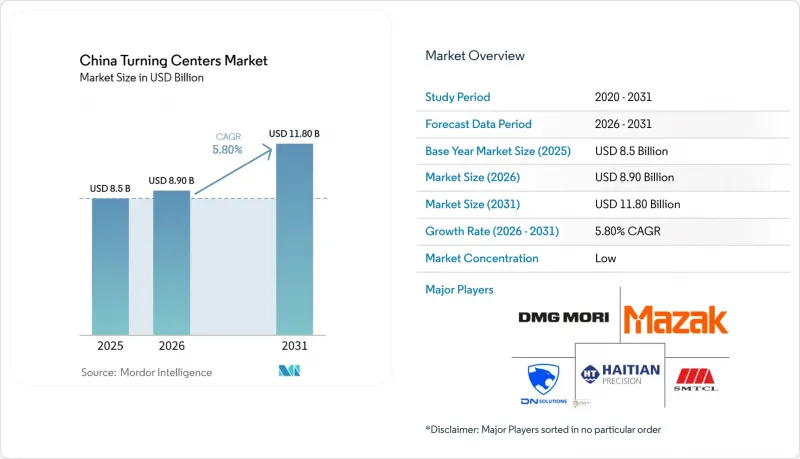
Mordor Intelligence에 의하면, 중국 터닝 센터 시장 규모는 2025년에 85억 달러, 2026년에 89억 달러가 되어, 2031년까지 118억 달러에 이를 것으로 예측되며, 2026년부터 2031년까지 CAGR 5.80%로 성장할 전망입니다.
본 보고서는 제품 유형(수평 선반, 수직 선반 등), 축 구성(3축, 4축 등), 자동화 유형(수동, 반자동 등) 및 최종 사용자 산업(자동차, 항공우주 및 방위, 의료기기·수술 기구 등)별로 분류되어 있습니다. 시장 전망은 금액(달러) 및 수량(대)으로 제시되어 있습니다.
중국 터닝 센터 시장 동향 및 인사이트
전기차(EV) 생산에 따른 정밀 터닝 센터 수요 증가
중국 내 전기차(EV) 생산의 급증은 중국 터닝 센터 시장 전체의 가공 요건에 변화를 가져오고 있습니다. 이는 구동계 및 구조 부품의 가공 비중이 확대되는 가운데, 표준 공차의 설비만으로는 부족해졌기 때문입니다. 2025년, 중국에서는 전년 대비 29% 증가한 1,663만 대의 전기차가 생산되었으며, 전기차는 신차 판매 총량의 47.9%를 차지했습니다. 이에 따라 현지 제조업체가 필요로 하는 정밀 선반 가공된 샤프트, 로터 하우징, 기어박스 부품에 대한 수요가 급증하고 있습니다. 이러한 부품에는 더 우수한 표면 마감과 높은 재현성이 요구되는 경우가 많아, 이에 따라 중국 터닝 센터 시장에서 구매자들의 선호도는 고속 수평형 플랫폼 및 고성능 CNC 시스템으로 이동하고 있습니다. 또한, 일체형 다이캐스팅 배터리 하우징 및 통합형 구조 주조품으로의 전환도 대구경 선반 가공 능력에 대한 수요를 확대시키고 있습니다. 이러한 얇은 두께의 선반 가공 용도는 기존의 샤프트 가공뿐만 아니라 수직형 터닝 센터 수요도 뒷받침하고 있습니다. 즉, 전기차 사이클은 중국 터닝 센터 시장에서 여러 제품 카테고리에 걸쳐 수요를 높이고 있으며, 다양한 가공 형식에 대응할 수 있는 공급업체에게 포착할 수 있는 비즈니스 기회를 확대되고 있습니다. 이러한 장기적인 투자 전망은 ‘제15차 5개년 계획’에 의해 더욱 뒷받침되고 있으며, 해당 계획에서는 스마트 커넥티드 신에너지차가 2030년까지 정책적 지원을 계속 받을 전략적 신흥 산업 중 하나로 꼽히고 있습니다.
'중국 제조 2025' 및 후속 정책의 영향
'중국 제조 2025'의 정책적 유산은 여전히 중국의 터닝 센터 시장을 형성하고 있지만, 그 영향이 밸류체인 전반에 고르게 미치고 있는 것은 아닙니다. MFAT의 검토에 따르면, 중국이 가장 큰 성과를 거둔 분야는 업스트림 투입 자재가 국내에서 관리되던 분야, 특히 전기차(EV), 태양광 발전, 산업용 로봇 분야였습니다고 지적되고 있습니다. 반면, 하이엔드 공작기계 분야는 여전히 장단점이 공존하는 영역이며, 최상위권에서는 해외 제조업체의 기술적 우위가 지속되고 있습니다. 이러한 경향은 중국의 선반 시장에 중요한 의미를 지닙니다. 정책 지원을 통해 항공우주, 반도체, 의료 분야에서의 정밀도 격차를 즉시 해소하지 않더라도, 현지 규모의 확대나 중급 수준의 현지화를 촉진할 수 있다는 사실이 입증되었기 때문입니다. '제15차 5개년 계획'은 AI를 활용한 제조, 친환경 생산, 그리고 기술의 추가적인 현지화를 추진함으로써 이와 같은 방향성을 유지하는 한편, 2030년까지 전국의 연구개발비를 연평균 최소 7%씩 증가시킬 것을 요구하고 있습니다. 두 번째 영향으로, 더 스마트하고 친환경적이며 디지털화된 생산 라인으로의 업그레이드를 추진하는 제조업체들은 구형 기계를 소프트웨어 통합, 공정 안정성, 무인 운전을 더 잘 지원하는 구조의 기계로 교체하는 경향이 강해지고 있습니다. 그 결과, 중국의 선반 시장은 직접적인 생산량 증가뿐만 아니라, 정책 주도 하에 공장 현장에 설치되는 설비에 대한 품질 기대치의 상승에 의해서도 뒷받침되고 있습니다.
국내 대안이 있음에도 불구하고, 수입 컨트롤러에 대한 의존이 지속되고 있습니다.
중국 터닝 센터 시장의 큰 제약은 컨트롤러의 현지화가 기계 조립이나 중급 수준의 기계적 성능 향상과 같은 속도로 진행되지 않고 있다는 점입니다. 그럼에도 불구하고 5축 선반, 항공우주용 셀, 반도체 장비용 하이엔드 컨트롤러 분야에서는 여전히 해외 공급업체에 대한 의존도가 높은 상황입니다. 중국 공업정보화부(MIIT)에 따르면, 2025년 수입 CNC 제어 시스템 시장 규모는 10억 5,000만 달러에 달했습니다. 이는 공작기계 업계 전반에서 현지화 노력이 지속되고 있음에도 불구하고, 고도의 가공 작업이 여전히 외부 기술에 대한 수요를 견인하고 있음을 보여줍니다. CAE의 조사에 따르면, 이러한 격차의 원인 중 하나로 5축 연동 기능에 대한 소프트웨어상의 제약으로 인해 국내 개발자들이 독자적인 코드 경로를 구축할 수밖에 없었고, 그 결과 검증에 지연이 발생하여 중요한 이용 사례에서 신뢰할 수 있는 성능에 도달하는 데 걸리는 시간이 길어지고 있다는 점이 지적되고 있습니다. 이로 인해 중국 터닝 센터 시장의 일부 구매자에게는 실질적인 상한선이 발생하고 있습니다. 가장 까다로운 작업을 지원하는 컨트롤러나 소프트웨어 스택보다 공작기계 자체를 조달하는 것이 더 신속하게 현지화될 수 있기 때문입니다. 복잡한 선삭 환경에서 국산 제어 시스템이 장기적인 신뢰성을 더욱 확고히 입증하기 전까지는 이러한 의존 관계가 부가가치가 가장 높은 용도에서의 채택을 계속해서 제한할 것입니다.
부문 분석
2025년, 수평형 터닝 센터는 50.2%의 점유율을 차지하며 중국 터닝 센터 시장의 중심적인 위치를 유지했습니다. 이는 대량 생산되는 자동차, 일반 산업 및 전기차(EV)용 샤프트 생산에서 여전히 대규모 공구 생태계를 갖춘 확립된 플랫폼이 선호되기 때문입니다. 이러한 주도적 지위는 효율적인 직선형 워크플로우, 익숙한 셋업, 낮은 자본 집약도라는 이점을 누릴 수 있는 샤프트, 부시, 로터 및 기타 부품에 여전히 큰 비중이 실려 있는 제조 구조를 반영합니다. 이는 또한 많은 구매자가 셀 전체를 재설계하기보다는 기존 공구, 작업자의 숙련도 및 유지보수 관행을 기반으로 확장하는 것을 선호하기 때문에 이미 도입된 설비가 향후 구매를 지속적으로 견인하고 있음을 의미합니다. 중국의 터닝 센터 산업에서 이미 도입된 설비는 고부가가치 작업 분야에서 보다 진보된 형태가 보급되고 있음에도 불구하고, 수평형 선반 수요를 지탱하는 관성을 만들어내고 있습니다. 따라서 제품 유형의 구성이 여전히 폭넓은 가운데, 수평형 선반이 지배적인 역할을 하고 있는 배경에는 가격뿐만 아니라 실용적인 생산 경제성이 있기 때문입니다.
수직형 선반은 대구경·중량 공작물의 가공 용도에서 계속해서 중요한 역할을 수행하고 있습니다. 하우징, 프레임 부품, 대형 구조 부재를 다루는 제조업체에게 있어 중력을 이용한 고정, 셋업의 안정성, 그리고 공작물에 대한 접근성은 여전히 중요한 요소이기 때문입니다. 그 중요성은 절삭 속도와 마찬가지로 부품의 크기 및 치수 관리가 중시되는 대형 EV 인클로저, 에너지 장비, 항공우주용 프레임 가공 등의 분야에서 더욱 커지고 있습니다. 멀티태스크 선반은 가장 빠르게 성장하는 제품 부문이며, 중국 선반 시장에서 이 부문의 규모는 2031년까지 연평균 성장률(CAGR) 8.1%로 확대될 것으로 예측됩니다. 이는 구매자들이 선삭, 밀링, 드릴링을 한 번의 세팅으로 완료할 수 있기를 점점 더 요구하고 있기 때문입니다. 이러한 수요 변화는 부품의 복잡성이 증가하는 분야, 특히 항공우주, 반도체 장비, 로봇의 구조 부품에서 가장 두드러지며, 세팅 시간 단축과 공차의 일관성이 표준 양산 가공보다 더 중요하게 여겨지고 있습니다. 스위스형 선반 및 특수 선반을 포함하는 ‘기타’ 부문은 규모는 여전히 작지만, 표면 품질, 오염 관리 및 초소형 부품의 재현성이 극히 중요시되는 의료 분야나 초소형 정밀 용도에서 그 중요성이 높아지고 있습니다.
수평형 기계는 가장 광범위한 서비스 지원 체계의 혜택도 누리고 있습니다. 이는 중국 선반 시장에서 중요한 요소입니다. 중소기업의 경우 최첨단 고성능 기능보다 가동 시간이나 신속한 공구 체인 교체가 더 중요한 경우가 많기 때문입니다. 한편, 수직형 기계는 그 가치가 수평형 설비로는 효율적으로 처리할 수 없는 특정 부품 형상에 있기 때문에 역할은 제한적이지만 확고한 입지를 다지고 있습니다. 멀티태스크 시스템은 세팅 횟수 감소, 핸들링 손실 저감, 복잡한 부품군에 대한 공정 제어 향상을 실현함으로써 프리미엄 구성에 대한 투자를 더욱 유도하고 있습니다. 이에 따라 제품 유형별 수요는 양극화가 진행되고 있으며, 수평형 기계가 생산량의 기반을 지탱하는 한편, 멀티태스크 플랫폼이 전략적 투자 점유율을 확대되고 있습니다.
2025년에는 3축 구성이 54.5%의 점유율을 차지하고 있으며, 이는 중국의 터닝 센터 시장이 여전히 표준 자동차, 산업용 및 중소기업 생산 라인에서 사용되는 기존 CNC 설비의 방대한 도입 기반에 의존하고 있음을 보여줍니다. 이러한 기계는 정밀한 표면 경로 제어가 필요하지 않은 제조업체에게 실용적인 생산성, 낮은 도입 비용, 쉬운 프로그래밍, 그리고 간단한 유지보수 체계를 제공하기 때문에 여전히 매력적입니다. 이러한 점유율은 또한 중국 터닝 센터 시장의 상당 부분이 여전히 복잡도가 중간 수준이며, 사이클 비용 측면에서 단순한 형태가 유리한 일상적인 생산 요구와 연결되어 있다는 사실을 반영합니다. 중국 터닝 센터 업계에서 이는 시장의 고부가가치 분야가 급속히 변화하고 있는 상황에서도 3축 기계에 확고한 역할을 부여하고 있습니다. 4축 가공기는 비용 중심의 표준 선반 가공과 고급 다면 가공 사이의 공백을 계속해서 메우고 있으며, 특히 편심 가공에서 더 높은 생산성을 필요로 하면서도 5축 플랫폼으로 인한 비용 급증을 피하고자 하는 구매자에게 유용합니다.
5축 이상의 구성은 축 수 부문 중 가장 빠르게 성장하고 있으며, 항공우주, 의료, 반도체 분야의 가공에서 보다 정교한 기하학적 제어와 셋업 횟수 감축이 요구됨에 따라, 이 부문의 중국 터닝 센터 시장은 2031년까지 연평균 성장률(CAGR) 9.2%로 확대될 것으로 예측됩니다. CAE 조사에서 5축 소프트웨어의 제약에 대한 고찰을 통해서도 이 부문이 전략적으로 중요한 위치를 유지할 것이라는 점이 드러납니다. 구매자가 복잡한 선삭 가공을 평가할 때, 컨트롤러 수준의 성능이 기계적 하드웨어와 동등하게 중요해지고 있기 때문입니다. 그 결과, 중국 터닝 센터 시장의 축 수 구성은 앞으로도 폭넓은 범위를 보일 것으로 보입니다. 다만, 시장 규모는 최종 사용자의 고도화된 요구 사항을 충족할 수 있는 다축 기계로 꾸준히 이동하고 있습니다.
5축 설비로 전환되면서 구매 행동에도 변화가 일어나고 있습니다. 조달 과정에서 스핀들이나 구조 사양뿐만 아니라 소프트웨어 호환성, 시뮬레이션 정확도, 장기적인 지원이 점점 더 중요시되고 있기 때문입니다. 4축 기계는 특히 중견 자동차 부품 제조업체나, 부품 라인업은 확대되고 있지만 예산이 제한된 일부 일반 산업 분야에서 유용한 과도기적 역할을 유지할 것입니다. 따라서 가장 큰 기회는 축 수 스펙트럼의 양 끝에 있으며, 3축 기계는 폭넓은 수요를 유지하고, 5축 기계는 가장 강력한 업그레이드 투자를 주도하게 될 것입니다. 이러한 양분법은 한 형태가 다른 형태를 대체한다는 단순한 설명보다 중국 터닝 센터 시장의 현재 구조를 더 정확하게 포착하고 있습니다.
기타 혜택:
- 엑셀 형식 시장 예측(ME) 시트
- 3개월간의 애널리스트 지원
자주 묻는 질문
목차
제1장 서론
제2장 조사 방법
제3장 주요 요약
제4장 시장 구도
제5장 시장 규모와 성장 예측
제6장 경쟁 구도
제7장 시장 기회와 향후 전망
JHS 26.08.05According to Mordor Intelligence, the China turning centers market size is projected to be USD 8.5 billion in 2025, USD 8.90 billion in 2026, and reach USD 11.80 billion by 2031, growing at a CAGR of 5.80% from 2026 to 2031.
This report is Segmented by Product Type (Horizontal Turning Centers, Vertical Turning Centers, and More), by Axis Configuration (3-Axis, 4-Axis, and More), by Automation Type (Manual, Semi-Automatic, and More), and by End-User Industry (Automotive, Aerospace & Defense, Medical Devices and Surgical Instruments, and More). The Market Forecasts are Provided in Terms of Value (USD) and Volume (Units).
China Turning Centers Market Trends and Insights
Rising Demand for Precision Turning Centers in EV Production
China's EV production surge is changing machining requirements across the China turning centers market, as standard-tolerance equipment is insufficient for a growing share of drivetrain and structural work. China produced 16.63 million EVs in 2025, up 29% year over year, and EVs accounted for 47.9% of total new vehicle sales, sharply boosting demand for precision-turned shafts, rotor housings, and gearbox components required by local manufacturers. These parts often require better surface finish and higher repeatability, which shifts buyer preference within the China turning centers market toward high-speed horizontal platforms and higher-performance CNC systems. The move toward integrated die-cast battery enclosures and unified structural castings is also widening demand for large-diameter turning capabilities. These thin-wall-turning applications support vertical turning center demand rather than just conventional shaft work. This means the EV cycle is raising demand across multiple product categories in the China turning centers market, broadening the addressable opportunity for suppliers that can cover multiple machining formats. The long investment horizon is further supported by the 15th Five-Year Plan, which lists intelligent connected new energy vehicles among the strategic emerging industries that will continue to receive policy backing through 2030.
Impact of Made in China 2025 and Successor Policies
The policy legacy of Made in China 2025 continues to shape the China turning centers market, though its effects are not evenly distributed across the value chain. The MFAT review noted that China achieved its strongest gains where upstream inputs were under domestic control, especially in EVs, solar, and industrial robotics. At the same time, high-end machine tools remained a mixed area with continued foreign capability advantages at the top tier. That pattern matters for the China turning centers market because it confirms that policy support can lift local scale and mid-range localization without immediately closing the precision gap in aerospace, semiconductor, and medical applications. The 15th Five-Year Plan kept the same direction by pushing AI-enabled manufacturing, green production, and deeper technological localization, while also calling for annual growth of at least 7% in nationwide R&D spending through 2030. A second effect is that manufacturers upgrading to smarter, cleaner, and more digitalized production lines are more likely to replace older machines with configurations that support better software integration, process stability, and unattended operation. As a result, the China turning centers market is being supported not only by direct output growth, but also by a policy-led rise in quality expectations for the equipment installed on factory floors.
Reliance on Imported Controllers Despite Domestic Options
A major constraint in the China turning centers market is that controller localization has not advanced at the same pace as machine assembly or mid-range mechanical capability. Yet, the high-end controller layer for five-axis turning, aerospace cells, and semiconductor equipment still relies heavily on foreign suppliers. Imported CNC control systems reached USD 1.05 billion in 2025, according to the Ministry of Industry and Information Technology (MIIT), indicating that advanced workloads are still driving demand for external technology even as localization efforts continue across the broader machine tool base. The CAE study explains part of the gap, noting that software restrictions on five-axis linkage functions forced domestic developers to build independent code paths, which slows validation and raises the time needed to reach trusted performance in critical use cases. This creates a practical ceiling for some buyers in the China turning centers market, because machine procurement can be localized more quickly than the controller and software stack that support the most demanding operations. Until domestic control systems prove stronger long-run reliability in complex turning environments, this dependency will continue to limit adoption in the highest-value end uses.
Other drivers and restraints analyzed in the detailed report include:
- High-End Turning Centers and Import Substitution Mandate
- Robotics and Automation Boosting Structural Component Demand
- Margin Compression Due to Domestic Price Wars and Overcapacity
For complete list of drivers and restraints, kindly check the Table Of Contents.
Segment Analysis
Horizontal turning centers held a 50.2% share in 2025, keeping them at the center of the China turning centers market, as high-volume automotive, general industrial, and EV shaft production still favors established platforms with large tooling ecosystems. Their leadership reflects a manufacturing structure that remains heavily weighted toward shafts, bushings, rotors, and other parts that benefit from efficient linear workflows, familiar setups, and lower capital intensity. This also means the installed base continues to reinforce future purchases, since many buyers prefer to expand around existing tooling, operator familiarity, and maintenance practices rather than redesign the entire cell. In the China turning centers industry, the installed base creates inertia that supports horizontal demand even as more advanced formats gain traction in higher-value work. The product type mix, therefore, remains broad, but the dominant role of horizontal machines is still tied to practical production economics rather than only price.
Vertical turning centers continue to serve large-diameter and heavy-workpiece applications, where gravity-assisted holding, setup stability, and workpiece access remain important for manufacturers handling housings, frame parts, and larger structural elements. Their relevance is increasing in areas such as large EV enclosures, energy equipment, and aerospace frame machining, where part size and dimensional control matter as much as cutting speed. Multi-tasking turning centers are the fastest-growing product segment, with the China turning centers market size for this segment projected to expand at an 8.1% CAGR through 2031, because buyers increasingly want turning, milling, and drilling completed in a single setup. That demand shift is strongest where part complexity is rising, especially in aerospace, semiconductor equipment, and robot structural components, making setup reduction and tolerance consistency more valuable than in standard-volume work. The others segment, which includes Swiss-type turning centers and specialized lathes, remains smaller but is gaining importance in medical and miniature precision applications where surface quality, contamination control, and micro-part repeatability carry outsized weight.
Horizontal machines also benefit from the broadest service support base, which matters in the China turning centers market because uptime and quick toolchain replacement are often more important to SMEs than top-tier sophistication. Vertical machines offer a narrower but durable role, since their value lies in specific part geometries that cannot be handled as efficiently on horizontal equipment. Multi-tasking systems are pulling more capital toward premium configurations because they reduce multiple setups, lower handling losses, and support better process control in complex part families. This leaves product-type demand more polarized, with horizontal machines anchoring volume while multitasking platforms capture a rising share of strategic investment.
3-axis configurations held a 54.5% share in 2025, indicating that the China turning centers market still relies on a large installed base of conventional CNC capacity used in standard automotive, industrial, and SME production lines. These machines remain attractive because they offer workable productivity, lower acquisition costs, easier programming, and a simpler maintenance profile for manufacturers that do not need advanced surface path control. Their share also reflects the fact that a large portion of the China turning centers market is still tied to everyday production needs where complexity remains moderate, and cycle economics favor simpler formats. In the China turning centers industry, this gives 3-axis machines a durable role even when the premium part of the market is moving much faster. Four-axis machines continue to fill the space between cost-sensitive standard turning and high-end multi-surface machining, especially for buyers who need better productivity for eccentric work but want to avoid the cost jump into a five-axis platform.
Five-axis and above configurations are the fastest-growing axis segment, and the China turning centers market for this segment is projected to expand at a 9.2% CAGR through 2031 as aerospace, medical, and semiconductor work demand greater geometric control and fewer setups. The CAE study's discussion of five-axis software constraints also shows why this tier remains strategically important, as controller-level capability becomes just as important as mechanical hardware when buyers evaluate complex turning operations. As a result, the axis mix in the China turning centers market is likely to remain broad. Still, the value pool is steadily moving upward toward higher-axis machines that can support premium end-user requirements.
The shift toward five-axis equipment also changes buying behavior, since procurement increasingly includes software compatibility, simulation accuracy, and long-run support rather than only spindle or structure specifications. Four-axis machines will retain a useful transitional role, especially in mid-tier automotive parts and selected general industrial programs where part families are expanding but budgets remain controlled. The largest opportunities, therefore, lie at both ends of the axis spectrum, with 3-axis machines sustaining broad demand and five-axis equipment driving the strongest upgrade spending. That split captures the current structure of the China turning centers market more accurately than a simple narrative of one format replacing another.
Complete Report Scope:
- By Product Type
- Horizontal Turning Centers
- Vertical Turning Centers
- Multi-Tasking Turning Centers
- Others
- By Axis Configuration
- 3-Axis
- 4-Axis
- 5-Axis and Above
- By Automation Type
- Manual
- Semi-Automatic
- Fully Automatic CNC
- By End-User Industry
- Automotive and Commercial Vehicles
- Aerospace & Defense
- Medical Devices and Surgical Instruments
- Oil, Gas, and Energy
- Electrical, Electronics and Semiconductor Equipment
- General Industrial Machinery
- Others
List of Companies Covered in this Report:
- Shenyang Machine Tool Co.(SMTCL)
- DMG MORI
- Mazak Corporation
- Ningbo Haitian Precision Machinery
- DN Solutions
- Okuma Corporation
- Genertec Dalian Machine Tool (DMTG)
- Qinchuan Machine Tool Group
- Zhejiang RIFA Precision Machinery
- JIER Machine-Tool Group
- Fanuc Corporation
- Hwacheon Machinery
- Hyundai WIA
- Nakamura-Tome Precision Industry Co., Ltd
- INDEX-Werke GmbH
- Wuhan Heavy Duty Machine Tool Group
- Baoji Machine Tool Group
- Ningjiang Machine Tool Group
- EMAG GmbH
- Tsugami Corporation
Additional Benefits:
- The market estimate (ME) sheet in Excel format
- 3 months of analyst support
TABLE OF CONTENTS
1 Introduction
- 1.1 Study Assumptions & Market Definition
- 1.2 Scope of the Study
2 Research Methodology
3 Executive Summary
4 Market Landscape
- 4.1 Market Overview
- 4.2 Market Drivers
- 4.2.1 Rising Demand for Precision Turning Centers in EV Production
- 4.2.2 Impact of Made in China 2025 and Successor Policies
- 4.2.3 High-End Turning Centers and Import Substitution Mandate
- 4.2.4 Robotics and Automation Boosting Structural Component Demand
- 4.2.5 SME Modernization in Yangtze and Pearl River Delta Clusters
- 4.2.6 Aerospace Turning Center Orders Driven by COMAC C919 and AVIC Programs
- 4.3 Market Restraints
- 4.3.1 Reliance on Imported Controllers Despite Domestic Options
- 4.3.2 Margin Compression Due to Domestic Price Wars and Overcapacity
- 4.3.3 Quality Perception Gap in High-Precision Work vs. Japanese and German OEMs
- 4.3.4 Skilled CNC Operator and CAM Programmer Shortage Impacting Utilization
- 4.4 Value / Supply-Chain Analysis
- 4.4.1 Raw Material & Critical Component Ecosystem
- 4.4.2 Manufacturing & Assembly Value Chain
- 4.4.3 Distribution & Go-to-Market Channels
- 4.4.4 Aftermarket Services & Lifecycle Support
- 4.5 Regulatory Landscape
- 4.6 Technological Outlook & Innovation Investment Landscape
- 4.6.1 AI-driven adaptive control and chatter suppression
- 4.6.2 High-speed spindle and HSK-T interface evolution
- 4.7 Pricing Analysis
- 4.7.1 Average Selling Price (ASP) Benchmarking of Key Market Participants
- 4.7.2 Average Selling Price (ASP) Analysis, by Product Type
- 4.7.3 Average Selling Price (ASP) Analysis, by Axis Configuration
- 4.7.4 Average Selling Price (ASP) Analysis, by Automation
- 4.8 Buying Criteria & Procurement Analysis
- 4.9 Porter's Five Forces Analysis - Industry Attractiveness Scoring
- 4.9.1 Threat of New Entrants
- 4.9.2 Bargaining Power of Suppliers
- 4.9.3 Bargaining Power of Buyers
- 4.9.4 Threat of Substitutes
- 4.9.5 Industry Rivalry
- 4.10 Impact of Geopolitical Events on the Market
5 Market Size & Growth Forecasts
- 5.1 By Product Type
- 5.1.1 Horizontal Turning Centers
- 5.1.2 Vertical Turning Centers
- 5.1.3 Multi-Tasking Turning Centers
- 5.1.4 Others
- 5.2 By Axis Configuration
- 5.2.1 3-Axis
- 5.2.2 4-Axis
- 5.2.3 5-Axis and Above
- 5.3 By Automation Type
- 5.3.1 Manual
- 5.3.2 Semi-Automatic
- 5.3.3 Fully Automatic CNC
- 5.4 By End-User Industry
- 5.4.1 Automotive and Commercial Vehicles
- 5.4.2 Aerospace & Defense
- 5.4.3 Medical Devices and Surgical Instruments
- 5.4.4 Oil, Gas, and Energy
- 5.4.5 Electrical, Electronics and Semiconductor Equipment
- 5.4.6 General Industrial Machinery
- 5.4.7 Others
6 Competitive Landscape
- 6.1 Market Concentration
- 6.2 Strategic Moves
- 6.3 Market Share Analysis
- 6.4 Competitive Benchmarking Analysis
- 6.5 Company Profiles (Includes Global Level Overview, Market Level Overview, Core Segments, Financials as Available, Strategic Information, Products & Services, and Recent Developments)
- 6.5.1 Shenyang Machine Tool Co.(SMTCL)
- 6.5.2 DMG MORI
- 6.5.3 Mazak Corporation
- 6.5.4 Ningbo Haitian Precision Machinery
- 6.5.5 DN Solutions
- 6.5.6 Okuma Corporation
- 6.5.7 Genertec Dalian Machine Tool (DMTG)
- 6.5.8 Qinchuan Machine Tool Group
- 6.5.9 Zhejiang RIFA Precision Machinery
- 6.5.10 JIER Machine-Tool Group
- 6.5.11 Fanuc Corporation
- 6.5.12 Hwacheon Machinery
- 6.5.13 Hyundai WIA
- 6.5.14 Nakamura-Tome Precision Industry Co., Ltd
- 6.5.15 INDEX-Werke GmbH
- 6.5.16 Wuhan Heavy Duty Machine Tool Group
- 6.5.17 Baoji Machine Tool Group
- 6.5.18 Ningjiang Machine Tool Group
- 6.5.19 EMAG GmbH
- 6.5.20 Tsugami Corporation
7 Market Opportunities & Future Outlook
- 7.1 White-Space & Unmet-Need Assessment