|
시장보고서
상품코드
2099249
미국의 터닝 센터 시장 : 점유율 분석, 업계 동향 및 통계, 성장 예측(2026-2031년)United States Turning Centers - Market Share Analysis, Industry Trends & Statistics, Growth Forecasts (2026 - 2031) |
||||||
 Mordor Intelligence
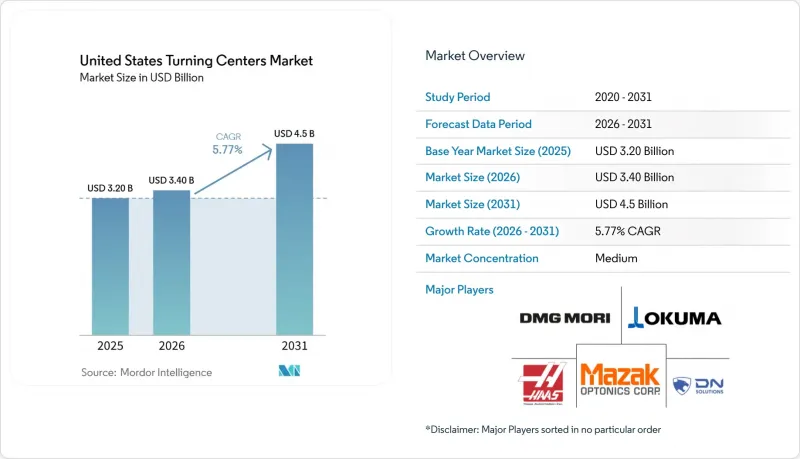
Mordor Intelligence에 의하면, 미국 터닝 센터 시장 규모는 2025년 32억 달러에서 2026년에는 34억 달러로 확대되어 2026년부터 2031년까지 CAGR 5.77%로 성장을 지속하여, 2031년까지 45억 달러에 이를 것으로 예측됩니다.
본 보고서는 제품 유형(수평형 터닝 센터, 수직형 터닝 센터 등), 축 구성(3축, 4축, 5축 이상), 자동화 유형(수동, 반자동 등) 및 최종 사용 산업(자동차·상용차, 항공우주 및 방위 등)별로 분류되어 있습니다. 시장 전망은 금액(달러) 및 수량(대)으로 제시되어 있습니다.
미국 터닝 센터 시장 동향 및 인사이트
IRA, CHIPS 법, 인프라 법이 2조 달러 규모의 제조업 투자를 견인
미국 터닝 센터 시장에 대한 가장 강력한 구조적 뒷받침은 IRA, CHIPS·과학 법, 그리고 인프라 투자·고용법의 시너지 효과에 기인합니다. 상무부는 2021년부터 2024년까지 공장 건설이 2배 이상 증가했으며, 같은 기간 제조업 투자는 많은 예측자들의 예상을 뛰어넘는 견조한 추세를 유지했다고 밝혔습니다. CHIPS 프로그램 사무국은 이미 20개 주를 대상으로 190억 달러가 넘는 인센티브 방안을 약속했으며, 반도체 및 전자 분야에서의 4,500억 달러 이상의 민간 투자를 촉진하고 있습니다. 새로운 제조 시설이 건설될 때마다 공정 장비 제조, 서비스용 공구 및 유지보수 가공에 사용되는 터닝 센터에 대한 수요가 증가합니다. 이에 따라 미국의 터닝 센터 시장은 일회성 건설 지출만으로는 예상보다 더 긴 수요 주기를 누리게 될 것입니다. 유사한 추세는 배터리 및 전기차(EV) 공급망에서도 관찰됩니다. 이 분야에서는 대규모 공장 건설이 설비 설치 및 생산 확대 단계로 접어들면서, 반복 가공이 가능한 CNC 선반의 생산 능력이 요구되고 있습니다.
항공우주 및 방위 예산 확대가 다축 터닝 센터 수요를 견인
방위 지출은 미국 터닝 센터 시장에 있어 단기적인 수요를 뒷받침하는 가장 명확한 요인 중 하나입니다. 2026 회계연도 국방부 예산 요청 총액은 961억 6,000만 달러에 달할 전망입니다. 여기에는 잠수함 산업 기반을 위한 약 57억 달러와 더불어, 금속 가공의 개발, 인증 및 생산 인프라 현대화를 위한 6억 4,070만 달러가 포함되어 있습니다. 또한, 3,107억 달러에 달하는 2025 회계연도 무기 조달 요청은 항공기, 해군 플랫폼 및 첨단 무기 시스템에 걸친 다년간의 생산 파이프라인을 더욱 강화할 것입니다. 잠수함 선체 링, 터빈 디스크, 착륙 장치 부품, 추진 장치 등의 부품은 여전히 인증된 다축 선반 가공에 의존하고 있으며, 현행 기준에서는 이러한 요건을 대규모로 전환하는 것이 허용되지 않습니다. 하원 군사위원회가 미국의 공작기계 산업 기반과 해외 의존도에 관한 보고서를 요청함에 따라 의회의 관심도 높아지고 있습니다. 이는 국내 생산 능력과 국내 조립을 점점 더 중시하는 조달 환경을 지적하는 것입니다.
중저가대 터닝 센터 시장에서 일본 및 한국의 OEM 제조업체들과의 치열한 경쟁
수입품과의 경쟁은 미국 터닝 센터 시장에서 가격 결정력을 제한하는 주요 요인 중 하나로 계속되고 있습니다. 일본 및 한국의 각 OEM 업체들은 기능이 풍부한 CNC 터닝 센터를 무기로 20만 달러에서 60만 달러에 이르는 중가대 시장을 지속적으로 공략하고 있어, 국내 제조업체가 가격 면에서 대항하기는 어려운 상황입니다. USTR 자료에 따르면, 2024년 일본 대 미국 간 상품 무역 흑자는 570억 달러였던 반면, 2025년 한국 대 미국 간 상품 무역 흑자는 564억 달러였으며, 두 경우 모두 기계류가 여전히 중요한 수출 품목으로 자리 잡고 있습니다. 2026년 3월, USTR은 구조적 과잉 생산 능력과 관련된 섹션 301 조사에서 공작기계를 구체적으로 지목하며, 전 세계 제조업의 설비 가동률이 76% 미만으로, 이는 가격 균형을 위해 건전하다고 여겨지는 수준을 여전히 밑돌고 있다고 지적했습니다. 이러한 조사가 구체적인 무역 조치로 이어지기 전까지는 미국 바이어들은 계속해서 경쟁력 있는 가격의 수입품에 직면하게 될 것이며, 대량 생산 품목에 있어 국내 및 유럽 공급업체에 대한 압박이 지속될 것으로 보입니다.
부문 분석
2025년, 수평형 터닝 센터는 미국 터닝 센터 시장 점유율의 46%를 차지하며 제품으로서의 주도적 지위를 유지했습니다. 이러한 규모는 자동차 구동계, 유압 부품, 석유 및 가스용 관재 용도에 걸친 대량 생산 원통형 부품 제조에서 해당 제품이 계속해서 수행하고 있는 역할을 반영합니다. 수평형 시스템을 위한 광범위한 공구 생태계 또한 그 위상을 뒷받침하고 있습니다. 이는 공장이 바 피더, 갠트리 로더, 확립된 프로그래밍 루틴을 활용하여 공정을 크게 중단하지 않고도 자동화를 확대할 수 있기 때문입니다. 수직형 터닝 센터는 대구경 디스크 및 링 부품 분야에서 여전히 중요하며, 특히 설치 면적 효율과 부품 취급이 중요한 에너지 분야 및 중공업 분야에서 그 가치를 발휘하고 있습니다.
멀티태스크 터닝 센터는 이 제품군에서 2031년까지 미국 터닝 센터 시장 규모에서 연평균 성장률(CAGR) 6.8%라는 가장 높은 성장률을 나타낼 것으로 예측됩니다. 항공우주, 의료, 반도체 장비 제조업체들은 더 복잡한 부품의 셋업 시간을 단축하고 공정 내 재고를 줄일 수 있다는 점에서 이러한 플랫폼으로의 전환을 추진하고 있습니다. 미국 국방부가 금속 가공의 현대화에 주력하고 있는 점도 이러한 전환을 뒷받침하고 있습니다. 이는 공급업체들이 바닥 면적을 비슷한 수준으로 확대하지 않고도 1회 세팅당 생산량을 늘리라는 압력을 받고 있기 때문입니다. 스위스형 및 역방향 수직 형식은 앞으로도 보다 전문적인 용도로만 사용될 전망이지만, 공차 요구 사항이 너무 엄격하여 광범위한 표준화가 어려운 마이크로 부품 및 정밀 용도에서는 여전히 중요한 역할을 하고 있습니다.
2025년, 미국 터닝 센터 시장에서 4축 구성은 48.5%를 차지하며 가장 큰 축 카테고리가 되었습니다. 이러한 시스템은 구동 공구 기능이 필요한 경우나, 완전한 5축 프로그래밍의 복잡성을 정당화하기에는 미치지 못하는 많은 자동차, 산업기계, 에너지 분야의 용도 요구를 충족시키고 있습니다. 3축 부문은 피팅, 체결 부품 및 이와 유사한 부품과 같은 대량 생산용 범용 선반 가공 분야에서 여전히 중요한 위치를 차지하고 있습니다. 이러한 분야에서는 축 수를 늘려도 충분한 투자 대비 효과를 얻을 수 없기 때문입니다. 그 결과, 4축 플랫폼은 광범위한 도입 기반에 있어 실용적인 중간 선택지가 되고 있습니다.
5축 이상 시스템은 2031년까지 연평균 성장률(CAGR) 7.9%로 확대될 것으로 예상되며, 이로 인해 미국 터닝 센터 시장에서 가장 빠르게 성장하는 축 부문이 될 것입니다. 수요를 견인하고 있는 것은 항공우주 구조물, 터빈 부품, 정형외과용 임플란트, 그리고 단일 클램프 내에서 동시 다축 보간이 필요한 기타 형상들입니다. 2026 회계연도 국방 예산에는 203억 달러의 과학기술 예산이 편성되어 있으며, 이는 첨단 제조 프로토타입 및 하이브리드 절삭 능력을 지원함으로써 공급업체 기반의 각 부문에서 인증 기준을 높이고 있습니다. 또한, NIST 및 Manufacturing USA의 각 프로그램은 기술 이전과 프로그래밍 지원을 통해 중규모 공장의 도입 장벽을 지속적으로 낮추고 있으며, 5축 선반 시스템의 잠재적 고객 기반 확대에 기여하고 있습니다.
기타 혜택:
- 엑셀 형식 시장 예측(ME) 시트
- 3개월간의 애널리스트 지원
자주 묻는 질문
목차
제1장 서론
제2장 조사 방법
제3장 주요 요약
제4장 시장 구도
제5장 시장 규모와 성장 예측
제6장 경쟁 구도
제7장 시장 기회와 향후 전망
JHSAccording to Mordor Intelligence, the United States turning centers market size is expected to grow from USD 3.20 billion in 2025 to USD 3.40 billion in 2026 and is forecast to reach USD 4.5 billion by 2031 at 5.77% CAGR over 2026-2031.
This report is Segmented by Product Type (Horizontal Turning Centers, Vertical Turning Centers, and More), by Axis Configuration (3-Axis, 4-Axis, 5-Axis and Above), by Automation Type (Manual, Semi-Automatic, and More), and by End-User Industry (Automotive and Commercial Vehicles, Aerospace & Defense, and More). The Market Forecasts are Provided in Terms of Value (USD) and Volume (Units).
United States Turning Centers Market Trends and Insights
IRA, CHIPS Act, and Infrastructure Act Driving USD 2 Trillion in Manufacturing Investments
The strongest structural support for the United States turning centers market comes from the combined effect of the IRA, the CHIPS and Science Act, and the Infrastructure Investment and Jobs Act. The Department of Commerce stated that factory construction more than doubled between 2021 and 2024, and manufacturing investment remained stronger than many forecasters expected over the same period. The CHIPS Program Office has already committed more than USD 19 billion in proposed incentives across 20 states, helping catalyze more than USD 450 billion in private investment in semiconductor and electronics. Each new fabrication facility increases demand for turning centers used in process equipment manufacturing, service tooling, and maintenance machining, which gives the United States turning centers market a longer demand cycle than one-time construction spending alone would suggest. The same pattern is visible in battery and EV supply chains, where large-scale plant buildouts are moving into equipment installation and production ramp-up phases that need repeatable CNC turning capacity.
Aerospace and Defense Budget Expansion Boosting Multi-Axis Turning Center Demand
Defense spending is one of the clearest near-term demand supports for the United States turning centers market. The FY2026 Department of Defense budget request totals USD 961.6 billion. It includes nearly USD 5.7 billion for the submarine industrial base, as well as USD 640.7 million for metalworking development, certification, and modernization of production infrastructure. The FY2025 weapons procurement request of USD 310.7 billion also reinforces a multi-year production pipeline across aircraft, naval platforms, and advanced weapons systems. Components such as submarine hull rings, turbine discs, landing gear parts, and propulsion hardware still rely on qualified multi-axis turning operations, and current standards do not allow those requirements to shift away at scale. Congressional attention is also increasing, as the House Armed Services Committee called for a report on the United States machine tool industrial base and foreign dependencies, pointing to a procurement environment that increasingly favors domestic capacity and domestic assembly.
Intense Import Competition from Japanese and Korean OEMs in Mid-Market Turning Centers
Import competition remains one of the main limits on pricing strength in the United States turning centers market. Japanese and Korean OEMs continue to target the USD 200,000 to USD 600,000 mid-market range with feature-rich CNC turning centers that are difficult for domestic manufacturers to match on price. USTR data showed that Japan held a USD 57 billion goods trade surplus with the United States in 2024, while Korea's goods trade surplus with the United States stood at USD 56.4 billion in 2025, and machinery remained an important export category in both cases. In March 2026, USTR specifically named machine tools in its Section 301 investigations related to structural excess capacity, noting that global manufacturing capacity utilization remained below 76%, which is still below the level considered healthy for balanced pricing. Until those investigations produce concrete trade actions, United States buyers are likely to continue seeing competitively priced imports that keep pressure on domestic and European suppliers in higher-volume categories.
Other drivers and restraints analyzed in the detailed report include:
- Automotive Reshoring and EV Gigafactory Investments Increasing Need for Turning Center Cells
- Buy American and Domestic Content Mandates Shaping Defense Procurement
- Impact of Elevated Interest Rates on Payback Periods and CapEx Decisions
For complete list of drivers and restraints, kindly check the Table Of Contents.
Segment Analysis
Horizontal turning centers held 46% of the United States' turning centers market share in 2025, maintaining their leading product position. Their scale reflects their continued role in high-volume cylindrical part production across automotive drivetrains, hydraulic components, and oil-and-gas tubular applications. The broad tooling ecosystem for horizontal systems also supports their position, as shops can scale automation with bar feeders, gantry loaders, and established programming routines without major process disruption. Vertical turning centers remained important for large-diameter disc and ring parts, especially in energy and heavy industrial settings where footprint efficiency and part handling matter.
Multi-tasking turning centers are expected to record the fastest growth at a 6.8% CAGR through 2031 in the United States turning centers market size for this product class. Aerospace, medical, and semiconductor equipment producers are moving toward these platforms because they reduce setups and lower in-process inventory for more complex components. The Department of Defense's focus on metalworking modernization is reinforcing this shift because suppliers are under pressure to increase output per setup without expanding floor space at the same pace. Swiss-type and inverted vertical formats will remain more specialized, but they still serve micro-component and precision applications where tolerance demands are too specific for broader standardization.
4-axis configurations accounted for 48.5% of the United States turning centers market in 2025, which made them the largest axis category. These systems meet the needs of many automotive, industrial machinery, and energy applications that require driven-tool capability but do not yet justify full 5-axis programming complexity. The 3-axis segment still has a place in high-volume commodity turning for fittings, fasteners, and similar parts where added-axis capability does not yield an adequate return. This leaves 4-axis platforms as the practical middle ground for a wide installed base.
5-axis and above systems are forecast to expand at a 7.9% CAGR through 2031, which makes them the fastest-growing axis segment in the United States turning centers market. Demand is driven by aerospace structures, turbine parts, orthopedic implants, and other geometries that require simultaneous multi-axis interpolation within a single clamping. The FY2026 defense budget includes a USD 20.3 billion science and technology allocation that supports advanced manufacturing prototypes and hybrid subtractive capability, which raises qualification standards across parts of the supplier base. NIST and Manufacturing USA programs also continue to lower adoption barriers for mid-sized shops through technology transfer and programming support, helping expand the addressable base for 5-axis turning systems.
Complete Report Scope:
- By Product Type
- Horizontal Turning Centers
- Vertical Turning Centers
- Multi-Tasking Turning Centers
- Others
- By Axis Configuration
- 3-Axis
- 4-Axis
- 5-Axis and Above
- By Automation Type
- Manual
- Semi-Automatic
- Fully Automatic CNC
- By End-User Industry
- Automotive and Commercial Vehicles
- Aerospace & Defense
- Medical Devices and Surgical Instruments
- Oil, Gas, and Energy
- Electrical, Electronics and Semiconductor Equipment
- General Industrial Machinery
- Others
List of Companies Covered in this Report:
- Haas Automation
- Mazak Corporation
- DMG MORI
- Okuma Corporation
- DN Solutions
- Hyundai WIA
- Hwacheon Machinery
- Nakamura-Tome Precision Industry Co., Ltd
- INDEX-Werke GmbH
- Hardinge Inc.
- EMAG GmbH
- Murata Machinery
- Star CNC Machine Tool Corp.
- Kent CNC
- Takamaz Corporation
- Tornos Holding AG
- Victor Taichung Machinery Works Co., Ltd.
- Hurco Companies, Inc.
- Tsugami Corporation
- Citizen Machinery Co., Ltd.
Additional Benefits:
- The market estimate (ME) sheet in Excel format
- 3 months of analyst support
TABLE OF CONTENTS
1 Introduction
- 1.1 Study Assumptions & Market Definition
- 1.2 Scope of the Study
2 Research Methodology
3 Executive Summary
4 Market Landscape
- 4.1 Market Overview
- 4.2 Market Drivers
- 4.2.1 IRA, CHIPS Act, and Infrastructure Act Driving USD 2 Trillion in Manufacturing Investments
- 4.2.2 Aerospace and Defense Budget Expansion Boosting Multi-Axis Turning Center Demand
- 4.2.3 Automotive Reshoring and EV Gigafactory Investments Increasing Need for Turning Center Cells
- 4.2.4 Buy American and Domestic Content Mandates Shaping Defense Procurement
- 4.2.5 Nearshoring from Mexico Fueling Cross-Border Turning Center Investments
- 4.2.6 Section 232 Tariffs Elevating Prices for Domestic and Allied OEM Machine Tools
- 4.3 Market Restraints
- 4.3.1 Intense Import Competition from Japanese and Korean OEMs in Mid-Market Turning Centers
- 4.3.2 Impact of Elevated Interest Rates on Payback Periods and CapEx Decisions
- 4.3.3 Skilled CNC Operator and Programmer Shortage Affecting Turning Center Deployment
- 4.3.4 Long Lead Times for High-Specification Turning Centers from Japanese and European OEMs
- 4.4 Value / Supply-Chain Analysis
- 4.4.1 Raw Material & Critical Component Ecosystem
- 4.4.2 Manufacturing & Assembly Value Chain
- 4.4.3 Distribution & Go-to-Market Channels
- 4.4.4 Aftermarket Services & Lifecycle Support
- 4.5 Regulatory Landscape
- 4.6 Technological Outlook & Innovation Investment Landscape
- 4.6.1 AI-Driven Adaptive Control and Chatter Suppression
- 4.6.2 High-Speed Spindle and HSK-T Interface Evolution
- 4.7 Pricing Analysis
- 4.7.1 Average Selling Price (ASP) Benchmarking of Key Market Participants
- 4.7.2 Average Selling Price (ASP) Analysis, by Product Type
- 4.7.3 Average Selling Price (ASP) Analysis, by Axis Configuration
- 4.7.4 Average Selling Price (ASP) Analysis, by Automation
- 4.8 Buying Criteria & Procurement Analysis
- 4.9 Porter's Five Forces Analysis - Industry Attractiveness Scoring
- 4.9.1 Threat of New Entrants
- 4.9.2 Bargaining Power of Suppliers
- 4.9.3 Bargaining Power of Buyers
- 4.9.4 Threat of Substitutes
- 4.9.5 Industry Rivalry
- 4.10 Impact of Geopolitical Events on the Market
5 Market Size & Growth Forecasts
- 5.1 By Product Type
- 5.1.1 Horizontal Turning Centers
- 5.1.2 Vertical Turning Centers
- 5.1.3 Multi-Tasking Turning Centers
- 5.1.4 Others
- 5.2 By Axis Configuration
- 5.2.1 3-Axis
- 5.2.2 4-Axis
- 5.2.3 5-Axis and Above
- 5.3 By Automation Type
- 5.3.1 Manual
- 5.3.2 Semi-Automatic
- 5.3.3 Fully Automatic CNC
- 5.4 By End-User Industry
- 5.4.1 Automotive and Commercial Vehicles
- 5.4.2 Aerospace & Defense
- 5.4.3 Medical Devices and Surgical Instruments
- 5.4.4 Oil, Gas, and Energy
- 5.4.5 Electrical, Electronics and Semiconductor Equipment
- 5.4.6 General Industrial Machinery
- 5.4.7 Others
6 Competitive Landscape
- 6.1 Market Concentration
- 6.2 Strategic Moves
- 6.3 Market Share Analysis
- 6.4 Competitive Benchmarking Analysis
- 6.5 Company Profiles (Includes Global Level Overview, Market Level Overview, Core Segments, Financials as Available, Strategic Information, Products & Services, and Recent Developments)
- 6.5.1 Haas Automation
- 6.5.2 Mazak Corporation
- 6.5.3 DMG MORI
- 6.5.4 Okuma Corporation
- 6.5.5 DN Solutions
- 6.5.6 Hyundai WIA
- 6.5.7 Hwacheon Machinery
- 6.5.8 Nakamura-Tome Precision Industry Co., Ltd
- 6.5.9 INDEX-Werke GmbH
- 6.5.10 Hardinge Inc.
- 6.5.11 EMAG GmbH
- 6.5.12 Murata Machinery
- 6.5.13 Star CNC Machine Tool Corp.
- 6.5.14 Kent CNC
- 6.5.15 Takamaz Corporation
- 6.5.16 Tornos Holding AG
- 6.5.17 Victor Taichung Machinery Works Co., Ltd.
- 6.5.18 Hurco Companies, Inc.
- 6.5.19 Tsugami Corporation
- 6.5.20 Citizen Machinery Co., Ltd.
7 Market Opportunities & Future Outlook
- 7.1 White-Space & Unmet-Need Assessment