
|
시장보고서
상품코드
2099268
AI 인프라 서비스(IaaS) 시장 : 점유율 분석, 업계 동향 및 통계, 성장 예측(2026-2031년)AI Infrastructure-as-a-Service - Market Share Analysis, Industry Trends & Statistics, Growth Forecasts (2026 - 2031) |
||||||
 Mordor Intelligence
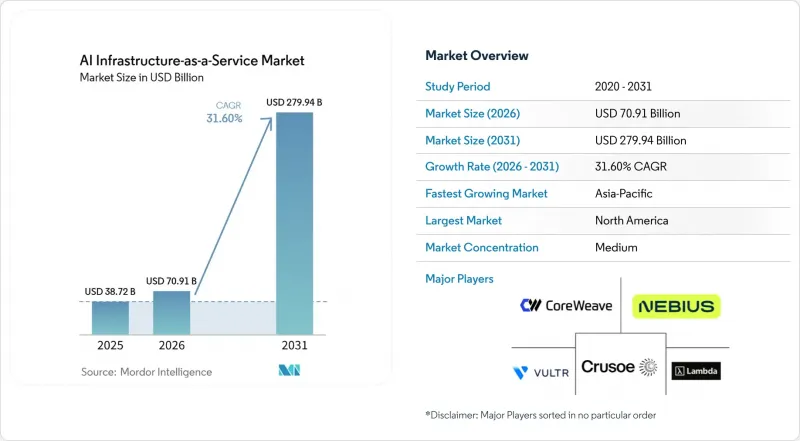
Mordor Intelligence에 의하면, AI 인프라 서비스(IaaS) 시장 규모는 2025년 387억 2,000만 달러에서 2026년에는 709억 1,000만 달러로 확대되어 2026년부터 2031년까지 CAGR 31.60%로 성장을 지속하여, 2031년에는 2,799억 4,000만 달러에 이를 것으로 예측됩니다.
본 보고서는 인프라 유형(AI 컴퓨팅 인프라, AI 스토리지 인프라 등), 워크로드 유형(모델 훈련 및 미세 조정 등), 배포 모드(퍼블릭 클라우드, 관리형 프라이빗 클라우드 등), 고객 조직 규모(대기업 등), 최종 용도(BFSI 등), 지역별로 분류되어 있습니다. 시장 전망은 금액(달러) 기준으로 제시되어 있습니다.
세계 AI 인프라 서비스(IaaS) 시장 동향 및 인사이트
탄력적인 GPU 용량에 대한 수요가 AI IaaS 확장을 주도
AI 인프라 서비스(IaaS) 시장의 가장 큰 매력은 워크로드 양의 변화에 따라 GPU 접근 규모를 유연하게 확대·축소할 수 있다는 점에 있습니다. 많은 기업은 훈련 실행 횟수, 미세 조정 주기, 또는 추론의 피크를 정확히 예측할 수 없어 고정된 하드웨어를 보유할 정당성을 입증하기 어렵습니다. 이러한 불확실성으로 인해, 특히 모델 출시, 용도 출시, 또는 고객 트래픽이 며칠 내에 급격히 변화할 가능성이 있는 경우, 정적 예약보다 버스트 액세스가 더 높은 가치를 지닙니다. 아카마이는 2026년 보고서에서 조직의 64%가 중요한 이용 사례에서 엔드투엔드 AI 응답 시간을 250밀리초 미만으로 요구하고 있는 반면, 현재 도입 사례의 50%는 피크 부하 시 그 기준을 충족하지 못하고 있다고 보고했으며, 이는 확장성과 응답성에 최적화된 탄력적인 인프라의 가치를 뒷받침하는 것입니다. AI 인프라 서비스(IaaS) 시장에서도 이용 현황에 변화가 나타나고 있습니다. 이전의 훈련 중심 단계에 비해, 현재는 추론이 GPU 가동 시간에서 더 큰 비중을 차지하고 있기 때문입니다. 이러한 추세는 용량을 신속하게 확보하고, 워크로드를 클러스터 간에 이동시키며, 프로덕션 환경에서 저지연 서비스 제공을 지원할 수 있는 공급자에게 유리하게 작용합니다.
자본 지출(Capex)이 큰 비중을 차지하는 AI 구축에서 사용량 기반의 소비 모델로의 전환
AI 인프라 서비스(IaaS) 시장은 자본 집약적인 GPU 자체 보유에서 운영 비용 모델로의 명확한 전환의 혜택을 받고 있습니다. 기업의 AI 프로그램은 급속히 확대되고 있지만, 이를 뒷받침하기 위해 필요한 하드웨어의 조달, 설치, 최적화에는 수개월이 소요될 수 있습니다. 이러한 시기의 불일치는 특히 신세대 GPU가 더 높은 성능을 발휘하여 기존 시스템의 수명을 단축시키는 상황에서 유휴 자본 리스크를 초래합니다. 사용량 기반 조달을 통해 기업은 컴퓨팅 관련 지출을 가동 중인 모델, 사업 부문, 도입 일정에 맞추어 조정할 수 있으므로 이러한 위험을 완화할 수 있습니다. 또한 팀이 비용을 광범위한 인프라 풀 전체에 고루 분산시키지 않고 특정 용도에 직접 연계할 수 있으므로 AI 예산 추적도 용이해집니다. AI 인프라 서비스(IaaS) 시장이 성숙해짐에 따라, 이 지출 모델은 기업이 자체 소유의 GPU 환경 대신 공유 또는 전용 클라우드 용량을 선택하는 주요 이유 중 하나로 계속 남아 있을 것입니다.
만성적인 GPU 및 HBM 공급 부족이 용량 확장을 제한
AI 인프라 서비스(IaaS) 시장의 단기적인 가장 큰 제약 요인은 수요가 아니라, 고성능 GPU 및 그 제조에 필요한 메모리 패키지공급 부족입니다. 고대역폭 메모리(HBM)는 이것이 없으면 GPU 조립을 확장할 수 없기 때문에 여전히 업스트림 공정에서 중대한 병목 현상으로 작용하고 있습니다. 2026년 업계 보고서에 따르면, SK하이닉스는 2026년까지의 HBM3e 생산 물량을 모두 매진했으며, 2027년까지 상당한 양의 선매매 계약을 체결한 반면, 마이크론은 HBM 시장이 2025년 350억 달러에서 2028년까지 1,000억 달러로 확대될 것으로 예측했습니다. 해당 보고서에 따르면, SK하이닉스, 삼성, 마이크론이 전 세계 HBM 생산량의 95% 가까이를 차지하고 있어, 공급의 급속한 다각화 여지는 거의 없다고 지적하고 있습니다. 엔비디아의 첨단 시스템은 리드타임이 길기 때문에 공급업체는 필요한 하드웨어를 확보하기 전에 고객 수요를 파악하는 경우가 많습니다. 그 결과, AI 인프라 서비스(IaaS) 시장은 고객의 낮은 관심 때문이 아니라 공급 상황에 의해 단기적인 수익 상한선에 직면해 있습니다.
부문 분석
2025년, AI 컴퓨팅 인프라는 AI 인프라 서비스(IaaS) 시장의 72.53% 점유율을 차지하고, 이는 GPU 클러스터 임대 및 대규모 AI 가속기 프로비저닝이 매우 높은 가치를 지닌다는 점을 반영합니다. 거의 모든 훈련 및 추론 워크로드가 고가의 가속기가 탑재된 컴퓨팅에 대한 접근에 의존하고 있기 때문에 AI 인프라 서비스(IaaS) 시장의 이 부분은 계속해서 스택의 경제적 중심을 이루고 있습니다. NVIDIA H100 및 Blackwell 시스템의 높은 비용으로 인해 구매 결정에서 소프트웨어 및 오케스트레이션의 중요성이 높아지더라도, 컴퓨팅은 여전히 고객 지출의 중심에 위치하고 있습니다. 훈련 성능은 데이터 세트의 빠른 확보와 여러 노드 간의 저지연 통신에 의존하기 때문에 스토리지와 네트워크는 여전히 필수적인 지원 계층으로 남아 있습니다. AI 스토리지 인프라는 대규모 데이터셋에 대한 지속적인 처리량을 지원하며, AI 네트워크 인프라는 그렇지 않으면 서버 간 병목 현상으로 어려움을 겪을 수 있는 분산 작업을 가능하게 합니다.
AI 인프라 관리 및 오케스트레이션은 2031년까지 연평균 성장률(CAGR) 32.78%를 나타낼 것으로 예측되며, AI 인프라 서비스(IaaS) 시장에서 가장 빠르게 성장하는 하위 부문이 될 것입니다. 이러한 성장은 단일 클러스터에서의 실험 단계에서 멀티 클라우드, 멀티 모델, 멀티 리전 프로덕션 환경으로의 전환을 반영합니다. 추론이 GPU 사용률에서 더 큰 비중을 차지하게 됨에 따라, 기업들은 지연 시간 및 비용 목표를 달성하면서 작업을 적절한 하드웨어 계층으로 라우팅할 수 있는 도구가 필요합니다. 이에 따라 스케줄링, 활용도 모니터링, 워크로드 배치, 정책 제어를 연계하는 오케스트레이션 소프트웨어가 고객 가치 창출의 핵심적인 역할을 담당하게 될 것입니다. 따라서 AI 인프라 서비스(IaaS) 업계는 하드웨어 중심의 구매 결정에서 플랫폼 중심의 결정으로 전환되고 있으며, 이기종 혼합 플릿을 관리하는 능력이 중요한 차별화 요소가 되고 있습니다. 컴퓨팅 접근성과 강력한 관리 도구를 결합한 제공업체는 고객이 해당 운영 계층에 의존하게 되면 전환이 어려워지기 때문에 고객을 장기적으로 유지할 가능성이 높다고 볼 수 있습니다. 이는 소규모 전문 벤더에게도 경쟁의 여지를 제공합니다. 하이퍼스케일러의 인프라가 가진 광범위한 규모에는 미치지 못하더라도, 소프트웨어 측면에서 부가가치를 제공할 수 있기 때문입니다. 시간이 지남에 따라 구매자가 순수한 용량뿐만 아니라 워크로드의 효율성과 운영 제어력을 중시하게 됨에 따라, 오케스트레이션이 수익에서 차지하는 비중은 더욱 확대될 전망입니다. 그 결과, 현재 컴퓨팅이 여전히 최대 수익원인 AI 인프라 서비스(AI Infrastructure-as-a-Service) 시장 내에서 보다 균형 잡힌 부문 구조가 형성될 것입니다.
2025년에는 모델 훈련 및 미세 조정이 매출의 49.34%를 차지하며, AI 인프라 서비스 시장에서 가장 큰 워크로드 카테고리가 되었습니다. 이러한 주도적인 위상은 대규모 모델 개발에 필요한 고밀도 GPU 클러스터, 첨단 상호 연결, 그리고 장시간 소요되는 작업에 따른 높은 비용에서 기인합니다. 많은 기업과 모델 개발자가 프로덕션 환경에서의 활용을 위해 최첨단 시스템 및 도메인별 시스템의 미세 조정을 지속하고 있기 때문에 훈련 워크로드는 여전히 중요합니다. 또한, 이러한 워크로드는 대규모 분산 환경 전반에 걸쳐 관리형 데이터 준비, 스토리지 처리량 및 성능 모니터링에 대한 수요도 창출하고 있습니다. 워크로드 구성이 다양해지더라도, 훈련은 가장 고성능의 하드웨어를 소비하며, 대부분의 경우 예약되거나 고도로 전문화된 클러스터 구성에서 실행되기 때문에 여전히 주요 수익원입니다.
모델 추론 및 서빙은 2031년까지 연평균 성장률(CAGR) 32.45%를 나타낼 것으로 예측되며, AI 인프라 서비스(IaaS) 시장에서 가장 빠르게 성장하는 워크로드가 될 전망입니다. Vast.AI는 2026년에 추론 워크로드가 AI 컴퓨팅의 약 3분의 2를 차지할 것이라고 밝혔으며, 이는 많은 환경에서 실험보다 실제 운영이 더 중요해지고 있다는 관점을 뒷받침합니다. 추론은 지속적이며 지연 시간에 민감하고 고객 수요와 밀접하게 연관되어 있기 때문에 이러한 변화는 인프라의 경제성을 바꿀 것입니다. 또한 모델 라우팅, 자동 확장, 캐시, 검색 증강 생성(RAG) 파이프라인을 위한 벡터 데이터베이스와 같은 코로케이션 서비스에 대한 관심도 높아지고 있습니다. AI 데이터 처리 및 분석은 기업이 훈련 데이터 준비, 응답 타당성 확인, 배포 후 검색 워크플로우 지원을 위해 관리형 파이프라인을 필요로 하기 때문에 여전히 중요합니다. 합성 데이터 생성, 인간의 피드백에 기반한 강화 학습, 신약 개발 및 자율 시스템을 위한 시뮬레이션 등 기타 AI 워크로드는 이용 패턴을 확대시키는 버스트 수요를 유발합니다.
지역별 분석
2025년, 북미는 AI 인프라 서비스(IaaS) 시장의 56.12%를 차지하며 계속해서 최대 지역 기여자로서의 지위를 유지했습니다. 이 지역의 우위는 하이퍼스케일러의 규모, 기업의 조기 AI 도입, 그리고 데이터센터 및 GPU 확장을 위한 풍부한 자금 조달 능력에 힘입은 것입니다. 최대 규모의 클라우드 플랫폼, AI 소프트웨어 생태계, 그리고 고부가가치 기업 계약의 대부분이 미국에 집중되어 있어, 미국은 여전히 핵심 시장으로 자리 잡고 있습니다. 캐나다는 재생에너지와 연계된 데이터센터 개발 및 미국의 주요 클라우드 회랑과의 근접성을 통해 전략적 중요성을 높이고 있습니다. 멕시코는 북미 AI 인프라에 대한 저지연 접근이라는 이점을 누릴 수 있는 급성장 중인 니어쇼어 디지털 서비스 기반을 통해 이 지역의 전체적인 구도를 뒷받침하고 있습니다.
2025년, 유럽은 AI 인프라 서비스(IaaS) 시장에서 상당한 점유율을 차지하고 있으며, 독일, 영국, 프랑스가 주요 국내 수요 거점으로 부상하고 있습니다. 이 지역 수요는 주권 클라우드에 대한 우선순위, 조달 규정, 그리고 훈련 데이터, 인프라 입지, 운영 거버넌스에 대한 보다 명확한 관리 필요성에 의해 형성되고 있습니다. 이러한 상황으로 인해 현지 및 주권 중심 공급업체들은 2024년 이전보다 규제 대상 워크로드 분야에서 경쟁할 여지가 확대되고 있습니다. 따라서 유럽의 AI 인프라 서비스(IaaS) 시장은 특히 금융, 의료, 정부 분야의 이용 사례에서 북미보다 강력한 정책적 프레임워크 하에서 진화하고 있습니다. 그 결과, 기업과의 계약을 수주하기 위해서는 규정 준수 기능, 감사 추적 기록, 그리고 지역별 운영 모델이 더욱 중요해지고 있습니다.
아시아태평양은 2031년까지 연평균 성장률(CAGR) 32.84%로 확대될 것으로 예측되며, AI 인프라 서비스(IaaS) 시장에서 가장 빠르게 성장하는 지역 부문이 될 전망입니다. 중국은 여전히 이 지역 최대의 단일 시장이지만, 일본, 한국, 인도는 각각 산업 정책, 반도체, 소프트웨어 서비스, 규제 대상 기업 도입과 관련된 서로 다른 수요 패턴을 보이고 있습니다. 말레이시아, 싱가포르, 태국이 주도하는 동남아시아는 토지, 세제, 전력 면에서 우위를 점하고 있어 지역적 진출 거점으로서 중요성이 높아지고 있습니다. 남미 및 중동 및 아프리카는 현재 규모는 작지만, 국가 주도의 AI 프로그램, 통신 수요, 그린필드 데이터센터 프로젝트에 힘입어 AI 인프라 서비스(AI Infrastructure-as-a-Service) 시장의 향후 전개 범위가 확대됨에 따라 두 지역 모두 그 중요성이 커지고 있습니다.
기타 혜택:
- 엑셀 형식 시장 예측(ME) 시트
- 3개월간의 애널리스트 지원
자주 묻는 질문
목차
제1장 서론
제2장 조사 방법
제3장 주요 요약
제4장 시장 구도
제5장 시장 규모와 성장 예측
제6장 경쟁 구도
제7장 시장 기회와 향후 전망
JHSAccording to Mordor Intelligence, the AI infrastructure-as-a-Service market size is expected to grow from USD 38.72 billion in 2025 to USD 70.91 billion in 2026 and is forecast to reach USD 279.94 billion by 2031 at 31.60% CAGR over 2026-2031.
This report is Segmented by Infrastructure Type (AI Compute Infrastructure, AI Storage Infrastructure, and More), Workload Type (Model Training and Fine-Tuning, and More), Deployment Mode (Public Cloud, Managed Private Cloud, and More), Customer Organization Size (Large Enterprises, and More), End-Use (BFSI, and More), and Geography. The Market Forecasts are Provided in Terms of Value (USD).
Global AI Infrastructure-as-a-Service Market Trends and Insights
Demand For Elastic GPU Capacity Fuels AI IaaS Expansion
The strongest draw of the AI Infrastructure-as-a-Service market is the ability to scale GPU access up or down as workload volumes change. Many enterprises cannot accurately predict training runs, fine-tuning cycles, or inference peaks to justify fixed hardware ownership. That uncertainty makes burst access more valuable than static reservations, especially when model releases, application launches, or customer traffic can shift sharply within days. Akamai reported in 2026 that 64% of organizations required end-to-end AI response times below 250 milliseconds for critical use cases, while 50% of current deployments failed to meet that standard at peak load, which reinforces the value of elastic infrastructure tuned for scale and responsiveness. The AI Infrastructure-as-a-Service market is also seeing a shift in utilization, as inference now consumes a larger share of GPU hours than it did during the earlier training-led phase. This pattern favors providers that can quickly release capacity, move workloads across clusters, and support low-latency serving in production.
Shift From Capex-Heavy AI Buildouts to Usage-Based Consumption Models
The AI Infrastructure-as-a-Service market is benefiting from a clear shift away from capital-intensive GPU ownership toward operating-cost models. Enterprise AI programs are scaling quickly, but the hardware needed to support them can take many months to procure, install, and optimize. That timing mismatch creates stranded capital risk, especially as newer GPU generations deliver higher performance and shorten the useful life of earlier systems. Usage-based procurement reduces that risk by letting firms align compute spending with active models, business units, and deployment schedules. It also makes AI budgets easier to trace, because teams can map costs to specific applications rather than amortize them across broad infrastructure pools. As the AI Infrastructure-as-a-Service market matures, this spending model is likely to remain one of the main reasons enterprises choose shared or dedicated cloud capacity over owned GPU estates.
Chronic GPU And HBM Scarcity Limits Capacity Expansion
The largest near-term constraint on the AI Infrastructure-as-a-Service market is not demand, but the limited supply of advanced GPUs and the memory packages required to build them. High-bandwidth memory remains the critical upstream bottleneck because GPU assembly cannot scale without it. Industry reporting in 2026 showed that SK Hynix had pre-sold its HBM3e output through 2026 and substantially into 2027, while Micron projected that the HBM market would rise from USD 35 billion in 2025 to USD 100 billion by 2028. The same report noted that SK Hynix, Samsung, and Micron accounted for close to 95% of global HBM output, leaving little room for rapid supply diversification. Long lead times for advanced NVIDIA systems mean providers often have customer demand in hand before the required hardware is available. As a result, the AI Infrastructure-as-a-Service market faces a short-term revenue ceiling driven by supply availability rather than weak customer interest.
Other drivers and restraints analyzed in the detailed report include:
- Rapid Enterprise Adoption of Managed AI Workload Stacks
- Growing Need for Edge-Ready Low-Latency AI Infrastructure
- High Power Density and Cooling Challenges Slow Data Center Build-Out
For complete list of drivers and restraints, kindly check the Table Of Contents.
Segment Analysis
AI Compute Infrastructure held 72.53% of the AI Infrastructure-as-a-Service market share in 2025, which reflects the very high value of GPU cluster rentals and AI accelerator provisioning at scale. This part of the AI Infrastructure-as-a-Service market remains the economic core of the stack because nearly every training and inference workload depends on access to expensive accelerated compute. The dollar intensity of NVIDIA H100 and Blackwell systems keeps compute at the center of customer spending, even when software and orchestration become more important for buying decisions. Storage and networking remain essential supporting layers, because training performance depends on fast dataset retrieval and low-latency communication across multiple nodes. AI Storage Infrastructure supports sustained throughput for large datasets, while AI Networking Infrastructure enables distributed jobs that would otherwise suffer from bottlenecks between servers.
AI Infrastructure Management and Orchestration is projected to grow at a 32.78% CAGR through 2031, making it the fastest-rising subsegment of the AI Infrastructure-as-a-Service market. This growth reflects the move from single-cluster experimentation to multi-cloud, multi-model, and multi-region production environments. As inference takes a larger share of GPU utilization, enterprises need tools that can route jobs to the right hardware tier while meeting latency and cost targets. That makes orchestration software more central to customer value, because it connects scheduling, utilization monitoring, workload placement, and policy control. The AI Infrastructure-as-a-Service industry is therefore shifting from a hardware-centered purchase decision to a platform-centered one, where the ability to manage heterogeneous fleets becomes a key source of differentiation. Providers that combine compute access with strong management tooling are likely to retain accounts longer, because migration becomes harder once customers depend on those operating layers. This also gives smaller specialists room to compete, because they can add value in software even when they cannot match hyperscaler infrastructure breadth. Over time, orchestration is likely to capture a larger share of revenue as buyers prioritize workload efficiency and operating control alongside raw capacity. The result is a more balanced segment structure within the AI Infrastructure-as-a-Service market, even though compute remains the largest revenue pool today.
Model Training and Fine-Tuning accounted for 49.34% of revenue in 2025, making it the largest workload category in the AI Infrastructure-as-a-Service market. This leadership came from the high cost of dense GPU clusters, advanced interconnects, and long-duration jobs required for large-scale model development. Training workloads still matter because many enterprises and model developers continue to fine-tune frontier or domain-specific systems for production use. They also create demand for managed data preparation, storage throughput, and performance monitoring across large distributed environments. Even as the workload mix broadens, training remains a large revenue anchor because it consumes the most premium hardware and often runs on reserved or highly specialized cluster setups.
Model Inference and Serving is projected to grow at 32.45% CAGR through 2031, making it the fastest-growing workload in the AI Infrastructure-as-a-Service market. Vast.AI stated in 2026 that inference workloads accounted for roughly two-thirds of AI compute, supporting the view that production usage now outweighs experimentation in many environments. This shift changes infrastructure economics because inference is continuous, latency-sensitive, and closely tied to customer-facing demand. It also increases interest in model routing, autoscaling, caching, and co-located services such as vector databases for retrieval-augmented generation pipelines. AI Data Processing and Analytics remains important because enterprises need managed pipelines to prepare training data, ground responses, and support retrieval workflows after deployment. Other AI workloads, including synthetic data generation, reinforcement learning from human feedback, and simulation for drug discovery or autonomous systems, add burst demand that broadens utilization patterns.
Complete Report Scope:
- By Infrastructure Type
- AI Compute Infrastructure
- AI Storage Infrastructure
- AI Networking Infrastructure
- AI Infrastructure Management and Orchestration
- By Workload Type
- Model Training and Fine-Tuning
- Model Inference and Serving
- AI Data Processing and Analytics
- Other AI Workloads
- By Deployment Mode
- Public Cloud
- Managed Private Cloud
- Hybrid Cloud
- By Customer Organization Size
- Large Enterprises
- Small and Medium Enterprises
- Government, Research, and Educational Organizations
- By End-Use Industry
- IT, Cloud, SaaS, and Digital Services
- Telecommunications
- BFSI
- Healthcare and Life Sciences
- Automotive and Mobility
- Other End-Use Industries
- By Geography
- North America
- United States
- Canada
- Mexico
- Europe
- Germany
- United Kingdom
- France
- Italy
- Rest of Europe
- Asia-Pacific
- China
- Japan
- South Korea
- India
- Southeast Asia
- Rest of Asia-Pacific
- South America
- Middle East and Africa
- North America
Geography Analysis
North America held 56.12% of the AI Infrastructure-as-a-Service market in 2025, which kept it as the largest regional contributor. The region's lead rests on hyperscaler scale, early enterprise AI adoption, and deep access to capital for data center and GPU expansion. The United States remains the core market because most of the largest cloud platforms, AI software ecosystems, and high-value enterprise contracts are concentrated there. Canada adds strategic weight through renewable-energy-linked data center development and its proximity to major United States cloud corridors. Mexico supports the regional picture through a growing nearshore digital services base that can benefit from lower-latency access to North American AI infrastructure.
Europe held a meaningful share of the AI Infrastructure-as-a-Service market in 2025, with Germany, the United Kingdom, and France serving as the main national demand centers. Regional demand is being shaped by sovereign cloud priorities, procurement rules, and the need for clearer control over training data, infrastructure location, and operational governance. These conditions are giving local and sovereignty-aligned providers more room to compete in regulated workloads than they had before 2024. The AI Infrastructure-as-a-Service market in Europe is therefore evolving with a stronger policy layer than in North America, especially in finance, healthcare, and government use cases. That makes compliance features, audit trails, and regional operating models more important for winning enterprise contracts.
Asia-Pacific is projected to expand at 32.84% CAGR through 2031, making it the fastest-growing regional segment in the AI Infrastructure-as-a-Service market. China remains the largest single market in the region, while Japan, South Korea, and India each support different demand patterns tied to industrial policy, semiconductors, software services, and regulated enterprise adoption. Southeast Asia, led by Malaysia, Singapore, and Thailand, is gaining importance as a regional deployment hub because of its land, tax, and power advantages. South America and the Middle East and Africa are smaller today, but both are becoming more relevant as sovereign AI programs, telecom demand, and greenfield data center projects expand the future footprint of the AI Infrastructure-as-a-Service market.
- CoreWeave, Inc.
- Nebius Group N.V.
- Lambda, Inc.
- Crusoe Energy Systems LLC
- Vultr Holdings Corporation
- TensorWave Inc.
- Together Computer, Inc.
- Fireworks AI, Inc.
- Baseten, Inc.
- DataCrunch Oy
- Genesis Cloud Ltd.
- FluidStack Limited
- DigitalOcean Holdings, Inc.
- Oracle Corporation
- Amazon Web Services, Inc.
- Microsoft Corporation
- Google LLC
- NVIDIA Corporation
- Hewlett Packard Enterprise Company
Additional Benefits:
- The market estimate (ME) sheet in Excel format
- 3 months of analyst support
TABLE OF CONTENTS
1 INTRODUCTION
- 1.1 Study Assumptions and Market Definition
- 1.2 Scope of the Study
2 RESEARCH METHODOLOGY
3 EXECUTIVE SUMMARY
4 MARKET LANDSCAPE
- 4.1 Market Overview
- 4.2 Market Drivers
- 4.2.1 Demand for Elastic GPU Capacity for Model Training and Inference
- 4.2.2 Shift From Capex Heavy AI Buildouts to Usage Based Infrastructure
- 4.2.3 Rapid Enterprise Adoption of Managed AI Workload Stacks
- 4.2.4 Growing Need for Edge Ready Low Latency AI Infrastructure
- 4.2.5 Expansion of Sovereign and Data Residency Compliant AI Clouds
- 4.2.6 Rising Demand for Multi Model and Multi Tenant AI Delivery Platforms
- 4.3 Market Restraints
- 4.3.1 Chronic GPU and High Bandwidth Memory Supply Constraints
- 4.3.2 High Power Density and Data Center Cooling Requirements
- 4.3.3 Interoperability and Vendor Lock In Across AI Stack Layers
- 4.3.4 Compliance Burden From Cross Border Data and AI Governance Rules
- 4.4 Industry Value Chain Analysis
- 4.5 Impact of Macroeconomic Factors on the Market
- 4.6 Technological Outlook
- 4.7 Porter's Five Forces Analysis
- 4.7.1 Bargaining Power of Suppliers
- 4.7.2 Bargaining Power of Buyers
- 4.7.3 Threat of New Entrants
- 4.7.4 Threat of Substitutes
- 4.7.5 Industry Rivalry
5 MARKET SIZE AND GROWTH FORECASTS (VALUE)
- 5.1 By Infrastructure Type
- 5.1.1 AI Compute Infrastructure
- 5.1.2 AI Storage Infrastructure
- 5.1.3 AI Networking Infrastructure
- 5.1.4 AI Infrastructure Management and Orchestration
- 5.2 By Workload Type
- 5.2.1 Model Training and Fine-Tuning
- 5.2.2 Model Inference and Serving
- 5.2.3 AI Data Processing and Analytics
- 5.2.4 Other AI Workloads
- 5.3 By Deployment Mode
- 5.3.1 Public Cloud
- 5.3.2 Managed Private Cloud
- 5.3.3 Hybrid Cloud
- 5.4 By Customer Organization Size
- 5.4.1 Large Enterprises
- 5.4.2 Small and Medium Enterprises
- 5.4.3 Government, Research, and Educational Organizations
- 5.5 By End-Use Industry
- 5.5.1 IT, Cloud, SaaS, and Digital Services
- 5.5.2 Telecommunications
- 5.5.3 BFSI
- 5.5.4 Healthcare and Life Sciences
- 5.5.5 Automotive and Mobility
- 5.5.6 Other End-Use Industries
- 5.6 By Geography
- 5.6.1 North America
- 5.6.1.1 United States
- 5.6.1.2 Canada
- 5.6.1.3 Mexico
- 5.6.2 Europe
- 5.6.2.1 Germany
- 5.6.2.2 United Kingdom
- 5.6.2.3 France
- 5.6.2.4 Italy
- 5.6.2.5 Rest of Europe
- 5.6.3 Asia-Pacific
- 5.6.3.1 China
- 5.6.3.2 Japan
- 5.6.3.3 South Korea
- 5.6.3.4 India
- 5.6.3.5 Southeast Asia
- 5.6.3.6 Rest of Asia-Pacific
- 5.6.4 South America
- 5.6.5 Middle East and Africa
- 5.6.1 North America
6 COMPETITIVE LANDSCAPE
- 6.1 Market Concentration
- 6.2 Strategic Moves
- 6.3 Vendor Positioning Analysis
- 6.4 Company Profiles (includes Global Level Overview, Market Level Overview, Core Segments, Financials as available, Strategic Information, Market Rank/Share, Products and Services, Recent Developments)
- 6.4.1 CoreWeave, Inc.
- 6.4.2 Nebius Group N.V.
- 6.4.3 Lambda, Inc.
- 6.4.4 Crusoe Energy Systems LLC
- 6.4.5 Vultr Holdings Corporation
- 6.4.6 TensorWave Inc.
- 6.4.7 Together Computer, Inc.
- 6.4.8 Fireworks AI, Inc.
- 6.4.9 Baseten, Inc.
- 6.4.10 DataCrunch Oy
- 6.4.11 Genesis Cloud Ltd.
- 6.4.12 FluidStack Limited
- 6.4.13 DigitalOcean Holdings, Inc.
- 6.4.14 Oracle Corporation
- 6.4.15 Amazon Web Services, Inc.
- 6.4.16 Microsoft Corporation
- 6.4.17 Google LLC
- 6.4.18 NVIDIA Corporation
- 6.4.19 Hewlett Packard Enterprise Company
7 MARKET OPPORTUNITIES AND FUTURE OUTLOOK
- 7.1 White-Space and Unmet-Need Assessment