

|
시장보고서
상품코드
2099200
AI GPU용 HBM 시장 : 점유율 분석, 업계 동향 및 통계, 성장 예측(2026-2031년)HBM For AI GPUs - Market Share Analysis, Industry Trends & Statistics, Growth Forecasts (2026 - 2031) |
||||||
 Mordor Intelligence
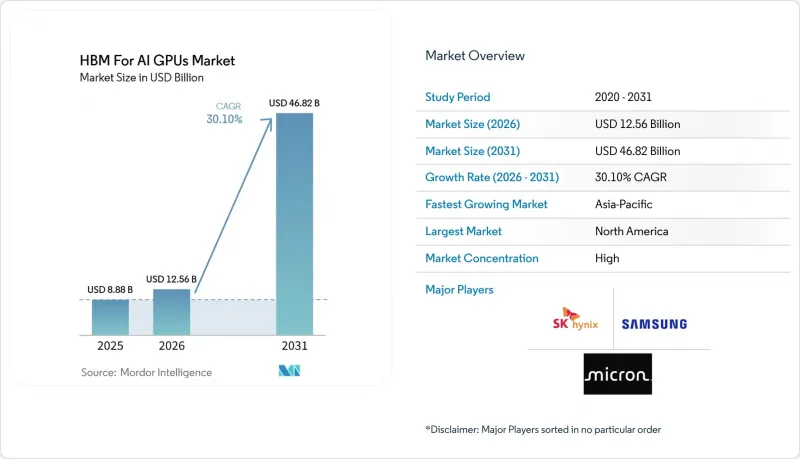
Mordor Intelligence에 의하면, AI GPU용 HBM 시장 규모는 2025년 88억 8,000만 달러에서 2026년에는 125억 6,000만 달러로 확대되어 2031년까지 468억 2,000만 달러에 이를 것으로 예상되고 있어 2026년부터 2031년까지 CAGR 30.10%로 성장할 전망입니다.
본 보고서는 HBM 세대별(HBM2e, HBM3, HBM3e, HBM4), 저장 용량별(최대 32 GB, 32-64GB, 64-128 GB 및 그 이상), 용도(훈련용 GPU, 추론용 GPU, HPC 및 과학 AI, 엣지 AI), 최종 사용자(하이퍼스케일러, 엔터프라이즈 AI, 연구·슈퍼컴퓨팅, 정부·국방), 지역(아시아태평양, 기타)별로 분류되어 있습니다. 시장 예측은 금액(달러) 기준으로 제시되어 있습니다.
AI GPU용 HBM의 세계 동향 및 인사이트
AI GPU 메모리 대역폭의 병목 현상이 HBM 탑재율을 끌어올리고 있다.
AI GPU용 HBM 시장은 확대 추세를 보이고 있습니다. 이는 현대의 대규모 언어 모델 추론에서 순수한 연산 처리량보다 메모리 이동이 병목 현상이 되는 경우가 많기 때문입니다. NVIDIA는 GB300 Blackwell Ultra가 8개의 12-high HBM3e 스택을 통합하여 GPU당 288GB 및 8TB/s를 달성할 것이라고 발표했습니다. 이는 새로운 가속기 세대가 나올 때마다 메모리 용량이 어떻게 증가하고 있는지를 보여줍니다. 이 설계 변경이 중요한 이유는 일시적인 것이 아니라 아키텍처상의 변경이기 때문입니다. 즉, AI GPU 시장에서 HBM의 단위 출하 패턴이 변화하더라도, 각 신제품 사이클마다 HBM 탑재량은 계속 증가하게 될 것입니다. 추론 컨텍스트가 길어질수록 키-값 캐시에 대한 요구도 높아지기 때문에 모델의 컨텍스트 윈도우가 확대됨에 따라 저용량 구성은 실제 운영 환경에서의 추론에 적합하지 않게 됩니다. 이로 인해 HBM이 AI GPU 시장에서 프리미엄 옵션이 아닌 필수 설계 요소로 자리 잡음에 따라, 대역폭 제한은 공급업체에게 지속적인 수익원이 됩니다. 그 결과, AI 하드웨어가 대용량 및 고적층 구성으로 전환됨에 따라 메모리 스택은 가속기의 부품 구성에서 전략적 중요성을 계속해서 높여가고 있습니다.
차세대 훈련 클러스터에서 HBM3e의 급속한 보급
HBM3e는 HBM3에 비해 뚜렷한 대역폭 우위를 제공했기 때문에 빠르게 주도권을 잡으며 최첨단 훈련 플랫폼의 표준이 되었습니다. NVIDIA는 141GB의 HBM3e와 4.8 TB/s의 메모리 대역폭을 갖춘 H200을 발표했으며, 이는 대규모 훈련 배포에 있어 새로운 성능 기준을 확립하는 데 기여했습니다. 또한 Google은 192GB의 HBM3e와 7,300GB/s를 갖춘 Ironwood TPU를 소개했으며, AWS는 144GB의 HBM3e와 4.9TB/s를 갖춘 Trainium3를 발표했습니다. 이를 통해 하이퍼스케일러의 맞춤형 칩이 경쟁 플랫폼 간에 동일한 메모리 규격을 강화하고 있음을 보여줍니다. 이는 AI용 GPU 시장의 HBM에 있어 중요한 의미를 지닙니다. 왜냐하면 HBM 수요는 더 이상 NVIDIA의 출하량에만 의존하는 것이 아니라, 더 광범위한 가속기 프로그램으로부터 지지를 얻고 있기 때문입니다. SK하이닉스는 2025 회계연도의 사상 최대 실적이 AI 메모리 수요에 힘입은 것이라고 밝히며, 트레이닝 클러스터 도입이 얼마나 신속하게 HBM 매출 확대로 이어졌는지를 강조했습니다. 더 넓은 의미에서 보면, HBM3e가 1사이클 이내에 최첨단 AI 인프라의 실질적인 최소 사양이 되어 공급업체의 가동률을 가속화하고, AI GPU용 HBM 시장을 지속적인 급성장 궤도에 올려놓고 있다는 것입니다.
HBM 스택 및 인터포저 통합의 높은 비용
AI GPU용 HBM 시장은 적층 메모리의 비용과 최상위급 가속기에서 사용할 수 있도록 하는 데 필요한 첨단 패키징 기술로 인해 여전히 큰 걸림돌에 직면해 있습니다. 본 글에서는 HBM이 기존 DRAM보다 여전히 훨씬 비싸며, 단일 칩에 여러 스택이나 복잡한 인터포저 패키징이 추가되면 비용이 더욱 상승한다는 사실이 밝혀졌습니다. 이는 AI GPU용 HBM 시장에 불균등한 영향을 미치고 있습니다. 왜냐하면 하이퍼스케일러는 고정 예산을 가진 중소기업, 학술 기관, 공공 부문 프로그램에 비해 높은 조달 비용을 더 쉽게 흡수할 수 있기 때문입니다. 또한, 메모리 및 패키징 비용 상승은 시스템이 최종 사용자에게 전달되기 전에 가속기의 가격에 영향을 미치기 때문에 이러한 압박은 밸류체인 전체로 파급됩니다. 그 결과, 기술적 수요가 명확하고 성능 향상도 현저함에도 불구하고, 가장 가치가 높은 워크로드 이외의 분야에서는 도입이 주춤하고 있습니다. 비용 곡선이 개선될 때까지는 AI GPU용 HBM 시장이 대규모 훈련 및 실제 운영 추론의 경제성을 통해 고가 시스템 도입을 정당화할 수 있는 구매자들에게 가장 접근하기 쉬운 시장으로 남아 있을 것입니다.
부문 분석
2025년에는 HBM3e가 매출의 58.67%를 차지하며, 현재 플랫폼 주기에서 AI GPU용 HBM 시장에서 가장 큰 비중을 차지하는 세대가 되었습니다. 이러한 우위는 NVIDIA H200, Blackwell B200 및 Google Ironwood TPU에 대한 광범위한 도입에 기인하며, 이들 모두는 경쟁력 있는 AI 하드웨어의 메모리 최저 기준을 높였습니다. HBM3는 H100의 지속적인 생산을 통해 여전히 잔여 수요를 유지하고 있는 반면, HBM2e는 더 이상 AI GPU용 HBM 업계의 중심을 정의하지 않는 구형 HPC 및 비용 중심의 과학 계산 워크로드로만 국한되어 있습니다. 이 부문의 구조는 인증 규칙에 의해서도 형성됩니다. JEDEC 상호 운용성 표준으로 인해 엔지니어링 샘플과 실질적인 양산 수익 사이에 시차가 발생하기 때문입니다. 이 시차로 인해 고객은 더 이른 단계에서 계약을 체결하고, 공급업체는 더 긴 검증 기간이 필요하기 때문에 다른 많은 반도체 카테고리에 비해 세대 교체가 더 예측하기 쉬워졌습니다. 이러한 패턴 속에서 HBM3e는 대규모 훈련 클러스터와 더 까다로운 추론 시스템 모두의 메모리 요구 사항을 충족하는 최초로 널리 이용 가능해진 세대라는 이점을 누렸습니다. 따라서 HBM3e는 2025년 매출의 주축이 될 뿐만 아니라, 기존 HBM3 도입 환경과 HBM4의 첫 상용화 사이의 가교 역할도 수행했습니다. 그 결과, HBM3e는 단순히 HBM3을 대체한 데 그치지 않고, AI GPU용 HBM 시장 전체의 기본 사양을 혁신하게 되었습니다.
HBM4는 2031년까지 가장 빠르게 성장하는 세대가 될 것으로 예측되며, 이 부문에서 가장 중요한 미래 성장 동력이 될 것입니다. 보고서에 따르면, HBM4는 2026년에 매출 구성에 포함되었으며, 같은 해에 주요 3개 공급업체 모두가 NVIDIA의 Vera Rubin 플랫폼 인증을 획득한 후, 해당 플랫폼을 위한 양산 출하가 시작되었습니다. 또한 SK하이닉스는 당초 일정을 앞당겨 2026년 6월에 12층 HBM4E 샘플을 출하했다고 발표했으며, 삼성도 2026년 5월 하순에 HBM4E 샘플을 공급했습니다. 이는 개발 주기가 얼마나 급속히 단축되고 있는지를 보여줍니다. 이러한 속도가 중요한 이유는 차세대 메모리인 AI GPU용 HBM 시장 규모가, 각 세대의 인증 비용 회수 기간 단축과 프리미엄 제품으로의 전환 가속화에 의해 형성되고 있기 때문입니다. 또한, 이 부문에서는 제조 공정을 통해 비용 절감 효과가 본격화되기 전까지, 새로운 세대의 메모리일수록 평균 판매 가격이 높아지는 가격 패턴도 나타납니다. 따라서 HBM4는 조기에 인증을 획득하고 효율적으로 생산 규모를 확대할 수 있는 공급업체에게 판매량 증가와 제품 구성 개선이라는 두 가지 가능성을 모두 안고 있습니다. 이로 인해 AI GPU용 HBM 시장은 급속한 세대 교체가 중심이 될 것이며, 시장 주도권은 순수한 제조 능력과 마찬가지로 인증 시기에 크게 좌우될 것입니다. 또한 이는 고객들이 현재의 도입 주기뿐만 아니라 미래의 로드맵을 바탕으로 조달 계획을 수립하는 경향이 강해지고 있음을 의미합니다.
64-128GB 대역은 2025년에 매출 점유율의 48.34%를 차지하며, 기준 연도 AI GPU용 HBM 시장 규모의 중심에 위치했습니다. 이러한 위상은 141GB H200과 같은 시스템 및 다음 용량 대역의 경계에 가까운 플랫폼에 의해 뒷받침되어, 이 범위의 상업적 확장을 유지해 왔습니다. 최대 32GB 부문은 구형 HBM2e 설계가 더 고밀도의 후속 제품으로 대체됨에 따라 계속해서 중요성을 잃어갔지만, 32-64GB 범위는 아직 최상위급 메모리 풀을 필요로 하지 않는 미드티어 추론 및 엣지 HPC 이용 사례에서 여전히 중요한 위치를 차지하고 있었습니다. 이 부문의 주요 요인은 모델 호스팅 및 훈련 요구 사항이 구매자들을 꾸준히 대용량 구성으로 이끌고 있다는 점입니다. 실용적인 관점에서 볼 때, 대용량 메모리는 더 이상 단순한 프리미엄 기능이 아니라 대규모 모델에서 높은 성능을 발휘하기 위한 기본 요건이 되어가고 있습니다. 이러한 변화는 이미 교체 주기에 영향을 미치고 있으며, 클라우드 사업자들은 H100 기반 노드에 비해 추론 지연 시간과 처리 능력을 향상시키기 위해 H200으로의 업그레이드를 활용하고 있습니다. 또한 메모리 용량이 도입된 컴퓨팅 리소스의 상업적 유용성과 직접적으로 연동되게 되면서, AI용 GPU HBM 시장 수요 동향도 변화했습니다. 그 결과, 용량 구분은 가격대뿐만 아니라 워크로드의 복잡성을 반영하는 경향이 강해지고 있습니다.
128GB를 초과하는 대역폭은 2031년까지 가장 빠른 성장세를 기록할 것으로 예상되며, AI GPU용 HBM 시장에서 가장 전략적인 용량 구간으로 자리 잡고 있습니다. NVIDIA는 GPU당 288GB를 탑재한 'GB300 Blackwell Ultra'를 소개했고, Google도 비슷한 수준의 288GB급인 'TPU 8t'를 발표하여 주요 벤더들이 동일한 대용량 대역으로 수렴하고 있음을 확인할 수 있었습니다. 또한 NVIDIA는 72개의 GPU에 총 37TB의 HBM3e를 탑재한 ‘GB300 NVL72’도 소개했습니다. 이는 랙 스케일 설계가 현재 매우 대규모의 집약형 메모리 풀을 핵심으로 구축되고 있음을 보여줍니다. AI GPU용 HBM 시장에서는 시스템당 메모리 용량이 많고 가격 결정력도 강한 고밀도 구성으로 시장 점유율이 이동하고 있으므로, 이 점은 중요합니다. 12단 적층으로의 전환도 이러한 구성 변화를 뒷받침하고 있습니다. 왜냐하면 이러한 구성은 더 복잡하며, 가치를 대용량 하드웨어에 계속 집중시키기 때문입니다. 따라서 수요가 용량 계층의 상위 단계로 이동함에 따라 매출액은 판매 대수보다 빠른 속도로 증가하게 될 것입니다. 이는 AI GPU용 HBM 시장의 프리미엄 부문을 강화하고, 더 높은 스택에서 수율을 유지할 수 있는 공급업체의 중요성을 높여줍니다. 또한, 도입 기반이 메모리를 많이 사용하는 추론 및 훈련 시스템으로 전환됨에 따라, 프리미엄 가격 책정이 장기적으로 유지될 수 있는 기반도 마련됩니다.
지역별 분석
2025년, 북미는 AI GPU용 HBM 시장의 52.43%를 차지하며 매출 측면에서 가장 규모가 큰 지역 기여도를 보였습니다. 이 지역은 미국에 최대 규모의 하이퍼스케일러, 주요 AI GPU 설계 기업, 그리고 최첨단 모델 개발 기업의 상당수가 집중되어 있다는 이점을 누리고 있습니다. 이러한 조합을 통해 하드웨어 설계, 클라우드 배포 및 최종 수요 간에 견고한 연계가 형성되어, AI GPU용 HBM 시장 전체에서 해당 지역의 입지를 공고히 하고 있습니다. 또한 2026년에는 미국의 수출 정책도 이 지역 수요 패턴에 영향을 미쳤습니다. BIS(미국 상무부 산업안보국)가 첨단 컴퓨팅 장비에 대한 라이선스 요건이 중국 외부에 소재하는 경우에도 국가 그룹 D, 5에 본거지를 둔 사업체까지 적용된다는 점을 확인했기 때문입니다. 이로 인해 최첨단 시스템을 이용할 수 있는 고객층이 좁아졌으며, 규정 준수를 충족하는 출하 기회는 국내 및 동맹국 수요로 이동하게 되었습니다. 또한 NVIDIA는 Microsoft, Oracle Cloud Infrastructure 및 CoreWeave가 GB300 NVL72 시스템을 도입했다고 발표했으며, 이는 Blackwell Ultra 플랫폼과 관련된 단기 출하 전망을 뒷받침하는 것입니다. 따라서 이 지역은 대량 구매뿐만 아니라, AI GPU 시장에서 HBM의 다른 분야에 대한 플랫폼 도입 시기를 좌우하는 측면에서도 여전히 중심적인 위치를 차지하고 있습니다.
아시아태평양은 공급 측면에서의 주도적 입지와 지역 내 컴퓨팅 투자 증가가 맞물려, 2026년부터 2031년까지 가장 빠르게 성장하는 지역이 될 것으로 예측됩니다. 한국이 여전히 주요 HBM 제조 거점이며, 대만도 첨단 패키징 공정에서 필수적인 역할을 수행하고 있기 때문에 이 지역은 이미 AI GPU용 HBM 시장의 생산 핵심으로 자리 잡고 있습니다. 이러한 공급 측면의 입지가 중요한 이유는 해당 지역 기업들이 시장 전체의 인증 속도, 할당 결정, 그리고 세대 교체에 따른 양산 개시 시기에 영향을 미치기 때문입니다. 동시에 한국, 일본, 인도에서는 각국 정부와 하이퍼스케일러가 지원하는 AI 인프라 관련 활동이 활발해지고 있어, 수출 지향적인 공급에 더해 현지 수요도 창출되고 있습니다. 이러한 조합으로 인해 아시아태평양은 북미와 확연히 차별화됩니다. 이 지역은 AI GPU용 HBM 시장에서 제조 거점으로서, 그리고 부상하는 도입처로서 양쪽 모두에 깊이 관여하고 있기 때문입니다. 또한 이는 지역의 정책, 설비 투자, 기술 로드맵이 공급량과 최종 시장의 흡수력 양쪽에 동시에 영향을 미칠 가능성이 있음을 의미합니다. 따라서 아시아태평양의 성장 양상은 단순한 ‘추격’이라는 틀을 넘어선 폭넓은 것이며, 세계 HBM 공급망의 핵심 운영 거점으로서의 역할을 반영하고 있습니다.
유럽은 2025년에 의미 있는 수준이긴 하지만 비교적 작은 점유율을 차지할 것으로 보이며, 독일, 영국, 프랑스가 AI 인프라 도입의 주요 지역 거점 역할을 하고 있습니다. 이 지역은 조달 주기가 길고, 대규모 하드웨어 양산에 앞서 규정 준수 대응이 우선시되는 경우가 많기 때문에 성장 속도가 완만하며, AI GPU용 HBM 시장의 성장률은 북미 및 아시아태평양보다 낮았습니다. 남미, 중동 및 아프리카는 여전히 초기 단계의 기여에 그치고 있지만, 중동의 국가 주도 컴퓨팅 프로그램을 고려할 때, 이러한 시장은 예측 기간 후반에 더 큰 비중을 차지할 가능성이 있는 것으로 보입니다. 따라서 지역별 구성은 여전히 불균형하며, AI GPU용 HBM 시장 규모는 하이엔드 컴퓨팅 수요, 플랫폼 접근성, 그리고 반도체 공급망과의 견고한 연계성을 모두 갖춘 지역에 집중된 상태를 유지하고 있습니다.
기타 혜택:
- 엑셀 형식 시장 예측(ME) 시트
- 3개월간의 애널리스트 지원
자주 묻는 질문
목차
제1장 서론
제2장 조사 방법
제3장 주요 요약
제4장 시장 구도
제5장 시장 규모와 성장 예측
제6장 경쟁 구도
제7장 시장 기회와 향후 전망
JHS 26.08.07According to Mordor Intelligence, the HBM for AI GPUs market size is expected to increase from USD 8.88 billion in 2025 to USD 12.56 billion in 2026 and reach USD 46.82 billion by 2031, growing at a CAGR of 30.10% over 2026-2031.
This report is Segmented by Generation (HBM2e, HBM3, Hbm3e, and HBM4), Memory Capacity (Up To 32 GB, 32-64 GB, 64-128 GB, and More), Application (Training GPUs, Inference GPUs, HPC and Scientific AI, and Edge AI), End User (Hyperscalers, Enterprise AI, Research and Supercomputing, and Government and Defense), and Geography (Asia-Pacific, and More). The Market Forecasts are Provided in Terms of Value (USD).
Global HBM For AI GPUs Market Trends and Insights
AI GPU Memory Bandwidth Bottlenecks Raising HBM Attach Rates
The HBM for AI GPUs market is moving higher because modern large language model inference is often limited by memory movement rather than raw compute throughput. NVIDIA stated that the GB300 Blackwell Ultra integrates eight 12-high HBM3e stacks, delivering 288GB and 8TB/s per GPU, demonstrating how memory capacity is rising with each new accelerator generation. That design change matters because it is architectural rather than temporary, which means higher HBM content remains tied to each new product cycle, even if unit shipment patterns shift across HBM for the AI GPU market. Longer reasoning contexts also raise key-value cache requirements, so lower-capacity configurations become less suitable for production inference as model context windows expand. This makes bandwidth limits a durable revenue driver for suppliers, as HBM becomes a required design element rather than a premium option in the AI GPU market. The result is that the memory stack keeps gaining strategic weight in accelerator bill of materials as AI hardware moves toward higher-capacity and taller-stack configurations.
Rapid HBM3e Adoption In Next-Generation Training Clusters
HBM3e quickly moved into the lead because it offered a clear bandwidth advantage over HBM3 and became the standard on the most advanced training platforms. NVIDIA listed the H200 with 141GB of HBM3e and 4.8 TB/s of memory bandwidth, which helped define the new performance floor for large-scale training deployments. Google also described Ironwood TPU with 192GB of HBM3e and 7,300GB/s, while AWS presented Trainium3 with 144GB of HBM3e and 4.9TB/s, showing that hyperscaler custom silicon is reinforcing the same memory standard across competing platforms. This matters for the HBM for AI GPU market because HBM demand no longer depends solely on NVIDIA shipments and instead draws support from a broader set of accelerator programs. SK hynix said its FY2025 record results were driven by AI memory demand, underscoring how quickly training-cluster deployment translated into HBM revenue expansion. The wider implication is that HBM3e became the minimum practical specification for frontier AI infrastructure within a single cycle, accelerating supplier utilization and keeping HBM for the AI GPU market on a steep growth path.
High Cost Of HBM Stacks And Interposer Integration
The HBM for the AI GPU market still faces a meaningful brake from the cost of stacked memory and the advanced packaging needed to make it usable in top-end accelerators. The input material makes clear that HBM remains far more expensive than conventional DRAM, and that the cost rises further when several stacks and complex interposer packaging are added to a single chip. This has an uneven effect across the HBM for AI GPUs market because hyperscalers can absorb higher procurement costs more easily than smaller enterprises, academic buyers, and public-sector programs with fixed budgets. The pressure also flows through the supply chain, as higher memory and packaging costs affect accelerator pricing before systems reach end users. That slows adoption outside the highest-value workloads, even when technical demand is clear, and performance gains are strong. Until cost curves improve, the HBM for AI GPUs market will remain most accessible to buyers who can justify premium systems through large-scale training or production inference economics.
Other drivers and restraints analyzed in the detailed report include:
- Advanced Packaging Capacity Expansion Unlocking HBM Output
- HBM4 Roadmap Pulling Forward Qualification And Supply Agreements
- Limited CoWoS And Other Advanced-Packaging Capacity
For complete list of drivers and restraints, kindly check the Table Of Contents.
Segment Analysis
HBM3e accounted for 58.67% of revenue in 2025, making it the largest generation in the HBM for the AI GPU market during the current platform cycle. Its lead came from broad deployment across the NVIDIA H200, Blackwell B200, and Google Ironwood TPU, all of which set a higher memory threshold for competitive AI hardware. HBM3 still retained residual demand through ongoing H100 production, while HBM2e remained tied to older HPC and cost-sensitive scientific computing workloads that no longer define the center of the HBM for AI GPUs industry. The structure of this segment is also shaped by qualification rules because JEDEC interoperability standards create a lag between engineering samples and meaningful volume revenue. That lag brings more predictability to generational handovers than in many other semiconductor categories because customers commit earlier and suppliers need a longer validation window. Within that pattern, HBM3e benefited from being the first broadly available generation that aligned with the memory needs of both large training clusters and more demanding inference systems. It therefore served as both the revenue anchor of 2025 and the bridge between legacy HBM3 deployments and the first HBM4 commercial ramps. The result is that HBM3e did not simply replace HBM3, and instead reset the baseline specification across the HBM for AI GPU market.
HBM4 is projected to be the fastest-growing generation through 2031, and that makes it the most important forward driver inside this segment. The input states that HBM4 entered the revenue mix in 2026 with volume shipments tied to NVIDIA Vera Rubin, after all 3 major suppliers qualified for the platform in the same year. SK hynix also said it shipped 12-layer HBM4E samples in June 2026 ahead of its earlier timeline, while Samsung supplied HBM4E samples in late May 2026, which shows how quickly development cycles are compressing. That speed matters because the HBM for AI GPUs market size for next-generation memory is being shaped by shorter recovery windows for each generation's qualification costs and by faster migration toward premium products. The segment also reflects a pricing pattern in which newer memory generations hold elevated average selling prices before cost learning spreads through manufacturing. HBM4 therefore carries both volume growth and mix improvement potential for suppliers that qualify early and scale efficiently. This keeps the HBM for AI GPU market centered on a rapid generational ladder, where leadership depends on qualification timing as much as on raw manufacturing capacity. It also means customers are increasingly planning procurement around future roadmaps instead of only current deployment cycles.
The 64-128 GB tier held a 48.34% revenue share in 2025, which placed it at the center of the HBM for the AI GPU market size during the base year. That position was supported by systems such as the H200 at 141GB and by platforms close to the boundary of the next capacity band, which kept this range commercially broad. The up to 32 GB segment continued to lose importance as older HBM2e designs gave way to denser successors, while the 32-64 GB range remained relevant for mid-tier inference and edge HPC use cases that did not yet require top-end memory pools. The main force in this segment is that model hosting and training requirements are steadily pushing buyers toward larger configurations. In practical terms, higher memory capacity is no longer just a premium feature; it is becoming a baseline requirement for strong performance on larger models. That shift has already influenced replacement cycles, as cloud operators have used H200 upgrades to improve inference latency and capacity compared with H100-based nodes. It also changed the demand profile in the HBM for AI GPUs market, as memory capacity now tracks directly with the commercial usefulness of deployed compute. For that reason, capacity segmentation increasingly mirrors workload complexity instead of price brackets alone.
The above 128 GB band is expected to record the fastest growth through 2031 and is becoming the most strategic capacity tier in the HBM for AI GPUs market. NVIDIA described the GB300 Blackwell Ultra with 288GB per GPU, while Google presented TPU 8t around the same 288GB class, confirming that major vendors are converging on the same high-capacity bracket. NVIDIA also highlighted GB300 NVL72 with 37TB of total HBM3e across 72 GPUs, which shows how rack-scale design is now built around very large aggregate memory pools. This matters because the HBM for AI GPUs market share is shifting toward denser configurations that carry higher per-system memory content and stronger pricing power. The move to 12-high stacks also supports that mix shift because these builds are more complex and keep value concentrated in higher-capacity hardware. Revenue therefore grows faster than unit volume when demand migrates toward the top of the capacity ladder. This reinforces the premium end of the HBM for AI GPU market and raises the importance of suppliers that can maintain yields on taller stacks. It also supports a longer runway for premium pricing as the installed base moves toward memory-heavy inference and training systems.
Complete Report Scope:
- By HBM Generation
- HBM2e
- HBM3
- HBM3e
- HBM4
- By Memory Capacity
- Up to 32 GB
- 32-64 GB
- 64-128 GB
- Above 128 GB
- By Application
- Training GPUs
- Inference GPUs
- HPC and Scientific AI
- Edge AI
- By End User
- Hyperscalers and Cloud Service Providers
- Enterprise AI Deployments
- Research and Supercomputing Centers
- Government and Defense
- Geography
- North America
- United States
- Canada
- Mexico
- Europe
- Germany
- United Kingdom
- France
- Italy
- Rest of Europe
- Asia-Pacific
- China
- Japan
- South Korea
- India
- Southeast Asia
- Rest of Asia-Pacific
- South America
- Middle East and Africa
- North America
Geography Analysis
North America accounted for 52.43% of the HBM for AI GPUs market in 2025, making it the largest regional contributor by revenue. The region benefits from the concentration of the largest hyperscalers, the leading AI GPU designer, and many of the most advanced model developers in the United States. That combination creates a tight link between hardware design, cloud deployment, and end demand, which keeps the regional base strong across the HBM-based AI GPU market. U.S. export policy also shaped regional demand patterns in 2026, as BIS confirmed that license requirements for advanced computing items extend to entities headquartered in Country Group D:5, even when they are outside China. This narrowed the pool of accessible customers for the most advanced systems and pushed more compliant shipment opportunities toward domestic and allied-country demand. NVIDIA also stated that Microsoft, Oracle Cloud Infrastructure, and CoreWeave are deploying GB300 NVL72 systems, which support near-term shipment visibility tied to Blackwell Ultra platforms. The region, therefore, remains central not only because it buys large volumes, but also because it shapes the timing of platform adoption across the rest of the HBM for the AI GPU market.
Asia Pacific is projected to be the fastest-growing region over 2026-2031, driven by a mix of supply leadership and rising regional compute investment. The region already sits close to the production core of the HBM for the AI GPUs market because South Korea remains the main HBM manufacturing base, and Taiwan remains essential in advanced packaging flows. That supply position matters because regional companies influence qualification pace, allocation decisions, and generational ramp timing across the whole market. At the same time, the input shows growing sovereign and hyperscaler-backed AI infrastructure activity across South Korea, Japan, and India, which adds local demand on top of export-oriented supply. This combination makes Asia Pacific different from North America because it participates heavily on both sides of the HBM for AI GPUs market, as a manufacturing anchor and as a rising deployment destination. It also means that regional policy, capital spending, and technology roadmaps can simultaneously affect both volume availability and end-market absorption. For that reason, Asia Pacific's growth profile is broader than a simple catch-up story and reflects its role as a core operating base for the global HBM chain.
Europe held a meaningful but smaller share in 2025, with Germany, the United Kingdom, and France serving as the main regional centers for AI infrastructure deployment in the input material. The region moved more slowly because procurement cycles are longer and compliance priorities have often preceded large hardware ramps, which kept growth below North America and Asia Pacific in the HBM for AI GPUs market. South America, the Middle East, and Africa remained early-stage contributors, though sovereign compute programs in the Middle East suggest these markets could gain greater weight later in the forecast period. The geographic mix, therefore, remains uneven, with the HBM for the AI GPU market size still concentrated in regions that combine high-end compute demand, platform access, and strong links to the semiconductor supply chain.
- SK hynix Inc.
- Samsung Electronics Co., Ltd.
- Micron Technology, Inc.
Additional Benefits:
- The market estimate (ME) sheet in Excel format
- 3 months of analyst support
TABLE OF CONTENTS
1 INTRODUCTION
- 1.1 Study Assumptions and Market Definition
- 1.2 Scope of the Study
2 RESEARCH METHODOLOGY
3 EXECUTIVE SUMMARY
4 MARKET LANDSCAPE
- 4.1 Market Overview
- 4.2 Impact of Macroeconomic Factors on the Market
- 4.3 Market Drivers
- 4.3.1 AI GPU Memory Bandwidth Bottlenecks Raising HBM Attach Rates
- 4.3.2 Advanced Packaging Capacity Expansion Unlocking HBM Output
- 4.3.3 Rapid HBM3e Adoption in Next-Generation Training Clusters
- 4.3.4 Hyperscaler Custom Accelerator Programs Increasing HBM Design Wins
- 4.3.5 Rising Multi-Die GPU Architectures Increasing Per-Accelerator Memory Content
- 4.3.6 HBM4 Roadmap Pulling Forward Qualification and Supply Agreements
- 4.4 Market Restraints
- 4.4.1 Limited CoWoS and Other Advanced-Packaging Capacity
- 4.4.2 High Cost of HBM Stacks and Interposer Integration
- 4.4.3 Yield Losses in High-Stack DRAM Assembly
- 4.4.4 Export Controls and Customer Concentration Risk in AI GPUs
- 4.5 Industry Supply Chain Analysis
- 4.6 Regulatory Landscape
- 4.7 Technological Outlook
- 4.8 Porter's Five Forces Analysis
- 4.8.1 Bargaining Power of Suppliers
- 4.8.2 Bargaining Power of Buyers
- 4.8.3 Threat of New Entrants
- 4.8.4 Threat of Substitutes
- 4.8.5 Competitive Rivalry
5 MARKET SIZE AND GROWTH FORECASTS (VALUE)
- 5.1 By HBM Generation
- 5.1.1 HBM2e
- 5.1.2 HBM3
- 5.1.3 HBM3e
- 5.1.4 HBM4
- 5.2 By Memory Capacity
- 5.2.1 Up to 32 GB
- 5.2.2 32-64 GB
- 5.2.3 64-128 GB
- 5.2.4 Above 128 GB
- 5.3 By Application
- 5.3.1 Training GPUs
- 5.3.2 Inference GPUs
- 5.3.3 HPC and Scientific AI
- 5.3.4 Edge AI
- 5.4 By End User
- 5.4.1 Hyperscalers and Cloud Service Providers
- 5.4.2 Enterprise AI Deployments
- 5.4.3 Research and Supercomputing Centers
- 5.4.4 Government and Defense
- 5.5 Geography
- 5.5.1 North America
- 5.5.1.1 United States
- 5.5.1.2 Canada
- 5.5.1.3 Mexico
- 5.5.2 Europe
- 5.5.2.1 Germany
- 5.5.2.2 United Kingdom
- 5.5.2.3 France
- 5.5.2.4 Italy
- 5.5.2.5 Rest of Europe
- 5.5.3 Asia-Pacific
- 5.5.3.1 China
- 5.5.3.2 Japan
- 5.5.3.3 South Korea
- 5.5.3.4 India
- 5.5.3.5 Southeast Asia
- 5.5.3.6 Rest of Asia-Pacific
- 5.5.4 South America
- 5.5.5 Middle East and Africa
- 5.5.1 North America
6 COMPETITIVE LANDSCAPE
- 6.1 Market Concentration
- 6.2 Strategic Moves
- 6.3 Market Share Analysis
- 6.4 Company Profiles (includes Global Level Overview, Market Level Overview, Core Segments, Financials as available, Strategic Information, Products and Services, Recent Developments)
- 6.4.1 SK hynix Inc.
- 6.4.2 Samsung Electronics Co., Ltd.
- 6.4.3 Micron Technology, Inc.
- 6.5 Other Ecosystem Players
- 6.5.1 NVIDIA Corporation
- 6.5.2 Advanced Micro Devices, Inc.
- 6.5.3 Intel Corporation
- 6.5.4 Taiwan Semiconductor Manufacturing Company Limited
- 6.5.5 ASE Technology Holding Co., Ltd.
- 6.5.6 Amkor Technology, Inc.
- 6.5.7 Tokyo Electron Limited
- 6.5.8 Applied Materials, Inc.
- 6.5.9 Lam Research Corporation
- 6.5.10 Kioxia Holdings Corporation
- 6.5.11 SanDisk Corporation
- 6.5.12 Renesas Electronics Corporation
- 6.5.13 Qualcomm Incorporated
- 6.5.14 Broadcom Inc.
- 6.5.15 Marvell Technology, Inc.
- 6.5.16 Apple Inc.
- 6.5.17 Alibaba Group Holding Limited
- 6.5.18 Alphabet Inc.
- 6.5.19 Amazon.com, Inc.
- 6.5.20 Microsoft Corporation
- 6.5.21 Meta Platforms, Inc.
7 MARKET OPPORTUNITIES AND FUTURE OUTLOOK
- 7.1 White-space and Unmet-Need Assessment


