

|
시장보고서
상품코드
2099322
안구 염증 치료 시장 : 점유율 분석, 업계 동향 및 통계, 성장 예측(2026-2031년)Ocular Inflammation Treatment - Market Share Analysis, Industry Trends & Statistics, Growth Forecasts (2026 - 2031) |
||||||
 Mordor Intelligence
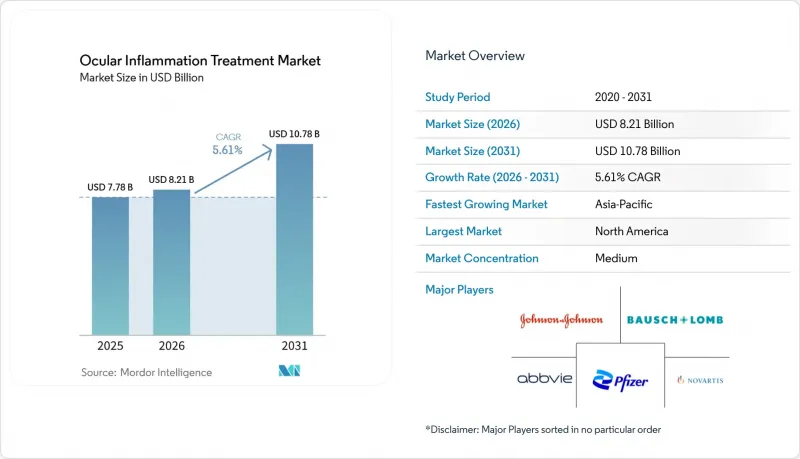
Mordor Intelligence에 의하면, 안구 염증 치료 시장 규모는 2025년에 77억 8,000만 달러로 평가되었고 2026년 82억 1,000만 달러에서 2031년까지 107억 8,000만 달러에 이를 것으로 예측되며, 예측 기간(2026-2031년) CAGR은 5.61%를 나타낼 전망입니다.
본 보고서는 치료법별(코르티코스테로이드, 생물학적 제제 등), 질환별(포도막염, 결막염 등), 원인별(비감염성, 감염성 등), 투여 경로별(국소 투여, 경구 투여 등), 유통 채널별(병원 약국, 소매 약국 등), 지역별(북미 등)로 분류되어 있습니다. 시장 예측은 금액(달러) 기준으로 제시되어 있습니다.
전 세계 안구 염증 치료 시장 동향 및 인사이트
포도막염 및 기타 안구 염증성 질환의 유병률 증가
안구 염증 치료 시장은 단순히 환자 수만으로는 추측할 수 있는 것보다 훨씬 더 심각한 시력 상실을 유발하는 포도막염의 부담으로 인해 시장 규모 확대를 지속적으로 뒷받침받고 있습니다. 2025년 TriNetX의 분석에 따르면, 포도막염의 누적 유병률은 인구 10만 명당 260.8명이며, 이 중 전방 포도막염이 전체 사례의 75.1%를 차지하고 있어, 이에 따라 1차 선택 항염증 요법에 대한 수요는 광범위하게 지속되고 있습니다. 동 조사에서는 많은 사례가 전신성 염증성 질환과 관련되어 있음이 밝혀졌는데, 이는 중요한 점입니다. 왜냐하면 염증성 척추관절염의 진단 범위가 넓어짐에 따라, 결국 안과 진료를 받는 환자층이 확대되고 있기 때문입니다. 병인에 따른 지역별 차이도 중요한 요소입니다. 안구 염증 치료 시장의 제품 수요가 국가별로 균일하게 확대되는 것은 아니기 때문에 현지에서 입증된 근거를 보유한 기업일수록 환자층에 맞추어 치료법 선택을 최적화하기 쉽기 때문입니다. 따라서 안구 염증 치료 시장은 신규 사례 증가뿐만 아니라, 재발성 질환의 검출률 향상 및 재치료 시행 여부에 따라 좌우될 것입니다.
난치성 및 만성 사례에서의 생물학적 제제 채택 확대
안구 염증 치료 시장은 난치성 및 만성 질환에 대한 생물학적 제제나 기타 스테로이드 절약 요법의 조기 도입으로부터도 뒷받침을 받고 있습니다. 미국의 면역 조절 요법 동향을 살펴보면, 비감염성 포도막염에서 아달리무맙의 사용은 정식 승인 전부터 이미 증가 추세를 보였습니다. 이는 규제가 따라잡기 전에 이미 임상 현장의 관행이 변화하기 시작했음을 보여줍니다. 이러한 변화는 현재 새로운 경구용 표적 치료제 선택지로도 확대되고 있으며, 2024년 9월에는 Priovant사가 브레포시티닙에 대해 FDA의 패스트트랙 지정을 획득하고, 같은 달 제3상 CLARITY 임상시험의 첫 환자 등록을 시작했습니다. 2상 NEPTUNE 임상시험 데이터에 따르면, 브레포시티닙 45mg 투여군에서 24주 시점의 치료 실패율이 29%였던 것으로 나타났으며, 이는 특정 비전방 포도막염 사례에서 작용기전에 기반한 경구 요법이 조만간 주사용 바이오의약품에 도전할 가능성을 시사합니다. 또한, 2025년 9월 휴미라의 소아용 희귀질환 의약품 독점권이 종료됨에 따라 바이오시밀러 시장 진입 길도 넓어졌습니다. 이로 인해 브랜드 제품의 가격에 압박이 가해지는 상황에서도 생물학적 제제를 통한 치료를 받을 수 있는 환자 수가 증가할 전망입니다. 이러한 추세에 따라 안구 염증 치료 시장에서는 스테로이드 단독 요법에서 벗어나, 보다 장기적인 전신 요법으로 전환할 가능성이 있는 환자층이 중간층에서 더욱 확대될 것입니다.
바이오의약품 및 첨단 약물 전달 시스템의 높은 비용
안구 염증 치료 시장은 여전히 큰 접근 장벽에 직면해 있습니다. 이는 생물학적 제제나 첨단 약물 전달 시스템이 많은 환자와 보험사에게 여전히 고가이기 때문입니다. 2024년 체계적 문헌고찰에 따르면, 비감염성 포도막염의 연간 약제비는 345달러에서 1만 3,134달러 사이였으며, 전맹 환자의 처방 비용은 중등도의 시력 저하가 있는 환자에 비해 60% 더 높은 것으로 나타났습니다. 또한, 2025년 『American Journal of Ophthalmology』지에 실린 연구에 따르면, 사전 승인 절차가 바이오의약품 투여 시작을 지연시켜 질환 악화 위험 증가와 관련이 있는 것으로 밝혀졌습니다. 이는 비용 문제가 정가에 그치지 않고 치료 시기에도 영향을 미치고 있음을 의미합니다. 바이오시밀러 시장 진입으로 이 문제가 완전히 해결된 것은 아닙니다. 2025년 『Heliyon』 저널의 연구에 따르면, 메디케어 파트 D 보험 플랜 중 아달리무맙 바이오시밀러를 보장하는 곳은 약 절반에 불과했으며, 임상 현장에서 더 빈번하게 사용되는 고농도 제제를 보장하는 플랜은 더욱 적었기 때문입니다. 이 때문에 오리지널 의약품의 가격 결정력은 예상보다 여전히 견고하며, 많은 의료 현장에서 안구 염증 치료 시장에는 보험 급여 대상 범위보다 더 넓은 임상적 기회가 남아 있습니다.
부문 분석
2025년 시점에서 코르티코스테로이드는 안구 염증 치료 시장 점유율의 32.89%를 차지하며, 안구 염증 치료 시장에서 가장 큰 치료법이 되었습니다. 이러한 우위는 수술 후 염증, 전방 안과 질환, 만성 후방 포도막염과 같은 광범위한 영역에서의 사용을 반영한 것으로, 이러한 영역에서는 일상 진료에서 여전히 신속한 증상 관리가 중요시되고 있습니다. 일본의 J-CAT 연구에 따르면, 조사 시점에서 비감염성 포도막염 환자의 68.7%가 코르티코스테로이드 점안제만으로 관리되고 있었던 것으로 보고되었으며, 이는 선진적인 의료 시스템에서도 안구 염증 치료 시장이 얼마나 보수적인 1차 치료법에 계속 의존하고 있는지를 보여줍니다. 특히 질환이 조기에 발견되거나 전부에 국한된 경우, 많은 환자가 즉시 전신 요법으로 전환하지 않기 때문에 스테로이드 사용량은 높은 수준을 유지하고 있습니다. 또한, 코르티코스테로이드를 기반으로 하는 이 시장은 병원, 소매, 온라인 등 모든 유통 채널 수요를 뒷받침하고 있으며, 이를 통해 안구 염증 치료 업계는 대규모의 정기 처방 환자층을 유지할 수 있습니다.
면역억제제 및 면역조절제는 만성 질환 관리에서 스테로이드 절약 요법의 도입 시기가 앞당겨짐에 따라, 2031년까지 연평균 성장률(CAGR)이 6.83%를 나타낼 것으로 예측되는 가장 빠르게 성장하는 치료군입니다. 메토트렉세이트, 미코페놀산 및 관련 전신 투여 약물은 스테로이드의 반복 투여가 적합하지 않은 환자에서 보다 장기적인 증상 관리를 지원할 수 있어 그 중요성이 커지고 있습니다. 바이오의약품은 여전히 가장 활발한 혁신 분야이며, 아달리무맙과 TYK2 및 JAK1 억제제와 같은 새로운 작용기전의 약물이 주도하고 있습니다. 이들 약물은 3상 임상시험 결과가 양호할 경우, 중기적으로 시장 점유율에 변화를 가져올 가능성이 있습니다. 전부 포도막염의 경우, 산동제가 여전히 안정적인 보조적 역할을 수행하고 있는 반면, 비감염성 염증과는 다른 치료 경로가 필요한 감염성 하위 그룹에 대해서는 항생제나 항바이러스제가 여전히 필수적입니다.
2025년, 포도막염은 안구 염증 치료 시장에서 34.18%의 점유율을 차지하며 가장 큰 질환 범주가 되었습니다. 이러한 우위는 치료 빈도가 높고 재발이 잦으며, 포도막염성 황반부종이나 녹내장과 같은 합병증의 위험에 기인하며, 이러한 요인들이 환자의 장기적인 경과 관찰과 약물 사용량 증가를 촉진하고 있습니다. 타시아 파마(Tarsier Pharma)는 2025년 신규 데이터를 통해 포도막염으로 인한 시력 상실이 급증하고 있다고 보고했습니다. 이는 현재의 치료 성과에 있어 여전히 더 안전하고 지속 가능한 치료 접근 방식의 여지가 남아 있음을 시사합니다. 포도막염은 환자 수, 중증도, 반복 치료의 필요성 등 여러 요인을 모두 갖추고 있어 안구 염증 치료 시장에서 계속해서 중심적인 위치를 차지하고 있습니다.
결막염은 신흥 시장에서 알레르기성 및 감염성 결막염 진단이 확대됨에 힘입어, 2031년까지 연평균 성장률(CAGR)이 6.36%에 달하며 가장 빠르게 성장하는 질환 유형입니다. 도시화, 환경 알레르겐 노출, 그리고 진단 접근성 향상으로 인해 아시아태평양 및 남미에서 치료를 받는 환자층이 확대되고 있습니다. 2025년에 개정된 일본안과학회의 바이러스성 결막염 관련 지침에 따르면, 치료 경로가 더욱 표준화되고 있어 이를 통해 처방의 일관성이 향상될 것으로 기대됩니다. 각막염, 공막염, 망막염은 규모는 작지만 중증화되기 쉽고 표적 치료가 필요하며, 일반적인 결막염에 비해 1인당 치료 가치가 높기 때문에 임상적으로 중요한 범주로 남아 있습니다.
지역별 분석
2025년, 북미는 안구 염증 치료 시장 점유율의 42.38%를 차지하며, 지역별로는 가장 큰 기여도를 보였습니다. 이 지역은 바이오의약품의 높은 보급률, 전문의의 광범위한 커버리지, 그리고 자가 주사용 제품과 병원 투여용 제품 모두를 지원할 수 있는 보험 급여 제도의 혜택을 받고 있습니다. 미국은 규제 및 보험 환급 관련 동향이 다른 대부분의 지역보다 빠르게 상업적 접근성을 형성해 나가고 있기 때문에 안구 염증 치료 시장의 주요 출시 시장으로 자리매김하고 있습니다. 2025년 9월 ‘휴미라’의 소아 희귀질환 의약품 독점권이 종료됨에 따라, 포도막염 분야에서 바이오시밀러의 공식적인 진입이 확대되었습니다. 또한, 2024년 1월 ‘XIPERE’에 대한 CPT 카테고리 1 코드가 유효화됨에 따라, 맥락막 상부 수술의 보험 적용 기반이 개선되었습니다. 캐나다에서는 2025년 7월 ‘XIPERE’가 포도막염에 수반되는 황반부종 적응증으로 승인된 것에서도 알 수 있듯이, 고부가가치 안과용 제품 분야에서 미국의 주요 승인 시기와 격차를 좁혀가고 있습니다.
유럽은 안구 염증 치료 시장에서 여전히 강력하고 독자적인 지역으로서의 위상을 유지하고 있습니다. 이는 처방 의사가 미국의 많은 의료 기관보다 치료 초기 단계에서 비생물학적 면역억제제를 사용해 왔기 때문입니다. 독일, 영국, 프랑스는 전문의 밀도가 높고, 만성 치료를 지속할 수 있는 공적 또는 법정 환급 제도를 갖추고 있어 해당 지역의 생물학적 제제 판매량의 대부분을 차지하고 있습니다. 또한, 산텐은 ‘베르카지아’를 통해 유럽에서 안구 표면 항염증제 분야에서 확고한 입지를 다지고 있으며, 이는 안과 염증 치료 분야에서의 보다 광범위한 활동을 위한 실질적인 기반이 되고 있습니다. 따라서 이 지역에서는 안과 염증 치료 시장의 꾸준한 확산이 예상되지만, 생물학적 제제로의 전환은 북미에 비해 보다 점진적인 경로를 따르는 경향이 있습니다.
아시아태평양은 가장 빠르게 성장하는 지역이며, 이 지역의 안과 염증 치료 시장 규모는 2031년까지 연평균 성장률(CAGR) 7.16%로 확대될 것으로 예측됩니다. 이러한 성장은 전문의 수 증가, 진단 범위의 확대, 그리고 새로운 투여 시스템 및 표적 치료에 관한 규제상의 진전에 힘입은 것입니다. Arctic Vision사는 2024년 7월, 중국에서 포도막염에 따른 황반부종을 대상으로 한 ARCATUS의 3상 임상시험의 주요 결과가 양호했다고 보고했으며, 호주 및 싱가포르에서 신약 승인 신청(NDA)을 제출했습니다. 이는 아시아태평양의 안구 염증 치료 시장이 제네릭 국소 치료제의 범위를 넘어 발전하고 있음을 보여줍니다. 또한, 산텐(Santen)사가 2025년 12월 중국에서 ‘Verkazia’를 출시함에 따라, 이 지역 최대의 안과 의료 시장에서 항염증 안과 치료제의 선택지도 확대되었습니다. 일본 시장은 여전히 특히 중요하며, 실세계 데이터에 따르면 비감염성 포도막염 환자의 68.7%가 여전히 코르티코스테로이드 점안제 단독으로 관리되고 있는 것으로 나타났는데, 이는 이미 고도의 전문 의료 시스템이 구축된 곳에서도 향후 치료 강화의 여지가 있음을 시사합니다.
기타 혜택:
- 엑셀 형식 시장 예측(ME) 시트
- 3개월간의 애널리스트 지원
자주 묻는 질문
목차
제1장 서론
제2장 조사 방법
제3장 주요 요약
제4장 시장 구도
제5장 시장 규모와 성장 예측
제6장 경쟁 구도
제7장 시장 기회와 향후 전망
JHS 26.08.05According to Mordor Intelligence, the ocular inflammation treatment market size was valued at USD 7.78 billion in 2025 and is estimated to grow from USD 8.21 billion in 2026 to reach USD 10.78 billion by 2031, at a CAGR of 5.61% during the forecast period (2026-2031).
This report is Segmented by Treatment Type (Corticosteroids, Biologics, and More), Disease Type (Uveitis, Conjunctivitis, and More), Cause (Non-Infectious, Infectious, and More), Route of Administration (Topical, Oral, and More), Distribution Channel (Hospital Pharmacies, Retail Pharmacies, and More), and Geography (North America and More). The Market Forecasts are Provided in Terms of Value (USD).
Global Ocular Inflammation Treatment Market Trends and Insights
Rising Prevalence of Uveitis and Other Ocular Inflammatory Disorders
The ocular inflammation treatment market continues to gain volume support from the burden of uveitis, which causes a level of vision loss that is much higher than its case count alone would suggest. A 2025 TriNetX analysis reported cumulative uveitis prevalence of 260.8 per 100,000 persons, and anterior uveitis made up 75.1% of cases, which keeps first-line anti-inflammatory therapy demand broad and persistent. The same study linked many cases to systemic inflammatory disease, and that matters because wider diagnosis of inflammatory spondyloarthropathies is enlarging the population that eventually reaches ophthalmic care. Regional variation in etiology is also important because product demand in the ocular inflammation treatment market does not scale evenly across countries, and companies with local evidence are better placed to match therapy choice to patient mix. This keeps the ocular inflammation treatment market tied not only to headline case growth, but also to better detection and repeat treatment in recurrent disease.
Higher Biologic Adoption in Refractory and Chronic Cases
The ocular inflammation treatment market is also gaining support from earlier use of biologics and other steroid-sparing therapies in refractory and chronic disease. The United States immunomodulatory therapy trends showed that adalimumab use was already rising before formal approval in non-infectious uveitis, which indicates that clinical practice had started shifting before regulation caught up. That shift is now extending to new oral targeted options, as Priovant received FDA Fast Track Designation for brepocitinib in September 2024 and enrolled the first patients in the Phase 3 CLARITY trial in the same month. Phase 2 NEPTUNE data also showed a 29% treatment-failure rate at week 24 with brepocitinib 45 mg, which suggests that oral mechanism-based therapy may soon challenge injectable biologics in selected non-anterior cases. The September 2025 end of Humira pediatric orphan exclusivity also widened the path for biosimilar entry, which should increase the number of patients who can reach biologic therapy even as brand pricing comes under pressure. This pattern gives the ocular inflammation treatment market a broader middle layer of patients who may move beyond steroid-only care and into longer-duration systemic treatment.
High Cost of Biologics and Advanced Drug-Delivery Systems
The ocular inflammation treatment market still faces a major access barrier because biologics and advanced delivery systems remain expensive for many patients and payers. A 2024 systematic review found annual medication costs for non-infectious uveitis ranging from USD 345 to USD 13,134, and prescription costs were 60% higher for blind patients than for patients with moderate vision loss. A 2025 American Journal of Ophthalmology study also found that prior authorization delays biologic initiation and is linked with a higher risk of disease exacerbation, which means the cost problem extends beyond list price and into timing of care. Biosimilar entry has not fully solved the issue because a 2025 Heliyon study reported that only around half of Medicare Part D plans covered adalimumab biosimilars, and fewer plans covered the higher-concentration versions used more often in practice. This keeps originator pricing power stronger than expected and leaves the ocular inflammation treatment market with a wider clinical opportunity than its reimbursed opportunity in many settings.
Other drivers and restraints analyzed in the detailed report include:
- Sustained-Release and Depot Delivery Innovation
- AI-Guided Phenotyping and Imaging-Based Treatment Selection
- Steroid Safety Burden and Long-Term Compliance Issues
For complete list of drivers and restraints, kindly check the Table Of Contents.
Segment Analysis
Corticosteroids held 32.89% of the ocular inflammation treatment market share in 2025, which made them the largest treatment type in the ocular inflammation treatment market. Their lead reflects broad use across post-surgical inflammation, anterior disease, and chronic posterior uveitis, where fast symptom control still matters in routine care. The Japanese J-CAT study reported that 68.7% of non-infectious uveitis patients were managed only with corticosteroid eye drops at the index date, which shows how much the ocular inflammation treatment market still depends on conservative first-line therapy even in advanced health systems. This keeps steroid volumes high because many patients never move immediately into systemic escalation, especially when the disease is detected early or remains anterior in location. The corticosteroid base also supports demand across hospital, retail, and online distribution channels, which helps the ocular inflammation treatment industry preserve a large recurring prescription pool.
Immunosuppressants and immunomodulators are the fastest-growing treatment group with a projected 6.83% CAGR through 2031, as steroid-sparing use moves earlier in chronic disease management. Methotrexate, mycophenolate, and related systemic options continue to gain relevance because they can support longer control in patients who are not good candidates for repeat steroid exposure. Biologics remain the most active innovation layer, led by adalimumab and newer mechanisms such as TYK2 and JAK1 inhibition, which could alter share over the medium term if Phase 3 programs read out well. Cycloplegic agents still hold a stable supporting role in anterior uveitis, while antibiotics and antivirals remain necessary for infectious disease subsets that require a different treatment path from non-infectious inflammation.
Uveitis accounted for 34.18% share in 2025, which made it the largest disease category in the ocular inflammation treatment market. Its lead comes from high treatment intensity, recurrent episodes, and the threat of complications such as uveitic macular edema and glaucoma, which push patients into longer follow-up and higher medication use. Tarsier Pharma reported new 2025 data showing a sharp rise in vision loss from uveitis, which suggests current outcomes still leave room for safer and more durable treatment approaches. This keeps uveitis at the center of the ocular inflammation treatment market because it combines volume, severity, and repeat treatment need.
Conjunctivitis is the fastest-growing disease type at a 6.36% CAGR through 2031, supported by wider diagnosis of allergic and infectious forms across emerging markets. Urbanization, environmental allergen exposure, and easier access to evaluation are widening the treated patient base in the Asia-Pacific and South America. The 2025 Japanese Ophthalmological Society guideline update for viral conjunctivitis shows that treatment pathways are becoming more standardized, which can support more consistent prescribing. Keratitis, scleritis, and retinitis remain smaller but clinically important categories because they are often severe, require targeted therapy, and can carry higher value per treated patient than routine conjunctivitis.
Complete Report Scope:
- By Treatment Type
- Corticosteroids
- Immunosuppressants and Immunomodulators
- Biologics
- Cycloplegic Agents
- Antibiotics
- Antivirals
- Others (Analgesics and Antifungals, among others)
- By Disease Type
- Uveitis
- Conjunctivitis
- Keratitis
- Scleritis
- Retinitis
- Others (Endophthalmitis and Optic Neuritis, among others)
- By Cause
- Non-Infectious
- Infectious
- Autoimmune Disease Related
- Trauma and Injury Related
- Others (Drug-induced ocular inflammation and Post-surgical inflammation, among others)
- By Route of Administration
- Topical
- Oral
- Injectable
- Others (Intravitreal and Subconjunctival, among others)
- By Distribution Channel
- Hospital Pharmacies
- Retail Pharmacies
- Online Pharmacies
- Others (Drug Stores and Specialty Pharmacies, among others)
- By Region
- North America
- United States
- Canada
- Mexico
- Europe
- Germany
- United Kingdom
- France
- Italy
- Spain
- Rest of Europe
- Asia-Pacific
- China
- India
- Japan
- South Korea
- Australia
- Rest of Asia-Pacific
- Middle East and Africa
- GCC
- South Africa
- Rest of Middle East and Africa
- South America
- Brazil
- Argentina
- Rest of South America
- North America
Geography Analysis
North America held 42.38% of the ocular inflammation treatment market share in 2025, which made it the largest regional contributor. The region benefits from high biologic penetration, broad specialist coverage, and reimbursement systems that can support both self-injected and hospital-administered products. The United States remains the main launch market in the ocular inflammation treatment market because regulatory and reimbursement events continue to shape commercial access earlier than in most regions. The September 2025 end of Humira pediatric orphan exclusivity widened formal biosimilar entry in uveitis, while the January 2024 activation of the CPT Category 1 code for XIPERE improved reimbursement footing for suprachoroidal procedures. Canada continues to follow major U.S. approvals with a shorter lag in high-value ophthalmic products, as shown by the July 2025 XIPERE approval for uveitic macular edema.
Europe remains a strong but distinct region in the ocular inflammation treatment market because prescribers have used non-biologic immunosuppressants earlier in the treatment path than many United States centers. Germany, the United Kingdom, and France account for much of the region's biologic volume because they combine specialist density with public or statutory reimbursement systems that can carry chronic therapy. Santen also holds an established ocular surface anti-inflammatory position in Europe through Verkazia, which gives it a practical base for broader ophthalmic inflammation activity. The region therefore supports steady uptake in the ocular inflammation treatment market, but its conversion into biologics often follows a more stepwise path than in North America.
Asia-Pacific is the fastest-growing region, and the ocular inflammation treatment market size there is projected to expand at a 7.16% CAGR through 2031. Growth is being supported by rising specialist density, broader diagnosis, and regulatory progress for new delivery systems and targeted therapies. Arctic Vision reported positive Phase 3 topline results for ARCATUS in uveitic macular edema in China in July 2024 and filed NDAs in Australia and Singapore, which shows that the ocular inflammation treatment market in Asia-Pacific is moving beyond generic topical care. Santen's December 2025 launch of Verkazia in China also expanded anti-inflammatory ophthalmic availability in the region's largest eye-care market. Japan remains especially important because real-world data showed that 68.7% of non-infectious uveitis patients were still managed with corticosteroid drops alone, which suggests room for future escalation in a system that already has advanced specialist care.
- Abbvie
- Akron Pharma, Inc.
- Alimera Sciences, Inc.
- Bausch + Lomb Incorporated
- Cipla, Inc.
- Clearside Biomedical
- EyePoint Pharmaceuticals, Inc.
- Galapagos NV
- Graybug Vision, Inc.
- Johnson & Johnson
- Novartis
- Ocular Therapeutix, Inc.
- Pfizer
- Priovant Therapeutics, Inc.
- Regeneron Pharmaceuticals
- Roche
- Sanofi
- Santen Pharmaceuticals
- Sun Pharmaceuticals Industries
- Takeda Pharmaceuticals
- Tarsier Pharma
Additional Benefits:
- The market estimate (ME) sheet in Excel format
- 3 months of analyst support
TABLE OF CONTENTS
1 INTRODUCTION
- 1.1 Study Assumptions and Market Definition
- 1.1.1 Scope of the Study
2 RESEARCH METHODOLOGY
3 EXECUTIVE SUMMARY
4 MARKET LANDSCAPE
- 4.1 Market Overview
- 4.2 Market Drivers
- 4.2.1 Rising Prevalence of Uveitis and Other Ocular Inflammatory Disorders
- 4.2.2 Higher Biologic Adoption in Refractory and Chronic Cases
- 4.2.3 Sustained-Release and Depot Delivery Innovation
- 4.2.4 AI-Guided Phenotyping and Imaging-Based Treatment Selection
- 4.2.5 Office-Based Administration and Specialty Pharmacy Access Expansion
- 4.2.6 Pediatric and Recurrent-Case Treatment Recurrence Creating Repeat Demand
- 4.3 Market Restraints
- 4.3.1 High Cost of Biologics and Advanced Drug-Delivery Systems
- 4.3.2 Steroid Safety Burden and Long-Term Compliance Issues
- 4.3.3 Limited Biomarker Standardization for Precision Treatment Selection
- 4.3.4 Sterile Manufacturing and Cold-Chain Supply Vulnerability
- 4.4 Supply Chain Analysis
- 4.5 Regulatory Landscape
- 4.6 Technological Outlook
- 4.7 Porter's Five Forces Analysis
- 4.7.1 Threat of New Entrants
- 4.7.2 Bragaining Power of Suppliers
- 4.7.3 Bragaining Power of Buyers
- 4.7.4 Threat of Substitutes
- 4.7.5 Industry Rivalry
5 MARKET SIZE AND GROWTH FORECASTS (VALUE, USD)
- 5.1 By Treatment Type
- 5.1.1 Corticosteroids
- 5.1.2 Immunosuppressants and Immunomodulators
- 5.1.3 Biologics
- 5.1.4 Cycloplegic Agents
- 5.1.5 Antibiotics
- 5.1.6 Antivirals
- 5.1.7 Others (Analgesics and Antifungals, among others)
- 5.2 By Disease Type
- 5.2.1 Uveitis
- 5.2.2 Conjunctivitis
- 5.2.3 Keratitis
- 5.2.4 Scleritis
- 5.2.5 Retinitis
- 5.2.6 Others (Endophthalmitis and Optic Neuritis, among others)
- 5.3 By Cause
- 5.3.1 Non-Infectious
- 5.3.2 Infectious
- 5.3.3 Autoimmune Disease Related
- 5.3.4 Trauma and Injury Related
- 5.3.5 Others (Drug-induced ocular inflammation and Post-surgical inflammation, among others)
- 5.4 By Route of Administration
- 5.4.1 Topical
- 5.4.2 Oral
- 5.4.3 Injectable
- 5.4.4 Others (Intravitreal and Subconjunctival, among others)
- 5.5 By Distribution Channel
- 5.5.1 Hospital Pharmacies
- 5.5.2 Retail Pharmacies
- 5.5.3 Online Pharmacies
- 5.5.4 Others (Drug Stores and Specialty Pharmacies, among others)
- 5.6 By Region
- 5.6.1 North America
- 5.6.1.1 United States
- 5.6.1.2 Canada
- 5.6.1.3 Mexico
- 5.6.2 Europe
- 5.6.2.1 Germany
- 5.6.2.2 United Kingdom
- 5.6.2.3 France
- 5.6.2.4 Italy
- 5.6.2.5 Spain
- 5.6.2.6 Rest of Europe
- 5.6.3 Asia-Pacific
- 5.6.3.1 China
- 5.6.3.2 India
- 5.6.3.3 Japan
- 5.6.3.4 South Korea
- 5.6.3.5 Australia
- 5.6.3.6 Rest of Asia-Pacific
- 5.6.4 Middle East and Africa
- 5.6.4.1 GCC
- 5.6.4.2 South Africa
- 5.6.4.3 Rest of Middle East and Africa
- 5.6.5 South America
- 5.6.5.1 Brazil
- 5.6.5.2 Argentina
- 5.6.5.3 Rest of South America
- 5.6.1 North America
6 Competitive Landscape
- 6.1 Market Concentration
- 6.2 Market Share Analysis
- 6.3 Company Profiles (includes Global Level Overview, Market Level Overview, Core Segments, Financials as available, Strategic Information, Market Rank/Share, Products and Services, Recent Developments)
- 6.3.1 AbbVie Inc.
- 6.3.2 Akron Pharma, Inc.
- 6.3.3 Alimera Sciences, Inc.
- 6.3.4 Bausch + Lomb Incorporated
- 6.3.5 Cipla, Inc.
- 6.3.6 Clearside Biomedical, Inc.
- 6.3.7 EyePoint Pharmaceuticals, Inc.
- 6.3.8 Galapagos NV
- 6.3.9 Graybug Vision, Inc.
- 6.3.10 Johnson and Johnson Services, Inc.
- 6.3.11 Novartis AG
- 6.3.12 Ocular Therapeutix, Inc.
- 6.3.13 Pfizer Inc.
- 6.3.14 Priovant Therapeutics, Inc.
- 6.3.15 Regeneron Pharmaceuticals, Inc.
- 6.3.16 Roche Holding AG
- 6.3.17 Sanofi
- 6.3.18 Santen Pharmaceutical Co., Ltd.
- 6.3.19 Sun Pharmaceutical Industries Ltd.
- 6.3.20 Takeda Pharmaceutical Company Limited
- 6.3.21 Tarsier Pharma Ltd.
7 Market Opportunities and Future Outlook
- 7.1 White-Space and Unmet-Need Assessment


