|
시장보고서
상품코드
2119168
안검염 치료 시장 : 시장 점유율 분석, 업계 동향 및 통계, 성장 예측(2026-2031년)Blepharitis Treatment - Market Share Analysis, Industry Trends & Statistics, Growth Forecasts (2026 - 2031) |
||||||
 Mordor Intelligence
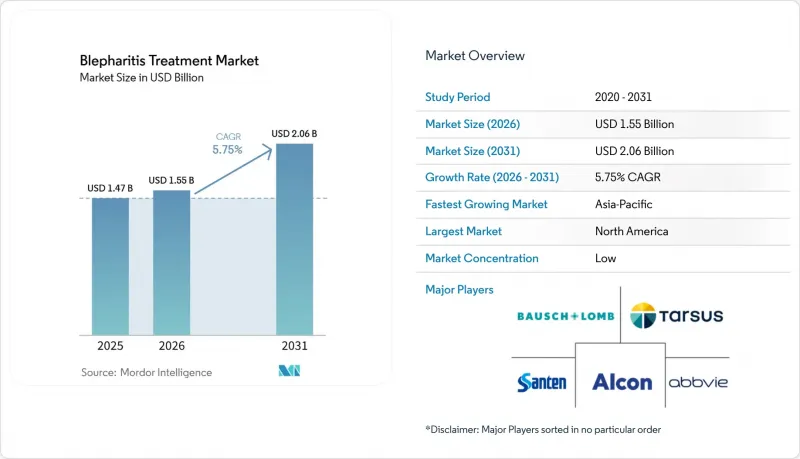
Mordor Intelligence에 의하면, 안검염 치료 시장 규모는 2025년 14억 7,000만 달러로 평가되었고, 2026년 15억 5,000만 달러에서 2031년까지 20억 6,000만 달러로 확대될 전망이며, 2026-2031년 CAGR 5.75%를 나타낼 것으로 예측됩니다.
본 보고서는 질환 유형별(전부 안검염, 후부 안검염, 기타), 치료 유형별(눈꺼풀 위생 제품, 인공눈물 및 윤활제, 기타), 용도별(급성 안검염 관리, 기타), 유통 채널별(병원 약국, 소매 약국, 기타), 지역별(북미, 기타)로 분류되어 있습니다. 시장 예측은 금액(달러) 기준으로 제시되어 있습니다.
세계의 안검염 치료 시장 동향 및 인사이트
FDA 주도의 데모덱스 근본 원인 치료제 상용화
2023년 이전까지, 임상의들은 데모덱스성 안검염의 근본 원인을 해결할 수 있는 FDA 승인 약물을 보유하고 있지 않았습니다. Tarsus Pharmaceuticals가 ‘XDEMVY’라는 상품명으로 판매하는 로티라나르 점안액 0.25%의 승인으로, 처방 의사는 데모덱스 진드기를 박멸하기 위한 표적 치료라는 선택지를 얻게 되었습니다. 이 치료법은 단순히 증상을 관리하는 데 그치지 않고, 기생충 특이적인 GABA 의존성 염소 이온 채널을 선택적으로 억제합니다. Tarsus에 따르면, 2025년 2분기 XDEMVY의 순제품 매출은 1억 270만 달러로 전년 동기 대비 152% 증가했으며, 2만 명 이상의 안과 의료 전문가가 이 제품을 처방하고 있습니다. 이 회사에 따르면, 보험 적용 범위는 민간 보험, 메디케어, 메디케이드 가입자의 90% 이상에 달하며, 많은 적격 환자들의 주요 접근 장벽이 완화되었다고 합니다. Tarsus는 현재 2026년 매출을 6억 7,000만-7억 달러로 전망하고 있으며, 정점 시 매출은 20억 달러를 넘어설 것으로 예측했습니다. 이는 새로운 카테고리를 창출하는 승인이 지닌 상업적 중요성을 보여줍니다.
마이봄선 기능 부전과 안구건조증의 동반 진단 건수 증가
마이봄선 기능 부전과 후부 안검염에는 선 개구부의 폐색, 마이봄선 분비물의 질 저하, 눈물막의 불안정성 등의 공통점이 있습니다. 2026년 체계적 문헌고찰에 따르면, 3,637명의 참가자 중 무증상 마이봄선 기능 부전의 유병률은 72.86%인 것으로 밝혀졌습니다. 따라서 안검염 이외의 질환을 검사하는 과정에서 많은 환자를 식별할 수 있습니다. Eos 연구에 따르면, 유럽 안과 진료소 내원자의 54%에서 칼라렛이 발견되었으며, 32%에서 중증 기생충 감염이 확인되었습니다. 70세 이상 환자의 경우 칼라렛 유병률이 62%로 상승하여, 고령 환자 집단에서 정기적인 평가의 중요성이 입증되었습니다. 안구건조증 관련 설문지, 눈물 평가, 마이보그래피 또한 지속적인 안검염 관리가 필요한 환자를 더 광범위하게 식별하는 데 도움이 됩니다.
열 치료 및 광 치료에 대한 보험 보상 제한
미국의 많은 민간 보험사는 열 펄스 요법과 고강도 펄스 광(IPL) 요법을 ‘연구 단계’ 또는 ‘선택적 치료’로 분류하고 있어, LipiFlow, TearCare 및 유사한 치료법에 대한 보험 적용이 제한되고 있습니다. 미국안과학회(AAO)는 광범위한 보험 적용 결정에 필요한 근거 기반이 독립적인 무작위 배정 맹검 임상시험을 통해 아직 확립되지 않았다고 지적하고 있습니다. 이로 인해 임상의가 잠재적인 이점을 인정하더라도, 환자는 본인 부담으로 치료를 받을지 여부를 결정해야 하는 상황에 처하게 됩니다. 또한 이로 인해 임상적 동기가 더 강한 환자나 지불 능력이 높은 환자로 수요가 제한될 수밖에 없습니다. 각 제조업체는 향후 보험 적용에 관한 논의와 더 광범위한 접근성을 확보하기 위해 더욱 강력한 독립적 근거를 제시해야 합니다.
부문 분석
2025년 시점에서 전방 안검염은 질환 유형별 부문의 38.31%를 차지했으며, 이는 확립된 위생 관리 및 약물 치료 경로를 반영합니다. 후방 안검염은 2031년까지 연평균 성장률(CAGR) 8.58%를 나타낼 것으로 예측됩니다. 이러한 성장은 마이봄선 기능 부전에 대한 인식 제고와 근본 원인인 데모덱스에 대한 치료법의 보급 확대와 관련이 있습니다. Eos 연구에 따르면, 유럽 안과 클리닉 내원자의 54%에서 칼라렛이 확인되었으나, 그 중 상당수는 안과와 무관한 이유로 내원한 것으로 나타났습니다. 이는 후방 안검염이나 데모덱스 관련 질환이 ‘존재하지 않는’ 것이 아니라 ‘간과되기 쉬운’ 것이라는 견해를 뒷받침합니다. 따라서 안검염 치료 시장은 일상적인 안과 진료에서 안검 소견을 보다 체계적으로 평가하는 방향으로 전환되고 있습니다. 이로 인해, 특히 증상으로 단일 원인을 명확히 특정할 수 없는 경우, 일상적인 소견의 파악이 치료 계획 수립에 있어 더욱 중요해집니다. 환자가 지속적인 건조감, 자극감 또는 시각적 불편감을 호소하는 경우, 집중적인 눈꺼풀 검사가 특히 유용합니다.
전부·후부 혼합형 안검염은 여전히 질환 유형 중 가장 규모가 작은 범주에 속합니다. 이러한 환자들에게는 많은 경우 위생 용품, 항염증 요법, 항기생충 점안제의 병용이 필요합니다. 이로 인해 단일 질환 패턴에 대한 치료보다 관리가 더 복잡해집니다. 정밀도가 더 높은 마이보그래피를 통해, 지금까지 명확하게 분류되지 않았던 혼합형 사례를 식별할 수 있을 가능성이 있습니다. 조기 분류는 임상의가 표면 염증과 그 근본 원인이 되는 진드기 및 선(腺) 요인 모두를 다루는 치료법을 선택하는 데 도움이 됩니다. 안검염 치료 시장은 이러한 명확한 분류의 혜택을 누릴 수 있습니다. 왜냐하면 혼합형 사례에는 여러 가지 치료 형태가 필요하기 때문입니다. 일본의 한 연구에 따르면, 아지스로마이신의 국소 투여가 안검염 및 마이봄선 기능 부전 환자의 눈꺼풀 무거움, 이물감, 눈을 뜨기 어려운 증상을 개선하는 것으로 나타났습니다. 보고된 이러한 삶의 질(QOL) 관련 결과는 후부 안검염에 대한 전문적인 약물 요법의 지속적인 역할을 뒷받침합니다. 또한, 이는 후부 안검염 사례에서 기본적인 증상 완화나 일상적인 위생 관리 이상의 평가가 필요한 이유도 보여줍니다. 치료법 선택은 염증, 마이봄선 폐쇄, 또는 데모덱스(모낭 진드기) 소견의 유무에 따라 달라질 수 있습니다.
2026년 안검염 치료 시장 규모 중 인공눈물과 윤활제가 36.24%를 차지했습니다. 이 비율은 일상적인 증상 완화 및 장기적인 안구 표면 관리 수단으로서 이러한 제품들이 지속적으로 사용되고 있음을 반영합니다. 의료기기를 이용한 치료법은 2031년까지 연평균 성장률(CAGR) 8.22%를 나타낼 것으로 예측됩니다. 이 범주에는 LipiFlow 및 TearCare와 같은 열 펄스 치료 시스템과 IPL 장치가 포함됩니다. 2025년 네트워크 메타분석에 따르면, 마이봄선 짜내기 요법이 선의 분비 개선에 있어 가장 높은 유효성을 보이는 것으로 밝혀졌습니다. 또한, 해당 분석에서는 IPL과 디쿠아포솔 나트륨을 병용하는 등, IPL의 병용 요법을 통한 강력한 복합 효과가 확인되었습니다.
외용 항생제는 특히 세균의 관여가 의심되는 경우 여전히 중요한 역할을 하고 있습니다. 그러나 항균제 적정 사용의 추진으로 인해 만성 증상에 대한 일상적인 항생제 투여의 적응증은 점차 축소되고 있습니다. 클렌징 티슈, 차아염소산 스프레이, 온찜질 패드 등의 눈꺼풀용 위생 제품은 소매점이나 온라인 채널을 통해 계속해서 구입할 수 있습니다. 이러한 제품은 저렴한 비용으로 일반의약품으로 판매되고 있어 자주 사용하기 쉽다는 장점이 있습니다. 경구용 항생제나 항염증제는 일반적으로 중증 또는 난치성 질환에 사용됩니다. 외용 코르티코스테로이드도 급성 악화 시 단기 병용 요법을 포함하여 여전히 중요한 역할을 수행하고 있습니다. 안검염 치료 시장에서는 증상 완화뿐만 아니라, 선의 폐쇄나 데모덱스 기생충 감염에 대처하기 위한 치료 옵션들이 점점 더 결합되고 있습니다. 이를 통해 단일 제품 범주에 의존하지 않고, 증상의 원인에 따른 치료 계획을 수립할 수 있게 됩니다. 또한, 기저 질환에 대한 평가가 진행되는 동안 불편감을 완화하는 제품의 역할도 여전히 유지되고 있습니다. 경미한 증상과 선과 관련된 지속성 질환의 경우 치료 강도가 다를 수 있으므로, 이는 중요한 점입니다.
지역별 분석
2025년, 북미는 지역 부문의 40.61%를 차지했습니다. 이 지역은 안과 전문의의 높은 밀집도, 처방약에 대한 보험 적용, 2023년 FDA 승인 후 XDEMVY의 상업적 출시 시작 등의 혜택을 받고 있습니다. 미국은 이 지역 수요를 주도하는 주요 동력입니다. 임상 현장에서 안과 전문의가 진료한 환자의 약 37%에서 47%가 안검염을 앓고 있는 것으로 추정됩니다. 캐나다와 멕시코는 제네릭 항생제 및 인공눈물 시장의 기반이 확고히 자리 잡고 있습니다. 의료기기를 이용한 치료는 이 지역의 대부분에서 여전히 도입 초기 단계에 있습니다. 이용 확대는 임상적 근거, 보험 급여 결정, 의료 제공업체의 해당 시술 도입 의지에 좌우될 것으로 보입니다. 북미의 안검염 치료 시장은 표적 처방 치료에 대한 초기 경험의 혜택도 받고 있습니다.
아시아태평양은 2031년까지 연평균 성장률(CAGR) 8.25%를 나타낼 것으로 예측되며, 이는 각 지역 중 가장 높은 성장률입니다. 이러한 성장은 치료받지 못한 환자 수가 많고, 전문의의 수용 능력이 확대되며, 마이봄선 질환에 대한 인식이 높아짐에 따라 뒷받침되고 있습니다. 중국에서는 2026년 3월, 데모덱스성 안검염 치료제로 ‘TP-03(로티라나르 점안액 0.25%)’이 승인되었습니다. 이 승인으로 그레이터 차이나 지역에서 데모덱스를 근본 원인으로 하는 치료법에 대한 처방 경로가 열렸습니다. 동아시아 인구층은 마이봄선 기능 부전의 부담이 더 크고, 선의 위축이 조기에 진행되는 경향이 있어 이 지역의 치료 수요는 더욱 높아지고 있습니다. 일본 또한 새로운 안과용 제제 및 임상 협력을 위한 우수한 환경을 제공합니다. 새로운 데모덱스 치료법이 이용 가능해짐에 따라, 지역 간 협력은 임상적 인사이트의 공유를 촉진할 것으로 보입니다. 아시아태평양의 안검염 치료 시장은 전문의 네트워크 전반에 걸쳐 진단의 일관성이 높아짐에 따라 성장 여지가 있습니다. 임상의에 대한 접근성이 향상되면, 환자들은 자가 치료에서 보다 명확하게 정의된 치료 경로로 전환할 수 있게 될 것입니다. 이를 통해 후부 질환, 혼합형 질환, 데모덱스와 관련된 소견에 대한 인식이 향상될 가능성이 있습니다.
유럽은 확립된 안과 의료 체계와 주요 국가들 시장 존재에 힘입어 2025년에는 지역별 점유율에서 2위를 차지했습니다. Eos 연구에 따르면, 유럽 안과 클리닉 내원 환자의 54%에서 칼라렛이 확인되었습니다. 동 조사에 따르면, 영국과 벨기에에서는 그 비율이 66%에 달한 것으로 보고되었습니다. 이러한 결과는 질환의 징후와 처방된 치료량 사이에 격차가 있음을 보여줍니다. 남미, 중동 및 아프리카는 규모는 작지만 성장세가 두드러지는 지역적 기회를 내포하고 있습니다. 남미에서는 2024년 조사 결과, 실내 근로자의 70%, 학생의 71%에서 건성안 유병률이 확인되었습니다. 전문의 체계가 정비됨에 따라 이 계층에서 검진 및 치료에 대한 수요가 발생할 가능성이 있습니다. 안구건조증의 증상과 안검염의 연관성으로 인해, 정기적인 안구 표면 검사의 중요성이 더욱 높아질 것으로 보입니다. 이러한 지역에서는 임상적 인식과 의료 접근성이 향상됨에 따라, 안검염 치료 시장은 보다 완만하게 발전해 나갈 가능성이 있습니다. 현지에서 전문 의료 서비스를 이용할 수 있는 여부는 증상이 있는 환자가 정식 평가를 받기까지 걸리는 시간에 영향을 미칩니다. 또한 도입 속도는 적절한 처방약이나 의료기기 선택지가 이용 가능한지 여부에도 좌우됩니다.
기타 혜택
- 엑셀 형식 시장 예측(ME) 시트
- 3개월간의 애널리스트 지원
목차
제1장 서론
제2장 조사 방법
제3장 주요 요약
제4장 시장 구도
제5장 시장 규모 및 성장 예측
제6장 경쟁 구도
제7장 시장 기회 및 향후 전망
AJYAccording to Mordor Intelligence, the blepharitis treatment market size is projected to expand from USD 1.47 billion in 2025 and USD 1.55 billion in 2026 to USD 2.06 billion by 2031, registering a CAGR of 5.75% between 2026 to 2031.
This report is Segmented by Disease Type (Anterior Blepharitis, Posterior Blepharitis, and More), Treatment Type (Eyelid-Hygiene Products, Artificial Tears and Lubricants, and More), Application (Acute Blepharitis Management and More), Distribution Channel (Hospital Pharmacies, Retail Pharmacies, and More), and Geography (North America and More). The Market Forecasts are Provided in Terms of Value (USD).
Global Blepharitis Treatment Market Trends and Insights
FDA-Led Commercialization Of Root-Cause Demodex Therapy
Before 2023, clinicians had no FDA-approved drug that addressed the root cause of Demodex blepharitis. The approval of lotilaner ophthalmic solution 0.25%, marketed as XDEMVY by Tarsus Pharmaceuticals, gave prescribers a targeted option for eliminating Demodex mites. The therapy selectively inhibits parasite-specific GABA-gated chloride channels rather than only managing symptoms. Tarsus reported USD 102.7 million in XDEMVY net product sales during Q2 2025, a 152% year-over-year increase, with more than 20,000 eye-care professionals prescribing the product. The company stated that coverage reached more than 90% of commercial, Medicare, and Medicaid lives, reducing a major access barrier for many eligible patients. Tarsus currently guides for USD 670 million to USD 700 million in 2026 sales and cited peak sales potential above USD 2 billion, demonstrating the commercial importance of a category-creating approval.
Rising Diagnosis Of Meibomian Gland Dysfunction And Dry-Eye Overlap
Meibomian gland dysfunction and posterior blepharitis share obstructed gland openings, poor-quality meibum, and tear-film instability. A 2026 systematic review found a pooled asymptomatic meibomian gland dysfunction prevalence of 72.86% across 3,637 participants. Many patients can therefore be identified during assessments for conditions other than blepharitis. The Eos Study found collarettes in 54% of European ophthalmology clinic attendees and severe infestation in 32%. Collarette prevalence rose to 62% among patients aged 70 and older, which strengthens the rationale for routine assessment in older clinical populations. Dry-eye questionnaires, tear assessment, and meibography can also expand identification of patients who need ongoing blepharitis care.
Limited Reimbursement For Thermal And Light-Based Procedures
Many U.S. private payers classify thermal pulsation and intense pulsed light procedures as investigational or elective, limiting reimbursement for LipiFlow, TearCare, and similar interventions. The American Academy of Ophthalmology noted that independent, randomized, masked clinical trials had not yet established the evidence base needed for broad coverage decisions. This leaves patients to make an out-of-pocket decision even when a clinician sees a potential benefit. It also narrows demand to patients with stronger clinical motivation or greater ability to pay. Manufacturers need stronger independent evidence to support future coverage discussions and wider access.
Other drivers and restraints analyzed in the detailed report include:
- Screen-Exposure-Related Ocular-Surface Symptoms
- AI-Assisted Eyelid Imaging And Severity Grading
- Antimicrobial Resistance And Stewardship Constraints
For complete list of drivers and restraints, kindly check the Table Of Contents.
Segment Analysis
Anterior blepharitis held 38.31% of the disease-type segment in 2025, reflecting established hygiene and medication pathways. Posterior blepharitis is forecast to grow at 8.58% CAGR through 2031. Its growth is linked to greater recognition of meibomian gland dysfunction and increased availability of root-cause Demodex treatment. The Eos Study found collarettes in 54% of European ophthalmology clinic attendees, even though many attended for unrelated reasons. This supports the view that posterior and Demodex-associated disease can be missed rather than absent. The Blepharitis Treatment Market is therefore moving toward more structured assessment of lid findings in routine eye-care visits. This makes routine identification more relevant to treatment planning, particularly when symptoms do not clearly indicate a single cause. A focused lid examination can be especially useful when patients present with persistent dryness, irritation, or visual discomfort.
Mixed anterior and posterior blepharitis remained the smallest disease-type category. These patients often require a combination of hygiene products, anti-inflammatory therapies, and antiparasitic drops. This makes care more complex than treatment for a single disease pattern. Better meibography may identify mixed cases that were previously not classified clearly. Earlier classification can help clinicians choose therapies that address both surface inflammation and an underlying mite or gland component. The Blepharitis Treatment Market can benefit from this clearer classification because combination cases need more than one form of care. Japanese evidence showed that topical azithromycin improved lid heaviness, foreign-body sensation, and difficulty opening the eyes in patients with blepharitis and meibomian gland dysfunction. These reported quality-of-life outcomes support the continued role of specialized pharmacological options for posterior presentations. They also show why posterior cases may require evaluation beyond basic symptom relief and routine hygiene. Treatment selection may depend on whether inflammation, meibomian gland obstruction, or Demodex findings are present.
Artificial tears and lubricants accounted for 36.24% of the Blepharitis Treatment Market size in 2026. Their position reflects continued use for regular symptom relief and long-term ocular-surface support. Device-assisted therapies are forecast to grow at an 8.22% CAGR through 2031. This category includes thermal pulsation systems, such as LipiFlow and TearCare, and intense pulsed light devices. A 2025 network meta-analysis found that meibomian gland expression showed the highest efficacy for improving gland secretion. The same analysis found strong composite benefits from intense pulsed light combinations, including IPL with diquafosol sodium.
Topical antibiotics retain a meaningful role, particularly where bacterial involvement is suspected. Antimicrobial stewardship, however, is reducing the suitability of routine antibiotics in chronic presentations. Eyelid-hygiene products, including cleansing wipes, hypochlorous acid sprays, and warm compresses, remain accessible through retail and online channels. Their lower cost and over-the-counter availability support frequent use. Oral antibiotics and anti-inflammatory products are generally used for severe or refractory disease. Topical corticosteroids also retain a role during acute flares, including in short-course combination regimens. The Blepharitis Treatment Market increasingly combines symptom relief with options intended to address gland obstruction or Demodex infestation. This allows treatment plans to reflect the source of symptoms rather than relying on a single product category. It also preserves a role for products that manage discomfort while the underlying condition is assessed. This is important because treatment intensity can differ between mild symptoms and persistent gland-related disease.
Complete Report Scope:
- By Disease Type
- Anterior Blepharitis
- Posterior Blepharitis
- Mixed Anterior and Posterior Blepharitis
- By Treatment Type
- Eyelid-Hygiene Products
- Artificial Tears and Lubricants
- Topical Antibiotics
- Topical Corticosteroids and Anti-Inflammatories
- Oral Antibiotics and Anti-Inflammatories
- Device-Assisted Therapies
- Other Treatment Types
- By Application
- Acute Blepharitis Management
- Chronic Blepharitis Long-Term Care
- Bacterial Blepharitis Treatment
- Demodex Blepharitis Treatment
- Meibomian Gland Dysfunction-Associated Treatment
- By Distribution Channel
- Hospital Pharmacies
- Retail Pharmacies and Drug Stores
- Online Pharmacies and E-Commerce
- Other Distribution Channels
- By Geography
- North America
- United States
- Canada
- Mexico
- Europe
- Germany
- United Kingdom
- France
- Italy
- Spain
- Rest of Europe
- Asia-Pacific
- China
- Japan
- India
- Australia
- South Korea
- Rest of Asia-Pacific
- Middle East and Africa
- GCC
- South Africa
- Rest of Middle East and Africa
- South America
- Brazil
- Argentina
- Rest of South America
- North America
Geography Analysis
North America held 40.61% of the regional segment in 2025. The region benefits from a high concentration of eye-care specialists, prescription coverage, and the initial commercial rollout of XDEMVY after its 2023 FDA approval. The United States is the main contributor to regional demand. Blepharitis affected an estimated 37% to 47% of patients seen by eye-care specialists in clinical practice. Canada and Mexico add established markets for generic antibiotics and artificial tears. Device-assisted therapy remains at an earlier stage of adoption across much of the region. Wider use will depend on clinical evidence, reimbursement decisions, and the willingness of providers to add procedures. The Blepharitis Treatment Market in North America also benefits from early experience with targeted prescription treatment.
Asia-Pacific is forecast to grow at 8.25% CAGR through 2031, the fastest rate among regions. Its growth is supported by a larger untreated population, wider specialist capacity, and greater recognition of meibomian gland disease. China approved TP-03, lotilaner ophthalmic solution 0.25%, for Demodex blepharitis in March 2026. The approval opened a prescription route for root-cause Demodex therapy in Greater China. East Asian populations may carry a higher burden of meibomian gland dysfunction and earlier gland atrophy, which reinforces the region's treatment need. Japan also provides a premium environment for novel ophthalmic formulations and clinical collaboration. Regional collaborations can support clinical learning as new Demodex treatments become available. The Blepharitis Treatment Market in Asia-Pacific has room to expand as diagnosis becomes more consistent across specialist networks. Greater access to clinicians can move patients from self-treatment toward more clearly defined treatment pathways. This can improve recognition of posterior disease, mixed disease, and Demodex-related findings.
Europe held the second-largest regional share in 2025, supported by established ophthalmic care and the presence of major country markets. The Eos Study found collarettes in 54% of European ophthalmology clinic patients. The same study reported 66% proportions in the United Kingdom and Belgium. These results show a gap between disease signs and prescription treatment volumes. South America and the Middle East and Africa represent smaller but growing regional opportunities. In South America, a 2024 review found dry-eye disease prevalence of 70% among indoor workers and 71% among students. As specialist capacity grows, this population may generate related demand for assessment and treatment. The relationship between dry-eye symptoms and blepharitis can make routine ocular-surface assessment more relevant. The Blepharitis Treatment Market can develop more gradually in these regions as clinical awareness and access improve. Local availability of specialist services will influence how quickly symptomatic patients receive formal assessment. The pace of adoption will also depend on the availability of suitable prescription and device options.
- Abbvie
- Alcon
- Bausch + Lomb Corporation
- Bruder Healthcare Company
- Eyevance Pharmaceuticals
- I-MED Pharma Inc.
- Johnson & Johnson Vision Care, Inc.
- Laboratoires Thea
- Lumenis
- NovaBay Pharmaceuticals, Inc.
- Novartis
- OCuSOFT Inc.
- Santen Pharmaceuticals
- Scope Ophthalmics Ltd.
- Sight Sciences, Inc.
- Sun Pharmaceuticals Industries
- Tarsus Pharmaceuticals, Inc.
Additional Benefits:
- The market estimate (ME) sheet in Excel format
- 3 months of analyst support
TABLE OF CONTENTS
1 Introduction
- 1.1 Study Assumptions and Market Definition
- 1.2 Scope of the Study
2 Research Methodology
3 Executive Summary
4 Market Landscape
- 4.1 Market Overview
- 4.2 Market Drivers
- 4.2.1 Rising Diagnosis of Meibomian Gland Dysfunction and Dry-Eye Overlap
- 4.2.2 FDA-Led Commercialization of Root-Cause Demodex Therapy
- 4.2.3 Aging-Related Growth in Chronic Ocular-Surface Disease
- 4.2.4 Expansion of Specialist Eye-Care and Retail Optical Networks in Asia-Pacific
- 4.2.5 Screen-Exposure-Related Ocular-Surface Symptoms
- 4.2.6 AI-Assisted Eyelid Imaging and Severity Grading
- 4.3 Market Restraints
- 4.3.1 Low Persistence With Daily Lid-Hygiene Regimens
- 4.3.2 Limited Reimbursement for Thermal and Light-Based Procedures
- 4.3.3 Antimicrobial Resistance and Stewardship Constraints
- 4.3.4 Fragmented Diagnosis of Mixed and Demodex Disease
- 4.4 Supply-Chain Analysis
- 4.5 Regulatory Landscape
- 4.6 Technological Outlook
- 4.7 Porter's Five Forces Analysis
- 4.7.1 Bargaining Power of Suppliers
- 4.7.2 Bargaining Power of Buyers
- 4.7.3 Threat of New Entrants
- 4.7.4 Threat of Substitutes
- 4.7.5 Industry Rivalry
5 Market Size & Growth Forecasts (Value, USD)
- 5.1 By Disease Type
- 5.1.1 Anterior Blepharitis
- 5.1.2 Posterior Blepharitis
- 5.1.3 Mixed Anterior and Posterior Blepharitis
- 5.2 By Treatment Type
- 5.2.1 Eyelid-Hygiene Products
- 5.2.2 Artificial Tears and Lubricants
- 5.2.3 Topical Antibiotics
- 5.2.4 Topical Corticosteroids and Anti-Inflammatories
- 5.2.5 Oral Antibiotics and Anti-Inflammatories
- 5.2.6 Device-Assisted Therapies
- 5.2.7 Other Treatment Types
- 5.3 By Application
- 5.3.1 Acute Blepharitis Management
- 5.3.2 Chronic Blepharitis Long-Term Care
- 5.3.3 Bacterial Blepharitis Treatment
- 5.3.4 Demodex Blepharitis Treatment
- 5.3.5 Meibomian Gland Dysfunction-Associated Treatment
- 5.4 By Distribution Channel
- 5.4.1 Hospital Pharmacies
- 5.4.2 Retail Pharmacies and Drug Stores
- 5.4.3 Online Pharmacies and E-Commerce
- 5.4.4 Other Distribution Channels
- 5.5 By Geography
- 5.5.1 North America
- 5.5.1.1 United States
- 5.5.1.2 Canada
- 5.5.1.3 Mexico
- 5.5.2 Europe
- 5.5.2.1 Germany
- 5.5.2.2 United Kingdom
- 5.5.2.3 France
- 5.5.2.4 Italy
- 5.5.2.5 Spain
- 5.5.2.6 Rest of Europe
- 5.5.3 Asia-Pacific
- 5.5.3.1 China
- 5.5.3.2 Japan
- 5.5.3.3 India
- 5.5.3.4 Australia
- 5.5.3.5 South Korea
- 5.5.3.6 Rest of Asia-Pacific
- 5.5.4 Middle East and Africa
- 5.5.4.1 GCC
- 5.5.4.2 South Africa
- 5.5.4.3 Rest of Middle East and Africa
- 5.5.5 South America
- 5.5.5.1 Brazil
- 5.5.5.2 Argentina
- 5.5.5.3 Rest of South America
- 5.5.1 North America
6 Competitive Landscape
- 6.1 Market Concentration
- 6.2 Market Share Analysis
- 6.3 Company Profiles (includes Global Level Overview, Market Level Overview, Core Segments, Financials as available, Strategic Information, Market Rank/Share, Products and Services, Recent Developments)
- 6.3.1 AbbVie Inc.
- 6.3.2 Alcon Inc.
- 6.3.3 Bausch + Lomb Corporation
- 6.3.4 Bruder Healthcare Company
- 6.3.5 Eyevance Pharmaceuticals LLC
- 6.3.6 I-MED Pharma Inc.
- 6.3.7 Johnson & Johnson Vision Care, Inc.
- 6.3.8 Laboratoires Thea
- 6.3.9 Lumenis Ltd.
- 6.3.10 NovaBay Pharmaceuticals, Inc.
- 6.3.11 Novartis AG
- 6.3.12 OCuSOFT Inc.
- 6.3.13 Santen Pharmaceutical Co., Ltd.
- 6.3.14 Scope Ophthalmics Ltd.
- 6.3.15 Sight Sciences, Inc.
- 6.3.16 Sun Pharmaceutical Industries Ltd.
- 6.3.17 Tarsus Pharmaceuticals, Inc.
7 Market Opportunities and Future Outlook
- 7.1 White-Space and Unmet-Need Assessment