

|
시장보고서
상품코드
2106275
안저 질환 시장(제2판) : 사업 규모, 분자 유형, 대상 적응증, 지역, 주요 기업, 일반의약품(OTC) 판매 예측, 동향 및 예측(-2035년)Back of the Eye Disorders Market (2nd Edition) by Scale of Operation, Type of Molecule, Target Indication, Geographical Regions, Key Players, and Sales Forecast of Commercialized Drugs - Trends and Forecast Till 2035 |
||||||

안저 질환 시장 : 개요
Roots Analysis의 조사에 따르면 세계의 안저 질환 시장 규모는 올해 182억 8,000만 달러에서 2035년에는 415억 6,000만 달러로 성장하며, 2035년까지의 예측 기간 중 CAGR 9.6%로 확대할 것으로 추정되고 있습니다.
안저 질환 시장 : 성장 및 동향
후안부 질환에 대한 치료적 개입과 첨단 약물전달 기술은 현대 안과 의료에서 중요한 분야를 형성하고 있습니다. 이러한 치료법은 노인성 황반변성(AMD), 당뇨병성 망막병증(DR), 당뇨병성 황반부종(DME), 망막정맥폐쇄증 등 시력을 위협하는 망막 질환을 대상으로 개발되고 있습니다. 이 시장에서는 첨단 생물제제, 유전자 치료, 서방형 제제, 혁신적인 약물전달 플랫폼의 통합이 진행되고 있습니다. 이들은 후안부에 존재하는 복잡한 해부학적 장벽을 극복하면서 치료 효과, 효과 지속성, 환자의 치료 결과를 향상시키는 것을 목표로 하고 있습니다.
기술 및 치료법의 지속적인 발전에 힘입어, 후안부 질환 시장은 꾸준한 성장을 달성하고 있습니다. 주요 혁신 기술로는 차세대 항-VEGF 요법, 이중특이성 항체, 장시간 작용형 제제, 포트 투여 시스템, 치료 빈도를 줄이고 망막의 장기적 보존을 개선하도록 설계된 유전자·세포 치료법 등이 있습니다. 한편, 혈액-망막 장벽을 넘어 약물을 효율적으로 전달하거나, 유리체내 주사를 반복함으로써 발생하는 임상적·경제적 부담을 경감하는 등 여전히 해결해야 할 과제도 남아 있습니다.
향후 전 세계 당뇨병 유병률 증가, 고령 인구 확대, 정밀 안과 의료 및 차세대 안과용 약물전달 기술에 대한 투자 확대에 힘입어 이 시장은 큰 혜택을 볼 것으로 예상됩니다. 이러한 요인들이 지속적인 혁신을 지원하며, 향후 수년간 견실한 시장 확장을 이끌어갈 것으로 전망됩니다.
안구 후부 질환 시장의 세분화
시장 규모 및 기회 분석은 다음 매개변수를 기준으로 분류됩니다.
사업 규모별
- 임상 규모
- 상업적 규모
분자 유형별
- 생물제제
- 저분자 화합물
대상 적응증별
- 당뇨병성 황반부종
- 신생혈관형(삼출형) 노인성 황반변성
- 당뇨병성 망막병증
- 녹내장
- 지도상 위축
- 포도막 악성 흑색종
- 망막정맥폐쇄증
- 포도막염성 황반부종
- 맥락막 신생혈관
- 양알레르성 RPE65 돌연변이 관련 망막 이영양증
- 미숙아 망막병증
- 라벨 유전성 시신경증
지역별
- 북미
- 미국
- 캐나다
- 유럽
- 독일
- 영국
- 프랑스
- 이탈리아
- 스페인
- 기타 유럽 국가
- 아시아태평양
- 중국
- 일본
- 인도
- 한국
- 호주
- 기타 아시아태평양
- 중동·북아프리카
- 사우디아라비아
- 이집트
- 기타 중동·북아프리카
- 라틴아메리카
- 브라질
- 아르헨티나
- 기타 라틴아메리카
안저 질환 시장 : 주요 부문
임상 개발 파이프라인 확장이 안저 질환 시장의 성장을 가속화
현재 안저 질환 시장의 대부분을 차지하는 것은 상용화 단계의 부문로, 시장 총매출의 약 95%를 차지하고 있습니다. 이러한 압도적인 점유율은 주로 확립된 유효성, 안전성 및 임상 성과를 갖춘 승인된 치료법의 광범위한 채택에 기인합니다.
반면, 예측 기간 중는 임상 단계의 파이프라인이 가장 빠른 성장을 보일 것으로 예상되며, 이는 향후 시장의 큰 잠재력을 반영합니다. 이 부문의 확장은 후기 임상 개발 단계로 진입하는 혁신적인 치료 후보 물질의 증가와 더불어, 여러 망막 질환 적응증에 대한 새로운 작용 기전에 관한 연구가 지속되고 있는 데서 원동력을 얻고 있습니다. KSI-501(Kodiak Sciences), OVX-001(Ocuvex Therapeutics), ADX-2191(Aldeyra Therapeutics), ONS-5010(Outlook Therapeutics), OTX-TKI(Ocular Therapeutix) 등 유망한 3상 후보 약물 중 일부는 규제 당국의 승인을 받게 되면 향후 시장 확대에 기여할 것으로 예상됩니다.
당뇨성 황반부종이 여전히 가장 큰 치료 부문을 차지하고 있습니다.
당뇨성 황반부종(DME)은 안저 질환 시장에서 주요 적응증으로, 올해 전체 시장 점유율의 40% 가까이를 차지하고 있습니다. 이 부문의 우위는 인구 고령화, 앉아 있는 생활 습관, 식생활 변화로 인해 발생하는 전 세계 당뇨병 부담의 증가에 크게 힘입고 있습니다. Eylea(R), Eylea HD(R), Lumitin(R), Lucentis(R), Vabysmo(R) 등의 기존 치료제가 계속해서 견고한 시장 수요를 지원하고 있습니다. 또한 Oculis가 개발중인 방부제 무첨가 임상시험용 의약품 OCS-01도 3상 임상시험에서 양호한 결과를 보였으며, 이후 규제 당국의 승인을 획득하면 치료 옵션 확충에 기여할 것으로 기대됩니다. 현재 시장 수익의 대부분을 차지하는 것은 DME이지만, 예측 기간 중는 포도막염성 황반부종 부문이 가장 높은 성장률을 기록할 것으로 전망됩니다. 이러한 성장은 비감염성 포도막염의 유병률 증가, 장시간 작용형 유리체내 임플란트 및 표적형 생물제제의 채택 확대, 충족되지 않은 임상적 수요의 규모, 점차 호전되고 있는 보험 급여 환경에 힘입어 가속화될 것으로 예상됩니다.
이 보고서는 전 세계 안저 질환 시장을 조사하여 시장 개요, 배경, 시장 영향 요인 분석, 시장 규모 추이 및 전망, 각종 부문·지역/주요 국가별 상세 분석, 경쟁 현황, 주요 기업 개요 등을 종합적으로 다루고 있습니다.
목차
제1장 배경
제2장 조사 방법
제3장 시장 역학
제4장 거시경제 지표
제5장 개요
제6장 서론
제7장 안저 질환 시장 : 의약품과 개발 기업의 상황 개요
제8장 안저 질환 시장 : 기업 경쟁력 분석
제9장 기업 개요 : 안저 질환 치료제 개발 기업
제10장 시장 영향 분석
제11장 세계의 안저 질환 시장
제12장 안저 질환 시장 : 사업 규모별
제13장 안저 질환 시장 : 분자 유형별
제14장 안저 질환 시장 : 대상 질환별
제15장 안저 질환 시장 : 지역별
제16장 안저 질환 시장 : 북미
제17장 안저 질환 시장 : 유럽
제18장 안저 질환 시장 : 아시아태평양
제19장 안저 질환 시장 : 중동·북아프리카
제20장 안저 질환 시장 : 라틴아메리카
제21장 안저 질환 시장 : 주요 기업별 분석
제22장 안저 질환 시장 : 일반의약품(OTC) 판매 예측
제23장 결론
제24장 이그제큐티브 인사이트
제25장 부록 1 : 표형식 데이터
제26장 부록 2 : 기업 및 조직 리스트
KSA 26.08.19BACK OF THE EYE DISORDERS MARKET: OVERVIEW
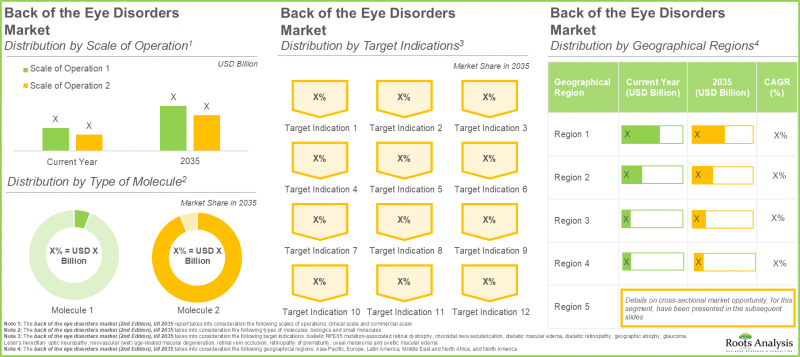
As per Roots Analysis, the global back of the eye disorders market is estimated to grow from USD 18.28 billion in the current year to USD 41.56 billion by 2035, at a CAGR of 9.6% during the forecast period, till 2035.
BACK OF THE EYE DISORDERS MARKET: GROWTH AND TRENDS
Therapeutic interventions for posterior segment (back-of-the-eye) disorders, along with advanced drug delivery technologies, constitute a vital segment of modern ophthalmology. These solutions are developed to address vision-threatening retinal conditions, including Age-Related Macular Degeneration (AMD), Diabetic Retinopathy (DR), Diabetic Macular Edema (DME), and Retinal Vein Occlusion. The market is characterized by the integration of advanced biologics, gene therapies, sustained-release formulations, and innovative drug delivery platforms designed to overcome the complex anatomical barriers of the posterior eye segment while enhancing treatment efficacy, durability, and patient outcomes.
Driven by continuous technological and therapeutic advancements, the back of the eye disorders market is witnessing sustained growth. Key innovations include next-generation anti-VEGF therapies, bispecific antibodies, long-acting formulations, port delivery systems, and gene and cell therapies designed to reduce treatment frequency and improve long-term retinal preservation. Despite these advancements, challenges remain, particularly in achieving efficient drug delivery across the blood-retinal barrier and mitigating the clinical and economic burden associated with repeated intravitreal injections.
Looking ahead, the market is expected to benefit significantly from the increasing global prevalence of diabetes, the expanding geriatric population, and growing investments in precision ophthalmology and next-generation ocular drug delivery technologies. These factors are anticipated to support continued innovation and drive robust market expansion over the coming years.
Growth Drivers: Strategic Enablers of Market Expansion
The growth of the back-of-the-eye disorders market is being primarily driven by the rising global prevalence of age-related and diabetes-associated retinal diseases, including age-related macular degeneration (AMD) and diabetic retinopathy (DR). The increasing burden of diabetes, combined with a rapidly aging population, is significantly expanding the patient pool requiring long-term retinal care. According to published research, nearly 200 million individuals worldwide are currently affected by AMD, with the number expected to approach 300 million by 2040, creating sustained demand for effective therapeutic interventions.
Complementing this demand, ongoing innovations in long-acting anti-VEGF therapies, sustained-release implants, and emerging gene therapy approaches are transforming the treatment landscape by reducing injection frequency, improving clinical outcomes, and alleviating patient burden. Furthermore, the accelerated development pipeline and favorable regulatory approvals are supporting broader clinical adoption of these advanced therapies. At the same time, advancements in diagnostic technologies, particularly high-resolution optical coherence tomography (OCT), alongside expanded screening initiatives and disease awareness programs, are enabling earlier diagnosis and intervention.
Collectively, these factors are increasing the number of treatable patients, improving disease management outcomes, and reinforcing the long-term growth trajectory of the back-of-the-eye disorders market.
Market Challenges: Critical Barriers Impeding Progress
Despite significant therapeutic advancements, the back-of-the-eye disorders market continues to face several clinical, technological, and economic challenges that may constrain its growth potential. One of the primary barriers is the complex anatomy of the posterior eye segment, which makes efficient drug delivery particularly difficult. The presence of physiological barriers, including the blood-retinal barrier, limits drug penetration and often necessitates invasive administration methods such as intravitreal injections. These procedures are associated with patient discomfort, treatment fatigue, and risks of complications, including infection and retinal damage. Furthermore, the chronic nature of conditions such as age-related macular degeneration (AMD), diabetic retinopathy (DR), and diabetic macular edema (DME) requires long-term treatment and monitoring, resulting in a substantial healthcare and economic burden for both patients and providers.
In addition, the high cost of advanced biologics, gene therapies, and sustained-release drug delivery platforms poses affordability and reimbursement challenges, particularly in emerging healthcare markets. Variability in patient response to existing therapies, the need for frequent follow-up visits, and limited access to specialized retinal care in underserved regions further hinder optimal disease management. Moreover, the development of novel ophthalmic therapies is associated with lengthy clinical timelines, stringent regulatory requirements, and complex manufacturing processes, increasing development costs and commercialization risks. Addressing these challenges will be critical to improving treatment accessibility, enhancing patient adherence, and unlocking the full growth potential of the back-of-the-eye disorders market.
BACK OF THE EYE DISORDERS MARKET: KEY INSIGHTS
The report delves into the current state of the back of the eye disorders market and identifies potential growth opportunities within the industry. Some key findings from the report include:
1. Given the rising prevalence of back of the eye disorders and the growing need for advanced treatment modalities, several researchers and industry players have shifted their focus on the development of safe and effective therapeutic drug molecules.
2. Over the years, the drug landscape for back of the eye disorders has transformed significantly, featuring a robust pipeline of around 690 drugs that are currently approved or are in various clinical stages of development.
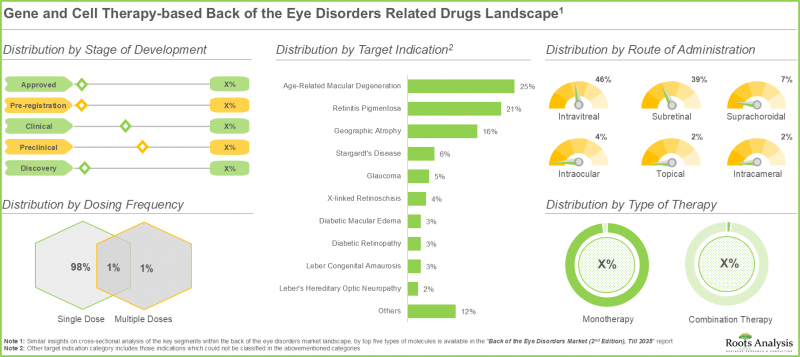
3. Close to 45% of the posterior segment drugs / therapies are in the preclinical stage of development; of these, majority (>30%) of the drugs / therapies are gene and cell therapies.
4. ~50% of gene and cell therapy-based drugs under development for posterior segment diseases are administered through intravitreal route, as it enables better local retinal exposure at lower drug doses.
5. Given the ongoing advancements in novel drug delivery systems and increasing prevalence of age and diabetes associated retinal diseases, the market is anticipated to witness a steady growth in the foreseen future.
6. Majority of the back of the eye disorders market is currently captured by biologics, owing to their ability to target the underlying biological pathways associated with back of the eye disorders.
7. North America is expected to capture a significant share of the overall back of the eye disorders market owing to the rapid innovations for targeted drug delivery systems in the region.
8. Driven by the rapid success of approved back of the eye disorders related drugs developed by prominent players in the US, the market is expected to grow at a steady annualized rate.
9. Given the surge in demand for novel therapeutics to target various chronic posterior eye diseases, and expedited regulatory approvals, the back of the eye disorders market is anticipated to rise steadily in the coming years.
Back of the Eye Disorders Market Segments
The market sizing and opportunity analysis has been segmented across the following parameters:
By Scale of Operation
- Clinical Scale
- Commercial Scale
By Type of Molecule
- Biologics
- Small Molecules
By Target Indication
- Diabetic Macular Edema
- Neovascular (Wet) Age-Related Macular Degeneration
- Diabetic Retinopathy
- Glaucoma
- Geographic Atrophy
- Uveal Melanoma
- Retinal Vein Occlusion
- Uveitic Macular Edema
- Choroidal Neovascularization
- Biallelic RPE65 mutation-associated Retinal Dystrophy
- Retinopathy of Prematurity
- Leber's Hereditary Optic Neuropathy
By Geographical Regions
- North America
- US
- Canada
- Europe
- Germany
- UK
- France
- Italy
- Spain
- Rest of Europe
- Asia-Pacific
- China
- Japan
- India
- South Korea
- Australia
- Rest of Asia-Pacific
- Middle East and North Africa
- Saudi Arabia
- Egypt
- Rest of Middle East and North Africa
- Latin America
- Brazil
- Argentina
- Rest of Latin America
BACK OF THE EYE DISORDERS MARKET: KEY SEGMENTS
Clinical Pipeline Expansion Accelerating Growth in the Back of the Eye Disorders Market
The commercial-stage segment currently accounts for most of the back of the eye disorders market, representing approximately 95% of total market revenue. This dominance is primarily attributed to the widespread adoption of approved therapies that offer well-established efficacy, safety, and clinical outcomes.
However, the clinical-stage pipeline is expected to witness the fastest growth during the forecast period, reflecting significant future market potential. The expansion of this segment is driven by the increasing number of innovative therapeutic candidates progressing through late-stage clinical development, alongside continued research into novel mechanisms of action across multiple retinal disease indications. Several promising Phase III candidates, including KSI-501 (Kodiak Sciences), OVX-001 (Ocuvex Therapeutics), ADX-2191 (Aldeyra Therapeutics), ONS-5010 (Outlook Therapeutics), and OTX-TKI (Ocular Therapeutix), are expected to contribute to future market expansion upon successful regulatory approval.
Diabetic Macular Edema Remains the Largest Therapeutic Segment
Diabetic Macular Edema (DME) represents the leading indication within the back of the eye disorders market, accounting for nearly 40% of the total market share in the current year. The segment's dominance is largely supported by the rising global burden of diabetes, driven by demographic aging, sedentary lifestyles, and changing dietary patterns. Several established therapies, including Eylea(R), Eylea HD(R), Lumitin(R), Lucentis(R), and Vabysmo(R), continue to support strong market demand. Additionally, OCS-01, a preservative-free investigational therapy being developed by Oculis, is expected to strengthen the treatment landscape pending positive Phase III clinical outcomes and subsequent regulatory approval. While DME currently dominates market revenues, the Uveitic Macular Edema segment is projected to register the highest growth rate during the forecast period. This growth is expected to be fueled by the increasing incidence of non-infectious uveitis, greater adoption of long-acting intravitreal implants and targeted biologics, substantial unmet clinical needs, and a progressively favorable reimbursement environment.
Regional Market Dynamics
North America Maintains Market Leadership
North America is expected to remain the largest regional market for back of the eye disorders, accounting for approximately 60% of global market share by 2035. The region's strong position is supported by extensive collaboration between academic institutions and industry stakeholders, advanced drug development and manufacturing capabilities, and a highly active intellectual property landscape. Further, strategic mergers and acquisitions continue to strengthen the regional ecosystem and accelerate innovation. A notable example includes the acquisition of Whitecap Biosciences by an affiliate of Bausch + Lomb. This transaction enhances Bausch + Lomb's ophthalmology pipeline by incorporating innovative investigational therapies targeting glaucoma and geographic atrophy, a late-stage manifestation of dry age-related macular degeneration, thereby reinforcing the company's long-term growth strategy in ophthalmic therapeutics.
Increasing Adoption of Back of the Eye Disorder Therapies Across Asia-Pacific
The Asia-Pacific market is projected to witness robust growth, expanding at a CAGR of 11.9% throughout the forecast period. Growth in the region is supported by increasing healthcare expenditure, improving access to advanced ophthalmic treatments, expanding patient population, and a growing focus on retinal disease management. Several leading pharmaceutical companies headquartered in the region, including Astellas Pharma and Otsuka Pharmaceutical, are actively engaged in the development of innovative therapies targeting back of the eye disorders. These initiatives, combined with ongoing investments in research and development, are expected to significantly enhance the region's contribution to the global market over the coming decade.
Example Players in Back of the Eye Disorders Market
- AbbVie
- Astellas Pharma
- Bausch + Lomb
- Chiesi
- Genentech
- Novartis
- Otsuka Pharmaceutical
- Regeneron Pharmaceuticals
- Roche
- Sun Pharma
Primary Research Overview
The opinions and insights presented in this study were influenced by discussions conducted with multiple stakeholders. The research report features detailed transcripts of interviews held with the following industry stakeholders:
- Former Chief Executive Officer, Small Company, Australia
- Former President and Chief Executive Officer, Mid-sized Company, US
- Former Senior Vice President, Small Company, US
In addition, the back of the eye disorders market report includes transcripts of the following third-party discussions:
- Associate Professor & Senior Consultant, Mid-sized Organization, Italy
- Assistant Professor, Very Large Organization, US
- Postdoctoral Researcher, Very Large Organization, US
BACK OF THE EYE DISORDERS MARKET: RESEARCH COVERAGE
- Market Sizing and Opportunity Analysis: The report features an in-depth analysis of the back of the eye disorders market, focusing on key market segments, including [A] scale of operation, [B] type of molecule, [C] target indication, and [D] geographical regions.
- Market Landscape: A detailed assessment of the overall back of the eye disorders market: drug and developers landscape, featuring information on several relevant parameters, such as [A] stage of development, [B] target indication, [C] route of administration, [D] type of molecule, [E] dosing frequency, [F] mechanism of action, [G] type of therapy, [H] drug designation, [I] year of establishment, [J] company size (based on employee count), [K] location of headquarters, and [L] most active developers.
- Product Competitiveness Analysis: A detailed competitiveness analysis of the drug developers based on several relevant parameters, such as company strength (in terms of years of experience and company size), portfolio strength (based on stage of development of drugs developed, number of drugs developed, type of molecule developed, and route of administration of drug developed) and portfolio diversity (number of target indications).
- Company Profiles: In-depth profiles of key drug developers in the back of the eye disorders market, focusing on [A] company overviews, [B] financial information, [C] drug portfolio, [D] recent developments, and [E] an informed future outlook.
- Market Impact Analysis: The report analyzes various factors such as drivers, restraints, opportunities, and challenges affecting market growth.
KEY QUESTIONS ANSWERED IN THIS REPORT
- Which are the leading companies in the back of the eye disorders market?
- Which region dominates the back of the eye disorders market?
- What are the key trends observed in the back of the eye disorders market?
- What factors are likely to influence the evolution of this market?
- What are the primary challenges faced by back of the eye disorder drug developers?
- What is the current and future market size?
- What is the CAGR of this market?
- How is the current and future market opportunity likely to be distributed across key market segments?
REASONS TO BUY THIS REPORT
- The report provides a comprehensive market analysis, offering detailed revenue projections of the overall market and its specific sub-segments. This information is valuable to both established market leaders and emerging entrants.
- The report offers stakeholders a comprehensive overview of the market, including key drivers, barriers, opportunities, and challenges. This information empowers stakeholders to stay abreast of market trends and make data-driven decisions to capitalize on growth prospects.
- The report can aid businesses in identifying future opportunities in any sector. It also helps in understanding if those opportunities are worth pursuing.
- The report helps in identifying customer demand by understanding the needs, preferences, and behavior of the target audience in order to tailor products or services effectively.
- The report equips new entrants with requisite information regarding a particular market to help them build successful business strategies.
- The report allows for more effective communication with the audience and in building strong business relations.
ADDITIONAL BENEFITS
- Complementary Excel Data Packs for all Analytical Modules in the Report
- 15% Free Content Customization
- Detailed Report Walkthrough Session with Research Team
- Free Updated report if the report is 6-12 months old or older
TABLE OF CONTENTS
1. BACKGROUND
- 1.1. Context
- 1.2. Project Objectives
2. RESEARCH METHODOLOGY
- 2.1. Chapter Overview
- 2.2. Research Assumptions
- 2.2.1. Market Landscape and Market Trends
- 2.2.2. Market Forecast and Opportunity Analysis
- 2.2.3. Comparative Analysis
- 2.3. Database Building
- 2.3.1. Data Collection
- 2.3.2. Data Validation
- 2.3.3. Data Analysis
- 2.4. Project Methodology
- 2.4.1. Secondary Research
- 2.4.1.1. Annual Reports
- 2.4.1.2. Academic Research Papers
- 2.4.1.3. Company Websites
- 2.4.1.4. Investor Presentations
- 2.4.1.5. Regulatory Filings
- 2.4.1.6. White Papers
- 2.4.1.7. Industry Publications
- 2.4.1.8. Conferences and Seminars
- 2.4.1.9. Government Portals
- 2.4.1.10. Media and Press Releases
- 2.4.1.11. Newsletters
- 2.4.1.12. Industry Databases
- 2.4.1.13. Roots Proprietary Databases
- 2.4.1.14. Paid Databases and Sources
- 2.4.1.15. Social Media Portals
- 2.4.1.16. Other Secondary Sources
- 2.4.2. Primary Research
- 2.4.2.1. Types of Primary Research
- 2.4.2.1.1. Qualitative Research
- 2.4.2.1.2. Quantitative Research
- 2.4.2.1.3. Hybrid Approach
- 2.4.2.2. Advantages of Primary Research
- 2.4.2.3. Techniques for Primary Research
- 2.4.2.3.1. Interviews
- 2.4.2.3.2. Surveys
- 2.4.2.3.3. Focus Groups
- 2.4.2.3.4. Observational Research
- 2.4.2.3.5. Social Media Interactions
- 2.4.2.4. Key Opinion Leaders Considered in Primary Research
- 2.4.2.4.1. Company Executives (CXOs)
- 2.4.2.4.2. Board of Directors
- 2.4.2.4.3. Company Presidents and Vice Presidents
- 2.4.2.4.4. Research and Development Heads
- 2.4.2.4.5. Technical Experts
- 2.4.2.4.6. Subject Matter Experts
- 2.4.2.4.7. Scientists
- 2.4.2.4.8. Doctors and Other Healthcare Providers
- 2.4.2.5. Ethics and Integrity
- 2.4.2.5.1. Research Ethics
- 2.4.2.5.2. Data Integrity
- 2.4.2.1. Types of Primary Research
- 2.4.3. Analytical Tools and Databases
- 2.4.1. Secondary Research
- 2.5. Robust Quality Control
3. MARKET DYNAMICS
- 3.1. Chapter Overview
- 3.2. Forecast Methodology
- 3.2.1. Top-down Approach
- 3.2.2. Bottom-up Approach
- 3.2.3. Hybrid Approach
- 3.3. Market Assessment Framework
- 3.3.1. Total Addressable Market (TAM)
- 3.3.2. Serviceable Addressable Market (SAM)
- 3.3.3. Serviceable Obtainable Market (SOM)
- 3.3.4. Currently Acquired Market (CAM)
- 3.4. Forecasting Tools and Techniques
- 3.4.1. Qualitative Forecasting
- 3.4.2. Correlation
- 3.4.3. Regression
- 3.4.4. Extrapolation
- 3.4.5. Convergence
- 3.4.6. Sensitivity Analysis
- 3.4.7. Scenario Planning
- 3.4.8. Data Visualization
- 3.4.9. Time Series Analysis
- 3.4.10. Forecast Error Analysis
- 3.5. Key Considerations
- 3.5.1. Demographics
- 3.5.2. Government Regulations
- 3.5.3. Reimbursement Scenarios
- 3.5.4. Market Access
- 3.5.5. Supply Chain
- 3.5.6. Industry Consolidation
- 3.5.7. Pandemic / Unforeseen Disruptions Impact
- 3.6. Limitations
4. MACRO-ECONOMIC INDICATORS
- 4.1. Chapter Overview
- 4.2. Market Dynamics
- 4.2.1. Time Period
- 4.2.1.1. Historical Trends
- 4.2.1.2. Current and Forecasted Estimates
- 4.2.2. Currency Coverage
- 4.2.2.1. Major Currencies Affecting the Market
- 4.2.2.2. Factors Affecting Currency Fluctuations
- 4.2.2.3. Impact of Currency Fluctuations on the Industry
- 4.2.3. Foreign Currency Exchange Rate
- 4.2.3.1. Impact of Foreign Exchange Rate Volatility on the Market
- 4.2.3.2. Strategies for Mitigating Foreign Exchange Risk
- 4.2.4. Recession
- 4.2.4.1. Assessment of Current Economic Conditions and Potential Impact on the Market
- 4.2.4.2. Historical Analysis of Past Recessions and Lessons Learnt
- 4.2.5. Inflation
- 4.2.5.1. Measurement and Analysis of Inflationary Pressures in the Economy
- 4.2.5.2. Potential Impact of Inflation on the Market Evolution
- 4.2.6. Interest Rates
- 4.2.6.1. Interest Rates and Their Impact on the Market
- 4.2.6.2. Strategies for Managing Interest Rate Risk
- 4.2.7. Commodity Flow Analysis
- 4.2.7.1. Type of Commodity
- 4.2.7.2. Origins and Destinations
- 4.2.7.3. Values and Weights
- 4.2.7.4. Modes of Transportation
- 4.2.8. Global Trade Dynamics
- 4.2.8.1. Import Scenario
- 4.2.8.2. Export Scenario
- 4.2.8.3. Trade Policies
- 4.2.8.4. Strategies for Mitigating the Risks Associated with Trade Barriers
- 4.2.8.5. Impact of Trade Barriers on the Market
- 4.2.9. War Impact Analysis
- 4.2.9.1. Russian-Ukraine War
- 4.2.9.2. Israel-Hamas War
- 4.2.10. COVID Impact / Related Factors
- 4.2.10.1. Global Economic Impact
- 4.2.10.2. Industry-specific Impact
- 4.2.10.3. Government Response and Stimulus Measures
- 4.2.10.4. Future Outlook and Adaptation Strategies
- 4.2.11. Other Indicators
- 4.2.11.1. Fiscal Policy
- 4.2.11.2. Consumer Spending
- 4.2.11.3. Gross Domestic Product (GDP)
- 4.2.11.4. Employment
- 4.2.11.5. Taxes
- 4.2.11.6. Stock Market Performance
- 4.2.11.7. Cross-Border Dynamics
- 4.2.1. Time Period
- 4.3. Conclusion
5. EXECUTIVE SUMMARY
- 5.1. Executive Summary: Market Landscape
- 5.2. Executive Summary: Market Forecast and Opportunity Analysis
6. INTRODUCTION
- 6.1. Overview of Back of the Eye Disorders
- 6.2. Back of the Eye Structure
- 6.3. Challenges Associated with Back of the Eye Drug Delivery
- 6.4. Back of the Eye Drug Delivery Routes
- 6.5. Prominent Back of the Eye Disorders
- 6.6. Factors Contributing to Back of the Eye Disorders
- 6.7. Signs and Symptoms of Back of the Eye Disorders
- 6.8. Treatment Approaches for Back of the Eye Disorders
- 6.9. Recent Trends in the Back of the Eye Disorders Domain
7. BACK OF THE EYE DISORDERS MARKET: DRUGS AND DEVELOPERS LANDSCAPE
- 7.1. Methodology and Key Parameters
- 7.2. Back of the Eye Disorders Market: Drugs Landscape
- 7.2.1. Analysis by Stage of Development
- 7.2.2. Analysis by Type of Molecule
- 7.2.3. Analysis by Mechanism of Action
- 7.2.4. Analysis by Dosing Frequency
- 7.2.5. Analysis by Route of Administration
- 7.2.6. Analysis by Target Indication
- 7.2.7. Analysis by Type of Therapy
- 7.2.8. Analysis by Drug Designation
- 7.3. Gene and Cell Therapy-based Back of the Eye Disorders Related Drugs Landscape
- 7.3.1. Analysis by Stage of Development
- 7.3.2. Analysis by Dosing Frequency
- 7.3.3. Analysis by Target Indication
- 7.3.4. Analysis by Route of Administration
- 7.3.5. Analysis by Type of Therapy
- 7.4. Small Molecule-based Back of the Eye Disorders Related Drugs Landscape
- 7.4.1. Analysis by Stage of Development
- 7.4.2. Analysis by Dosing Frequency
- 7.4.3. Analysis by Target Indication
- 7.4.4. Analysis by Route of Administration
- 7.4.5. Analysis by Type of Therapy
- 7.5. Antibody-based Back of the Eye Disorders Related Drugs Landscape
- 7.5.1. Analysis by Stage of Development
- 7.5.2. Analysis by Dosing Frequency
- 7.5.3. Analysis by Target Indication
- 7.5.4. Analysis by Route of Administration
- 7.5.5. Analysis by Type of Therapy
- 7.6. Protein-based Back of the Eye Disorders Related Drugs Landscape
- 7.6.1. Analysis by Stage of Development
- 7.6.2. Analysis by Dosing Frequency
- 7.6.3. Analysis by Target Indication
- 7.6.4. Analysis by Route of Administration
- 7.6.5. Analysis by Type of Therapy
- 7.7. Peptide-based Back of the Eye Disorders Related Drugs Landscape
- 7.7.1. Analysis by Stage of Development
- 7.7.2. Analysis by Dosing Frequency
- 7.7.3. Analysis by Target Indication
- 7.7.4. Analysis by Route of Administration
- 7.7.5. Analysis by Type of Therapy
- 7.8. Back of the Eye Disorders Market: Developers Landscape
- 7.8.1. Analysis by Year of Establishment
- 7.8.2. Analysis by Company Size
- 7.8.3. Analysis by Location of Headquarters
- 7.8.4. Analysis by Company Size and Location of Headquarters
- 7.8.5. Most Active Players: Analysis by Number of Drugs
8. BACK OF THE EYE DISORDERS MARKET: COMPANY COMPETITIVENESS ANALYSIS
- 8.1. Methodology and Key Parameters
- 8.2. Scoring Criteria
- 8.3. Overview of Peer Groups
- 8.3.1. Company Competitiveness Analysis: Developers based in North America (Peer Group I)
- 8.3.2. Company Competitiveness Analysis: Developers based in Europe (Peer Group II)
- 8.3.3. Company Competitiveness Analysis: Developers based in Asia-Pacific and Rest of the World (Peer Group III)
9. COMPANY PROFILES: BACK OF THE EYE DISORDERS DRUG DEVELOPERS
- 9.1. Chapter Overview
- 9.2. AbbVie*
- 9.2.1. Company Overview
- 9.2.2. Management Team
- 9.2.3. Back of the Eye Drugs Portfolio
- 9.2.4. Key Initiatives
- Similar details are presented for other companies mentioned below (based on information in the public domain)
- 9.3. Astellas Pharma
- 9.4. Bausch + Lomb
- 9.5. Chiesi
- 9.6. Genentech
- 9.7. Novartis
- 9.8. Otsuka Pharmaceutical
- 9.9. Regeneron Pharmaceuticals
- 9.10. Roche
- 9.11. Sun Pharma
10. MARKET IMPACT ANALYSIS
- 10.1. Chapter Overview
- 10.2. Market Drivers
- 10.3. Market Restraints
- 10.4. Market Opportunities
- 10.5. Market Challenges
11. GLOBAL BACK OF THE EYE DISORDERS MARKET
- 11.1. Key Assumptions and Methodology
- 11.2. Global Back of The Eye Disorders Market, Historical Trends (Since 2022) and Forecasted Estimates (Till 2035)
- 11.2.1. Scenario Analysis
- 11.2.1.1. Conservative Scenario
- 11.2.1.2. Optimistic Scenario
- 11.2.1. Scenario Analysis
- 11.3. Key Market Segmentations
12. BACK OF THE EYE DISORDERS MARKET, BY SCALE OF OPERATION
- 12.1. Key Assumptions and Methodology
- 12.2. Back of The Eye Disorders Market: Distribution by Scale of Operation
- 12.2.1. Back of The Eye Disorders Market at Clinical Scale, Forecasted Estimates (Till 2035)
- 12.2.2. Back of The Eye Disorders Market at Commercial Scale, Historical Trends (Since 2022) and Forecasted Estimates (Till 2035)
13. BACK OF THE EYE DISORDERS MARKET, BY TYPE OF MOLECULE
- 13.1. Key Assumptions and Methodology
- 13.2. Back of The Eye Disorders Market: Distribution by Type of Molecule
- 13.2.1. Back of The Eye Disorders Market for Biologics, Historical Trends (Since 2022) and Forecasted Estimates (Till 2035)
- 13.2.2. Back of The Eye Disorders Market for Small Molecules, Historical Trends (Since 2022) and Forecasted Estimates (Till 2035)
14. BACK OF THE EYE DISORDERS MARKET, BY TARGET INDICATION
- 14.1. Key Assumptions and Methodology
- 14.2. Back of The Eye Disorders Market: Distribution by Target Indication
- 14.2.1. Back of The Eye Disorders Market for Diabetic Macular Edema, Historical Trends (Since 2022) and Forecasted Estimates (Till 2035)
- 14.2.2. Back of The Eye Disorders Market for Neovascular (Wet) Age-Related Macular Degeneration, Historical Trends (Since 2022) and Forecasted Estimates (Till 2035)
- 14.2.3. Back of The Eye Disorders Market for Diabetic Retinopathy, Historical Trends (Since 2022) and Forecasted Estimates (Till 2035)
- 14.2.4. Back of The Eye Disorders Market for Glaucoma, Historical Trends (Since 2022) and Forecasted Estimates (Till 2035)
- 14.2.5. Back of The Eye Disorders Market for Geographic Atrophy, Historical Trends (Since 2023) and Forecasted Estimates (Till 2035)
- 14.2.6. Back of The Eye Disorders Market for Uveal Melanoma, Historical Trends (Since 2022) and Forecasted Estimates (Till 2035)
- 14.2.7. Back of The Eye Disorders Market for Retinal Vein Occlusion, Historical Trends (Since 2022) and Forecasted Estimates (Till 2035)
- 14.2.8. Back of The Eye Disorders Market for Uveitic Macular Edema, Historical Trends (Since 2022) and Forecasted Estimates (Till 2035)
- 14.2.9. Back of The Eye Disorders Market for Choroidal Neovascularization, Historical Trends (Since 2022) and Forecasted Estimates (Till 2035)
- 14.2.10. Back of The Eye Disorders Market for Biallelic RPE65 mutation-associated Retinal Dystrophy, Historical Trends (Since 2022) and Forecasted Estimates (Till 2035)
- 14.2.11. Back of The Eye Disorders Market for Retinopathy of Prematurity, Historical Trends (Since 2022) and Forecasted Estimates (Till 2035)
- 14.2.12. Back of The Eye Disorders Market for Leber's Hereditary Optic Neuropathy, Historical Trends (Since 2022) and Forecasted Estimates (Till 2035)
15. BACK OF THE EYE DISORDERS MARKET, BY GEOGRAPHICAL REGIONS
- 15.1. Key Assumptions and Methodology
- 15.2. Back of The Eye Disorders Market: Distribution by Geographical Regions
- 15.2.1. Back of The Eye Disorders Market in North America, Historical Trends (Since 2022) and Forecasted Estimates (Till 2035)
- 15.2.1.1. Back of The Eye Disorders Market in the US, Historical Trends (Since 2022) and Forecasted Estimates (Till 2035)
- 15.2.1.2. Back of The Eye Disorders Market in Canada, Historical Trends (Since 2022) and Forecasted Estimates (Till 2035)
- 15.2.2. Back of The Eye Disorders Market in Europe, Historical Trends (Since 2022) and Forecasted Estimates (Till 2035)
- 15.2.2.1. Back of The Eye Disorders Market in Germany, Historical Trends (Since 2022) and Forecasted Estimates (Till 2035)
- 15.2.2.2. Back of The Eye Disorders Market in the UK, Historical Trends (Since 2022) and Forecasted Estimates (Till 2035)
- 15.2.2.3. Back of The Eye Disorders Market in France, Historical Trends (Since 2022) and Forecasted Estimates (Till 2035)
- 15.2.2.4. Back of The Eye Disorders Market in Italy, Historical Trends (Since 2022) and Forecasted Estimates (Till 2035)
- 15.2.2.5. Back of The Eye Disorders Market in Spain, Historical Trends (Since 2022) and Forecasted Estimates (Till 2035)
- 15.2.2.6. Back of The Eye Disorders Market in Rest of Europe, Historical Trends (Since 2022) and Forecasted Estimates (Till 2035)
- 15.2.3. Back of The Eye Disorders Market in Asia-Pacific, Historical Trends (Since 2022) and Forecasted Estimates (Till 2035)
- 15.2.3.1. Back of The Eye Disorders Market in China, Historical Trends (Since 2022) and Forecasted Estimates (Till 2035)
- 15.2.3.2. Back of The Eye Disorders Market in Japan, Historical Trends (Since 2022) and Forecasted Estimates (Till 2035)
- 15.2.3.3. Back of The Eye Disorders Market in India, Historical Trends (Since 2022) and Forecasted Estimates (Till 2035)
- 15.2.3.4. Back of The Eye Disorders Market in South Korea, Historical Trends (Since 2022) and Forecasted Estimates (Till 2035)
- 15.2.3.5. Back of The Eye Disorders Market in Australia, Historical Trends (Since 2022) and Forecasted Estimates (Till 2035)
- 15.2.3.6. Back of The Eye Disorders Market in Rest of Asia-Pacific, Historical Trends (Since 2022) and Forecasted Estimates (Till 2035)
- 15.2.4. Back of The Eye Disorders Market in Middle East and North Africa, Historical Trends (Since 2022) and Forecasted Estimates (Till 2035)
- 15.2.4.1. Back of The Eye Disorders Market in Saudi Arabia, Historical Trends (Since 2022) and Forecasted Estimates (Till 2035)
- 15.2.4.2. Back of The Eye Disorders Market in Egypt, Historical Trends (Since 2022) and Forecasted Estimates (Till 2035)
- 15.2.4.3. Back of The Eye Disorders Market in Rest of Middle East and North Africa, Historical Trends (Since 2022) and Forecasted Estimates (Till 2035)
- 15.2.5. Back of The Eye Disorders Market in Latin America, Historical Trends (Since 2022) and Forecasted Estimates (Till 2035)
- 15.2.5.1. Back of The Eye Disorders Market in Brazil, Historical Trends (Since 2022) and Forecasted Estimates (Till 2035)
- 15.2.5.2. Back of The Eye Disorders Market in Argentina, Historical Trends (Since 2022) and Forecasted Estimates (Till 2035)
- 15.2.5.3. Back of The Eye Disorders Market in Rest of Latin America, Historical Trends (Since 2022) and Forecasted Estimates (Till 2035)
- 15.2.1. Back of The Eye Disorders Market in North America, Historical Trends (Since 2022) and Forecasted Estimates (Till 2035)
16. BACK OF THE EYE DISORDERS MARKET: NORTH AMERICA
- 16.1. Back of The Eye Disorders Market in North America: Distribution by Scale of Operation
- 16.1.1. Back of The Eye Disorders Market in North America at Clinical Scale, Forecasted Estimates (till 2035)
- 16.1.2. Back of The Eye Disorders Market in North America at Commercial Scale, Historical Trends (since 2022) and Forecasted Estimates (till 2035)
- 16.2. Back of The Eye Disorders Market in North America: Distribution by Type of Molecule
- 16.2.1. Back of The Eye Disorders Market in North America for Biologics, Historical Trends (since 2022) and Forecasted Estimates (till 2035)
- 16.2.2. Back of The Eye Disorders Market in North America for Small Molecules, Historical Trends (since 2022) and Forecasted Estimates (till 2035)
- 16.3. Back of The Eye Disorders Market in North America: Distribution by Target Indication
- 16.3.1. Back of The Eye Disorders Market in North America for Diabetic Macular Edema, Historical Trends (Since 2022) and Forecasted Estimates (Till 2035)
- 16.3.2. Back of The Eye Disorders Market in North America for Neovascular (Wet) Age-Related Macular Degeneration, Historical Trends (Since 2022) and Forecasted Estimates (Till 2035)
- 16.3.3. Back of The Eye Disorders Market in North America for Diabetic Retinopathy, Historical Trends (Since 2022) and Forecasted Estimates (Till 2035)
- 16.3.4. Back of The Eye Disorders Market in North America for Glaucoma, Historical Trends (Since 2022) and Forecasted Estimates (Till 2035)
- 16.3.5. Back of The Eye Disorders Market in North America for Geographic Atrophy, Historical Trends (Since 2022) and Forecasted Estimates (Till 2035)
- 16.3.6. Back of The Eye Disorders Market in North America for Uveal Melanoma, Historical Trends (Since 2022) and Forecasted Estimates (Till 2035)
- 16.3.7. Back of The Eye Disorders Market in North America for Retinal Vein Occlusion, Historical Trends (Since 2022) and Forecasted Estimates (Till 2035)
- 16.3.8. Back of The Eye Disorders Market in North America for Uveitic Macular Edema, Historical Trends (Since 2022) and Forecasted Estimates (Till 2035)
- 16.3.9. Back of The Eye Disorders Market in North America for Choroidal Neovascularization, Historical Trends (Since 2022) and Forecasted Estimates (Till 2035)
- 16.3.10. Back of The Eye Disorders Market in North America for Biallelic RPE65 mutation-associated Retinal Dystrophy, Historical Trends (Since 2022) and Forecasted Estimates (Till 2035)
- 16.3.11. Back of The Eye Disorders Market in North America for Retinopathy of Prematurity, Historical Trends (Since 2022) and Forecasted Estimates (Till 2035)
- 16.3.12. Back of The Eye Disorders Market in North America for Leber's Hereditary Optic Neuropathy, Historical Trends (Since 2022) and Forecasted Estimates (Till 2035)
17. BACK OF THE EYE DISORDERS MARKET: EUROPE
- 17.1. Back of The Eye Disorders Market in Europe: Distribution by Scale of Operation
- 17.1.1. Back of The Eye Disorders Market in Europe at Clinical Scale, Forecasted Estimates (till 2035)
- 17.1.2. Back of The Eye Disorders Market in Europe at Commercial Scale, Historical Trends (since 2017) and Forecasted Estimates (till 2035)
- 17.2. Back of The Eye Disorders Market in Europe: Distribution by Type of Molecule
- 17.2.1. Back of The Eye Disorders Market in Europe for Biologics, Historical Trends (since 2017) and Forecasted Estimates (till 2035)
- 17.2.2. Back of The Eye Disorders Market in Europe for Small Molecules, Historical Trends (since 2017) and Forecasted Estimates (till 2035)
- 17.3. Back of The Eye Disorders Market in Europe: Distribution by Target Indication
- 17.3.1. Back of The Eye Disorders Market in Europe for Diabetic Macular Edema, Historical Trends (Since 2017) and Forecasted Estimates (Till 2035)
- 17.3.2. Back of The Eye Disorders Market in Europe for Neovascular (Wet) Age-Related Macular Degeneration, Historical Trends (Since 2017) and Forecasted Estimates (Till 2035)
- 17.3.3. Back of The Eye Disorders Market in Europe for Diabetic Retinopathy, Historical Trends (Since 2017) and Forecasted Estimates (Till 2035)
- 17.3.4. Back of The Eye Disorders Market in Europe for Glaucoma, Historical Trends (Since 2017) and Forecasted Estimates (Till 2035)
- 17.3.5. Back of The Eye Disorders Market in Europe for Geographic Atrophy, Historical Trends (Since 2017) and Forecasted Estimates (Till 2035)
- 17.3.6. Back of The Eye Disorders Market in Europe for Uveal Melanoma, Historical Trends (Since 2017) and Forecasted Estimates (Till 2035)
- 17.3.7. Back of The Eye Disorders Market in Europe for Retinal Vein Occlusion, Historical Trends (Since 2017) and Forecasted Estimates (Till 2035)
- 17.3.8. Back of The Eye Disorders Market in Europe for Uveitic Macular Edema, Historical Trends (Since 2017) and Forecasted Estimates (Till 2035)
- 17.3.9. Back of The Eye Disorders Market in Europe for Choroidal Neovascularization, Historical Trends (Since 2017) and Forecasted Estimates (Till 2035)
- 17.3.10. Back of The Eye Disorders Market in Europe for Biallelic RPE65 mutation-associated Retinal Dystrophy, Historical Trends (Since 2017) and Forecasted Estimates (Till 2035)
- 17.3.11. Back of The Eye Disorders Market in Europe for Retinopathy of Prematurity, Historical Trends (Since 2017) and Forecasted Estimates (Till 2035)
- 17.3.12. Back of The Eye Disorders Market in Europe for Leber's Hereditary Optic Neuropathy, Historical Trends (Since 2017) and Forecasted Estimates (Till 2035)
18. BACK OF THE EYE DISORDERS MARKET: ASIA-PACIFIC
- 18.1. Back of The Eye Disorders Market in Asia-Pacific: Distribution by Scale of Operation
- 18.1.1. Back of The Eye Disorders Market in Asia-Pacific at Clinical Scale, Forecasted Estimates (till 2035)
- 18.1.2. Back of The Eye Disorders Market in Asia-Pacific at Commercial Scale, Historical Trends (since 2022) and Forecasted Estimates (till 2035)
- 18.2. Back of The Eye Disorders Market in Asia-Pacific: Distribution by Type of Molecule
- 18.2.1. Back of The Eye Disorders Market in Asia-Pacific for Biologics, Historical Trends (since 2022) and Forecasted Estimates (till 2035)
- 18.2.2. Back of The Eye Disorders Market in Asia-Pacific for Small Molecules, Historical Trends (since 2022) and Forecasted Estimates (till 2035)
- 18.3. Back of The Eye Disorders Market in Asia-Pacific: Distribution by Target Indication
- 18.3.1. Back of The Eye Disorders Market in Asia-Pacific for Diabetic Macular Edema, Historical Trends (Since 2022) and Forecasted Estimates (Till 2035)
- 18.3.2. Back of The Eye Disorders Market in Asia-Pacific for Neovascular (Wet) Age-Related Macular Degeneration, Historical Trends (Since 2022) and Forecasted Estimates (Till 2035)
- 18.3.3. Back of The Eye Disorders Market in Asia-Pacific for Diabetic Retinopathy, Historical Trends (Since 2022) and Forecasted Estimates (Till 2035)
- 18.3.4. Back of The Eye Disorders Market in Asia-Pacific for Glaucoma, Historical Trends (Since 2022) and Forecasted Estimates (Till 2035)
- 18.3.5. Back of The Eye Disorders Market in Asia-Pacific for Geographic Atrophy, Historical Trends (Since 2022) and Forecasted Estimates (Till 2035)
- 18.3.6. Back of The Eye Disorders Market in Asia-Pacific for Uveal Melanoma, Historical Trends (Since 2022) and Forecasted Estimates (Till 2035)
- 18.3.7. Back of The Eye Disorders Market in Asia-Pacific for Retinal Vein Occlusion, Historical Trends (Since 2022) and Forecasted Estimates (Till 2035)
- 18.3.8. Back of The Eye Disorders Market in Asia-Pacific for Uveitic Macular Edema, Historical Trends (Since 2022) and Forecasted Estimates (Till 2035)
- 18.3.9. Back of The Eye Disorders Market in Asia-Pacific for Choroidal Neovascularization, Historical Trends (Since 2022) and Forecasted Estimates (Till 2035)
- 18.3.10. Back of The Eye Disorders Market in Asia-Pacific for Biallelic RPE65 mutation-associated Retinal Dystrophy, Historical Trends (Since 2022) and Forecasted Estimates (Till 2035)
- 18.3.11. Back of The Eye Disorders Market in Asia-Pacific for Retinopathy of Prematurity, Historical Trends (Since 2022) and Forecasted Estimates (Till 2035)
- 18.3.12. Back of The Eye Disorders Market in Asia-Pacific for Leber's Hereditary Optic Neuropathy, Historical Trends (Since 2022) and Forecasted Estimates (Till 2035)
19. BACK OF THE EYE DISORDERS MARKET: MIDDLE EAST AND NORTH AFRICA
- 19.1. Back of The Eye Disorders Market in Middle East and North Africa: Distribution by Scale of Operation
- 19.1.1. Back of The Eye Disorders Market in Middle East and North Africa at Clinical Scale, Forecasted Estimates (till 2035)
- 19.1.2. Back of The Eye Disorders Market in Middle East and North Africa at Commercial Scale, Historical Trends (since 2022) and Forecasted Estimates (till 2035)
- 19.2. Back of The Eye Disorders Market in Middle East and North Africa: Distribution by Type of Molecule
- 19.2.1. Back of The Eye Disorders Market in Middle East and North Africa for Biologics, Historical Trends (since 2022) and Forecasted Estimates (till 2035)
- 19.2.2. Back of The Eye Disorders Market in Middle East and North Africa for Small Molecules, Historical Trends (since 2022) and Forecasted Estimates (till 2035)
- 19.3. Back of The Eye Disorders Market in Middle East and North Africa: Distribution by Target Indication
- 19.3.1. Back of The Eye Disorders Market in Middle East and North Africa for Diabetic Macular Edema, Historical Trends (Since 2022) and Forecasted Estimates (Till 2035)
- 19.3.2. Back of The Eye Disorders Market in Middle East and North Africa for Neovascular (Wet) Age-Related Macular Degeneration, Historical Trends (Since 2022) and Forecasted Estimates (Till 2035)
- 19.3.3. Back of The Eye Disorders Market in Middle East and North Africa for Diabetic Retinopathy, Historical Trends (Since 2022) and Forecasted Estimates (Till 2035)
- 19.3.4. Back of The Eye Disorders Market in Middle East and North Africa for Glaucoma, Historical Trends (Since 2022) and Forecasted Estimates (Till 2035)
- 19.3.5. Back of The Eye Disorders Market in Middle East and North Africa for Geographic Atrophy, Historical Trends (Since 2022) and Forecasted Estimates (Till 2035)
- 19.3.6. Back of The Eye Disorders Market in Middle East and North Africa for Uveal Melanoma, Historical Trends (Since 2022) and Forecasted Estimates (Till 2035)
- 19.3.7. Back of The Eye Disorders Market in Middle East and North Africa for Retinal Vein Occlusion, Historical Trends (Since 2022) and Forecasted Estimates (Till 2035)
- 19.3.8. Back of The Eye Disorders Market in Middle East and North Africa for Uveitic Macular Edema, Historical Trends (Since 2022) and Forecasted Estimates (Till 2035)
- 19.3.9. Back of The Eye Disorders Market in Middle East and North Africa for Choroidal Neovascularization, Historical Trends (Since 2022) and Forecasted Estimates (Till 2035)
- 19.3.10. Back of The Eye Disorders Market in Middle East and North Africa for Biallelic RPE65 mutation-associated Retinal Dystrophy, Historical Trends (Since 2022) and Forecasted Estimates (Till 2035)
- 19.3.11. Back of The Eye Disorders Market in Middle East and North Africa for Retinopathy of Prematurity, Historical Trends (Since 2022) and Forecasted Estimates (Till 2035)
- 19.3.12. Back of The Eye Disorders Market in Middle East and North Africa for Leber's Hereditary Optic Neuropathy, Historical Trends (Since 2022) and Forecasted Estimates (Till 2035)
20. BACK OF THE EYE DISORDERS MARKET: LATIN AMERICA
- 20.1. Back of The Eye Disorders Market in Latin America: Distribution by Scale of Operation
- 20.1.1. Back of The Eye Disorders Market in Latin America at Clinical Scale, Forecasted Estimates (till 2035)
- 20.1.2. Back of The Eye Disorders Market in Latin America at Commercial Scale, Historical Trends (since 2022) and Forecasted Estimates (till 2035)
- 20.2. Back of The Eye Disorders Market in Latin America: Distribution by Type of Molecule
- 20.2.1. Back of The Eye Disorders Market in Latin America for Biologics, Historical Trends (since 2022) and Forecasted Estimates (till 2035)
- 20.2.2. Back of The Eye Disorders Market in Latin America for Small Molecules, Historical Trends (since 2022) and Forecasted Estimates (till 2035)
- 20.3. Back of The Eye Disorders Market in Latin America: Distribution by Target Indication
- 20.3.1. Back of The Eye Disorders Market in Latin America for Diabetic Macular Edema, Historical Trends (Since 2022) and Forecasted Estimates (Till 2035)
- 20.3.2. Back of The Eye Disorders Market in Latin America for Neovascular (Wet) Age-Related Macular Degeneration, Historical Trends (Since 2022) and Forecasted Estimates (Till 2035)
- 20.3.3. Back of The Eye Disorders Market in Latin America for Diabetic Retinopathy, Historical Trends (Since 2022) and Forecasted Estimates (Till 2035)
- 20.3.4. Back of The Eye Disorders Market in Latin America for Glaucoma, Historical Trends (Since 2022) and Forecasted Estimates (Till 2035)
- 20.3.5. Back of The Eye Disorders Market in Latin America for Geographic Atrophy, Historical Trends (Since 2022) and Forecasted Estimates (Till 2035)
- 20.3.6. Back of The Eye Disorders Market in Latin America for Uveal Melanoma, Historical Trends (Since 2022) and Forecasted Estimates (Till 2035)
- 20.3.7. Back of The Eye Disorders Market in Latin America for Retinal Vein Occlusion, Historical Trends (Since 2022) and Forecasted Estimates (Till 2035)
- 20.3.8. Back of The Eye Disorders Market in Latin America for Uveitic Macular Edema, Historical Trends (Since 2022) and Forecasted Estimates (Till 2035)
- 20.3.9. Back of The Eye Disorders Market in Latin America for Choroidal Neovascularization, Historical Trends (Since 2022) and Forecasted Estimates (Till 2035)
- 20.3.10. Back of The Eye Disorders Market in Latin America for Biallelic RPE65 mutation-associated Retinal Dystrophy, Historical Trends (Since 2022) and Forecasted Estimates (Till 2035)
- 20.3.11. Back of The Eye Disorders Market in Latin America for Retinopathy of Prematurity, Historical Trends (Since 2022) and Forecasted Estimates (Till 2035)
- 20.3.12. Back of The Eye Disorders Market in Latin America for Leber's Hereditary Optic Neuropathy, Historical Trends (Since 2022) and Forecasted Estimates (Till 2035)
- *Detailed information on Chapters 16 to 20 is available in the Excel Data Packs shared along with the report**
21. BACK OF THE EYE DISORDERS MARKET, BY KEY PLAYERS
22. BACK OF THE EYE DISORDERS MARKET, SALES FORECAST OF COMMERCIALIZED DRUGS
- 22.1. Back of the Eye Disorders Market: Commercialized Drug Sales Forecast
- 22.1.1. ALPHAGAN(R) P / COMBIGAN(R) Franchise
- 22.1.2. AZARGA(R)
- 22.1.3. Beovu(R) (brolucizumab) / RTH258
- 22.1.4. Duotrav(TM)
- 22.1.5. Eylea HD(R) (aflibercept)
- 22.1.6. Eylea(R) (aflibercept)
- 22.1.7. IZERVAY(TM)
- 22.1.8. KIMMTRAK(R) (tebentafusp-tebn)
- 22.1.9. Latanoprost / DE-130A / (Catioprost) / Catiolanze(R)
- 22.1.10. Lucentis(R) / Ranibizumab
- 22.1.11. Lumigan/Ganfort
- 22.1.12. Lumitin(R) (Conbercept Ophthalmic Solution) / KH902
- 22.1.13. LUXTURNA(R) (voretigene neparvovec-rzyl)
- 22.1.14. NCX 470 / OT-301 / K-911
- 22.1.15. Omidenepag / Isopropyl / OMLONTI(R) / Eybelis / DE-117
- 22.1.16. ONS-5010 / LYTENAVA(TM)
- 22.1.17. Raxone(R) / Idebenone
- 22.1.18. Rhopressa(R) + ROCKLATAN(TM)
- 22.1.19. Sepetaprost / DE-126 / SETANEO(R) Ophthalmic Solution
- 22.1.20. Simbrinza(R)
- 22.1.21. SYFOVRE(R) (pegcetacoplan injection)
- 22.1.22. Tafluprost / Timolol Maleate / TAPCOM Combination Ophthalmic Solution
- 22.1.23. Travatan Z(R) / Travoprost
- 22.1.24. Vabysmo (faricimab-sova, RG7716)
- 22.1.25. VYZULTA(R)
- 22.1.26. XIPERE(R) / ARCATUS(R) / ARVN001
23. CONCLUDING REMARKS
24. EXECUTIVE INSIGHTS
- 24.1. Chapter Overview
- 24.2. Company A
- 24.2.1. Interview Transcript: Former Chief Executive Officer
- 24.3. Company B
- 24.3.1. Interview Transcript: Former Senior Vice President
- 24.4. Company C
- 24.4.1. Interview Transcript: Former President and Chief Executive Officer
- 24.5. Company D
- 24.5.1. Interview Transcript: Postdoctoral Researcher
- 24.6. Company E
- 24.6.1. Interview Transcript: Assistant Professor
- 24.7. Company F
- 24.7.1. Interview Transcript: Associate Professor & Senior Consultant


