

|
시장보고서
상품코드
2099337
경피적 관상동맥 중재술 유도 장치 : 시장 점유율 분석, 업계 동향 및 통계, 성장 예측(2026-2031년)Percutaneous Coronary Intervention Guidance Devices - Market Share Analysis, Industry Trends & Statistics, Growth Forecasts (2026 - 2031) |
||||||
 Mordor Intelligence
Mordor Intelligence에 의하면, 경피적 관상동맥 중재술 유도 장치 시장 규모는 2025년 19억 6,000만 달러로 평가되었습니다. 2026년 21억 4,000만 달러에서 2031년까지 33억 3,000만 달러로 확대되어 2026년부터 2031년에 걸쳐 CAGR 9.23%를 나타낼 것으로 예측됩니다.
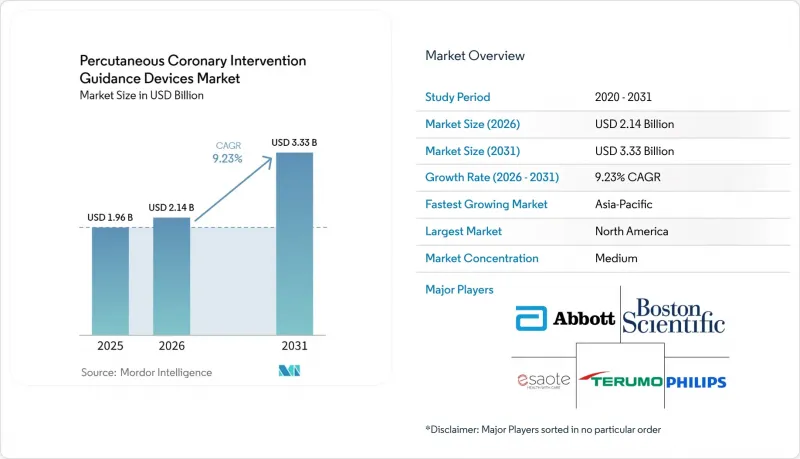
본 보고서는 제품 유형(혈관 내 초음파(IVUS) 시스템 등), 기술(IVUS 기반 유도, OCT 기반 유도 등), 용도(병변 평가 등), 최종 사용자(병원, 외래수술센터(ASC) 등), 지역(북미, 유럽, 아시아태평양 등)별로 분류되어 있습니다. 시장 전망은 금액(달러)으로 제시되어 있습니다.
세계의 경피적 관상동맥 중재술 유도 장치 시장 동향 및 인사이트
복잡한 관상동맥 병변 및 석회화 질환의 부담 증가
경피적 관상동맥 중재술 유도 장치 시장은 혈관조영술만으로는 평가하기 어려운 석회화 병변이나 해부학적으로 복잡한 병변을 가진 환자층의 확대에 힘입어 성장하고 있습니다. 침습적 관상동맥 조영술을 받는 환자의 20%에서 30%에서 중등도에서 중증의 석회화가 관찰되며, 그 유병률은 고령 남성에서 급격히 상승하기 때문에 영상 진단 수요는 구조적으로 고령화 사회와 밀접하게 연결되어 있습니다. 이와 유사한 경향은 만성 완전 폐색(CTO) 치료에서도 나타나며, PROGRESS-CTO 레지스트리 보고에 따르면, 2012년부터 2025년 사이에 등록된 1만 6,916건의 CTO PCI 시술에서 병변의 49.6%에서 중등도 또는 중증의 석회화가 확인되었습니다. 또한, ECLIPSE 연구에서 혈관 내 영상 유도 기술을 통해 중증 석회화 병변의 1년 후 표적 혈관 실패율이 13.2%에서 9.3%로 감소한 것으로 나타남에 따라, 병원이 이러한 임상적 근거를 무시하기는 점점 더 어려워지고 있습니다. 이러한 결과로 인해 경피적 관상동맥 중재술 유도 장치 시장은 시술 건수 증가뿐만 아니라, 보다 적절한 병변 준비, 칼슘 스코어링 및 스텐트 삽입 후 평가가 필요한 시술의 비율 증가와도 밀접하게 연관되어 있습니다.
영상 유도 및 생리학적 유도에 의한 PCI로의 전환
경피적 관상동맥 중재술 유도 장치 시장은 혈관조영술만을 사용하는 워크플로우에서 영상 유도 및 생리학적 지표에 기반한 PCI로의 광범위한 전환에 의해서도 촉진되고 있습니다. 통합 시스템을 통해 의사는 하나의 콘솔에서 IVUS, OCT 및 압력 측정 도구에 접근할 수 있게 되어, 설정 부담이 줄어들고 카테터실 내 워크플로우의 일관성이 향상되고 있습니다. 22건의 임상시험을 대상으로 한 2025년 메타분석에 따르면, 혈관 내 영상 유도 하 PCI는 혈관조영술만으로 유도하는 경우에 비해 심혈관 사망을 45%, 표적 병변 불완전 치료를 29%, 확정적 스텐트 혈전증을 48% 감소시키는 것으로 밝혀졌습니다. 또한, OCTIVUS 연구에서는 스텐트 최적화를 달성한 환자에서 표적 혈관 손상이 52% 상대적으로 감소한 것으로 나타났으며, 그 효과는 OCT 유도 하에서 가장 두드러졌습니다. 이러한 결과로 인해 병원들은 가이드 플랫폼을 치료 성과 향상과 최신 진료 기준에 대한 보다 엄격한 준수를 모두 지원하는 도구로 인식하게 되었으며, 이에 따라 조달 동향에 변화가 나타나고 있습니다.
고액의 초기 투자와 카테터의 지속적인 비용
경피적 관상동맥 중재술 유도 장치 시장은 콘솔, 소프트웨어 및 일회용 카테터의 총 소유 비용으로 인해 여전히 제약을 받고 있습니다. 병원 측은 플랫폼의 기본 가격뿐만 아니라, 종합적 지불 제도 하에서 광범위한 PCI 사례 수에 걸쳐 카테터의 지속적인 사용이 정당화될 수 있는지도 판단하고 있습니다. 보스턴 사이언티피크(Boston Scientific)의 2026년판 상환 가이드에 따르면, 외래수술센터(ASC)에서는 IVUS 및 FFR을 별도로 청구할 수 없기 때문에 의료 기관은 많은 ASC 관리자들에게 여전히 다루기 어렵다고 여겨지는 코딩 체계를 통해 비용을 회수할 수밖에 없습니다. 이 문제는 자본 예산이 더 엄격하고, 영상 진단이 일상적인 시술에서 표준화되지 않고 가장 위험이 높은 사례로만 제한되는 신흥 시장에서 더욱 심각합니다. 그 결과, 경피적 관상동맥 중재술(PCI)용 안내 장치 시장은 여전히 하드웨어 도입과 안정적인 일회용 소모품 구매를 모두 뒷받침할 수 있는 일류 병원 및 의뢰 센터에 크게 의존하고 있습니다.
부문 분석
2025년, 혈관 내 초음파(IVUS) 시스템은 경피적 관상동맥 중재술 유도 장치 시장 점유율의 36.74%를 차지하며, IVUS는 계속해서 주요 제품 유형으로서의 지위를 유지했습니다. 이러한 우위는 의료진의 오랜 사용 경험, 성숙한 카테터 공급망, 그리고 OCT의 플래시 요구 사항이 실용성을 제한할 수 있는 구강부 및 좌주관동맥 병변에서의 적극적인 사용을 반영한 것입니다. 또한, 이 부문은 복잡한 PCI에서 고해상도 IVUS 카테터로의 전환이 진행된 것도 호재로 작용했습니다. 이러한 사례에서 의사들은 보다 상세한 혈관 평가와 더불어 플라크 및 석회화의 선명한 시각화를 요구하고 있습니다. OCT는 여전히 2위 제품 카테고리이며, 비교 연구 결과에 따라 이 두 모달리티 간의 치료 성과 차이에 대한 인식은 계속해서 줄어들고 있습니다. 2024년에 실시된 6건의 무작위 대조 시험 및 4,402명의 환자를 대상으로 한 메타분석에 따르면, OCT 유도 PCI와 IVUS 유도 PCI 간에 MACE, 심혈관 사망 또는 스텐트 혈전증에서 유의미한 차이는 확인되지 않았습니다.
경피적 관상동맥 중재술 유도 장치 시장에서 iFR 시스템은 제품 유형별 가장 빠른 성장세를 보이고 있으며, 2031년까지 연평균 성장률(CAGR) 10.45%로 확대될 것으로 예측됩니다. 그 주된 매력은 아데노신을 사용하지 않는 워크플로우에 있습니다. 이를 통해 시술 시간이 단축되고, 약물의 추가 사용이 피되며, 일상적인 생리학적 평가 프로토콜이 간소화되기 때문입니다. FFR 시스템은 여전히 보완적인 역할을 수행하고 있지만, 무선 및 혈관조영술 기반 대안을 둘러싼 경쟁 압력은 점점 더 두드러지고 있습니다. 2025년에 발표된 FLAVOUR II 연구에서는 혈관조영술 기반 FFR 가이드 전략이 12개월간의 임상 결과에서 IVUS 가이드에 비해 비열등함이 입증되어, 일부 와이어 기반 사례에서 점진적으로 전환되는 추세를 뒷받침했습니다. 액세서리 및 일회용 제품은 경피적 관상동맥 중재술 유도 장치 업계에서 여전히 중심적인 위치를 차지하고 있습니다. 이는 가이드와이어, 이미징 카테터, 플러시 키트가 콘솔 설치 대수 및 의사의 충성도와 밀접하게 연결된 지속적인 수익원이기 때문입니다.
IVUS 기반 가이드는 2025년에 34.68%의 기술 점유율을 차지했으며, 이는 도입 실적과 플라크 부하 및 석회화 깊이의 평가가 필요한 병변에서의 실용적 가치에 힘입은 것입니다. 이 기법은 OCT 조영제 주입이 적합하지 않은 사례에서 특히 중요하며, 이를 통해 IVUS는 더욱 복잡한 관상동맥 해부학에서 지속적인 역할을 수행하고 있습니다. 이러한 선도적 지위는 현재의 AI 및 멀티모달리티 기술 도입 붐 이전에, 많은 병원이 이미 IVUS 콘솔을 중심으로 한 워크플로우를 구축하고 있었습니다는 사실도 반영하고 있습니다. 동시에, 병원들이 특정 병변에 대해 영상 기반 가이드라인과 생리학적 가이드라인을 비교 검토함에 따라 기술의 조합은 다양해지고 있습니다. 이로 인해 경피적 관상동맥 중재술(PCI)용 가이드라인 기기 시장은 불과 몇년전과 비교해 단일 가이드라인 기법에 대한 의존도가 낮아지고 있습니다.
FFR 및 iFR을 통한 생리학적 가이드는 2031년까지 연평균 성장률(CAGR) 12.89%를 나타낼 것으로 예측되며, 가장 빠르게 성장하는 기술 그룹으로 자리매김하고 있습니다. ACC.26에서 발표된 CathWorks ALL-RISE 임상시험에서는 전 세계 59개 기관의 환자 1,930명을 대상으로 무작위 배정 시험이 진행되었으며, FFRangio가 침습적 와이어를 이용한 생리학적 평가와 동등한 임상 결과를 가져온다는 사실이 입증되었습니다. 또한, AI를 활용한 PCI 가이던스는 단순한 마케팅상의 특징이 아니라 기술적 기반으로서 그 신뢰성을 높이고 있습니다. 『Journal of the Society for Cardiovascular Angiography &Interventions』지에 게재된 연구에 따르면, 애보트(Abbott)사의 Ultreon AI 플랫폼은 시술자의 경험 수준에 관계없이 기존 소프트웨어에 비해 더 정확하고, 변동성이 적으며, 시간 효율성이 뛰어난 PCI 계획 의사결정을 실현하는 것으로 밝혀졌습니다. 이러한 변화로 인해 경피적 관상동맥 중재술 유도 장치 업계의 경쟁 환경은 더욱 확대되었으며, 영상의 깊이, 생리학적 데이터의 통합, 그리고 소프트웨어의 생산성 모두가 설비 투자 결정에 영향을 미치고 있습니다.
지역별 분석
2025년, 북미는 경피적 관상동맥 중재술 유도 장치 시장의 39.58%를 차지하며, 계속해서 최대 지역 기여자로서의 지위를 유지했습니다. 이 지역은 성숙한 보험 환급 제도, 고빈도 PCI 시술 기관이 밀집된 기반, 그리고 주요 플랫폼 공급업체의 상업적 입지라는 이점을 누리고 있습니다. 미국 지침 개정은 병원들이 복잡한 PCI에서 영상 진단의 활용과 기대되는 표준 치료법을 점점 더 연계하도록 하고 있어, 설비 투자 및 소모품 수요를 지속적으로 뒷받침하고 있습니다. 진료 장소에 따라 코딩 세부 사항은 여전히 다르지만, 지급 지원도 다른 대부분의 지역보다 계속해서 견고합니다. 캐나다와 멕시코도 지역 시장 규모를 끌어올리고 있지만, 조달까지의 기간 및 3차 의료 기관에 대한 접근 격차가 여전히 더 광범위한 보급 속도를 제한하고 있습니다.
2025년에도 유럽은 2위 규모 시장을 기록했으며, 독일, 프랑스, 영국이 첨단 혈관 내 유도 기술의 주요 거점으로 자리 잡았습니다. 이 지역에서는 확립된 중재 심장학 기반에 더해, 구형 플랫폼이 교체 주기에 접어들면서 시스템 교체 수요가 증가하고 있습니다. Philips는 2026년 3월, FDA 및 CE 마크를 획득한 ‘IntraSight Plus’를 출시하며 유럽 내 입지를 강화했습니다. 이 제품은 하나의 화면에서 IVUS와 생리학적 검사 워크플로우를 통합하고자 하는 병원을 지원하는 것입니다. 다만, 자본 제약으로 인해 혈관조영 유도 하의 진료가 여전히 일반적인 지역 병원에 비해, 높은 환자 수를 처리하는 의료 센터에서 도입이 더 빠르게 이루어지고 있어, 지역 내 보급 상황에는 여전히 편차가 나타나고 있습니다.
아시아태평양은 2031년까지 경피적 관상동맥 중재술 유도 장치 시장 규모에서 연평균 성장률(CAGR) 14.73%를 나타낼 것으로 예측되어, 가장 빠르게 성장하는 지역이 될 전망입니다. 일본에서는 PCI 시술의 80% 이상이 이미 혈관 내 영상 유도 하에 시행되고 있어, 계속해서 벤치마크 시장으로서의 지위를 유지하고 있습니다. 이러한 이용 수준은 보험 환급 제도와 임상 문화가 시간이 지남에 따라 서로를 강화해 주고 있음을 보여줍니다. 이 광역 지역 전체에서도 시술 건수 증가, 카테터실 인프라 확충, 그리고 통합형·하이브리드형 플랫폼에 대한 관심 고조가 긍정적인 요인으로 작용하고 있습니다. 한국은 FLASH 연구를 비롯한 AI 지원 PCI 워크플로우 검증에 있어 매우 중요한 근거를 제공해 온 점에서 중요한 위치를 차지하고 있습니다. 인도 및 동남아시아는 여전히 전환에 시간이 걸리는 시장이며, 민간 병원 네트워크가 역량을 확충하고는 있지만 보조 영상 진단에 대한 보험 급여 지원은 여전히 일관성이 부족합니다. 중동 및 아프리카는 걸프 국가들의 3차 의료기관에 대한 투자와 남아프리카공화국의 조기 도입에 힘입어, 소규모 기반에서 성장을 이어가고 있습니다. 남미는 여전히 브라질이 중심을 이루고 있으나, 공공 의료 시스템 전반에서의 보다 광범위한 활용에 있어서는 보험 급여 제한 및 승인 절차상의 마찰이 여전히 장벽으로 작용하고 있습니다.
기타 혜택 :
- 엑셀 형식 시장 예측(ME) 시트
- 3개월간의 애널리스트 지원
자주 묻는 질문
목차
제1장 서론
제2장 조사 방법
제3장 주요 요약
제4장 시장 구도
제5장 시장 규모 및 성장 예측
제6장 경쟁 구도
제7장 시장 기회 및 향후 전망
KTH 26.08.10According to Mordor Intelligence, the percutaneous coronary intervention guidance devices market size is projected to expand from USD 1.96 billion in 2025 and USD 2.14 billion in 2026 to USD 3.33 billion by 2031, registering a CAGR of 9.23% between 2026 to 2031.
This report is Segmented by Product Type (Intravascular Ultrasound (IVUS) Systems, and More), Technology (IVUS-Based Guidance, OCT-Based Guidance, and More), Application (Lesion Assessment, and More), End User (Hospitals, Ambulatory Surgical Centers, and More), and Geography (North America, Europe, Asia-Pacific, and More). The Market Forecasts are Provided in Value (USD).
Global Percutaneous Coronary Intervention Guidance Devices Market Trends and Insights
Increasing Burden of Complex Coronary Lesions and Calcified Disease
The percutaneous coronary intervention guidance devices market is benefiting from a larger pool of patients with calcified and anatomically complex lesions that are difficult to assess with angiography alone. Moderate to severe calcification is present in 20% to 30% of patients undergoing invasive coronary angiography, and prevalence rises sharply in older men, which keeps imaging demand structurally tied to aging populations. The same pattern appears in chronic total occlusion treatment, where the PROGRESS-CTO Registry reported moderate or severe calcification in 49.6% of lesions across 16,916 CTO PCI procedures enrolled between 2012 and 2025. Clinical evidence has also become harder for hospitals to ignore because the ECLIPSE Trial showed that intravascular imaging guidance lowered 1-year target vessel failure to 9.3% from 13.2% in severely calcified lesions. That outcome keeps the percutaneous coronary intervention guidance devices market tied not only to procedure volume growth, but also to the rising share of procedures that require better lesion preparation, calcium scoring, and post-stent assessment.
Shift Toward Image-Guided and Physiology-Guided PCI
The percutaneous coronary intervention guidance devices market is also being lifted by a wider shift from angiography-only workflows toward imaging-guided and physiology-guided PCI. Integrated systems now let physicians access IVUS, OCT, and pressure-based tools on one console, which reduces setup burden and supports more consistent cath lab workflows. A 2025 meta-analysis covering 22 clinical trials found that intravascular imaging-guided PCI reduced cardiac death by 45%, target lesion failure by 29%, and definite stent thrombosis by 48% against angiography guidance alone. The OCTIVUS Trial also showed that patients who achieved stent optimization had a 52% relative reduction in target vessel failure, and the benefit was strongest under OCT guidance. These results are changing procurement behavior because hospitals now see guidance platforms as tools that support both better outcomes and closer compliance with updated practice standards.
High Capital and Recurring Catheter Cost
The percutaneous coronary intervention guidance devices market remains constrained by the full ownership cost of consoles, software, and single-use catheters. Hospitals do not only evaluate the base platform price, but they also judge whether recurring catheter use can be justified across a broad PCI caseload under bundled payment structures. Boston Scientific's 2026 reimbursement guide notes that IVUS and FFR are not separately billable in ambulatory surgical centers, which leaves institutions to recover costs through coding structures that many ASC administrators still find difficult to use. That issue is even more acute in emerging markets, where capital budgets are tighter, and imaging is reserved for the highest-risk cases rather than normalized across routine procedures. As a result, the percutaneous coronary intervention guidance devices market still depends heavily on premium hospitals and referral centers that can support both hardware acquisition and steady disposable pull-through.
Other drivers and restraints analyzed in the detailed report include:
- AI-Assisted Lesion Assessment and Workflow Automation
- Reimbursement Support for Intravascular Imaging in Mature Markets
- Shortage of Trained Interventional Cardiologists
For complete list of drivers and restraints, kindly check the Table Of Contents.
Segment Analysis
Intravascular ultrasound systems accounted for 36.74% of the percutaneous coronary intervention guidance devices market share in 2025, which kept IVUS as the leading product type. That lead reflected long physician familiarity, a mature catheter supply chain, and strong use in ostial and left-main disease, where OCT flush requirements can limit practicality. The segment also benefited from the shift toward higher-definition IVUS catheters in complex PCI, where physicians want deeper vessel assessment together with clearer plaque and calcium visualization. OCT remained the second-largest product category, and comparative evidence continued to narrow perceived outcome differences between the two modalities. A 2024 meta-analysis across 6 randomized controlled trials and 4,402 patients found no significant difference between OCT-guided and IVUS-guided PCI in MACE, cardiac mortality, or stent thrombosis.
The percutaneous coronary intervention guidance devices market is seeing its fastest product-type momentum in iFR systems, which are projected to grow at a 10.45% CAGR through 2031. The main appeal is the adenosine-free workflow, since it reduces procedure time, avoids added drug use, and simplifies the protocol for routine physiology assessment. FFR systems still hold a complementary role, but the competitive pressure around wire-free and angio-derived options is becoming clearer. The FLAVOUR II Trial published in 2025 showed that an angiography-derived FFR-guided strategy was non-inferior to IVUS guidance for 12-month clinical outcomes, which supports a gradual shift away from some wire-based cases. Accessories and disposables remain central to the percutaneous coronary intervention guidance devices industry because guidewires, imaging catheters, and flush kits keep recurring revenue tied closely to console placement and physician loyalty.
IVUS-based guidance held a 34.68% technology share in 2025, supported by its installed base and its practical value in lesions that need plaque burden and calcification depth assessment. The modality remains especially important in cases where OCT contrast flushing is less suitable, which gives IVUS a durable role in more complex coronary anatomy. This leadership also reflects the fact that many hospitals have already built their workflow around IVUS consoles before the current wave of AI and multimodality launches. At the same time, the technology mix is widening as hospitals compare image-led guidance with physiology-led strategies for selected lesions. This leaves the percutaneous coronary intervention guidance devices market less dependent on a single guidance method than it was only a few years ago.
FFR and iFR physiological guidance is forecast to grow at a 12.89% CAGR through 2031, which makes it the fastest-growing technology group. The CathWorks ALL-RISE Trial, presented at ACC.26, randomized 1,930 patients across 59 global sites and showed that FFRangio delivered similar clinical outcomes to invasive wire-based physiology assessment. AI-enabled PCI guidance is also becoming more credible as a technology layer rather than a marketing feature. A study in the Journal of the Society for Cardiovascular Angiography & Interventions found that Abbott's Ultreon AI platform produced more accurate, less variable, and more time-efficient PCI planning decisions than conventional software across operator experience levels. This shift gives the percutaneous coronary intervention guidance devices industry a broader competitive field, where imaging depth, physiology integration, and software productivity all influence capital spending decisions.
Complete Report Scope:
- By Product Type
- Intravascular Ultrasound (IVUS) Systems
- Optical Coherence Tomography (OCT) Systems
- Fractional Flow Reserve (FFR) Systems
- iFR Systems
- Hybrid IVUS-OCT Systems
- Accessories and Disposables
- By Technology
- IVUS-Based Guidance
- OCT-Based Guidance
- FFR/iFR Physiological Guidance
- AI-Enabled PCI Guidance
- Others
- By Application
- Lesion Assessment
- Stent Selection and Optimization
- Post-PCI Expansion Assessment
- Complex PCI Guidance
- Others
- By End User
- Hospitals
- Ambulatory Surgical Centers
- Specialty Cardiology Centers
- Cardiac Catheterization Laboratories
- Others
- By Geography
- North America
- United States
- Canada
- Mexico
- Europe
- Germany
- United Kingdom
- France
- Italy
- Spain
- Rest of Europe
- Asia-Pacific
- China
- India
- Japan
- Australia
- South Korea
- Rest of Asia-Pacific
- Middle East and Africa
- GCC
- South Africa
- Rest of Middle East and Africa
- South America
- Brazil
- Argentina
- Rest of South America
- North America
Geography Analysis
North America held 39.58% of the percutaneous coronary intervention guidance devices market share in 2025, which kept it as the largest regional contributor. The region benefits from mature reimbursement architecture, a dense base of high-volume PCI centers, and the commercial presence of the leading platform vendors. U.S. guideline changes continue to support capital and consumable demand because hospitals increasingly link imaging use with expected standards of care in complex PCI. Payment support also remains stronger here than in most other regions, even if coding details still vary by site of care. Canada and Mexico add to regional volume, though procurement timelines and uneven tertiary access still limit the pace of broader adoption.
Europe remained the second-largest region in 2025, with Germany, France, and the United Kingdom acting as the main centers for advanced intravascular guidance use. The region combines an established interventional cardiology base with growing demand for system refreshes as older platforms approach replacement cycles. Philips strengthened its European position in March 2026 by launching IntraSight Plus with both FDA and CE marks, which supports hospitals seeking a combined IVUS and physiology workflow on one screen. Adoption is still uneven across the region because high-volume centers move faster than community hospitals where capital constraints keep angiography-guided practice more common.
Asia-Pacific is projected to grow at a 14.73% CAGR in the percutaneous coronary intervention guidance devices market size through 2031, making it the fastest-growing region. Japan remains the benchmark market because more than 80% of PCI procedures are already performed under intravascular imaging guidance. That level of use shows how reimbursement alignment and clinical culture can reinforce each other over time. The broader region also benefits from procedural volume growth, expanding cath lab infrastructure, and rising interest in integrated and hybrid platforms. South Korea is important because it has contributed pivotal evidence in AI-assisted PCI workflow validation, including the FLASH Trial. India and Southeast Asia remain longer-conversion markets where private hospital networks are adding capability, but reimbursement support for adjunct imaging is still inconsistent. The Middle East and Africa are growing from a small base, led by tertiary investment in Gulf countries and early adoption in South Africa. South America remains anchored by Brazil, though reimbursement limits and approval friction still constrain wider use across public systems.
- Abbott Laboratories
- ACIST Medical Systems, Inc.
- ACUTUS Medical (Acutus Medical, Inc.)
- Avinger, Inc.
- Boston Scientific
- Canon
- CathWorks Ltd.
- Conavi Medical Corp.
- Esaote S.p.A.
- HeartFlow, Inc.
- Infraredx, Inc.
- Insight Lifetech
- Koninklijke Philips
- Magnetecs, Inc.
- Medis Medical Imaging B.V.
- Opsens Inc.
- Pie Medical Imaging
- Sino Medical Sciences Technology Inc. (SINOMED)
- Stereotaxis, Inc.
- Terumo
Additional Benefits:
- The market estimate (ME) sheet in Excel format
- 3 months of analyst support
TABLE OF CONTENTS
1 Introduction
- 1.1 Study Assumptions and Market Definition
- 1.2 Scope of the Study
2 Research Methodology
3 Executive Summary
4 Market Landscape
- 4.1 Market Overview
- 4.2 Market Drivers
- 4.2.1 Increasing Burden of Complex Coronary Lesions and Calcified Disease
- 4.2.2 Shift Toward Image-Guided and Physiology-Guided PCI
- 4.2.3 AI-Assisted Lesion Assessment and Workflow Automation
- 4.2.4 Reimbursement Support for Intravascular Imaging in Mature Markets
- 4.2.5 Hybrid IVUS-OCT and Multimodality Console Adoption
- 4.2.6 Cath Lab Standardization in High-Volume Tertiary Centers
- 4.3 Market Restraints
- 4.3.1 High Capital and Recurring Catheter Cost
- 4.3.2 Shortage of Trained Interventional Cardiologists
- 4.3.3 Variable Reimbursement and Prior Authorization Friction in Emerging Markets
- 4.3.4 Limited Intra-Procedure Reimbursement for Adjunct Analytics Software
- 4.4 Value and Supply-Chain Analysis
- 4.5 Regulatory Landscape
- 4.6 Technological Outlook
- 4.7 Porter's Five Forces Analysis
- 4.7.1 Threat of New Entrants
- 4.7.2 Bargaining Power of Buyers
- 4.7.3 Bargaining Power of Suppliers
- 4.7.4 Threat of Substitutes
- 4.7.5 Competitive Rivalry
5 Market Size & Growth Forecasts (Value, USD)
- 5.1 By Product Type
- 5.1.1 Intravascular Ultrasound (IVUS) Systems
- 5.1.2 Optical Coherence Tomography (OCT) Systems
- 5.1.3 Fractional Flow Reserve (FFR) Systems
- 5.1.4 iFR Systems
- 5.1.5 Hybrid IVUS-OCT Systems
- 5.1.6 Accessories and Disposables
- 5.2 By Technology
- 5.2.1 IVUS-Based Guidance
- 5.2.2 OCT-Based Guidance
- 5.2.3 FFR/iFR Physiological Guidance
- 5.2.4 AI-Enabled PCI Guidance
- 5.2.5 Others
- 5.3 By Application
- 5.3.1 Lesion Assessment
- 5.3.2 Stent Selection and Optimization
- 5.3.3 Post-PCI Expansion Assessment
- 5.3.4 Complex PCI Guidance
- 5.3.5 Others
- 5.4 By End User
- 5.4.1 Hospitals
- 5.4.2 Ambulatory Surgical Centers
- 5.4.3 Specialty Cardiology Centers
- 5.4.4 Cardiac Catheterization Laboratories
- 5.4.5 Others
- 5.5 By Geography
- 5.5.1 North America
- 5.5.1.1 United States
- 5.5.1.2 Canada
- 5.5.1.3 Mexico
- 5.5.2 Europe
- 5.5.2.1 Germany
- 5.5.2.2 United Kingdom
- 5.5.2.3 France
- 5.5.2.4 Italy
- 5.5.2.5 Spain
- 5.5.2.6 Rest of Europe
- 5.5.3 Asia-Pacific
- 5.5.3.1 China
- 5.5.3.2 India
- 5.5.3.3 Japan
- 5.5.3.4 Australia
- 5.5.3.5 South Korea
- 5.5.3.6 Rest of Asia-Pacific
- 5.5.4 Middle East and Africa
- 5.5.4.1 GCC
- 5.5.4.2 South Africa
- 5.5.4.3 Rest of Middle East and Africa
- 5.5.5 South America
- 5.5.5.1 Brazil
- 5.5.5.2 Argentina
- 5.5.5.3 Rest of South America
- 5.5.1 North America
6 Competitive Landscape
- 6.1 Market Concentration
- 6.2 Market Share Analysis
- 6.3 Company Profiles (includes Global Level Overview, Market Level Overview, Core Segments, Financials as available, Strategic Information, Market Rank/Share, Products and Services, Recent Developments)
- 6.3.1 Abbott Laboratories
- 6.3.2 ACIST Medical Systems, Inc.
- 6.3.3 ACUTUS Medical (Acutus Medical, Inc.)
- 6.3.4 Avinger, Inc.
- 6.3.5 Boston Scientific Corporation
- 6.3.6 Canon Medical Systems Corporation
- 6.3.7 CathWorks Ltd.
- 6.3.8 Conavi Medical Corp.
- 6.3.9 Esaote S.p.A.
- 6.3.10 HeartFlow, Inc.
- 6.3.11 Infraredx, Inc.
- 6.3.12 Insight Lifetech Co., Ltd.
- 6.3.13 Koninklijke Philips N.V.
- 6.3.14 Magnetecs, Inc.
- 6.3.15 Medis Medical Imaging B.V.
- 6.3.16 Opsens Inc.
- 6.3.17 Pie Medical Imaging B.V.
- 6.3.18 Sino Medical Sciences Technology Inc. (SINOMED)
- 6.3.19 Stereotaxis, Inc.
- 6.3.20 Terumo Corporation
7 Market Opportunities & Future Outlook
- 7.1 White-space and Unmet-Need Assessment


