

|
시장보고서
상품코드
2121987
소아과 중재적 심장학 : 시장 점유율 분석, 업계 동향과 통계, 성장 예측(2026-2031년)Pediatric Interventional Cardiology - Market Share Analysis, Industry Trends & Statistics, Growth Forecasts (2026 - 2031) |
||||||
 Mordor Intelligence
Mordor Intelligence에 의하면, 소아 인터벤션 심장병학 시장 규모는 2025년 29억 9,000만 달러에서 2026년에는 32억 8,000만 달러에 이르고, 2026-2031년 CAGR 9.76%로 성장을 지속하여 2031년에는 52억 3,000만 달러에 달할 것으로 예측됩니다.
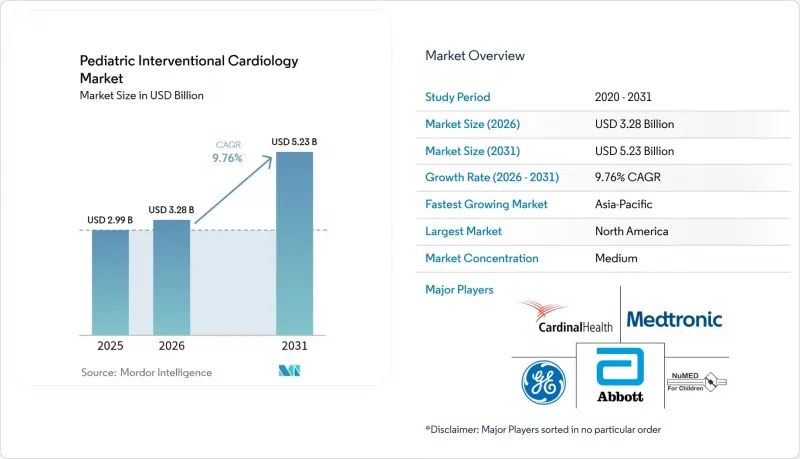
본 보고서에서는 업계를 ‘기기 유형’(폐쇄형 기기 등), ‘시술 유형’(카테터를 이용한 판막 이식술, 선천성 심장병 교정 등), ‘최종 사용자’(소아 병원 및 전문 의료 센터 등),‘지역’(북미, 유럽, 아시아태평양, 중동 및 아프리카, 남미)으로 분류하고 있습니다. 시장 예측은 금액(달러) 기준으로 제시되어 있습니다.
전 세계 소아 중재적 심장학 시장 동향 및 인사이트
선천성 심장병 발생률 증가
신생아 선별 검사 및 보험 데이터베이스에 따르면, 선천성 심장병(CHD)의 유병률은 소아 인구의 2%에 육박하며, 이는 기존의 추정치를 크게 상회하는 수치입니다. 상하이에서 진행된 시범 사업에서 태아 심초음파 검사 및 듀얼 인덱스 맥박 산소 측정 프로그램의 확충을 통해 조기 발견 민감도가 100%에 달했습니다. 조기 진단으로 생존 기간이 연장됨에 따라, 평생 카테터를 이용한 중재적 치료가 지속적으로 필요한 청소년 및 성인 집단이 확대되고 있습니다.
소형화된 중재용 기기의 발전
재료 및 공학의 발전으로 기기의 직경은 불과 1.6mm까지 축소되었습니다. 그 대표적인 예가 메드트로닉사의 4.7프렌치 ‘OmniaSecure ICD 리드’로, 임상시험에서 100%의 제세동 성공률을 보였습니다. 풍선 확장형 ‘Minima 스텐트’는 혈관의 성장에 맞추어 신축하며, 심각한 유해 사건 없이 97.6%의 시술 성공률을 달성하고 있습니다. 흡수성 금속 스텐트와 8년 경과 시점에서 99.3%의 열화 없는 비율을 보인 ‘RESILIA’ 조직 판막은 재시술 위험을 최소화하는 것을 목표로 합니다. 이러한 기술은 기존부터 지적되어 온 소아용 의료기기 부족이라는 과제를 직접적으로 해결하는 것입니다.
고액의 치료비 및 의료기기 비용
미국에서 선천성 심장병(CHD) 치료에 드는 병원 지출은 연간 98억 달러를 초과합니다. CHD를 앓는 여성의 임신 비용은 1건당 평균 2만 4,290달러로, 일반적인 산과 의료에 비해 큰 부담이 되고 있습니다. CMS(미국 의료보험의료서비스센터)는 2025년 CT 혈관조영술의 지급액을 178.02달러에서 357.13달러로 인상했으나, 신흥국에서의 본인 부담금은 여전히 높아 도입 확산을 저해하고 있습니다.
부문 분석
폐쇄 장치는 심방 중격 결손 및 심실 중격 결손의 폐쇄에 폭넓게 사용될 수 있기 때문에 2025년에는 소아 중재 심장학 시장의 31.78%를 차지했습니다. 이 장치의 사용은 소아 중재 심장학 시장의 거래량 상당 부분을 차지하고 있으며, 이식 성공률 100%를 기록한 ‘Occlutech Atrial Flow Regulator’와 같은 제품에 힘입어 성장하고 있습니다. 풍선 카테터는 좁은 병변 부위를 통과하여 보다 신속한 감압이 가능한 1.2mm 프로파일로 계속 진화하고 있는 반면, 차세대 아테렉토미 기구는 혈관 손상을 최소화하면서 석회화를 제거합니다.
경카테터 심장 판막은 연평균 성장률(CAGR) 13.75%로 성장하고 있으며, 가장 빠르게 성장하는 부문입니다. 에드워즈(Edwards)사의 ‘EVOQUE’ 삼첨판이나 애보트(Abbott)사의 ‘Tendyne’ 시스템과 같은 기기는 현재 개흉 수술 없이도 역류나 석회화를 치료할 수 있게 되어, 판막 치료 솔루션 분야의 소아 중재 심장학 시장 규모를 두 자릿수 성장률로 확대되고 있습니다. 흡수성 금속 스텐트는 아동의 성장에 따른 향후 재시술을 방지하는 것을 목적으로 하며, AI와 MRI 가이드를 통합한 영상 진단 콘솔은 적격 사례에서 방사선 피폭을 제로로 억제하고 있습니다. 이러한 발전들이 결합되면서 새로운 병원 및 외래 진료 센터들이 복잡한 구조적 심장 질환 프로그램에 진출하고 있습니다.
지역별 분석
북미는 2025년 매출의 41.20%를 차지하고 있으며, 이는 소아용 의료기기 승인에서 FDA가 주도적인 역할을 하고, 성숙한 보험 환급 제도, 그리고 선천성 심장병 프로그램에 대한 막대한 자선 기금이 있기 때문입니다. 민간 보험사들이 AI 유도 시술을 수용하고, ‘획기적인 의료기기(Breakthrough Device)’ 지정과 같은 규제 절차가 승인 기간을 단축함에 따라, 이 지역의 소아 중재 심장학 시장 규모는 꾸준히 확대되고 있습니다. 캐나다는 복잡한 증상을 보이는 신생아를 3차 의료 기관으로 이송하는 의뢰 네트워크를 통해 미국의 의료 체계를 보완하고 있습니다. 한편, 멕시코는 시술 비용이 저렴하여 국경을 넘어 환자들이 유입되고 있습니다.
유럽은 일관된 공적 의료 제도와 독일, 프랑스, 영국에 집중된 외과적 전문 지식 덕분에 큰 시장 점유율을 차지하고 있습니다. 소형화된 심장 판막의 조기 도입과 신생아를 대상으로 한 맥박 산소 포화도 측정을 통한 정기 검진이 EU 회원국 전반에서 소아 중재 심장학 시장을 견인하고 있습니다. 공동 임상 레지스트리는 실제 임상 데이터 생성을 가속화하여 제조업체가 시판 후 승인을 획득할 수 있도록 지원하고 있습니다.
아시아태평양은 연평균 성장률(CAGR) 12.31%로 가장 빠르게 성장하고 있습니다. 중국의 신생아 선별 검사 프로그램은 중증 선천성 심장병(CHD)에 대해 100%의 민감도를 달성하여 수술 건수를 증가시키고 있습니다. 한편, 일본은 경카테터 폐동맥판막 교체술 분야를 선도하고 있습니다. 인도의 심장 센터는 비용 문제에 직면해 있지만, 저가 폐쇄 장치의 국내 생산에 힘입어 소아 카테터 검사실의 사례 수는 매년 두 배로 증가하고 있습니다. 인도네시아, 베트남, 태국에서 정부가 보험 적용 범위를 확대함에 따라 치료 수요가 증가하고 있습니다.
중동 및 아프리카 및 남미는 뒤처져 있지만 성장세를 보이고 있습니다. 걸프 국가들은 전문 병원에 막대한 투자를 하고 있으며, 남아프리카공화국의 전담 소아 심장병 치료팀은 지역 내 의뢰 거점으로서의 역할을 수행하고 있습니다. 브라질과 아르헨티나에서는 민관 협력 보험 모델에 따라 소아 카테터실 접근성이 확대되고 있으나, 통화 변동으로 인해 당분간 확대 속도는 둔화되고 있습니다. 신흥 지역 전반에 걸쳐 휴대용 심초음파 검사 장치와 원격 진료 플랫폼을 통해 전문의의 지식이 외딴 지역의 진료소에도 제공되고 있습니다.
기타 혜택:
- 엑셀 형식 시장 예측(ME) 시트
- 3개월간의 애널리스트 지원
자주 묻는 질문
목차
제1장 서론
제2장 조사 방법
제3장 주요 요약
제4장 시장 구도
제5장 시장 규모와 성장 예측
제6장 경쟁 구도
제7장 시장 기회와 향후 전망
LSH 26.09.10According to Mordor Intelligence, the pediatric interventional cardiology market size is expected to grow from USD 2.99 billion in 2025 to USD 3.28 billion in 2026 and is forecast to reach USD 5.23 billion by 2031 at 9.76% CAGR over 2026-2031.
This report Segments the Industry Into Device Type (Closure Devices, and More), Procedure (Catheter-Based Valve Implantation, Congenital Heart Defect Correction, and More), End User (Children's Hospitals & Specialty Centres, and More), and Geography (North America, Europe, Asia-Pacific, Middle East and Africa, South America). The Market Forecasts are Provided in Terms of Value (USD).
Global Pediatric Interventional Cardiology Market Trends and Insights
Rising Incidence of Congenital Heart Diseases
Newborn screening and insurance databases show CHD prevalence nearing 2% of pediatric populations, far higher than historic estimates. Enhanced prenatal echocardiography and dual-index pulse-oximetry programs have lifted early-detection sensitivity to 100% in Shanghai pilots. Earlier diagnosis extends survival, creating larger cohorts of adolescents and adults who continue to require catheter-based interventions across their lifespans.
Advancements in Miniaturized Interventional Devices
Advances in materials and engineering have cut device diameters to as little as 1.6 mm, exemplified by Medtronic's 4.7 French OmniaSecure ICD lead, which demonstrated 100% defibrillation success in trials. The balloon-expandable Minima Stent adapts to vessel growth, achieving 97.6% procedural success without major adverse events. Absorbable metal stents and RESILIA tissue valves, which showed 99.3% freedom from deterioration at eight years, aim to minimize re-intervention risk. Such technology directly targets historic shortages of child-sized hardware.
High Cost of Procedures and Devices
Hospital expenditures for CHD care surpass USD 9.8 billion annually in the United States. Pregnancy costs for women with CHD average USD 24,290 per case, a material burden versus routine obstetrics. Although CMS boosted 2025 CT angiography payments from USD 178.02 to USD 357.13, out-of-pocket exposure in emerging economies remains high, slowing adoption.
Other drivers and restraints analyzed in the detailed report include:
- Expanding R&D Pipeline for Pediatric-Specific Implants
- Regulatory Incentives and Support Programs
- Shortage of Trained Pediatric Interventional Cardiologists
For complete list of drivers and restraints, kindly check the Table Of Contents.
Segment Analysis
Closure devices captured 31.78% of pediatric interventional cardiology market share in 2025 thanks to their versatility in sealing atrial and ventricular septal defects. Their usage underpins a sizeable slice of pediatric interventional cardiology market volume, buoyed by products such as the Occlutech Atrial Flow Regulator, which posted 100% implant success. Balloon catheters keep evolving toward 1.2 mm profiles that cross tight lesions with faster deflation, while next-generation atherectomy tools remove calcium with minimal vessel trauma.
Transcatheter heart valves represent the fastest-growing segment, climbing at a 13.75% CAGR. Devices including Edwards' EVOQUE tricuspid valve and Abbott's Tendyne system now address regurgitation and calcification without sternotomy, expanding the pediatric interventional cardiology market size for valve solutions by double digits. Absorbable metal stents aim to obviate future re-interventions as children grow, and imaging consoles integrating AI and MRI guidance are cutting radiation exposure to zero for eligible cases. Collectively, these advances draw new hospitals and ambulatory centers into complex structural heart programs.
Complete Report Scope:
- By Device Type
- Closure Devices
- Transcatheter Heart Valves
- Atherectomy Devices
- Catheters
- Balloons
- Stents
- Imaging & Guidance Systems
- Other Device Types
- By Procedure
- Catheter-Based Valve Implantation
- Congenital Heart Defect Correction
- Angioplasty
- Coronary Thrombectomy
- Hybrid Surgery-Assisted Interventions
- Other Procedures
- By End User
- Paediatric Catheterisation Laboratories
- Children's Hospitals & Specialty Centres
- Ambulatory Surgical Centres
- Research & Academic Institutes
- By Geography
- North America
- United States
- Canada
- Mexico
- Europe
- Germany
- United Kingdom
- France
- Italy
- Spain
- Rest of Europe
- Asia-Pacific
- China
- Japan
- India
- Australia
- South Korea
- Rest of Asia-Pacific
- Middle East & Africa
- GCC
- South Africa
- Rest of Middle East & Africa
- South America
- Brazil
- Argentina
- Rest of South America
- North America
Geography Analysis
North America accounted for 41.20% of 2025 revenue, propelled by FDA leadership in clearing pediatric devices, mature reimbursement, and substantial philanthropic funding for congenital programs. The pediatric interventional cardiology market size in the region expands steadily as private insurers accept AI-guided procedures and as regulatory pathways such as Breakthrough Device Designation trim approval times. Canada complements U.S. capacity through referral networks that funnel complex neonates to tertiary centers, while Mexico draws cross-border patients with lower procedural tariffs.
Europe commands a sizeable share due to cohesive public healthcare and concentrated surgical expertise in Germany, France, and the United Kingdom. Early adoption of miniaturized heart valves and routine newborn pulse-oximetry screening boost the pediatric interventional cardiology market across EU member states. Joint clinical registries accelerate real-world data generation, helping manufacturers secure post-market authorizations.
Asia-Pacific is the fastest grower at 12.31% CAGR. China's newborn screening programs have achieved 100% sensitivity for critical CHDs and lifted operative volumes, while Japan leads in transcatheter pulmonary valve replacements. Indian cardiac centers face cost constraints yet double pediatric cath-lab cases annually, supported by domestic production of lower-price closure devices. Government insurance expansions in Indonesia, Vietnam, and Thailand are unlocking procedure demand.
Middle East & Africa and South America trail but show momentum. Gulf nations invest heavily in specialty hospitals, and South Africa's dedicated pediatric cardiac units serve as regional referral hubs. Brazil and Argentina widen pediatric cath-lab access under public-private insurance models, though currency volatility tempers immediate scale. Across emerging regions, portable echocardiography and tele-consult platforms extend specialist expertise to remote clinics.
- Abbott Laboratories
- Medtronic
- Boston Scientific
- Edward Lifesciences
- GE Healthcare
- Siemens Healthineers
- BIOTRONIK
- NuMed
- W. L. Gore & Associates
- Canon
- Cardinal Health
- Cordis
- Terumo
- Merit Medical Systems
- Lepu Medical
- Balton
- MicroPort
- Lifetech Scientific
- Occlutech
- AngioDynamics
Additional Benefits:
- The market estimate (ME) sheet in Excel format
- 3 months of analyst support
TABLE OF CONTENTS
1 Introduction
- 1.1 Study Assumptions & Market Definition
- 1.2 Scope of the Study
2 Research Methodology
3 Executive Summary
4 Market Landscape
- 4.1 Market Overview
- 4.2 Market Drivers
- 4.2.1 Rising Incidence of Congenital Heart Diseases (CHDs)
- 4.2.2 Advancements in Miniaturized Interventional Devices
- 4.2.3 Expanding R&D Pipeline for Pediatric-Specific Implants
- 4.2.4 Regulatory Incentives and Support Programs
- 4.2.5 Venture Capital Investment in Pediatric Med-Tech Startups
- 4.2.6 Integration of AI in Cath-Lab Imaging
- 4.3 Market Restraints
- 4.3.1 High Cost of Procedures and Devices
- 4.3.2 Reimbursement Challenges in Emerging Markets
- 4.3.3 Limited Availability of Pediatric-Sized Components
- 4.3.4 Shortage of Trained Pediatric Interventional Cardiologists
- 4.4 Porter's Five Forces Analysis
- 4.4.1 Threat of New Entrants
- 4.4.2 Bargaining Power of Buyers
- 4.4.3 Bargaining Power of Suppliers
- 4.4.4 Threat of Substitute Products
- 4.4.5 Intensity of Competitive Rivalry
5 Market Size & Growth Forecasts (Value in USD)
- 5.1 By Device Type
- 5.1.1 Closure Devices
- 5.1.2 Transcatheter Heart Valves
- 5.1.3 Atherectomy Devices
- 5.1.4 Catheters
- 5.1.5 Balloons
- 5.1.6 Stents
- 5.1.7 Imaging & Guidance Systems
- 5.1.8 Other Device Types
- 5.2 By Procedure
- 5.2.1 Catheter-Based Valve Implantation
- 5.2.2 Congenital Heart Defect Correction
- 5.2.3 Angioplasty
- 5.2.4 Coronary Thrombectomy
- 5.2.5 Hybrid Surgery-Assisted Interventions
- 5.2.6 Other Procedures
- 5.3 By End User
- 5.3.1 Paediatric Catheterisation Laboratories
- 5.3.2 Children's Hospitals & Specialty Centres
- 5.3.3 Ambulatory Surgical Centres
- 5.3.4 Research & Academic Institutes
- 5.4 By Geography
- 5.4.1 North America
- 5.4.1.1 United States
- 5.4.1.2 Canada
- 5.4.1.3 Mexico
- 5.4.2 Europe
- 5.4.2.1 Germany
- 5.4.2.2 United Kingdom
- 5.4.2.3 France
- 5.4.2.4 Italy
- 5.4.2.5 Spain
- 5.4.2.6 Rest of Europe
- 5.4.3 Asia-Pacific
- 5.4.3.1 China
- 5.4.3.2 Japan
- 5.4.3.3 India
- 5.4.3.4 Australia
- 5.4.3.5 South Korea
- 5.4.3.6 Rest of Asia-Pacific
- 5.4.4 Middle East & Africa
- 5.4.4.1 GCC
- 5.4.4.2 South Africa
- 5.4.4.3 Rest of Middle East & Africa
- 5.4.5 South America
- 5.4.5.1 Brazil
- 5.4.5.2 Argentina
- 5.4.5.3 Rest of South America
- 5.4.1 North America
6 Competitive Landscape
- 6.1 Market Concentration
- 6.2 Market Share Analysis
- 6.3 Company Profiles (includes Global level Overview, Market level overview, Core Segments, Financials as available, Strategic Information, Market Rank/Share for key companies, Products & Services, and Recent Developments)
- 6.3.1 Abbott
- 6.3.2 Medtronic
- 6.3.3 Boston Scientific Corporation
- 6.3.4 Edwards Lifesciences Corporation
- 6.3.5 GE Healthcare
- 6.3.6 Siemens Healthineers
- 6.3.7 BIOTRONIK
- 6.3.8 NuMED Inc.
- 6.3.9 W. L. Gore & Associates, Inc.
- 6.3.10 Canon Medical Systems Corporation
- 6.3.11 Cardinal Health
- 6.3.12 Cordis
- 6.3.13 Terumo Corporation
- 6.3.14 Merit Medical Systems
- 6.3.15 Lepu Medical
- 6.3.16 Balton
- 6.3.17 MicroPort Scientific
- 6.3.18 Lifetech Scientific
- 6.3.19 Occlutech
- 6.3.20 AngioDynamics
7 Market Opportunities & Future Outlook
- 7.1 White-space & Unmet-Need Assessment


