

|
시장보고서
상품코드
2099482
개인화 서비스 시장 : 점유율 분석, 업계 동향 및 통계, 성장 예측(2026-2031년)Personalization Services - Market Share Analysis, Industry Trends & Statistics, Growth Forecasts (2026 - 2031) |
||||||
 Mordor Intelligence
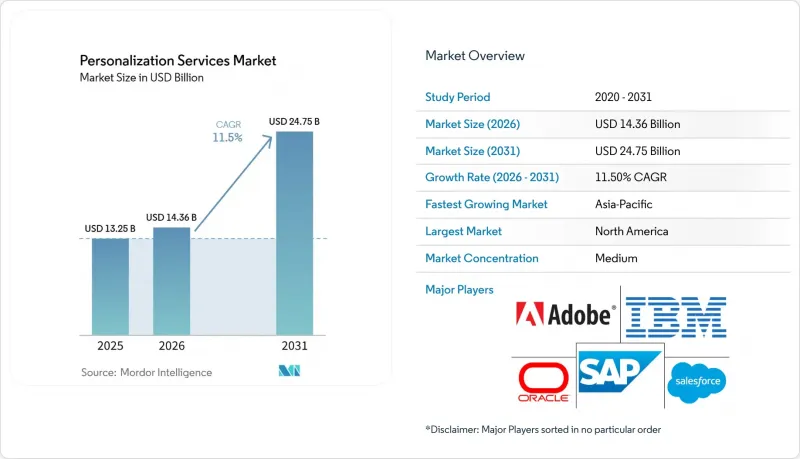
Mordor Intelligence에 의하면, 개인화 서비스 시장 규모는 2025년 132억 5,000만 달러, 2026년 143억 6,000만 달러에서 2031년까지 247억 5,000만 달러로 확대한다고 예측되고 있어 2026년부터 2031년까지 연평균 복합 성장률(CAGR)은 11.50%를 나타낼 전망입니다.
본 보고서는 서비스 유형(개인화 전략 및 컨설팅 등), 도입 형태(클라우드 기반, On-Premise형, 하이브리드형), 기술(웹 개인화 플랫폼 등), 기업 규모(대기업, 중소기업), 최종 사용자 산업(소매 및 전자상거래, BFSI 등) 및 지역별로 분류되어 있습니다. 시장 전망은 금액(달러) 기준으로 제시되어 있습니다.
세계 개인화 서비스 시장 동향 및 인사이트
실시간 고객 경험 오케스트레이션에 대한 수요 증가
개인화 서비스 시장에서 실시간 오케스트레이션은 기업 고객 전략의 중심에 점점 더 가까워지고 있습니다. 기업들은 현재 고정된 캠페인 주기를 기다리기보다는 고객의 행동에 실시간으로 반응할 수 있는 시스템을 원하고 있습니다. 어도비(Adobe)는 2026년 4월 ‘CX Enterprise’를 발표했으며, 이번 출시에서는 오디언스 구축, 컨텐츠 결정, 고객 여정 실행에 걸친 에이전트형 AI가 핵심이 되었습니다. 또한 Amperity사도 2026년 5월에 실시간 사이트 개인화 및 장바구니 포기 방지 도구를 발표했습니다. 이를 통해 즉각적인 인식과 트리거를 통한 복구 여정이 운영 측면에서도 더욱 활용하기 쉬워졌음이 입증되었습니다. 많은 기업에서 여전히 마케팅, 커머스, 서비스 시스템이 연동되지 않은 채 운영되고 있기 때문에 이러한 변화는 통합 및 컨설팅 지원에 대한 수요를 부추기고 있습니다. 또한, 고객 여정 전반에 걸쳐 데이터 수집부터 실행에 이르는 프로세스를 단축할 수 있는 벤더의 우위도 더욱 확대되고 있습니다.
AI 주도형 추천 및 의사결정 엔진의 확산
AI 주도형 추천 도구는 구매자가 전환 및 관련성 목표와 직접 연결할 수 있기 때문에 개인화 서비스 시장에서 가장 확실한 성장 동력 중 하나가 되고 있습니다. 시장은 규칙 기반의 추천 로직에서 행동, 거래, 맥락 신호를 종합적으로 해석할 수 있는 모델로 전환되고 있습니다. Databricks는 2026년, 자사의 레이크하우스 환경 내에서 에이전트형 CDP인 'CustomerLake'를 도입했습니다. 이번 출시를 통해 자율적인 캠페인 분석과 오디언스 활성화가 표준 도입 방식에 가까워지고 있음을 보여줍니다. 또한, Salesforce는 2026년 3월 Cimulate 인수를 완료하며, 자사의 광범위한 플랫폼 스택에 AI 기반 상품 발견 기능과 에이전트형 커머스 기능을 추가했습니다. 이러한 움직임으로 인해 상품 발견, 추천 로직, 실행 간의 격차가 점차 좁혀지고 있습니다. 또한, 기업은 초기 도입 후에도 지속적인 조정이 필요하기 때문에 관리형 지원에 대한 수요도 증가하고 있습니다.
데이터 품질 저하로 인한 개인화 성능 저하
낮은 데이터 품질은 개인화 서비스 시장에서 여전히 가장 명백한 운영상의 제약 요소 중 하나입니다. 2025년 보고서에 따르면, 90%의 조직이 CRM 데이터를 업무의 핵심으로 인식하고 있음에도 불구하고, 76%의 조직에서 CRM 데이터의 정확성과 완전성이 절반 이하에 그치는 것으로 나타났습니다. 이러한 격차는 심각한 문제입니다. 불충분한 기록은 추천의 정확도를 떨어뜨릴 뿐만 아니라 고객 경험을 악화시키며, 일단 출시되면 수정하기 어렵기 때문입니다. 많은 기업에서는 여전히 CRM, 커머스, 로열티, 마케팅 자동화, POS, 모바일 시스템 등 다양한 시스템에 걸쳐 고객 정보를 관리하고 있으며, 이러한 시스템 간의 연동에 미비한 점이 있을 때마다 고객 식별이나 메시징 오류의 위험이 높아집니다. 이 때문에 보다 광범위한 개인화 목표를 달성하기 전에 데이터 클렌징, ID 해결, 고객 데이터 플랫폼(CDP) 서비스에 대한 수요는 계속해서 높은 수준을 유지하고 있습니다. 또한, 구매자가 핵심 고객 데이터 기반을 구축하기 전에 시장에 진입한 벤더의 경우, 투자 회수가 지연되는 요인이 되기도 합니다.
부문 분석
2025년에는 도입 및 시스템 통합이 28.41%의 점유율을 차지하고, 이는 개인화 도구를 CRM, CDP, 커머스 및 실행 시스템과 연동하는 데 필요한 작업량을 반영한 것입니다. 개인화 서비스 시장에서 구매자들은 여전히 구매한 플랫폼과 기대하는 성과 사이에 큰 운영상의 격차를 겪고 있습니다. 이것이 기술 자체에 대한 접근성이 높아졌음에도 불구하고, 도입 관련 수익이 계속 집중되고 있는 이유입니다. 전략, 설계, 지원 및 교육 서비스가 계속해서 중요시되는 이유는 기업이 채널 전반에 걸쳐 개인화된 참여를 전개하기 위해서는 소프트웨어 라이선스 이상의 것이 필요하기 때문입니다. AI 기반 개인화 플랫폼은 2031년까지 연평균 성장률(CAGR) 14.82%를 나타낼 것으로 예측되며, 이러한 성장세는 자동화가 서비스 제공의 핵심이 됨에 따라 향후 서비스 수요가 어떤 방향으로 나아갈지를 보여줍니다.
이 부문에서 다가올 변화는 서비스의 폐지가 아니라, 도입 후 어떤 서비스가 가장 중요해질지에 대한 변화입니다. 많은 구매 기업에는 AI 주도 의사결정 시스템을 장기적으로 관리할 수 있는 사내 팀이 여전히 부족하기 때문에 교육 및 역량 강화의 중요성이 커지고 있습니다. 2026년 OECD 조사 결과에 따르면, AI 통합은 조직 규모에 따라 여전히 불균형하며, 시간적 제약과 기술 격차가 여전히 주요 장벽으로 남아 있습니다. 이러한 압박으로 인해 자문 및 관리형 제공 서비스에 대한 수요가 증가하고 있습니다. 이는 기업들이 도입 후에도 성능의 지속성을 원하기 때문입니다. 따라서 매니지드 개인화 지원은 독립적인 옵션의 계층이라기보다는 도입의 실질적인 연장선으로 자리매김하고 있습니다. 개인화 서비스 업계의 이 분야에서 시스템 통합과 도입 후 운영 지원을 결합할 수 있는 벤더는 고객과 더욱 견고한 관계를 구축할 수 있을 것입니다.
2025년에는 클라우드 기반 도입이 전체의 71.26%를 차지하며, 개인화 서비스 시장의 대부분의 프로그램에 있어 명확한 운영 기반이 되었습니다. 구매자들은 프로비저닝 시간을 단축하고 방대한 양의 고객 신호를 유연하게 처리할 수 있다는 점 때문에 계속해서 클라우드 환경을 선호하고 있습니다. 이러한 이점은 추천 로직, 고객 여정 자동화, 그리고 멀티채널 실행 워크로드에서 여전히 중요합니다. 동시에 시장은 On-Premise에서 클라우드로의 단순한 일방통행 경로를 따르고 있는 것은 아닙니다. 하이브리드 배포는 2031년까지 연평균 성장률(CAGR) 13.69%를 나타낼 것으로 예측되며, 이는 규정 준수, 데이터 소재지, 시스템 관리 문제가 도입의 다음 단계를 형성하고 있음을 보여줍니다.
하이브리드 배포의 확대가 의미하는 바는 일부 구매자들이 기밀 데이터에 대한 로컬 관리 권한을 포기하지 않으면서도 클라우드 수준의 속도를 추구하고 있다는 것입니다. 이는 법적 또는 운영상의 이유로 완전한 클라우드 전환이 여전히 어려운 규제 산업에서 특히 두드러지게 나타납니다. Braze는 2026년 4월, 이러한 추세에 대응하여 AI 의사 결정 환경을 위해 유럽연합(EU) 내에 호스팅된 인프라를 추가함으로써 자사의 서비스를 데이터 거주 요건에 더욱 밀접하게 부합하도록 했습니다. 많은 기업에게 하이브리드 아키텍처는 일시적인 전환 단계가 아니라 안정적인 장기 모델로 자리 잡고 있습니다. 이에 따라 클라우드 네이티브 환경과 관리형 On-Premise 환경을 모두 아우르는 도입 계획, 아키텍처 설계 및 통합 서비스에 대한 수요가 뒷받침되고 있습니다. 또한, 이로 인해 개인화 서비스 시장은 규정 준수를 고려한 인프라 구축과 밀접하게 연계된 상태를 유지하고 있습니다.
지역별 분석
북미는 2025년에 34.72%의 점유율을 차지하며, 개인화 서비스 시장에서 가장 규모가 큰 지역 블록을 형성하고 있습니다. 이 지역은 성숙한 클라우드 인프라, 기업용 소프트웨어의 광범위한 도입, 그리고 주요 고객 경험 및 마케팅 기술 벤더가 집중되어 있다는 이점을 가지고 있습니다. 이 지위의 대부분은 미국이 차지하고 있으며, 이는 대규모 기업 고객과 개인화 서비스 기능을 지속적으로 확장하고 있는 벤더가 공존하고 있기 때문입니다. 캐나다와 멕시코는 금융 서비스 및 소매 업계에서의 활용 사례가 도입을 촉진하고 있어 이 지역 시장의 깊이를 더하고 있습니다. 북미 개인화 서비스 시장 점유율은 벤더의 제품 개발과 기업 내 도입 사이의 피드백 루프가 짧다는 점을 반영하고 있으며, 이를 통해 프로젝트를 조달 단계에서 실행 단계로 더 신속하게 진행할 수 있게 되었습니다.
유럽은 여전히 주요 수요 거점이지만, 사업 환경은 개인정보 보호 및 거버넌스 요건에 의해 점점 더 형성되고 있습니다. GDPR(EU 개인정보보호규정) 및 관련 투명성 기대에 따라 기업들은 다른 많은 지역보다 더 견고한 동의 및 문서화 기반 위에 개인화 시스템을 구축해야 하는 압박을 받고 있습니다. 독일, 영국, 프랑스는 특히 금융 서비스, 자동차, 전자상거래 분야에서 계속해서 지역 수요를 주도하고 있습니다. 남미는 여전히 성장 주기의 초기 단계에 있으며, 브라질과 아르헨티나가 도입을 주도하고 있는 반면, 개인정보 보호 규제가 데이터 인프라 결정에 계속해서 영향을 미치고 있습니다.
아시아태평양은 2031년까지 연평균 성장률(CAGR) 14.21%로 확대될 것으로 예측되며, 개인화 서비스 시장에서 가장 빠르게 성장하는 지역이 될 전망입니다. 모바일 우선의 디지털 행동, 대규모 온라인 상거래 생태계, 그리고 AI를 활용한 운영 모델의 기업 내 활용 확대가 이러한 성장을 뒷받침하고 있습니다. 인도는 전자상거래 및 헬스케어 활용 사례에서 큰 기회를 지닌 시장으로 부상하고 있는 반면, 중국과 동남아시아에서는 그 규모와 깊은 디지털 참여도를 통해 플랫폼의 광범위한 도입이 지속적으로 뒷받침되고 있습니다. 중동 및 아프리카는 여전히 초기 단계에 있지만, 사우디아라비아와 아랍에미리트(UAE)의 국가적 디지털 전환 노력이 미래의 개인화 수요를 위한 견고한 기반 구축에 기여하고 있습니다.
기타 혜택:
- 엑셀 형식 시장 예측(ME) 시트
- 3개월간의 애널리스트 지원
자주 묻는 질문
목차
제1장 서론
제2장 조사 방법
제3장 주요 요약
제4장 시장 구도
제5장 시장 규모와 성장 예측
제6장 경쟁 구도
제7장 시장 기회와 향후 전망
JHS 26.08.05According to Mordor Intelligence, the personalization services market size is projected to expand from USD 13.25 billion in 2025 and USD 14.36 billion in 2026 to USD 24.75 billion by 2031, registering a CAGR of 11.50% between 2026 and 2031.
This report is Segmented by Service Type (Personalization Strategy and Consulting, and More), Deployment (Cloud-Based, On-Premise, and Hybrid), Technology (Web Personalization Platforms, and More), Enterprise Size (Large Enterprises, and Small and Medium Enterprises), End-User Industry (Retail and E-Commerce, BFSI, and More), and Geography. The Market Forecasts are Provided in Terms of Value (USD).
Global Personalization Services Market Trends and Insights
Rising Demand for Real-Time Customer Experience Orchestration
Real-time orchestration has moved closer to the center of enterprise customer strategy in the Personalization Services Market. Enterprises now want systems that can react to customer behavior in real time, rather than waiting for fixed campaign cycles. Adobe introduced CX Enterprise in April 2026, and the launch centered on agentic AI across audience assembly, content decisions, and journey execution. Amperity also introduced real-time site personalization and cart abandonment tools in May 2026, which showed that instant recognition and triggered recovery journeys are becoming more operationally accessible. This shift is driving demand for integration and consulting support, as many enterprises still run disconnected marketing, commerce, and service systems. It is also widening the advantage for vendors that can shorten the path from data capture to action across the full customer journey.
Wider Adoption of AI-Led Recommendation and Decision Engines
AI-led recommendation tools are one of the clearest growth engines in the Personalization Services Market because buyers can connect them directly to conversion and relevance goals. The market is moving away from rule-based recommendation logic and toward models that can interpret behavioral, transactional, and contextual signals together. Databricks introduced CustomerLake in 2026 as an agentic CDP within its lakehouse environment, and the launch showed how autonomous campaign analysis and audience activation are moving closer to standard deployment practice. Salesforce also completed the Cimulate acquisition in March 2026, which added AI-powered product discovery and agentic commerce capability to its broader platform stack. These developments are reducing the distance between product discovery, recommendation logic, and execution. They are also increasing demand for managed support because enterprises need continuous tuning after the initial rollout.
Weak Personalization Performance Caused by Poor Data Quality
Poor data quality remains one of the clearest operational limits on the Personalization Services Market. In 2025, a report found that 76% of organizations had less than half of their CRM data accurate and complete, even though 90% recognized CRM data as central to operations. That gap matters because weak records not only reduce recommendation precision but also create poor customer experiences that are harder to correct after launch. Many enterprises still manage customer information across CRM, commerce, loyalty, marketing automation, point-of-sale, and mobile systems, and every break in that chain raises the risk of identity and messaging errors. This keeps demand high for data cleaning, identity resolution, and customer data platform services before broader personalization goals can be met. It also slows returns for vendors that enter the account before the buyer has fixed its core customer data foundation.
Other drivers and restraints analyzed in the detailed report include:
- Expansion of First-Party Data Activation Across Digital Touchpoints
- Need for Higher Conversion Rates Across E-Commerce and Retail Funnels
- Enterprise Concerns Over Consent Management and Data Governance
For complete list of drivers and restraints, kindly check the Table Of Contents.
Segment Analysis
Implementation and system integration held 28.41% share in 2025, and that position reflects the amount of work required to connect personalization tools with CRM, CDP, commerce, and execution systems. In the Personalization Services Market, buyers still face large operational gaps between the platform they purchase and the outcomes they expect. This is why implementation revenue remains concentrated even as the technology itself becomes easier to access. Strategy, design, support, and training services continue to matter because enterprises need more than software licenses to run personalized engagement across channels. AI-driven personalization platforms are projected to grow at a 14.82% CAGR through 2031, and that pace shows where future service demand is moving as automation becomes more central to delivery.
The next shift in this segment is not the removal of services, but the change in which services matter most after launch. Training and enablement are gaining relevance because many buyers still lack in-house teams that can manage AI-led decision systems over time. OECD findings in 2026 showed that AI integration remained uneven across organizations of different sizes, with time constraints and skill gaps still the main barriers. That same pressure supports advisory and managed delivery work because enterprises want performance continuity after implementation. Managed personalization support is therefore becoming a practical extension of deployment rather than a separate optional layer. In this part of the Personalization Services industry, vendors that can combine system integration with post-launch operating support are likely to hold stronger client relationships.
Cloud-based deployment accounted for 71.26% of the mix in 2025, which made it the clear operating base for most programs in the Personalization Services Market. Buyers continue to prefer cloud environments because they reduce provisioning time and support elastic processing for high-volume customer signals. That advantage remains important for recommendation logic, journey automation, and multichannel execution workloads. At the same time, the market is not moving along a simple one-way path from on-premises to the cloud. Hybrid deployment is projected to grow at a 13.69% CAGR through 2031, which shows that compliance, residency, and system control issues are shaping the next phase of adoption.
The practical meaning of hybrid growth is that some buyers want cloud-scale speed without giving up local control over sensitive data. This is especially visible in regulated sectors where full cloud migration remains difficult for legal or operational reasons. Braze responded to this pattern in April 2026 by adding European Union-hosted infrastructure for its AI decisioning environment, aligning its offer more closely with data residency requirements. For many enterprises, hybrid architecture is becoming a stable long-term model rather than a temporary transition stage. That supports demand for deployment planning, architecture design, and integration services spanning both cloud-native and controlled local environments. It also keeps the Personalization Services Market tied closely to compliance-aware infrastructure work.
Complete Report Scope:
- By Service Type
- Personalization Strategy and Consulting
- Implementation and System Integration
- Personalization Design and Experience Optimization
- Managed Personalization Services
- Support and Maintenance
- Training and Enablement
- By Deployment
- Cloud-Based
- On-Premise
- Hybrid
- By Technology
- Web Personalization Platforms
- Mobile App Personalization Platforms
- Customer Data Platforms (CDPs)
- Recommendation and Decisioning Engines
- AI-Driven Personalization Platforms
- Omnichannel Personalization Platforms
- By Enterprise Size
- Large Enterprises
- Small And Medium Enterprises
- By End-User Industry
- Retail and E-Commerce
- BFSI
- Healthcare and Life Sciences
- IT and Telecom
- Media and Entertainment
- Industrial Manufacturing
- Government and Public Administration
- Other End-User Industries
- By Geography
- North America
- United States
- Canada
- Mexico
- South America
- Brazil
- Argentina
- Rest of South America
- Europe
- Germany
- United Kingdom
- France
- Italy
- Spain
- Russia
- Rest of Europe
- Asia-Pacific
- China
- India
- Japan
- South Korea
- Australia
- Rest of Asia-Pacific
- Middle East and Africa
- Middle East
- Saudi Arabia
- United Arab Emirates
- Rest of Middle East
- Africa
- South Africa
- Nigeria
- Rest of Africa
- Middle East
- North America
Geography Analysis
North America held a 34.72% share in 2025, making it the largest regional block in the Personalization Services Market. The region benefits from mature cloud infrastructure, deep enterprise software adoption, and a large concentration of major customer experience and marketing technology vendors. The United States accounts for most of this position because it combines large enterprise buyers with vendors that continue to expand their personalization service capabilities. Canada and Mexico add regional depth, with financial services and retail use cases supporting adoption. The North American Personalization Services Market share also reflects shorter feedback loops between vendor product development and enterprise deployment, which helps move projects from procurement to execution more quickly.
Europe remains a major demand center, but the operating environment is increasingly shaped by privacy and governance requirements. GDPR and related transparency expectations push enterprises to build personalization systems on a stronger consent and documentation base than in many other regions. Germany, the United Kingdom, and France continue to lead regional demand, especially across financial services, automotive, and e-commerce. South America is still earlier in its growth cycle, with Brazil and Argentina leading adoption while privacy regulation continues to influence data infrastructure decisions.
Asia-Pacific is projected to expand at a 14.21% CAGR through 2031, making it the fastest-growing geography in the Personalization Services Market. Mobile-first digital behavior, large online commerce ecosystems, and stronger enterprise use of AI-enabled operating models are supporting growth. India is emerging as a high-opportunity market for e-commerce and healthcare use cases, while China and Southeast Asia continue to support broader platform adoption through scale and deep digital engagement. The Middle East and Africa remain at an earlier stage, but national digital transformation efforts in Saudi Arabia and the United Arab Emirates are helping create a stronger foundation for future personalization demand.
- Adobe Inc.
- Salesforce, Inc.
- Oracle Corporation
- SAP SE
- IBM Corporation
- Braze, Inc.
- Bloomreach, Inc.
- Dynamic Yield Ltd.
- Insider
- MoEngage, Inc.
- Iterable, Inc.
- Klaviyo, Inc.
- Acoustic, L.P.
- Optimizely
- Tealium
- Treasure Data, Inc.
- Amperity, Inc.
- Segment.io, Inc.
- Zeta Global
- Kibo Commerce, Inc.
Additional Benefits:
- The market estimate (ME) sheet in Excel format
- 3 months of analyst support
TABLE OF CONTENTS
1 INTRODUCTION
- 1.1 Study Assumptions and Market Definition
- 1.2 Scope of the Study
2 RESEARCH METHODOLOGY
3 EXECUTIVE SUMMARY
4 MARKET LANDSCAPE
- 4.1 Market Overview
- 4.2 Market Drivers
- 4.2.1 Rising Demand for Real-Time Customer Experience Orchestration
- 4.2.2 Expansion of First-Party Data Activation Across Digital Touchpoints
- 4.2.3 Wider Adoption of AI-Led Recommendation And Decision Engines
- 4.2.4 Need for Higher Conversion Rates Across E-Commerce and Retail Funnels
- 4.2.5 Privacy-First Personalization Architecture Upshifts Enterprise Investment
- 4.2.6 Unification of Marketing, Service, and Commerce Data in One Stack
- 4.3 Market Restraints
- 4.3.1 Weak Personalization Performance Caused by Poor Data Quality
- 4.3.2 Enterprise Concerns Over Consent Management and Data Governance
- 4.3.3 High Integration Complexity With Legacy MarTech and CRM Environments
- 4.3.4 Talent Gaps in Personalization Strategy, Model Operations, And Measurement
- 4.4 Impact of Macroeconomic Factors on the Market
- 4.5 Industry Value Chain Analysis
- 4.6 Technology Outlook
- 4.7 Regulatory Landscape
- 4.8 Porter's Five Forces Analysis
- 4.8.1 Threat of New Entrants
- 4.8.2 Bargaining Power of Suppliers
- 4.8.3 Bargaining Power of Buyers
- 4.8.4 Threat of Substitutes
- 4.8.5 Intensity of Competitive Rivalry
5 MARKET SIZE AND GROWTH FORECASTS (VALUE)
- 5.1 By Service Type
- 5.1.1 Personalization Strategy and Consulting
- 5.1.2 Implementation and System Integration
- 5.1.3 Personalization Design and Experience Optimization
- 5.1.4 Managed Personalization Services
- 5.1.5 Support and Maintenance
- 5.1.6 Training and Enablement
- 5.2 By Deployment
- 5.2.1 Cloud-Based
- 5.2.2 On-Premise
- 5.2.3 Hybrid
- 5.3 By Technology
- 5.3.1 Web Personalization Platforms
- 5.3.2 Mobile App Personalization Platforms
- 5.3.3 Customer Data Platforms (CDPs)
- 5.3.4 Recommendation and Decisioning Engines
- 5.3.5 AI-Driven Personalization Platforms
- 5.3.6 Omnichannel Personalization Platforms
- 5.4 By Enterprise Size
- 5.4.1 Large Enterprises
- 5.4.2 Small And Medium Enterprises
- 5.5 By End-User Industry
- 5.5.1 Retail and E-Commerce
- 5.5.2 BFSI
- 5.5.3 Healthcare and Life Sciences
- 5.5.4 IT and Telecom
- 5.5.5 Media and Entertainment
- 5.5.6 Industrial Manufacturing
- 5.5.7 Government and Public Administration
- 5.5.8 Other End-User Industries
- 5.6 By Geography
- 5.6.1 North America
- 5.6.1.1 United States
- 5.6.1.2 Canada
- 5.6.1.3 Mexico
- 5.6.2 South America
- 5.6.2.1 Brazil
- 5.6.2.2 Argentina
- 5.6.2.3 Rest of South America
- 5.6.3 Europe
- 5.6.3.1 Germany
- 5.6.3.2 United Kingdom
- 5.6.3.3 France
- 5.6.3.4 Italy
- 5.6.3.5 Spain
- 5.6.3.6 Russia
- 5.6.3.7 Rest of Europe
- 5.6.4 Asia-Pacific
- 5.6.4.1 China
- 5.6.4.2 India
- 5.6.4.3 Japan
- 5.6.4.4 South Korea
- 5.6.4.5 Australia
- 5.6.4.6 Rest of Asia-Pacific
- 5.6.5 Middle East and Africa
- 5.6.5.1 Middle East
- 5.6.5.1.1 Saudi Arabia
- 5.6.5.1.2 United Arab Emirates
- 5.6.5.1.3 Rest of Middle East
- 5.6.5.2 Africa
- 5.6.5.2.1 South Africa
- 5.6.5.2.2 Nigeria
- 5.6.5.2.3 Rest of Africa
- 5.6.5.1 Middle East
- 5.6.1 North America
6 COMPETITIVE LANDSCAPE
- 6.1 Market Concentration
- 6.2 Strategic Moves
- 6.3 Market Share Analysis
- 6.4 Company Profiles (includes Global Level Overview, Market Level Overview, Core Segments, Financials as available, Strategic Information, Market Rank/Share, Products and Services, Recent Developments)
- 6.4.1 Adobe Inc.
- 6.4.2 Salesforce, Inc.
- 6.4.3 Oracle Corporation
- 6.4.4 SAP SE
- 6.4.5 IBM Corporation
- 6.4.6 Braze, Inc.
- 6.4.7 Bloomreach, Inc.
- 6.4.8 Dynamic Yield Ltd.
- 6.4.9 Insider
- 6.4.10 MoEngage, Inc.
- 6.4.11 Iterable, Inc.
- 6.4.12 Klaviyo, Inc.
- 6.4.13 Acoustic, L.P.
- 6.4.14 Optimizely
- 6.4.15 Tealium
- 6.4.16 Treasure Data, Inc.
- 6.4.17 Amperity, Inc.
- 6.4.18 Segment.io, Inc.
- 6.4.19 Zeta Global
- 6.4.20 Kibo Commerce, Inc.
7 MARKET OPPORTUNITIES AND FUTURE OUTLOOK
- 7.1 White-Space and Unmet-Need Assessment


