

|
시장보고서
상품코드
2123441
IT 서비스 시장 : 점유율 분석, 업계 동향과 통계, 성장 예측(2026-2031년)IT Services - Market Share Analysis, Industry Trends & Statistics, Growth Forecasts (2026 - 2031) |
||||||
 Mordor Intelligence
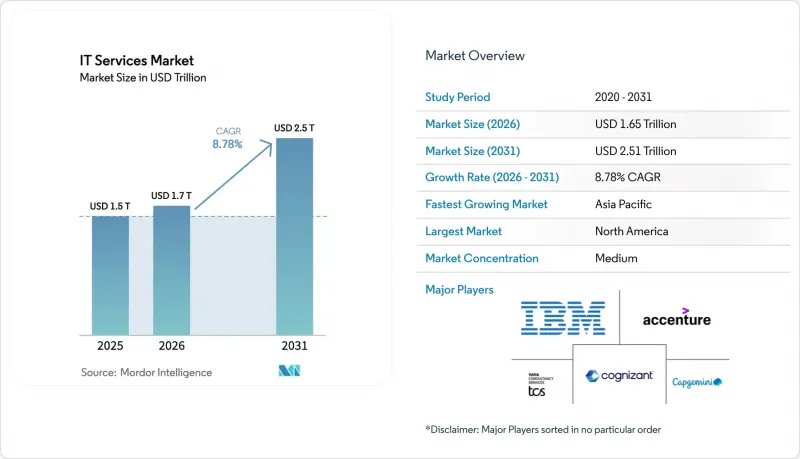
Mordor Intelligence에 의하면, IT 서비스 시장 규모는 2026년에 1조 6,500억 달러로 추정되고 있어 예측 기간(2026-2031년)에서 CAGR 8.78%로 확대되어 2031년에는 2조 5,100억 달러에 이를 전망입니다.
본 보고서는 서비스 유형(IT 컨설팅 및 도입 등), 최종 사용자의 기업 규모(중소기업 등), 도입 모델(온쇼어, 니어쇼어 등), 최종 사용자 산업(은행, 금융서비스 및 보험(BFSI), 제조업 등), 지역(북미, 남미, 유럽, 아시아태평양, 중동 및 아프리카)별로 분류되어 있습니다. 시장 전망은 금액(미화) 기준으로 제시되어 있습니다.
세계 IT 서비스 시장 동향 및 인사이트
코로나19 이후 가속화되는 디지털 전환
멀티 클라우드 도입률은 기업의 87%를 넘어섰으며, 51%의 기업이 용도 리팩토링, AI 서비스, 데이터 플랫폼을 결합한 클라우드 네이티브 현대화 프로젝트에 자금을 투자하고 있습니다. 현재 세계 IT 서비스 시장에서는 단순한 ‘리프트 앤 시프트(lift-and-shift)’ 방식의 마이그레이션보다 컨테이너 오케스트레이션, 마이크로서비스,DevOps에 정통한 제공업체가 높이 평가받고 있습니다. DXC Technology의 ‘Cloud Right’ 접근 방식을 통해 Ocean Network Express는 다운타임 제로 마이그레이션을 실현했으며, 벤더가 인프라 관리자에서 전략적 비즈니스 파트너로 변모하는 모습을 보여주었습니다. 수익원은 고도의 기술적 전문 지식과 업계에 대한 깊은 인사이트력을 모두 필요로 하는 자문 및 관리형 클라우드 운영 부문으로 이동하고 있습니다. 일반적으로 공유된 서비스 수준 성과를 기반으로 구축되는 이러한 계약은 공급업체에 대한 고객의 충성도 및 단위당 수익성을 높입니다. Kubernetes, 사이트 신뢰성 엔지니어링(SRE), FinOps 분야의 기술 인력 부족은 서비스 요금을 더욱 상승시키고 있으며, 이는 ‘클라우드 퍼스트’ 프로그램이 장기적인 성장에 가장 큰 긍정적 영향을 미치는 이유를 여실히 보여줍니다.
하이브리드 클라우드 전환 붐
기업들이 워크로드의 이식성과 규제 준수를 추구하는 가운데, 전 세계 클라우드 ERP 지출은 2022년부터 2027년 사이에 거의 두 배로 증가할 전망입니다. 유럽 기업들은 2025년에 4,898억 유로(5,535억 달러)를 IT 서비스에 투자할 예정이며, 이 중 45%는 클라우드 이니셔티브에 할당되었습니다. 멀티클라우드 전략은 조직이 벤더 종속을 피하는 데 도움이 되지만, 거버넌스의 복잡성을 초래하여 결과적으로 자문 및 최적화 서비스에 대한 수요가 증가하고 있습니다. 데이터 주권에 관한 규제로 인해 지역별 호스팅 거점의 필요성이 높아지고 있으며, 니어쇼어 및 온쇼어에서의 노력이 확대되고 있습니다. 인증된 클라우드 아키텍트 및 매니지드 FinOps 인력을 제공하는 업체들은 IT 서비스 시장 전반에서 고수익 계약을 확보하고 있습니다.
서비스 가격의 상품화 압력
자동화와 오프쇼어 확대에 따라 일반적인 헬프데스크나 인프라 관련 업무의 진입 장벽이 제거되면서, 기존 아웃소싱의 이익률이 압박받고 있습니다. 고객은 성과 기반의 과금을 점점 더 요구하고 있으며, 벤더에게는 구체적인 비즈니스 효과를 입증할 것이 요구되고 있습니다. 소규모 경쟁사들이 가격을 인하함에 따라, 프리미엄 컨설팅이나 보안 서비스를 교차 판매할 수 있는 기존 기업 간의 통합이 가속화되고 있습니다. 그 결과 발생하는 업계 재편으로 인해 향후 2년 동안 IT 서비스 시장 경쟁 구도가 재편될 전망입니다.
부문 분석
매니지드 보안 서비스는 연평균 성장률(CAGR) 12.18%로 성장하고 있으며, 이는 IT 서비스 시장 전체에서 가장 높은 성장률입니다. 기업들은 위협 감지 및 사고 대응에 있어 전문 제공업체가 사내 팀보다 우수한 성과를 발휘한다는 점을 인식하고 있으며, 지속적인 규정 준수 모니터링을 포함한 장기 아웃소싱 계약이 체결되고 있습니다. IT 아웃소싱은 확고히 자리 잡은 비용 최적화 요구에 힘입어 매출액 기준 28.04%라는 최대 점유율을 유지하고 있습니다. 그러나 상품화된 업무 분야의 이익률 압박으로 인해 벤더들은 가격을 유지하기 위해 아웃소싱과 컨설팅을 패키지로 묶을 수밖에 없는 상황입니다. 클라우드 및 플랫폼 서비스는 하이브리드 클라우드 도입이 급증하는 혜택을 누리고 있습니다. 프로젝트에서는 ERP 현대화와 데이터 통합 레이어가 빈번하게 결합되어 크로스셀의 모멘텀을 뒷받침하고 있습니다.
이러한 수요 동향은 비즈니스 프로세스 아웃소싱(BPO)에도 유리하게 작용하고 있습니다. 특히 재무, 인사 및 산업별 백오피스 업무에서 로봇 프로세스 자동화(RPA)가 효율성을 한층 더 높이고 있습니다. IT 컨설팅 매출은 복잡성이 증가함에 따라 늘어나고 있습니다. 조직들이 AI, 엣지 컴퓨팅, 수직형 클라우드를 통합하기 위한 지침을 필요로 하고 있기 때문입니다. 레퍼런스 아키텍처, 마이그레이션을 가속화하는 툴킷, 도메인 중심 솔루션을 제공하는 벤더들은 IT 서비스 시장 전체에서 시장 점유율을 확대되고 있습니다.
중소기업(SME)은 2031년까지 연평균 성장률(CAGR) 10.92%로 성장을 지속하고, 있으며, 이는 클라우드를 통해 제공되는 ERP, CRM, 사이버 보안 번들 솔루션에 대한 접근이 널리 보급되고 있음을 반영합니다. 사용량 기반 과금 제도로 인해 중소기업은 기존에는 대기업만 이용할 수 있었던 기능을 도입할 수 있게 되었으며, 도입 기간도 수개월에서 수주로 단축되었습니다. 의료 및 금융 서비스 분야의 규정 준수 부담으로 인해 중소기업은 사내에서 관리 체제를 구축하기보다 외부 전문가에게 의뢰하는 경향이 있으며, 이로 인해 매니지드 서비스 파트너의 잠재 수익이 확대되고 있습니다.
대기업은 여전히 매출의 69.42%를 차지하고 있으며, 그 배경에는 장기적인 변혁 로드맵이 필요한 광범위한 레거시 시스템 군이 있습니다. 사내 전문 조직과 특정 분야에 특화된 외부 전문 지식을 융합한 하이브리드 모델이 주류를 이루고 있으며, 이는 틈새 시장 제공업체에게 고부가가치 계약 확보로 이어지고 있습니다. 기업의 구매 담당자들은 RFP(제안 요청서)에 지속가능성 관련 실적이나 탄소 보고서 작성 준비 상황을 기재하는 경향이 강해지고 있으며, 이는 IT 서비스 시장 전체에서 Scope 3 배출량을 추적하는 제공업체에게 차별화의 기회가 되고 있습니다.
지역별 분석
북미는 2025년 매출의 37.05%를 차지하며, 2조 7,000억 달러에 달하는 기업용 기술 지출과 AI 및 클라우드 플랫폼에 대한 얼리 어답터적인 동향이 이를 견인하고 있습니다. AI 거버넌스 위원회 설치를 의무화하는 연방 정부의 지침에 따라, 전략적 자문 및 도입 서비스에 대한 수요가 제도화되었습니다. 캐나다는 디지털 정부 프로그램과 천연자원 자동화를 추진하는 한편, 멕시코의 니어쇼어(nearshore) 제안은 문화적 친화성과 지적 재산권 보호를 추구하는 미국 기업들을 끌어들이고 있습니다.
아시아태평양은 2031년까지 연평균 성장률(CAGR)이 11.12%로 가장 높은 성장세를 기록하고 있습니다. 중국은 스마트 시티 시범 사업과 친환경 제조로의 전환을 확대하고 있으며, 인도는 기존의 물류 거점으로서의 강점을 활용하면서 내수 수요를 확대되고 있습니다. 또한 아세안(ASEAN) 국가들은 국경을 초월한 전자상거래와 핀테크의 성장을 뒷받침하기 위해 인프라 격차 해소에 힘쓰고 있습니다. 일본과 한국은 첨단 제조업 및 통신 분야에 투자를 집중하고 있으며, 5G 및 엣지 컴퓨팅과 관련된 틈새 컨설팅 시장을 활성화하고 있습니다. 호주 및 뉴질랜드는 IT 지출이 성숙 단계에 접어들었음에도 불구하고, 은행 및 정부 기관의 사이버 보안과 클라우드 규정 준수를 계속해서 우선시하고 있습니다.
유럽에서는 2025년에 IT 서비스에 4,898억 유로(5,535억 달러)를 배정할 예정이며, 그 중 45%가 클라우드 프로그램에 할당될 것입니다. GDPR(EU 개인정보보호규정), DORA, NIS2와 같은 규제 프레임워크가 보안 및 규정 준수 관련 지출을 뒷받침하며, 자격을 갖춘 공급업체에게 안정적인 프로젝트 파이프라인을 확보해 주고 있습니다. 독일은 제조업의 디지털화를 주도하고, 영국은 금융 서비스의 변혁을 이끌며, 프랑스, 이탈리아, 스페인은 클라우드 ERP 도입을 확대되고 있습니다. 동유럽은 니어쇼어 개발 거점으로서, 또한 현대화 서비스 수요처로서 발전하고 있으며, IT 서비스 시장 전체의 생태계 깊이를 강화하고 있습니다.
기타 혜택:
- 엑셀 형식 시장 예측(ME) 시트
- 3개월간의 애널리스트 지원
자주 묻는 질문
목차
제1장 서론
제2장 조사 방법
제3장 주요 요약
제4장 시장 구도
제5장 시장 규모와 성장 예측
제6장 경쟁 구도
제7장 시장 기회와 향후 전망
JHS 26.09.09According to Mordor Intelligence, the IT services market size is estimated at USD 1.65 trillion in 2026, and is expected to reach USD 2.51 trillion by 2031, at a CAGR of 8.78% during the forecast period (2026-2031).
This report is Segmented by Service Type (IT Consulting and Implementation, and More), End-User Enterprise Size (Small and Medium Enterprises, and More), Deployment Model (Onshore, Nearshore, and More), End-User Vertical (BFSI, Manufacturing, and More), and Geography (North America, South America, Europe, Asia-Pacific, and Middle East and Africa). The Market Forecasts are Provided in Terms of Value (USD).
Global IT Services Market Trends and Insights
Digital-transformation acceleration post-COVID-19
Multi-cloud adoption has crossed 87% of enterprises, while 51% are funding cloud-native modernization tracks that bundle application refactoring, AI services and data platforms. The Global IT services market now rewards providers that master container orchestration, micro-services and DevOps over simple lift-and-shift migration. DXC Technology's "Cloud Right" approach enabled Ocean Network Express to achieve zero-downtime migration, showcasing how vendors move from infrastructure caretakers to strategic business partners. Revenue pools are shifting toward advisory and managed cloud operations layers that demand both deep technical credentials and sector insight. These engagements, typically structured around shared service-level outcomes, lift provider stickiness and unit economics. Skills scarcity in Kubernetes, site reliability engineering and FinOps is further buoying service rates, underscoring why cloud-first programmes add the highest positive delta to long-run growth.
Hybrid-cloud migration boom
Global cloud-ERP outlays are on track to nearly double between 2022 and 2027 as enterprises pursue workload portability and regulatory compliance. European firms directed EUR 489.8 billion (USD 553.5 billion) to IT services in 2025, with 45% tagged for cloud initiatives. Multi-cloud strategies help organizations avert vendor lock-in, yet they impose governance complexity that drives demand for advisory and optimization services. Data sovereignty mandates heighten the need for region-specific hosting footprints, bolstering nearshore and onshore engagements. Providers offering certified cloud architects and managed FinOps talent are capturing high-margin contracts across the IT services market.
Service-price commoditization pressure
Automation and offshore scale have erased entry barriers for common help-desk and infrastructure tasks, compressing margins in traditional outsourcing. Clients increasingly demand outcome-based billing, compelling vendors to prove tangible business impact. Smaller rivals undercut pricing, which accelerates consolidation among incumbents able to cross-sell premium consulting and security offerings. The resulting shake-out is likely to realign the competitive order within the IT services market over the next two years.
Other drivers and restraints analyzed in the detailed report include:
- Escalating cyber-threat landscape
- Enterprise AI and analytics spend surge
- Global talent shortage and attrition
For complete list of drivers and restraints, kindly check the Table Of Contents.
Segment Analysis
Managed Security Services is growing at a 12.18% CAGR, the steepest rate across the IT services market. Enterprises accept that specialized providers outperform internal teams in threat detection and incident response, prompting long-term outsourcing contracts that include continuous compliance monitoring. IT Outsourcing retains the largest 28.04% revenue position due to entrenched cost-optimization mandates. However, margin compression in commoditized workstreams is pushing vendors to package outsourcing with consulting to protect pricing. Cloud and Platform Services benefit from surging hybrid-cloud adoption; projects frequently bundle ERP modernization with data-integration layers, supporting cross-selling momentum.
Demand dynamics also favor Business Process Outsourcing, especially in finance, HR, and industry-specific back-office workflows where robotic process automation amplifies efficiency gains. IT Consulting revenues rise on complexity: organizations need guidance to harmonize AI, edge computing, and vertical clouds. Vendors that deliver reference architectures, accelerated migration toolkits, and domain-centric solutions increase wallet share across the IT services market.
Small and Medium Enterprises register an 10.92% CAGR through 2031, reflecting democratized access to cloud-delivered ERP, CRM, and cybersecurity bundles. Consumption-based pricing allows SMEs to deploy capabilities historically reserved for large corporations, compressing deployment timelines from months to weeks. Compliance burdens in healthcare and financial services incentivize SMEs to engage external specialists rather than build in-house controls, expanding addressable revenue for managed-service partners.
Large Enterprises still command 69.42% revenue, underpinned by sprawling legacy estates that demand long-duration transformation roadmaps. Hybrid models blending internal centers of excellence with targeted external expertise prevail, securing high-value contracts for niche providers. Enterprise buyers increasingly list sustainability credentials and carbon-reporting readiness in RFPs, offering differentiation avenues for providers that track Scope-3 emissions across the IT services market.
Complete Report Scope:
- By Service Type
- IT Consulting and Implementation
- IT Outsourcing (ITO)
- Business Process Outsourcing (BPO)
- Managed Security Services
- Cloud and Platform Services
- By End-User Enterprise Size
- Small and Medium Enterprises (SMEs)
- Large Enterprises
- By Deployment Model
- Onshore Delivery
- Nearshore Delivery
- Offshore Delivery
- By End-user Vertical
- BFSI
- Manufacturing
- Government and Public Sector
- Healthcare and Life-Sciences
- Retail and Consumer Goods
- Telecom and Media
- Logistics and Transport
- Energy and Utilities
- Other End-user Verticals
- By Geography
- North America
- United States
- Canada
- Mexico
- South America
- Brazil
- Argentina
- Rest of South America
- Europe
- Germany
- United Kingdom
- France
- Italy
- Spain
- Russia
- Rest of Europe
- Asia-Pacific
- China
- India
- Japan
- South Korea
- ASEAN
- Australia and New Zealand
- Rest of Asia-Pacific
- Middle East and Africa
- Middle East
- Saudi Arabia
- United Arab Emirates
- Turkey
- Rest of Middle East
- Africa
- South Africa
- Nigeria
- Egypt
- Rest of Africa
- Middle East
- North America
Geography Analysis
North America represents 37.05% of 2025 revenue, steered by USD 2.7 trillion in enterprise tech spending and early-adopter behavior toward AI and cloud platforms. Federal mandates requiring AI governance boards have institutionalized demand for strategic advisory and implementation services. Canada advances digital-government programs and natural-resource automation, whereas Mexico's nearshore proposition attracts U.S. firms seeking cultural affinity and IP protection.
Asia-Pacific records the highest 11.12% CAGR through 2031. China scales smart-city pilots and green-manufacturing upgrades, India leverages its delivery-hub heritage while expanding domestic demand, and ASEAN economies close infrastructure gaps to support cross-border e-commerce and fintech growth. Japan and South Korea funnel investments into advanced manufacturing and telecom, spurring niche consulting around 5G and edge computing. Australia and New Zealand, despite mature IT spend, continue prioritizing cybersecurity and cloud compliance in banking and government.
Europe allocates EUR 489.8 billion (USD 553.5 billion) to IT services in 2025, 45% of which funds cloud programs. Regulatory frameworks-GDPR, DORA, and NIS2-propel security and compliance spend, ensuring consistent engagement pipelines for qualified providers. Germany spearheads manufacturing digitization, the United Kingdom leads in financial services transformation, and France, Italy, and Spain scale cloud-ERP rollouts. Eastern Europe develops as both a nearshore delivery basin and a consumer of modernization services, strengthening ecosystem depth across the IT services market.
- Accenture plc
- International Business Machines Corporation (IBM)
- Tata Consultancy Services Limited (TCS)
- Infosys Limited
- Cognizant Technology Solutions Corporation
- Capgemini SE
- Wipro Limited
- HCL Technologies Limited
- DXC Technology Company
- Atos SE
- Fujitsu Limited
- NTT DATA Corporation
- CGI Inc.
- L&T Technology Services Limited
- Tech Mahindra Limited
- EPAM Systems Inc.
- Endava plc
- Globant S.A.
- Mindtree Limited
- Sopra Steria Group SA
- Rackspace Technology Inc.
- Virtusa Corporation
- Persistent Systems Limited
- UST Global Inc.
Additional Benefits:
- The market estimate (ME) sheet in Excel format
- 3 months of analyst support
TABLE OF CONTENTS
1 INTRODUCTION
- 1.1 Study Assumptions and Market Definition
- 1.2 Scope of the Study
2 RESEARCH METHODOLOGY
3 EXECUTIVE SUMMARY
4 MARKET LANDSCAPE
- 4.1 Market Overview
- 4.2 Market Drivers
- 4.2.1 Digital-transformation acceleration post-COVID-19
- 4.2.2 Hybrid-cloud migration boom
- 4.2.3 Escalating cyber-threat landscape
- 4.2.4 Enterprise AI and analytics spend surge
- 4.2.5 Vertical-specific cloud platforms adoption
- 4.2.6 Sustainability-driven Green-IT audits
- 4.3 Market Restraints
- 4.3.1 Service-price commoditization pressure
- 4.3.2 Global talent shortage and attrition
- 4.3.3 Data-sovereignty geopolitical barriers
- 4.3.4 Scope-3 carbon-reporting compliance costs
- 4.4 Industry Value Chain Analysis
- 4.5 Impact of Macroeconomic Factors
- 4.6 Evaluation of Critical Regulatory Framework
- 4.7 Technological Outlook
- 4.8 Porter's Five Forces Analysis
- 4.8.1 Bargaining Power of Buyers
- 4.8.2 Bargaining Power of Suppliers
- 4.8.3 Threat of New Entrants
- 4.8.4 Threat of Substitutes
- 4.8.5 Competitive Rivalry
5 MARKET SIZE AND GROWTH FORECASTS (VALUE)
- 5.1 By Service Type
- 5.1.1 IT Consulting and Implementation
- 5.1.2 IT Outsourcing (ITO)
- 5.1.3 Business Process Outsourcing (BPO)
- 5.1.4 Managed Security Services
- 5.1.5 Cloud and Platform Services
- 5.2 By End-User Enterprise Size
- 5.2.1 Small and Medium Enterprises (SMEs)
- 5.2.2 Large Enterprises
- 5.3 By Deployment Model
- 5.3.1 Onshore Delivery
- 5.3.2 Nearshore Delivery
- 5.3.3 Offshore Delivery
- 5.4 By End-user Vertical
- 5.4.1 BFSI
- 5.4.2 Manufacturing
- 5.4.3 Government and Public Sector
- 5.4.4 Healthcare and Life-Sciences
- 5.4.5 Retail and Consumer Goods
- 5.4.6 Telecom and Media
- 5.4.7 Logistics and Transport
- 5.4.8 Energy and Utilities
- 5.4.9 Other End-user Verticals
- 5.5 By Geography
- 5.5.1 North America
- 5.5.1.1 United States
- 5.5.1.2 Canada
- 5.5.1.3 Mexico
- 5.5.2 South America
- 5.5.2.1 Brazil
- 5.5.2.2 Argentina
- 5.5.2.3 Rest of South America
- 5.5.3 Europe
- 5.5.3.1 Germany
- 5.5.3.2 United Kingdom
- 5.5.3.3 France
- 5.5.3.4 Italy
- 5.5.3.5 Spain
- 5.5.3.6 Russia
- 5.5.3.7 Rest of Europe
- 5.5.4 Asia-Pacific
- 5.5.4.1 China
- 5.5.4.2 India
- 5.5.4.3 Japan
- 5.5.4.4 South Korea
- 5.5.4.5 ASEAN
- 5.5.4.6 Australia and New Zealand
- 5.5.4.7 Rest of Asia-Pacific
- 5.5.5 Middle East and Africa
- 5.5.5.1 Middle East
- 5.5.5.1.1 Saudi Arabia
- 5.5.5.1.2 United Arab Emirates
- 5.5.5.1.3 Turkey
- 5.5.5.1.4 Rest of Middle East
- 5.5.5.2 Africa
- 5.5.5.2.1 South Africa
- 5.5.5.2.2 Nigeria
- 5.5.5.2.3 Egypt
- 5.5.5.2.4 Rest of Africa
- 5.5.5.1 Middle East
- 5.5.1 North America
6 COMPETITIVE LANDSCAPE
- 6.1 Market Concentration
- 6.2 Strategic Moves
- 6.3 Market Share Analysis
- 6.4 Company Profiles (includes Global level Overview, Market level overview, Core Segments, Financials as available, Strategic Information, Market Rank/Share for key companies, Products and Services, and Recent Developments)
- 6.4.1 Accenture plc
- 6.4.2 International Business Machines Corporation (IBM)
- 6.4.3 Tata Consultancy Services Limited (TCS)
- 6.4.4 Infosys Limited
- 6.4.5 Cognizant Technology Solutions Corporation
- 6.4.6 Capgemini SE
- 6.4.7 Wipro Limited
- 6.4.8 HCL Technologies Limited
- 6.4.9 DXC Technology Company
- 6.4.10 Atos SE
- 6.4.11 Fujitsu Limited
- 6.4.12 NTT DATA Corporation
- 6.4.13 CGI Inc.
- 6.4.14 L&T Technology Services Limited
- 6.4.15 Tech Mahindra Limited
- 6.4.16 EPAM Systems Inc.
- 6.4.17 Endava plc
- 6.4.18 Globant S.A.
- 6.4.19 Mindtree Limited
- 6.4.20 Sopra Steria Group SA
- 6.4.21 Rackspace Technology Inc.
- 6.4.22 Virtusa Corporation
- 6.4.23 Persistent Systems Limited
- 6.4.24 UST Global Inc.
7 MARKET OPPORTUNITIES AND FUTURE OUTLOOK
- 7.1 White-space and Unmet-Need Assessment


