

|
시장보고서
상품코드
2099526
켈로이드 치료 시장 : 점유율 분석, 업계 동향 및 통계, 성장 예측(2026-2031년)Keloid Treatment - Market Share Analysis, Industry Trends & Statistics, Growth Forecasts (2026 - 2031) |
||||||
 Mordor Intelligence
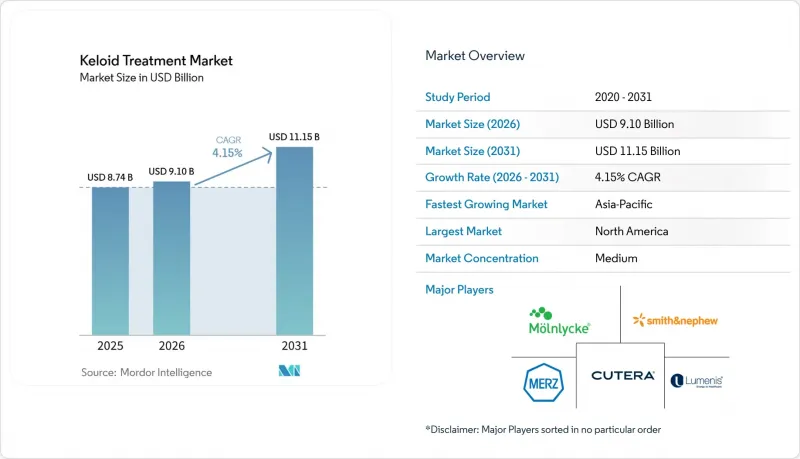
Mordor Intelligence에 의하면, 켈로이드 치료 시장 규모는 2025년 87억 4,000만 달러에서 2026년에는 91억 달러로 확대되어 2031년까지 111억 5,000만 달러에 이를 것으로 예상되고 있어 2026년부터 2031년까지 CAGR 4.15%로 성장할 전망입니다.
본 보고서는 치료 유형(병변 내 코르티코스테로이드, 5-FU 계열, 실리콘 계열, 냉동 요법, 외과적 절제, 레이저, 방사선, 기타), 투여 경로(주사제, 외용제, 시술·기기 기반), 최종 사용자(병원, 피부과 클리닉, ASC, 전문 클리닉), 지역(북미, 유럽, 아시아태평양, 중동 및 아프리카, 남미)별로 분류되어 있습니다. 예측치는 금액(달러)으로 표시되어 있습니다.
전 세계 켈로이드 치료 시장 동향과 인사이트
켈로이드 치료에 대한 다각적인 관심 증가
켈로이드 치료 시장은 단기적인 병변 축소뿐만 아니라 재발 억제도 중요시되게 됨에 따라, 단일 요법에서 다각적인 치료로 전환되고 있습니다. 162건의 연구를 평가한 2026년 체계적 문헌고찰에 따르면, 병변 내 코르티코스테로이드, 외과적 절제, 레이저 요법 및 방사선 요법을 결합한 치료 계획이 단일 요법 접근 방식보다 강력하고 지속적인 치료 성과를 가져온다는 사실이 밝혀졌습니다. 이러한 변화로 인해 약물, 시술 및 경과 관찰 진료에 비용이 분산됨에 따라 1회 치료당 수익이 증가합니다. 2025년 네트워크 메타분석에 따르면, 트리암시놀론 아세토니드(TAC)에 5-플루오로우라실 및 펄스 색소 레이저를 병용한 경우, TAC 단독 요법과 비교하여 상대 위험도가 2.98로 나타났습니다고 보고되었으며, 이는 통합 치료 프로토콜의 보다 광범위한 채택을 뒷받침하는 것입니다.
병변 내 코르티코스테로이드와 5-FU 병용 요법의 보급 확대
켈로이드 치료 시장에서는 반복 주사 프로토콜이 가능한 환경에서 코르티코스테로이드와 5-플루오로우라실(5-FU)의 병용 요법으로의 명확한 전환이 진행되고 있으며, 그 혜택을 누리고 있습니다. 2024년에 수행된 15건의 연구를 대상으로 한 체계적 문헌고찰 및 메타분석에 따르면, 코르티코스테로이드와 5-FU 병용 요법은 코르티코스테로이드 단독 요법에 비해 환자 및 관찰자에 의한 평가가 더 양호하고, 흉터의 높이 감소가 더 현저하며, 색소 소실, 피부 위축, 모세혈관 확장증 등의 부작용도 적은 것으로 밝혀졌습니다. 이 연구 결과는 저비용의 단일제 요법에서 눈에 띄는 치료 효과와 내약성을 향상시키는 요법으로의 전환을 뒷받침합니다. 또한, 이로 인해 시장에서 실질적인 양극화가 발생하여, 자원이 풍부한 클리닉에서는 병용 요법이 채택되는 반면, 비용에 민감한 의료 시스템에서는 계속해서 스테로이드 단독 주사에 대한 의존도가 높아지게 될 것입니다.
단일 요법 후 높은 재발률
단일 요법 후 높은 재발률은 켈로이드 치료 시장의 주요 제약 요인으로 계속 남아 있습니다. 206명의 환자를 대상으로 한 유럽 코호트 연구(2025년)에서는 트리암시놀론 아세토니드(TAC) 주사 및 레이저 치료를 받은 환자에서 재발률이 유의하게 높은 것으로 밝혀졌으며, TAC의 경우 χ²=21.9, p < 0.001이라는 결과가 보고되었습니다. 이는 저강도 치료 경로에 대한 신뢰성을 훼손할 뿐만 아니라, 환자가 지속적인 증상 관리를 달성하기까지 여러 치료법을 전전할 가능성을 높입니다. 또한, 지속적인 치료 성과 개선으로 이어지지 않을 경우, 반복적인 내원은 의료 제공의 효율을 저하시킵니다. 복합 요법의 활용이 여전히 제한적인 자원이 부족한 환경에서는 이것이 켈로이드 치료 시장에서 치료 성공에 대한 구조적인 상한선을 만들어내고 있습니다. 의료 제공업체가 보다 일관된 재발 억제 프로토콜을 채택하기 전까지는 시장에서 지역이나 의료 제공업체의 유형에 따라 치료 성과에 편차가 계속 나타날 것입니다.
부문 분석
2025년, 켈로이드 치료 시장에서 병변 내 스테로이드 주사는 28.12%의 점유율을 차지하며 매출 기준 최대 치료 부문이 되었습니다. 이러한 위상은 임상 현장에서의 높은 인지도, 낮은 도입 비용, 그리고 병원 및 외래 진료의 광범위한 현장에서의 사용을 반영한 것입니다. 이 부문은 임상의가 전용 대형 의료기기를 필요로 하지 않고도 스테로이드 주사를 투여할 수 있기 때문에 확립된 워크플로우의 이점을 지속적으로 누리고 있습니다. 그러나 보다 장기적인 질환 관리를 위한 병용 요법을 뒷받침하는 강력한 임상적 근거가 제시됨에 따라, 시장은 스테로이드 단독 요법에서 점차 전환되고 있습니다.
2025년 네트워크 메타분석에 따르면, 트리암시놀론 아세토니드(TAC), 5-플루오로우라실 및 레이저 요법을 결합한 병용 요법이 단일 요법보다 우수한 효과를 보였으며, 이는 환자 수가 많은 의료 기관에서의 치료 프로토콜 전환을 뒷받침하고 있습니다. 이러한 변화로 인해, 이 부문에서 5-플루오로우라실 기반 요법이 2031년까지 5.53%라는 가장 높은 연평균 성장률(CAGR)로 확대될 것으로 예측됩니다. 임상의들은 이를 단순한 대체 주사제로서가 아니라 병용 요법의 약리학적 핵심으로서 점점 더 많이 활용하고 있습니다. 실리콘계 요법은 예방을 목적으로 하는 용도, 특히 수술 후나 반복적인 주사가 적합하지 않은 환자에서 여전히 중요한 위치를 차지하고 있습니다.
지역별 분석
북미는 2025년에 켈로이드 치료 시장 점유율의 41.56%를 차지하고, 지역별로는 가장 큰 점유율을 기록할 전망입니다. 미국은 탄탄한 피부과 의료 인프라, 폭넓은 시술 접근성, 그리고 전문 의료 분야에서 환자 1인당 지출액이 높은 점 덕분에 이러한 위치를 주도할 것으로 예측됩니다. 이 지역은 약물 요법, 레이저 요법, 보조 요법이 확립된 조합의 혜택을 받고 있으며, 전체 치료 경로에 걸친 치료법의 보급을 뒷받침하고 있습니다. 캐나다 역시 새로운 외용제의 조기 상용화를 뒷받침하고 있으며, 2026년 2월 캐나다에서 승인이 예상되는 BirchBioMed의 사례는 차별화된 제품 출시에서 이 지역이 수행하는 역할을 여실히 보여주고 있습니다.
아시아태평양은 가장 빠르게 성장하는 지역이 될 것으로 예상되며, 켈로이드 치료 시장 규모는 2031년까지 연평균 성장률(CAGR) 8.56%로 확대될 것으로 전망됩니다. 아시아의 일부 집단에서 나타나는 높은 유전적 감수성, 민간 피부과 네트워크의 확대, 그리고 수술이나 외상 후 흉터의 외관에 대한 관심 증대가 이러한 성장을 뒷받침하고 있습니다. 한국과 일본은 기술 도입을 주도하고 있는 반면, 중국은 도시 지역의 방대한 환자층과 확대되는 피부과 클리닉 체인을 통해 시장 규모를 확대되고 있습니다. 2025년에 예정된 다계통 연구에서는 26개의 감수성 유전자좌가 확인될 것으로 예상되며, 이는 표적화된 진단 및 치료 계획 수립에 있어 해당 지역의 중요성을 더욱 뒷받침합니다.
유럽은 2025년에 3위 시장 규모를 차지하고, 독일, 영국, 프랑스, 이탈리아, 스페인이 이 지역의 매출 대부분을 차지할 전망입니다. 유럽의 켈로이드 치료 시장에서는 신중한 치료 접근 방식이 반영되어, 실리콘을 주된 치료법으로 하는 방법이나 보존적 치료법의 지속적인 활용이 지지받고 있습니다. 중동 및 아프리카에서는 잠재적 환자 부담이 높음에도 불구하고, 주로 여러 국가에서 치료 인프라가 제한적이기 때문에 시장 침투율은 여전히 낮은 수준을 유지하고 있습니다. 남미에서는 꾸준한 성장이 관찰되며, 주요 국가에서는 피부과 서비스 확대에 따라 병용 요법이 점차 도입되고 있습니다.
기타 혜택:
- 엑셀 형식 시장 예측(ME) 시트
- 3개월간의 애널리스트 지원
자주 묻는 질문
목차
제1장 서론
제2장 조사 방법
제3장 주요 요약
제4장 시장 구도
제5장 시장 규모와 성장 예측
제6장 경쟁 구도
제7장 시장 기회와 향후 전망
JHS 26.08.05According to Mordor Intelligence, the keloid treatment market size is expected to increase from USD 8.74 billion in 2025 to USD 9.10 billion in 2026 and reach USD 11.15 billion by 2031, growing at a CAGR of 4.15% over 2026-2031.
This report is Segmented by Treatment Type (Intralesional Corticosteroids, 5-FU Based, Silicone Based, Cryotherapy, Surgical Excision, Laser, Radiation, Others), Route of Administration (Injectable, Topical, Procedural/Device Based), End User (Hospitals, Dermatology Clinics, Ascs, Specialty Clinics), and Geography (North America, Europe, Asia-Pacific, MEA, and South America). Forecasts in Value (USD).
Global Keloid Treatment Market Trends and Insights
Rising Preference For Multimodal Keloid Therapy
The keloid treatment market is shifting from single-modality care as recurrence control becomes as critical as short-term lesion reduction. A 2026 systematic review assessing 162 studies found that treatment plans combining intralesional corticosteroids, surgical excision, laser modalities, and radiotherapy delivered stronger and more durable outcomes than single-modality approaches. This shift increases revenue per treated episode by distributing spending across drugs, procedures, and follow-up visits. A 2025 network meta-analysis reported that Triamcinolone acetonide (TAC) combined with 5-Fluorouracil and pulsed-dye laser achieved a relative risk of 2.98 compared with TAC monotherapy, supporting broader adoption of bundled treatment protocols.
Expanding Use Of Intralesional Corticosteroid And 5-FU Combination
The keloid treatment market is benefiting from a clear shift toward corticosteroid and 5-Fluorouracil (5-FU) combinations in settings that support repeat injection protocols. A 2024 systematic review and meta-analysis covering 15 studies found that corticosteroid plus 5-FU delivered stronger patient and observer assessments, greater scar height reduction, and fewer adverse effects, such as hypopigmentation, skin atrophy, and telangiectasia, than corticosteroid-only treatment. This finding supports escalation from low-cost monotherapy to a regimen that improves visible outcomes and tolerability. It also creates a practical market split, with higher-resource clinics adopting combination care and cost-sensitive systems continuing to rely more heavily on steroid-only injections.
High Recurrence Rates After Monotherapy
High recurrence after single-modality treatment remains a key constraint in the keloid treatment market. A European cohort study (2025) of 206 patients found that patients treated with triamcinolone acetonide (TAC) injections and laser therapy had significantly higher recurrence rates, with TAC reporting χ2 = 21.9 and p< 0.001. This limits confidence in low-intensity treatment pathways and increases the likelihood of patients moving through multiple regimens before achieving durable disease control. Repeat visits also reduce care delivery efficiency when they do not result in sustained outcome improvements. In lower-resource settings, where combination care remains less available, this creates a structural ceiling on therapeutic success within the keloid treatment market. Until providers adopt more consistent recurrence-control protocols, the market will continue to record uneven outcomes across regions and provider types.
Other drivers and restraints analyzed in the detailed report include:
- Growing Adoption Of Post-Excision Adjuvant Radiotherapy
- Increasing Availability Of Laser-Assisted Delivery And Advanced Equipment
- Access Constraints For Radiation And Device-Based Care In Smaller Markets
For complete list of drivers and restraints, kindly check the Table Of Contents.
Segment Analysis
Intralesional corticosteroids held 28.12% of the keloid treatment market share in 2025, making them the largest treatment segment by revenue. Their position reflected strong clinical familiarity, low acquisition cost, and broad use across hospital and outpatient settings. The segment continues to benefit from established workflows, as clinicians can administer steroid injections without specialized capital equipment. However, the market is shifting away from steroid monotherapy as stronger clinical evidence supports combination regimens for longer-lasting disease control.
A 2025 network meta-analysis showed that combinations involving Triamcinolone acetonide (TAC), 5-Fluorouracil, and laser modalities outperformed monotherapy approaches, supporting protocol migration in high-volume centers. This shift explains why 5-Fluorouracil-based therapy is forecast to expand at the fastest CAGR of 5.53% through 2031 within this segment. Clinicians increasingly use it as the pharmacological backbone of combination regimens rather than only as an alternative injectable. Silicone-based therapy remains important for prevention-oriented use, especially after surgery and in patients for whom repeated injections are less suitable.
Complete Report Scope:
- By Treatment Type
- Intralesional Corticosteroids
- 5-Fluorouracil Based Therapy
- Silicone Based Therapy
- Cryotherapy
- Surgical Excision With Adjuvant Therapy
- Laser Therapy
- Radiation Therapy
- Other Treatment Types
- By Route Of Administration
- Injectable
- Topical
- Procedural Or Device Based
- By End User
- Hospitals
- Dermatology Clinics
- Ambulatory Surgical Centers
- Specialty Clinics
- By Geography
- North America
- United States
- Canada
- Mexico
- Europe
- Germany
- United Kingdom
- France
- Italy
- Spain
- Rest of Europe
- Asia-Pacific
- China
- India
- Japan
- Australia
- South Korea
- Rest of Asia-Pacific
- Middle East and Africa
- GCC
- South Africa
- Rest of Middle East and Africa
- South America
- Brazil
- Argentina
- Rest of South America
- North America
Geography Analysis
North America is expected to account for 41.56% of the keloid treatment market share in 2025, making it the largest regional contributor. The United States is projected to drive this position through its strong dermatology infrastructure, broad procedural availability, and higher per-patient spending on specialist care. The region benefits from an established mix of pharmacological, laser-based, and adjuvant approaches, supporting broader treatment adoption across the care pathway. Canada also supports early commercialization of novel topical options, and BirchBioMed's expected approval in Canada in February 2026 highlights the region's role in differentiated product launches.
Asia-Pacific is expected to be the fastest-growing region, with the keloid treatment market size projected to increase at a CAGR of 8.56% through 2031. Elevated genetic susceptibility across several Asian populations, expanding private dermatology networks, and rising focus on scar appearance outcomes after surgery or injury support this growth. South Korea and Japan lead in technology adoption, while China adds scale through its large urban patient pool and expanding dermatology clinic chains. A 2025 multi-ancestry study expected to identify 26 susceptibility loci reinforces the region's importance for targeted identification and treatment planning.
Europe is expected to hold the third-largest position in 2025, with Germany, the United Kingdom, France, Italy, and Spain contributing most of the regional revenue. The European keloid treatment market reflects a cautious treatment approach, supporting continued use of silicone-led and conservative management pathways. The Middle East and Africa remain underpenetrated despite a high underlying burden, mainly due to limited treatment infrastructure across several countries. South America shows steady growth, with larger countries gradually adopting combination care as dermatology services expand.
- 3M
- Alliance Pharma plc
- AVITA Medical, Inc.
- Bausch Health
- Biodermis LLC
- Candela Medical
- CCA Industries, Inc.
- Cutera
- Galderma Group AG
- HRA Pharma
- Johnson & Johnson
- Lumenis
- Merz Pharma GmbH and Co. KGaA
- Molnlycke Health Care
- Newmedical Technology Inc.
- Perrigo Company
- Scar Heal Inc.
- Sensus Healthcare, Inc.
- Smiths Group
- Sonoma Pharmaceuticals
- Stratpharma AG
Additional Benefits:
- The market estimate (ME) sheet in Excel format
- 3 months of analyst support
TABLE OF CONTENTS
1 INTRODUCTION
- 1.1 Study Assumptions and Market Definition
- 1.2 Scope of the Study
2 RESEARCH METHODOLOGY
3 EXECUTIVE SUMMARY
4 MARKET LANDSCAPE
- 4.1 Market Overview
- 4.2 Market Drivers
- 4.2.1 Rising Preference for Multimodal Keloid Therapy
- 4.2.2 Expanding Use of Intralesional Corticosteroid and 5-FU Combinations
- 4.2.3 Growing Adoption of Post-Excision Adjuvant Radiotherapy
- 4.2.4 Better Scar-Appearance Expectations in Aesthetic and Reconstructive Procedures
- 4.2.5 Increasing Availability of Laser-Assisted Delivery and Advanced Energy Devices
- 4.3 Market Restraints
- 4.3.1 High Recurrence Rates After Monotherapy
- 4.3.2 Adverse Events From Repeated Steroid Injections
- 4.3.3 Limited Standardization in Protocols and Dosing
- 4.3.4 Access Constraints for Radiation and Device-Based Care in Smaller Centers
- 4.4 Supply/Value Chain Analysis
- 4.5 Regulatory Landscape
- 4.6 Technological Outlook
- 4.7 Pricing Analysis
- 4.8 Porter's Five Forces Analysis
- 4.8.1 Bargaining Power Of Suppliers
- 4.8.2 Bargaining Power Of Buyers
- 4.8.3 Threat Of New Entrants
- 4.8.4 Threat Of Substitutes
- 4.8.5 Competitive Rivalry
5 MARKET SIZE AND GROWTH FORECASTS (VALUE, USD)
- 5.1 By Treatment Type
- 5.1.1 Intralesional Corticosteroids
- 5.1.2 5-Fluorouracil Based Therapy
- 5.1.3 Silicone Based Therapy
- 5.1.4 Cryotherapy
- 5.1.5 Surgical Excision With Adjuvant Therapy
- 5.1.6 Laser Therapy
- 5.1.7 Radiation Therapy
- 5.1.8 Other Treatment Types
- 5.2 By Route Of Administration
- 5.2.1 Injectable
- 5.2.2 Topical
- 5.2.3 Procedural Or Device Based
- 5.3 By End User
- 5.3.1 Hospitals
- 5.3.2 Dermatology Clinics
- 5.3.3 Ambulatory Surgical Centers
- 5.3.4 Specialty Clinics
- 5.4 By Geography
- 5.4.1 North America
- 5.4.1.1 United States
- 5.4.1.2 Canada
- 5.4.1.3 Mexico
- 5.4.2 Europe
- 5.4.2.1 Germany
- 5.4.2.2 United Kingdom
- 5.4.2.3 France
- 5.4.2.4 Italy
- 5.4.2.5 Spain
- 5.4.2.6 Rest of Europe
- 5.4.3 Asia-Pacific
- 5.4.3.1 China
- 5.4.3.2 India
- 5.4.3.3 Japan
- 5.4.3.4 Australia
- 5.4.3.5 South Korea
- 5.4.3.6 Rest of Asia-Pacific
- 5.4.4 Middle East and Africa
- 5.4.4.1 GCC
- 5.4.4.2 South Africa
- 5.4.4.3 Rest of Middle East and Africa
- 5.4.5 South America
- 5.4.5.1 Brazil
- 5.4.5.2 Argentina
- 5.4.5.3 Rest of South America
- 5.4.1 North America
6 COMPETITIVE LANDSCAPE
- 6.1 Market Concentration
- 6.2 Market Share Analysis
- 6.3 Company Profiles (includes Global Level Overview, Market Level Overview, Core Segments, Financials as available, Strategic Information, Market Rank/Share, Products and Services, Recent Developments)
- 6.3.1 3M Company
- 6.3.2 Alliance Pharma plc
- 6.3.3 AVITA Medical, Inc.
- 6.3.4 Bausch Health Companies Inc.
- 6.3.5 Biodermis LLC
- 6.3.6 Candela Corporation
- 6.3.7 CCA Industries, Inc.
- 6.3.8 Cutera, Inc.
- 6.3.9 Galderma Group AG
- 6.3.10 HRA Pharma
- 6.3.11 Johnson and Johnson
- 6.3.12 Lumenis Be Ltd.
- 6.3.13 Merz Pharma GmbH and Co. KGaA
- 6.3.14 Molnlycke Health Care AB
- 6.3.15 Newmedical Technology Inc.
- 6.3.16 Perrigo Company plc
- 6.3.17 Scar Heal Inc.
- 6.3.18 Sensus Healthcare, Inc.
- 6.3.19 Smith and Nephew plc
- 6.3.20 Sonoma Pharmaceuticals, Inc.
- 6.3.21 Stratpharma AG
7 MARKET OPPORTUNITIES AND FUTURE OUTLOOK
- 7.1 White-Space and Unmet-Need Assessment


